Author: mxmadmin

  • Debrief: Thomas Cook: Forced humour

    By Anil Thakraney


    ‘Travel Smooth’ is Thomas Cook’s latest punch line. And the promise in their new campaign is that they will ensure we don’t face embarrassing situations when we travel abroad. That Thomas Cook is an expert travel agent and we can feel safe when we do business with them.


    I watched three ads; each caters to a specific traveller’s need. One involves a conservative desi family booked into a very shady hotel, courtesy an unreliable agent. Likewise, other ads deal with problems on foreign currency and sight-seeing. It’s a negative campaign, an attempt to get a positive spin-off by rubbishing the competition.


    I like the strategy. Rather than use the tried and tested route of boasting about Thomas Cook’s great work, better to make fun of the rivals. This ensures refreshing advertising, so that’s fine. However, in the execution of that intent, the advertiser loses the way.


    [youtube width=”400″ height=”200″]http://www.youtube.com/watch?v=EAhfCt4GKdM[/youtube]
    [youtube width=”400″ height=”200″]http://www.youtube.com/watch?v=vp1kql2V9ZY[/youtube]

    The commercials try hard to be funny; they are executed quite shoddily and end up becoming a bit irritating. While the hotel one is marginally better, the currency and the bus tour ads leave you totally cold.


    Maybe the writers of this campaign haven’t travelled much. I can put out a laundry list of hilarious events that unfold because of poor planning. Enjoy an international holiday, guys. And then come back and write the storyboards.


    Rating: (On a scale of 1 to 5): 2. Good strategy not backed by creative.


  • One Alliance & Neo renew arrangement

    By A Correspondent


    NEO Sports Broadcast Pvt. Ltd and MSM Discovery Pvt. Ltd have come together once again for the distribution of television channels NEO Sports and NEO Cricket under the aegis of TheOneAlliance bouquet effective January 4.


    TheOneAlliance bouquet is further strengthened with a line up of blockbuster sports events – Asia Cup (Cricket), UEFA Euro 2012 (Football), French Open (Tennis) and World Series Hockey (Hockey). This stellar line up coupled with DLF IPL on SET MAX makes TheOneAlliance bouquet the preferred choice of sports fans.


    Rajesh Kaul, President – MSM Discovery Pvt. Ltd, said: “The philosophy of TheOneAlliance is to create a strong product offering of diverse and strong television content. The sports genre has always been a strong growth driver. We are happy to welcome back NEO to TheOneAlliance bouquet. The blockbuster line up on Neo channels coupled with DLF IPL on SET MAX will ensure the bouquet is poised for further growth.”


    Prasana Krishnan, COO – NEO Sports Broadcast Pvt. Ltd added: “TheOneAlliance and NEO distribution deal is a strategically sound arrangement. NEO has shared an extremely fruitful and pleasant relationship with MSMD and we are happy to rejoin TheOneAlliance bouquet and aspire to take it to greater heights. The combined offering of the bouquet will ensure viewers get to witness the biggest blockbusters in Cricket and major sporting events in 2012.”


  • The Anchor: 5 reasons advertisers should bet on new sports that appeal to Gen Y

    #1 75 percent of India is below the age of 35 years.

    They are more connected and the world is a smaller place for them. They consume all global sporting action including Soccer, Motor Sports and so on. Advertisers trying to reach them need to understand that they do not consume the same old mix of cricket. The brand needs to be clear if they are targeting 25 per cent ofIndiaor the 75 per cent.


    #2 Cricket is expensive.

    Advertisers used to get best ROI with Indian Cricket in the earlier days. But now the property is very expensive and out of reach of most advertisers. Brands with a few million rupees to spend for a month cannot even dream of cricket properties like IPL.


    #3 Brands looking to be multinational need to associate and build the brand around multinational sports.

    With more and more Indian brands buying global companies and entering new countries, they realize the need to look beyond sports played in a very few countries. Only Soccer and Motor sport are truly global.


    #4 The future lies wide open to companies that are willing to be nimble, adventurous and innovative.

    With the market dynamics changing so quickly brands need to invest into new age sports that allow innovation and brand integration. Unfortunately, established sports do not allow any tweaking as the rules are very firmly set. New sporting ventures keen to gain market share will be more open to innovations.


    #5 Cricket is overcrowded.

    The market is already very crowded with new competitors are entering every day. And every new brand seems to try and build around the platform of cricket. How will you differentiate your brand and its ethos if everyone has the same product features, same benefits and now the same brand ambassador? Investing into new sports will give the brands a new and exclusive identity. They help brands stand out of the crowd.


    Darshan M is the CEO, I1 Super Series at Machdar Motorsports Private Limited.


  • Vijaydutt Shridhar: Passion for the printed word

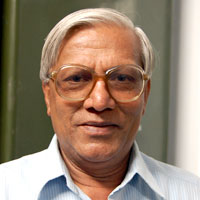
    The Padma Shri award for Sahitya (Literature) this year has gone to author Vijaydutt Shridhar, 60, former editor of Navbharat and the only journalist on the list. The award is well-deserved for the man who has almost single-handedly taken up the task of preservingIndia’s history through the lens of time, past and present – the newspapers, magazines and periodicals.


    In an email and telephonic interview with MxM India’s Archita Wagle, Mr Shridhar talks about his passion, the Madhavrao Sapre Samachar Patra Sangrahalaya evam Shodh Sansthan in Bhopal, Madhya Pradesh.


    Q: Tell us about your career, and what you are doing now.

    I am retired now and I concentrate on the museum and my books nowadays. Before that I was the director at Makhanlal Chaturvedi University of Journalism and Communications. I also worked as the editor of Navbharat. I have worked with several state level committees related to journalists and newspapers in Madhya Pradesh. I was a member of the Madhya Pradesh Vidhan Sabha Press gallery committee for two decades.


    Q: What prompted you to start the Sapre Sangralaya in 1984?

    I was working on my book Shabd Satta, which chronicles 150 years of journalism in Madhya Pradesh. I had to travel far and wide to research for my book. While researching for the book, I realised that there was no systematic classification of the material that I required. Authenticating the material was also difficult, and posed a lot of problems for me as history is incomplete without properly verified material. I visited individual collectors, but the newspapers in their collections had started deteriorating. This sparked the idea of preserving newspapers.


    Q: How did you get the material for starting the museum?

    I met Pandit Rameshwar Guru, a veteran journalist, Hindi poet and Mathematics teacher. He also had an extensive collection of journals, newspapers and periodicals going back two generations. But due to family obligations he was ready to donate them. He had two conditions, though. One, he wanted the material to be saved systematically and in the name of future generations. Two, the collection or the museum which would house them will not be handed over to the government or any university as Mr Guru feared that the material would not be cared for properly at either places and that the universities are more concerned with their salaries than preserving the heritage that such a collection represents.


    Q: Can you tell us more about the Sapre Sangralaya and the work it does?

    After Mr Guru agreed to donate his collection, a society was set up in the name of Madhavrao Sapre, the pioneer of Hindi journalism. The ideology that Lokmanya Tilak had when he started Kesari, was the same ideology that Shri Sapre had, so he launched Hindi Kesari. The Sapre Sangralaya collects all kinds of old periodicals and newspapers in all the languages – Hindi, Marathi, Urdu and so on – for the purpose of preserving them. Earlier I used to travel to different places scouting for materials. I once bought an old collection of Punch magazines from a man who sold them for a song because he wanted to pay for his liquor. But as time passed, people came to know about the work we are doing and they donate their private collections to us, knowing that we will take good care of the material they donate.


    Q: How are the footfalls in the museum? Do you get a lot of visitors?

    The museum is acknowledged as a research centre by many universities. We mostly get journalists and academicians who come to the museum as they know that what they might not get anywhere else, they will find it here. Once, the editor of an established and well-known Hindi newspaper came to the museum because he wanted to see a copy of a particular issue for January 1962 of his paper. It was a moment of pride that we had the issue which their archives didn’t have.


    Q: How do you arrange for the funding for the Sangralaya?

    The Central and the state government provide funding for the museum but they never interfere in the day-to-day working. We also receive donations. So funding is not a problem for us.


    Q: Any future plans for the Sangralaya?

    You should know that the paper a newspaper is printed on is not of the finest quality. We have newspapers and journals dating from the 1600s. Constant handling also accelerates the deterioration. We have preserved the material we have gathered so far by chemical treatment, pest control, laminating the old papers, and transferring the old papers onto microfilm. So far, we have transferred material up till the 19th century. But now we are looking at digitising the content we have. We are looking at transferring all the material to DVD so that people who come to the museum to look at these newspapers for their research will be able to go through the DVDs and the newspapers can be preserved better.


    Q: The website for the museum is in Hindi. Would you consider having a website in English, in order to reach a wider audience?

    The suggestion that you have given is a good one. We are translating the summary for the website in to English and other languages… but only the summary, the rest of the website will be in Hindi as that is the language we work in. But once we translate the summary, that will provide enough information for people about what we do.


    Q: You are an author; any work in progress on that front?

    I have written three books and now I am in the process of completing my fourth. My first book was Bhartiya Patrakarita Kosh, which is an in-depth study of Indian journalism in the pre-Independence period (1780-1947). The book covered the whole sub-continent -India,Bangladesh and Pakistan. It is the history of Indian journalism in all languages of country – origin, growth, struggles, achievements and contribution.

    My second book was Shabd Satta which covered the history of 150 years of journalism in Madhya Pradesh from 1849 to 1999. My book Choutha Padav is the history of 1000 years of Bhopal with special reference to BHEL. Now I am working on my latest work, Pahela Sampadkiya, which is a collection of the first editorial in prominent Hindi language newspapers. The book has about 28 editorials and my comments and analysis on each of the editorial.


    Q: How do you find time to manage both your writing and your day-to-day commitments?

    Now that I have retired, I can devote more time to writing and my work at museum. So it is not difficult.


    Q: How does it feel to have your efforts recognized by the government in the form of the Padma Shri in Sahitya?

    I didn’t expect to be awarded. I have been working on the museum for the last 28 years. I never expected to get the award as the government doesn’t declare it in advance, but it feels good.

     

  • Is cricket overpriced?


    By A Correspondent


    The past six to nine months has been a phase where Indian cricket has seen a remarkable slump. BCCI, which is at the helm of affairs, has been criticised for not keeping an eye on the future. The general sense is that the board is not prepared to mend this sorry state of Indian cricket despite pressures from broadcasters, the media and of course, viewers at large which matter the most if the plan is to sustain the sport in the long run.


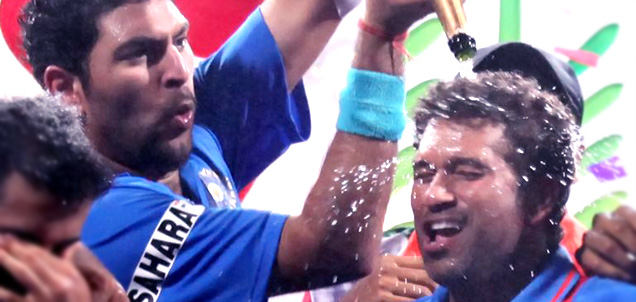
    Yes, cricket is the only celebrated sport in the country and advertisers have banked on its popularity. But recently, the game has come under the scanner with India’s debacle in its current series. Sahara has decided to end its 11-year association with BCCI and the Indian cricket team. And have also put the fate of Pune Warriors in jeopardy. The question here is whether cricket, as it is today, is an overpriced sport.


    Jai Lala, Principal Partner – The Exchange, Mindshare said, “Cricket has always been a very attractive sport for advertisers. Therefore, it has been priced highly. When the performance of the Indian cricket team goes down, the viewership goes down and hence advertisers find it expensive. Advertisers want guaranteed viewership. So as a broadcaster if you’re able to provide that, advertisers will be more open to pay expensive ad rates on cricket.”


    So it’s about the TRPs. R Sridhar, CEO, Brand-Comm offers a different dimension. “I think there is too much of cricket and too many properties are being created. What needs to be done is to bring focus back on the game and once India starts to win matches, which it shall as for the next 20 months it is playing at the home turf, it’ll be business as usual. Cricket will always have takers. But, with the current development there is likely to be some kind of negotiation.”


    On whether BCCI is losing the plot, Mr Lala said, “BCCI has to be more professional. They are riding on a monopoly as far as Cricket in India is concerned. I think the time has come for them to corporatize their proceedings. There is a need to ensure that the future of Cricket in India is safe. The systems, procedures etc. needs to be relooked at.


    IPL as is known is the game that corporate czars play, and are in no mood to go soft on their plans around the property.


    However, a senior media planner on condition of anonymity said that there is a swing in the opinion because of India’s performance where the same people were betting high on the game. She said, “Cricket was not an expensive sport when India was winning, people who advertised during the Word Cup paid off their skins and didn’t complain. Now that India is losing, there’s been a negative sentiment among all stake-holders.”


    On the recent development of Sahara pulling out of the Indian team sponsorship, the senior source said: “This is nothing but politics. Unfortunately, BCCI is interested in only making money rather than focusing on the future of this sport.”


    Another media planner is of the opinion that there may be a bit of caution in the air. But he says, “There is no property better than cricket when it comes to capturing a large chunk of audience. So one pays premium for the kind of viewership which in any other property is difficult to get.”


    He added that the association of Sahara and Indian cricket team was that of passion. Though it was not a brand-building exercise for Sahara, in the bargain the brand gained too. He says Rs 120 cr is what it takes to spend on cricket in India in a year. And if one thinks of that number, then the choice of corporates wanting to associate would be a handful. “Telecom players would have been a good bet but with the fiasco that they are facing, that seems to be an unlikely choice. However, there might be some price cutting on this front but getting a sponsor would not be difficult.”


    For now, it seems everything rests on BCCI as far as the margins for broadcasters are concerned. Nimbus has found itself in a fix, with BCCI terminating the contract on non-payment of dues. An insider reveals that the heavy price levied on the part of BCCI, plus the slowdown, impacted ROI for the broadcast major.


    Even in the case of IPL, MSM has already paid a heavy price, and are looking to monetise the same via hiking ad rates (by 10 per cent this year, as stated by President of MSM, Mr Rohit Gupta). Any plans to relook the 10-second on air-spots will drastically bring down revenues for the broadcaster.


    Plus, the back-to-back cricketing schedule lined up by BCCI, as many opinion makers within the sporting arena agree, is the single reason why Indian cricket is experiencing a downfall never seen before, which could mean India losing many more matches, loss in viewership, loss in advertisers/sponsors. In a nutshell, cricket as a sport in India will lose its sheen

    Photograph: Fotocorp


  • The Anchor: 5 reasons why media audits must be taken seriously

    By Stephen White


    There is an increasing requirement in the world’s major media markets, for advertisers to gain more traction in understanding the media values they are achieving.


    However, increasing focus from marketing, finance, and particularly procurement departments on the mechanics and the lack of transparency on many media deals, means that specific help is required.


    #1 Across the globe, media auditing companies are being engaged more and more by advertisers who are seeking independent, high-level media expertise and advice.


    #2 Media auditors deliver that advice to the clients, covering all the details of how media agencies service, media quality KPIs, and full clarity on media buying arrangements, are being fulfilled.


    #3 In Europe, over 30 percent of all media expenditure is audited. In the US it is around 15 percent and growing fast. In India, it is around 10-15 percent, and in Japan it is less than 1 percent. This is why the Indian media market needs to fully embrace media auditing to catch up with the more sophisticated markets of Europe and the US.


    #4 Initial media agency fears are soon pacified, when EMM’s audit reports show “how well” media agencies are performing, and how they could be earning more for exceptional results measured independently by the media auditors. The abiding reality from media auditing around the world is that smarter advertisers are those who are audited, always getting better results.


    #5 The biggest issue for the Indian market is not the development of media auditing in isolation, it is the perception from outsiders that the lack of media transparency is a very cloudy issue in India, and potentially casts an unwelcome shadow over the whole media industry. Surely the declaration by the Indian government last November to publicly fight alleged corruption in business is just the stimulus the media industry needs, and the arrival of media auditors in India provides the right tools, and the right people, to do the job.


    All these issues combined gave EMM reason to research the Indian media market place in terms of the appetite for independent media performance evaluation, with views from the major media agencies and groups, and a broad sample of advertisers. The results of that research confirmed, and welcomed, the benefits that media auditing offers would stimulate improvements for the advertiser and from the measured deliverables from the motivated media agencies.


    Inevitably some uncertainties will remain, but judging by the amount of interest in EMM’s launch into India, combining high level local media expertise with EMM’s 20-year international media auditing expertise is a system that strikes the right balance for India right now.


    Stephen White is Chairman, EMM India.


  • Coffee Bean & Tea Leaf looking to brew more

    By Tuhina Anand


    Coffee Bean & Tea Leaf (CBTL) which was launched in 2008 in India is eyeing to capture a segment that has grown up to coffee culture and now is migrating to the next level of coffee as an experience.


    The future growth path for many of the players in the cafe business is to offer a different experience depending on the TG. India having gone through the phase where cafes have established themselves as a ‘hangout’ place, there is a need for a better offering for those looking for more. Hence, there is Cafe Coffee Day coming out with its Lounge concept or players like Costa Coffee and CBTL stepping in to provide that evolved ambience. With Starbucks set to enter India, this space will only see more competition.


    The organized coffee chain retail market is said to be approximately Rs1,000 crore and has been steadily growing. For CBTL this is where opportunity lies for future growth where, having started with one outlet in Select CityWalk in Saket in New Delhi, in the last three and half years they have expanded to 17 stores, including three outlets at airports, in Delhi, Mumbai, Bangalore, Kolkata and Pune.


    Talking about their growth plan, Vinay Gopinath, Head, Marketing, Pan India Foods, the company that has brought CBTL to India, said, “We are looking at expanding our presence and clocking in at 25 stores by May this year. There are plans to expand in a big way in Pune, Bangalore and Kolkata. We are also looking to enter newer markets like Jaipur and places like Ludhiana and Chandigarh in Punjab.”


    The expansion for CBTL is along four formats including high street, property inside a mall, kiosk model and high profile office building. There are around 2,000 organised players in the cafe segment including CCD, Gloria Jean’s, Costa Coffee, Barista and Mocha among other stores. As Mr Gopinath says, they have been growing their store presence by 25 per cent yoy and that has been the case with many leading players in this segment.


    CBTL worldwide has around 812 outlets and their USP, as Mr Gopinath describes it, is having the best coffee on their menu coupled with their mojo effect plus offering high-quality food and the best music.


    However on pricing, Mr Gopinath clarifies, “Yes, we do charge a premium but that is only on our signature offering. Pricing of, say, our cappuccino or any other regular product will be as competitive as any other cafe.


    “At CBTL we cater to the upper strata of market and it’s definitely not a hangout place. It’s about better experience. Our TG would be anyone 20 plus to 35 who has traveled around the world and looking for a better coffee experience. There are many who are looking for this experience so there is opportunity galore. The positive thing is that finally a segmentation is happening and gradually a pyramid is being drawn in terms of coffee consumption at various places. With increase in coffee consumption outside homes there is immense scope to grow the top end of the spectrum.”


  • Anil Thakraney: A Sahara lesson for BCCI

    By Anil Thakraney


    Though they may eventually resolve their dispute, and Sahara could again partner the BCCI in some form, it must be said one feels happy that the former decided to pull the plug on constant moolah supply to the cricket board. And the Sahara group has also opted out of the IPL. The world’s richest (and most arrogant) cricketing body can do with some hard jolts like these.


    In fact, I do believe sponsors and advertisers are the ONLY entities with the power to clean up cricket in India, so that the sport doesn’t wither away and lose its mass appeal. They must list down harsh terms and conditions on the BCCI before they put the money down. And this includes demand for complete transparency in the way the BCCI functions. The cricket body has conveniently cloaked its workings in dark secrecy, and this has led to many dubious deeds. Including financial scandals, unethical business practices, badly planned tour itineraries and a myopic vision of the future of Indian cricket. Humiliating defeats of the team in the recent past is sure to affect viewership of both, international tournaments and the great IPL. This means ad rates must be slashed as well.


    The big problem is that the BCCI appears to be accountable to no one. And quite characteristically, they are completely allergic to being put under the purview of the RTI Act. Which means there is no way to clean up this dodgy organization. Unless of course the advertisers gang up against them, and put some serious pressure. The autocratic style of operating Indian cricket cannot be allowed to go on. This is very important for the future of cricket in this country.


    Hopefully, Sahara’s bombshell will serve as a wake-up call for everyone else.


    ***


    [youtube width=”400″ height=”200″]http://www.youtube.com/watch?v=pGMOhOYvcw4[/youtube]

    PS: An ad tailor-made for the commercial break. Chrysler released this stunning patriotic commercial during the Super Bowl half-time, featuring the Hollywood superstar, Clint Eastwood. I can feel the blood rising miles away in Mumbai, imagine the impact on Americans. Super stuff.


  • Gouri Dange: Those deliciously bizarre Google ads

    By Gouri Dange


    You know how Google watches over your shoulder and reads the content of your emails and sends you what it thinks are appropriate ads on the sidebar? I just love the convoluted logic behind the ads that are selected to send to you. For the longest time, I just didn’t notice them, but once I began to glance at them, it became a most illuminating exercise. There is something so deliciously bizarre in the way the ads refract your reality. Open your emails in the last week and take a look at the sidebar.


    It’s like some slightly deranged/overreacting person is keeping a log or diary of your life as it is unfolding. On top of it, this deranged person has the job of continuously coming up with solutions – all sorts of goods and services – to counter what it thinks is the angst in your life.


    So, for instance, a couple of years ago an ageing dog of mine began to get epileptic fits. I must have written in anguish to a couple of close friends about this development, and there it was: Google began to urge upon me ads for homeopathy, allopathy, healing crystals and what-have-you for epilepsy. Then I may have mentioned to someone in an email that the vet has said that I might have to prepare myself to have the old dog put down. So now the ads in a rather ghoulish but ever-helpful manner began to become about humane vet services, pet cemeteries, incinerators and other such sombre subjects.


    Once you begin to notice the ads, two distinct realities begin to emerge about yourself. Parallel Universes. One is what is actually happening in your life and what you need to do about it, and one is what the Google ad-world thinks is happening in your life and what it thinks are some of the solutions and strategies that you need to adopt with the help of its advertisers and their sparkling merchandise.


    Just today, I wrote to a niece saying I need to get a hardship allowance from the government for putting up with the idiosyncrasies of a neighbour. And whadyouknow – the ads on the sidebar became about government jobs, government grants, and properties for sale. So my offhand joke got interpreted as: lady, you need in some way to be connected up with the government, and/or you need to move house.


    Of course, given that dabbling in real estate is urban India’s new religion, the ads for rent, sell, buy, beg, borrow, steal apartments come fast and thick anyway, whether you mention this subject in your mails or not. ‘Luxurious 1 bedroom apartments’ are being peddled all the time.


    But my most favourite interpretation-misinterpretation came from a flurry of emails that were flying amongst some 11 fellow writers. The subject of our emails was the less-than-professional behaviour of a publisher soliciting our writings for the Chicken Soup for the Soul series. I hadn’t been paying attention to the ads that Google had been wildly generating in tandem with our mails. Once the matter was sorted out in our favour, someone sent around mail saying let’s get together soon, toast each other and have chicken soup on the menu. Heading the list of ads that day was one for ‘poultry slaughter lines’. All those hot and bothered emails that us renegade writers had been exchanging, translated in the mind of Google to this reading: the one thing that would solve all our problems was if we got ourselves a fully-automated chicken beheading, skinning and dismembering machine!


    And why not. Perhaps I’ll get one anyway. May come in handy.


    Naming no Names is the mid-week column where novelist, columnist and counsellor Gouri Dange presents her tongue-in-cheek view of our world.


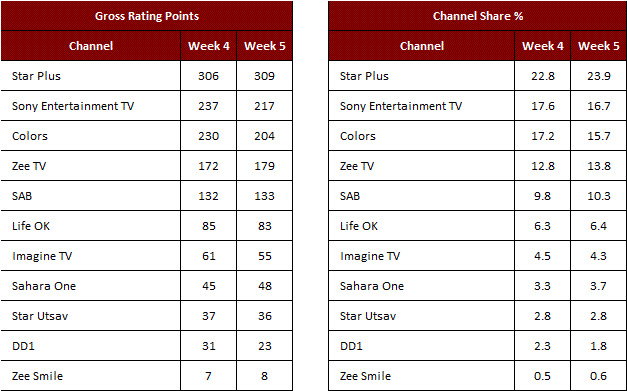
  • TAM Data (GRPs Channel shares of HGECs)- Wk 5 ’12

    Source: TAM Peoplemeter System
    TG: CS 4+ yrs
    Market: HSM
    Period: Wk 4: Jan 22 to Jan 28, 2012
    Period: Wk 5: Jan 29 to Feb 4, 2012


    About TAM Media Research


    TAM is a joint venture between Nielsen Company & Kantar Media Research. Besides measuring TV Viewership, TAM also monitors Advertising Expenditure of Television, Print & Radio through its division AdEx India. Since 2004, it extended its presence in the PR Measurement & Analysis space for Corporate/Marketing Clients by setting up a separate division Eikona PR Measurement.


    In 2007, the joint venture introduced RAM (Radio Audio Measurement) service to track Radio Listenership for the Indian Radio Broadcast Industry. In year 2009, TAM launched a division, called TAM Sports that specializes in monitoring Sports Sponsorship ROI.


    TAM Media Research’s objective is to fuel media insights that will drive the growth of the Indian Media Industry.

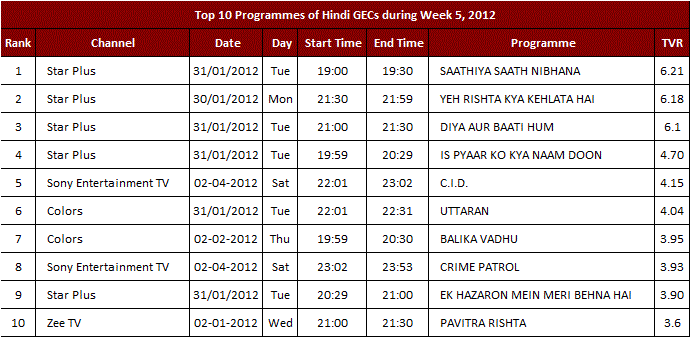
  • TAM data Top 10 programmes on HGEC – Wk 5 ’12


    Source: TAM Peoplemeter System
    TG: CS 4+ yrs
    Market: Hindi Speaking Market
    Period: Wk 5 (Jan 29 to Feb 4) 2012


    About TAM Media Research


    TAM is a joint venture between Nielsen Company & Kantar Media Research. Besides measuring TV Viewership, TAM also monitors Advertising Expenditure of Television, Print & Radio through its division AdEx India. Since 2004, it extended its presence in the PR Measurement & Analysis space for Corporate/Marketing Clients by setting up a separate division Eikona PR Measurement.


    In 2007, the joint venture introduced RAM (Radio Audio Measurement) service to track Radio Listenership for the Indian Radio Broadcast Industry. In year 2009, TAM launched a division, called TAM Sports that specializes in monitoring Sports Sponsorship ROI.


    TAM Media Research’s objective is to fuel media insights that will drive the growth of the Indian Media Industry.

  • Top Ramen consolidates its advertising duties with Dentsu

    By A Correspondent


    Top Ramen, the instant noodle company from Indo-Nissin, has consolidated its advertising duties with the Dentsu India Group. Dentsu Communications has been already handling the creative duties and now with media, too, coming under its umbrella, Dentsu has consolidated the entire business.


    The media duties were earlier being handled by Madison Media. The size of the business in the last financial year was close to Rs10 crore and is slated to scale upwards and be in the range of Rs15 crore.


    Confirming the development, MNVV Prasad, General Manager, Sales and Marketing, Indo-Nissin Foods Ltd, said: “At this juncture we were looking at integrating our communication. Since Dentsu is already partnering with us for creative, we decided to consolidate the media with them too.”


    He added: “The instant noodle market has undergone tremendous change in the last two years, especially with international players coming into fray and the existing ones going aggressive. Top Ramen has been a leader in the world in this category and scores in innovative product strategy. We hope to combine our advantages and come out with a strategic communication that will differentiate us from others. We want to grow on the basis of our different positioning in this category.”


    Top Ramen has been competing with Nestle’s Maggi much before Knorr, ITC’s Yippee or GSKs Foodles came in the fray. Sensing competition, Top Ramen has gone aggressive on its marketing plan in the last two years and even signed on Saina Nehwal to feature in its advertising, which is a shift from its earlier strategy.