Author: mxmadmin

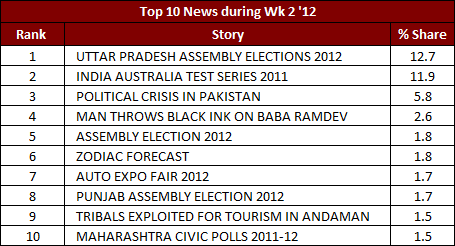
  • NCT Data Wk 2 ’12

    Source: News Content Track – A service of TAM Media Research Pvt. Ltd
    Channels: Aaj Tak, CNN IBN, Headlines Today, IBN 7, India TV, NDTV 24/7, NDTV India, Star News, Times Now, News 24 & Zee News
    Period: Wk 2 – Jan 8 to Jan 14, 2012
    Note : Analysis is based on the Telecast duration


    About TAM Media Research


    TAM is a joint venture between Nielsen Company & Kantar Media Research. Besides measuring TV Viewership, TAM also monitors Advertising Expenditure of Television, Print & Radio through its division AdEx India. Since 2004, it extended its presence in the PR Measurement & Analysis space for Corporate/Marketing Clients by setting up a separate division Eikona PR Measurement.


    In 2007, the joint venture introduced RAM (Radio Audio Measurement) service to track Radio Listenership for the Indian Radio Broadcast Industry. In year 2009, TAM launched a division, called TAM Sports that specializes in monitoring Sports Sponsorship ROI.


    TAM Media Research’s objective is to fuel media insights that will drive the growth of the Indian Media Industry.

  • Some clarity on Rushdie, please!

    By Ranjona Banerji


    The case of Salman Rushdie and the Jaipur Literary Festival gets curiouser and curiouser. After the Deoband seminary asked that the writer be denied a visa to attend the festival, Rushdie clarified that he did not need a visa to visit India. Newspaper articles and TV debates focused on freedom of speech and the sentiments of Muslim voters keeping the UP elections in mind.


    After a couple of days of confusion, the Rajasthan government said it feared violence if Rushdie showed up. Soon after Rushdie announced he wasn’t coming because of death threats reported by the Mumbai and Rajasthan police. It took The Hindu to break the lies off that story – there were no such threats said the Mumbai police and they had passed on no such information to anyone. The Rajasthan police then corroborated this and the Rajasthan government waffled on about how they felt there was a threat and the Union home ministry also issued an advisory about a threat and then said that the government was willing to provide security.


    So far then we have examples of religious sensitivities, an election, a controversial writer and governmental pusillanimity. By now, confused readers and viewers were weeping for a comprehensive report putting all these diverse elements together. No such luck. Front page news and top of the hour headlines give you updates but not explanation and analysis.


    Editorials and opinions were still about freedom of speech and not so much about all these other angles popping up. India’s long and controversial history of dealing with “sentiments” also needs better examination. Sidharth Bhatia has commented very aptly on our fear “offending” sentiments in Asian Age/Deccan Chronicle. Fali Nariman on the Indian Express edit page points out that blasphemy laws in the UK apply only to Christianity and are still in use.


    The additional problem now seems to be that the organisers showed some extra caution or cowardice – depending on how you look at it – by seemingly giving in to official pressure. Apart from a little hysteria on TV from the Hyderabad-based Asauddin Owaisi of the MIM, not enough effort has been spent perhaps speaking to Muslims and their representative groups about the issue, except perhaps by Mohammed Wajihuddin on the Times of India and by the Indian Express.


    **


    TV and the newspapers have kept up the pressure as far as the story goes, however. Extra twists have come from four writers, who in protest, read from Rushdie’s Satanic Verses, which is still banned in India. These writers were then either asked to leave the festival or left of their own accord. Again, reports are confused. Writer Hari Kunzru writes on his blog that he read from the book as a form of protest but seems to imply that the organisers wanted him to go since they had been “advised” of a threat or arrest. Jeet Thayil is quoted as saying that the organisers did not ask him to leave per se and they must have their reasons. Ruchir Joshi writes in India Today that Rushdie should be judged on fact not fiction.


    Everywhere then there is this “perceived” threat from some or the other Muslim groups but it’s all very bewildering. Nowhere have there been reports of massive street protests by Muslims or vandalism or anything similar. The organisers have appeared on TV saying that Rushdie chose not to come and that they had even at the last minute informed him that the Rajasthan government was willing to provide security. Yet, according to TV reports on Monday morning, even a video link up to Rushdie was seen as a terrifying idea.


    **


    Clearly, what we need is clarity! If someone could please do a little investigation and give us the real and perceived threats and figure out who is really in danger, other than the Indian Constitution.


    eom

  • Debrief: Titan Raga: Great attitude

    By Anil Thakraney


    Titan Raga has released a new commercial with brand ambassador Katrina Kaif. And it strikes the right balance between attitude, lifestyle and product.


    In the commercial, Katrina appears all set to go off on a journey, but her plans get scuttled by a sudden text message, apparently from her boyfriend, saying: “My flight’s cancelled, let’s postpone our trip.” (Incidentally, this isn’t Salman Khan’s message, and I say that for one significant reason: Bhai cannot craft one English word without glaring typos.) Disappointed, but only for a moment, the sprightly actress decides to carry on with the journey. She grabs her Titan Raga, and invites her mom to join her. Both zip off in a car, grooving to a cool track.


    [youtube width=”400″ height=”200″]http://www.youtube.com/watch?v=oCGsUqI3RW4[/youtube]

    Nice commercial. Highlights the ‘Life is now’, never-say-die spirit of young urban India. Katrina looks glam and the situation is endearing. Mother and daughter living it up together warms the heart. And there’s just enough branding in the film, it’s there but it’s not in your face. Simple idea, zippy execution. Good show.


    Just one small gripe: Did Kats have to ask her mom out ONLY because her partner let her down? Couldn’t she have done it anyway? Wouldn’t that have been cooler? But, no matter. It still works.


    Rating: (On a scale of 1 to 5): 3. Brand and attitude nicely matched.


  • Ad Strat: McDonald’s Happy Price Menu

    KV Sridhar, NCD, Leo Burnett


    Name of the Campaign/Ad: Happy Price Menu

    The Brief: Since the launch of Happy Price Menu in 2004, McDonald’s & Leo Burnett have constantly endeavoured to go to consumers every year with a fresh way of communicating the already established Rs 25 affordability message. The outlined challenge for the 2012 campaign was to go beyond transactional/value communication and forge an emotional bond with customers.


    [youtube width=”400″ height=”200″]http://www.youtube.com/watch?v=iKCe0Za3lBA[/youtube]

    Research insights: While food is why people come to McDonald’s, it’s the moments one shares over that food that makes them come back.


    The thought process behind the creative: McDonald’s is all about simple easy enjoyment. The burger may cost a few rupees, but the conversations, the human connection one creates over that burger is priceless. And hence, the core thought – real happiness doesn’t cost a lot – interpreted through simple, everyday, innocent charming stories that bring a smile to your face.


    [youtube width=”400″ height=”200″]http://www.youtube.com/watch?v=22P9FCX2Ybg[/youtube]

    Media vehicles chosen: The campaign launches with a TV plan and in store merchandizing in the first phase and additional media like radio, outdoor etc will be added in subsequent phases.


    Key issues kept in mind while executing the ad: We needed to adhere to brand tone – fun, optimistic, welcoming and genuine. While we worked on compiling mushy priceless moments, we needed to take care that we weren’t being over the top or unreal. All McDonald’s communication must be stories that you can imagine happening around you.


    Does the treatment do justice to the brief? Simple execution, enjoyable stories and adorable performances – cliched as it may sound, the films touch an emotional chord and take the happy price menu beyond the basic value for Rs 25!


    [youtube width=”400″ height=”200″]http://www.youtube.com/watch?v=-sTqF1owZvI[/youtube]

    What according to you is the differentiating factor about the ad? From discovering love in an arranged marriage to realizing that you are more than just a driver to a bunch of school kids to a role reversal between a father and son, all such moments no one can put a price to. So we took these real slice of life situations and married them to the Happy Price Menu’s affordability to create this fresh campaign-emphasizing price yet talking of making moments that will last a lifetime.


    Market and client feedback: Rameet Arora, Senior Director McDonald’s, says, “The new McDonald’s campaign for the Happy Price Menu reflects the joy, optimism and happiness that epitomizes McDonald’s. The Happy Price Menu, with its deliciously affordable pricing and iconic products, opens the doors for everyone, young old; affluent, budget seeker; working adult, families. The campaign ropes together the brand, the food and the prices. In my opinion it isn’t just advertising for the budget menu, it’s advertising for McDonald’s the brand.” Within a week of the launch, McDonald’s has reported a significant rise in footfalls.


    The campaign got 8,000 hits on YouTube within 4 days of the launch. The films are also being circulated heavily on social media websites.


  • Why the PR industry needs some PR


    By A Correspondent


    The PR industry in India today is facing potential growth-limiting challenges such as a dearth of home-grown talent, the fallout from recent PR scandals and a move away from traditional PR towards strategic communications.


    This is the thrust of the most recent executive report on the public relations industry in India from MSLGroup India’s Hanmer MSL and 20:20 MSL, both part of MSLGroup, Publicis Groupe’s flagship public relations, speciality communications and engagement group. The report, Understanding the Public Relations Industry in India: Challenges, Opportunities and 2012 Outlook, takes an in-depth view of the PR industry in India, drawing on quantitative and qualitative research to bring together a hard-hitting and frank appraisal.


    The report touches on these issues, as well as the widely reported misconceptions about size of the Indian PR industry, and the ramifications of this over-inflated figure on the market. A recent Associated Chambers of Commerce and Industry of India study pegged the size of the industry at a “wildly inflated” $6 billion whilst MSLGroup’s research points to $140 million being a more true representation.


    Jaideep Shergill, CEO for Hanmer MSL and Member of MSLGroup India Management Board commented, “The challenges before the Indian PR industry are not that different from what other service industries have had to face in the past – a serious talent shortage, disconnections between fees and value, and measuring performance accurately. Furthermore, we must look ahead and ask ourselves how the industry should react to a worsening global economic situation. These are questions this report tackles and by bringing these tough issues to the fore, we hope that it puts the industry into perspective and kicks off a discussion on the roadmap that PR in India so desperately requires.”


    “The industry is at an important crossroads, and we have taken the first step in not only asking difficult questions of ourselves and the industry, but also providing potential solutions to foster a stronger and sustainable India PR market,” added Sunil Agarwal, founder of 20:20 MSL and Member of MSLGroup India Management Board.


    In addition to highlighting a variety of trouble spots, Understanding the Public Relations Industry in India: Challenges, Opportunities and 2012 Outlook report also identifies opportunities for PR agencies such as offering integrated strategic and speciality communications, bridging the compensation gap, ensuring performance measurement and understanding client expectations.


    Throughout the report, critical questions are posed to agencies and their staff, clients and their organizations, media and the industry at large which are aimed to spark debate, ideas and potential solutions that can strengthen the industry’s future. Some of these include:


    • A misunderstanding of the size of India’s PR industry, hiding the on the ground realities and core issues.
    • A serious Indian talent crunch, stunted by a more lucrative in-house corporate communications sector, increasing the demand-supply.
    • A lack of understanding of how PR can play a strategic role, resulting in low PR retainers – in the Rs 20-lakh ($40,000) range compared to the average advertising retainer of Rs 2 crore ($400,000).
    • A vital need for PR firms to offer integrated communications as the line between PR, advertising and digital begins to blur.
    • Speciality communications such as niche PR, engagement through social media and employer branding to be recognized as growth focus areas for PR agencies.
    • Despite the global economic turmoil, India continues to grown at 7%, presenting a unique opportunity for PR firms in terms of global and Indian MNCs.


    MSLGroup India has developed this report to further its and the industry’s goals for sustainable and professional development. PR professionals, clients, organisations and the industry recognise that PR in India is at a critical juncture and Public Relations Industry in India: Challenges, Opportunities and 2012 Outlook offers a transparent and robust précis to move the industry forward.


    (To learn more about the Public Relations Industry in India: Challenges, Opportunities and 2012 Outlook, or to read the report by MSLGroup India in full, visit asia.mslgroup.com.)


  • 6 reasons why wall graffiti advertising attracts brands

    By Mihir Mody


    #1 Wall advertising is cost-effective

    These campaigns act like small billboards, which are comparatively cheaper than hoardings and give distinct visibility in any part of India. It is a cost-effective method of communicating with the people.


    #2 Shapes, sizes and more…

    Brands get a variety of options to reach out to consumers. Wall paints can be done in any shape and size and at any location according to the target audience.


    #3 Effective media

    It is the most effective media in reaching masses – it reaches the small town as well as interior villages across the country. For example, if a firm has a Rs 20 lakh budget, it can cover any state deeply.


    #4 Different strokes, different flavours

    Painting in regional languages with good innovation can create high brand awareness among the local population. It is easy for people to connect with that brand which creates a brand image with a local touch.


    #5 Wall paintings have rural reach

    There are a number of brands which target semi-urban and rural audiences. For them wall painting is an excellent way of reaching these audiences en masse. They can reach out to nearly 75 percent of the rural audience. Wall paintings create a better impact through good visuals as they target uneducated people across the country.


    #6 Longer shelf life

    Wall paintings have a longer shelf life as compared to other media. They can give distinct visibility for a longer period of time which other media fail to do. A TV commercial, for example, has a shorter span of time – a few seconds – while on the other hand print media (newspapers) have a short span too, of one day.


    Mihir Mody is Founder and CEO, Adwallz.


  • Walt Disney India MD Mahesh Samat resigns

    By Nandini Raghavendra


    Mahesh Samat, managing director of Walt Disney India, has put in his papers in the middle of the US entertainment company buying out its Indian partner, UTV, and a possible delisting from the stock exchanges.


    Both Disney and Mr Samat did not reply to emails inquiring about Mr Samat’s decision, but more than one person in the company, who did not want to be named, confirmed the development.


    Last July, Walt Disney made a $454-million offered to buy the Indian promoters, including UTV promoter Mr Ronnie Screwvala from UTV Software Communications. At that time, the company had said that Mr Screwvala would head Disney’s operations in India while Mr Samat would report to Mr Screwvala in the role of chief executive officer.


    Disney had originally invested $44.5 million in UTV more than five years ago for a 15% stake and subsequently increased its holdings to 50.4%.


    Mr Samat had joined Disney India in 2007 and rose from being a senior vice president to managing director in three years. An alumni of IIM-Calcutta, he came with over 20 years of experience across India, Asia-Pacific and Europe. He has had worked with Johnson & Johnson as managing director for southern Europe, based out of London.


    Prior to that, he worked with Kellogg’s in India, Warner Lambert/Parke-Davis and Boots India. At Disney, he reported to Mr Andy Bird, Disney’s president, and managed all divisions of Disney India except ESPN-Star.


    In the period, Mr Samat has been with Disney, the company made a foray into Hindi cinema with a first co-produced animation film with Yashraj called Roadside Romeo.


    Source: The Economic Times

    Copyright © 2012, Bennett, Coleman & Co. Ltd. All Rights Reserved


  • 3 EDs quit in 1.5 years… all well at Hindustan Unilever?

    By Kala Vijayraghavan & Chaitali Chakravarty


    Three of Hindustan Unilever’s top team of eight executive directors – Gopal Vittal, Shrijeet Mishra and Ashok Gupta – have quit in the past 18 months. There have also been more than a few exits in lower levels of the company.


    And sources within and outside the marquee employer say managers are feeling stifled by paucity of growth options. The FMCG giant, once considered an impregnable vault of top-notch talent, is now beginning to look vulnerable.


    What ails HUL? The cause for the simmering discontent among local managers can be traced back to a bunch of strategic changes CEO Paul Polman is rolling out to make Unilever more responsive globally, past and present HUL managers say.


    First, Mr Polman has consolidated the global business into four divisions – personal care, home care, food and refreshments (like Ice Cream). Secondly, he is centralising much of the decision-making globally, stifling the role of local managers.


    Thirdly, he is forcing the company to consider outside talent, upsetting growth aspirations of internal candidates. Mr Polman, who took over in January 2009, is the first outsider in 77 years to head Unilever.


    And lastly, global postings in the Unilever universe, once a big draw for Indian mangers, are no longer as attractive. “While the company has become bigger, roles have become fewer,” a top HUL official told ET. “Jobs at HUL are becoming more functional and narrow,” other top officials with an inside line to the company added.


    An insider points to Mr Pankaj Gupta, who quit Unilever recently to join Reckitt Benckiser as supply chain head for South East Asia. He is now managing many factories across countries. He has the freedom to strategise, change and make the system more efficient. But as category VP, supply excellence for Unilever in Singapore, he had limited operational freedom.


    Insiders say HUL will not miss exits like Mr Gupta as they have an excellent knowledge management system which means managers are told how things are to be done. There is little room for initiative.


    Mr Polman is also mandating longer tenures at each position for its top management including the CEO. He is doing this to ensure business accountability and continuity in the face of growing competition and volatility. But at HUL, which is used to quicker job rotations and promotions, this too, is being viewed as a disadvantage by internal staffers.


    Moreover, Mr Polman’s view that outside candidates should also be considered for every senior management role to ensure diversity, is another reason for angst among internal candidates used to netting such roles, sources say.


    “It is highly speculative and incorrect to draw such conclusions,” a HUL spokesperson said in an email response to an ET questionnaire. “The average age of our Management Committee is around 45 years. This is a reflection of our focus on identifying high potential talent and investing in them through exposure to big and challenging jobs early in their career.”


    A young management committee could be another reason making the second rung of managers restless, an FMCG expert, who has worked in HUL for several years in the past, said. “The so-called number two gets impatient,” he said.


    Sources point to examples like Mr Samir Jain, vice-president, laundry at HUL, who quit to join Bungee, an agro-trading company, as it’s second in charge. He has a better and quicker shot at becoming CEO, they point out.


    “HUL has over 1,500 managers and attrition is significantly below industry level at 5% per annum for the past four years. Our approach for identifying and grooming top talent has established the company as a source of leadership talent,” the HUL spokesperson said in the email response.


    Moreover, global posting, once an attractive carrot, is no longer effective. Highly placed sources say that both Mr Gopal Vittal and Mr Shrijeet Mishra (currently the chief operating officer of Bennett, Coleman and Co Ltd, the publisher of The Economic Times) were offered global postings, but found them unattractive.


    There are more such instances even at lower levels, they added. “India is where the action is. Why would I want to move to Moscow or Poland,” a former HUL executive, who was offered one such posting, quipped.


    Source:The Economic Times

    Copyright © 2012, Bennett, Coleman & Co. Ltd. All Rights Reserved


  • Full-service mobile offering for Mindshare India

    By A Correspondent


    Being an early practitioner in offering mobile media solutions to clients in India may have paid off for Mindshare India. Having rolled out a dedicated mobile practice division in India in 2006 may have been one of the big factors in Mindshare India being appointed as the network’s Mobile Marketing Centre of Excellence recently. As per the new development that came into effect last week, Mindshare India will now be responsible for driving mobile thought-leadership and establishing best practice with the rest of the network as well as developing and nurturing new talent. In addition, India will also act as a production hub for mobile content production needs, including mobile web sites, augmented reality and online advertising units such as Apple’s iAds. The Indian full-service offering will extend to everything from mobile strategy to ideas to actual development.


    The Centre of Excellence team will be led by Ashok Lalla, Leader, Digital Mindshare South Asia. He will be working with Vinod Thadani, Regional Director – Group M South Asia.


    Sharing his thoughts on the progress the division has made over the years and the possible reason for India being chosen as the country of choice, Mr Lalla said, “We have invested in the Mobile Marketing space over five years and have developed a very talented team along the way. We have also done a lot of excellent work in the Mobile space which has received plenty of global and national accolades. This track record and the availability of top notch trained talent made India the natural choice for Mindshare’s global Mobile Marketing Centre of Excellence.”


    On the immediate changes that could be expected on the talent front, Mr Lalla said, “We are putting together a scalable team including operations that will be responsive to the fast changing mobile marketing space and also serve as the production centre for all Mobile marketing requirements for Mindshare worldwide.”


    Applauding the Indian unit for the honours bestowed upon it, Norm Johnston, Global Digital Leader said, “The Mumbai office has consistently been at the forefront of driving innovations in mobile marketing. We want to tap into this expertise and share it throughout our network. Our clients are increasingly looking for smart, cost-effective mobile marketing solutions given the exponential growth in smartphone and tablet penetration and the corresponding uptake in mobile Internet usage.”


    When asked whether there would be a change in the way it deals with its siblings from other parts of the globe, Mr Lalla stated, “We are sure that as other networks recognize the quality of the Mobile marketing talent and work coming out of India, they too will look to India to lead Mobile initiatives for them.” In fact, Mindshare India proposes to establish and socialize Mobile marketing best practices and learning opportunities to the rest of the Mindshare network, he said.


    Though a market leader by a huge margin, Mr Lalla is positive of the growth that will come out from its mobile unit in India. “We see Mobile marketing services as a key driver of the overall growth of our Digital business in India. Both in terms of absolute numbers from Mobile marketing services provided, as well as through other Digital marketing services that would be required to complement Mobile.”


    While it may be too early to cite the impact of this development on the growth of the division, Mr Lalla is very clear on the focus for the division. “Our focus will be to build a scalable team structure that delivers to the needs of our global network effectively and efficiently. And also use best practices to build valuable brand assets which include Mobile internet sites, applications for different platforms and campaign production capabilities that can be deployed quickly. Also, as said earlier, our key aim would be to keep growing our Excellence in Mobile Marketing services not just within the Mindshare network but across the global Mobile marketing landscape.”


  • What’s-On-India launchesTV streetmaps

    By A Correspondent


    What’s-On-India, India’s premier TV guidance company has launched a new business vertical – ‘television street maps’ – to monitor day-to-day changes to TV Channel availability and placement across Cable and Satellite households. The service has already gone live and has attracted a host of customers from the TV sector.


    The move to launchTV streetmaps by What’s-On-India is considered very strategic, especially in the context of dramatic changes expected in the distribution side of the TV business over the next couple of years due to digitalization being introduced by the government.


    What’s-On-India has already expanded this system nationwide to cover 700+ Analogue and Digital head ends across almost 300 towns and cities making it the largest ground coverage in the business.


    “Our plans are to expand the system to 1000+ head ends over the next 3 months, besides providing insightful value added services in this space to stakeholders,” said Joydip Kapadia, Executive Vice President, What’s-On-India.


    This new vertical has added a series of new customers which include One-Alliance, MSM Network, UTV Network, Viacom-18 among a host of others.


    Atul Phadnis, Chief Executive, What’s-On-India said: “We are very excited to enter this space. Over the next few quarters, What’s-On-India will be investing in this vertical to expand its scope across the country as well as to bring in newer technologies and automation for faster information from the ground. We are also integrating TV Street Maps with our EPG Systems for certain breakthrough solutions within the Indian market!”


    What’s-On-India Media Private Limited isIndia’s Premier TV Guidance and EPG Company. The company’s technology vertical powers EPG Metadata content from 500+ TV channels into more than 35 million Set-Top-Boxes and devices across Cable, Direct-To-Home, IPTV, mobile TV, Smart-TVs and Tablets.


  • Vivek Malhotra joins TV Today as VP – Marketing

    By A Correspondent


    TV Today Network Limited (TVTN) has appointed Vivek Malhotra as VP, Marketing. As part of his new role, Malhotra will be responsible for developing the brand and communication strategy for leading media brands under TVTN, and will additionally be taking charge of the research and the special projects division.


    Mr Malhotra will be reporting to Joy Chakraborty, CEO, TVTN and is expected to play an important role in future plans envisaged by the new leadership.


    Joy Chakraborty said in a prepared statement: “As the pioneers of news broadcast inIndia, TVTN products have consistently been breaking new ground across verticals. With Vivek’s understanding of the news category, we look forward to communicating this even better and achieving a serious resonance for each of our media brands. His complementary understanding of research and communication should help us create a superlative viewer and advertiser experience”


    Before joining TVTN, Mr Malhotra has a brief stint with BigFM as the head of marketing. Prior to that he served as the Senior Vice-president – Marketing, PR & Research at Bloomberg UTV where he set up the marketing division and held the portfolio since the channel was launched. He also oversaw the distribution and co-ordination at the business news channel.


    Mr Malhotra’s earlier stint was with Star News Network, where he headed the trade engagement and the research unit. He also acquired experience around regional products like Star Majha. He was also instrumental in evolving within TV18, an independent resource centre of creative solutions and media research which he later led as a national intelligence unit called ‘The Edge’.


  • Swati Mohan is VP – Prog & Ops for Fox, NGC India

    By A Correspondent


    Swati Mohan has been appointed as the new Vice President-Programming and Operations for FOX International Channels and NGC NetworkIndia. In her new role, Ms Mohan will be responsible for programming and operations for the bouquet of channels under the company inIndia, including National Geographic channel, FOX Traveller, Baby TV, Nat Geo Wild, Nat Geo Adventure, Nat Geo Music and National Geographic Channel HD.


    Keertan Adyanthaya, Managing Director, FOX International Channels and National Geographic NetworkIndia, said: “Swati comes with a vibrant tapestry of experience in creating content for successful brands. I am confident that she will bring this experience to play in creating engaging and relevant shows for our suite of channels and strengthen them even further.”


    Ms Mohan said in a statement: “I am extremely thrilled to be associated with the Fox International bouquet of channels. National Geographic Channel and Fox Traveller are the gold standard in their respective genres and I will strive to create a great line up of international and locally produced content that will enhance the appeal of these channels inIndia”


    Ms Mohan comes on board with 12 years of experience in the industry. Beginning her career as a copywriter at Ogilvy and Mather, she went on to making content for television as an Executive Producer at FBC Media and Endemol. Her last five years at Group M across Mindshare and Maxus, had her successfully develop the space of brand building with the aid of specially created content for many advertisers across the country. In her last assignment, she was National Director – Entertainment, Sports and Partnerships at Maxus.