Author: mxmadmin

  • Smaaash launches new digital campaign

    By Our Staff


    The gaming and entertainment hub Smaaash (Fun Gateway Arena Private Limited) has launched a digital brand campaign.


    Talking about the campaign, Avanish Agarwal, CMO, Smaaash said: “Throughout our journey, we have encountered a lot of love and acceptance from our audience. In order to ensure that consumers are aware of how much time and money they are spending, we believe it is crucial for us as a responsible brand to frequently emphasize the importance of responsible gaming. This new campaign is another step in further solidifying our brand’s message and how we’re revolutionizing the gaming industry for today’s new generation of millennials.”


  • Das ka Dum with Dr Bhaskar Das | As per a recent survey by Kantar, a majority of marketers believe digital channels are a more effective tool for building brands. Digital got 86.7% votes, while offline got 80.1%. Your view?

    Bhaskar DasIt’s an answer that must be read by all marketers and planners. Here’s Dr Bhaskar Das in the June 27 edition of Das ka Dum. Read on…


    If you wish to access the archives, please go to the Das Ka Dum tab on the website’s top navigation bar or click here: https://www.mxmindia.com/category/columns/das-ka-dum/


    Q. As per a recent survey by Kantar, a majority of marketers believe digital channels are a more effective tool for building brands. Digital got 86.7% votes, while offline got 80.1%. Your view?


    A. As the popular adage goes, if you want to prove something, do research. It is so heuristic-based that any conclusive theorisation is hazardous. In today’s world of multi-channel, multi-window consumer habits and omnichannel communication trends by marketers, any unidimensional thought about brand-building can be a sure recipe for failure. If one’s branding decisions hinge on the said research, the safety moat for brands invincibility would get compromised.


    In today’s marketing context, it is difficult to know from where adversarial onslaught can come. While intra-category onslaught can be anticipated because of linearity of sectoral challenges, it is the inter-category invasions (more black swan type) that can come in unanticipated format due to intersections of technology-led disruptions.


    Steve Jobs once famously said that the art of innovation lies in decoding what even the customer didn’t know what they want. The digital revolution has created a condition that companies can be in constant touch with their present and potential stakeholders in a collaborative manner for future innovations. Imagine a situation that in a platform-agnostic world, any discordant note about brands is heard whether through paid and owned media (controllable format) and earned media from the consumer side. In view of this, any skewed approach about the core essence of a brand must be uniform and homogenous across media and not used in a silo manner.


  • Ranjona Banerji: Modi meets the Press. Or does he?

    By Ranjona Banerji


    Ranjona BanerjiThe Prime Minister of India, on his state visit to the United States of America, had to face the press. Something he does not do in India and initially refused to be part of. The acceptance by the Indian government reportedly came after much backing and forthing. The White House apparently insisted because a joint press conference is the way they roll in the strange US version of democracy where politicians take questions from a group of journalists. Do you remember this phenomenon?
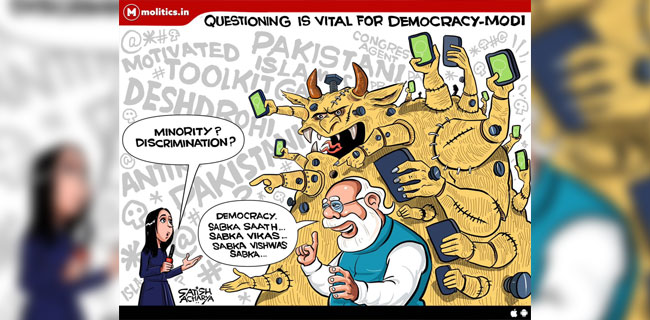
    All right, press conferences happen all the time in India. Just not with Narendra Modi. The negotiations led to Modi agreeing to two questions. One from an American journalist, the other from an Indian. The American journalist from The Wall Street Journal asked Modi about discrimination against religious minorities.

    The Prime Minister said he was surprised at such a question. And his long and convoluted answer basically said this: “India is a democracy. A democracy is about human rights. If there were no human rights, India would not be a democracy. And India is a democracy.”

    A fine example of syllogism. An even better example of how Modi has handled the media in his nine years in office. With bombastic nothings. No counter-questions allowed, so there was no way to present the Prime Minister with evidence of the daily human rights assaults on Muslims, Dalits, Christians, Tribals…

    The second question from an Indian journalist was about climate change. Although Modi’s first answer has got plenty of traction, his second answer, which was largely ignored, was even worse. One might even call it close to a falsehood: “we do not believe in the exploitation of nature”.

    It is hard to remember a government, since the environment became a global concern, more hellbent on exploiting nature than this one.

    The Prime Minister’s pet project, the all-weather Char Dham Yatra road, is an ecological disaster. The collapse of the town of Joshimath thanks to the road and to hydro projects. The permissions to cut forests and build townships across the fragile Himalayas of Uttarakhand.

    The constant diminishing of the powers of the National Green Tribunal. The silencing of citizens’ voices. The systematic targeting of environmentalists. The snatching of tribal rights to suit mining companies. The list goes on and on.

    Again, no counter-questions.

    The exercise itself was pointless.

    Because for the bulk of the mainstream media, life is about publicity for Modi anyway. Thus, the clothes, the menu, the dancing NRIs, the chants, the hoopla was all that mattered. The Indian media knows that what the foreign media did or did not do is immaterial. Its own future is secure as long as it carries on its pro-Modi song and dance. Therefore Barack Obama’s interview to Christiane Amanpour where he said: “Part of my argument would be that if you do not protect the rights of ethnic minorities in India, then there is a strong possibility India at some point starts pulling apart. And we’ve seen what happens when you start getting those kinds of large internal conflicts,”, upset social media warriors more than the Indian media.

    Obama can be safely ignored and CNN dismissed. Even if several TV people joined the media because of Amanpour. All opposition to Modi in the US was dismissed by TV as a Congress-Rahul Gandhi “toolkit”.

    But little birdies cheep of change within sections of the media. The exit of the very toxic Rahul Shivshanker from the very toxic Times Now has set off a chain of speculations. That the BJP’s loss in Karnataka has made the mainstream media realize that if they want news from the South, they need to be less Modi-centric.

    Well. Maybe the earth will also change its axis.


    Ranjona Banerji is a senior journalist and commentator. She writes on MxMIndia on Tuesdays and Fridays. Her views here are personal.


  • When White House condemned venom thrown at reporter…


    By Ranjona Banerji


    Ranjona BanerjiIf ever India’s insecurity as a nation shows, it is in our relationship to the rest of the world. On the one hand, we are constantly looking for affirmation, especially from the West: India is the greatest, Indians are the greatest, best democracy, best prime minister, most popular leader, best national anthem and so on.

    On the other, we are constant “freedom fighters”: Who cares about the West, we are better, our family values are better.

    Often both these exists at the same time in one sentence.

    And let’s not forget that we are a nation that loves to emigrate. You can find Indians everywhere. Far more than you find people of other countries in our land.

    Should I ignore for now the sad fact that those who leave India to settle elsewhere are touchiest about India being criticised?

    Thus the talk around Prime Minister Narendra Modi’s visit to the US.

    Best, greatest, they said, they love us and more.

    But when Modi is asked about the reality of discrimination of Muslims and religious minorities in India, out comes the anger. How dare, what about America and so on.

    And this being today’s India, trolls were quick to pick up on the name of the reporter of the Wall Street Journal who asked Modi the question: Sabrina Siddiqui. Her second name sounds Muslim and that alone was enough to set off the rightwing Hindutva brigade.

    https://thewire.in/media/wsj-reporter-sabrina-siddique-modi-question-human-rights-targeted

    The harassment reached such a point that the White House stepped in to condemn the online venom being thrown at the reporter.

    https://www.thehindu.com/news/international/white-house-condemns-harassment-of-journalist-who-asked-pm-modi-a-question/article67013371.ece

    If anything does not show India in a good light, and raises questions about press freedom in India, it is this.

    Indian journalists who question the government are relentlessly trolled online and attacked in the real world. From Israeli spyware being used on them to hacking of devices to raids, court cases and worse.

    Although we are supposed to pretend that all is well in India, everyone is rich, everyone is happy, to further boost the image and ego of the prime minister, the job of journalists is to tell us that we are pretending.

    Does no one see this?

    Modi returns to India, he asks “what’s happening” as if he does not know, and then has a meeting. Having the problem of violence, anarchy and possible civil war in Manipur, he then proceeds to include the inauguration of a few more trains.

    In other times, history shows us, this is how dictators behave. But in India, you will find a media which promotes and tolerates this dissonant behaviour.

    You also have a media which revels in Islamphobia, in othering anyone who is not a chosen upper caste Hindu – “liberals”, civil rights activists, and anyone who criticizes the Modi government loses Hindu status by dint of criticism – and thus furthering the cause of Hindutva.

    As Manipur burns, there is a massive Hindutva movement growing in Uttarakhand.

    A difficult case like the murder of Ankita Bhandari, where the accused’s father was part of the BJP, is being sidelined. The public prosecutor, says the victim’s father, has been assisting the accused.

    There is little in the national or local media about this, even though the murder created much public interest.

    https://www.newsclick.in/ankita-bhandari-murder-case-public-prosecutor-colluding-accused-know-what-family-said

    At the same time, the targeting of Muslims continues in Purola, Uttarkashi.

    https://thewire.in/communalism/purola-posters-muslims-vacate-shops

    It has taken the high court to somewhat calm things down:

    https://indianexpress.com/article/india/purola-mahapanchayat-uttarakhand-hc-8664504/

    The reason I highlight these cases in Uttarakhand is to underline the fact that India is not Delhi and India is not Modi.

    Like Manipur, Uttarakhand is a small state away from the national gaze. But if Manipur spirals down any further or the Himalayas collapse, it will affect all of India.

    You cannot survive as a democracy if the national media promotes a prime minister who inaugurates trains in the midst of various national calamities.

    It doesn’t matter what the outside world says or does not say. Fake online popularity polls will not change this:

    https://www.deccanherald.com/opinion/second-edit/douse-the-flames-in-manipur-at-least-now-1228980.html


    Ranjona Banerji is a senior journalist and commentator. She writes on MxMIndia on Tuesdays and Fridays. Her views here are personal.


  • Candy Crush is favourite kiddie game: Nickelodeon Awards

    By Our Staff


    The Nickelodeon Kids Choice Awards 2022 are set to take place on June 28 (that’s tomorrow). As per a release, the awards received 1.7 million votes.


    The film Pathaan emerged as the Favourite Movie, and Shah Rukh Khan earns the title of Favourite Movie Actor for his role. Kiara Advani bags the title of Favourite Movie Actor (Female), while Hrithik Roshan and Madhuri Dixit are declared as Favourite Dancing Star (Male) and (Female), respectively. The Favorite Sportsperson title is won by PV Sindhu, along with a host of special awards being presented to Ayushmann Khurrana, Kartik Aryan, and Bhumi Pednekar.


    Popular sitcom Taarak Mehta Ka Ooltah Chasmah maintains its winning streak by securing the title of Favourite TV Show for the eighth consecutive time, with actor Dilip Joshi once again taking home the award for Favourite TV Actor (Male).


    Momos take the crown as the ultimate favourite food among the generation, while Candy Crush Saga claims the title of the Favuorite Mobile Game. Nickelodeon’s Motu Patlu is the Favourite Show on Kids Channel, with Motu himself being the Favourite Indian Cartoon Character.


    Speaking on the massive response received for Kids’ Choice Awards 2022, Sonali Bhattacharya, Head – Marketing, Kids TV Network, Viacom18, said: “With year-on-year successful editions of the Kids’ Choice Awards, Nickelodeon continues to be the ultimate platform that puts kids at the centre of all that it does. This year’s edition garnered a record-breaking 1.7 million votes, proving that kids have been empowered to voice their choice. Our focus with Nickelodeon Kids Choice Awards 2022 was to engage with kids on all platforms where they consume content. By tapping into these touchpoints, we were able to drive inclusivity and participation to this one-of-its-kind award. We are delighted with the response and thrilled that we could meaningfully entertain our young audiences.”


    The Nickelodeon Kids Choice Awards 2022 will be hosted by Varun Buddhadev and have a digital simulcast on June 28, 2023 on various network platforms, including Nickindia.com and Sonicgang.com, as well as the social media platforms of Nickelodeon India, Sonic Gang, MTV India and Colors. JioTV will also air it.


  • Malaika Arora is brand ambassador for Anastasia Beverly Hills

    By Our Staff


    Anastasia Beverly Hills beauty brand is celebrating  its 25th anniversary with Malaika Arora as brand ambassador in India.


    Said Anastasia Soare, Founder & CEO Anastasia Beverly Hills: “Celebrating 25 years is a truly an exciting milestone for all of us at Anastasia Beverly Hills. It is a moment to thank our millions of customers who have put their faith in us, followed and participated in our growth and a moment to celebrate and honour our hundreds of colleagues and team members globally, who continue to deliver impeccable service to our customers. Anasatsia Beverly Hills welcomes the vibrant and multi-talented Malaika Arora as the first ever Brand Ambassador in India.


    Added Sanjali Giri ,Vice President, International Brands & Retail at House of Beauty: “ABH has reached an incredible milestone, and this achievement is truly remarkable for everyone involved with the brand. This is even more special for us, as the brand in India, being true to its ethos of inclusivity, announces Malaika Arora as the brand ambassador for India market. I am sure she will inspire beauty enthusiast across culture and age group to represent ABH in the true sense.”


  • Fibe & Tahir Raj Bhasin Join Forces

    By Our Staff


    Fibe (formerly known as EarlySalary), personal loan apps, has unveiled its newest commercial campaign, featuring actor Tahir Raj Bhasin. To connect with today’s young generation and spread the reach of its financial services across the country, the actor was appointed as the brand ambassador of Fibe in 2022.


    Speaking on the launch Sudesh Shetty, Founding Member and Director – Marketing, Fibe said: “The first #PaiseWaliVibe campaign highlighted the brand as a hassle-free solution for any credit need, no questions asked with a series of larger-than-life scenarios. While we continue to reiterate the promise in the second campaign, we do so by showcasing various real-life aspirations of millennials & GenZs and how Fibe’s personal loan can help fulfil them, with a touch of delightful humour.”


  • Godrej Agrovet drives campaign for cattle health

    By Our Staff


    Godrej Agrovet Ltd (GAVL), a player in the cattle feed industry, has launched its new campaign. It is aimed to drive awareness amongst the farmers by emphasising on how a good quality feed is important for better health of the cattle and can lead to more milk output.


    Said Sandeep Kumar Singh, CEO – Animal Feed, GAVL: “Cattle health plays a critical role in enhancing their yield. With India having one of the highest livestock population and food contamination being one of the main concerns for consumers, we at GAVL are fully committed to provide good quality feed to our farmers. Using best quality ingredients to create a balanced diet for better health of the cattle, our aim is to enable farmers get maximum yield and prosper.”


  • Das ka Dum with Dr Bhaskar Das | Some global brands are said to be looking to the future by taking inspiration from their archives by reviving old slogans, jingles or logos. Anything from India that you would like to see re-emerge?

    Bhaskar DasWe read about this somewhere and thought we should ask our Wizard with Words to share his wisdom. And it speaks a lot for someone who has over five decades of experience, that he doesn’t live in the past. Here’s Dr Bhaskar Das in the June 28 edition of Das ka Dum. Read on…


    If you wish to access the archives, please go to the Das Ka Dum tab on the website’s top navigation bar or click here: https://www.mxmindia.com/category/columns/das-ka-dum/


    Q. Some global brands are said to be looking to the future by taking inspiration from their archives by reviving old slogans, jingles or logos. Anything from India that you would like to see re-emerge?


    A. ‘Thanda matlab Coca-Cola’ or ‘There is nothing official about it’ are memorable taglines of two different brands that created a rage at their relevant time. If they are revived today, will they be equality successful is the million dollar question. I am not a representative sample of various consumer cohorts that have been evolving as tribals of shared interests and perspectives.


    Let’s get back to the core logic of why even the thought of reviving old slogans has come up. I think nostalgia is comforting to a set of consumer class who feel unnerved by the breakneck speed of changes that we are experiencing in every facet of life and can’t always decode its meaning. Nostalgia engenders a cocooned feeling that the future is a continuation of the past. But a major flaw in the axiom is whether the nostalgia will work for the new cohort of consumers.


    I wonder if there has been a famine of creative ideation for a brand. In a sense brand is like a human being which also evolves over time. The core appeal need not get diluted but the rendition can get contemporised. That’s easier said than done, because the value systems across Generation X, Y, millennials and Z, are no longer homogenous. And creating a universal brand appeal that cuts across generations of attitudinal cohorts may be a challenging task. If one goes through the history book of revival of nostalgia through memorable communication taglines, I don’t remember anyone. In fact, the list of failures come more to my mind than successes. You may have to correct me.


  • We’re closed tomorrow. Eid Mubarak

    By Our Staff


    Our offices will be closed tomorrow, Thursday, June 29, on account of Bakri Eid. We’ll be back on Friday, June 30.


    Hence there will be no scheduled updates and editions of our newsletter.


  • BigB promotes MediBuddy in new campaign

    By Our Staff


    MediBuddy, a digital healthcare platform, has rolled out a brand campaign with actor Amitabh Bachchan to showcase the convenience of video consultations with specialist doctors in just 10 minutes.


    Speaking about the campaign, Satish Kannan, Co-founder & CEO of MediBuddy, said: “It’s been our vision to make high-quality healthcare accessible to a billion Indians. We constantly invest in technology to bridge the urban and rural healthcare divide. Our platform will provide our fellow Indians with the convenience of consulting a doctor on video in 10 minutes, ensuring accessibility to expert doctors and healthcare services. This will help them make informed decisions, leading to a healthier community. We are confident that the desired message to raise awareness about the convenience and accessibility of online video doctor consultations will create a shift in existing mindset amongst people at large and enable them to make healthier choices.”


    Added Saibal Biswas, Head of Marketing, Partnerships & PR at MediBuddy: “The new brand campaign is based on the fact that people usually make arbitrary decisions or procrastinate in seeking expert medical attention. It aims to create a top-of-mind recall for choosing online video doctor consultation actively challenging the accepted status quo. It emphasizes that accessing expert medical consultation can be as convenient as everyday online activities like banking, shopping, and food delivery. Mr Bachchan’s portrayal in the ad films echoes MediBuddy’s positioning as an expert caregiver who is always there to assist users during their healthcare journey. In the ads, Mr. Bachchan pops out of the mobile phone magically in a never seen before avatar, as a buddy and a living personification of the MediBuddy app.”


  • Sanjeev Kotnala: What makes people risk adventure?

    By Sanjeev Kotnala


    Sanjeev KotnalaThe recent submersible visit to the Titanic wreckage was an adventure that went wrong. It is safe to presume that such exploration with high-paying passengers engaging in a risky adventure would have been carefully planned and adhered to every safety guideline. Everyone was aware of the risks involved, yet took the journey knowing the possibilities. Initially, the potential for enjoyment and successful completion would have been far higher than the possible misadventure. Otherwise, why would they get into the act? And that raises the question of why people undertake such adventures. Or was it just a case of ‘the vanity of the bored and extremely wealthy’ looking for stimulation that no one else can, as suggested by a person in my alumni group?


    The Adventurer

    The Real Adventurer in life is willing to sacrifice the ultimate, the loss of identity, name, position, and power in pursuit of the objective. These adventures may be nameless travel, get into discussions without revealing their identity or travel with the masses when they can easily afford the better options.

    The High-Risk Adventurer. They are people who climb Mount Everest, get down deep in the ocean to explore, go river rafting, explore the dense Amazon forest exploration or deep dive from the skies. The Red-bull stuntman like Felix Baumgartner, who jumped from space or Dario Costa flying a plane through a tunnel, the Formula-1 drivers, or the Fred Fugen and Vince Reffet wingsuit divers who dared to dive to enter a plane. It is part of their life.

    The Tourist Adventurer who are not that trained in adventure but participate for the fun and excrement, people doing a tandem skydives, Bunge jumps, and river water rafting. As and when they have opportunities, they tend to ensure the experience, even if it is holding a Python or sitting next to a sedated tiger.

    The Fantasy Day Dreamer Adventurer. The person thinks and visualises more instead of doing it. Those who watch ads like Mountain Dew and feel charged by consuming the product. The people who made ‘Angry Young Man’ a booming phenomenon. Who sees things on screen and mentally becomes part of the reel-life drama? The ones who play adventure games rather than patriciate in adventure. And this is the insight many brands use.


    Social Media Adventurer

    Social media adventurers are not a new breed of adventurers, but they have a new tool- social media to explore and exploit. Their main and only reason for any adventure is for others to know what they have done and achieved, be it travel, eating new food, staying at places, sports, or thrill events. Their tribe may be the largest of all adventurers and is increasing daily.

    No denying the fact that the converse is also true. People who have travelled extensively- have done what would be adventure sports and events but don’t regularly share that on social media. To them doing it and the accomplishment is the biggest joy. They are not guided or influenced by what others think. Hence, they never try to influence the experience, net impression, or perceptions by sharing their act.


    Pick Your Adventure.

    Adventures come in different types, and people engage in them depending on their interests, preferences, thrill quotient, safety concerns, available funds and time, including the training or briefing required. Be it an outdoor adventure like hiking, camping, rock climbing, mountaineering, kayaking, canoeing, rafting, skiing, snowboarding, and biking. Extreme Sports involve a high level of risk and require specialised skills, like skydiving, bungee jumping, base jumping, paragliding, wingsuit flying, cave diving, and free solo climbing. Exploration and Expeditions venturing into uncharted territories or embarking on challenging journeys. These include exploring remote wilderness, diving into the ocean’s depths, or scaling unclimbed peaks. Cultural Adventures immerse in different cultures, traditions, and lifestyles. Endurance Challenges are long-duration physical challenges testing an individual’s mental and physical stamina, like ultramarathons, long-distance cycling, multi-day trekking expeditions, and triathlons.


    Why Push Beyond Comfort and Take on Adventure?

    Everyone has an overt and covert reason for trying or not trying the adventure. People seek the intense adrenaline rush, the challenge of conquering nature’s obstacles, pushing one’s limits, overcoming fear, thirst for discovery, the pursuit of knowledge, and the desire to test one’s abilities in unfamiliar environments, providing a sense of enrichment, personal growth, and a deeper understanding of diverse perspectives, build resilience, and achieve personal goals.

    The feeling of accomplishment can be addictive and give a sense of aliveness and vitality. It pushes people beyond their comfort zone, allowing them opportunities for personal growth by taking on challenges and overcoming obstacles. It does help people develop resilience, self-confidence, and a stronger sense of identity.

    For many, it is a way to escape routine and monotony, offering a chance to experience something new and exciting. For some, these risky adventures are part of achievement and Self-Discovery, a sense of accomplishment and fulfilment.

    Additionally, adventure experiences can help individuals to understand their strengths, weaknesses, and inner resilience.

    It is not always the idea of ‘Living on the edge’ that guide and motivates people to participate or undertake an adventure. For some, the sheer possibilities are enough.

    George Mallory said three decades before Edmund Hillary and Tenzing Norgay climbed the Everest. When asked in 1924, on his third attempt to climb Everest- why do you try climbing it? He answered with a simple truth – “Because it is there”. And that is a decently good reason for many adventurers to do what they do- including taking a big roller coaster ride.


    Net-Net

    Everyone has a different appetite for adventure and passion. However, adventure seekers should undertake the activity only after being clear about the possibilities, things that can go wrong, and their physical condition.

    I stood at the MACAU tower to Bunge jump and decided against it. However, I have religiously Skydived at Pattaya for 6-7 years, jumped into level 3 river rafting, tried snookering, and fantasised about scuba diving and Formula car driving. But the biggest adventure has been singing in a college competition while creating the lyrics as I went along.

    Don’t myopically define adventure. It has a wide spectrum, and the definition differs for every individual, as does the motivation and the reason to indulge in it. Whatever it may be, one is sure that it adds to the person’s experience and personality. What is life if not an adventure in the true sense?