Author: mxmadmin

  • ABP Network appoints Saurabh Yagnik as COO

    By Our Staff


    ABP Network has appointed Saurabh Yagnik as its Chief Operating Officer (COO) with P&L responsibilities. Yagnik will be reporting to Avinash Pandey, CEO of ABP Network.


    Speaking on the appointment, Pandey said: “We are delighted to welcome Saurabh to the ABP Network family. His impressive track record and vast experience in the media industry will be a valuable asset as we continue to grow and expand our reach across the country. I am confident that Saurabh’s leadership skills, combined with his deep knowledge of media and consumer insights, will help us achieve our strategic goals and take ABP Network to new heights.”


    Said Yagnik: “I am excited to join ABP Network, a leading media conglomerate and look forward to working and contributing towards the growth of the company and delighting viewers and stakeholders as the company moves to its next phase of growth and transformation.”


  • The Rise & Rise of Dungeons & Dragons

    Courtesy IMDB via The Conversation


    We don’t feature stories on gaming too often, but this one caught our attention given the rising popularity of Dungeons & Dragons. Anyone in India listening and getting inspired?


    By Premeet Sidhu


    Death, dramatic diversions and dark wizards: the new Dungeons & Dragons film successfully adapts aspects of the famous tabletop game of the same name to the big screen.

    Making US$71 million (A$106 million) globally and taking out the top box office spot during its opening weekend, Dungeons & Dragons: Honor Among Thieves is a film that follows a group of thieves who must choose between heroism and riches in order to topple an evil sorceress.

    The film is one of the latest examples of a largely well-received game adaptation. It knows which parts of the game are best portrayed through the film medium – sprawling fantasy landscapes and visual depictions of magic and monsters. It also knows which parts are best left out for film audiences, such as continual dice rolls and extended meta-narratives.

    Dungeons & Dragons: Honor Among Thieves is a great example of why the storytelling world of Dungeons & Dragons has persisted and thrived for so many years: its adaptability to a broad range of different mediums and styles of narrative.


    What is Dungeons & Dragons?

    Originally published in 1974, Dungeons & Dragons (also colloquially known as D&D) is a tabletop role-playing game where groups of players meet to role-play characters, fight monsters and play make-believe with their friends – usually using dice rolls to decide how things play out.

    Though traditionally played over a physical tabletop, online D&D play has become more commonplace and is an accessible alternative for players who can’t participate in person.

    Historically, Dungeons & Dragons was often viewed as a complex high fantasy hobby and was stigmatised when it became associated with the Satanic Panic of the 1980s. This association began when unproven claims linked the death of two teenagers back to their Dungeons & Dragons play.

    However, the game’s reputation, rules and player base have evolved since then, and it is experiencing a modern resurgence in play and popularity.

    Even though there are official published rulebooks that help guide play, Dungeons & Dragons publishers have consistently emphasised the importance of imagination and collaboration. They have encouraged players to cater their games to their own interests by developing rules that allow for various types of gameplay to be valid. The most recent edition of the player’s handbook even states:

    D&D is your personal corner of the universe, a place where you have free reign to do as you wish […] Read the rules of the game and the story of its worlds, but always remember that you are the one who brings them to life. They are nothing without the spark of life that you give them.


    The modern trend of transmedia storytelling

    In his book on convergence culture, media scholar Henry Jenkins describes “transmedia storytelling” as the act of telling a story across multiple formats.

    At a time where we are consuming larger volumes of content across various digital and non-digital platforms, transmedia storytelling offers audiences multiple points of entry into media properties based on their own preferences. Beyond the strong financial motives, transmedia storytelling also delivers content to audiences that may not have been targeted or interested otherwise.

    Dungeons & Dragons has been widely adapted over the years and many of these representations have directed greater interest and attention towards the original game.

    Although the animated TV series from the early 1980s and the original trilogy of Dungeons & Dragons films from the 2000s were met with critical reviews, both adaptations lean into the strong visual affinities of their respective mediums.

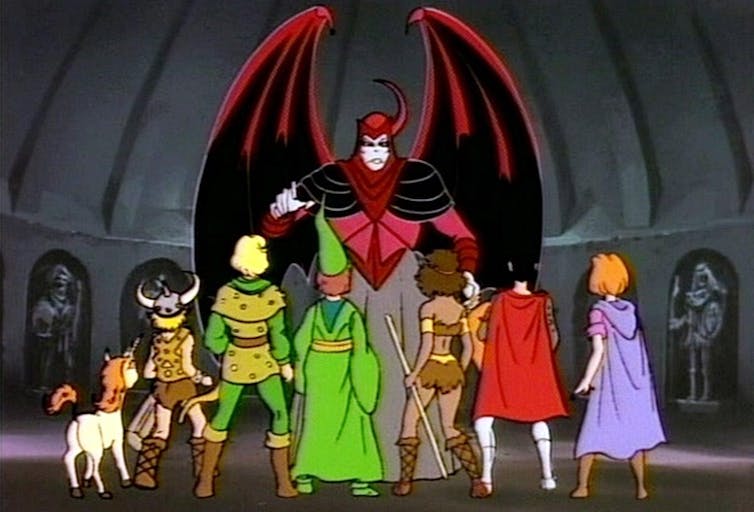
    The Dungeons & Dragons animated series from 1983 focuses on a group of six friends from Earth who are transported into the realm of Dungeons & Dragons. Courtesy IMDB via The Conversation


    This can also be seen in The Record of Lodoss War. The independently created series originated as a published campaign log of a Japanese Dungeons & Dragons game. It has since evolved into a multi-media franchise which includes manga, animation and video game adaptations.

    Actual-play is a term that is used to describe how people play tabletop role-playing games like D&D for audiences. It’s growing into one of the most popular types of content for live-streaming and podcast media.

    Notable and popular examples of actual-play D&D adaptations include The Adventure Zone, Critical Role, Dimension 20 and The Dragon Friends. The stories told can range from classic Dungeons & Dragons campaigns to unique and adapted stories that simply use the rule system.

    Though they vary in genre, run time and production methods, these actual-play representations of Dungeons & Dragons games appeal to audiences that are interested in the players and play of Dungeons & Dragons, just as much as the stories, characters or worlds that are explored.


    Dungeons & Dragons in popular culture

    In addition to the game’s fantasy worlds and gameplay dynamics, Dungeons & Dragons’ capacity for social connection and personal growth has also been covered in popular culture and media.

    Stranger Things, Freaks and Geeks and Community are just some examples of how popular media has successfully incorporated the social dynamics of Dungeons & Dragons play.


    Characters within these shows use the game to develop skills to overcome various challenges or connect with others. Research has indicated that representations of Dungeons & Dragons in popular culture have helped reshape perceptions of the game and have likely played a part in the game’s modern resurgence.

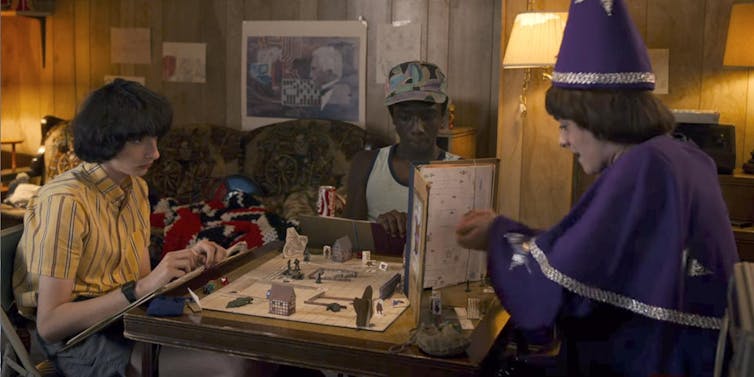
    Dungeons & Dragons game depicted in Netflix’s Stranger Things. Courtesy Netflix


    The continued importance of D&D’s open gaming licence

    Dungeons & Dragons content and media is not solely created or distributed by the game’s official publishers. Since 2000, the game’s open gaming license (known as the OGL) has let audiences create content that is compatible with some of the game’s core mechanics.

    However, the longevity of original and independently created content was put into jeopardy earlier this year when a new version of the license was proposed. This version of the OGL was perceived to be more restrictive and anti-competitive than the initial version, leaving the future of Dungeons & Dragons adaptations unknown.

    What we do know is that Dungeons & Dragons is experiencing a resurgence in play and popularity because it’s able to leverage the way audiences currently consume content: across multiple forms and through diverse narratives.The Conversation


    Premeet Sidhu, PhD Student in Media and Communications, University of Sydney. This article is republished from The Conversation under a Creative Commons license. Read the original article.


  • Das ka Dum with Dr Bhaskar Das | It may be tough doing it in a short response, but what according to you should be the key desirables for achieving marketing effectiveness?

    Bhaskar DasWe asked him for a short answer, he did that. But also gave us a longer one. Here’s Dr Bhaskar Das in the April 19 edition of Das ka Dum. Read on…


    If you wish to access the archives, please go to the Das Ka Dum tab on the website’s top navigation bar or click here: https://www.mxmindia.com/category/columns/das-ka-dum/


    Q. It may be tough doing it in a short response, but what according to you should be the key desirables for achieving marketing effectiveness?


    A. Brief answer: Deliver in sync with organisational aspirations in a measurable manner.

    A longish answer:

    1. Ability to decode business and market challenges,

    2. Ability to make sense of changing customers tastes and preferences of various age cohorts

    3. Competitive intelligence (not intra -category basis but also inter-category basis too and on a future-backwards basis)

    4. Brand positioning on a dynamic basis (depending on changing marketing landscape)

    5. How to leverage data and analytics to take informed decisions

    6. Fixing key goals and metrics for every marketing activity

    7. Ability to leverage all formats of social media including social listening and ChatGPT to optimise digital touchpoints with analogue craftsmanship

    8. Ability to align the organisation horizontally through appropriate collaboration for delivering customer expectations.

  • Sanjeev Kotnala: Breaking the IIMA heritage legacy- Brick By Brick

    By Sanjeev Kotnala


    Sanjeev KotnalaI am surprised and intrigued. In an unhurried ease and calm, the IIM Ahmedabad (IIMA) Governing Council blatantly takes unilateral decisions on demolishing the Architectural and cultural heritage of Ahmedabad and the leading management institutes of India. They remain unopposed under the guise of being autonomous. I am surprised it is not a subject of national debate why the Government of Gujarat and the Government of India, the Architecture Society of India, the alumni and the faculty and the intelligentsia -the protectors of societal heritage remain silent on this murderous intent of the institute known for its management education. Changing the logo is one thing (though I do not prescribe to the restored modified logo), but playing around with the heritage structure demolition is entirely different.


    It seemed, in 2020, the IIMA authorities decided to replace most of the original historic fabric of IIMA and to risk irreversible alterations, including the demolition of several structures and construction of new multi-storey blocks that would adversely impact the unique hierarchical spatial order, visual harmony and innovation construction for which the IIMA campus is valued and known the world over. And now propose to rebuild public-facing dorms 16-18, the Louis Khan Plaza and the faculty and the classrooms of the old campus with the same old exterior façade to create a seismically safe structure, and non-major renovation of the internal space to improve its functionality to suit the needs of the user!. But breakdown dorms 1-14 for what is being called a growth-led design and efficient space utilisation.


    The ex-Director of the institute Errol D’Souza, in fact, tried to hide behind the changes and questioned the heritage association. He says: “Over time, it has become difficult to identify the structure with the original creativity that was manifested in the building associated with the architect ( Louis Khan ) and his associates. A definitive blinkered view.”


    Now, this can be seen as an ineffective blabbering of alumni who lived in and loved the inspiring architecture that pushed you to do a bit more. A minor stakeholder who is paranoid of change of status, a block into the lofty expansion plan of IIMA. Who does not understand that things must evolve with time? The aspirations of the new students at the campus desire and deserve better facilities. That the Louis Khan ideological integration of the student and faculty residential complex with the seat of education, the classrooms, faculty rooms, the library and the magnificent plaza, the nerve centre of activities, and the spaces created for interaction, community creation, and teamwork including the famed academic meetings and discussion in non-academic spaces is no longer holds good when the students and the education process are more digitalised.


    The Institute does not realise the importance of affinity and community building among the batches and through the unique dorm culture. They fail to recognise that these are the defacto identity of the alumni. And the biggest strength of the institute comes from lifelong alumni support and network despite no central functional alumni association. Then how the alumni can question this judgement?


    This myopic view considers the so-called legacy heritage structure association and reflection only with IIMA because it was created for it and is part of it. It fails to see a more significant association and integral impact, which cries for it to be recognised as the city, the state, and the national heritage. A space where the government must intervene.


    The IIMA heritage architecture that the Governing Council has decided to demolish is a reference taught in major architecture courses in India and abroad. This makes the whole architectural society and stakeholders an extended impact group. What the alumni and the architectural bodies ask for is simple, a more conservation-sensitive approach to development, legal heritage protection for the IIMA campus, and maintenance of historically significant buildings.


    The institute fails to recognise and support the competent professionals it has helped ingrain the best of management practices. Many of them, being civil engineers or closely associated with the builder’s community, could help them with proper analysis, problem analysis, alternate solutions and picking a solution that is the best for all the stakeholders. Is that not what the institute has been teaching all this while?


    In fact, this issue before the institute or heritage structure vs space for growth is ripe for a nationwide case study analysis across platforms. That is really a fantasy. Not something one can expect from an institute that teaches transparency in management decisions but refuses to make public the reports on structural viability and restoration.


    The institute management has repeatedly raised a few concerns with the old campus and the need to reconstruct instead of restoration- which according to them, is not viable. Concerns like – providing a safe environment for the users (Faculty and students), meeting the current living and learning standards ( AC, attached baths, new working realities), and shortage of land for future expansion seem genuine in isolation. Added to this is the question of use value, taking into account perceptions of obsolescence and risk to life and property, the economics of conservation, restoration vs Longevity of restored properties vs the new design and construction.


    The only problem that needs to be resolved is whether it can keep the heritage architectural design and ethos intact. And the answer most likely will be YES. It can be unless the people in power have already made up their minds for a new contemporary concretisation of the institute.


    There are more questions than answers, but the feeling and intent are the same, at least with stakeholders other than the Governing Council and the automounts IIMA. We all want to protect the heritage and the legacy of the IIMA architecture incorporating the new aspiration and desires of the students and the faculty, including the so-called facilities like Air Conditioners!


    So, it was interesting to attend the International Webinar, ‘Future for the Modern Past – Heritage-led development for IIM Ahmedabad’. It addressed three major sessions. ‘Working Towards a Value-Based Approach -Assessing the Cultural Significance of IIMA’, ‘Managing Louis Khan’s Legacy’ and ‘Promoting, Protecting, Conserving 20 C Heritage’.


    The session by Kiran Joshi-Architect, Academic, Author, Heritage Advocate; India on Day 1 was the most eyeopening and focussed one for me. It questions if the heritage is exclusively assigned to the campus built under Louis Khan or if it should include the entire old campus where other architects like Annat Raje and Doshi have expanded, keeping the architectural fabric of IIMA intact.


    It was Amit Srivastava, Director, Centre of Asian and Middle Eastern Architecture (CAMEA) based at the University of Adelaide, Australia, who focussed on the impact of IIMA architecture in the city and trade. His original research on the IIMA architectural project explored the challenge of material encounters, authorship, and historiography in architecture. He pointed out the association and important role played by NID (National School of Design) Ahmedabad representatives and the impact of state division into Gujarat and Maharashtra. Thus raising a question of who is the rightful owner of the legacy and why it is a heritage of impact that must be protected and, in this case, restored.


    To quote Amit Srivastava and again point out the broader association, he quotes Ned Kaufmann and Paul Rappoport (2013). Then he implies that IIMA and its narrative are linked to Ahmedabad’s building culture. And it makes ample sense.


    ‘Intangible heritage is both physical and associational. Paying attention to the narratives expressed through people’s customs, stories, and memories can give invaluable insights into the psychological bonds that people form with these places and that, with time, comes to define their heritage value.’ Ned Kaufmann and Paul Rappoport (2013)


    Net-Net

    I believe the heritage architectural structure of the old campus IIMA cannot be considered the sole property of the autonomous IIMA. It has a broader perspective and impact. And this is a subject that the city, State Government, and Central Government must consider. It has cultural as well as educational importance and hence a wider stakeholder. It requires a conservation-sensitive approach and a solution that is in the stakeholders’ best interest. And the best includes keeping the heritage feel, ethos and design structure intact.

    You will find solutions if there is love and passion for the structure. It is hard to think that no one can develop better brick that looks the same, the concrete that is better suited and reimagines the interior space. If the people from IIMA attended the webinar on day -II, they would have realised and seen the case studies of restoring Doon School, Dehradun, School Of Architecture, Ahmedabad, Sanatorium “Zonnestraal” and The Christo Obrero conservation plan. Help may be available from the National School of Design and School of Architecture, the alumni and the architects interested in restoring such a prestigious heritage structure. Net Net- these restoration project reinforce the belief that proper heritage architecture restoration and renovation is possible with a focussed conservation sensitive approach. However, things could be different if the people in power have already decided to demolish and reconstruct rather than restore and renovate.

    ………………………………………………………………………………


    The webinar was organised by ICOMOS- India’s National Scientific Committee of 20th Century Heritage ( NSC-20) in collaboration with ICOMOS- India’s Emerging professionals working Group ( EPWG) & West Zone, ICOMOS India. Along with Institutional partner USM’s Kamla Raheja Vidhyanidhi Institute for Architecture & Environmental Studies ( KRVIA), Mumbai. As Alumni representation in this primarily architectural webinar was provided by Meenakshi Nath ( My batchmate from 1987 IIMA) and Rashmi Bansal (1993 batch IIMA), who both have been at the forefront of the alumni, push for the restoration of heritage architecture instead of concretisation in the name of future needs for growth.


    I have primarily taken my notes from the first technical session. Interested parties and stakeholders ( a shout-out to IIMA management) can watch the  Day 1 and 2 proceedings here.  


    People interested may read the ex-directors’ 33-page note titled Conception, Creation & Corporeality A Tract on the Louis Kahn Designed Buildings at IIM Ahmedabad. Where the ex-director painfully prepares the case for no restoration and new construction to the extent of implying that there is no original heritage structure at the old campus.


    Sanjeev Kotnala is a senior business strategist and educator. He writes on MxMIndia every Wednesdays. His views here are personal.

     

  • Ormax Media launches Ormax Cine Sense

    By Our Staff


    Media analytics firm Ormax Media has released its latest research report titled Ormax Cine Sense: 2023. Ormax Cine Sense is based on primary consumer research conducted among 9,500 audiences across Hindi, Tamil, Telugu, Kannada and Malayalam theatrical markets in India, to understand their viewing behaviour, content preferences and media habits in the post-pandemic era.


    Ormax Cine Sense is a follow-up to Sizing The Cinema: 2023 report, which Ormax Media released in February 2023, that pegged India’s total theatrical audience base at an estimated 12.2 Crore (122 Million). In Ormax Cine Sense, regular theatre goers in each language were interviewed, to understand their behaviour and perceptions on a wide range of topics related to their movie-going choices, ranging from their genre preferences, motivators and barriers to watch (or not watch) films, OTT consumption, marketing sources for new films, etc.


    Speaking about Ormax Cine Sense, Gautam Jain, Partner – Ormax Media, said: “Audience’s movie-going behaviour has changed significantly in the last two years, since theatres re-opened after being shut down for more than a year due to the pandemic. Our business partners expressed the need to understand audience behaviour in the post-pandemic scenario, and Ormax Cine Sense provides rich and layered audience data in five languages to this effect.”


  • Nickelodeon launches 2 new homegrown IPs

    By Our Staff


    The Nickelodeon kids’ network from Viacom18 has announceed the launch of two new IPs, ‘Abhimanyu Ki Alien Family’ and ‘Kanha – Morpankh Samrat’ starting April 24. ‘Abhimanyu Ki Alien Family’, the only alien show in the kids’ category, is a sci-fi comedy series.


    Speaking on bolstering its IP play, Nina Elavia Jaipuria, Head, Hindi Mass Entertainment and Kids TV Network, Viacom18, said: “At Nickelodeon, our understanding of kids and the whitespaces in the industry has led us to define the category and fuel its growth. As a responsible storyteller, it has always been our endeavour to deliver category-defining content that sparks imaginations, while being equally sensitive to needs of our audience. We take pride in being home to characters and IPs that have created an everlasting bond with our discerning young viewers and driven preference to the channel, making us advertisers’ favourite. Over the last decade, our long-standing leadership is a testament to Nickelodeon’s unwavering commitment to delivering top-quality content that resonates with young audiences.”


    Added Anu Sikka, Head – Creative, Content & Research, Kids TV Network, Viacom18: “At Nickelodeon we have always crafted stories with love; Both the shows, Abhimanyu ki Alien Family’ and Kanha – Morpankh Samrat are centered around characters that have their own individualities, making them extremely endearing and relatable. Moreover, they tap into genres that will surely get kids excited, leaving them wanting for more. We are certain both IPs will offer our viewers unmatched entertainment this summer season.”


    Said Ashish J Thapar, Chief Executive Officer, Hi-Tech Animations Studios: “Our partnership with Nickelodeon is filled with creative innovation. We have always looked for new avenues to create and bring to life characters that kids can resonate, and grow up with, while the character and storytelling evolves. With Abhimanyu ki Alien Family, India gets its very first, homegrown sci-fi kids show.  The show allows us to tap into a new genre and drive excitement and interest within kids.  Each character is carefully designed to be extremely relatable and amiable. We are confident about the success of a concept that is new-age, and one that delivers an experience that is new to the kids’ category in India.”


  • More jury chairs for Abby 2023 announced

    By Our Staff


    More jury chairs for Abby One Show 2023 have been announced. Valerie Pinto, CEO, Weber Shandwick, Ahmed Aftab Naqvi, Global CEO & Co-founder, Gozoop and Ashwini Deshpande, Co-Founder and Director of Elephant Design, join as Jury Chair for Public Relations category, Jury Chair of Mobile Category, and Jury Chair of Design category respectively.


    Said Ashwini Deshande: “It is an absolute privilege to be judging the Design category at Abby One Show Awards. India is a unique playground for brands and consumers. I define Design as a creative way of solving a challenge.  I am hoping to see great work based on real life insights that solve a challenge in a delightful way.”


  • DViO Digital elevates Vivek Kumar Anand as CBO

    By Our Staff


    Vivek Kumar Anand
    Vivek Kumar Anand

    DViO Digital has elevated Vivek Kumar Anand as its Chief Business Officer (CBO). As Chief Business Officer, he will continue to head Strategy, Performance, Media and Tech divisions along with other roles and responsibilities. In addition to that, he will also work as a growth champion, given his proven record of achieving fast growth and bold innovation despite significant market headwinds. He will now work towards expanding and nurturing this culture, capabilities, and services to all clients and markets.


    Said Sowmya Iyer, Founder & CEO of DViO Digital: “He is incredible and has made building DViO easier. His balanced yet focused strategies, coupled with guided approaches, have successfully led us to growth and only growth and strengthened our foothold in manifold ways. I wish him all the best for his new role and look forward to our next decade.”


  • Tista Sen joins hands with Rediff to launch Ladyfinger, an all-women ad agency

    By Our Staff


    Tista Sen
    Tista Sen

    Senior advertising professional Tista Sen has joined hands with Rediffusion to set up Ladyfingeer, an all-women advertising agency. Based in Mumbai, Ladyfinger, as a communique notes, “aims to challenge norms, break barriers, and create positive change in the Indian advertising landscape”. Adding: “With a mission to elevate women’s voices and perspectives, Ladyfinger is driven by a vision of inclusivity, empowerment, and creativity. The agency is founded on the belief that though a vast majority of Indian advertising is targeted at women consumers, the female perspective is either missing in most of the communication or is largely characterised by casual gender stereotyping.”


    Led by Sen, who will be its CEO and CCO, the agency will be peopled by a team of accomplished professionals and supported by a powerful panel of women advisors with extensive experience in advertising, marketing, branding, media, Bollywood, architecture and law.  Ladyfinger will offer a full range of services including creative services, strategic planning communication, insight mining, policy and content development across all media platforms.


    “It’s about time, said Sen in a statement. “At Ladyfinger our team of talented women bring a fresh and unique approach to advertising, fuelled by our collective passion for creativity, diversity, and innovation. We believe we can unshackle brands to generate more business and there is an opportunity across beauty, finance, nutrition, personal care, banking and yes even real estate.  We are committed to driving a positive change in the advertising world and beyond and we believe that our all-women agency will make a significant impact.”


    Added Dr Sandeep Goyal, MD Rediffusion: “Most brands don’t quite do justice to a woman’s point-of-view. Women today are not just the primary buyers of most FMCG brands, but are also big drivers of banking to beauty, wellness to wanderlust. Ladyfinger will represent the woman customer in the buying process and help brands think afresh, think anew.  Tista brings tremendous brand building expertise to Ladyfinger; she has got together an awesome team. I am sure Ladyfinger will considerably stir things up in Indian advertising.”


    Said Tanya Goyal, Chairperson Ladyfinger and Director Rediffusion: “The team is diverse; their experience rich and varied. And Rediffusion as the parent will provide resources such as Red Lab and Rediffusion Studios to help the new agency.”


    The Ladyfinger panel of advisors include Juhi Chaturvedi, Bollywood movie writer; Srishti Behl CEO Phantom Films; Malvika Mehra, Independent creative director; Nonita Kalra, Editor in chief Tata Cliq Luxury, Ashwini Deshpande, Co-founder Elephant Design; Nirmika Singh, Executive Editor Rolling Stone India; Bindu Sethi, Strategic Brand Consultant; Geeta Rao, Ex Beauty and Health Director Vogue; Sakshi Choudhary, Founder Indian Creative Women; Alyna Haji Omar, Founder Audacity Sri Lanka, Communication Strategist Editor Co. and Sheetal Kumar, High Court Lawyer.


  • 10 Trends in Commerce Media


    By Our Staff


    Criteo, the commerce media company, released its ‘2023 Commerce Media Market Trends Report’, which sheds light on how retailers and advertisers can seize opportunities in the rapidly evolving landscape of Commerce Media.


    The report highlights 10 key trends that are set to alter the Commerce Media landscape which includes:


    ChatGPT is rewriting marketing and retail playbooks

    Generative AI like ChatGPT is set to transform the ad tech industry and will likely gain a permanent seat on the ad tech agenda due to its ability to provide a more personalized shopping experience. Retailers and brands are expected to adopt retail-specific generative AI tools to optimize their ad campaigns and improve customer service.


    Gen Z’s new spending power is changing commerce

    As Gen Zers move beyond TikTok and become more established as adults with significant spending power, advertisers are seeking to tap into this conscientious consumer demographic. In 2023, marketers will use a mix of tactics and platforms to reach this cohort and tap into their values around sustainability, affordability, diversity, and inclusion more efficiently.


    Sustainability in advertising

    Media buyers and owners are expected to prioritize eco-conscious practices in every aspect of their business. Adopting carbon-neutral campaigns, utilizing net-zero emissions marketplaces, and leveraging attention-monitoring technology to optimize ad effectiveness are all examples of this.


    Omnichannel becomes Essential

    As online and offline channels increasingly converge, retailers and brands must accelerate their efforts to embrace a fully integrated commerce future. This will involve leveraging strategies such as research online purchase offline, cross-channel attribution, and physical attraction to create a seamless customer experience.


    Data Monetisation Redefined

    By leveraging first-party, closed-loop data sets, advertisers gain valuable insights into consumer behaviour and preferences. Retailer data sets offer several advantages, including reliable and compliant data in the face of growing privacy regulations and the vulnerability of third-party cookie replacements. As a result, retailers’ first-party data is becoming increasingly valuable for creating effective advertising campaigns.


    Brand Budget

    A brand budget is crucial for businesses looking to establish a strong brand identity. A brand budget is the amount of money allocated to promote and maintain a brand image, and it includes expenses such as advertising, content creation, and influencer partnerships. The report suggests that businesses should aim to allocate a minimum of their revenue towards their brand budget. However, this may vary depending on the industry and the stage of the business’s growth. The report also highlights the importance of tracking and measuring the effectiveness of the brand budget to ensure that it is generating a return on investment. By prioritising a brand budget, businesses can establish a strong brand identity and increase their brand recognition among consumers.


    Agency partner

    An agency is cited as a key strategy for businesses looking to improve their marketing efforts. An agency partner can provide a wealth of expertise and resources to help a business reach its marketing goals. The report suggests that businesses should look for an agency that specializes in their industry and has a strong track record of success. In addition, the report highlights the importance of clear communication and collaboration between the business and its agency partner. By working together closely, businesses and agencies can develop effective marketing campaigns that drive results. Overall, partnering with an agency can be a valuable investment for businesses looking to improve their marketing efforts and stay ahead of the competition.


    Budget Migration

    The concept of budget migration, which refers to the shifting of advertising budget from traditional channels to digital channels. With the rise of digital advertising, many businesses are recognizing the need to allocate more of their budget towards digital channels in order to reach their target audience effectively. The report highlights the benefits of budget migration, such as the ability to reach a wider audience and track the effectiveness of advertising campaigns more accurately. However, the report also acknowledges that traditional channels such as TV and print can still be effective for certain businesses and audiences. Overall, budget migration can be a valuable strategy for businesses looking to stay competitive in the ever-evolving landscape of advertising.


    Going offsite

    The growing trend of businesses “going offsite” to reach new audiences and diversify their marketing efforts. Going offsite refers to the practice of advertising on platforms and websites outside of a business’s own website and social media channels. This can include partnering with influencers or advertising on third-party websites and social media platforms. The report suggests that going offsite can be a valuable strategy for businesses looking to reach new audiences and increase their brand recognition. However, the report also emphasizes the importance of selecting the right offsite channels and tracking the effectiveness of campaigns to ensure a positive return on investment. Overall, going offsite can be a valuable addition to a business’s marketing strategy in today’s digital landscape.


    Generative AI

    Generative AI is a form of artificial intelligence that can create new content such as images, videos, and text. The report suggests that generative AI can be a valuable tool for businesses looking to create personalised and engaging content for their audiences. For example, generative AI can be used to create personalised product recommendations or to generate unique images and videos for advertising campaigns. However, the report also acknowledges that the use of generative AI raises ethical concerns, such as the potential for the creation of biased or offensive content. As such, businesses using generative AI must be careful to ensure that their content is ethical and aligns with their brand values.


    Taranjeet Singh
    Taranjeet Singh

    Said Taranjeet Singh, Managing Director, Enterprise, APAC, Criteo on the report: “In this competitive landscape, there remain opportunities for retailers and advertisers to continue engaging customers while expanding their reach and it simply lies in their ability to identify and create shoppable moments. Our report captures the changing landscape of commerce media and the opportunities that retailers and advertisers will face in 2023. As the industry continues to evolve, Criteo is excited about the potential of commerce media and committed to empowering our clients with the technology and insights they need to succeed in this dynamic landscape.”


  • Greenpanel launches TVC

    By Our Staff


    Greenpanel, the wood panel manufacturer, has launched its first TVC with the tagline, Greenpanel- MDF ka doosra naam. The TVC features the three players, David Warner, Prithvi Shaw and Manish Pandey of the IPL’s Delhi Capitals Team. Greenpanel is the principal partner of Delhi Capital IPL team 2023.


    Conceptualised by Law and Kenneth Saatchi & Saatchi Pvt. Ltd., this TVC is a fresh take on the conventional ‘problem-solution’ narrative.


    Expressing his contentment, Arvind Joshi, VP, Marketing, Greenpanel, said: “As a team, we’re thrilled to embark on our first-ever massive consumer outreach under the leadership and vision of our MD & CEO, Mr. Shobhan Mittal. We are excited to bring Greenpanel to the forefront of consumer consciousness with our above-the-line approach. The timing couldn’t be better, as we align ourselves with the excitement of the IPL tournament and our principal partnership with the Delhi Capitals team. We feel our TVC is truly remarkable – standing out amidst the clutter of advertising during this highly competitive season. We are confident that this campaign will make a lasting impression on our customers and are excited to see the impact it will generate.”


    Sharing his views on the campaign, Rohit Malkani, Joint National Creative Director, L&K Saatchi & Saatchi, added: “Sharing his views on the campaign, Rohit Malkani, Joint National Creative Director, L&K Saatchi & Saatchi said, “While it’s always fun to do an IPL film for a brand, doing it on the heels of the pitch was even more exciting. Being the leader in the MDF category, the task set out for us was simple: make Greenpanel synonymous with MDF such that the two words are almost used interchangeably! With the Greenpanel film, we managed to do not just that, but also make people regret their choice of material/wood IF they haven’t used Greenpanel MDF!”


  • PR Professionals awarded Patna Metro mandate

    By Our Staff


    PR Professionals, ithe ntegrated communications agency, has been awarded the public relations mandate of Patna Metro. The scope of work includes public relations, stakeholder mapping and engagement, and crisis management, among others. Patna Metro with two lines and 24 stations is an urban Mass Rapid Transit System (MRTS) under construction in Patna, Bihar’s capital city.


    Said Dr. Sarvesh Tiwari Founder & Managing Director, PR Professionals: “The Patna Metro project is a significant milestone for Bihar and we are honored to have been chosen as the communications partner for it. We have a proven track record of providing effective communications solutions for large-scale infrastructure projects, and we look forward to working closely with the Patna Metro team to deliver a world-class mass rapid transit system to the city. We will leverage our expertise and experience of MRTS projects and ensure seamless communication and engagement of Patna Metro with its key stakeholders, including the media, government, and the general public.”