Author: mxmadmin

  • The Advertising Club gears up for 54th edition of ABBYs

    By Our Staff


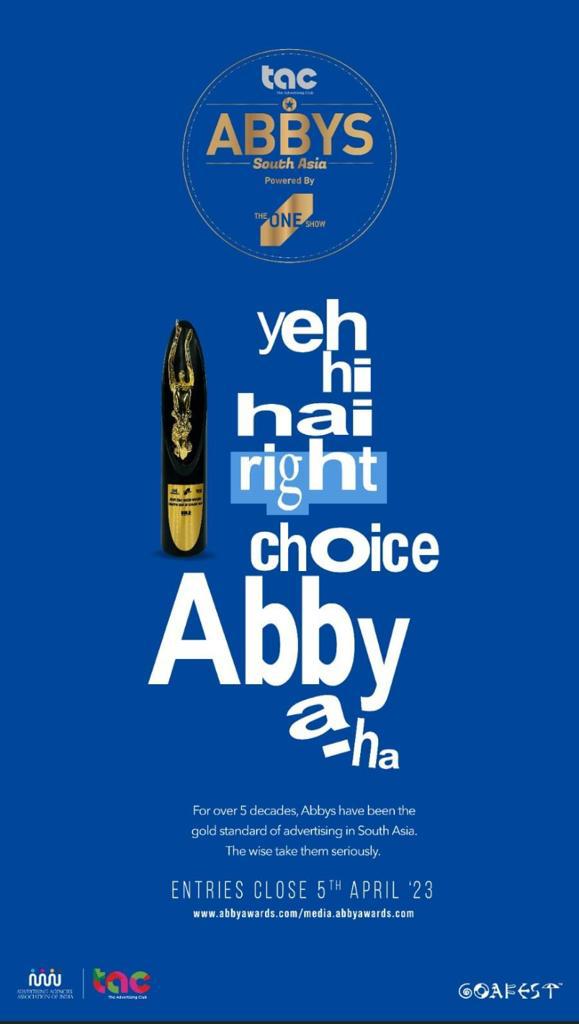
    The Advertising Club revs up to announce the 54th edition of ABBYs, South Asia’s Gold standard, which has been recognizing creative excellence in advertising for over five decades. Held over three days, The ABBY Awards, are scheduled to take place on the 24th, 25th, and 26th of May during Goafest at Grand Hyatt, Bambolim, Goa.


    The preeminent awards for Creativity, Media, and Communication have once again partnered with The One Show, the award program, to upheave the global standards of judging, jury selection, and transparency to the already revered and celebrated ABBY Awards.


    With a promise to bring global recognition to outstanding achievements in creative advertising, the ABBYs make for a highly coveted award property. Undoubtedly, the biggest and the most prestigious ad award show in the country, wins at the ABBYs, over the years, have further gone on to win international recognitions at Cannes and One Show, setting new benchmarks on scale and innovation.


    With preparations in full momentum, The Advertising Club also announces the Awards Governing Committee for the 54th edition of ABBYs which includes:

    1. Partha Sinha, President Times of India Group and President of The Advertising Club

    2. Rana Barua, Group CEO, Havas Group India & Chairman, The ABBYs Award Governing Council

    3. Ajay Kakar, Managing Committee Member, The Advertising Club & Co-chair, The ABBYs Award Governing Council

    4. Ajay Chandwani, Managing Committee Member, The Advertising Club

    5. Shashi Sinha, CEO-India, IPG Mediabrands

    6. Malcolm Raphael, Senior Vice-President, The Times of India Group

    7. Prasanth Kumar, CEO, Group M South Asia

    8. Jaideep Gandhi, Founder, Another Idea

    9. Mohit Joshi, Managing Director,  Havas Media

    10. Anupriya Acharya, CEO South Asia, Publicis Groupe

    11. Sam Balsara, Chairman & Managing Director,  Madison Communications

    12. Rohit Ohri, Group Chairman & CEO,  FCB Ulka Advertising


    The list of international judges will be announced by The One Show after the process of selection of both Indian and international juries. The Abby Awards will represent the South Asia region that includes India, Sri Lanka, Nepal, Bangladesh, and Pakistan and has been doing so since 2004.


    Providing in-depth recognition and increasing participation opportunity, the ABBY Awards has witnessed the introduction of new sub-categories in Digital Technology, Mobile, Design, and Audio Technology based on valuable feedback from the creative professionals of the industry in the annual town hall conducted by The Advertising Club.


    The Radio category has now evolved into the Audio category with the introduction of Content, the new sub-categories are in Use of Music, Sound Design, Script, Casting, Performance, Audio Technology, Voice Activation, Branded Content, Podcasts, and Content placement.


    Speaking on the initiative, Partha Sinha, President Times of India Group and President of The Advertising Club, said: “With ABBYs, we at The Advertising Club, owe it to the industry and colleagues to present an award show that is authentic, transparent, and of global standards. For 54 years, ABBYs have been pivotal in recognizing creativity and innovation in India’s communication industry. To elevate its presence on the global stage, we continue to augment its significance, and therefore associating with ‘The One Show’ once again provides the necessary impetus. We look forward to witnessing a lot of innovative work this year that will go on to live up to the repute of being the most coveted award property in South Asia.”


    Rana Barua, Group CEO, Havas Group India & Chairman, The ABBYs Award Governing Council, and Ajay Kakar, Managing Committee Member, The Advertising Club & Co-chair, The ABBYs Award Governing Council added: “In addition to being a significant platform for young creative professionals in the industry to exhibit their ground-breaking work accomplished throughout the year, the ABBY Awards have consistently been the most anticipated event at Goafest. We look forward to seeing outstanding creative work being recognized and appreciated at ABBYs this year.”


    The Abby Awards will be a part of the Goafest 2023 and will mark the fourteenth Abby Awards at Goafest.

     

  • Das ka Dum with Dr Bhaskar Das | IPL is also the time when the maximum ad-related controversies happen. Alcohol brands, Edtech claims and now gambling sites? Shouldn’t the government issue an advisory so as to avoid these advertisers running amuck?

    Bhaskar DasNot an easy question to answer, but we asked it nevertheless. Here’s Dr Bhaskar Das’s response to our question in the March 31 edition of Das ka Dum. Read on…

     

    If you wish to access the archives, please go to the Das Ka Dum tab on the website’s top navigation bar or click here: https://www.mxmindia.com/category/columns/das-ka-dum/


    Q. IPL is also the time when the maximum ad-related controversies happen. Alcohol brands, Edtech claims and now gambling sites? Shouldn’t the government issue an advisory so as to avoid these advertisers running amuck?


    A. The subject in your question has been a bone of contention (read controversy) for eons as regulating surrogacy advertisements to circumvent formal regulation, has not yet been evolved. Creativity can always find a way to communicate a message within the framework given by the government. A self-regulatory body like ASCI can act but there has to be a complaint from civil society or from an advertiser. But that might not prevent the initial airing of the advertisements. The other route could be a draconian legislation whereby no communication in any media, in whatever surrogate format, would be allowed. The moral justification for such an action might evoke protests against democratic right of expression. Come to think of it, it’s a complex subject that defy a black and white answer.


  • Advertising in the Gameverse: The Need for a New Paradigm


    By Ashoke Agarrwal


    Ashoke AgarrwalWhile the Metaverse is just a gleam (fading?) in Zuckerberg’s eyes and Large Language Models is the latest hot tech trend, the Gameverse has, over the past decades, changed, almost unnoticed, the media world.

    The numbers are impressive enough.


    The forecast is that consumers will spend USD 185 billion globally on video games – five times more than they will spend on cinema and 70% more than what they will spend on TV streaming services like Netflix. The latest Harry Potter title, “Hogwart’s Legacy” – a video game – took in USD 850 million in two weeks. Gaming concepts are spawning TV and movie spin-offs- “The Last of Us” on HBO and the upcoming movie – “Tetris’ – on Apple TV. Increasingly powerful smartphones put gaming consoles in consumers’ pockets, increasing the time spent on games. Smart TVs, streaming and subscription libraries will further accelerate the growth of games. In 2022 3.2 billion people – four in ten worldwide played video games, rising by 100 million annually. Gaming occupies the entire engagement spectrum – from individual absorption to small and large group play to a mass spectator activity that is e-sports. E-sports is now among the big leagues of sport. For example, Riot Games sold the streaming rights of its Chinese league to Huya, a streaming service, for USD 310 million. The Asian Games in September will include digital games.


    Besides the growing audience for professional e-sports, there is an equally large audience for user-generated gaming content. With its USD 30 billion ad revenue, YouTube says gaming is its second largest category after music. In addition, Twitch, a user-generated gaming content platform, has over half a million quarterly active streamers. Gaming-As-A-Service (GAAS) is a growing business model. “World of Warcraft” offers a subscription service with regular updates to maps, missions and characters. Grand Theft Auto has blockbuster sequels, and GTA Online offers continuously refreshed content at $6 a month.


    What about gaming in India? In value terms, it is small but growing – USD 1.2 billion in 2020 and projected to grow at a CAGR of 26%. However, gaming’s reach in India is already high. Five hundred and ten million people played video games in India in 2022. 94% of Indian gamers use mobiles as their platform, 9% use PCs and 4% play on consoles.


    Over the coming decades, will India leapfrog into being an advanced video game market? Perhaps, given the fast pace of technology diffusion as a society transits upwards economically.


    Given the preferences of the young and its multi-directional growth, gaming will be the driver of a new media paradigm.


    What about advertising in the Gameverse? Does it need a new paradigm?


    Advertising strategy and grammar underwent a paradigm shift from the age of print to the age of radio and then TV. Over the last two decades, with the advent of search and social media, performance marketing has driven a seminal shift in advertising grammar. In addition, the age of generative AI will significantly impact advertising processes and economics.


    If brands and their advertising are to harness the opportunity that gaming presents, they will have to resonate with gamers’ unique needs and motivations.


    A 2020 book – Games: Agency As Art by C. Thi Nguyen – offers insight into why games engage people.


    Games engage because they are a motivational inversion of life. In life, means are for the sake of ends; in games, ends are for the sake of means.


    People play games because they offer them the chance to assume different roles within a given set of rules. The gamer plays to achieve a particular end, but the engagement and enjoyment are in the playing. The core motivation driving gaming engagement is that it offers the gamer an agency different from his real-life persona. This agency transformation is true not just for video games but even simple games like card games of poker or rummy. Many highly engaged players of these card games assume a game persona that is very different from the real persona. For example, a quiet man transforms into a chatty one at the card table, and a chatty one becomes the strong, silent type.


    The highly creative and immersive worlds of modern video games multiply the agency that games offer to unprecedented levels.


    The mediums of television, radio and advertising offer convenient spaces where advertising can insert itself without any connection or reference to the content it has interrupted. The creative challenge here is to overcome the irritation caused by the interruption. This challenge multiplied with the arrival of the multi-channel world and the remote control, but the core challenge and the response remained the same.


    In the era of performance marketing, the creative challenge of overcoming the urge to ignore remains. However, the grammar has shifted with the arrival of performance marketing; the objective now is action – click a link – and not the amorphous building of brand awareness and equity.


    In the Gameverse, interruption is not a challenge; it is taboo, given the intense nature of the engagement. Instead, the advertising’s challenge in the Gameverse is multi-fold:

    :: An advertised brand needs to be present as an integral part of the gaming experience and not as an interruption.

    :: The brand needs to allow the gamer to remain in their chosen persona.

    :: Outside the game, the gamer’s interaction with the game continues by creating and watching user-generated content and e-sports events centred on that game. The brand can maximize its impact by a) enabling the gamer to generate content and b) enhancing the gamer’s experience as a spectator of e-sports or other user-generated content.


    The path to profiting from advertising in the Gameverse is to choose a shortlist of games to focus on and build a 360-degree customized strategy for each game. The advertising strategy focused on a specific game that follows the tenet of going with the game’s flow can only be achieved in collaboration with the game creators. Therefore, good advertising within a game is not about buying space and time but about a creative partnership with the game’s creators.


    For example, a brand could offer a bonus race in a specially branded car in a car-racing game. Red Bull has done so in some games.


    The higher the degree of integration into the game, the greater the impact and, thus, the ROI for the advertiser’s brand. For example, a game-integrated brand could offer players a branded assistant who analyses, offers tips and gives pep talks. With advances in generative AI, such a strategy offers fascinating possibilities. Moreover, this assistant becomes a part of the content creation and e-sports-watching experience outside the game.


    Is the Gamverse advertising opportunity category agnostic? TV, press and digital are product category agnostic in that advertising across product categories can be effective with the right creative and media strategy.


    Given its unique characteristics, advertising in the Gameverse can be genuinely effective for categories and brands that, at the core, connote a persona and a lifestyle- fashion, personal accessories, cars etc.


    The estimate is that in 2020 advertising in the Gameverse worldwide was USD 65 billion. By consensus, the most effective brand with its Gameverse advertising strategy is Red Bull, with a Gameverse budget of nearly USD 600 million. Red Bull’s core brand proposition is that it empowers its consumers – encapsulated in the theme “Red Bull Give You Wings”. This brand proposition resonates in the Gameverse, where the primary motivation driving Gamers is, as Ngyuven’s book proposes, to find a new persona, a new agency – a new set of wings.


    To sum up, if your brand is considering the Gameverse as a medium for advertising, first make sure that there is a fit between your brand’s proposition and the essential motivation that drive gamers. The subsequent steps then consist of finding a suitable game or a concise list of games to focus on and building a partnership with the game developers to create a highly integrated brand presence in the game.


  • ‘57% prefer watching IPL on TV, 30% on mobile’


    By Our Staff


    Pause for a moment. Look to the left or right of the screen. Or text in a different colour. This is no marketing initial or promotional exercise done at the behest of one of the competing platforms. It’s the main finding of an Axis My India survey of 10,034 people surveyed, 66% of who are from Rural India while 34% are from Urban India. This is part of the India Consumer Sentiment Index (CSI), a monthly analysis of consumer perception on a wide range of issues. The April report highlights that 19% of families have reported a rise in media consumption. Moreover, the survey reveals that urban areas and male viewers are leading the surge in media viewership. The enthusiasm for IPL is expected to increase further, with both TV & mobile contributing to viewership. The study also delved into the key factors that influence consumers’ buying decisions, revealing that product quality and brand name remain important considerations. Additionally, the survey sheds light on the role of celebrity endorsements in driving product purchases, with younger age groups being more susceptible to their influence.


    The April net CSI score, calculated by percentage increase minus percentage decrease in sentiment, is at +8, which is the same as last month. The corresponding net score last year was +11.


    The sentiment analysis delves into five relevant sub-indices – Overall household spending, spending on essential and non-essential items, spending on healthcare, media consumption habits, entertainment & tourism trends.


    The survey was carried out via Computer-Aided Telephonic Interviews with a sample size of 10,034 people across 33 states and UTs. 66% belonged to rural India, while 34% belonged to urban counterparts. In terms of regional spread, 25% belong to the Northern parts while 26% belong to the Eastern parts of India. Moreover, 28% and 21% belonged to Western and Southern parts of India respectively. 63% of the respondents were male, while 37% were female. In terms of the two majority sample groups, 29% reflect the age group 36YO to 50YO and 29% reflect the age group of 26YO to 35YO.


    Commenting on the CSI report, Pradeep Gupta, Chairman & MD, Axis My India, said: “Closely examining the findings of our latest survey, it is clear that media consumption habits are not uniform across demographics, with variations emerging among different age and gender groups. It is noteworthy that younger age groups are showing a greater appetite for media consumption, with a particular interest in watching the Indian Premier League. Digital is expected to contribute significantly to the rise of IPL viewership. As we delve deeper into consumer behaviour, it is evident that product quality and brand name remain key considerations, but we are also seeing a significant impact of celebrity endorsements on purchasing decisions, especially among younger age groups. These insights highlight the need for brands to stay attuned to the evolving consumer preferences and tailor their marketing strategies accordingly to drive engagement and enhance customer loyalty.”


    On topics of current national interest


    • :: • This month Axis My India’s CSI survey further deep dived to understand citizens’ sentiments towards the 16th edition of Indian Premier League. As per the survey 42% would watch IPL this season, out of this 19% would watch all the matches whereas 22% would only watch matches where their ‘favourite’ teams will play or critical matches like eliminators and finals. About 26% of youngsters (18-25YO) wants to watch all the matches as compared to older age group highlighting their younger spirit and interest in IPL. In addition, male viewers and urban areas show more interest in watching the tournament.

    • :: • Further investigating sentiments, the study discovered that 57% would watch the matches only on cable/DTH Television sets while 30% will watch it only on mobile – Jio Cinema. 8% said they would watch on both TV and mobile. 3% plans to watch the tournament physically from the stadium. About 32% from rural areas show more interest in watching IPL on mobile given the free telecast of IPL matches. Middle age groups, of 26-50 YO would prefer watching more on television than younger age groups.

    • :: • In an attempt to understand product purchase behaviour, the survey found out that 52% considers product quality and 33% considers brand name as important factors. 60% of 18-25YO puts weightage on the product quality whereas 35% of 36-50YO considers brand name as important factors. Price is overall considered as the third most important factor with a vote of only 22%.

    • :: • The survey also unveiled that advertisement in which celebrities feature, influence product buying decisions of 30% to some extent. Of this, about 35% of them are youngsters (of age 18-25) and 27% are middle-old and older age group.

    • :: • With summers approaching, the survey highlighted that overall 15% plans to buy durables like AC or Refrigerators in the next 2-3 months. Moreover 19% of youngsters (18-25 YO), highest amongst all age groups are considering to buy durables like AC, fridge etc. this summer season.

    • :: • The survey also threw light on consumer travel plans this summer season. Overall 24% plans to travel of which 23% said they are planning for a domestic holiday while 1% is planning for an international vacation. Plans of travel is higher in the younger age group of 18-25 years at 30%.

    • :: • On employment opportunities the survey revealed that 50% believe that there are more openings/opportunities as compared to last 10 years. 53% of the female population have a positive outlook regarding the same highlighting the raise in the number of jobs available for the gender. In addition, younger age group (18-25YO) also thinks job opportunities have increased overtime.

    • :: • Moreover, the survey discovered that among the top professions in the country 25% would prefer their children to enrol in the Govt service, 16% would prefer them to be in medical profession while 10% would prefer them to work in fields related to Engineering, Computer application, IT. A majority of 35% are of the view that their children should do whatever they want to do.


    Key findings


    • :: • Overall household spending has increased for 56% of the families, this reflects a decrease of 2% from last month and 6% from April’22. The net score, which was +51 last month and +53 in April’22 has reduced to +49 this month. The two states, which reflected the highest increase, are Telangana with 70%, followed by Andhra Pradesh with 66%. The age group between 26-50 showcased the highest increase (58%).

    • :: • Spends on essentials like personal care & household items has increased for 33% of the families, which reflects a dip by 3% from last month and 15% from April’22. The net score, which was at +23 last month and +29 in April’22, has decreased to +21 this month. Essential spends has increased more for rural segment (33%) as compared to the urban counterparts (31%). Karnataka and Tamil Nadu reflects the highest essential spends with 50% and 49% respectively. The age group between 36-50 showcased the highest increase (36%).

    • :: • Spends on non-essential & discretionary products like AC, Car, and Refrigerator have increased for 4% of families, which is the same as last month and reflects a dip by 9% from April’22. The net score, which was at 0 last month, remains the same.

    • :: • Expenses towards health-related items such as vitamins, tests, healthy food has surged for 32% of the families. This reflects a decrease in consumption by 3% from last month and 6% from April’22. The health score which has a negative connotation i.e., the lesser the spends on health items the better the sentiments, has a net score value -22 this month. Health related products consumption increased more in rural areas (33%) and among age group of 26-35 (about 34%). Karnataka with 49% and Bihar with 43% reflect the highest spends in health-related products.

    • :: • Consumption of media (TV, Internet, Radio etc.) has increased for 19% of the families, which is the same as last month and reflects a dip by 3% from April’22. The overall, net score is at 0 this month. Media viewership has increased more in urban areas (21%) and among males (20%) while it is only 17% among females. In addition, media consumption is more among 18-25 YO which (29%) as compared to older age groups.

    • :: • Mobility has increased for 6% of the families, which reflects a decrease by 1% from last month and same as April’22. The overall mobility net indicator score, which was at 0 last month, is at -1 this month. 10% of the youngsters from the age group of 18-25, has gone out more in the last month as compared to other age groups.


  • Das ka Dum with Dr Bhaskar Das | For a change, we won’t ask you a forecast for 2023-24 in terms of adspends. How much do you think will technology take over the way media conducts itself?

    Bhaskar DasWe know how much he has integrated into all things digital, and it was hence appropriate to ask him this question. Here’s Dr Bhaskar Das in the April 3 edition of Das ka Dum. Read on…


    If you wish to access the archives, please go to the Das Ka Dum tab on the website’s top navigation bar or click here: https://www.mxmindia.com/category/columns/das-ka-dum/


    Q. For a change, we won’t ask you a forecast for 2023-24 in terms of adspends. How much do you think will technology take over the way media conducts itself?


    A. That technology would play, if not playing already, increasingly a dominant role in every facet of media is a GIVEN. The question is not how much, as much as: by WHEN. Any significant player of media or user of media would ignore the reality at her/his peril. Period.


  • Pentragram revamps Appy Fizz for Parle Agro

    By Our Staff


    Parle Agro has revamped the identity for Appy Fizz.


    Nadia Chauhan, the Joint Managing Director &  CMO of Parle Agro, has emphasised Appy Fizz as a “statement-making beverage that has consistently maintained a distinct and outstanding identity.”


    The new packaging has been designed and conceptualised by Pentagram. Speaking on the new design. Said Harry Pearce, Partner, Pentagram Design Ltd: “The essential idea for the Appy Fizz design was to modernise and to create a more visually arresting identity and bottle shape moving the brand away from the huge number of copycats. We re-addressed the emphasis giving the word ‘Appy’ equal prominence to ‘Fizz’ and employed a distinctive font with custom elements. The design retains the brand equity invested in black, white and red with a nod to the apple in the red dot.”


    Kriti Sanon and Jr. NTR, the charismatic actors who are Appy Fizz’s brand ambassadors, are seen in the new campaigns with fresh packaging of the brand.


  • Scarecrow M&C Saatchi creates Fund Island for Gro X App

    By Our Staff


    Scarecrow M&C Saatchi has created a 3D animation film, Fund Island for the launch of U Gro Captial’s Gro X App.


    Said Shachindra Nath, Vice Chairman and Managing Director, U GRO Capital: “We at U GRO Capital have always believed that data is the future of lending in India and have been at the forefront of its adoption. We understand dynamic MSME space and have pioneered a unique statistical underwriting model which uses repayment behaviour, banking behaviour & GST returns of the customer to arrive at a credit decision within minutes. Through this campaign we wanted to showcase our ability to offer on tap credit through our GRO X app, where the MSMEs can not only manage their limit and dispense credit on UPI but can also accept payments. Scarecrow M&C Saatchi understood our proposition and their ability to create distinctive, strategically relevant creative work is what drew us to them.”


    Added Manish Bhatt, the Founder Director of Scarecrow M&C Saatchi: “Technology in a digital era is invisible. We got an opportunity to give it a physical form. And the most challenging part is that there are no symbols or metaphors to represent this futuristic technology. So, we found the answers in the steampunk retro-futuristic genre, which has rich imagery in illustration and animation. We leveraged it to show something unusual and fascinating in a rather transactional fintech communication. The youngest design and art team of Scarecrow got a limitless opportunity to express their ability to imagine and create this magnum opus film.”


  • Mi Ads appoints Xapads Media as Core Agency Partner for India

    By Our Staff


    Xapads Media is now the Core Agency Partner of Mi Ads for the India market and will offer advertisers exclusive access to premium app inventory of Mi Ads for in-OEM advertising.


    Speaking on the occasion, Alok Pandey, Vice President, Sales & Marketing, Xapads Media, said, “I am beyond excited to announce our association with Mi Ads as their Core Agency Partner. Our collaboration will redefine performance programmatically and support brands to thrive in the ever-evolving adtech landscape. The branding and promotion opportunities will aid marketers in connecting with niche audiences that are challenging to reach.”


    Bono Wu, Director of Channel Partnership, Mi Ads, International Internet Business, said, “We are proud to be associated with Xapads which is our core partner for Mi Ads, Marketing Solution in the regions of US, India and SEA. Xapads is not only a business growth driver, but also a trusted partner and value creator. Their expertise in programmatic advertising and data-driven marketing solutions are just a few reasons why we’re thrilled to have them. Together we look forward to delivering unparalleled results for our clients.”


  • Ranjona Banerji: Falsifying Indian history?

    By Ranjona Banerji


    Ranjona BanerjiThe children of Uttar Pradesh who use NCERT textbooks will not be taught Mughal history in Class XII anymore.

    A few years ago, even after the historic landmark year of 2014, there would have been some noise in the media and in the public discourse. RSS ideologue and “educator” Dinanath Batra has received flak for his attempts to “rewrite” Indian history to suit his parent organisation’s historical fantasies in order to indoctrinate new generations of Indians.

    But now, we take all this in our stride.

    Indian history will be falsified. Indian children will be under-educated. History and fact embarrassing and/or unacceptable to the Hindutva majoritarian mindset will be removed from Indian life and consciousness. Presumably the East India Company forays and the colonisation of the Indian subcontinent will also soon become inconvenient to the RSS and its captive media?

    This is the media which after all is far more excited about publicising some dubious poll which announced that Narendra Modi is the “world’s most popular leader”. Whatever that means.

    This is a media which reports poker-faced that India’s home minister, Amit Shah, announced that all rioters would be hung upside-down if the BJP returned to power in Bihar. Law and order comes under the aegis of the home ministry. But evidently, the Home Minister can openly contravene all provisions of the rule of law in India.

    Modi himself has claimed that a contract has been given to “someone” to dent his image. He used the word “supari”, a term used by the Bombay/Mumbai underworld to hire a contract killer.  The media is very excited here, knowing that the accusation is not aimed at them since the media does nothing to dent Modi’s image and everything to bolster it. Instead, the media tells us the etymology of the word “supari” and betelnuts and so on. Fascinating stuff that proves how effective journalists are at using internet search engines.

    The Indian education system is bad enough as it is. In the years that I have conducted entry-level tests for journalists in various newsrooms, it is hard to be optimistic about general levels of knowledge. I know we are proud of our schooling in that we can learn by rote and regurgitate. But the ability to think is not as cherished and this failing is now evident in every aspect of our lives. Not least the media because low-paying jobs do not always attract the best talent.

    Having said that, I now think of overpaid TV people who show no greater talent or skill. Well, one hears that at the top levels, TV people are often hired for family contacts and proximity to the powerful. True or false?

    I now segue and spin to an emerging problem. A captive pliant media, which ignores the basics – forget speaking truth to power – but even basics like protecting Constitutional rights, with ignorant and undereducated elements outnumbering the committed and talented, over-dependent on the internet for information, unable to research and search for information will soon turn to AI to “assist” in their work.

    Imagine what will happen then?

    Even if you consider the best aspects of ChatGPT for instance, what does it do for any hope for independent journalism if journalists depends on basic Artificial Intelligence to do most of the work? It will happen. It happened with the internet.

    Like this: via Hindi cinema. The number of young journalists who have argued with me in the mid-2000s that the Mumbai riots of January1993 were a response to the bomb blasts of March 1993 was very distressing at the time. Finally, when faced with paper evidence, they all claimed they had got this idea from a Hindi film. And even that they had misunderstood, apparently.

    I’ve only looked superficially at the media. Just repeat state-sponsored ignorance across all areas of life and then…

    Well, what?

    Any ideas?


    Ranjona Banerji is a senior journalist and columnist. Her views here are personal. She writes on MxMIndia on Tuesdays and Fridays.


  • Das ka Dum with Dr Bhaskar Das | Since we know that you are working on your third PhD, would you think of using ChatGPT to write your thesis?

    Bhaskar DasWe know how much he has integrated into all things digital (and AI), and it was hence appropriate to ask him this question. Here’s Dr Bhaskar Das in the April 4 edition of Das ka Dum. Read on…


    If you wish to access the archives, please go to the Das Ka Dum tab on the website’s top navigation bar or click here: https://www.mxmindia.com/category/columns/das-ka-dum/


    Q. Since we know that you are working on your third PhD, would you think of using ChatGPT to write your thesis?


    A. I would not like to. Anyway, my area of research is exploratory, and ChatGPT might not be able to help much as in the area of my research, not much secondary work would be available. These are early days of my PhD and nothing can be predicted with a finality. Besides, the University/ UGC has its protocols to be adhered to which doesn’t include use of ChatGPT.


  • Greaves Cotton gets Varghese Thomas to head comms

    By Our Staff


    Greaves Cotton Limited, a leading diversified engineering company in the world, has announce the appointment of Varghese M Thomas as Chief Communication Officer.


    Said Nagesh Basavanhalli, Executive Vice Chairman of Greaves Cotton Limited: “Greaves Cotton is well on its way to make the challenging yet important transition to a sustainable mobility company.  Our stakeholders are varied, and strategic communications will play a pivotal role in our success. We are pleased to welcome Varghese M. Thomas to our team as the new Chief Communication Officer for the Group.  His extensive experience in communication, strategic planning, and brand management will be instrumental in driving seamless communication across the Group and elevating our global communication efforts.”


    Prior to joining Greaves Cotton, Varghese has held senior communication positions in organisations such as TVS Motor Company, BlackBerry, Cisco and Intel.


  • PR Professionals bags Paras Health mandate

    By Our Staff


    PR Professionals (PRP), the integrated communications firm, has bagged the PR mandate of Paras Health after a multi-agency pitch. PRP will be responsible for end-to-end public-relations services for Paras Health across India.


    Said Dr Sarvesh Tiwari, Founder & Managing Director, PR Professionals:  “Paras Health’s mission has always been to provide compassionate and quality healthcare services to everyone. They have an exceptional team of people passionate about providing the best care for patients and their families. We are honoured to work with them to ensure that it continues to improve and deliver healthcare services and enhance patient outcomes via clinical excellence, empathy, and compassionate care.”