 By Rajiv Mishra
#1 Continue providing strong alternatives to commercial channels:
Broadcasters funded out of the public purse have historically formed a vital component of the broadcasting sector in most countries. The rationale for these broadcasters, which can offer alternative programming to that provided by the commercial sector, remains strong. Some countries support public service broadcasting more enthusiastically where the public service broadcasters (PSBs) are seen as more informal, modern, and informative than before, without having lost their reputation for quality.
#2 Encourage public sector broadcasting partnership with government funded telecom companies:
Broadcasting is changing. Rarely a day goes by without more news of an innovative way to access audiovisual content over the internet, mobile phone networks, hand held devices or other new media. In television, meanwhile, we have moved rapidly from one network to hundreds of competing channels, and will soon move to a digital only television environment. It is with the development of new media platforms that this conflict has deepened. We no longer have an environment with a small number of providers. The internet and digital television represent near limitless forums for broadcasting content, whether news, entertainment, sport, movie, music, live events or anything else, and competition for audiences is much more intense. The benefit to the public service broadcasting in India is that government funded telecom companies is having the pan India presence and PSB’s can join hand for seamless delivery of content in triple play environment as well.
#3 Public sector broadcasters can experiment and provide alternate programming more often:
The vast library and archival footage are also a major strength of PSB’s. Further the private companies face much tougher financial constraints. One may think, public service broadcasting has no role in the contemporary media and may argue that state funded broadcasters should not replicate services that the market can already provide. This weakness is actually the strength of the public service broadcasters as they can experiment and provide alternative programming frequently in very innovative manner.
#4 Encourage private-public sector partnership in broadcasting:
The private and public sector have co-existed peacefully since the emergence of modern broadcasting, even providing similar services. There seems no reason why this should not continue in an expanded media environment. One has to suspect that the repeated emphasis on the newness of the new media suggesting that wholly reformed approaches to content are needed is perhaps a little exaggerated.
#5 Public sector broadcasting must develop a new relationship with the audience:
The long-term future of public service broadcasting in the context of a rapidly changing media landscape and with intense competition between private players is to remain extremely focused on long term goal to strengthen our economy, our culture and our democracy. The public service broadcasting must in the future both retain its basic characteristics and change very significantly. Public service broadcasting can and should aim to develop a new relationship with their audiences, this will be vital as expectations as well as the technology are fundamentally changing.
Rajiv Mishra is the CEO of Lok Sabha TV and anchors a weekly show – ‘Special Guest’

 The threat of an MNS agitation is not going to see musical frontiers being bridged. At the time of writing, MxMIndia learns that Colors and Sahara One are going ahead with the broadcast of the cross-border Indo-Pak musical reality show – Sur-Kshetra. The Chitrapat Karmachari Sena of Raj Thackeray’s Maharashtra Navnirman Sena (MNS) is said to have sent an alert to the channels to not air the show as also to noted playback singer Asha Bhosle to step back from being on its jury though. The reason: the MNS wing believes that Pakistan had banned ‘Ek Tha Tiger’ and thereby not reciprocated India’s desire to forge relationships via the arts.
 Bridging the gap between consumers and their quest for a natural lifestyle, Satvikshop.com was launched recently, offering consumers a large collection of organic and ayurvedic solutions and products from reputed brands.

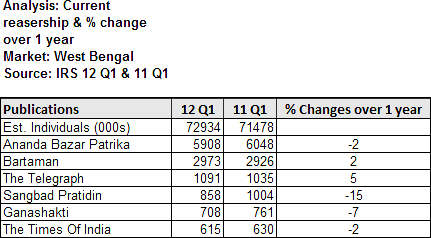 “If there is good marketing support in the new market, combined with good benefits to the readers, the loyalty will obviously be dislodged. TOI has had enough experience in the local markets, and it will be a good war to watch in Bengal,” Mr Mukherjee noted.
 By Ranjona Banerji
 By Vidya Heble
 Joker
Joker By Anil Thakraney