Author: mxmadmin

  • DLF exits IPL lead sponsorship as BCCI ups rate

    By A Correspondent


    After being associated with the Indian Premier League (IP) for five years, real estate major DLF has decided to stop being the league’s lead presenting sponsor. DLF, which had bagged exclusive rights to the IPL in 2008 for over Rs 200 core, feels it is not commercially viable anymore to be associated with the T20 cricket tournament.


    “We have decided not to be the title sponsor for the IPL,” says Rajeev Talwar, group executive director, DLF Ltd. He said the IPL provided a nationwide platform to DLF for brand building for the past five years.


    “But, every decision has to make business sense,” he adds. DLF’s decision to vacate the seat of the title sponsor could open a window of opportunity for several brands and companies.


    According to the Board of Control for Cricket in India (BCCI), a host of sponsors are interested in grabbing the opportunity. “There are a lot of people who are waiting for an opportunity. We will initiate the process in a month,” Ratnakar Shetty, chief administrative officer, BCCI said without commenting on DLF’s position.


    According to a person aware of the matter, the cricket association is looking for a significant increase in sponsorship revenues and has even hiked the amount required to be invested by those who wish to stay associated with the IPL.


    “The BCCI is looking at almost three to four times the price of the original sponsorship deals signed in 2008. For the title presenter, they are eyeing anywhere between Rs 750 crore and Rs 800 crore,” said the person close to the development.


    Meanwhile, the Board has started negotiations with co-sponsors like Vodafone, Karbonn Mobiles and Hero MotoCorp. “It is too early to comment on the matter,” said a Vodafone spokesman. Hero MotoCorp’s long association with cricket – it has sponsored the World Cup and the Champions Trophy in the past – makes it a candidate for the IPL’s title sponsorship, reckons a media planner. The company, however, refused to comment on the matter.


    Without commenting on the future of Karbonn Mobiles and the IPL, Shashin Devsare, executive director, Karbonn Mobiles said: “Negotiations are going on and we have not taken a call on it yet.” Earlier this month, the mobile phone maker had announced a partnership with ESPN Star Sports to become the title sponsor of the Champions League Twenty20 (CLT20) tournament, which will be held in South Africa later this year.


    Source:The Economic Times

    Copyright © 2012, Bennett, Coleman & Co. Ltd. All Rights Reserved


  • Week 34, Hindi GECs: Star Plus #1, Colors #2, Zee #3

    By A Correspondent


    Star Plus is back as the top Hindi GEC in Week 34 in the weekly ratings made available to MxMIndia from an industry source. Star Plus score 265 (255), whereas Colors secured seven point lesser and was at 258 (238) and Zee was at 237 (283). Sony was a distant fourth at 211. Sab and Life OK were neck-and-neck at 126 (133) and 125 (135) respectively.


    Please note that the information has not supplied and verified by TAM Media. However our sources are reasonably reliable. The figures in brackets indicate ratings of the previous week.


  • The Anchor: 5 things that make OTAs tick among consumers

    By Rajiv Malhotra


    #1 Be ‘smart’.

    Having active apps on mobile platforms is an absolutely must for OTAs. Penetration of internet and mobile broadband services is on the rise in India, the number of smartphone users has increased exponentially and so has the usage of smart apps. Today there is an app for just about everything and the benefits of these apps are being experienced in various ways. Travel apps by OTAs help to connect with customers on an additional platform other than the web portal. They also provide convenience and enable travellers to make their booking while they are on the go or even at the last minute.


    #2 Be social.

    Social media, digital networking, YouTube are the buzzwords at the moment. Social media is an effective platform to connect and engage with the target audience. It is important for OTAs to monitor and participate in consumer conversations on social networking sites to manage and leverage their brand. Consumers read reviews, posts, recommendations, etc. shared on social websites which actually influence their buying decision. Also brands can engage with their audience through innovative and interesting activities on social media to create stronger recall for the brand. One example is Hotels.com’s recently-launched 2nd Xtreme Bookingvideo, which shows a person booking a hotel through the Hotels.com iPad app while running with the bulls in Pamplona.


    #3 Have an engaging website.

    It is important to have a website which is customer friendly and easy to browse. It should seem like a two way conversation wherein the customer has space to post his views or recommendations on the portal. The website should carry destination pictures, hotel views and a city map or similar information which make it easier for the consumer to take a decision. Also, there should be unbiased content on the website which will help travellers take an informed decision.


    #4 Offer multiple payment options.

    Consumers like to be spoilt for choice. Very often booking process comes to a startling halt due to lack of payment options. Providing multiple payment options gives travellers the freedom to choose the mode of payment they are most comfortable with. This also leads to more travellers making bookings through the website and helps expand the customer base.


    #5 Other ‘must-have’s.

    Having a loyalty programme helps to further connect with customers and encourage repeat bookings. Welcome Rewards, the loyalty programme by Hotels.com is an example of a simple and straightforward one. Additionally, OTAs must acknowledge that Indians still prefer phone interactions over the internet. Hence, adding that personal touch is necessary.


    Rajiv Malhotra is Head of Marketing, South East Asia, Hotels.com


  • Books & mobiles enter IAMAI’s monthly tracker

    By A Correspondent


    The Internet & Mobile Association of India (IAMAI) has released the ‘Internet Economy Watch’ for the month of July 2012. ‘Internet Economy Watch’ the monthly tracker by IAMAI, is based on absolute numbers captured from various relevant sites, encapsulates online usage for E-tailing, Online Travel and Vertical Classifieds.


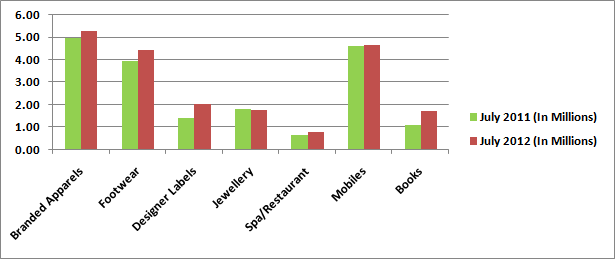
    In the July 2012 report, IAMAI has introduced two new categories – Mobiles and Books. Mobile has infact emerged as the second most popular category among the online consumers i.e. after Branded Apparels. With the exception of Jewellery, all the other e-commerce categories have shown growth in July 2012 as against July 2011. The number of resumes uploaded has continued to decline even in July 2012 as against the previous year whereas the number of matrimonial uploads continued to grow.


    So do these trends indicate that consumers in India are fast adapting to online buying? According to Dr Subho Ray, President, IAMAI, consumers have over the years have become more confident about purchasing online. “Definitely, Indian consumers over a period of time have become more confident about purchasing online. The figures from the Internet Economy Watch report for various that how internet savvy Indians have become and how comfortable and confident they are doing online transactions” he said.


    Speaking on the kind of response IAMAI has been receiving on the ‘Internet Economic Watch’ report, Dr Ray explained, “The Internet Economy Watch report has helped marketers and brands to map the consumer behaviour online and devise their digital strategy accordingly – to be in sync with the online behaviour of consumers. Having said this, we must also keep in mind that the ‘Internet Economy Watch’ report is at a nascent stage and will be of comprehensive use in the months to come.”


    In the months to come IAMAI not only aims to add more categories in the report but, also plans to make the monthly report more comprehensive by giving it a holistic view of usage of internet in India.


    Source: IAMAI/e-Commerce sites


    E-Commerce Sites:

    As per the data captured by the report there has been a significant increase in the online user visit to books and designer label category during July 2012 when compared to the numbers of last year. While 1.74 million hits were registered for the books segment in July 2012 as compared to 1.11 million hits in July 2011, designer label segment registered a y-o-y growth of 45 per cent with 2.04 million user visits in July 2012. It is in comparison to 1.41 million user visits in the corresponding period last year.


    While branded apparel and footwear segment witnessed a marginal rise, y-o-y growth of 6 percent and 12 percent respectively in number of online user visits in July 2012 as compared to July 2011, Jewellery category saw a decline from 1.84 million hits in July 2011 to 1.76 million hits in July 2012.


    Online Travel Portals:

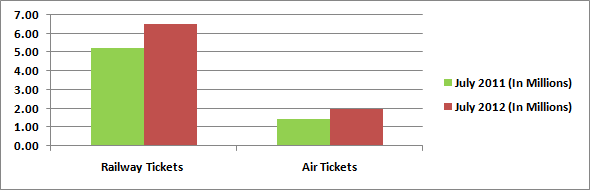
    In e-ticketing segment irctc.com clocked 6.53 million bookings in July 2012 as against 5.23 million in July 2011. The e-ticketing on airlines witnessed a y-o-y growth of 34% with 1.95 million bookings in July 2012 compared to 1.46 million in corresponding month last year.


    Source: IAMAI/ Online Travel Portals


    Verticals Classifieds:

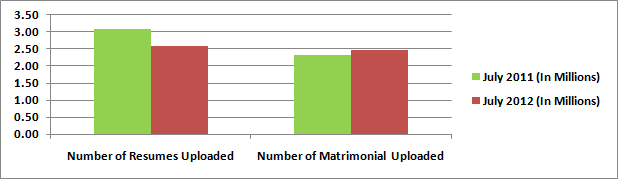
    Data captured from prominent recruitment websites reveals that the number of resume uploads have gone down from 3.09 million in July 2011 to 2.60 million in July 2012. The matrimonial profile uploads has increased from 2.33 million in July 2011 to 2.47 million in July 2012.


    Source: IAMAI/ Vertical Classifieds


    The Internet and Mobile Association of India (IAMAI) is an association which is said to be representing the entire gamut of digital businesses in India. It was established in 2004 by the leading online publishers. IAMAI is also said to be the only professional industry body representing the online and mobile VAS industry in India.


  • WPP moves New York Supreme Court for dismissal of NDTV lawsuit

    By A Correspondent


    Global advertising and marketing services firm WPP has moved the Supreme Court of the State of New York for dismissal of a complaint filed by NDTV alleging TAM India of fudging television viewership and ratings data favouring some TV channels that paid bribes.


    WPP is a shareholder in Kantar Media Research Services, which co-owns TAM India with Nielsen. NDTV had filed a lawsuit against them in late July.


    In a motion filed on Tuesday to dismiss NDTV’s complaint, the company claimed that the “case is nothing more than a desperate attempt by the plaintiff, a television station in New Delhi, India, to drum up media coverage in India to divert attention from the real reasons its programmes have had low audience ratings and its financial performance has been abysmal for five years.


    New Delhi TV has crossed the globe and come to New York State Supreme Court to complain about an Indian company, TAM, and how it measures the ratings of television programmes in India”.


    It also says that the complaint should be dismissed because it was not served properly to the defendants by NDTV. “NDTV’s drafting of the complaint is as careless as its attempt at service.”


    The motion points out that NDTV’s complaint improperly names several of the defendants and that the Supreme Court of the State of New York does not have jurisdiction over Kantar India, which is an Indian company with no presence in the US.


    The lawyers also filed similar motions on behalf of other defendants in the case, including Nielsen, Kantar, TAM India and IMRB.


    The motion will be taken up for hearing on September 13. NDTV declined to comment as the matter is in court. The broadcaster has filed the lawsuit seeking damages of around $1.4 billion for negligence and hundreds of millions more for interference and breach of fiduciary duty on the part of TAM India, and other parties named in the suit.


    NDTV claimed that TAM India has been manipulating television viewership data and ratings to favour some television channels. It also claimed that it had confronted Nielsen with evidence of data manipulation, including taped meetings with TAM India employees, which showed that they were willing to tamper data for bribes.


    Nielsen, according to the news network, admitted in meetings and through emails that its data was indeed being manipulated and that it was willing to address the issue by July 1, 2012, but Nielsen continued to publish these ratings despite repeated demands to stop distribution of TAM TV ratings until the sample size was increased and a proper security mechanism was put in place.


    Source:The Economic Times

    Copyright © 2012, Bennett, Coleman & Co. Ltd. All Rights Reserved


  • Paritosh Joshi | Digitization’s best kept secret

    By Paritosh Joshi


    The entire Television industry: Equipment makers, Broadcasters, Distribution Platform Operators like DTH Players or MSOs; and finally, the end consumer, are all on the verge of extreme anxiety. The government, having notified the “THE TELECOMMUNICATION (BROADCASTING AND CABLE SERVICES) INTERCONNECTION (DIGITAL ADDRESSABLE CABLE TELEVISION SYSTEMS) REGULATIONS, 2012”, is on pins and needles wondering whether full compliance is possible on time and hoping it won’t have another embarrassment on its hands.


    The analogue sunset for our big cities, while it has been pushed back, is imminent and even if it gets another postponement, it will have to be completed soon.


    What were the technologies that were considered by lawmakers when legislating digitization? A cursory reading of the ponderously named regulations will reveal that all options involve an intermediary “cable operator” defined as a “person who provides cable service through a cable television network or otherwise controls or is responsible for the management and operation of a cable television network”.


    Given that we have all but forgotten an era when a broadcaster (Doordarshan) provided its signals sans intermediary to consumers that they could pluck right off the air, it is scarcely surprising; but a good 30 million homes still receive their TV unintermediated. Remember the antenna?  (Evidently, none of those 30 million are reading this piece).


    And here’s another little factoid. As much as 44% of all TV consumption in the US is still from broadcast TV. We in India have apparently forgotten that terrestrial broadcast still represents the quickest and least expensive path to digitization.


    There are many reasons why terrestrial broadcast TV is ideal for India:


    • It is, by and large, FTA. Obviously you can run an encrypted channel as easily on broadcast as on satellite but in the main, broadcast TV works on advertising or public subsidy supported models.
    • It ends the tyranny of the intermediary and of all manner of anti-competitive piggybacking models.
    • It advances the cause of plurality of choice. So far we have only understood this in the context of programming but it is as legitimately an issue for platform plurality and choice as well. Remember that the MIB misses no opportunity to remind us about how important these virtues are.
    • It directly posits competition to the cable & satellite industry. (That doesn’t even need any elaboration, does it?)
    • It reasserts the citizens’ right over the broadcast spectrum, which is by definition a public resource.
    • It creates a new ‘spectrum auction’ style revenue source for the exchequer.
    • It enables the decentralization of TV. Terrestrial broadcast is line-of-sight. While a substantial portion of the content may be re-broadcast from shared, national channels, it opens huge possibilities for a new creative, and commercial, tier- local TV.


    So why has the private broadcast industry remained strangely silent on this issue?


    Let us remind ourselves that the metros are only the first milestones on the digitisation journey and a whole country must follow over the following years.


    Paritosh Joshi was until recently CEO, Star CJ. He has been a marketer, a mediaperson and on the Board/committees of various industry bodies. He can reached via his Twitter handle @paritoshZero


  • IRS will see a technology leap: Prashant Singh, MD-Media, Nielsen India


    By Johnson Napier


    Nine months since RSCI began the process for shortlisting the most bankable partner, it was jubilation time for the team at The Nielsen Company in India, having won the coveted contract of research work for the Indian Readership Survey. The victory is sweeter following as it does the controversies of the past few weeks.

    While the industry is still taking in the news of the appointment, for Nielsen India it is a chance to prove its authority in the print measurement space. And what better metric than IRS. The company plans to centre its focus on newer mediums – with increased dependence on technology – that will help ease data collection and analysis and more importantly bring about consistency in the readership numbers.


    MxMIndia interacted with Prashant Singh, Managing Director – Media, Nielsen India to gather his views on being appointed the new partner by RSCI for IRS. Though it is still early days, Mr Singh dwells on what the future will look like for readership studies in India and how they are geared for the big challenge that’s being watched closely by all concerned. He even had some words of comfort regarding the controversy that it is currently embroiled in thanks to its joint ownership of TAM Media but he assures that it won’t have any impact on how they continue to do business going forward. Excerpts:


    Q: This isn’t the first time the Nielsen Company has done a readership survey in India, though it is after a gap. How have things changed since then (other than the size of the population and hence sample size)?

    Things have changed within the market research industry itself. With the advent of technology there is so much that is available to us to tap into. Today, the scenario is such that any market research can be elevated to a level where one can get a much better read of the market without going through the peeves that are associated with it. For example, Nielsen is actively deploying Computer Aided Personal Interviews (CAPI) instead of the regular pen-and-paper format that was practised for market research. What that does is that while there is an interviewer who goes and interviews the person instead of using pen and paper, the person uses a computer/tablet/palm-device to capture responses. As I said, the entire market research industry has gone through a significant change in the past 5-6 years. With MRUC, we hope to bring significant technological upgrade even on the IRS.


    Q: What is it that you think won you the bid (we know it didn’t go to the lowest quote, because yours was higher)?

    I have no idea. This is something that you should ask MRUC. We are just happy that we bagged this prestigious project.


    Q: Do tell us what you are going to be doing from now to when your part of the study will start? When does work start for you?

    The MRUC and Nielsen teams will sit down and discuss what the plan will look like going forward. The first step for us is to sign the contract and start with those proceedings. Probably MRUC is the right body to talk about future plans, which we will do sometime in the near future.


    Q: For the benefit of the industry, what are a few of the salient differences between the IRS we see now and the IRS that we will see when you’ll be there?

    Multiple innovations in technology features are being brought in. Some of them would be visible to the users while some will be visible to MRUC. But at this point it is not fair for me to talk about the specifics of the proposals. There will be more clarity on what are the things that are coming to the fore in the near future.


    Q: Do you see any challenges cropping up with Nielsen planning to lay increased emphasis on technology?

    Where market research is concerned, with technology we’ve been fairly confident that there are benefits and not challenges. In fact there are challenges in doing market research in India whether it is about how you show inputs to respondents or about how you make sure that the right interviews are happening at the right time and place…and technology actually enables us to do a better job at it. In the last 3-4 years, we have taken multiple steps to embrace technology wherever we can right from data collection to data reporting, etc. So we see technology as an enabler and not a challenge.


    Q: One of the problems that any such vendor contract arrangement is about what do you do when the contract is not renewed? For instance, even after 8 years of working on, Hansa (and Ipsos) lost the contract to Nielsen?

    We do a good job and keep our clients happy; there is no reason that the contract will not be renewed. It is about how you deliver to the promises made. If one doesn’t deliver then obviously the contract could go away from you.


    Q: Will you hire some of the talent from Hansa if rendered redundant due to the loss of contract, later in the year?

    I cannot comment on this.


    Q: Media measurement is a tricky business these days and most often a thankless job. Your take on this?

    Not just media measurement but market research anyway is challenging. In India there are multiple challenges including sociological, geographical… and every market research agency has to understand these challenges and figure out ways to deal with them. Sometimes you can deal with them nicely and sometimes not so nicely. If we are open with our clients and talk to them about the challenges that there are then I think we should be fine.


    Q: One of the frequent peeves we’ve heard from the magazine sector is that IRSes don’t measure niche readership very effectively. How will you correct that?

    Again I cannot comment on that but it is part of the proposal and the RFP and you will hear more about that from us and MRUC together.


    Q: There have been some charges that while Nielsen is a specialist in television measurement, it isn’t with print readership?

    Globally, Nielsen is a specialist in television (measurement)…that’s what I can say. I cannot comment on what  others speculate. Yes, we do specialize in television measurement which does not mean that we do not do other things. People will speculate what we can and what we cannot but I cannot say much on that.


    To give you a higher perspective, Nielsen as a company globally looks at business in two key parts: we measure what people buy and we measure what people watch. Both the businesses are very significant in terms of revenue. So it’s not that Nielsen is just a ‘watch’ business we have a huge portfolio within the ‘buy’ side of the business too. It would suffice to say that we do a lot more than television.


    Q: One last question, and we know the matter is sub-judice: but we heard murmurs that Nielsen shouldn’t bag the contract because its name is stained in the TAM controversy. Also, a hitch with the retail audit earlier this month. Your comments.

    We are happy that the MRUC and RSCI have given due importance to the proposal that we submitted and have awarded the contract to us. We are working towards making sure that we do a great job in delivering IRS. As for the controversy, we have a policy of not commenting on issues that are under litigation and will stick with that. But I can say that it is business as usual for us amidst all that is happening around.

     

  • Ranjona Banerji: Was TV news reckless in covering 26/11?

    By Ranjona Banerji


    On Wednesday evening, after the Supreme Court upheld the death sentence of Mohammed Ajmal Kasab, the lone terrorist caught in the November 2008 terror attacks on Mumbai, I received a tweet saying that no TV panel discussions would ever be held on the way the court indicted TV channels for their “reckless” coverage.


    Perhaps they will and perhaps they won’t. Certainly newspapers have reported on the apex court’s comments.


    “The shots and visuals that were shown live by TV channels could have been shown after all the terrorists were neutralised and all the security operations were over. But in that case, the TV programmes would not have had the same shrill, scintillating and chilling effect and would not have shot up the TRP ratings of the channels,” said the two-judge bench of Justices Aftab Alam and CK Prasad.


    There was much discussion during and after the attacks about the sensational coverage of the attacks by TV channels and whether or not security had been jeopardised. There now seems to be evidence – conversations between the terrorists and their handlers in Pakistan – that certainly the terrorists knew what was going on because of the TV coverage.


    There was also the anger against NDTV for revealing the hotel room of a witness on live TV during an excited conversation. This was more fuel to a latent anger against NDTV and its celebrity anchor Barkha Dutt which started during the Kargil War over the perhaps injudicious use of a satellite phone.


    However, as any journalist knows covering a live event is not easy. There are instant decisions to be made under very stressful circumstances. Some mistakes are inevitable. This is not an excuse: rather it is a way to explain why mistakes will happen. Times Now, for instance, has to be commended for the way in which it decided not to give away important positions or reveal the status of those still trapped inside the two hotels and Nariman House. It was the coverage of this event which catapulted Times Now to the status it now has. Editor Arnab Goswami resisted the temptation to jump into the fray himself — unlike Dutt of NDTV and Rajdeep Sardesai of CNN-IBN who turned themselves into field reporters – and instead behaved like an editor by staying in the newsroom and directed his people.


    But the phenomenon of editors wanting to grab plum reporting assignments is a critique for another time.


    It also has to be pointed out that the print media not only has a better system of checks, balances and filters than TV but also that print editors usually get their celebrity status by pontificating in opinion pieces rather than stealing the thunder from their reporters. Print also has the time to sort out how a breaking event has to be presented.
    Unfortunately for Indian TV news, the notion of how an “editor” functions has still not penetrated into its functioning. There is too much breathless excitement and immaturity in the way events are covered. And four years ago, a vicious, ruthless and audacious terrorist attack in India’s commercial capital was one such event. Rather than indict the medium of television news itself, it might be a better idea to punish those particular channels which compromised national security. But it is also time for Indian news channels to adopt some more practical journalistic systems so that this argument does not come up again and again.


    Even if a live event is being covered, there has to be time for considered judgment about what can be shown and what cannot: a little more editorial discretion and a little less immature hysteria. Was it necessary, for instance, for Headlines Today to show godman Asaram Bapu’s helicopter crashing on a continuous loop for five minutes?
    But after all the indictments and criticism, this has to be said. TV news gave India the chance to see what was happening and the extent of Pakistan’s assault on India. We also Kasab creeping past VT station and that image is one of the many which ensured his sentencing. For this, we have to thank the medium. It made compelling viewing and I for one watched it for almost three days running.


    Can TV news get better? Certainly. Does it have to be damned unequivocally? Certainly not.


  • TAPROOT! | What would make an entrepreneur sell?

    By Ananya Saha


    Some create to sell. Some create to keep. Why would an entrepreneur who has created, built up and nurtured a company, wish to sell it? And given that the reasons are good, what then is a good time for this sell-out?


    PV Sahad, Editor of VCCircle, a news website dedicated to covering private equity, venture capital investments and M&A in India, said, “The right time to sell a business depends entirely on the objective of the management or the entrepreneur.”


    Mr Sahad added, “Usually, the companies are sold off when the markets are high or if there are suitable buyers for the company. The suitable buyers knock on the doors when the company is at the peak performance stage. This is when a buyer looks at the company and makes a good offer.”


    Prof Kavil Ramachandran of ISB Hyderabad opined, “There are various reasons why a company sells out. One, when the entrepreneur gets excited by something more challenging and wishes to move away from something he has established and toiled over. The entrepreneur and/or management might wish to sell out when the Return on Investment (ROI) and Return on Time and Investment (ROTI) for the effort put in seem good in terms of the valuation.”


    One more reason could be that the management of the company feels that the pressures of growing the company further are beyond their current means, and the entrepreneur starts to feel that someone else might be able to do a better job, added Prof Ramachandran.


    Mahendra Swarup

    Mahendra Swarup, President, Indian Venture Capital and Private Equity Association (IVCA), said that the reason to sell out depends vastly on the outlook of the entrepreneur. “If one’s company is heavily invested or has raised money through IPO, then the compulsion to exit the business is much more.” According to him little or less equity rights with the entrepreneur is also one reason when the companies prefer to sell out.


    The companies usually try and scale up their business with the money that an investor (for a stake sale) brings in, or it the entrepreneur wishes to exit the business altogether.


    Mr Swarup added that a good time to sell company is also dependent on the entrepreneur. “They can sell when the company is doing well, or is actually not doing well. But usually, companies are sold when the entrepreneur has an alternative scheme of things that can be a new investment horizon or venture.”


    Sanjeev Bhikchandani

    Sanjeev Bhikchandani, founder and executive vice-chairman of Naukri.com, said, “There are no general answers to when is a good time to sell a company. The motive to sell depends solely on the goals and objectives of the entrepreneur. If they wish to make a quick buck, they might scale up and sell. If they wish to create a huge company, they might not. The time is decided by the motive of the entrepreneur.”


  • TAPROOT! | Anil Thakraney:Talent & values rewarded

    By Anil Thakraney


    Ordinarily, I would envy Aggie and Paddy. They have landed up with mind-numbing sums in their savings bank accounts following the acquisition by Dentsu. In fact, I don’t even want to hear the numbers… that would make me feel like a very small man. Am certain this must be the feeling inside every single creative director’s heart in the Indian ad world, even if they don’t admit to it. And most importantly, Taproot has pulled off this financial coup within just three years of starting out. This is beyond dreams coming true.


    However, instead of feeling jealous, I actually feel very happy for them. I have never met Paddy, but Aggie I have, on more than one occasion, and I can tell you I am yet to meet a more simple, down-to-earth creative director. He is the kind of bloke who you want should win. His success will inspire a whole generation of advertising people, and not just a few eager hot shops.


    It’s a win-win marriage. Dentsu, which is not a name one usually associates with sparkling creative work, has bought itself a nice creative powerhouse. They must be elated. Taproot gets the scale, the logistics and the bucks they need, so they must be obviously thrilled. And for sure the Dentsu suits will leave Aggie and Paddy alone to do their own thingy. Only a silly parent would meddle with a brilliant child. So all is well, as they say.


    The only area of concern is this: What happens when Aggie and Paddy decide to offload their shares and retire to a beach house? There must definitely be a lock-in period of at least five years, I suppose. But what happens after that? Will Taproot be the same agency minus the two Big Brains? This is the only thing Dentsu must keep a sharp eye on. Remember, Taproot is a baby agency, it has no legacy. And if Aggie and Paddy don’t create their clones in the agency, if they don’t cultivate talent that is equally bright and hungry for success, five years down the line this acquisition may not look as rosy to Dentsu.


    For now, dear Aggie, bring out the bubbly. And please hire a bubbly secretary for yourself. No need to figure out airline tickets on your own anymore. You can afford her now.


    ***


    [youtube width=”400″ height=”220″]http://www.youtube.com/watch?v=mpWmowUtn5M[/youtube]

    PS: This is the last TVC directed by Tony Scott, the ace Hollywood movie director who recently killed himself. Incidentally, Scott directed many commercials in his career. Nothing special about this one, it’s typical soft drink trash. Only, it’s difficult to imagine suicide was on Scott’s mind while he was working on such lively stuff. Complex and unpredictable is the human mind.


  • Dentsu acquires 51% stake in Taproot, Management (&creative) controls stay with Agnello Dias and Santosh Padhi

    By Ravi Balakrishnan


    Japanese advertising behemoth Dentsu has acquired a 51% stake in Taproot, arguably the most creative among the Indian independent advertising agencies.


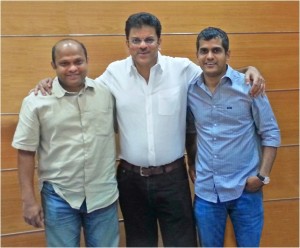
    Taproot's Agnello Dias (left) and Santosh Padhi (right) with Rohit Ohri of Dentsu (centre)

    With several of the most popular recent campaigns like ‘Har Ek Friend Zaroori Hota Hai’ and ‘Joh Tera Hai Woh Mera Hai’ for Airtel and ‘Change the Game’ for Pepsi under its belt, the five year old agency has seen a meteoric rise. It’s also won critical acclaim; the most recent being a Gold Lion at Cannes along with Ramesh Deo Productions for the ‘I Am Mumbai’ film for Mumbai Mirror, a newspaper from the Times Group, which also publishes The Economic Time


    The managements at both Dentsu and Taproot declined to discuss the financial aspects of the arrangement. Industry observers estimate the initial upfront payout at Rs 60 crore with another Rs 80 crore expected in future earn-outs


    In a global deal in July, Dentsu had paid $4.9 billion for British media buying group Aegis, valuing the company at 12 times its earnings before interest, taxes, depreciation & amortisation.


    The Economic Times had reported in June that Dentsu among other agency groups was speaking to Taproot about a possible acquisition. Says Rohit Ohri, executive chairman, Dentsu India group, who has previously worked with one of Taproot’s founders Agnello Dias at JWT: “They (Taproot’s co-founders & chief creative officers, Dias and Santosh Padhi) could have chosen anyone. What convinced them about Dentsu is that we are very entrepreneurial and evolving; and more willing to look at out of the box ways of working.”


    Adds Dias: “We felt it was the right thing to do. Of all the conversations we had, we felt most comfortable with the equation we were sharing with Dentsu. Another reason cited is Dentsu’s global strengths in the digital medium and that it is currently the leading network in Asia.


    Taproot will retain its identity and won’t be rebranded. Although Dentsu is a majority owner, management control of the agency continues to rest with Dias and Padhi. Dias says, “In terms of changes, there’s nothing in the pipeline. I think even Dentsu is saying ‘why should we upset a system that’s doing so well’?”


    What the arrangement brings Taproot is integrated communication, superior execution abilities and a national network. As far as Dentsu is concerned, Taproot, says Ohri, “is really the creative firepower we needed in the group.” However, the firepower is not likely to be immediately applied to any of Dentsu’s current client relationships.


    Both partners believe that Taproot will step in only when needed “on a case by case basis” according to Padhi. Interestingly enough, two of Taproot’s most productive client relationships have been with Airtel and Pepsi, brands that Ohri worked on in a previous stint at JWT. Ohri regards this as “a great bonus”, but he cites the talent of the two principals at Taproot and the chemistry with senior management at Dentsu as the main reasons for the merger.


    Among a spate of recently launched creative-led independent agencies which include Creativeland Asia and Scarecrow Communications, Taproot has arguably been the most successful with several marquee campaigns to its name for Airtel, Pepsi and The Times Group.


    The agency was founded in 2008 when Dias (then national creative director at JWT) decided to join forces with former colleague Santosh Padhi (executive creative director at Leo Burnett at the time). The 33 person strong agency has been particularly successful in wresting business from Dias’ former employer JWT, landing prestigious assignments from Pepsi and Airtel.


    Source:The Economic Times

    Copyright © 2012, Bennett, Coleman & Co. Ltd. All Rights Reserved

  • Global ad biggies like Omnicom, Publicis & Dentsu in hectic parleys to buy Taproot

    By Neha Dewan & Ravi Balakrishnan


    In 2011, when Taproot snatched two big-ticket assignments, PepsiCo and Airtel – both JWT clients – the joke was that JWTstood for Just Went to Taproot.


    Now JWT may just have to be shuffled around to become TJW – or Taproot Just Went – now that a clutch of global ad networks are in hectic parleys with the founders of the five-year-old independent Indian agency. Those in the fray, said a person familiar with the negotiations, include the Omnicom group, Publicis and Dentsu.


    Agnello Dias, chairman and co-founder, Taproot India, said: “There are three or four groups talking to us and Dentsu is one of them. It doesn’t have any head start and we are no closer to signing a dotted line (with Dentsu than with any other network).”


    A Dentsu spokesperson was unavailable for comment. Nakul Chopra, CEO, Publicis South Asia, said: “We don’t comment on acquisitions of any nature.”


    Taproot’s co-founders Dias and Santosh Padhi are clearly testing the market and checking out valuations, said an agency insider. But this may not tantamount to an immediate sale.


    “The global groups are speaking not just to Taproot but also to other independent agencies like Creativeland Asia. We are open to talking to anybody but at the end of the day it may not be Dentsu, Omnicom or anybody. We would just like to get an idea of how much we are worth and valued at,” is how the insider who requested anonymity put it.


    The agency, which had a slow beginning in 2007, eventually moved on to big clients. Campaigns such as ‘Har Ek Friend Zaroori Hota Hai’ (HFZ) and ‘Change the Game’ for Pepsi got popular acclaim as well as industry  accolades with HFZ winning seven medals at Goafest this year.


    At Goafest, considered the premier local ad festival in India, Taproot was runner-up to Ogilvy India, clinching 34 metals and beating top agencies such as Leo Burnett, DDB Mudra, Grey and JWT. Besides this, the agency had won the Grand Effie award last year for the ‘Change the Game’ campaign.


    In its fifth year, the agency runs a tight ship with 35 people on board. A senior official at a leading ad agency says that Taproot has had to turn down a lot of projects in the past year.


    “Funding via a sale of equity will help them increase their capabilities,” he said. For now though, a more interesting game is afoot with Dias and Padhi playing their cards very close to their chest.


    Source: The Economic Times
    Copyright © 2012, Bennett, Coleman & Co. Ltd. All Rights Reserved