Author: mxmadmin

  • Digit Insurance launches new YouTube series

    By Our Staff


    Go Digit General Insurance, a general insurance company, has released a new series on YouTube named ‘Simply Put’. The series will focus on simplifying complex financial decision making, including insurance, using pop-culture references, memes, data visualizations and more.


    Commenting on the newly-launched YouTube series, Tanya Marwah, Vice President and Head – Brand Marketing, Digit Insurance said: “The ‘Simply Put’ series is one of our latest conquests towards making insurance simple. Tackling inherent biases, doubting the real value of health cover or thinking of insurance through different life stages is something we have all done at some point in time. The series will demystify these complex ideas, albeit through simple and easy-to-understand references, all in a fun narrative that people would hopefully love watching.”


  • The Rise & Rise of Tier 2-3 Youngsters


    With apologies to none at all

    By Vikas Mehta


    Vikas MehtaIt’s not news when we talk about people like Dhoni, Bumrah, Lovelina Borgohain, Chanu Mirabai or even Vijay Shekhar Sharma who have made a name for themselves in sports or business. Towns like Kota which have churned out toppers for IIT entrance exams, actors and artists like Nawazuddin Siddiqui or Anurag Kashyap have already propelled small towns of India into the limelight. But, today, these towns are in the forefront of delivering much more than just sporadic gifted individuals. They are now changing the socio-economic structure of Bharat while contributing to a deluge of talent to corporate world too. And don’t forget these youngsters are also tomorrow’s consumers.


    What it underlines is the importance of Tier-2 and Tier-3 towns of India. While we understand Urban (read metro) India and talk about Rural India, there is a huge chunk of these towns which, like a sandwich, have imbibed the good and the bad of both Urban and Rural India. The fact that I have been living in one such town for the past nine-odd years has helped me understand this small town phenomenon better.


    Traditionally, Dehradun was a town with hardly any industry, some government and public sector undertakings and a decent tourism sector. Over the years, it also acquired the reputation of being a good education hub, in school education and training institutions of national importance and of late also in graduation and postgraduation.


    Till a decade ago, to earn a living, one had to be either a government employee in public sectors like ONGC, Survey of India, Forest Research Institute, or be associated with the likes of IMA, Indian Institute of Petroleum, or be self-employed. And getting a public sector job was the biggest dream of the youth. It promised a lifetime of employment, good perks and better retirement perks too.


    Since the above jobs were limited, self-employment played an important role in the commerce of Dehradun. People were self-employed in tourism, in retail, or as serviced employees in government or quasi-government employees in organisations like the ONGC or the educational institutes or the IMAs and the FRIs. And many of these self-employed carved interesting niches. They had bookshops which became a melting pot of the intellegentia, or food outlets like bakeries and restaurants that became a must for the tourists. With educational institutes abounding, hostels, tiffin service, small eateries, sprung up aplenty.


    But the abundance of educational institutes also changed the job scene. Many of the self-employed used to pass on their business to their children, who till not too long ago, were pretty content in accepting this. But now with education at their doorstep, they started thinking differently. And this has happened across socio-economic classes. A help in the household would earlier be content if her daughter took up similar jobs. Or a taxi-driver’s son would take up the same job from his father. A small-time kirana shopowner would let his son take over his shop and a restaurant-owner would pass on the restaurant to his progeny and his employees would pass on their jobs to their children.


    The arrival of education, across all levels, has changed the game. Ask a homemaker and she will complain how it is not easy to find household help. Ask a retailer and s/he will bemoan the fact that the son does not want to run the shop. Ask a small-time plumber and s/he will tell you with pride that his son is doing engineering. Ask a tailor and s/he will be proud to say that his daughter wants to pursue fashion designing. Ask a teacher in a school and s/he will wax eloquently about the daughter doing a computer course.


    Here, I will give the example of my parent’s household help. Thirty years ago, when my parents shifted to Dehradun after retirement, they had a household help whose husband was a daily wage-earner labourer and who had three sons and one daughter. Her initial outlook in life was that the sons will get into being labourers as soon as they hit the teens and the daughter will be married off and would continue her tradition. But then with my parents’ encouragement, she sent all her children to a local small-time private school with my parents funding part of the education and also tutoring them. Today, one son is a front-desk manager in a four-star hotel in Bhopal after doing a two-year course in Dehradun from a hotel management institute. Another one is a cashier with a retail chain having done a diploma in cost accountancy, the third one has started his own repair shop after getting a technical degree from a private college and the daughter has done under graduation before she was married off in an arranged marriage to an engineer in another town, where she takes some private tuition for primary government schoolchildren.


    That to me is the difference in education, even in a small town of Bharat. In another Bharat, without education this would never have happened.


    The arrival of education has shifted the benchmarks. Small towns offer all types of education. Dehradun has engineering colleges, management institutes, pharmacy courses, fashion design institutes, airhostess training institutes, institutes teaching various dances, institutes churning out trained actors, institutes offering retail courses, architecture courses, English-speaking courses, courses training you for a BPO job and of course institutes who train you to get admission into all these institutes. I am not even talking about the normal graduate courses and the ITIs, which are a given. And of course, for primary education Dehradun has more than 300 private non aided schools.


    Many of these institutes are charting their own unique courses. They are offering dual specialisations, credit-based trimester system, industry oriented certifications like SAP or NIIT Swift or even Art of Living. Many flaunt the number of patents their students have registered or the inventions that have merited international recognition.


    And I am sure this phenomenon is being replicated in Raipur, Ranchi, Kochi, Guwahati, Sangli, Mangalore etc. May not be at the same scale, but definitely across the spectrum. Dehradun has a classified weekly newspaper. It is a big hit with edition each week running into 30-40 pages. I see ads for everything in it. Last week, it had almost 10 pages of ads for educational institutes and teachers and other administrative posts. The interesting thing was that the ads were not just for Dehradun or its surroundings but for places as far as Jaipur, Bhopal, Varanasi…..And tell me how many metro cities even have such an amazing, classified only, newspaper?


    Yes, education has changed a lot. But the leveller has been technology. The 4G revolution has inspired the Bharat youngster in more ways than one. And I am not even getting into online education and different online specialisations available. First, is the exposure to the world. My daughter finds about a college in London to pursue her interest because an Instagram friend spoke about it. A beauty parlour owner’s son being a part of Arsenal Football club fan discovered his passion for football coaching.


    Second, is the confidence level. Mediums like Reels have not only given the youngsters a medium to express themselves but also realise that they are no less than the so-called slick city bred.


    Thirdly, it is also changing the cultural identity of the youngsters. It’s not uncommon to see teenaged girls in Dehradun wearing short skirts, hair tied back in a bun, speaking English, walking out of air hostess training institute. Nor is it uncommon to see young men in suits whizzing around on scooters, bending down to touch the feet of elders. Over the last two months, Doon Times has carried enough articles about international DJs and Bollywood stars performing at college festivals. And this evening on Christmas Day sitting at a small café, watching confident youngsters strutting around while talking in Hinglish, I realised that this could well have been the scene in a Gurugram or Mumbai café.


    Finally, the combination of all of the above is making the smalltown youngsters more risk-ready. They are not afraid of doing unconventional things. Exposure, confidence and comfort in finding one’s own identity is making the youngster willing to explore, look at new career paths and be ready to be an entrepreneur too. This is breaking many barriers. And talking to the youth today, it is clear they are ambitious. They still are keen for a job in public sector undertaking. But they are not averse to the private sector. They want a job that will expose them to the world. They want to move to a bigger city and also abroad. And those who have the independent streak, it’s not about opening a small restaurant or having his own taxi. It’s about having a chain of restaurants or a fleet of taxis. For a teenage girl, marriage, though still important, is no longer a driving force. She wants to have some education so that she too can contribute to the household. And she is not limiting her ambition to just be a teacher.


    My wife and I walked into a showroom of a global brand in a prestigious mall in Dehradun. We were discussing, in English, the merits of a T-shirt which seemed to be priced on the higher side. To my shock, which later turned into genuine surprise, the sales girl politely intervened and explained the premium on the T-shirt. I asked her about her good English and she explained to me that she had done her PGDBM from an institute in Dehradun itself and had joined the MNC as a trainee. Her first six months would be on shop floor for her to understand the consumer and the market dynamics.


    I was intrigued. Here was a small-town girl from Bharat. She was comfortable in conversing in English, with strangers, in a shop. She had no qualms or stigma associated being a sales girl, that too after doing a PGDBM! She had broken family barriers, social taboos and wanted to be a part of the world. And her school was called St Kabeer. Figure out if it’s Saint or Sant Kabeer. I spent five minutes quizzing her and I realised that the youth of Bharat has arrived. Not only is she confident and articulate but she is also contemporary. Not modern, but contemporary.


    She is with the times. Mind you she is not a rebel and neither has she given up on tradition. She had mehndi on her hands and the one holiday she never misses is Raksha Bandha. She would not admit that she has a boyfriend, but had some good male friends. She will marry a bit late after she is sure of her job or career. She will not mind a proposal that her parents get but she needs to accept the person too. And she was not interested in just a job but a career.


    What is surprising was not that she was ready to speak to an unknown male (of course my wife’s presence helped) but that she was willing to speak on some subjects which I thought were sensitive.


    The tough and determined rural life has had a very positive impact on such people. Their struggles have strengthened them. But the underbelly of the Urban India has also gotten to them. Drugs consumption is seen as a part of a lifestyle. Most of the youngsters I spoke to, don’t smoke and consider smoking as harmful but drugs were not a taboo. Social drinking seems to be on the rise. Two-hour hotel rooms are mushrooming in every locality at ridiculously low prices. Some private medical clinics talk about unwanted pregnancies being on the rise. But there is no real data to analyse this properly.


    The bottomline is very clear. Tier 2-3 towns youngsters are neither urban or rural but they have carved out their own niche. Companies and brands need to understand them better.
     

  • Das ka Dum with Dr Bhaskar Das | So the Roys have exited NDTV. Do you see the network scaling new highs? Or…?

    Bhaskar DasThe question is self-explanatory, so let’s dive straight in to what Dr Bhaskar Das writes in the December 26 edition of Das ka Dum. Read on…
     

    If you wish to access the archives, please go to the Das Ka Dum tab on the website’s top navigation bar or click here: https://www.mxmindia.com/category/columns/das-ka-dum/


    Q. So the Roys have exited NDTV. We’ve asked you questions on NDTV in the past, but now that it’s a done deal, do you see the network scaling new highs? Or…?


    A. I am not a futurologist. So can’t predict with authenticity about how consumers would respond to a genre, when they have plethora of choices.


    Over the years, I have observed that news as a genre is an insignificant per cent of the overall viewership of TV audience, but they attract disproportionate attention due to their topicality. With more than 400 news channels (including regional languages), the whole genre appear to be heterogeneously homogeneous with different levels of stridency and polarisation on issues. The war of winning TRPs (though largely inconsequential for media planning and buying but useful for rate negotiation), have intensified the competitive spirit to outcompete other channels in terms of breaking stories. Hence one channel scaling new heights (I don’t know what it means because I am not a journalist) might be quite a challenge. But if the new management of NDTV can achieve that, it would be a great service to the genre and good for the news viewers.


  • BBDO India wins communications mandate of Jack Daniel’s whiskey

    By Our Staff


    Jack Daniel’s Tennessee Whiskey appoints BBDO India as its integrated communications agency for the Indian market. As part of the mandate, BBDO India will be responsible for handling creative strategy and execution for the Indian market and localization of global campaigns, apart from managing social, packaging, retail design and mainline creative functions in India for Jack Daniel’s.


    Speaking on the new partnership, Vinay Joshi, Marketing Manager – Indian Subcontinent and Maldives at Brown-Forman said: “We are very excited to partner with BBDO India as our integrated communications agency on Jack Daniel’s for India, which is a very important market for the brand. We are sure BBDO India will add immense value through its energy and creativity and help the brand to build meaningful difference with consumers even more effectively and consolidate its position as the largest selling American whiskey in the country.”


    Nikhil Mahajan, Chief Growth Officer, BBDO India added: “We are delighted to be associated with Brown-Forman and are super excited to handle Jack Daniel’s, one of the most iconic brands in the world. The bold and unpretentious values Jack Daniel’s exhibits have always led to great communication over the years and as the brand treads on the growth path in the India market, we look forward to working with the visionary brand team to create more such iconic pieces of content and strategy.”


  • Platinum Evara collaborates with 3 young women influencers

    By Our Staff


    Platinum Evara jewellery collaborates with three young women influencers to roll out its new campaign. It has also partnered with lifestyle magazine Grazia.  The first piece of content features Yohani, the Sri Lankan singer and songwriter, the second stars South Indian actress Mrinalini Ravi, the third video in the series features actor and model Aisha Ahmed.


    Speaking on this campaign, Sujala Martis, Consumer Marketing Director, PGI- India said: “Platinum EVARA has always stood for a celebration of womanhood. Through this campaign, we wanted to strike a chord with today’s younger women who value authenticity & being true to who they are as individuals. They desire the freedom to live from the heart & revel in their independence. For them, self-acceptance, self-growth & self-love are all critical aspects of embracing who they are unabashedly. Jewellery to them is an emotion, it represents their style and individuality.”


    Tenzin Wangdi, Creative Director, Famous Innovations who helped shape this campaign added: “The joy of being a woman is something that’s meant to be celebrated. And that’s what the campaign is all about. #FromMyPOV marks the desire and free will of young women today who know that their biggest victory is in being themselves, unapologetically. In this campaign, we get up close and personal with the three influencers and hear what they have to say, in their own fabulously feminine style.”


  • Britannia launches campaign for new NutriChoice Herbs & Seeds Cookies

    By Our Staff


    Britannia unveils a campaign to launch its new NutriChoice Herbs & Seeds Cookies. The brand film has been conceptualised by Talented, an independent creative agency, and produced by Lucifer Circus, a Mumbai-based production house.


    Said Amit Doshi, Chief Marketing Officer at Britannia Industries Limited: “The NutriChoice portfolio has grown over the years by actively responding to changing consumer expectations around healthy snacking. The effort is to identify good-for-you ingredients through the convenience and taste of a cookie. It’s the reason we launched NutriChoice Diabetic Friendly Essentials Oats and Ragi cookies, and more recently cookies with 20% Protein. Our latest cookie launches are NutriChoice Seeds & NutriChoice Herbs – with the power of 5 Seeds & 5 Herbs. Playing up the ingredient story was essential – and I’m glad we found a truly entertaining way.”


    Added PG Aditiya – Co Founder & CCO, Talented: “These seeds & herbs haven’t belonged together in a cookie – they’ve been in shampoos, cough drinks and sambar, all independently. It’s for the benefit of you, the consumer that they’ve come together – leaving the baggage of their ‘old jobs’. For your immunity. For your convenience. Shout out to our director – Shayak Roy – whose vision brought this film (and each of its ingredients) to life. I have never relied purely on a director’s instinct as much as I did for this launch.”


    Shayak Roy, Director, Lucifer Circus said: “I love the way PG and the team at Talented drafted the script. Casting was key. Each element of the film from inside the biscuit, to each seed and herb was curated with a lot of effort put in by PG and I. We needed to make sure each cast member resonates the bizarre reality we were attempting. Grateful for the freedom team talented allowed me to execute this vision. Rarely does one come across films with so many layers; looking forward to collaborating with master craftsman, PG and the team at talented again.”


  • Das ka Dum with Dr Bhaskar Das | MxM’s ‘Mediaperson of the Year 2022’ saw a no-show. As in, no one from the Indian advertising and media was found to be suitable for the title. You agree?

    Bhaskar DasWhen you ask a question like this, you are asking for a trouble. But our Wizard with Words was thankfully not too unkind to us. Here’s Dr Bhaskar Das in the December 27 edition of Das ka Dum. Read on…


    If you wish to access the archives, please go to the Das Ka Dum tab on the website’s top navigation bar or click here: https://www.mxmindia.com/category/columns/das-ka-dum/


    Q. MxMIndia’s ‘Mediaperson of the Year 2022’ saw a no-show. As in, no one from the Indian advertising and media was found to be suitable for the title. You agree?


    A. You could’ve been a tad lenient. In an age of ambient pessimism emanating from global and local forces, some sunny side up (however hyperbolic) news can uplift the spirits of the players of the game. You can always revisit your decision. See how The Economist has chosen Ukraine as the country of the year for its heroism against an aggressor. Come to think of it, the media industry has shown exceptional resilience in the face of a variety of challenges for the last two years. And the award can go to….  But I am not the Boss.


  • GroupM India elevates Navin Khemka and Sonali Malaviya for EssenceMediacom

    By Our Staff


    GroupM India has elevated Navin Khemka and Sonali Malaviya at EssenceMediacom South Asia (EssenceMediacom = Essence + MediaCom). Khemka has been appointed as the CEO of EssenceMediacom South Asia, while Malaviya has been promoted as Chief Strategy and Transformation Officer – EssenceMediacom South Asia.


    Both Khemka and Malaviya will be based out of Gurugram. They will work together to bring additional specialisations such as e-commerce, addressable content and digital OOH, to the offerings, while ensuring best-in-class core capabilities.


  • LinkedIn @ 20: Transforming the business networking giant


    By Theo Tzanidis


    When someone says social media, you probably don’t immediately think of LinkedIn. But there’s no denying that the business networking site has gone the distance: it is now 20 years since it was founded in Silicon Valley.


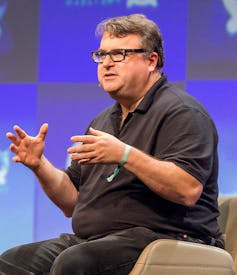
    It was the brainchild of Reid Hoffman, a US entrepreneur who worked on an early social media platform for Apple before launching one of his own in 1997. SocialNet was a dating and professional connections site, but folded two years later after failing to find a big enough userbase in those early days of the web.

    LinkedIn founder Reid Hoffman talking at a conferece
    LinkedIn founder Reid Hoffman. Photograph credit: Marco Verch, CC BY-SA


    Hoffman went on to become a senior manager at PayPal, and made a substantial amount of money when it was bought by eBay in 2002. This helped him to co-found LinkedIn on December 28 2002 with a team of former SocialNet colleagues, becoming its first chief executive and later executive chairman.


    This was a period when everyone was realising the importance of individual interconnection and peer-to-peer interactions. LinkedIn launched in May 2003, just ahead of Myspace and Facebook. But where they and others like Friendster went after the consumer market, Hoffman’s venture was always focused on business.


    How it grew

    LinkedIn was originally set up as a place where users could share their CVs and establish a network of people who could recommend them. It took a while for the service to find its feet via innovations like allowing users to upload their contacts books (2004), as well as jobs listings (2005) and public profiles (2006).

    LinkedIn went international in the late 2000s, opening an office first in the UK in 2008 and introducing Spanish and French language versions the same year. Jeff Weiner, formerly of Yahoo, took over as chief executive the following year as the company morphed into a proper business.

    It made money from premium features that enable users to do things like messaging outside their network, send promotional emails and access analytics. It also sells advertising space and packages to help recruiters attract talent.

    It floated on the stock market in 2011 with a valuation of US$9 billion. This helped to finance an acquisition spree that has gradually bolted new features onto the platform, such as posting articles (2015) and videos (2017).

    The company was acquired by Microsoft in 2016 for US$26 billion (£21 billion). With Hoffman joining the Seattle giant’s board the following year and Weiner still LinkedIn’s chief executive today, Microsoft has taken a relatively hands-off approach to ownership.


    Pandemic benefits

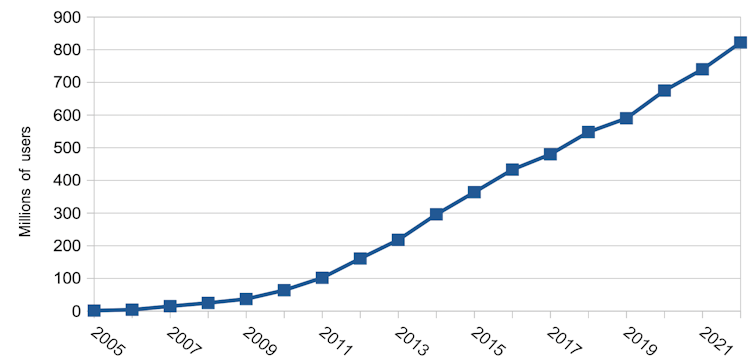
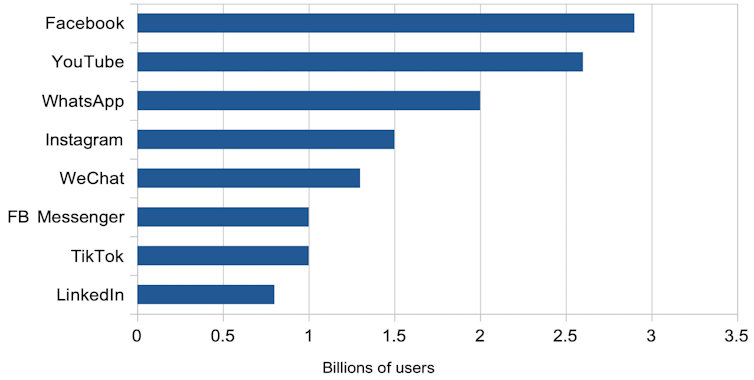
    Today LinkedIn is arguably the seventh largest social network after Facebook/Messenger, YouTube, WhatsApp, Instagram, Twitter and Tik Tok. In 2021 it had nearly 824 million users across 200 countries and territories, of which 6% (49 million) are premium subscribers, paying a minimum of US$29.99 a month.

    Not only does LinkedIn’s business focus attract an upmarket userbase, they are also youthful. The majority (59%) is made up of 25-34s, followed by 18-24s (20%) and 35-54s (18%). It generated revenues of over $10 billion in 2021.


    World’s biggest social networks

    Bar graph showing the largest social networks by user numbers
    All the data is monthly active users from January 2022, except LinkedIn, which just gives user numbers. Statista


    LinkedIn had a “good” pandemic, with conversations on the platform rising 43% and content-sharing almost 30%. It benefited from a shift in how people networked, related to findings from numerous studies that it’s the “weak links” in our professional networks who are the most important for gleaning critical information that leads us into jobs we genuinely desire.


    At a time when the usual barriers of time and space were less relevant and Zoom calls were ubiquitous, it became the perfect moment for reconnecting with these occasional contacts. Especially with so many people questioning their work situations, LinkedIn was the ideal place to see their posts and reach out to them.


    This meant that LinkedIn played a key role in the great resignation, particularly since like the platform, this movement was dominated by millennials. Users posting about changing or quitting jobs would attract large numbers of likes and comments, inspiring others to do likewise. The fact that so many people were connected on LinkedIn multiplied the effects, making it both the main catalyst and the main solution for employers.


    LinkedIn user growth over time

    Line graph showing growth in LinkedIn user numbers over time
    Various sources


    Meet the ‘work-fluencer’

    LinkedIn’s role as a lightning rod for work issues is also likely to determine how it develops, as a new category of social media influencer emerges – the “work-fluencer”. Companies are increasingly finding that employees’ LinkedIn profiles and postings can express the brand better than corporate accounts, allowing them to develop the corporate business network much more quickly and naturallyand naturally.

    When this is done well, employee posts are usually much more authentic than corporate PR. Rather than just curating articles on professional milestones and triumphs, people have become more open and honest about day-to-day work life.

    Over 13 million LinkedIn members have their profile set to “creator mode” to obtain higher exposure for their postings. Many use the hashtag #careertiktok to publish things like their wages and day-in-the-life vlogs about their professions, achieving over 1.5 billion views.

    This new “online watercooler” represents a change in the amount of information people reveal about their work on the internet. Workers are raising formerly taboo concerns like pay transparency, discrimination and professional undermining. Some professionals like lawyers, entrepreneurs and HR experts, have leveraged their posts into new content-marketing businesses and other profitable side hustles.

    Twenty years after LinkedIn was founded, this could enable the platform to enjoy the kind of trust and community growth that other social media networks would envy. Certainly it has challenges – fake accounts are an issue, for example. And LinkedIn inevitably attracts a lot of spam, which is probably one reason it doesn’t achieve the same amount of daily interactions as other social media.

    On the other hand, it benefits from not having a single direct competitor of scale. The nearest big ones would be Facebook Groups or Reddit, but LinkedIn’s purely corporate focus is always likely to be a plus against such players. At a time when traditional platforms like Facebook and Twitter are experiencing difficulties, LinkedIn has a real opportunity to continue succeeding as the one dedicated platform of its size.


    Theo Tzanidis is Senior Lecturer in Digital Marketing, University of the West of Scotland. This article is republished from The Conversation under a Creative Commons license. Read the original article.


  • Prime Video releases a new session of ‘Maitri: Female First Collective’

    By Our Staff


    Amazon Prime Video has released a new session of Maitri: Female First Collective. The collective is an endeavour to help build a community for women from media and entertainment where they can come together to discuss their experiences, challenges and successes, and offer their perspective and advice on how to bring about a positive shift.


    Moderated by the creator and curator of Maitri, Smriti Kiran, the participants comprised Aparna Purohit, Creator – Maitri and Head of India Originals, Prime Video; Indhu VS, Writer & Director; Ratheena Plathottathil, Writer, Director & Producer; Elahe Hiptoola, Creator & Producer; Parvathy Thiruvothu, Actor & Director; Rima Kallingal, Actor, Producer & Performing Artist; Shreya Dev Dube, Filmmaker & Cinematographer and Neha Parti Matiyani, Cinematographer.


    Said Aparna Purohit, head of India originals, Prime Video: “With the new session of Maitri, we wanted to take stock of where we stand with respect to diversity, equity and inclusion, understand the challenges ahead, and collaborate to find the right solutions. We are very heartened by the encouragement and support we have received for Maitri: Female First Collective so far. While it is a gradual journey, I am happy to see some change already coming through. To hear things like ‘we have women writers in our writers’ rooms’, or ‘our women characters have agency’ and ‘our content will definitely pass the Bechdel test’, in conversations with creators, for me, is a major step in the right direction. At Prime Video, we remain deeply committed to DEI. As the next step, we want to strive to have at least 30% women HODs across all our productions.”


  • Virushka features in Shyam Steel TVC

    By Our Staff


    Shyam Steel, the producer and manufacturer of TMT bars, has launched a new TVC campaign featuring Virat Kohli and Anushka Sharma. The new TVC has been created by Rediffusion Brand Solutions Pvt. Ltd. and the production house is Cornerstone.


    Speaking on the TVC campaign launch, Lalit Beriwala, Director, Shyam Steel said: “The campaign narrative embodies the principle of what Shyam Steel stands as a brand with strength and flexibility at its core. The relationship we share with our closed one at home forms the crux of the strong foundation. The previous TVC’s were also very well received by the audience and the star power of Virat Kohli and Anushka Sharma will help us to establish a strong connect amongst our target group.”


    Added Sreeparna Gupta of Rediffusion: “The film narrates the story of simple everyday situations to highlight how flexibility in relationships keep the bond strong over years. Virat Kohli and Anushka Sharma add their own charm and star power that helps to connect with the audience till the last mile.”


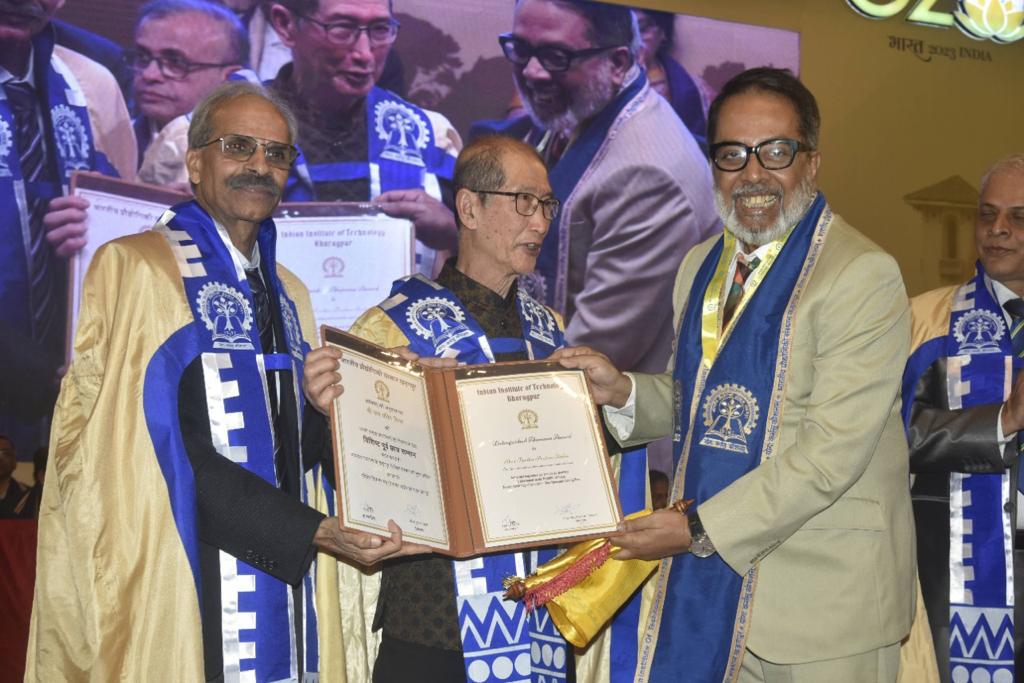
  • Partha Sinha wins the Distinguished Alumnus Award at IIT Kharagpur

    By Our Staff


    Partha Sinha wins the Distinguished Alumnus Award at IIT Kharagpur

    Partha Sinha, President at the Times of India group and President of the Advertising Club has been conferred the prestigious Distinguished Alumnus Award by IIT Kharagpur. The previous awardees included Sundar Pichai, Arvind Kejriwal etc.


    The concluding part of his citation reads: “In recognition of his significant contribution as a brand strategist and exemplary works in media and communication, the Indian Institute of Technology Kharagpur has decided to honour him with the Distinguished Alumnus Award on the occasion of the 68th convocation of the institute.”


    Reacting to the award, Sinha said: “There’s nothing more gratifying than being recognised by your own alma mater. IIT Kharagpur has shaped me as an individual. I will forever be indebted to my professors and my friends from IIT Kharagpur for their contributions in my life and career.”


    Sinha has a B Tech in Mechanical Engineering from IIT Kharagpur and an MBA from IIM Ahmedabad.