
Author: mxmadmin

  • IndiaDonates hands PR mandate to Lion Entertainment

    By Our Staff


    India Donates, an entity and a flagship initiative of DevPro, a software engineering services company, has tied up with public relations and communications agency Lion Entertainment to roll out the second phase of its ‘Synergy and Sustainability Symposium-II’.


    Speaking about the overall event and the association with Lion Entertainment, Sandeep Sharma, Founder of India Donates said: “The Synergy and Sustainability Symposium is a platform for different change agents to come together and look for answers to the most pressing social development questions in the country. We at INDIAdonates are big proponents of creating partnerships to multiply long-term impact. While at the first symposium we looked at effective synergies between the different sections of development institutions, at Synergy and Sustainability Series II, we want to focus on sustainability of development work.”


    Added Pooja Valeja, Founder and CEO, Lion Entertainment: “We have worked with IndiaDonates in the past and seen their dedication and efforts genuinely put into making the country a better place and also help the backward that require them. It would be our constant attempt to ensure that we are putting out the right messaging and speaking the story in a very authentic way so that the efforts taken by the organisation reach the right people and they could make the most of it. We have worked with them in the past and hope to live up to their expectations yet again.”


  • Dell launches video campaign for cybersecurity

    By Our Staff


    With Cybersecurity Awareness Month 2022 coming to a close, Dell Technologies India has launched a video-led social media campaign in line with its theme – #FortifyYourSecurity. It was conceptualised by 20:20 MSL and the communications team at Dell Technologies, the campaign created an avenue for people to share their experiences and initiate a conversation around cybersecurity at large.


    Said Ripu Bajwa, Director and General Manager, Data Protection Solutions, Dell Technologies, India: “Cybersecurity is no longer a boardroom discussion, rather a reality for anyone who is connected to the internet. That’s the message we wanted to drive with our campaign – #FortifyYourSecurity. With the campaign video series, our goal was to encourage an actionable dialogue around safeguarding oneself from cyber threats and data breaches in a simple and relatable manner. We are delighted to have collaborated with CXOs, executives, and content creators to help us further our mission of building a cyber resilient future.”


  • Colvyn Harris to be conferred with AAAI Lifetime Achievement Award

    By Our Staff


    Colvyn Harris
    Colvyn Harris

    The Advertising Agencies Association of India (AAAI) announced that the AAAI Lifetime Achievement Award for 2022 will be conferred on senior advertising professional Colvyn Harris. This is the highest honour to be given to an individual in India for his/ her outstanding contribution to the advertising industry.


    Anupriya Acharya
    Anupriya Acharya

    Making the announcement, Anupriya Acharya, President, AAAI, said: “Colvyn Harris is in every sense a true pioneer and visionary. Apart from singlehandedly making JWT a top agency, he has also contributed significantly to the industry in various capacities, including as President of AAAI. He’s been a key driver and pivotal force in establishing Goafest as the largest advertising festival in India.  I am pleased to say that the entire committee was unanimous in selecting Colvyn as this year’s AAAI’s Lifetime Achievement Award winner. He is truly deserving of this honour.”


    Some of the past winners of this award include Subhas Ghosal, Alyque Padamsee, Mike Khanna, R K Swamy, Piyush Pandey, Sam Balsara, Prem Mehta, Roda Mehta, Ram Sehgal, Madhukar Kamath, and Arvind Sharma amongst others.


  • When no standards apply…


    By Ranjona Banerji


    Ranjona BanerjiOften when I discuss the media with non-media people and occasionally with media people, I get a series of lectures and explanations. Anyone who knows me knows that I am inimically averse to lecturebaazi (unless I’m doing it myself, ahem) and more importantly, that I have spent over 35 years working in journalism. More in the media itself, if you count my little ill-fated foray into advertising! I know how it works, I say, without any modesty.

    But people will have their theories, and am sure they are intelligent and have used their powers of observation to work out why the Indian media is in such a pathetic state. The other truth is that these are people who spend an inordinate amount of time watching TV news and thus believe that all these star anchors are their friends, since they met them on TV last night or this morning. So you hear all about why Rajdeep, Nidhi, Barkha, Faye – these are just representative names – think or what motivates them.

    Sadly, few people I meet have such particular insights into the minds of Rahul Kanwal, Rahul Shivshankar, Navika Kumar and so on. I suspect it is not because they do not watch them but more because these anchors have no nuance and put all their hatred and incompetence assiduously and regularly in the public eye so that everyone knows what they stand for.

    Almost no one discusses print reporters or print columnists.

    The upshot of these insights gained from nightly observations is that these anchors are under immense pressure and are trying their best. They may work in difficult newsrooms and under trying circumstances but are trying to keep some amorphous journalism flag flying.

    It is a sweet argument, even if it has almost no connection to reality. It also supplies a neat out to the rampant false equivalences and nauseating both-sidesism which characterises the more “liberal” sections of the television media. For any mediaperson, most of TV “news” in India is weak, cowardly and lacks both judgment and perspective. Newsgathering is consigned to the corners and publicity for the regime is the top priority. No standards apparently apply, even if this is a medium notoriously short of standards.

    Sadly, no such concessions are made for people who work in print or digital journalism and display better journalism and higher standards. They are held to the highest scrutiny and must prove their high standards at all times. If ever they make a slight deviation or slip from this high standard, they are excoriated, often from amongst their own tribe of liberals. It’s an impossible level for anyone to maintain.

    And yet, The Wire – I come back to this – continues to suffer from its mistake in its “investigation” into Instagram following the BJP’s orders. It has to be taken to task repeatedly because it tried to maintain the higher standard. If it had consistently produced mediocre journalism, those around would have said, “poor things, see how hard it tries but what can it do in these difficult times.” It was similar with TV anchor Nidhi Razdan’s mistake over her Harvard appointment: she was attacked viciously from within the liberal community.

    Perhaps a big difference is that both The Wire and Razdan publicly acknowledged their mistakes. Rather than brazen it out with craven lapping at the feet of their masters or some masterly deflection to some other topic.

    The dichotomy is astounding and dangerous. Pushing religious bigotry and hatred, pushing misinformation, playing conveniently dead when the BJP and Narendra Modi break every rule, you hear: “all this is par for course, what can we do, they are like that only”.

    It is also difficult to try and remain “neutral”, that is to criticise both the BJP and other parties. Those who laud you for critiquing the BJP will turn on you viciously for criticising the Congress for instance. I may disagree with Swati Chaturvedi’s analysis on Rahul Gandhi’s remarks on Veer Savarkar, but I find the social media attacks on her ludicrous. Especially when the same people were happy with her earlier praise for Rahul Gandhi’s Bharat Jodo Yatra!

    Obviously, people must criticise whoever they want and journalists can develop carapaces to deal with the vitriol directed at them.

    But my larger point is to choose your targets wisely. Do not have double standards for news outlets. Do not feel sorry for extremely highly paid TV anchors who don’t have the gumption to do their basic job.

    And the more you attack within, the more you strengthen the divisive forces working hard to destroy our democracy.


    Ranjona Banerji is a senior journalist and commentator. She writes on MxMIndia on Tuesdays and Fridays. Her views here are personal


  • Luminary podcast network launches in India

    By Our Staff


    Luminary, the US-based subscription podcast network, announced its official launch in India, with a content slate for global South Asians.  The network is launching two new shows: Konkona Sen Sharma-hosted Barefoot Boys based on India soccer win against the British in 1911, and How I Masaba helmed by Masaba Gupta in conversation with women on business, art, culture and more. Luminary has also partnered with Times Bridge to scale and expand its reach in India.


    Commenting on the market entry, Rishi Malhotra, Luminary CEO said: “India is an important growth market for podcasting, storytelling, and Luminary.  Our shows truly blur the lines between podcast and art, and we’re excited to bring this unique approach into one of the world’s most rich and dynamic cultures.  There are endless stories to uncover in India, and we look forward to telling them through a premium, subscription-based model that  entertains and elevates.”


    Added Viral Jani, EVP & India Country Head, Times Bridge: “Luminary’s entry in the Indian market coincides with the exceptional growth in audio consumption across the country in recent years. With its vibrant cultural and demographic diversity, India is now the world’s third-largest podcast market, after China and the United States, where consumers are increasingly turning to high-quality audio experiences for entertainment, self-improvement, and awareness. We are delighted that Luminary is bringing its premium audio experience with Indian original shows to India’s thriving podcast market and are committed to furthering its mission of revolutionizing the non-music audio entertainment space in the country.”


  • Samsung launches digital campaign to thank retailers

    By Our Staff


    Samsung Electronics has launched a digital communications campaign titled #YouMakeItHappen to thank its retail partners across the country for making it a household name. To kickstart this campaign, Samsung posted the first video of the series on social media channels featuring some of its 33k consumer durable partners.


    Said Mohandeep Singh, Senior Vice President, Consumer Electronics Business, Samsung India: “#YouMakeItHappen is a tribute to our heroes – our partners. Through this ongoing initiative, we aim to bring forth some heartening stories of their passion, hard-work, belief, and courage. Our partners play a crucial role in transforming our vision of Powering Digital India into reality by ensuring our innovative products reach even the remotest areas of the country and offer utmost convenience to our consumers.”


  • Kalyan Jewellers unveils campaign for football-themed jewellery

    By Our Staff


    With FIFA World Cup having kickstarted, Kalyan Jewellers has launched a brand new football-themed jewellery – Es Vida. The brand has kickstarted the campaign with professional footballer Sweety Devi. The limited edition jewellery designs of Es Vida pays tribute to the country’s vibrant football culture.


    Talking about the football memorabilia, Ramesh Kalyanaraman, Executive Director – Kalyan Jewellers said: “We are delighted to introduce Es Vida to the passionate and enthusiastic football community in India and the Middle East. We believe that these all-new soccer-inspired designs will be something that the footballing community would love to wear and flaunt, as they celebrate this game season. In a brand first, we have associated with India’s football icons for the Es Vida campaign, and we hope that fan’s for whom football is life, will embrace Es Vida.”


  • Hindware launches third leg of social campaign

    By Our Staff


    Hindware, the sanitaryware and bathroom solutions brand, has launched the third leg of its social campaign ‘Build a Toilet, Build her Future’. The initiative which started on World Toilet Day in 2020 has been able to construct more than 250 toilets in schools across the states of Rajasthan, UP, Bihar, Telangana, and Andhra Pradesh impacting the lives of more than a million girls. Hindware has partnered with Ma My Anchor Foundation, a non-profit organisation, for the scheme.


    Said Sudhanshu Pokhriyal, Chief Executive Officer, Bath and Tiles Business, Hindware Limited said: “At Hindware, we have a vision to empower people with everything that we do. When we launched ‘Build a Toilet, build her Future’ project two years ago with the goal of bringing millions of girls to school and ensuring they have the right to equality and inclusion, we had no idea that this would become a movement. As our project enters its third year, we can’t thank our partners and allies enough for not only supporting but also contributing in big ways. We will continue to raise awareness for hygienic sanitation, and we encourage people to spread the message and take part in this cause.”


    Added Charu Malhotra Bhatia, Vice-President, Marketing, Hindware Limited: “Girls in India drop out of school due to a lack of clean toilets. The lack of proper sanitation facilities affects teenage girls the most as they are forced to miss school for a few days every month. Eventually, they fall behind in their class and prefer to drop out completely. In 2020 on World Toilet Day, Hindware began its mission to send them back to school, by helping build toilets in schools. Carrying forward the same initiative, for the third consecutive year, Hindware is determined to make sure girls don’t miss school again.”


  • Danone India launches campaign for flagship brand Protinex

    By Our Staff


    Protinex – the flagship brand of Danone India, has launched its new campaign to educate consumers about the importance and the role of protein in day-to-day life. The campaign is a part of ‘The Protinex Protein Abhiyaan’, an endeavour to sensitize Indian adults across age groups on the integral role of protein in improving physical health.


    On the launch of the campaign, Sriram Padmanabhan, Marketing Director, Danone India said: “Being an Indian Parent is a full-time job. You cannot afford to take even a day off. With growing age and hectic schedule, maintaining adequate protein and nutrient intake becomes more and more critical. Through this campaign, we are trying to shed light on how inadequate protein intake can, not only have an impact on our life but also on our little ones.”


  • Decluttering Personal Branding


    By Sanjeev Kotnala


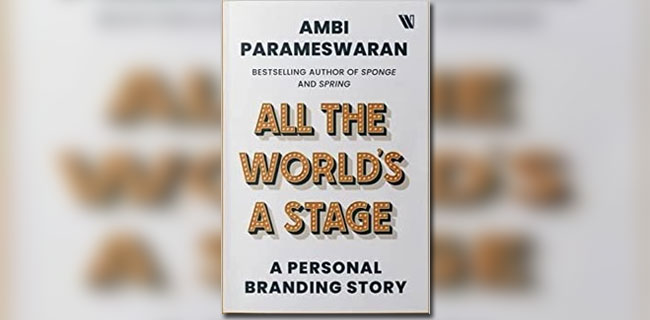
    Sanjeev KotnalaYou can read ‘All The World’s A Stage’, by Ambi Parameswaran, for a brief view of the ‘why’ and ‘how’ of personal branding. It is like the foundation course in an MBA institute – Personal Branding 1.0. So, after reading the course material- the book ‘All The World’s An Stage’, you know enough to hold attention and conversation on Personal Branding. However, there is not enough for you to push on a journey.


    Having read almost all the books by Ambi Parameswaran, I did expect something more. Something much solid. Something that could help a novice to start working on Personal Branding and not just think about it.


    As with all his books, in ‘All The World’s A Stage’, Ambi Parameswaran declutters and simplifies the subject matter. In this case, he oversimplifies the damn thing. It is an easy read with hardly any jargon. And wherever new terms are introduced, they are to create the opportunity to explain the subject – No complaints there.


    I do like the way the subject is approached. A conversation between friends Ambi, Shankar, Rita, Kunal and Joe during the Silver reunion at IIM Calcutta. Ambi plays the field expert role, amply supported by Rita, the HR expert, and Kunal, the almost convert. Shankar is the sceptic who gets converted by the end of 2 hours late-night walk late on the last night of the reunion.


    Now, in terms of personal branding, by naming the character of branding expert AMBI and suggesting he is much younger.


    Not that Ambi Parameswaran needs it, but demonstrating the nuances of personal, he uses the opportunity well. Ambi’s expertise, success with brands, networked connections, teaching assignments, books like Sponge and Spring, talks and references to keynote addresses are sprinkled throughout the book. Well, that is some real suggestion and hints towards Personal Branding.


    ‘All the World’s A Stage’ does an excellent job showing that each individual is a unique brand. Your responsibility is to care for and create your Personal Brand, as it is an influencing factor in your professional life.


    In the book, Parameswaran touches on various steps and questions that one needs to address in creating and nurturing a personal brand. However, it lacks a concrete roadmap and exercises that would allow the reader to gain much from the book. Maybe that is a flaw of the conversational storytelling adapted by Ambi Parameswaran in his books for the first time. But some exercises could have helped make the book more relevant and impactful.


    Discussing the process or the steps of Personal Branding will spoil the impact of enjoying reading ‘All The World’s A Stage’, which is not right.


    However, here is something that I can share without taking much away from the book. Brick by brick, the book brilliantly demolishes seven personal branding myths.

    1. Personal branding will conflict with corporate branding.

    2. Personal branding happens on its own.

    3. Personal branding is very different from product branding.

    4. Personal branding gets set in stone and is unchangeable.

    5. Personal branding can exist independent of your executive presence.

    6. Personal branding is very different from executive communication or executive voice.

    7. Social Media is a unidimensional one-way street for personal branding.


    Ambi’s book almost kills the book that I have been writing, which is still WIP. The idea of the book ‘You The Brand’ was seeded in our 30th Reunion at IIM Ahmedabad. There I took my batchmates through a small part of my ‘Brand-i’ workshop and empathised with my belief in being responsible for our Personal Brand. That night I ended up discussing the subject with a few of my friends at Louis Khan Plaza and a walk through the old campus. So, the book was almost a déjà vu and a reminder that the projects should be completed on time.


    I go further in my ‘Brand-i’ workshop on Personal Branding or individual coaching. I warn the participants that they better care and work towards the desired Personal Brand identity – impression and perception or be willing to be branded by default. Because branding anyone is as simple and naturally involuntary as breathing. Well, one does need to perform and have the desired skill sets. Still, a right Personal Brand – actual or perceived can definitely smoothen the process of climbing the organisational pyramid and exploiting business or personal opportunities. And here, as a true advertising person, I am more interested in how it is perceived than it actually is. Because perception is more potent than reality. I know I should have placed more importance on Executive Dressing, Voice and Presence than I did during my corporate life.


    To know more, read the book ‘All The World’s A Stage’ by Ambi Parameswaran. He does a pretty good job of explaining their importance.

     

  • Das ka Dum with Dr Bhaskar Das | Television & digital may have greater reach than print, but Jio Cinema still took a jacket ad to promote its Fifa World Cup coverage? Your views?

    Bhaskar DasWe know he loves print, so we had to provoke him with this question. Without any further ado, here’s Dr Bhaskar Das in the November 23 edition of Das ka Dum. Read on…


    If you wish to access the archives, please go to the Das Ka Dum tab on the website’s top navigation bar or click here: https://www.mxmindia.com/category/columns/das-ka-dum/


    Q. Television and digital may have greater reach than print, but Jio Cinema still took a jacket ad to promote its Fifa World Cup coverage? Your views?


    A. That’s the power of the print media in the Indian context, where algorithms are not the only factor that help determine media vehicle selection process. Let’s face one fact: in India, the print media is still the most trusted medium and it exerts disproportionate (compared to its reach) influence on the population. As the print audience is placed in the upper echelons of Indian society (because of the requirement of literacy to access it and the range of news and depth of analysis that it provides), to get rub off effect of trust, etc, any topical announcement/ launch/ has to keep leading print titles into the media consideration set. Why just Jio?! Look at the WhatApp campaign that is running now in print or Google’s as well when it advertises.


    It’s the richness of reach and the quality of trust that print media enjoys in the age of Fake News that distinguishes the medium from others. So the decision of Jio Cinema to release the campaign in print media makes sense.


  • Das ka Dum with Dr Bhaskar Das | The ABC figures are said to have shown a sharp decline in the circulation of newspapers which have reported their numbers? But very few newspaper companies have reinvented themselves. So, guess, it was expected. Your view?

    Bhaskar DasWe know he loves print, so we had to provoke him with another question. Without any further ado, here’s Dr Bhaskar Das in the November 24 edition of Das ka Dum. Read on…


    If you wish to access the archives, please go to the Das Ka Dum tab on the website’s top navigation bar or click here: https://www.mxmindia.com/category/columns/das-ka-dum/


    Q. The Audit Bureau of Circulations (ABC) figures are said to have shown a sharp decline in the circulation of newspapers which have reported their numbers? But very few newspaper companies have reinvented themselves. So, I guess it was expected. Your view?


    A. I wonder if report of one ABC period can be taken as a representative sample to support a premise that print circulation has gone down. One has to view the figures over a few periods and then compare. It would be unfair to compare the numbers with pre-Covid periods. When one compares apple with oranges, you would get skewed outcomes. Secondly, in terms of the total footprint of various newspaper brands, they have aggregated significant numbers in their digital versions (including e-papers) and one can’t ignore the role that each brand’s provenance plays in expanding its sphere of relevance & popularity. May be, ABC authorities may like to consider releasing certificates of phygital editions of each newspaper brand in future. In an omnichannel media environment, it may make logical sense. Finally, I don’t agree with your assumption that print media companies have not reinvented themselves which has resulted in decline in sales of copies. It’s no longer valid. If you scan the environment and investigate the leading newspapers of India, you would notice many initiatives to ensure interactivity and reader participation. Look at the changes made by The Hindu, for instance. One can always debate if the extent of transformation could have been more dramatic, but that’s always a subjective perception and it has to be evaluated in the context of cost-benefit analysis.