Author: mxmadmin

  • Dhoni to promote Navi financial services

    By Our Staff


    Sachin Bansal-backed Navi financial services company has appointed MS Dhoni as its brand ambassador. Dhoni will be the face of Navi’s branding initiatives. The company recently launched its first campaign to promote its various financial services.


    Sachin Bansal, Co-Founder, Navi Group said: “We are thrilled to introduce MS Dhoni as our brand ambassador and the newest member of the Navi family. He personifies trust, ambition, and dedication – qualities that resonate powerfully with Navi and all we stand for, making him the ideal brand ambassador. Associating with him, in my opinion, would greatly enhance the value of our brand and forward our mission to provide every Indian with simple, affordable, and reliable financial services.”


  • Filter Coffee wins Lacto Calamine mandate

    By Our Staff


    Filter Coffee Co., digital marketing and social media agency, has bagged the social media and production mandate for Piramal Pharma Limited’s skincare brand Lacto Calamine. Along with creating, managing, and executing end-to-end digital strategies, the agency will also be responsible for overall social content and product photoshoots.


    According to the Managing Director, Akash Mehrotra, Lacto Calamine: “Lacto Calamine has a wide range of oil control backed skincare solutions that cater to the needs of oily skin. The agency’s vision aligns very well with our approach and through this, we hope and look forward to keeping our audience engaged while creating an impactful shift on social media.”


    Anuja Deora, Founder, of Filter Coffee Co., added: “We are excited to be entering into a partnership with a brand like Lacto Calamine, which aims to create remarkable skincare solutions.” Our dedicated team at Filter Coffee Co aspires to achieve game-changing results. This will not only lay the foundation of a close partnership but will also give phenomenal results in the days to come.”


  • Government intervention in media must end


    By Ranjona Banerji


    Ranjona BanerjiNo matter how awful news outlets are and how bad their journalism is, government intervention is worse. It is our nursery mentality which wants the government to step in when something goes wrong, even when government is an essential part of the problem.


    News has to be independent of as many influences as possible, for it to be worthwhile to the consumer, whether reader or viewer or both. All too often you hear people saying X, Y channel is so bad, its news is so biased, why can’t the government do something.


    And what can or will the government do, if it controls what the media can or cannot show? Well, we already see that in many of our news channels and some of our other outlets. You don’t even have to go as far as state-owned broadcast media like All India Radio and Doordarshan. You get party and government propaganda masquerading as news. You see pretend journalists and some real journalists who should know better pushing party and government propaganda.


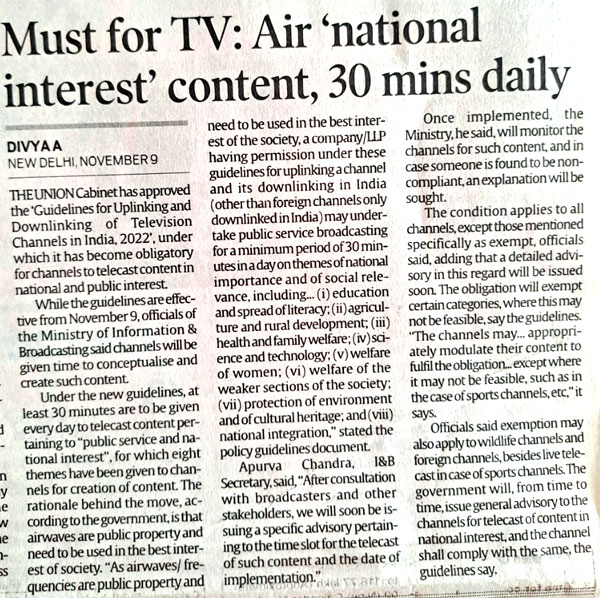
    In an already skewed and biased environment the recent Ministry of Information and Broadcasting rule that television channels must broadcast on themes of “national interest” for 30 minutes a day is a giant step in the wrong direction. It is not the government’s business what an entertainment or news outlet broadcasts, as long as it does not break the laws of the land. To direct media outlets to carry anything, of national interest or not, goes directly against the freedoms provided in Article 19 of the Constitution.


    It is television which governments target, not just for their reach, but because current broadcasting regulations make government intervention easy. The same new rules have brought some aspects of the broadcast media into the 21st century, but what one hand giveth the other taketh away.

    https://www.ndtv.com/india-news/centre-deregulates-uplinking-of-satellite-tv-channels-heres-why-3504929


    Although the I&B secretary claims that channels are “free to create their own content”, the very fact of the rule is a contravention of the media’s right to freedom of expression.


    In fact, the time will soon come when we must seriously discuss why we need a ministry of Information and Broadcasting, why we still need state-owned media and why the broadcast industry’s strings are pulled by government like a toddler in reins.


    After 75 years of Independence, we need a truly independent media. Without any government intervention in broadcast rules or paper import or digital space. Let the state-run media become licensed, where we all pay fees so that it is independent of political manipulation. It is only then what we can become truly adult.


    It is bad enough that so many sections of the media capitulate without being asked to, that media owners lack integrity and courage. We see the results of a population fed on misinformation and publicity campaigns. Free choice, free speech all these will soon be in name only.


    The attached screenshot in fact makes it clear just how much control the government wants. And the more you give in, the more you find you will eventually lose.


    This one is on us.

    And we’re losing for sure.


    Ranjona Banerji is a senior journalist and commentator. She writes on MxMIndia on Tuesdays and Fridays. Her views here are personal


  • Godrej launches New Age ABC on Children’s Day

    By Our Staff


    On the occasion of Children’s Day, Godrej Group introduced a new version of ABC song that’s contemporary. With a vision of replacing the traditional ABC with the new-age ABC, Godrej Group has tied up with Teach For India for an onground partnership.


    Speaking on the launch of the New ABC song, Tanya Dubash, Executive Director and Chief Brand Officer at the Godrej Group, said: “It is imperative that children learn and inculcate the right attitudes and habits at a tender age. Since Children’s Day is extra special for us at Godrej, we thought of gifting our kids with a song that will help them become better individuals tomorrow even as they learn the basics of the alphabet. The new ABC song will therefore be an appropriate introduction to learning for the children of today.


    Added Shaheen Mistri, CEO and Founder Trustee, Teach For India: “At Teach For India, we keep children at the centre of everything that we do. We want every child to reach their truest potential by giving them access to an excellent, reimagined education. With the new-age ABCDs, we can start to sow the seeds of what children can truly imagine for themselves, for others, and for India.”


    Said Anu Joseph, Co-Founder and Creative Vice Chairman at Creativeland Asia: “With so many things changing around us over the last couple of years, we thought kids should have a new set of things to remember and learn. Therefore, this new-age ABC song”.


  • Postcard from America: Acceptance of Nabeela Sayeed and rejection of Trump’s MAGA

    Shashidhar NanjundaiahBy Shashidhar Nanjundaiah


    This diary style in which I have been asked to write carries the advantage of a fluid style of writing and I plan to take full advantage of it. This is particularly important when offering personal insights from a country that is so well covered in Indian media that it becomes difficult to manoeuvre! Nevertheless, attempts must be made.


    Finally, as the Democrats do spectacularly well to retain the U.S. Senate, the rejection of Donald Trump is writ large on the U.S. electoral map. Even though the Senate is split 50:50 at present, the Vice President, currently a Democrat, holds a tiebreaking vote, so effectively, the Democrats are expected to have the upper hand, unless, of course, naysayers from within the party provide the anguish, as Kirsten Sinema and Joe Manchin have. Votes will continue to be counted into midweek, as mail-in ballots here trickle in well after the election date. (Someone must fix that lag to ensure timely results!) But it is also an extreme form of democracy, where the freedom of choice is multi-faceted. Some states vote by machine, some by paper ballots. In addition, people can vote in person, via mail, or using “ballot drop boxes”-where you can fill out a ballot at home and drop it off into a box.


    Such methods encourage people who might not be willing or able to travel and stand in line for hours. Recent surveys show that when images of polling booths with long lines appear live on television, they deter voters from joining those lines. So mailed or dropped ballots, which help avoid daunting queues, especially for aged and wheelchair-bound voters, have become a part of parties’ “absentee chase” programme. If India liberalised voting in similar ways, it will surely be met with suspicion, for obvious reasons. That is why, as a sceptic, I don’t want to go down that suggestion lane.


    The Indian news media covered the U.S. elections this time too. In historical terms, this whole elaborate interest is a relatively new trend, in which television networks have managed to create a fascination among their viewers towards U.S. elections over the past few elections. The popularity of any Indian-American in the fray adds to this media interest anyway. Five Indian Americans won, as against four last time, and the excitement among journalists over the “growing influence of the [Indian American] community in politics”. The Hindustan Times headlined the Indian American winners as the Samosa Caucus, a somewhat humorously self-deprecating term used among desi circles in the United States.


    Let there be no mistake. The hard political power for the Indian American community is inevitably rising-a community that enjoyed an astonishing increase of 67.3 percent from 1.9 million in 2000 to 2010, and another 44.6 percent from 3.18 million in 2010 to 4.6 million in 2021. The fact that five out of 435 members of the House of Representatives, roughly 1.1 percent, stand for about 4.6 million Indian Americans-just under 1.4 percent of the population-is impressive. This is particularly so when compared with the fact that there are a total of 16 Asian American members of the Congress (three in the Senate and 13 in the House of Representatives). The population of Chinese Americans alone is over 18 million, so their political participation by contrast is relatively low.


    So, let me ask, who is Nabeela Sayeed? Hint: She, too, is an Indian American, but uniquely so. The usual NDTV and a Moneycontrol here and The Quint there carried the agency report about her in bits and spurts. Meanwhile, the U.S. media is going gaga over her. At 23, Sayeed is one of the youngest ever members of the Congress to have won. She is a first-generation Indian American—in that her family moved here well after she was born. And as a Democrat, she flipped a Republican seat in this midterm election, making a significant difference to the tight race. A phenomenal success story, ignored because of the hijab around her head.


    Instead, we may notice that the Indian interest in identity politics is particularly strident when the candidate has a Hindu name, like Kamala. Although Harris has converted to Christianity, she still makes sure she invokes her half-Indian descent in various ways—such as her interest in the dosa—to keep the hypernationalist desi media fed with good fodder. The Indian media pretty much appropriates Rishi Sunak as our own, despite his multi-nation descent. Hence we observe the “acceptance” of Sunak as a visibly practising Hindu among India’s television channels’ hypernationalistic anchors and equally jingoistic “guests”.


    So, no longer do I need to explain to my semi-rural community that I use “Indian” to mean “from India” and not Native American. With 1.2 million U.S. visas promised for Indians just over the next several months, the population will rise even more steeply than it has in the past, the indications are clear: Why export jobs when we can import workers? The rapid rise in acceptance of the Indian American into the mainstream is also the rejection of Donald Trump-style Make America Great Again (MAGA) politics.


  • Ayush needs a cure push and not the prevention perception


    With apologies to none at all

    By Vikas Mehta


    Vikas MehtaWith the pandemic many things changed on the health front. Suddenly health and hygiene became a very important part of our lives. In India, with a parallel narrative on health and hygiene existing in the form of ancient methods like yoga, ayurveda, unani (all abbreviated as Ayush), and homeopathy (not strictly Indian but practised widespread), health and hygiene took a very interesting turn.


    Whereas the goodness of turmeric and ginger was already part of our modern lifestyle, yoga and ayurveda caught on in a big way. While established companies like Dabur and Baidyanath played it safe by highlighting the benefits of raising body immunity with products like Chyawanprash, Patanjali went headlong and actually claimed to have produced a cure to Corona with Coronil but then beat a hasty retreat to claim that it also is an immunity booster. In fact, currently if you look at the product benefit of Coronil, as listed on Amazon, it says, energy management and for specific uses of product it says, immunity booster


    Thisa was also the time that we saw lot of talk on various media including social media on overall wellness and health. Raising body immunity became a catch phrase and anyone related to health started hyping body immunity and how to achieve the same. Green tea, ginger tea, antioxidants, turmeric milk, tulsi drink, immunity bar, were some of the products which became part of the typical middle class family eating habits.


    And this was not all, ayurveda doctors and clinics came into big demand. Clinics and private practice mushroomed. Under the guidance of the Ayush ministry, the pandemic saw a growth in ayurveda as a medicinal opportunity. And then there is also a chain of nine ayurveda hospitals and clinics called AyurVAID which has now been acquired by India’s largest chain of hospitals, Apollo Hospitals. Why should an allopathy chain acquire an ayurveda chain of clinics and hospitals? Though that is an intriguing topic, given that allopathy doctors have protested when Ayush doctors were given more powers, including performing minor surgeries, that’s for another day.


    The elephant in the room is the viability and the success of traditional concepts like Ayurveda in the post-pandemic era. I don’t have any data on sales of Chyawanprash and many such immunity boosters but I guess their sales must have come down in the past six months or so. To understand why it is difficult to sell concepts like immunity boosters or wellness let’s take the analogy of oral care.


    Oral care is largely preventive. Brands like Colgate have to sell a story of prevention, not cure. You do not want cavities and the pain associated with it, start using a toothpaste. You want strong teeth that do not fall away or break, use a toothpaste. Toothpastes are not about cure. They are about prevention. Prevent cavities, prevent teeth from weakening. Prevent gum sensitivity. It’s not that you have toothache and by applying it the ache will go away. It’s the constant use that will prevent any oral problem. And still there is no guarantee that you will not develop cavities or other problems. That’s why in many parts of the world toothpaste penetration is still low. People want cure, not prevention.


    That is exactly the issue with alternate treatments. These are not necessary cure. AyurVAID hospitals in the first line describing themselves say “Today’s chronic illnesses require a comprehensive customized and affordable approach to prevention and treatment.” Prevention takes precedence over treatment.


    And that is the consumer perception too. The 2015 National Sample Survey says that 90% of Indians prefer allopathy to Ayush. I suspect the reason is simple. Allopathy is about cure. You got pain take x medicine. You have hernia get an operation done. Ayush, on the other hand is about wholistic. Root of the problem. Cure may exist but it will take some time to work. Simply put, the perception is that Allopathy is cure to a problem, Ayush is just prevention. The common man has been attuned to cure. Prevention is not part of the mental make up.


    So, when the Pandemic struck and allopathy had no cure, Ayush and its immunity boosters, its turmeric, ginger and tulsi ingredients etc were a great story. People flocked to them as there was no cure. And then came the vaccines. The vaccines were also prevention but armed with research and data, plus government push. In our simplistic minds, a cure to Covid had been found. We no longer needed Ayush. At best, it remained a top up.


    For Ayush to succeed it must move into the realm of cure. And to do that it needs to copy a page from the allopathy play book. Get into research and trials in a big way. Publicise the same. And no short-cuts. No sham research. It’s one thing for Baba Ramdev to hit out at allopathy but then by making exaggerated claims without any research backing on ayurveda he is doing a great disservice not just to the practice but also to those who are painstakingly trying to establish that Ayush can be a cure. Flexing his political connections to overturn decisions against Patanjali and its products is actually a sure shot way to create bigger dissonance in the consumer minds.


    Ayush also makes tall and sweeping claims. Any pack of Chyawanprash talks about power, mental and physical fitness, agility, increasing resistance and metabolic activity, prevention of infections like cough and cold, effective antioxidant, improving immunity and resistance. The glut of claims make it sound ridiculous and also unbelievable. Chyawanprash may do all that but it needs to focus on its core benefit. And then use science and data to make it come alive. Jack of all trades and master of none can make Ayush a dull and uninterested concept. Not to talk about being non trustworthy.


    Almost a decade ago, I had checked into an ayurveda ashram in Kerala for a specific health issue. The founder, an FRCS Doctor and Surgeon, bemoaned the lack of research rigour on ayurveda. He had over decades painstakingly studied Ayurveda and was using his allopathic skills to diagnose the issue and treat it with Ayurveda. He was well aware that Ayurveda was associated with general well being and prevention. He was afraid that ayurveda may just remain a lifestyle generic treatment and may become the preserve of the rich or the foreigners for whom the exoticism of ayurveda is a draw.


    Will the taking over of AyurVAID by Apollo Hospitals be the gateway to allopathy playbook that Ayush needs or will it be just another offering of exoticism for the rich and the famous?
     

  • Das ka Dum with Dr Bhaskar Das | There were celebrations in India because Pakistan lost the T20 Finale. Sad, or is this an expected part of India-Pak rivalry? A rival’s rival is a friend?

    Bhaskar DasDid we upset our Wizard with Words? Well, perhaps. But we could not have asked this question. Without any further ado, here’s Dr Bhaskar Das in the November 14 edition of Das ka Dum. Read on…
     

    If you wish to access the archives, please go to the Das Ka Dum tab on the website’s top navigation bar or click here: https://www.mxmindia.com/category/columns/das-ka-dum/


    Q. There were celebrations in India because Pakistan lost the T20 Finale. Sad, or is this an expected part of India-Pak rivalry? A rival’s rival is a friend?


    A. It is a sweeping generalisation and there is no statistical proof of your surmise. Being a lover of sports, I think we should be supportive of a good game and the deserving team wins. Real sportsmanship is about accepting victory and defeat with equanimity. I am sure no one wants to lose but that’s part of any game. One has to learn from each and move on to progress.


    I feel Pakistan has progressed tremendously from where they were in the league table and so did England after losing to Ireland. So it’s about resilience and indomitable spirit that are worthy of celebrating. There would be more T20 tournaments. But we must not pander to besmirching the spirit of sportsmanship.


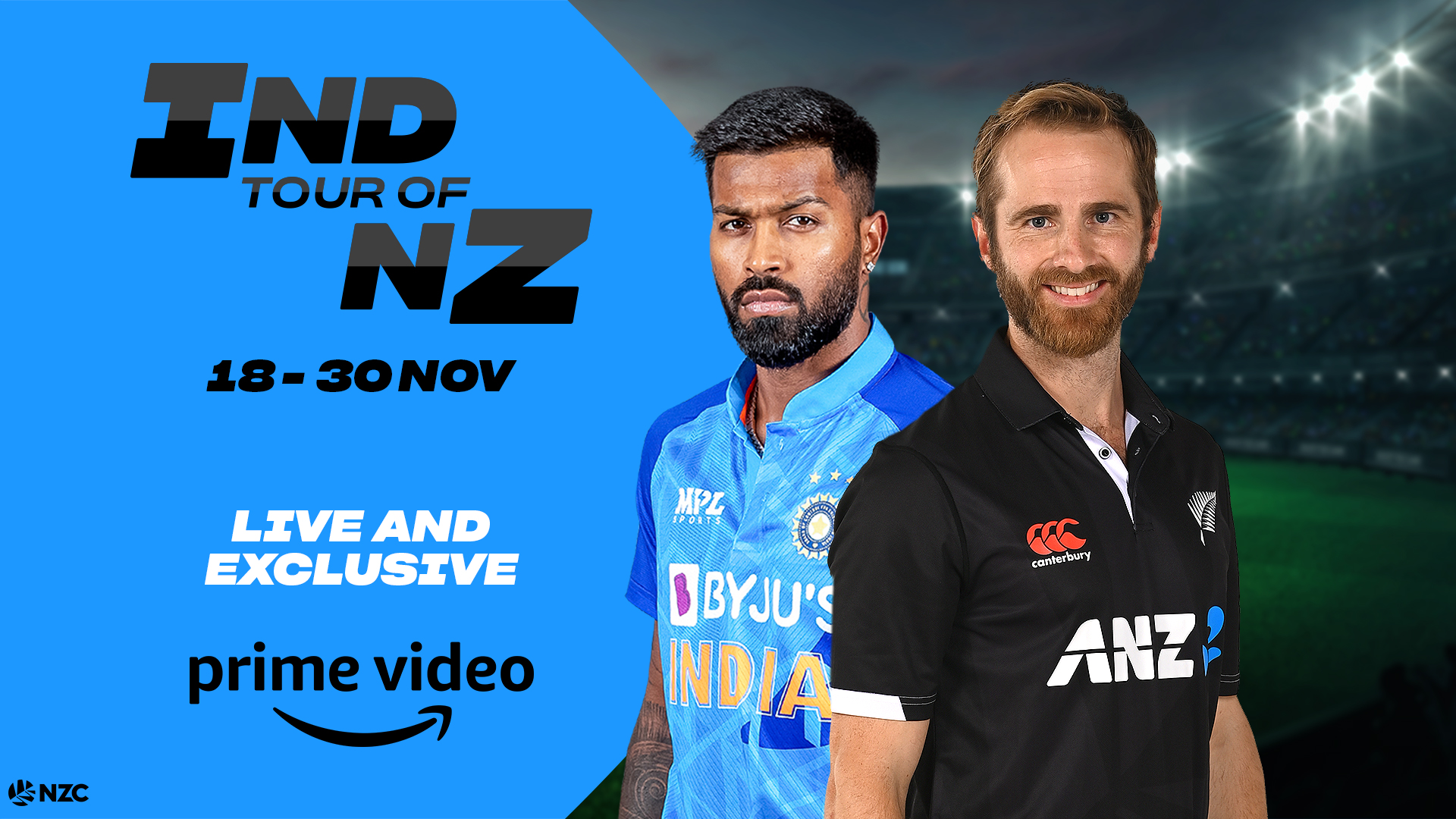
  • Prime Video announces immersive cricket experience for India-NZ tour

    By Our Staff


    Amazon Prime Video, or Prime Video, has announced special programming for the India-New Zealand men’s cricket series starting November 18. As a part of a multi-year partnership, international men’s and women’s cricket matches played in New Zealand across all formats – will be available exclusively on Prime Video India.


    Talking about the upcoming series, Sushant Sreeram, director – SVOD business, Prime Video, India said: “There are many things that are heterogeneous about the delightfully diverse India when it comes to entertainment – be it choice of language, genres of shows and movies, devices that customers prefer watching their favourite entertainment on, and so much more. But there is one absolute unifier that everyone across the country is unanimously passionate about, and that’s cricket! With our slate of compelling shows and movies over the last 6 years, we have strived to super-serve our customers, and they have emphatically picked Prime Video as their most loved entertainment destination. Now with live cricket, made immersive and accessible with multi-language feeds, fantastic studio programming and a superb set of commentators to take us through the series, we are confident we are not just going to deliver on a superior experience for the legions of cricket fans in the country, but make Prime Video that much more exciting, delightful and the first choice of entertainment for everyone.”


  • Salman Khan features in new Pepsi campaign film

    By Our Staff


    Pepsi launched its new film with actor Salman Khan.


    Speaking on the film, Saumya Rathor, Category Lead, Pepsi Cola, PepsiCo India, said: “Pepsi’s new campaign brings alive the philosophy of swag and refreshment with more fizz. This campaign is pivoted on driving trials while maintaining the brand’s quintessential irreverent challenger spirit. Working with Salman has been an absolute delight and we are sure all Pepsi lovers will enjoy his new swag avatar in the film.”


  • Canon launches film to unveil latest EOS R6 Mark II

    By Our Staff


    Canon India has launched a new digital film titled ‘Make it Dramagic’ to unveil its latest camera in the EOS R line-up, the EOS R6 Mark II.


    On the launch of the film, C Sukumaran, Senior Director, Consumer System Products, and Imaging Communication Business said: “At Canon, we believe in creating imaging solutions that push creative boundaries for photographers and filmmakers to capture the extraordinary. The digital film celebrates the spirit of ‘dramagic’ that can be brought to reality with our latest marvel- the EOS R6 Mark II. The futuristic build and advanced features of the EOS R6 Mark II with respect to image quality and post-production speed, make it an effortless fit across genres. We are of the utmost belief that India will be in as much awe of this new marvel and what it can do, as much as we at Canon are.”


  • Das ka Dum with Dr Bhaskar Das | Amazon Prime Video is now into cricket. But cricket is about rights, and spending huge dollars. Fraught with dangers to the P/L, would you say?

    Bhaskar DasDo we have a view on Amazon Prime Video hopping on the cricketing bandwagon. So we asked Dr Bhaskar Das the question for the November 15 edition of Das ka Dum. Read on…


    If you wish to access the archives, please go to the Das Ka Dum tab on the website’s top navigation bar or click here: https://www.mxmindia.com/category/columns/das-ka-dum/


    Q. Amazon Prime Video is now into cricket. But cricket is about rights, and spending huge dollars. Fraught with dangers to the P/L, would you say?


    A. It’s a good game to back in the Indian context for sure. The fact is that cricket has maximum following in this country. Amazon Prime would certainly introduce unique experience of the audience including immersive engagement, commentators of repute etc. With their AI/ML power and the power of commerce, if content is synergistically leveraged on top of that and that too in multiple Indian languages, I feel it’s worthy of an investment. At an overall level, the P&L might well be impacted positively, if not directly, but indirectly. And if the CX catches the imagination of the audience, it can create a new benchmark of consuming cricket content. If one takes into account a macro view of Amazon Prime Video’s India business, I feel it’s worth a try. It’s too premature to give a final verdict on the decision, but if one doesn’t try, one doesn’t know. And Amazon need not get too hassled about each P&L in the larger scheme of a business gameplan.


  • Ceat appoints Lakshminarayan B as CMO

    By Our Staff


    Tyres major Ceat Ltd has announced the appointment of Lakshmi Narayanan B as the Chief Marketing Officer of the company. In this role, Lakshminarayanan will spearhead the marketing initiatives of the company across all passenger vehicles, truck and bus in all markets.


    Commenting on the appointment, Arnab Banerjee, Chief Operating Officer at Ceat Tyres said: “We are extremely happy to welcome Lakshminarayanan onboard as our CMO. He is a highly experienced professional with a strong track record of building brands. His experience in the consumer marketing space as well as deep insights into the consumer psyche will play a pivotal role in shaping our marketing strategy and reinforce our position as a provider of Safe and Smart Mobility.”


    Added Lakshminarayanan: “I am excited to lead and drive new frontiers with Ceat Tyres. I have seen the evolution of the brand over years in both key OE manufacturers as well as consumers. CEAT has built interesting communication & invested smartly in the world of sports and I am committed to playing a big role in building on the great foundation that the company has laid in the automotive space. I see an opportunity in building the brand through seamless and superlative experience for our consumers and partners.”