Author: mxmadmin

  • Senco launches campaign to promote lightweight jewellery

    By Our Staff


    Senco Gold & Diamonds, the jewellery retailer from Eastern India, has launched a new Durga collection – a lightweight gold and diamond jewellery collection under its Everlite brand to celebrate the spirit of the Durga Puja and Navratri.


    Commenting on the occasion,  Joita Sen, Director, Senco Gold & Diamonds said: “Durga Puja, this year is extra special because it is the first one after receiving the prestigious heritage tag from Unesco. Our Everlite Durga collection is crafted for the modern Indian woman. The inspiration for our lightweight collection comes from the various aspects of life that the working women espouse. We are confident that this Durga Puja, our Everlite collection would be the preferred choice for all the women stepping out for pandal-hopping and more!”


  • Anyone bothered about rising inflation, stockmarket tanking, and rupee falling?


    By Ranjona Banerji


    Ranjona BanerjiThe excitement of a potential new Congress President has driven both our intellectual commentariat colleagues and our illustrious TV anchors absolutely crazy! So much happening! How will we cope??!! A candidate here! A competitor there! A nomination filed! A counter nomination filed! A rebellion here! A war of words there!

    Does the Family like this one or that one?

    Should so many people stand for election?

    The Congress is finished anyway!

    And so on.

    Of course, us journalists being what we are, when there was no election for a Congress president, we were equally excited. Why is there no election? Where is the internal democracy in the Congress Party? Who is closest to the Family? Gabba gabba gabba.

    Anyone would think that the Congress Party runs the country.

    Because meanwhile, the party that does run the country and has for the last eight years, just renominated the existing president for another term.

    Or to be fair, I have no idea how it happened. No members of the illustrious commentariat community and no illuminati from the TV anchor club either questioned or analysed or informed us about the process of becoming a president of the Bharatiya Janata Party. Nor did they debate the internal democracy of the BJP. Nor did we even know that it was time for a new President.

    The other day, a bland announcement: JP Nadda gets another term as BJP President.

    Was there an election?

    No idea.

    Where there any other contenders?

    Who knows?

    How many votes did Nadda win?

    Ha ha ha.

    You can go on and on like this.

    After eight years, we’re still terrified to question the BJP and its actions.

    Everything that come out of the BJP’s publicity machinery is accepted as the gospel truth. No questions allowed and so no questions asked.

    Meanwhile, I hear rumours that Rahul Gandhi of the Congress Party is on some massive Kerala to Kanyakumari Yatra. But there’s not much about that anywhere in the news. I learnt about it when Hollywood film star John Cusack tweeted about it and this enraged the BJP’s millions of IT trolls. I gather the marchers have crossed from Kerala to Karnataka. I have also heard some anger that 1, this Yatra is not travelling through election bound states and 2, the Yatra is travelling through election-bound states.

    I cannot in any fairness tell you what the truth is because:

    OMG! Modi ji has inaugurated a 4-lane intersection! A statue! The National Games! Gone to a funeral in Japan! OMG! OMG! OMG!

    There are some vague murmurs about rising inflation, the stockmarket tanking, and the rupee falling. Have you heard them also? That the rupee is now over Rs 80 to a dollar, but don’t fret that’s all good for exports and let’s not discuss imports. And also, let’s not discuss how much the Reserve Bank of India has spent shoring up the rupee. The stock market was rising phenomenally thanks to the great confidence that foreign investors have in India, according to our honourable Union finance minister, who was saddened that India Inc was not as impressed by India. I don’t know who’s to blame now. But knowing the stockmarket, they’ll pull out some random animal and blame it.

    Inflation? The size of Modi ji’s international importance trumps everything.

    Thus, friends, it is business as usual in India.

    Or not enough business.

    Or something like that.


    Ranjona Banerji is a senior journalist and commentator. She writes on MxMIndia on Tuesdays and Fridays. Her views here are personal


  • Avinash Pandey is IAA India President

    By Our Staff


    Avinash Pandey, CEO, ABP News Network

    ABP Network CEO Avinash Pandey was elected President of the India Chapter of the International Advertising Association (IAA) for the year 2022-23. Abhishek Karnani, Director, Free Press Journal Group, was elected Vice President, Nandini Dias, former CEO of Lodestar UM, is. Secretary and Jaideep Gandhi, Chairman, Another Idea, is Treasurer. Immediate Past President Megha Tata will also be on the Managing Committee.


    Other members of the mancom are Srinivasan K Swamy (Chairman & Managing Director, R K Swamy Pvt Ltd), Shreyams Kumar (Managing Director, Mathrubhumi Group), Prasanth Kumar (CEO-South Asia, GroupM), Anant Goenka (Executive Director, The Indian Express Group) and Janak Sarda (Managing Director, Deshdoot Media Group).


    The members co-opted at the first Managing Committee meeting were Nina Elavia Jaipuria (Head – Hindi and Kids TV Network, Viacom18), Neeraj Roy, (Founder, Hungama Digital Media Entertainment), Pradeep Dwivedi (Group CEO, Eros Media World PLC), Kranti Gada (President – New Business Opportunities Shemaroo Entertainment) and I.Venkat (Director, Eenadu Group.)


    The invitees to the Managing Committee include

    Ramesh Narayan, Founder Canco Advertising Pvt. Ltd.

    Neena Dasgupta, CEO & Director Zirca Digital Solutions Pvt. Ltd.

    Rana Barua, Chief Executive Officer, Havas Group India

    Partha Sinha, President, The Times of India Group

    Dr Bhaskar Das, Veteran mediaperson

    Mitrajit Bhattacharya, Founder & President, The Horologists

    Sam Balsara, Chairman & Managing Director, Madison Communications Pvt. Ltd.

    Alok Jalan, Managing Director, Laqshya Media Group

    Rahul Johri, President -Business South Asia, ZEE Entertainment Enterprises Ltd

    Rajeev Beotra, Executive Director, HT Media Ltd

    Kevin Vaz, Head – Network Entertainment Channels ,Disney Star

    Kunal Lalani, Managing Director, Crayons Advertising Pvt Ltd

    Ashok Venkatramani, Founder, Intelligent Insights Pvt Ltd

    Rani Reddy, Director, Indira Television Ltd.

    Monica Nayyar Patnaik, Managing Director, Sambad Group


  • Das ka Dum with Dr Bhaskar Das | It’s International Podcast Day today (Sept 30). With just 24 hours in a day and so little time to consume so many types of content, how often do you get yourself to listen to podcasts?

    Bhaskar DasA serious Friday question. So without much ado let’s hear it from Dr Bhaskar Das in the September 30 edition of Das ka Dum. Read on…


    If you wish to access the archives, please go to the Das Ka Dum tab on the website’s top navigation bar.


    Q. It’s International Podcast Day today (September 30). With just 24 hours in a day and so little time to consume so many types of content, how often do you get yourself to listen to podcasts?


    A. There is no doubt the interest in podcast has gone up significantly and a dedicated day is an indication of the same (however, fad it could be). Technology has enabled individuals to connect with relevant interest groups and some of them get stickiness too. But creativity and functionality are critical for drawing even a fleeting attention of a narrow-casting audience.


    You have correctly mentioned that with a plethora of steaming options within a span of 16 waking hours, it’s a huge challenge for the audience. The skill is how to find a market in a niche that can ensure audience loyalty. My consumption of podcast is small. Few and far between. I have no database to comment on the efficacy of podcasts as a great marketing promotool, though it has a potential, if one goes by its rising popularity.


  • Feedback: the new WOM tool in town


    The second instalment of  ‘With Apologies to None at All’, a fortnightly column by Vikas Mehta


    By Vikas Mehta


    Vikas MehtaI remember that while growing up all major purchase decisions at home, be it a fridge or a mixer grinder or even a bicycle would heavily depend upon the suggestions and experiences of neighbours, relatives and friends. Not that there was much choice but even if one had to choose between a Hero or an Atlas bicycle the recommendation of someone who had bought and used the brand would matter. I still remember, how my father spoke to at least 6-7 users of Ambassador and Fiat before deciding that a secondhand Fiat will be a good choice for the family of four. That’s the car which introduced me to the world of driving.


    But I deviate. The point being that in the days of thrift and limited choices, word-of-mouth really mattered. WOM was the initial marketing tool that was used by customers inadvertently It also played an important role in brand perception. So, if I remember correctly, all our acquaintances were clear that Lambretta was a better scooter, technically and for its reliability too. But its availability was always a problem and Bajaj became the family favourite as it had a better distribution and quicker delivery time, relatively (2-3 years as against Lambretta which was bhagwan bharose).


    I have seen WOM evolve with the times. It actually became an important tool even in advertising. Some categories started using consumer testimonials as a strategy to influence consumer behaviour. Actual consumers who had used the brand became its spokesperson and seeing or hearing someone who one could identify with, talking good about the brand became a WOM experience. I think detergents as a category was the first to use consumer testimonials effectively. And Dove mastered it wonderfully. The protagonists in the ad were not glamorous or young or had a model type of smooth talking but were real consumers who seemed just like our everyday friends and acquaintance. Even real life doctors or scientists being used by brands were effectively WOM expert testimonials. The problem started when the brands became greedy and started using models, who were professionals paid to become a consumer or a doctor, who also appeared in other ads as actors, and the effect of consumer/expert testimonials was lost.


    With the advent of Direct Marketing and CRM, marketing looked at WOM with a fresh approach.  WOM agencies came into existence, which started amassing consumers who had similar demographics and psychographics and used these consumers as brand evangelists. Events would be organised, gatherings would be held where brands would entertain and educate these groups of consumers, who in turn would spread the good word around. They would also gain some benefits out of this. So, in effect WOM was commercialised. Digital made this not only easy but also more widespread.


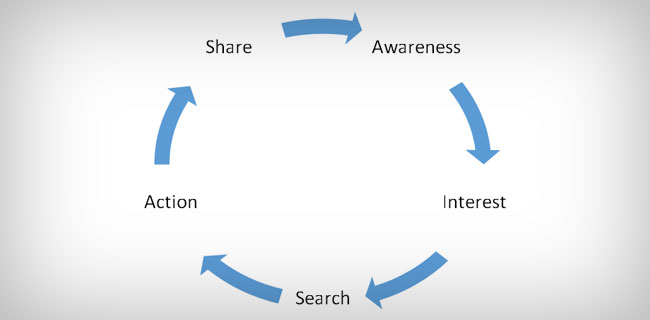
    But the last three-four years have seen another factor come into play which has recast the role of WOM. And I will use the AIDA model of buying behaviour to demonstrate the same. For decades, the model was linear. Catch attention, gain interest, create desire and close the action through sale. Digital changed this model into a never ending circular, self-perpetuating one with two additions. Search and feedback.


    Communication created interest. And thanks to the prevalence of the net, we translate the interest into search. We look for more information. We look for more brands/competition, we look for deals and then we tend to take action. Some may argue that this is not as prevalent in categories like groceries or commodities but I beg to differ. Search is still relevant. May not be for features or differentiation but definitely for bargains and offers. Even for weekly grocery shopping we do have a tendency to check if Big Basket or Jiomart or maybe even Amazon Fresh gives me better discounts or offers. Search is now second mature to us. So much so, that in US Amazon has almost 35% share in Search engines.


    And we do not stop after buying. Social media gave us a habit to share our purchases with our circle of friends. So, while we may want to show off our latest phone purchase or a dress or even a good deal, we are quicker on the draw to complain about a problem or a purchase gone bad. The habit of giving a feedback has also arrived. The habit of sharing our purchase and its experience.


    Therefore, when ecommerce companies ask explicitly for feedback on our purchases the feedback is provided for. Both good and bad. These are then classified as ratings and are posted on the product listing. Now tell me if this isn’t WOM, what is?


    And this is a tool waiting to be exploited. Imagine, you are a new player in the home accessory business. You list on Amazon. You pay to be sponsored on Amazon. Your product quality is good, your delivery is good and your consumer care is excellent. You give discounts to get the first batch of consumers and maybe 5% of these give feedback. Most of it is good, so your rating is close to 5 out of 5. Now, someone who wants to buy a new kitchen rack sees your product, likes the design but is not sure about your brand. He sees your ratings and is impressed. He then checks some of the feedback and sees mostly positive ones. He trusts these. Because these are from buyers. People like him. He may not know them, but they have used the product and are speaking up for it. A positive WOM.


    This positive WOM has now got a new customer. And the cycle continues. More positive feedback will get more new buyers. Will also reassure current buyers. The cycle will keep on expanding and a new brand can get success based on positive feedback. But if the feedback is not positive, the cycle will break. New consumers will be hesitant to buy. All because the feedback was negative. And the brand trial and usage may shrink.


    With the advent of digital Tripadvisor started customer feedback ratings of hotels, restaurants and other tourism related services. It’s success was illustrated just by the fact that many hotels etc would respond to negative feedback with apologies and promise to make the service better. Today Makemytrip and such sites also use this feedback mechanism.


    Feedback is the new avatar of WOM. It can be a strong and powerful tool. Ecommerce companies have realised its potential, travel and tourism companies have too. I think it’s time that brands in other sectors, especially new players, start looking at feedback as a digital WOM that can give them a true differentiation. It’s waiting to be exploited.


    Vikas Mehta is a senior business and marketing strategy consultant and educator. He is based in Dehradun. ‘With Apologies to None at All’ will appear every other Tuesday. His views here are personal


  • Can the tragic death of Cyrus Mistry be a gamechanger in the way we look at driving and safety rules?


    Introducing ‘With Apologies to None at All’, a new fortnightly column by Vikas Mehta


    By Vikas Mehta


    Vikas MehtaI do not believe in coincidences, but last Sunday evening, I had stumbled upon a report by the Ministry of Transport on road accidents in India for the year 2020. As I was glancing through the same, my phone flashed the news of the tragic death of Cyrus Mistry in a road accident, near Mumbai.


    The report was for 2020 and it had some chilling statistics. Even though the report boasted of a decline in road accidents by 18% and a decline of almost 13% in number of people killed in road accidents (not to forget that 2020 was the year of lockdown and restricted travel and road commerce), the absolute numbers were mindblowing. More than 3.66 lakhs reported accidents. More than 1.2 lakhs fatal accidents. More than 55% of the accidents happened on national and state highways and, hold your breath, 65% of accidents happened on stretches of straight roads. The report mentions a mix of traffic rules violations, driving without valid driving license and non-use of safety devices as the main reasons for road accidents.


    This was startling for me. Does a valid licence holder in India, know more than a non-driving licence holder? What extra or more safety precaution does a valid licence holder is aware of, or takes? My contention is actually the opposite. A valid licence holder thinks that s/he is now the king of the road and has the licence to do anything s/he pleases.


    And then came the news that the vehicle of Mr Mistry was over-speeding. That it tried to overtake another vehicle from the wrong side. That the passengers at the back were not wearing seat belts. I am sure that the person driving the vehicle had a valid driving licence. But that person, it seems, was flouting traffic rules and the passengers at the back were not using safety measures. If some of the most distinguished, well-educated people in India were responsible for such oversights then imagine the behaviour of the more common man.


    And now ask yourself. How many road safety rules are you aware of? Did you pass an oral test about driving rules when you got your licence? Was there an oral test at all? Were you given any rule book? Do you know the speed limits on the roads you frequently use? Can you understand road signs?


    Do you know how to use a traffic circle? When to enter it? Do you know that even when you change lanes you should signal the same? Have you heard of a blind spot which even a side rear view mirror cannot cover? What is the rule for joining the traffic from a side road? Do you know that you cannot stop or park your vehicle near a crossing or a turn or a bend in the road?


    These were some of the questions that I faced when I went for my driving tests abroad. In fact, I was not even allowed to take a test till I went through more than 30 driving classes and attended sessions on driving rules. This is after I had been driving in India for more than 12 years. And I was failed five times before I was deemed ready to drive on the roads.


    So, do not feel guilty if you do not know the answers to above questions. Because driving licence in India means testing the ability to drive engaging gears. Often you need not even have that capability. Yes, I have heard that things are changing. Automated tests which have no human interference or influence and which lay a strong emphasis on you understanding rules have started in key cities. But let us not forget that currently most of the drivers on road just know the basics of driving from point A to B. Period. The first step in reducing road accidents is in educating the current drivers about the driving and safety rules.


    Do not also feel guilty because my practical experience shows that even the traffic police are not well versed in traffic rules. They look at some basic violations like overspeeding, wrong side driving, driving under influence of alcohol, helmets, three to a two wheeler, registration of vehicles and maybe one or two more.


    So, in a country where increase in sale of vehicles is a benchmark of economic growth; where the transport ministry is claiming to build 100 kms of roads per day, isn’t it high time that all drivers are given a crash course (pun unintended) in safe driving and driving rules? For, if I am not even aware that what I am doing is wrong, how can I correct it?


    No, I am not talking about public service advertisements. Nor am I talking about some government drive of distributing leaflets or sending SMSs. I think that the communication industry along with the transport ministry must work out a comprehensive road rules and road safety education programme targeting all licence holders. Two-wheeler drivers, private vehicle drivers, heavy vehicle drivers, everyone must be sensitised to road rules. Call in all license holders for a programme. It may be voluntary but if the compliance is low then it needs to be enforced. If they do not attend even after three notices, cancel their licence. In the past, we have very successfully carried out literacy and adult literacy programmes. These were done when technological advances and innovations were nowhere at the level of toady. And these had good measure of success. So, why not a road rules and safety communication programme? The economic loss to the country in terms of road accidents is in billions of dollars per year. If a communication drive can reduce that, if it can reduce fatalities, then it’s not such a crazy idea at all.


    In a country, where we are willing to debate and maybe enforce some sort of population control measures, isn’t it time to think of a traffic safety and traffic rules education plan at a countrywide level? If we are determined to phase out carbon emission vehicles by 2040 then why can’t we look at increasing road safety, increasing awareness of road rules?


    Minister Mr Nitin Gadkari has taken some bold and revolutionary steps in road and surface transport. Is he willing to pick up this gauntlet?


    Vikas Mehta is a senior business and marketing strategy consultant and educator. He is based in Dehradun. This column will appear every other Tuesday. His views here are personal



  • Aroon Purie to deliver AAAI Subhas Ghosal Memorial Lecture on Oct 7

    By Our Staff


    The Advertising Agencies Association of India (AAAI) and the Subhas Ghosal Foundation (SGF) are have announced that the Subhas Ghosal Memorial Lecture will return this year with Aroon Purie, Chairman and Editor-In-Chief, India Today Group, as speaker. The event will be held on Friday, October 7 in Mumbai. While talking about his personal and professional experiences, Purie will share many valuable insights which he has gained during his lifetime.


    With the support of Advertising Agencies Association of India (AAAI), the SFT has been hosting its ‘AAAI Subhas Ghosal Memorial Lecture’ series, for several years, where industry leaders like Rajan Anandan, Uday Shankar, Ronnie Screwvalla have delivered keynotes.


    Said Sam Balsara on behalf of SGF: “We live in an age where media and advertising are shaping and also rapidly changing society. It will be interesting to hear Aroon speak about his journey, how he built a media empire, as well as his views on life today and how the media has changed over the years. I believe this lecture will be helpful and enlightening for both immigrants and natives of the advertising and media”.


    Ahead of the lecture, Anupriya Acharya, President, AAAI added: “Aroon Purie has been at the forefront of change and innovation in the news business as it transitioned from print to electronic media and then to digital and social media. A recipient of the Padma Bhushan award, his contribution to Indian journalism is exemplary. I am sure that Aroon’s life experiences will be fascinating for the audiences and we look forward to his perspectives at the Subhas Ghosal Memorial Lecture.”


  • New campaign by Dainik Bhaskar

    By Our Staff


    The Dainik Bhaskar group has announced a new advertising campaign titled ‘Sachchi Baat, Bedhadak’. Notes a communique: “With the symbol of a pen, torch and fist, where the pen denotes impartial journalism, the torch is a symbol of the light and the fist the signage of the loud voice to protest untruth, the objective of the ‘Sachchi Baat, Bedhadak’ campaign is also to underline the faith of the people towards truth and courage.”


    Commenting on the campaign, Dainik Bhaskar Group Promoter Director Girish Agarwaal, said: “Dainik Bhaskar has always been known to push the boundaries when it comes to courageous journalism and its impact on the lives of our readers. This national campaign aptly titled ‘Sachchi Baat, Bedhadak’ commemorates and reinforces this fearless journalistic ethos. We are proud of our team that has embraced this campaign wholeheartedly and brought to life the age-old saying – the pen is mightier than the sword.”


  • Research & Ranking launches educational campaign

    By Our Staff


    Research & Ranking, the equity investment advisory brand and a part of Equentis Wealth Advisory Services Private Limited, has announced the launch of its educational campaign #ShareBazaarKaRavan.  The video has been shot and edited by its Creative Agency Smart Magic Productions.


    The film stars senior members of the management including Sham Srinivas – VP, Marketing as Ravan and Jaspreet Singh Arora – Chief Investment Officer as the Hero who offers guidance (Marg Darshan) to investors.


    Speaking on the launch, Srinivas said: “Dassera is one of the most important festivals of India and has high recall across the country. Hence, we have created a character called ‘Share Bazaar Ka Ravan’. Each of his ten heads represents a common mistake made by investors. By using this metaphor, we have created a campaign that not only resonates with Indians but also demystifies jargon. We understand and appreciate that denizens of Bharat prefer to watch videos in languages of their choice, hence the dialogues are in Hindi. We are also exploring the possibility of creating videos in other Indian languages. We are delighted to share that this innovative campaign has been received very well by our target audience.”


  • Bajaj Pulsar N160 ad in two parts

    By Our Staff


    Bajaj Pulsar new ad asks viewers to ‘scan’ an embedded QR code to land on a second film – unlocking another level of an action sequence. It has been created by Ogilvy.


    Said Narayan Sundararaman, Head of Marketing, Bajaj Auto Ltd:  “Brand Pulsar is all about action and thrill. For its new avatar as Pulsar N160, we had to deliver a communication package that would talk about the category-first feature of Dual Channel ABS. In this cluttered media environment, we thought our best chance would be to involve the viewer and nudge them towards a thrilling film… do they want to watch an ‘uncensored’ ad of eye-popping motorcycling action? It’s great to see that the answer is a resounding yes!”


    Added Sukesh Nayak, Chief Creative Officer, Ogilvy India: “Pulsar is the most thrilling motorcycle on the road, so we took its communication a notch higher on the thrill. How? We got their attention twice! We made an ad in an ad. First, we made a Censored Pulsar ad for TV and released it with a QR code. The film invites the die-hard Pulsar fans to scan and view the most thrilling ‘Uncensored Pulsar ad’ ever. The Uncensored Pulsar QR code will make not just the TV ad but every ad thrilling, newspaper, outdoor, and even posters. Let the thrill take over.”


  • Das ka Dum with Dr Bhaskar Das | There is a sentiment in the UK that with every few CMOs over the age of 50, older people – especially women – feel under-represented in ads. Would you say this is true for India as well?

    Bhaskar DasWe read about this on one of the international A&M portals, and figured that it’s a trend that you sadly see in India as well. Let’s read what Dr Bhaskar Das has to say in the October 3 edition of Das ka Dum. Read on…


    If you wish to access the archives, please go to the Das Ka Dum tab on the website’s top navigation bar.


    Q. There is a sentiment in the UK that with every few CMOs over the age of 50, older people – especially women – feel under-represented in ads. Would you say this is true for India as well?


    A. I must admit I don’t have any statistical information about the validity of your observation but there is certainly a perception that in advertising in developed markets, including India, that when it comes to women above a certain age, they are less represented in advertisements. There are some distinctive ads though. I recall the SBI Life Insurance ad, or the Brooke Bond Red Label one on Instagram with actor Neena Gupta. Both are bold exceptions but it’s still not a dominant culture, even if they may be in a relevant segment in terms of financial capability, let alone addressing gender stereotyping. Instinctively I feel male counterparts beyond 50 years of age are represented more in Indian advertising. I am confident that things would change in the coming days and the advertising industry can take leadership in changing this gender stereotyping, even if it ultimately has to spread in the cultural mores of society in general. Long journey but it’s worth a beginning.


  • Do not berate brand purpose purposelessly


    With apologies to none at all

    By Vikas Mehta


    Vikas MehtaThe last two weeks were very purposeful. I was a panel member at a leading institute discussing the importance and genuineness of brand purpose in recent times. Coincidentally, two big brands in India, Stayfree and Dove also released some new work on their brand purpose.

    Both the pieces of work, have been panned by some marketing pundits and marketing gurus. While everyone has a reason and right to do so, I find the arguments put forward illuminating the ignorance of what is actually happening in the country. Most of the critics are metro-based with hardly any connect with the real India, Bharat, as it is called by some. Some of course also presume that every consumer is as marketing savvy and informed as they are. Let’s get into the details.

    First a look at Dove. And before I begin, here is a disclaimer. I was involved with Unilever brands for more than a decade at a global, regional and local level in South Asia, Middle East, North Africa and Far East and this includes Fair & Lovely now known as Glow & Lovely.

    Dove, for many years now, has been talking about body positivity. Very famously, Dove has in the past refrained from using models for its soaps and were using real homemakers, sans glamour and beauty, even in India. So, the body positivity was a natural progression with a scope to use various elements like colour, race, gender, depending upon the market they are in. The current campaign in India is about girls facing beauty issues as parents prepare them for the ‘marriage market”

    The issue that critics have raised is first, not with the brand but with the company Unilever. They have chided Unilever who have profited very well with Fair & Lovely in the same marriage market. And I concede it’s a valid point. It does sound hypocritical. But then if a brand is calling out a practice which another brand in the company stable maybe encouraging, is it wrong or gutsy? Sure, the company must look inwards but should it stop raising issues that are real in the society. The marriage market is still a reality. The focus on the daughter’s marriage is still an issue. Or are they saying that the issue is not important. I found some critics mentioning that. And that highlights a bigger problem. If we think that because our daughters or our friends’ daughters or even our driver or help’s daughter are getting educated and are building a career or niche for themselves, it does not mean that the problem does not exist. I live in a small town in North India and I find the focus on the girl’s marriage still takes centrestage from an early age. Prosperity has meant that more money is being spent on the daughter’s beauty issues. Visits to dermatologists, increase in use of facewash, is a sign of the times. But the issue has not subsided or lessened in its importance.

    And let us not forget that matchmaking, dowry etc have assumed gigantic proportions. When I started working in marketing more than three decades ago, the big society evil was dowry. Most of public service ads focussed on dowry problems. Now we hardly see any such communication or message. That does not mean that dowry problems or dowry as a society evil has lapsed. It’s in fact more monstrous. A cursory glance at vernacular newspapers in the Class 1 town editions reveal a spate of dowry-related death and torture stories on a continuous basis. The marriage market and the problems associated with someone who is not traditionally beautiful (read fair or blemishless skin) having to shell out more in dowry is a stinking reality of our times. Let us not wish it away. I moved to a small town almost a decade ago and not a month goes by when my wife is not reminded about our daughter’s future in the marriage market and what she should do to help her look better. And my daughter follows in amusement what some of her friends are forced to do.

    It’s a bigger hypocrisy that we are trying to attack a purpose which is most relevant just because another brand from the same stable partakes in the marriage market. In fact, I will stick my neck out and claim that Glow & Lovely had stopped partaking in the marriage market even in its earlier avatar of F&L. So that too actually does not hold good. The real issue that Dove has highlighted is the marriage market.

    I see similar issues in the panning of the Stayfree communication. Critics claim that the society has moved on from the “period talk is uncomfortable” issue. We have had movies like the Padman and some brands are showing in their demos red colour of blood, so why are we stuck with the same old issue of male friends and relatives uncomfortable with the talk of blood? I am afraid the critics again have a “big city” view. In metros, the issue of periods may not be uncomfortable anymore but in small towns and villages it is still taboo. Actually, I doubt if it has overcome the society stigma even in big cities. Just before the pandemic, I was attending an awards show in a 5-star hotel in a metro and a gent on our table noticed that a lady on the adjoining table had a stain. He pointed it out to his wife and was immediately admonished for making the observation so loudly and openly in front of men too. She then proceeded to discreetly inform the “victim” and help her cover it up with a stole, She was so embarrassed that she left the show, with a fuming partner in tow.

    The situations in the Stayfree communication are very common and prevalent in small towns. It’s actually quite irresponsible to think that the issue isn’t relevant anymore. Just because we had many anti-dowry communications did not mean that dowry as an evil was vanquished. Or just because our circle of friends and relatives, even in smaller towns have risen above the period issue does not mean that the society has. The brand has actually opened a new window to the same issue. Teach the boys that talking about periods is not taboo. Just like one detergent brand talks about sharing the load by teaching sons the same at a young impressionable age.

    I genuinely think that the metro, western influence phenomena continues to blindside our marketers. We also get overwhelmed by our own rhetoric. Yes, India has done very well. We have taken great strides in pulling up the society and breaking some myths and taboos. But the battle is far from over. A myopic metro-centric view is more detrimental than even the societal woes. Why, the most amusing comment I read was the one in which the marketing person stated that he is not sure that an average Indian user isn’t aware of Unilever, Axe and Glow & Lovely. Did he actually mean that an average Indian user knows that Axe, Glow & Lovely and Dove are all brands belonging to Unilever? Really?

    It tells me all about an average Indian marketer.


    Vikas Mehta is a senior business and marketing strategy consultant and educator. He is based in Dehradun. This column will appear every other Tuesday (and sometimes on other days as well). His views here are personal