Author: mxmadmin

  • Zee TV turns numero uno again

    By A Correspondent


    Zee TV has moved way ahead of the competition in the Hindi general entertainment channel space. According to the ratings out today (Week 33), the channel garnered 283 GRPs, with Star Plus slipping to 255, Colors up to 238 and Sony down at 214 GRPs.


    Last week (#32), Star Plus was leading with 270 GRPs as Zee TV trailed with 247, Sony with 225 and Colors with 217 GRPs.


    The high ratings can be attributed to the Dance India Dance season 2 Finale, which managed the ratings of 8.0 TVR on 12 August. Ramayan also caught many eyeballs, and managed the TVR of 2.7. The Gold Awards that were telecast on August 18 fetched the ratings of 3 TVR.


    Riding high on the success of Dance India Dance, the essential question is whether Zee will be able to sustain the ratings. Channel executives and an analyst MxMIndia spoke wit are bullish about Zee maintaining the lead since the channel is planning a standoff between season one and season two finale winners of DID. This will ensure that the interest is kept alive for the next five weeks.


    Dhruv Jha, Business Head at Lodestar Universal, is optimistic that the channel would have innovative content to keep the interest alive. He said, “Zee TV is always reinventing its programming. Even when this show ends, I am positive that they have another show in the kitty.”


  • BIG CBS brings X Factor in concurrent telecast with US

    By Meghna Sharma


    On the back of the success that the simulcast of the reality show America’s Got Talent delivered to the BIG CBS Network, it is going all out to cash in on the trend. The network has acquired the latest season of The X Factor, which will air concurrent to the United States, from Fremantle. The show will be simulcast across BIG CBS’s three channels – Prime, Love and Spark, beginning September 14 and then every Friday and Saturday at 9pm in India.


    Created by Simon Cowell and produced by Fremantle Media – North America, The X Factor is back for its second season with a jury mix that consists of Britney Spears, Demi Lovato, Simon Cowell and L.A Reid.


    Commenting on the show, Anand Chakravarthy, EVP marketing, RBNL said, “It has been our endeavour right from the start to offer India the latest-freshest-hottest of global entertainment, and with the acquisition of Fremantle’s hit show The X Factor, we once again live up to our promise. The X Factor’s concurrent telecast with the US and the simulcast across the Prime, Love and Spark channels will give us enormous mileage. Our strategy allows the show to reach a large relevant audience base across consumer segments, while simultaneously offering marketers an excellent platform to reach out to their audiences.”


    To ensure optimal reach, the BIG CBS Network has planned an extensive marketing plan for the show. The network will engage in a multimedia holistic marketing campaign across multiple touch points ranging over radio, television, out of home media and social media to promote the show.


  • Is the Indian government right in blocking the digital media?


    By Ananya Saha and Robin Thomas


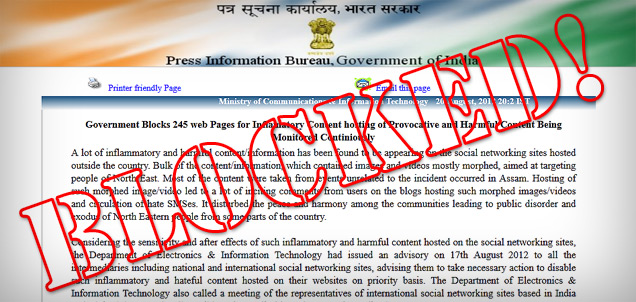
    In the recent wake of violence and riots in Assam, and against north-eastern Indians, the government ordered a ban on bulk SMS and blocked access to over 200 webpages. Even as these recent moves might seem to be curtailing freedom of expression, and have received mixed responses from the industry, the spotlight is now on internet freedom and content regulation.

     

    Sidharth Mishra

    Sidharth Mishra, Consulting Editor, Millennium Post & President, Centre for Reforms, Development and Justice said, “This is a kneejerk reaction by the government which completely failed to precede what happened with the North East residents. The government is trying to cover up its failure by indulging into such harsh measures on websites. I am not against any monitoring by the government but, there is a difference between monitoring and censorship. The drawbacks of social media domain can be stopped only by prevention and not by reactionary actions which we see from the government. If you ban one website another one will emerge and thus there will be no permanent solution to the problem. The government must therefore be pro-active and keep a vigil on these issues and then take necessary steps as and when required, rather than just putting a blanket ban.”


    As morphed images and hate messages targeted towards a certain community spread like wildfire, the Indian government is trying to tighten its noose on social media, and telecom operators. Twitter, Facebook and YouTube have been warned to pull off and remove the objectionable content by the Indian government, perhaps remembering Arab Spring that relied heavily on protests on the social media in the early stages and helped mobilise public opinion for several key social issues.


    LinkedIn, Yahoo!, and Sify did not participate in the story, but a Google spokesperson clarified, “We understand the gravity of the situation, strongly condemn acts of violence, and continue to work closely with relevant authorities. Content intended to incite violence, such as hate speech, is prohibited on Google products where we host content, including YouTube, Google+ and Blogger. We act quickly to remove such material flagged by our users. We also comply with valid legal requests from authorities wherever possible, consistent with our longstanding policy.”

     

    P N Vasanti

    But the damage has already been done, according to industry veterans. “The government should have taken steps like these earlier. Even though I am a strong supporter of freedom of internet and media, any instance that triggers communal violence should be strictly dealt with. I do not agree with censorship but penalising those who spread illegal, harmful and abusive material is important,” said P N Vasanti, Director, Centre for Media Studies.


    The government had initiated the Convergence Bill in 2000, with the objective of establishing a new “converged” regulatory framework to promote and develop the communications sector (including broadcasting, telecommunications and multimedia) in an environment of increasing convergence of technologies, services and service providers. In a multi-media environment when procedure of ownership and registration is as doubtful, the Bill would have helped in such a crisis. However, it failed to become operative.

     

    Pavan Duggal

    Pavan Duggal, Advocate, Supreme Court of India who specialises in the field of Cyberlaw, said, “The freedom of speech is relative, and is subject to relevant restriction. The govt is blocking out the content, which is anti-India. This is a legitimate step, but the govt needs to focus on the steps so that misuse of social media does not happen in the future. Only close to 200 websites have been blocked, which was a necessary step. The govt also needs to come up with specific rules for mobile operators, in time, so that the handheld tool is not misused.”


    Another industry analyst suggested that the government should plan long-term framework on the communication monitoring across the nation on the virtual and mobile platform to avoid similar circumstances in the future.

     

    BG Mahesh
    BG Mahesh

    BG Mahesh, Founder & MD, Greynium Information Technologies, opined, “SMS limit surely affects many but monitoring of social media, blogs has no effect on the majority as they are not doing anything anti-national. If my tweets are being read by the govt I am perfectly ok with it, after all it is in the public domain already. Free speech is a must but then people should not be posting anti-national content and spreading rumors. At the same time govt too should not be blocking content if it feels the policies are being criticized.”


    Giving a different perspective, Sanjay Aggarwal, CEO, Unicel Technologies, said, “What is effectively a blanket ban is actually not in the public interest. Banning communication systems in such a critical time can worsen the law-and-order situation rather than improving it. The lack of truthful news messages creates an information vacuum which increases anxiety and drives people even more toward unreliable rumors.

     

    Sanjay Aggarwal

    Despite the ban, person to person messaging is likely to continue as this is virtually impossible to control by the operators.” He further added, “Due to the SMS ban, as an industry we are looking at a 15-20% loss in this quarter, but considering the loss to our customers as well, businesses will take a hit in a multi-crore dimension and the numbers will be big. We have suffered bans in the past, and the financial impact is always large, but their effectiveness in achieving the government’s objectives is questionable.” There already exist solutions like BBM for Blackberry users and Nimbuzz, if the consumers prefer a multi-platform communication platform to avoid the SMS-related communication problems.


    Arunava Sinha, Head, ibnlive.com & cricketnext.com at Web 18, agreed. He said, “If the internet is the trigger, which I really doubt it is, then blocking the access to the websites is not the solution. It does not take much time to create another website. How many sites can only block? The solution is to act proactively, and do prompt campaigns and tell people not to believe in such messages.”


    Just as print media is responsible for it publishes, and follows self-regulation, is it time that internet be also regulated through the same protocols?


    “Any organization that wants to sustain itself will have to maintain some kind of self-regulation. They have to show some kind of responsibility towards the society. So, definitely self regulation is necessary and I am sure that most websites follow self regulation. At the same time some kind of government monitoring is also all right but, there must not be any censorship on the site or the internet,” said Mr Mishra.

     

  • Ranjona Banerji: Enough of serial debaters & screamers on news channels

    By Ranjona Banerji


    They maybe very nice people when they’re at home but there are some people whom I never want to see on television again. Well, preferably never again but if that is not possible then at least after a very long time. Here are their names, in no particular order: Manish Tiwari, Chandan Mitra, Swapan Dasgupta, Meenakshi Lekhi, Kamal Farooqui, Mohammed Owaisi, Suhel Seth, Renuka Choudhary, Mukul Oza, Jainarayan Vyas, Ravi Shankar Prasad, Rajiv Pratap Rudy, Vinod Sharma, Vinod Mehta, Mohandas Pai, Shobhaa De… News channels need to find a whole new list of serial debaters and screamers to appear on their channels every night to give the viewing public a break from this lot. I have nothing against some of these people and personally find some of them unbearable but I am tired of watching all of them.


    Of course, there is possibly a severe shortage of argumentative Indians in India, in which case these TV channels can get together and organise a training school for political spokespersons who are stuck in a groove and for societal leaders (yes, I know the jargon!) who have become a little jaded with all this constant TV exposure. A special refresher is needed for journalists who cannot decide if they are indeed journalists or spokespersons for political parties.


    Also, news channels need to make their guests sign a full disclosure about how many other TV channels they plan to visit on the same day. It can be very disturbing for viewers to see the same guest saying different things wearing a different shirt on different channels at exactly the same time. This can lead to moments of sheer terror at the tricks your mind is playing on you. It usually happens to me when I quickly hit the remote to get away from a certain screamer only to find him or her on the next news channels.


    A running scroll at the bottom of the screen could warn us: “Viewers are informed that guest number so-and-so is also currently appearing on all our rival channels and therefore they do not need to rush and join Alcoholics Anonymous immediately.”


    I do suspect however that the longer you watch TV news in India on a regular basis, the greater the likelihood of Alcoholics Anonymous becoming a distinct possibility.
    I forgot to mention, the warning scroll at the bottom of the screen needs to have at least three grammatical errors for it to look like legitimate journalism or viewers may well confuse it with an ad.


    I have to admit that the one person I really miss is Abhishek Manu Singhvi. His sneering arrogance and amazing felicity with the language made him very watchable. Why his sex life ended his television time I have not yet understood.


    **


    TV news therefore continued in its own inevitable fashion last week. The bigger excitement was in the social media as the government of India, which has never really understood freedom of expression in 65 years, tried to block websites, twitter, Facebook and so on.


    That this is a self-defeating exercise has not yet been understood.


    **


    Meanwhile Barkha Dutt, once India’s star TV anchor but now I’m not so sure, started a twit-fight by suggesting that the problem with twitter is that it is boring and predictable and full of agenda-pushers, stalkers, loser, lurkers and other such characters. I peeked into her profile (no, I am not a follower) and found that while she had thousands of followers, she followed only 160 people. No wonder twitter is boring for her. My advice is simple: follow more people and get to know more points of view than those of the stalkers, losers and lurkers who follow you!


    Ranjona Banerji is a senior journalist and commentator based in Mumbai. She is also Contributing Editor, MxMIndia. The views expressed here are her own


  • Dennis Koshy is VP, Draftfcb Ulka Bangalore

    By A Correspondent


    Dennis Koshy

    Draftfcb Ulka has announced the appointment of Dennis Koshy as Vice President for its Bangalore operations. Prior to this, Mr Koshy was the Vice President & Client Services Director, managing a large chunk of JWT’s business across Bangalore and Chennai offices.


    Commenting on the appointment Nitin Karkare, Chief Operating Officer, Draftfcb Ulka said, “Draftfcb Ulka Bangalore works with prestigious clients like Wipro [Santoor/Chandrika], ITC Foods [Sunfeast/Minto/Candyman], Paragon. We welcome Dennis on board and are confident that he will lead the Bangalore office and the client businesses to even greater heights. He has the support of a core senior and stable team, all of whom have worked alongside each other for almost a decade.”


    Dennis Koshy has done his Post Graduate Diploma in Marketing Communications from MICA in 1997. Post this, he joined Enterprise Nexus, Mumbai, as Management Trainee and worked on clients like Torrent Pharma, American Express Bank and VST [Charms]. In 2000, Dennis joined JWT, Bangalore as Sr Account Executive where he has worked on a wide spectrum of clients like HUL [Knorr, Lipton, Taj Mahal], Spice Telecom, UB, Van Heusen, Levi’s, Lifestyle and many more.


  • Paritosh Joshi: Say Hello to Hulu

    By Paritosh Joshi


    This fortnight, your humble correspondent is in the US, starting with the beautiful city of San Francisco. However, his responsibilities to mxmindia.com are never far from his mind so he will take a pause in his schedule to tell you about a creature of great wonder and delight that enchants the natives here while remaining tantalizingly out of reach for most other parts of the world.


    You are reading this on a computer or other electronic device (ok, some Luddite actually printed out a copy on dead trees but it still started off on a device). Said device is connected, ie it has access to the internet (or as the incomparable Dubya once called it, “The Internets”  (http://www.youtube.com/watch?v=LKTH6f1JfX8) – and as the clip that came up when you clicked on the link demonstrates, your device can deal confidently with voice and video too. Let’s be honest; all that FBing and tweeting you do inevitably has you clicking on video links with fair frequency; so you are scarcely a stranger to internet video.


    You are also no stranger to the grim truth that almost all the content on all the C&S channels that you get on your Dish, T-Sky, Hathway or whatever, is being routinely pirated and can be watched, off schedule or VOD if you will, online.


    There’s a simple rule related with criminal behaviour. Do what the crook does, but do it better than the crook does and people will even pay a small premium to get it the legit way. Al Capone could only run speakeasies until booze was illicit. The Netherlands (where Cannabis use is broadly legal) ranks 9th in its usage. Even Canada is ahead. Simple point. Do the same thing and do it above board and compliance generally should go up. (Who remembers India’s Income Tax regime in the 70s with near 100% marginal tax rates and the highest incidence of tax evasion probably on the planet?)


    Which is what Hulu is to online television content.


    You can get a full fix of what it is by checking out the Wikipedia entry but the basic idea is simple. Top American networks, NBC, CBS, ABC, Fox, Nickelodeon and several others have pooled their content into an advertising supported, high quality streaming service that simultaneously does justice to the consumer’s expectation of quality and the content owners’ expectation of fair compensation for intellectual property.


    What is most delightful about even the free tier of Hulu is the thoughtful Permission Marketing that it practices from the very landing page. A lot of content can be viewed by a simple registration and you also have the option of trying Hulu Plus for free. It wouldn’t foist it on you. Your call. This sensibility is visible at every stage. You choose a show to view, (I chose Jimmy Fallon learning the ‘Booty Tooch’ from Tyra Banks, don’t ask why) and even before clicking through, the mouse-over gives you a quick summary to help you decide if you want to go on. Next, you get advertising before the show starts. And it asks you if you find the advertising relevant. So the next time you are on Hulu again, the intelligent ad server engine will make better choices about advertising that actually make sense to you. Once you choose, the site will thank you for making the choice too! Inevitably these days, Hulu is keen to use your socmed (yes that is now a legit word) networks too. It asks you if you would like to post the video you just viewed to FB and Hulu giving you the option even here to opt out.


    I could go on but the short point is this. With bandwidth growing and streaming quality steadily improving as a result, we may well be at the point where an Indian ‘Hulu’ may be an idea whose time has come. Drive out piracy. Secure quality content for widest consumption. Get the advertising targeted to people who actually want it. What is not to like, eh?


    And in case you were wondering about Tyra… http://www.latenightwithjimmyfallon.com/video/booty-tooch-with-tyra-banks-82112/1414177


    Paritosh Joshi was until recently CEO, Star CJ. He has been a marketer, a mediaperson and on the Board/committees of various industry bodies. He can reached via his Twitter handle @paritoshZero


  • CNEB turns into Hummra M Bhojpuri music channel

    By Ananya Saha


    The Bhojpuri-speaking market has been categorised as Hindi-speaking market in TAM terms, so far. With an aim to change this, Complete News and Entertainment Broadcast Pvt Ltd (CNEB) and Launch Pad have joined hands to create Bhojpuri International Music TV Channel – Hummra M. Launch Pad, led by Probal Gaanguly and Vikas Varma, is acting as a consultant for setting up the channel.


    The channel, launched on August 13, is targeted at 15-24-year-olds in Bihar and Jharkhand (Bhojpuri-speaking) market. Probal Gaanguly, Partner, Launch Pad, said, “Strategically, the Bhojpuri market has been waiting to explode since quite some time. There is no regional music channel here. Hummra M is perfectly placed for advertisers to reach out to this important market.” The channel would telecast top-of-the-chart Bhojpuri film songs. The packaging and the look of the channel has been designed by Mr Varma (who was a part of the 9XM set-up team), and the channel would have 3D animated characters. The second phase would see more unique content, according to Mr Gaanguly.


    CNEB Hindi news channel, which did not turn commercially viable even after 4-5 years, was converted to Hummra M. The aim of Launch Pad is to look at profitability, create opportunities for marketers, and break even in the shortest time frame of 12-18 months.


    HS Sran, Group Chairman, HBN Group & Complete News & Entertainment Broadcast Pvt Ltd (CNEB Network), said, “We are delighted to join hands with Launch Pad to create the first entertainment TV offering from the CNEB network. With the proven track record of Vikas Varma and Probal Gaanguly in this genre of TV entertainment, it is a win-win situation for the CNEB Network, Launch Pad and the Bhojpuri TV viewer. We look forward to many more such ventures from this team.” According to the officials, the TAM ratings of Week 33 of Hummra M in BSM – 15 to 24 yrs TG is 6.42 which is almost the times of the three other Bhojpuri Music Entertainment Channels (Dabangg, Big Magic & Sangeet Bhojpuri).


    The Launch Pad team is already looking at regional channel markets of Orissa, Punjab, Bengal, and Assam. “We could act as consultant and take care of the entire project from launching to ensuring profitability, or become stakeholders. We are looking at different models and formats.”


    To market Hummra M, the channel would be engaging in below-the-line marketing and activations. The channel is also looking at tying up with film properties.


  • DID creator Ashish Golwalkar to leave Zee

    By Ananya Saha


    A journey that began in April 2001 for Ashish Golwalkar is drawing to a close. The head of non-fiction at Zee TV put in his papers recently. He is currently serving out his notice period, and August 24 will be his last day at the channel.


    He is credited with the creation of Dance India Dance, the popular property at the channel. Mr Golwalkar said, “It has been 12 years at Zee. I have worked at various roles and positions at Zee. I have worked as a sales person, programming head, brand manager. It was a great learning experience. I was responsible for DID. Nothing can be as big as DID. Zee was acted as a university for me.


    “Once you do something, it becomes difficult to outdo yourself at the same place. One needs to look for challenges and the challenges need to change constantly,” he said.


    Mr Golwalkar has not decided on his next destination yet. “I will be on leave and will evaluate things after a month.”


  • The Anchor: Madan Sanglikar on 4 big changes needed in Indian digital advertising

    #1 Erase the traditional vs digital mindset:

    This mindset has created a silo where what the digital team does is not known by the traditional media team and vice versa, whether it be at a client level, at an agency level etc. There is no unified thinking and therefore if we want to believe in convergence then it needs to first change with the mindset, not just in the devices. If we can therefore rule out this digital versus traditional mindset, it will work far better.


    #2 Single unified data points:

    We have different data points for different set of consumers, a lot of countries today are moving towards unified data points. It is high time that we start getting single sourced data which allows us to capture data points for the same consumer across different medium. Right now there are four or five different companies providing different data points, and hence like most developed countries it is high time India also adopts single source data points for tracking consumer behaviour.


    #3 Big creative shops must get serious about digital:

    While the media side of the business has seen tremendous growth, the creative part of the business is still struggling. I would like to see a lot more traditional media creative guys jumping into the digital media creative bandwagon. Because what I see today is a clear gap in the way work is done; as a result a lot of small time creative shops have got an opportunity to pull this gap. The big creative shops therefore must get serious about digital, not just by acquisition or adding business but, by actually understanding the medium and getting their hands dirty rather than just acquiring business.


    #4 Political will to make India more digital-savvy:

    There seems to be a lack of strong political will where building good infrastructure facilities in order to make India a digital-savvy country is concerned. I would like to see a strong political will in improving the broadband infrastructure of the country because India is ready and looking forward to newer opportunities in this area but, sadly there are not enough opportunities available at the moment.


    Madan Sanglikar is the Co-founder and CEO at AD2C


  • Round 2 judging of Emvies 2012 starts today

    By Ananya Saha


    The Emviees, the premier media awards instituted by The Advertising Club Bombay in 2001 – are completing 12 years. The Emvies Committee at the Ad Club after consulting media industry thought leaders has introduced new categories/changes at EMVIEs 2012.


    Three new categories have been introduced: Media Client of the Year, Best Ongoing Media Campaign and Young Emvie of the Year. Display and Video has been added as additional sub categories under ‘Best Media Innovation – Digital’. Zoom, the Bollywood channel, has introduced a special award category in the 12th edition of the EMVIES. The special award titled “Best Use of a Bollywood Celebrity in Media” will be given to an entry that uniquely showcases or integrates a Bollywood celebrity in media, creating impact and being relevant to the brand’s communication.


    For the first time ever, the entries were submitted digitally.


    Befitting the occasion the Ad Club has received an unprecedented response receiving 734 entries across 23 categories an all time record. The Ad Club had received 717 entries last year. The record entries are an indication of the growing media industry and the constantly evolving high standards.


    As many as 43 agencies have participated in the competition and their work was judged by 100 top notch media professionals in Round I spread over for three days. The judging was paperless. The Round II will happen on 23rd, 24th & 25th of August in the popular format of Case Study Presentation at Welingkar Institute and will be judged by 21 stalwarts from the marketing fraternity. Only those who will present on or before 10 am will get the ballot paper to exercise their vote. The Case Study Presentation for all three days and the Awards Ceremony will be webcasted live on www.adclubbombay.com.


    The Emvies have gone from strength to strength in these years with the very active and enthusiastic support of the entire media fraternity. Not only have these Awards become a matter of honour for media planning and buying houses, but are today receiving tremendous support from media marketers and clients as well.


    The Emvies will take place on September 3, 2012 at Taj Lands End, Bandra. The awards ceremony will be attended by over 1000 die heard professionals from Media, Marketing, Advertising, Research & Communications fraternity. An added attraction is the Band Baja Awards which will showcase musical talent within the media fraternity. Some Rockstars will emerge from that evening’s performance.


  • Debrief: Philips: Not very bright

    By Anil Thakraney


    Philips has released a new commercial for their bulbs. And it’s a good example of how to mess up communication by trying to achieve a dhobi list of things.


    The commercial is a cross between a corporate A/V and a brand advertisement. While on the one hand Philips wants to tell us that their bulbs are 20 per cent brighter than the other brands, they also want to tell us it is a ‘Desh Ka Bulb’. And these two messages clash, like in a bad road accident. To complicate life further, they have used yet another consumer insight! In India, people name their children after light, as in Roshni, Suraj, Prakash, etc. So this needs to be established as well. And as if all this wasn’t enough, there are many situations featured in the ad, some serious, some trying to be funny. So in end, you are left with nothing.


    [youtube width=”400″ height=”220″]http://www.youtube.com/watch?v=nTd8dfCnyVQ[/youtube]

    Complete waste of money. For one, there’s no need to tell us India uses Philips bulbs. It’s a very low involvement, low value product category, there’s no way this will induce brand recall at the retail outlet. A bulb is a bulb; all we want is that the damn thing works. However, Philips does have a tangible offer to make. That their bulbs are 20 percent brighter. THIS is what the entire communication ought to have been based on. This is what will induce brand recall. And I can see super, witty commercials being created with this one promise.


    And it’s all been short-circuited by a greedy brand manager. Sad.


    Rating: (On a scale of 1 to 5): 0. Bulb fuse ho gaya!


  • TLC to launch ‘What Not to Wear’ India edition

    By A Correspondent


    After its recent ‘Be Blunt with Adhuna Akhtar’, the India-based hair styling and makeover series, lifestyle channel TLC is all set to launch the India edition of the international makeover series – ‘What Not to Wear’. The channel has roped in actor Soha Ali Khan and acclaimed stylist Aki Narula.


    The 13-part series, ‘What Not to Wear – India’ is scheduled to air every night at 10pm beginning September 2, 2012 on TLC. With two back to India productions – ‘Be Blunt with Adhuna Akhtar’ and ‘What Not to Wear – India’, TLC is said to be planning more localised programming in the near future, thus further strengthening its localisation drive. ‘What Not to Wear – India’ will be available in both English and Hindi languages.


    Each episode is said to be a personal journey of women reinventing themselves with new-found vigour, as they bid adieu to clothing items from their wardrobe they never should have worn in the first place. Rahul Johri, Senior Vice President and General Manager – South Asia, Discovery Networks Asia-Pacific said, “TLC has been the front runner in bringing the world’s best experience to Indian television. Pushing the boundaries of differentiated and inspiring television entertainment, we are delighted to present another pertinent and refreshing India centric series- ‘What Not to Wear – India.’ Hosted by Soha Ali Khan and Aki Narula, the series will activate a new wave of style change and become the new benchmark in lifestyle programming.”


    Soha Ali Khan said, “I am excited to be part of TLC. ‘What Not to Wear – India’ is an extremely interesting makeover series that beautifully captures the emotional, psychological and physical journeys of women to style enlightenment. We hope that viewers enjoy the show as much as we enjoyed making it.”


    Aki Narula said, “This is a thoroughly researched, interactive and insightful series, where I can aptly put all my years of experience of fashion and style to great practical use for the participants and the viewers.”


    ‘What Not to Wear – India’ is based on the original format devised by BBC and produced by BBC Worldwide.