
Author: mxmadmin

  • Sony Sports announces broadcast plans for ÇWG

    By Our Staff


    Sony Sports Network has announced plans the live broadcast of the XXII Commonwealth Games starting from today, July 28 at 11 pm IST. The event will mark the return of Sony Sports’s ;ive wraparound studio show Sports Extraaa featuring eminent panelists and guests.


    Said Rajesh Kaul, Chief Revenue Officer, Distribution and Head – Sports Business, Sony Pictures Networks India: “After the huge success of the Olympic Games Tokyo 2020, it gives us immense pleasure to broadcast the Birmingham 2022 Commonwealth Games. The broadcast rights for the Birmingham 2022 positions Sony Sports Network as the home for international multi-sporting events in India. Armed with a single goal to put our country on the global sporting map, our athletes have been training incessantly and it is our endeavor to showcase the stories of these national heroes. Keeping this goal in mind and to rally our support for the Indian contingent, we have also launched the ‘Birmingham Mein Jeetega Hindustan Hamara’. In addition to this, to provide a holistic viewing experience, our studio show, Sports Extraaa will feature stellar panelists who will provide real-time insights into various games.”


  • IAA to host gender sensitisation summit

    By Our Staff


    The International Advertising Association (IAA), India chapter is hosting a summit on Gender Sensitisation In Media on July 29 in Mumbai. The theme is Gender Portrayal across the creative spectrum from a 30-second TVC to a three-hour film.


    Said Megha Tata, President IAA India: “IAA has always brought forward initiatives that are meaningful and Gender sensitive, on and off screen and has also been the one who has always taken the lead on this issue in the industry. We felt that it is time for all of us to come together and be the voice of change. We want to address the dialogue of gender discrimination across the media spectrum and hope we will collectively bring much needed change in the system.”


    Added Nina Elavia Jaipuria, Chairperson, IAA Women Empowerment Committee & Head – Hindi and Kids TV Network, Viacom18 Media Pvt. Ltd: “Over the last decade, women have broken stereotypes in this industry both behind the scenes and on the screen. It’s time we tell more of those stories and break biases. Through this change summit, the IAA brings prominent industry voices to communicate, converge and be the Voices Of Change that we need to empower the narrative.”


    The summit shall see leading industry bodies such as ASCI, UNICEF, Tata Institute Of Social Sciences, Unstereotype Alliance and Akshara Centre as partners. Prominent voices like Poonam Mahajan, Vidya Balan, Deepika Warrier, Monika Shergill, Anupama Chopra, Santosh Desai, Nandita Das, Ranveer Brar, Tista Sen, Anuradha Sengupta and others will be in attendance.


  • Shruti Pushkarna: Five ways to make media offerings accessible

    Shruti PushkarnaBy Shruti Pushkarna


    They say charity begins at home. Well, so does inclusion. We all love to judge others, call out their mistakes, conveniently forgetting our own follies. Aren’t we all guilty of excluding people who don’t talk, walk or look like us?


    Most of us don’t even realise how and when we omit vulnerable communities from everyday conversations, business, politics, entertainment et cetera.


    Persons with disabilities struggle to navigate not only in a physically inaccessible environment, but also among people unconsciously wired to discriminate and dismiss.


    My journey of disability inclusion started with observing gaps in things that mattered to me personally.


    As a shopaholic, I realised how measly are the options of accessible clothing or footwear. If at all available, the prices are exorbitant. As if living with a disability is not expensive enough. As a foodie, I noticed getting in and out of restaurants was an obvious challenge for wheelchair users but the deaf and blind customers had limited ways of communicating with the servers.


    The next logical step was to implement small changes in my behaviour in the personal and professional space. Something others could easily emulate. Obsessed with capturing moments on camera to share with my social media audience, I discovered how using ‘image description’ can help blind people enjoy and participate in the pictorial narrative.


    In a largely visual world, fueled by Instagram stories, including persons with disability on social media is a possibility, thanks to technology. A revelation to the television producer in me!


    It’s amazing how much we assume and take for granted as creatures of habit.


    Various stakeholders as well as individuals can break the cycle of ignorance by introducing little changes in their respective domains.


    What can mediapersons/ journalists do differently, to include persons with disabilities in their offerings?


    Here are five easy-to-do things to reach a wider audience irrespective of (dis)ability.

    1. Make video content accessible for everyone

    While adding subtitles can make the audio portions accessible to the deaf, overlaying a separate track of audio description can help the blind make sense of the silent parts in a video.

    2. Add sign language interpretation

    Recorded or live programming on television can be interlaced with sign language which can help persons with hearing impairment interpret the content easily. This is also true for conferences and award ceremonies.

    3. Read out graphic content

    Television news and sports coverage is a mix of audio, video and graphic content. A news bulletin has several sections of information displayed graphically, like statistics, forecasts, trends and so on. If the anchor reads out the graphic content on air, it immediately becomes accessible to persons with vision impairment. This is critical for disaster relief broadcasts, where contact and other info is flashing on TV screens continuously.

    4. Make websites and apps accessible

    Today, more than television, people consume news online. And that’s why it is important to make news websites and mobile applications disabled-friendly. The platforms should be built in compliance to the web accessibility guidelines and all software updates thereafter, should go through the same checks. Some usual suspects include pop-up advertisements, unlabelled images, colour contrast and drop-down menus.

    5. Use correct terminology

    Media teams should go through a thorough sensitisation and awareness programme to ensure they understand respectful, dignified and politically correct ways of addressing persons with disabilities. For instance, there is nothing wrong with calling someone blind given their loss of sight, but it’s not appropriate to call a speech-impaired person, dumb. Similarly, battling with disability might be challenging, but it doesn’t make the disabled ‘special’ or ‘gifted’. It is a physical/ mental condition and therefore, using the word ‘impairment’ or ‘disability’ is befitting.


    The key to inclusion is to accept there is an audience with diverse needs and ask what ways or solutions can reduce the existing gaps. Needless to say, that the media needs to ramp up its coverage on issues facing the large disabled population.


    Amidst the increased bellowing for Diversity Equity & Inclusion, does the media contribute anything apart from an incongruous rant for equality?


    Shruti Pushkarna is a former journalist who now works as Director, EnAble India where she heads North India operations as well as media and communications outreach. Shruti writes for MxMIndia every other Thursday. Her views here are personal. She can be reached via Twitter at @shrutipushkarna

     

  • Times of India launches festive campaign

    By Our Staff


    The Times of India is calling its festive period TGIF (Thank God It’s Festival) this year. Notes a communique: “The newspaper will celebrate the joys, hopes and dreams of the people of India during the long festive period from Raksha Bandhan to Diwali, under its umbrella theme, ‘Thank God It’s Festival’ in a multitude of ways, every day.”


    Other than various activities through this period, the ‘Leaders of Change’ issue last year on Independence Day will be out this year as well with a “bumper issue” on India’s 75th Independence Day.


    Adds the communique: “An economy which will see full colour celebrations after a long spell is an unmissable opportunity to grow one’s brand, and there isn’t a more reliable platform than The Times Group to showcase it. The Times of India with its unmatched reach of 54 editions and 1200+ towns is truly the only daily with a national footprint. It is the most trusted news brand in the country, as per the 2022 survey conducted by Reuters Institute and the most trusted English news brand when ranked out of 52 brands across media, as per Trust Index for English News Brands in India, Nielsen Media Report, March’22.”


  • Puretech launches branded content vertical

    By Our Staff


    Puretech Digital, the full-service digital agency, has announced the launch of its new branded content vertical RevUp. The new vertical will offer custom solutions that empower brands to build and sustain audiences over prolonged periods of time.


    The vertical will be headed by Aastha Beecham who has been associated with the agency since 2021. Speaking of the new vertical Prashant Deorah, CEO, Puretech Digital said “We are thrilled to announce the initiation of RevUp that will look after the branded content associations of Puretech Digital. With RevUp, we aim to showcase the creative expertise that Puretech Digital holds along with our stronghold in the performance marketing domain. The team is all set to exhibit outstanding projects and works in the creative content space while empowering brands to scale their audience connect.”


    The vertical has worked with leading brands like Calvin Klein eyewear, Vijay Sales, HT Media, Times Group, Bank of Baroda, HDFC Bank, Mirae Asset, and Pinc Insurance to name a few.


  • Das ka Dum with Dr Bhaskar Das | Just as the govt is engaged in television audience measurement, should it also ensure IRS happens for print?

    Bhaskar DasThe question is in itself a comment of the state of affairs, so we’ll reserve any further remarks. Here’s Dr Bhaskar Das with a response to our question for the July 28 edition of Das ka Dum. Read on…


     

    If you wish to access the archives, please go to the Das Ka Dum tab on the website’s top navigation bar.


    Q. Just as the government is engaged in the television audience measurement, should it also get involved in ensuring that IRS happens for print?


    A. Are you sure that the government is involved in BARC ratings? I am not aware of it. Even if it is so, I feel it may be due to the number of channels and their lack of convergence  on the measurement process. Since a lot investment of advertisers are at stake, the government must have thought of introducing an adjudication process, in the midst of allegations and counter-allegations. The government might have thought that the self-regulation mechanism might not be efficacious enough to put the house of measurements in order. A disclaimer: my assumptions may be far away from reality.


    Coming to IRS, I feel there is less internecine war of words. And in case of print medium, the pecking order of market leaders and followers have been established for quite some time. Hence, inspite of absence of IRS data for three years, the pecking order hasn’t changed dramatically. The empirical evidence do not suggest anything contrary, so far as I know (I am not referring to any category-level erosion). I am not suggesting that IRS data is less critical as a decision support system but the advertisers haven’t complained vociferously about its absence, as publishers have consistently maintained their standard and consequently, market specific leadership. Till you specifically raise the reason for government’s involvement in IRS data, I can’t comment. Governments have other pressing issues of the nation to address, I presume.


  • Here’s to celebrating failures!


    By Avik Chattopadhyay


    Avik ChattopadhyayThis week has been a revelation for me on two fronts, first getting to know about the ‘Museum of Failure’ and second watching a Hindi film called Samrat Prithviraj.
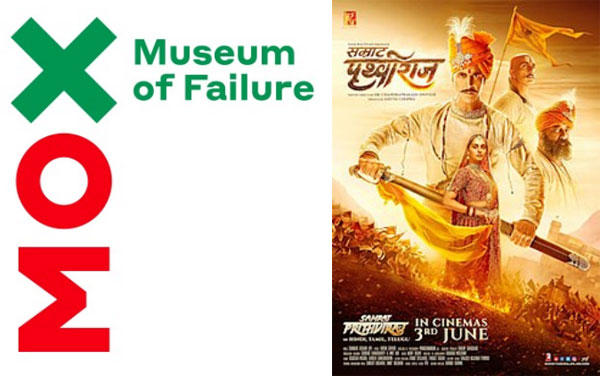

     

    The first celebrates defeats and the second tries its best to cover up one.


    Logo of the Museum of Failure / Poster of Samrat Prithviraj


    The Museum of Failure is a simply awesome concept. It showcases close to 150 products and solutions launched that ended up being duds. Examples are like the Apple Newton, Google Glass, Harley-Davidson Cologne, and Sony Betamax. Mega brands. Mega failures.


    The reasons for failure could range from being ahead of the times to being totally irrelevant. But the objective of creating this amazing display according to founder and creator Samuel West is to celebrate the spirit of innovation and learn from the failures. He says that the displays demonstrate the risks in innovations yet encourage the human mind and spirit to create newer things. Financially supported by the Swedish Innovation Authority [Vinnova], it opened in 2017 in Helsingborg, Sweden. Since then, it has evolved into a travelling show, doing stints in Los Angeles, Shanghai, Paris, and Minneapolis. The Parisians in fact celebrated a complete Festival of Failures!


    Big brands have sportingly supported him with providing exhibits. It was not demeaning for Kodak to donate a DC-40 camera [costing $1000 per piece which is why it failed] or for Lego to talk about its failed fibre optics venture. There is no shame in admitting to mistakes like Coke-II or Nokia Taco. They are brutal facts and hiding away from them just does not make any sense. It would be hilarious for Coca-Cola to wish away the Coke Blak. It was an interesting innovation, something new was tried but it did not work. Simple. Samuel West clarifies that every product or solution featuring in the museum is carefully chosen for its innovation quotient. Samsung Notes was a failure but will not qualify as an exhibit as it was nothing ‘new’! It’s not about the failure. It’s about the ability to be creative and at least try new things. And learn from failures, defeats and mistakes. That’s the hallmark of any successful brand.


    I remember Osamu Suzuki once telling us at Maruti [Udyog] Suzuki that one may launch 10 new cars and only two would finally work in the market. The success of these two will cover up the financial losses of the failed eight and provide the investment to create 10 more! The passion for innovation and creation cannot ever stop.


    Will Maruti Suzuki donate a Zen Classic to the Museum of Failure if it travels to Mumbai? Will brands operating in India happily own up to failures? Will brands believe that admitting to defeats and reversals endears them better with the customer and makes them more ‘human’? Will Ratan Tata own up that the Nano failed in spite of being a brilliant piece of design and engineering?


    Which brings me to Samrat Prithviraj, the movie. Made by Chandra Prakash Dwivedi, a person my generation has hugely admired for his portrayal of Chanakya on Doordarshan, I had expected the fundamental admission that Prithviraj Chauhan lost to Mohammad ibn Sam of Ghor [commonly known as Mohammad Ghori] in the second battle of Tarain in 1192 AD. Ghori outlived Prithviraj by close to 14 years. We Indians have a big problem with admitting to failures and defeats. So, we revel in the myth that Ghori was killed by a blind Prithviraj aided by his confidante Chand Bardai. The movie claims to be inspired by a work called “Prithviraj Raso” by Chand Bardai written much after the battle, to keep the spirit of the king alive and positive. However, in the movie he too dies along with Prithviraj leading to the basic question that who then wrote the very literary piece?


    This fear of admitting to failure drives our brands too. Reversals are not even whispered in the corporate corridors, leave alone openly sharing them with the outside world. For us, the Hindi term of ‘naak kat jaana’ which means ‘loss of face’ is a huge social stigma which leads to such defensive action. We do not wish to see the valour in Prithviraj’s defeat for in defeat there can be no valour. We do not wish to learn from the fact that Ghori lost once but came back again better prepared for outsiders or competition cannot be worthy of admiration. We love weaving myths and trying to live in them. I have never seen any politician, judge or bureaucrat accept mistakes and defeats in a truly candid and sporting manner. If in a position of power, we are seemingly invincible. Vulnerabilities are signs of improper parentage and weaknesses are to be hidden from all, including self. Which is why most of us fail to do reality checks in time. We tend to start checking too close to failure.


    The day we openly celebrate failures as a nation and society will see us as more confident of ourselves, bereft of falling back on our ‘golden past’ and bold enough to invite Samuel West and his Museum of Failure to do a nationwide tour!


  • Questions for the Indian Judiciary


    By Ranjona Banerji


    Ranjona BanerjiThe Chief Justice of India, NV Ramana, has been giving some great speeches outside the Supreme Court recently. Just this Saturday at Ranchi, at the inaugural lecture in memory of Justice Satya Brata Sinha, he talked about the danger of media trials and kangaroo courts which impede the judiciary in actual trials.


    The media needs to be responsible, said the Chief Justice.


    And then there’s this sentence:


    “Ill-informed and agenda-driven debates on issues involving justice delivery are proving to be detrimental to the health of democracy.”


    On Tuesday, at a book launch, the Chief Justice said that it is the responsibility of media houses to “present facts”. The people he said “still believe that whatever is printed is true”.


    “The media must confine itself to honest journalism without using it as a tool to expand its influence and business interests… Only media houses without business baggage were able to fight for democracy during (the) dark days of the Emergency. The true nature of media houses will certainly be assessed from time to time and appropriate conclusions will be drawn from their conduct during testing times.”


    All this is all very well.


    The media is irresponsible when it comes to upholding democracy.


    And thus it follows that the media is responsible for the ongoing destruction of democracy.


    As senior journalist Kingshuk Nag discusses here, the business influence on media houses is not new. But it has been fought and contained from within in earlier days. Today, less and less.

    https://theprobe.in/who-will-hold-the-media-to-account/


    But I have other questions for the esteemed judiciary. As political scientist Pratap Bhanu Mehta asks in the link below, why does the judicial system verify opaque provisions like in the money-laundering act, which threaten democracy itself?


    https://indianexpress.com/article/opinion/columns/pratap-bhanu-mehta-by-upholding-pmla-sc-puts-its-stamp-on-kafkas-law-8057249/


    And what is the judiciary’s role in helping those media houses who do their best to protect democracy in “these testing times”?


    And, when journalists, media houses, civil rights activists are actively targeted by various government agencies, why does the judiciary side with the oppressor and not the oppressed?


    Why are our bail laws used so selectively by the judiciary? So many journalists have been arrested and denied bail for doing precisely what the Chief Justice says that journalists are not doing enough. Others have been arrested for simply trying to cover incidents – which is their basic job.


    Why have some journalists been denied permission to travel abroad for unspecified reasons?


    What value is given to the freedoms in Article 19 of the Constitution of India if government agencies can so easily bypass them?


    What does it mean when a judgment or a statement by a judge in court accuses journalists and civil rights activists who speak for the oppressed of a “larger conspiracy”? And when activists are arrested on the basis of such statements?


    How are journalists or the general public to react when a judge informs the court that peacocks procreate by sharing tears?


    The Pegasus report which showed how the government used military grade spyware to target journalists, activists and others was released exactly a year ago, in 2021. How are media houses and journalists supposed to function when they are targeted like this, and get no help at all from the judiciary?


    Earlier in 2019, Whatsapp had revealed the government had tapped and hacked into phones of journalists.


    This year, evidence has been presented on how the phones and laptops of activists were hacked and fake evidence planted in them. This is the evidence on the basis of which these activists were arrested and imprisoned.


    What help has the judiciary given them?


    https://www.newslaundry.com/2022/06/17/pune-police-planted-false-evidence-on-computers-of-bhima-koregoan-accused-wired-report


    We understand what the Chief Justice means when he says that some cases are so complicated that even judges sometimes have a hard time understanding them.


    Because there is so much about the judiciary’s role in keeping democracy alive that we, journalists and citizens, do not understand at all.


    Ranjona Banerji is a senior journalist and commentator. She writes on MxMIndia on Tuesdays and Fridays. Her views here are personal


  • Das ka Dum with Dr Bhaskar Das | It’s International Friendship Day tomorrow. What does a day like that mean to you? An opportunity for gifting companies to cash in or a day when you sit back and reflect on relationships?

    Bhaskar DasBy now you know that we love these special ‘days’ observed through the year. So we asked Dr Bhaskar Das a question based on Friendship Day for the July 29 edition of Das ka Dum. Read on…


    If you wish to access the archives, please go to the Das Ka Dum tab on the website’s top navigation bar.


    Q. It’s International Friendship Day tomorrow. What does a day like that mean to you? An opportunity for gifting companies to cash in or a day when you sit back and reflect on relationships?


    A. I feel real friendship is equivalent to love , without judgment. Friendship can’t be suddenly celebrated on a special day for optics, as is wont in the days of social media. It is not seasonal nor occasional. In that case, it’s only acquaintance and situational.


    I agree with you, albeit with a small twist, that IFD is a day to sit forward (as opposed to sit back and immerse in the journey of friendship. Can you smile in the absence of your friend ruminating on some funny moments or can you seek guidance? Can you confide with a person your weakness as a human being without being judged? If these can be achieved, IFD can be celebrated every day. One needn’t amplify it on social media.


  • Twitter unveils report on video consumption behaviour

    By Our Staff


    Twitter, the popular global social networking service, has unveiled a recent report revealing insights into consumers’ video consumption behaviour. It reveals that for 62% of people in India, Twitter is one of the main sources of video content online. The report also found that the service in India is associated with informative (59%), professional (54%), and exclusive video content (53%).


    Commenting on the report, Preetha Athrey, Director, Global Business Marketing, Twitter APAC, said: “This report on consumer video consumption behaviour is a window into what people are seeking and how brands can lean into it. Video is growing and is fast becoming a central piece of what’s happening on Twitter. The possibilities for our favourite moving medium are endless and we are seeing more and more brands tap into the power of click ‘play’ to engage with the most leaned-in audience, connect to what’s happening, and be a part of today’s visually-driven digital world.”


    The report delves into many aspects of video consumption.

    What are people watching most on video?

    The top interest-based categories that attract the most viewers are:

    News and Current Affairs – 51%

    Celebrities – 43%

    Business/Finance – 39%

    Educational – 35%

    Sports – 33%


    The second-screen experience: people are not just watching video, they’re also talking about it

    Today audiences are on the lookout for more; their hunger for content goes beyond the television screen and converges on Twitter – where they come for a second-screen experience. Viewers turn to Twitter to catch-up on exclusive content like sports match highlights, behind-the-scenes footage from the most iconic events, or bytes and snippets from their favourite artists. Moreover, even while they’re watching videos on other platforms, they’re also on Twitter – talking about it.


    93% of Indians on Twitter say their usage of Twitter increases while watching TV, and they turn to the service for trailers, highlights, and latest news about TV shows. For 85%, the same is applicable when watching movies and 90% say this is true when they’re watching streaming content.


    79% people in India use Twitter more when they’re watching sports content elsewhere, and what they seek on Twitter is exclusive content, game highlights, interesting stats, and live coverage.


    People are spending more time viewing live video content

    While marketers lean on snackable content to tackle the short attention spans of today’s audiences, live streamed content might just break that pattern – almost 9 in 10 people on Twitter in India have watched a live stream video on the service. Several brands have harnessed the power of live video on Twitter – including automotives like Mahindra, OEMs like Oppo India, B2B-tech brands like Microsoft India – when introducing new products or campaigns.


    With Twitter’s real-time nature, it is no surprise that people turn to the service to watch events as they unfold around the world. 88% of audiences in India say they have watched a live stream on Twitter, and these are the top categories of live content people are engaging with:

    News events – 43%

    Product launches – 39%

    Red Carpet events/Award shows – 37%

    Festivals – 36%

    Sports events – 33%


  • Rediff wins Garden Vareli mandate

    By Our Staff


    Rediffusion has been assigned the entire communication portfolio of Garden Vareli, a brand owned by Garden Silk Mills Private Limited, Surat. The agency will help the client with marketing strategy, creatives, digital and media.


    Welcoming Rediffusion to Garden Vareli, Debi Prasad Patra, Director, Garden Silk Mills said: “Rediffusion launched the Garden Vareli brand in the 70s and made it a household brand with advertising that became famous. In working with Team Rediffusion again, we are hoping to re-create the magic.”


    Added Dr Sandeep Goyal, Managing Director, Rediffusion: “Garden Vareli is a cult brand. It had gone into a short hiatus. We are delighted to be assigned the task of re-igniting the brand. In the 1970s and 80s, Garden Vareli was the benchmark of fashion and style. We hope that in the days and months ahead, we will be able to recapture the imagination of our buyers.”


  • BD = Bhaskar (goes) Digital. After Unica Token, Dr Bhaskar Das joins IdeateLabs as Chairman

    By Our Staff


    So what’s Dr Bhaskar Das up to these days? After nearly four decades with traditional media, he’s going fully digital. Soon after quitting Republic Media Network in May this year, he joined Unica Token as Director – Content. And now he has formally joined digital marketing firm IdeateLabs as Chairman. This is in addition to his multiple academic commitments – with MICA, SPIJMR and a few others. He is also reported to be enrolling for his third PhD and according to sources, he may also advise one or more digital-led startups.


    Bhaskar DasOn joining IdeateLabs, Dr Das said: “I am glad to have joined hands with this rapidly growing organisation. The company is committed to bringing innovative solutions for building brand conversations and is at par with the current market trends, especially in the world of metaverse and Web 3.0 trends. I look forward to working cohesively with the senior management to sketch growth strategies for the group’s expansion in the Indian and international markets.”

     

    Amit Tripathi
    Amit Tripathi

    Added Amit Tripathi, Founder and Managing Director, IdeateLabs: “IdeateLabs is enhancing capabilities across functions to build the most comprehensive solutions stack for the brands we work with. In order to navigate the challenges that such growth brings, it was imperative to bring an experienced eye to guide the company’s journey toward becoming a true Marketing Partner. Having known Dr Das for more than a decade, we are absolutely delighted at his acceptance of working with the company to build the company vision as we diversify solutions with a Customer First Digital Transformation Strategy.”