Author: mxmadmin

  • Das ka Dum with Dr Bhaskar Das | No ratings, no ads, the Indian Society of Advertisers is reported to have said. Fair, unfair? And what about print ratings. ISA hasn’t commented on that.

    Bhaskar DasIt’s a question that needed to be asked, though we do know that the pandemic has impacted readership research. Let’s heat it from Dr Bhaskar Das in the June 13 edition of Das ka Dum. Read on…


    If you wish to access the archives, please go to the Das Ka Dum tab on the website’s top navigation bar.


    Q. The Indian Society of Advertisers is reported to have has said if a channel doesn’t subscribe to BARC ratings, its members won’t advertise on it. Fair, unfair? And what about print ratings. They’ve not been around for a while. The ISA hasn’t commented on that.


    A. Your question is very legit and in the age of data as new oil with a corresponding thrust on AI/ML-based ROI measurements, this might appear odd. But I am sure ISA must have used rational wisdom to defend the decision. There is no denying the fact that I have some subject innocence on the matter, but I guess empirical evidence of print editions’ ability to deliver (due to habit-led and primary pick-up-led immersion in a brand of newspaper), albeit-post facto, are  now established. This is  unlike TV, where ratings are critical to evaluate a plethora of parity brands , by genre and by context. Both quantitative and qualitative parameters are taken into account before including a channel in the consideration set. Empirical evidence certainly plays  a role here also  but a national appeal for building brand provenance is very different from the hyperlocal connect and appeal of newspapers, both in metros and non- metros. The hyper-localisation and contextual placement of ads offer additional dimensions to a newspaper (besides the credibility of the written and researched words). Besides, due to Covid, data collection at a ground level for IRS continues to be  a challenge. In case of  BARC, the technological sophistication, the ratings are directionally representative of the sample and  indicative, and hence are perhaps given more importance.


  • EOS Globe gets new identity

    By Our Staff


    Eureka Outsourcing Solutions announced plans to change its name to ‘EOS Globe’.


    Said Abhinav Arora, CEO at EOS Globe: “2022 observes a significant juncture in the expansion of this organisation. We have developed unique adroitness to serve the automotive, banking, consumer durables, direct to home and digital media, e-commerce and hospitality, financial, healthcare, insurance, manufacturing, media and communication, and energy and utility sectors over the past years. Now, we aim to grow EOS Globe as a brand of global repute in digital transformation. We will leverage technology and innovation to address the most pressing consumer needs. By changing the logo and our corporate name, EOS Globe aims to establish itself as an industry leader for enhanced customer experience, digital transformation, innovation, and relentless growth.


  • Policybazaar launches new campaign

    By Our Staff


    Policybazaar, one of India’s largest online insurance marketplaces, has unveiled its new tagline – ‘Har Family Hogi Insured’ .


    Said Yashish Dahiya, Co-Founder and Group CEO, Policybazaar.com said, “With our commitment to putting customers at the centre of our services, we have been able to successfully enhance the level of insurance awareness for our existing consumers. We want to take the insurance distribution and access to every nook and corner of the country. This refreshed brand commitment focuses on Tier 2 and 3 cities for advancing a higher level of awareness regarding insurance protection. The new tagline launch emphasises our aim to democratise insurance in India where each member of the household is insured.”


    Talking about the announcement, Sarbvir Singh, CEO, Policybazaar.com said, “Our focus has always been on improving India’s insurance penetration and casting a wider financial safety net for each family in the country. Our new tagline to ‘Har Family Hogi Insured’ strongly re-emphasizes the brand’s core values and focus. Customers in smaller towns and cities are now increasingly gravitating towards adequate insurance coverage. We are also seeing a steady shift in the business mix with 59 percent of our insurance business coming from non-tier 1 cities, up from 28 percent in FY17.”


  • Smalltown India is the future for SVOD


    By Indrani Sen


    Indrani SenOrmax Media, a specialised Insights consultancy firm, was established in 2008. In its own words: “Over the last 13 years we have pioneered the usage of various testing, tracking and forecasting-based tools, designed to achieve higher profitability in films, television, streaming, print, radio and other categories in the Indian media industry… We are constantly innovating to introduce new tools and build knowledge that can help the Indian media & entertainment industry use consumer insights and data analytics to create businesses, brands, shows, films and campaigns that are both consumer-centric and profitable.”


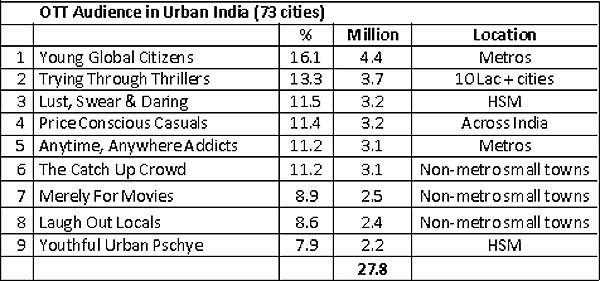
    Ormax Media launched the first edition of its Ormax OTT Audience Report 2019 with a promise to conduct similar reports year on year. In its first report, Ormax analysed the viewing behavior by preference of content watched and divided the urban OTT audience into interesting segments of nine different types.


    Source: OTT_AudienceSegments_OrmaxMedia__1_.pdf


    The onslaught of Covid-19 and the national lockdown forced them to miss the opportunity of conducting field research in 2020. But Ormax was back in 2021 with the 2021 report based on a 12,000 sample size across urban and rural India. As per that report, OTT audience universe in India in 2021 stood at 353.2 million (35.32 Crore) people. In other words, the penetration of OTT viewing was of 25.3% of the population, “which means that one in four Indians watched online videos at least once in the last one month”. The report was aligned to other syndicated media research and presented analysis of the universe by gender, age, NCCS, pop strata, states and cities.  This second report elevated OTT from a niche medium to a mass medium with huge prospect for further growth. It was possible to calculate reach of the OTT medium in different target audiences for the first time. The report also revealed that in 2021 there were 353 million OTT users in India of which 40.7 million were paying (SVOD) audiences accounting for 96 million active OTT subscriptions. In other words, each unduplicated paying audience member was subscribing to 2.4 OTT subscriptions on an average. This SOVD audience were dominated by male members who constituted 66% of 40.7 million.


    Last month, Ormax Media released The Ormax OTT Audience Report 2022, which has some interesting insights related to viewing habits of OTT audiences including content watched in different languages. The latest report is based on a sample size of 6,000 SVOD and AVOD audiences in urban India, and is probably India’s largest profiling study of the streaming /OTT audience.


    The report has revealed that Indian SVOD viewers use the dubbing and subtitling options on their OTT platforms and watch content in four to five languages on an average, while AVOD viewers watch in at least two languages, primarily due to less content options available to them. AVOD viewers watch a lot of content on YouTube where no dubbed content available.


    Content in the four South Indian languages have a large audience outside their home states, 88 per cent Malayalam SOVD content viewers and 82 per cent Tamil SOVD content viewers are respectively from outside Kerala and Tamil Nadu.


    This research also has highlighted the difference in preferences for content between SOVD and AOVD audiences.  The latter do not prefer to use web series instead they want more of shorter formats, like comedy scenes, songs, knowledge videos, including recipes, education and health, and films.


    The research has predicted that the next level of growth of SOVD viewers would come from small towns as 60-70 per cent of the top six metros’ population has already converted to SVOD audience, making the metros a near-saturated market. The male domination of the SOVD audience segment continues which may be due to other socio-cultural reasons and not just financial independence of women.


    On the whole, The Ormax OTT Audience Report 2022 has opened up a new vista of opportunities for content strategy and content creation for the Indian OTT platforms. It is interesting to note that Ormax media so far has not repeated any research on OTT audience in India, but has looked at a new concept for research every year to provide the users in the industry with either better estimates or in-depth insights.


  • Mr B, please note: Govt may slap Rs 5mn fine on habitual offenders from amongst celeb endorsers. Plus ban for 3 years

    By Our Staff


    The Central Consumer Protection Authority (CCPA) under the Department of Consumer Affairs of the Government of India has notified ‘Guidelines for Prevention of Misleading Advertisements and Endorsements for Misleading Advertisements, 2022’ with an objective to curb misleading advertisements and protect the consumers, who may be exploited or affected by such advertisements.


    The guidelines seek to ensure that consumers are not being fooled with unsubstantiated claims, exaggerated promises, misinformation and false claims. Such advertisements violates various rights of consumers such as right to be informed, right to choose and right to be safeguarded against potentially unsafe products and services.


    The CCPA has been established under section 10 of the Consumer Protection Act, 2019 for regulating matters relating to violation of the rights of the consumers, unfair trade practices and false or misleading advertisements which are prejudicial to the interests of public and consumers and to promote, protect and enforce the rights of consumers as a class.


    In exercise of the powers conferred by section 18 of the Consumer Protection Act, 2019, to CCPA, the Guidelines were notified


    Misleading advertisement has already been defined under section 2(28) of the Consumer Protection Act, 2019.


    The present guidelines define “bait advertisement”, “surrogate advertisement” and clearly provides what constitutes as “free claim advertisements”.


    Keeping in view the sensitiveness and vulnerability of children and severe impact advertisements make on the younger minds, several preemptive provisions have been laid down on advertisements targeting children. Guidelines forbid advertisements from exaggerating the features of product or service in such manner as to lead children to have unrealistic expectations of such product or service and claim any health or nutritional claims or benefits without being adequately and scientifically substantiated by a recognised body. The guidelines say that ads targeting children shall not feature any personalities from the field of sports, music or cinema for products which under any law requires a health warning for such advertisement or cannot be purchased by children.


    Disclaimers in advertisements play a pivotal role from consumer perspective since in a way it limits the responsibility of the company. Therefore, guidelines stipulates that disclaimers shall not attempt to hide material information with respect to any claim made in such advertisement, the omission or absence of which is likely to make the advertisement deceptive or conceal its commercial intent and shall not attempt to correct a misleading claim made in an advertisement. Further, it provides that, a disclaimer shall be in the same language as the claim made in the advertisement and the font used in a disclaimer shall be the same as that used in the claim.


    Similarly, guidelines have been laid for duties of manufacturer, service provider, advertiser and advertising agency, due diligence to be carried out before endorsing and others. Guidelines aims to protect consumer’s interest through bringing in more transparency and clarity in the way advertisements are being published, so that, consumers are able to make informed decisions based on facts rather than false narratives and exaggerations.


    Penalty for violating the guidelines are also clearly outlined. CCPA can impose penalty of upto Rs 1 million on manufacturers, advertisers and endorsers for any misleading advertisements. For subsequent contraventions, CCPA may impose a penalty of upto Rs 5 million. The Authority can prohibit the endorser of a misleading advertisement from making any endorsement for upto one year and for subsequent contravention, prohibition can extend upto three years.


    The guidelines can be viewed at

    https://consumeraffairs.nic.in/sites/default/files/file-uploads/latestnews/CCPA%20Notification.pdf

    PS: So, why did we put Mr B in the headline. Well, he’s a favourite of our friend Kamla. Yes, Kamla’s Pasand 😉


  • It’s raining monies at the IPL 2023-07 media rights auction


    By Our Staff


    There’s a popular reality show on general entertainment channel Colors called Khatron ke Khiladi. It requires contestants to perform daredevil acts, including tasks with snakes and scorpions, jumping off helicopters. And walking the tightrope. Literally.


    Now, veteran media professional Uday Shankar who has invested a fair deal in Viacom18 is now set to do a Khatron ke Khiladi act himself (lest it’s missed, the ‘fair deal’ pun was intended). The word ‘khatron’ should of course not be construed in the negative sense, but it’s just that what Shankar has bet really big on with the digital IPL win making him a ‘khiladi’ of the really big stage.


    Every summer, at the beginning and end of the cricketing extravaganza when the revenues will be aggregated, there will be an intense sweating, like it’s on the reality show. We should add the word ‘perhaps’ after ‘there will be’. Coz surely this is more than just playing fear factor. Unlike 2018 where he was an employee of Star, now he’s an investor in the project. So we can be sure there’s a method to the bidding.


    So, let’s get past the foreplay. Disney Star India and Viacom18 have bagged the TV and digital rights for the five-year 2023-2027 period of the Indian Premier League (IPL).


    The Board of Control for Cricket in India (BCCI)’s media rights for IPL 2023-27 will – as of now – generate Rs 44,075 crore, up from the Rs 16,347 crore paid by Disney Star for 2018-2022. An official statement from BCCI is awaited.


    Package A (television rights for Indian sub-continent) has netted it Rs 23,575 crore


    Package B (digital rights for Indian sub-continent) has got it Rs 20,500 crore


    Package C sundry digital rights have already touched Rs 1800 crore. The final outcome is awaited


    Package D rights results are also awaited


    It may be remembered that the entire television and digital rights were owned by Disney Star India until this year. In fact after bagging TV rights for 2023-27, Disney Star challenged Viacom18 in a fresh round of the e-auctions. Finally, Viacom18 took the big leap and closed the bidding with Rs 50 crore per match as its fee. Disney Star will need to pay Rs 57.5 crore per match for television. Overall, as of now, BCCI will earn Rs 107.5 crore per IPL encounter.


    During the media rights auctions that were held on June 12 and 13, TV rights fetched Rs 23,575 crore for broadcast rights and Rs 20,500 crore for digital, said people tracking the media rights auction.


    What’s balance is Package C and Package D rights, the results of which will be known later today (June 14).


    According to industry sources, ad rates will go north by 20-30 per cent on both digital and television. Industry commentators say the IPL 2023-27 dynamics will see a structural change happening in the media landscape. Linear television is going south in terms of viewership, and digital consumption is going to leapfrog. However, even though digital can allow micro-targeting, ad revenues are still found wanting. The play will surely be in the case of subscription-led revenues, and given that Viacom18 is part of the Reliance Industries stable which owns the Jio telecom network, there will be synergies.


  • Ranjona Banerji: No way back. We’re broken

    Ranjona BanerjiBy Ranjona Banerji


    If India is broken, the India media is broken.

    We have now lost all sense of right and wrong, of legal and illegal, of truth and lies, of power and helplessness.

    Across North India – and sadly, this has happened largely North India but there are repercussions all over our nation – “journalists” and media people dance on the debris of the bodies, lives and demolished homes of Muslims. And on rule of law, property, jurisdiction, human rights and democracy.

    And their danse macabre continues when Muslim journalists are targeted by the state. The glee increases if the journalists are Muslim and women.

    Senior journalist Saba Naqvi is this time’s target. She is one of people named in an FIR over the diplomatic debacle after former BJP spokesperson, Nupur Sharma, abused Islam and the Prophet in a TV show. The FIR against Naqvi is for promoting enmity, inducing to commit and offence and deliberate acts to outrage religious feeling. Others in the list are known hate-speech offenders of the most criminal variety.

    Naqvi’s crime? She retweeted something and then deleted it. She faces another FIR for a deleted tweet from earlier this year. And her name was included in the appalling ‘Bulli Bai” auction of Muslim women by young Hindu men and women.

    Several media organisations have protested against this FIR against Naqvi and statements have been issued by the Press Club of India (meaning Delhi) and the Delhi Union of Journalists. However, one hears that within the media community in Delhi our Modi-loving colleagues are angry at these statements and the support shown to Naqvi. Grumbles of how “Hindus must be avenged” are swirling about.

    Are we surprised? Not once in the past eight years have India’s journalists stood together when one of their own has been killed, abused, arrested by the state or the state’s henchmen. So, it’s a tall order to expect support for a mere FIR.

    Those of us who thought the media divide was bad in the late 1980s and early 90s during the Ram Janmabhoomi movement were living in a fool’s paradise it seems. Things are so much worse now because all the checks and balances are gone. After the demolition of the Babri Masjid by the RSS’s cohorts in 1992, many of the media’s outright Hindutva supporters vanished back into the woodwork.

    But since 2014, they’ve grown and multiplied. A new generation of journalists is now in charge. Some care not about democracy and rule of law nor about a free and secular India. Others are in it for as much material gain and power as they can squeeze out. And both categories are avid supporters of the RSS and BJP. Whether by personal belief or for personal profit.

    At the top of the pyramid, giving these bigots ample support is the old guard. Some are those who were too cowardly to put their bigotry up front in their day. Others prefer to maintain an “objective” front, which means looking back in history to find analogies in previous governments which can then be used as an excuse by current supporters of the regime. Both are as dangerous.

    Open bigots are easier to understand than these sly champions of destruction.

    You can see how no action has been taken against the TV anchors who encouraged Nupur Sharma. They are the same breed who will not speak up for the Naqvis of the world. They are the same breed who apparently believe that the correct “punishment” for rioting is the bulldozing of your property. Am interested to know how they would have responded if in 2002 the homes of rioting Hindus in Gujarat had been bulldozed? Or of the Hindu perpetrators of the Nellie massacre of 1983? Or of the Hindu rioters of Bombay 1993?

    There is one more tragic lesson for journalists here, those who sit permanently on the fence: eventually, there will be no one to speak up for you. Those whom you support with your “both sides-ism” do not care what happens to you. And those who will speak up are being picked off one by one.


    Ranjona Banerji is a senior journalist and commentator. She writes on MxMIndia on Tuesdays and Fridays. Her views here are personal.
     

  • Das ka Dum with Dr Bhaskar Das | In the entire Layer’r Shot ad controversy, while everyone is gunning for the advertiser, what about the media entities which aired it? Aren’t they as responsible? And liable?

    Bhaskar DasIt’s a question that needed to be asked, given that there have been murmurs that the media entities are as liable for the contents of everything they air. Let’s hear it from Dr Bhaskar Das in the June 14 edition of Das ka Dum. Read on…


    If you wish to access the archives, please go to the Das Ka Dum tab on the website’s top navigation bar.


    Q. In the entire Layer’r Shot ad controversy, while everyone is gunning for the advertiser, what about the media entities which aired it? Aren’t they as responsible? And liable?


    A. I think all concerned parties need to take the onus for creating communications (read advertising) that have repercussions on society at large. There are three actors when a communication is developed, viz: the client, the creative and media planning and buying agency and the media house. There needs to be some checks and balances at every level so that an appropriate control system can gets activated at relevant points of time. The million dollar question is that can liberty of creativity give us the licence to caricaturise sentiments and be oblivious of human dignity? The community involving all three players need to introspect on the subject.


  • Vahdam Teas appoints Sneha Beriwal as CMO

    By Our Staff


    Vahdam Teas has appointed Sneha Beriwal as Chief Marketing Officer. She will lead the entire marketing function at Vahdam India globally and will report into the Founder/CEO Bala Sarda.


    Said Sarda: “I’m very excited to welcome Sneha to our team. She has joined VAHDAM at an exciting time of growth and brings a tremendous amount of marketing expertise with her. As Chief Marketing Officer, she will be leveraging her capacity for storytelling and brand building to help the company usher in the next level of growth.”


    Added Beriwal: “I am excited to partner in Bala Sarda’s vision of building a Global brand from India. Vahdam has all the ingredients ready for creating a very unique and compelling brand. The vision, the product and the ambition to create something global is a combination that’s unique to Vahdam, and that is what has excited me to join Vahdam. I want to use my experience in brand building, storytelling and focusing on the customer and contribute to this growing purpose led organization.”


  • Charul Tomar is Head of Strategy @ OMD

    By Our Staff


    Media agency network OMD has appointed Charul Tomar as its new Head of Strategy.  In her new role at OMD, she will be spearheading impactful, strategic initiatives across the board, building upon existing strengths, and driving the next stage of OMD India’s growth story while working with key stakeholders to build a strong, strategic foothold in the region. She will be reporting to Anisha Iyer, CEO of OMD India.


    Speaking on the appointment, Iyer said: “We are stoked to have Charul on board with us. She is a fine strategic leader and frontrunner when it comes to having a pulse on the confluence of consumer, brand and insights. Her appointment comes at a time when OMD India is undergoing significant momentum and one that is fuelled by the most promising talent in the industry. I am certain that Charul’s valuable expertise, combined with her drive and commitment, will help us take our offerings to new heights. The future looks promising!”


    Added Tomar: “Sharp strategic management is always at the heart of every successful business. I am truly excited to be on board with OMD India, chiefly due to their commitment to futureproofing and their ability to adapt and innovate in an ever-changing marketplace. The agency exudes a strong vision and energy on the back of an exciting 2022 it has had so far, and I look forward to leveraging my experience to formulate game-changing strategies and deliver scalable business solutions, all while keeping empathy and attention at the core of what we do.”


  • Qyou Media partners with OnePlus

    By Our Staff


    Qyou Media India has partnered with OnePlus, giving OnePlus TV users access to its IP channels – The Q, Q Marathi, The Q Kahaniyan and The Q Comedistaan.


    Commenting on amping up its digital footprint in India, Krishna Menon, Chief Operating Officer, QYOU Media India, said: “Connected TV platforms as a medium are witnessing an explosive growth in India. As a young entertainment brand, making digital-native content available for viewers on linear TV, provides us with an opportunity to open doors to millions of viewers and also give our content a place and platform of its own. We believe that as a disruptive and differentiated brand, expanding our digital footprints with major Connected TV platforms such as OnePlus TV will further bring us one step closer in becoming a holistic entertainment brand in India.”


    Added Navnit Nakra, OnePlus India CEO and Head of India region: “Providing a truly immersive and intelligent smart TV experience to our community, is the central focus of the OnePlus smart TV portfolio. We are thrilled to partner with QYOU Media, and this association will provide our community access to unique content curated by digital creators from across the region, further elevating the viewing experience for our users.”


  • TV9 Network announces launch of Mega Thought Fest

    By Our Staff


    TV9 Network  has announced the launch of a two-day ‘thoughtfest’ titled ‘What India Thinks Today Global Summit’ to be held in New Delhi on June 17 and 18.


    The summit will bring together over 75 leading international and national speakers from the field of politics, governance, economics, healthcare, culture and sports.


    Union home minister Amit Shah will deliver the keynote address on June 17. Defence minister Rajnath Singh will launch the proceedings on June18, Day Two of the summit. In all 15 Union cabinet ministers will share their vision for India. Chief Ministers drawn from across the country will also speak. Former premiers David Cameron of Hamid Karzai of Aghanisation will also speak.


    Speaking on the occasion, Barun Das, CEO, TV9 Network said: “With this summit, we intend to catalyse interesting conversations, discussions and deliberations that hope to show a blueprint of India’s journey to become the leader of the new world. The journey isn’t without challenges. But the goal is as sacred as it is ambitious, driven by strong leadership, collective will and commitment of the entire nation. The ultimate aim of this event is to generate ideas and thoughts through free-wheeling discussions to achieve a common objective of India becoming the ‘Vishwa Guru’.”