Author: mxmadmin

  • AdsOnIPL21: Welcome distraction from the doom & gloom

    Vikas MehtaBy Vikas Mehta


    I waded into a discussion today about staging IPL with the virus raging all round us. I may sound too simplistic but with all the doom and gloom news which we all are exposed to, much of it at a personal level too, the IPL is a much required distraction and a break. Just like the football leagues have been in Europe during the second wave. And besides the matches one also gets to watch many new old fashioned ads. So, I decided to base my re-view today on the ads which have in some way entertained us. Not just made us smile but also involved and wanting to actually re-view it. (Now you understand why I have been writing review with a hyphen!).


    The first such ads that come to my mind is the Phone pe series of ads. They are short, sharp and highlighting the many generic benefits of UPI payment. Sure, the benefits are generic but these ads are appropriating the benefits for Phone Pe with delightful vivid demonstrations, without the need for any audio. And the one ad which did use some dialogue was done very smartly with the play on the word scan. My personal favourite though was the one with the two Bengali women angling for that one last Sandesh. For once, my choice was backed by my Gen Z sample.


    Finolex pipes. Not really a consumer product but I think they have done an entertaining job with Sehwag in the series of ads. And a very bold twist to the narrative has been added with the thought of “Jo cheez chalti rahti hain woh kahan yaad rahti hai.” What an interesting twist to long-lasting. Though what my Gen Z sample loved was the product shot at the end. Pipes and fittings in the form of a throne on which Sehwag is sitting for the sign off. A real nice touch, indeed for a boring simplistic looking product.


    I did speak about the MPL ad in one of my reviews earlier. I think they have done a good job of taking Hindi proverbs regarding brain and then using these to explain how one can use the MPL ad without too much of brain power, read thinking. Another reason I found these entertaining was because they take a diametrically opposite stance to Dream 11, specially the Dhoni ads which urges people not to use brains for excuses, lying etc but to use it to make the Dream 11 fantasy teams.


    Incidentally, I do have a question for MPL. What about the comprehension of these ads in south Indian languages? Do they have similar language idioms? Dear readers, any suggestions?


    The Groww ads were intriguing. The whole concept of giving up something close, like your child or a product one developed for nothing is thought provoking. But the link with the product was a bit weak. But hey, this re-view is about entertaining ads. Not necessarily effective. But you know why my Gen Z sample loved it. The line. Invest kar. Kuhud grow kar. Not karo. The irreverence of the line was entertaining for her.


    The Gulabjamun wale uncle ads of Swiggy were also entertaining. The guy has become a brand symbol or mnemonic for Swiggy and his losing his own identity is a nice twist.


    Sadly, I found not many other entertaining ads. No, I do not find Cred entertaining. Except for Dravid, which was more of a surprise and shock than entertain, the rest have no entertainment or even relevance factor for me. And that Zumba ad was a joke, right?


    But there is hope. We haven’t yet hit the halfway point also and I just get a feeling that some entertaining ads are on the way. Keep reading this column for some more.
  • AdsOnIPL21: Ads on Ranveer Premier League

    Vikas MehtaBy Vikas Mehta


    Come on IPL, BCCI and the communication agencies. After all that brouhaha about the IPL amidst a raging pandemic, about those players earning in millions and not caring about the millions suffering, the best response you had was to rehash an old hashtag, get your commentators, most of them from a bygone era, and get them to wag a finger at the public asking them to follow protocols. That’s what the government, media, doctors, epidemiologists have been doing for weeks. What makes you think that some ex-cricketers now commentating will mouth the same things and that will be heard? Ok, I did see some current players of some franchises doing the same, but does it really appeal? In advertising, we say that a good piece of communication is knowing the difference between desired response and stimuli. And that’s what exactly is the problem with the #unite2fightcorona campaign. As they say in Urdu: nasihat nahin, jazba dikhao. My Gen Z sample asked me to translate this. Frankly, no translation can do justice to it.


    While this was a tough week, with some close people falling prey to the pandemic, the Ranveer Premier League had its moments. The Lloyd refrigerator ad, the Lloyd AC ad, the innumerable JD Mart ads, the insufferable Jio Fiber ads, the My Circle 11.com ads…….incidentally the tag isn’t mine but I picked it up in a FB conversation. And it left my Gen Z sample in giggles.


    This summer is seeing a resurgence of fan ads. And guess what. All fans have become hi-tech. They do not start with the switch of a button. And even a remote is passé. Now it is all about voice command. I too am left-mouth agape at this huge leap of technology, like the kid in the Havell’s fan ad. When most of the ACs are still into remotes, fans seem to have leapfrogged them.


    And talking about ACs, with all the news about how ACs are not only spreading the virus but also helping it keep alive, trust AC manufacturers to come up with virus resistant or self-cleaning technology. Did I say that I saw a fan ad too, claiming to keep the virus away and also an ad for a cooler with the same claim? Sigh! one cannot just switch off the pandemic even if one wants to.


    Two ads featuring Virat caught my eye. One was, you guessed it right, for an AC. The Blue Star AC has Virat showcasing his dancing talent and he did a good job about it. But what I liked was the small super at the end. Owned by Virat, loved by Virat. That’s to shut up the naysayers like my Gen Z sample, who believe that stars endorse but do not use. I am sure when I will have dinner with Virat at his palatial apartment in Worli, Mumbai next, I shall be seeing Blue Star ACs around. Got you there for a moment, didn’t I?


    The second Virat ad was the new Vivo phone ad. Just when I was wondering why had Vivo renewed its sponsorship with no ad or any major news, it has finally introduced a new model, which is all about a selfie in dark become magically well-lit. The ad has banked on the sentiment of Virat becoming a father very appropriately and the vivid demonstration of the need for a lamp being obliviated by the night selfie feature came through very interestingly. It worked for me and my Gen Z sample too found it not just interesting but a bit mushy mushy. Aw! so cute.


    With summers on, can the soft drinks category be far behind. Well, let’s leave that for next week. What say?

  • AdsOnIPL21: Akal Badi ki Ads?


    Since there are enough and more new ads around IPL 2021, Vikas Mehta comes up with a bonus add-on to his weekly column


    By Vikas Mehta

    Vikas MehtaTrust my Gen Z single sample to ask me a pointed question during the IPL. How do the Indian  cricketers get to shoot ads? Aren’t they in some bubble and get transferred from one bubble to another? We hear them moaning about the mental agony of the bubble, but every few months, they do manage to somehow augment their incomes with new ad campaigns. Bubbles notwithstanding.

    This re-view is dedicated to the new ads during the IPL featuring our cricketers. Past and present.  Last weekend the match between Delhi Capitals and Chennai Super Kings was touted as the match between guru and shishya. Dhoni vs Pant. I carried this imaginary rivalry into the ad world while watching the ad for Indigo Paint with Dhoni and then the one with JSW Steel bars (boring, uninvolved, irrelevant category) with neither me nor my Gen Z sample being the intended target. Frankly, the brand decision in both categories, paints and steel bars, is heavily dependent on the middle men and of course our budget, but paints has come a long way and why can’t steel bars hope to go the paint way. Specially when JSW is one of the main sponsors of DC.

    For me, this battle was won by the shishya. The two JSW ads have managed to not only exploit Pant’s personality but have also communicated the brand benefit woven into an involved storyline. The guruji’s ad unfortunately was a damp squib which was content with the typical celebrity formula. Show Dhoni in the ad and the rest will follow. And this in an ad for floor paints. Usually all paint ads are about walls. I think so much more could have been done with Dhoni and floor paint. My Gen Z sample  made another pertinent comment. So many Dhoni ads, he is an old man now (I guess I am vintage for her) shouldn’t the brand make his ads about his experience or his knowledge. Clearly the Gen Z sample is totally influenced by the Gen Z shishya.

    I did re-view Dream 11 last time but as has been the case always, I am now swamped with more fantasy team ads. So, I turned to my Gen Z sample for help. Let it be known that she is an expert on fantasy team contests having participated and won in some EPL contests. For her Dream 11 was the Indian cricket team, My Circle 11 was Dada, MPL was Virat Kohli and Howzatt.com was Yuvraj. Phew! Some clarity.

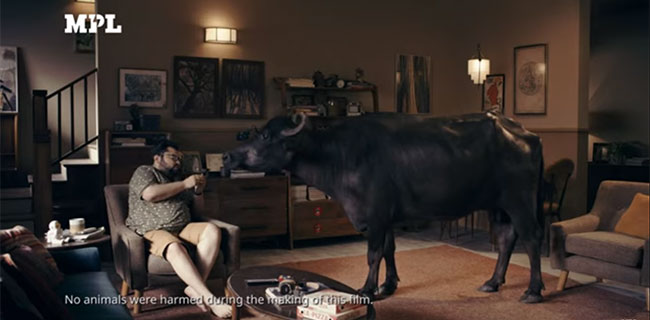
    MPL though have not used Kohli this time. They have done a literal interpretation of the Hindi proverb “Akal badi ki bhains” (is the brain better or a buffalo! No disrespect to both, please!) and it seems that currently the bhains is winning. I liked the ad because it clearly implies that making your fantasy team is so easy that you do not need to use your brains  to make the team. And it in its own way does take a dig at those short ads for Dream 11 which have Dhoni asking people to use their brains not on buttering your boss or your father but on choosing a fantasy team on Dream 11. Nicely done. My Gen Z sample though did not agree with me. Because she had never heard of the Hindi proverb. You cannot win them all, I say.

    My Circle 11 has roped in Ranveer Kapoor. Maybe Dada did not have enough time with his health issues, so Ranveer is now the co-anchor. And I do think I saw Rahane in one ad too. And me thinks that the ads have been done in a rush. Looked tacky and depended on Ranveer to announce a new promotion. But I do think that in the next few weeks we shall have more ads from My circle 11. I do hope so. Cannot re-view the current ones. What a waste of Ranveer, is the only comment from my Gen Z sample.

    The Yuvraj led Howzatt.com ads sounded familiar. Trust Gen Z sample to come to my rescue. She gently reminded me that the promotion was similar to My Circle 11 ads of beating the teams chosen by Dada, Watson, Rashid etc to win more money. Guess somebody has got me in plumb. Howzatt?

    And before I sign off I thought I saw another fantasy team ad for a new brand which was being endorsed by K Rahul. My head is now totally spinning with so many fantasy team ads, all around cricket. All using cricketers, ex and present. But my Gen Z sample had the last word, better than watching phone ads or ecommerce ads or those perpetually smiling Dhoni ads.

  • AdsOnIPL21: Ranveer Singh, the Dhoni equivalent of film stars in adland

    Vikas MehtaBy Vikas Mehta

    Since my last article was all about the cricket folks, can the film stars be far behind? Here is a re-view of the new IPL ads featuring our Bollywood folks.

    Let’s start with the ubiquitous Ranveer Singh Bhavnani. He is fast becoming the Dhoni equivalent of our filmy stars in the ad world. JD Mart, Jio Fiber, Lloyd fridges, MPL etc. I am sure I have missed some. In JD Mart, he is doing what many Indian Bollywood actors have done before. Caricaturing various stereotyped Indians. Bengali, Maharashtrian… and in Jio Fiber, he does the same except for donning a local dress and then breaking out into some grotesque dance moves while the bewildered cricket stars watch him, out of sympathy. Sheer waste of talent and hardly adding any value to the brand. Lloyd fridge is better but that maybe because he plays second fiddle to Deepika. Does the brand seriously expect to break through the refrigerator ad clutter with two Bollywood stars talking about the large storage capacity and efficient cooling? My Gen Z sample has the last say on this: I don’t think Ranveer can be bettered than in the Star Sports EPL ads. Typical Gen Z exaggeration?

    One ad which really stood out for me was the Tisca Chopra ad for Behrouz Biryani. I thought she was graceful, understated and classy adding value to the premium brand. And while I am writing this, I see the second ad in the series. Difficult to do an encore on the first one. My Gen Z sample just shrugs off the ad “Their Biryani is anyway damn good”. Such nonchalance, I say. At this rate, Gen Z will sound the death knell of the 30-second ads.

    And then I am hit with the “Pan Masala’ category ads. Or do they call it the flavoured elaichi category nowadays? Zuban Kesari has done a good job in appropriating the flavour but do I buy Zuban Kesari or… what was the brand name again? Or is it an Ajay Devgan ad and now a combo offer of Messrs Devgan and SRK? Someone must have told the brand owners that they are sick and tired of re-viewing Mr Devgan for the last two years. So, the communication was refreshed with the addition of SRK. But we the viewers have to now endure two aadaabs and decide who out does the other. My Gen Z sample who till a few years ago was an SRK fan thinks that the Devgan style has a much better cool quotient. The verdict is out.

    Messrs Devgan and SRK are taken. That leaves the two other Khans. And sure enough, one gets to see a haggard-looking old Salman dancing to tashsan ka jashan for Rajshri Elaichi. Will Aamir now rise to the Elaichi occasion?

    On a serious note, why are the old stars still dominating the ads? That’s not me talking, but my Gen Z sample. Why do the brands not use Lily Singh, Amit Bhadana or Liza Koshy or Carey Minati? I am nonplussed. Never heard of these people. Turns out these are Youtubers with fan following in millions. And they are young. Well, younger than even Mr Bhavnani who is 35.

    My counter to this was to point out the Lux Cozi ad with Mr Dhawan and then Ms Bhat and Mr Dhawan in ads for Frooti. Nah, I am told. Frooti ads are all the same Are these new? And why does the end super say Live the Frooti life when it’s always been about about fresh and juicy. So confusing. I cannot explain that. So, I meekly turn to the Lux Cozi ad, with no hope. And my Gen Z sample size looks at me incredulously as if to say ‘even a 100 Dhawans would not have saved this ad.’

    I decide not to ask the Gen Z sample about the garish-coloured Priyanka Chopra ad. Was it for Appy Fizz or B Fizz? But then I am dealing with Gen Z. “Now that’s a cool ad. Isn’t PC looking glam?” Folks, meet the Appy Fizz TG.


  • Review of AdsOnIPL21: Week 1

    IPL 2021's Television Broadcast Sponsors
    IPL 2021’s Television Broadcast Sponsors. Image from Star Sports Twitter handle


    By Vikas Mehta


    Vikas MehtaWhen the IPL season is on, my evenings are booked. For two events. The match and the new commercials that accompany every new season. Actually, when I was asked to re-view them, I did a double-take as I would be re-viewing them anyways right through the season.


    But first some disclaimers. For those who do not agree with my re-view, I am not the target audience, as hardly any ad is targeted at 50-plus Tier 2 city resident! But those who agree with it must give the credit to my Gen Z daughter (my advisor for such re-views) as many ads nowadays seem to be targeted to them.


    Ok, forget the second disclaimer for this re-view. The new series of Dream 11 ads. I think they are actually targeted at the nostalgic millennium generation and even 50-plus like me. To me, Dream 11 has always captured the essence of gully cricket. And so does this new series. It’s about the fun of working in a team. And what has really worked for me is how this time all the star cricketers have seamlessly blend in as gully cricketers. The cricketers are so natural and so unstarry. And such skilled performances. Usually, the cricket stars cannot spare much time for such shoots, so they come across as uncomfortable or unprepared. But here, Messrs Dhawan, Dhoni, Sharma, Pandya appear so natural and part of the script. Plus, the choice of the background songs: nostalgic and so apt. I can review these ads just for the songs.


    And then you watch the same people, Messrs, Sharma, Hardik etc in the ad for Jio Fiber and you hope that this one should not be re-viewed. But I suspect many more such avatars with more stars will be reviewed before the season is over. I have always felt that Jio is a great product which has thrived inspite of its advertising. And, yes, my total sample size one, of Gen Z, also washes its hands off this ad.


    Now this is a new one. I had never heard of this brand before Upstock, no, Upstork, no, no… Upstox… no, yes, my Gen Z sample says yes. So, is this ad targeted to them? Irrespective, it’s a cliched one. So difficult, so easy routine (must be very difficult to do such ads). But I did like the escalator one. Three decades ago, when I first one to Heathrow, I faced a similar dilemma, albeit on a horizontal walkway. I did get my Gen Z audience giggling when she heard my travail. But the ad??


    The last IPL had ads from a new brand, Cred and they were noticed and created waves (Upstox, are you listening?) They used film stars whom Gen Z has hardly heard about and it reminded me of a term that I always associated with porn. Self-flagellation. I mean why would Messrs Bappi Lahiri, Anil Kapoor or Madhuri Dixit enjoy being portrayed as caricatures of themselves? But the brand was noticed. As was the message. Forget all song and dance, just remember a good product. Much was written about the ads and soon the brand and its purpose were well-recalled. Also, they did a nice tie-up of actually showcasing people who received 100% cashback on credit card bill by using Cred, across the matches. Jargon-speak: it was believable testimonials (another disclaimer: I did try Cred and paid a whopping bill through them… but guess I am destined only for GPay Rs 3-Rs 5 cashback). So, I deduced that the Cred strategy (sounds important) is free publicity and going viral (tip: going viral can never be strategy).


    I therefore did a double-take when I saw an ad with the cool Mr Rahul Dravid becoming the Monster Man. But what is the message? Our product is as unbelievable as Mr Dravid’s anger? And when I opened the local Hindi daily on Saturday morning (reminder: I live in a Tier-2 town in the Hindi belt), it had an article on Mr Dravid losing his cool. Guess viral as a strategy does work.


    If you liked this re-view, do share and like the article so that the editor allows me to do another review next week.


    Vikas Mehta is a former marketing communications professional who has worked in India and abroad on many local and MNC brands. Currently, based in Dehradoon, he has his own consultancy and is also associated with some B-schools. His views here are personal

  • Das ka Dum with Dr Bhaskar Das | You’ve made the switch from legacy media to meta. Before you say because it’s the future, how about a field like agriculture? For a country like India, it’s the past, present and future?

    Bhaskar DasWe’ve been reading a fair bit on agriculture in the recent past, and thought we would provoke our Wizard with Words with this question. But no such luck. As always he had a ready response. Here’s Dr Bhaskar Das in the May 31 edition of Das ka Dum. Read on…


    If you wish to access the archives, please go to the Das Ka Dum tab on the website’s top navigation bar.


    Q. You’ve made the switch from legacy media to meta. Before you say because it’s the future, how about a field like agriculture? For a country like India, it’s the past, present and future? And also an area where your creative strategising will work?


    A. It’s not about me. It’s about something new thing happening in the world which could usher in a transformative period. There’s a shift from centralised to decentralised models in every area of life, whether it’s about individual or society. So, whether it’s media or agriculture, technology can create new networks, slowly and surely. In one thing today and in many things tomorrow. Especially when one knows how a problem has to be strategically resolved keeping in mind consumers’ challenges and how technology can resolve it in the safest and effective way.


  • Socxo brand advocacy platform launches Socxly social marketing tool

    By Our Staff


    Socxo, the Bengaluru-based brand advocacy platform, has announced the launch of Socxly, an organic social marketing platform of products.


    Speaking on the new product Socxly, Sudarsan Rao, Co-Founder and CEO, Socxo said: ‘We realized that content/social marketers were underutilizing the power of social media and were dependent on multiple tools to run their organic content posting on their social pages. Socxly is an attempt to offer a single point solution to marketers for all their ‘organic social marketing and campaign’ efforts and along with its core tool Socxo, to increase the value of their content marketing by further distributing/amplifying through trusted influencer/brand advocacy.”


  • No KitKat break. Zenith retains massive Nestle media biz

    By Our Staff


    There are some who would’ve hoped that Nestlé  India would practise what the adline of its bestselling brand Kit Kat preaches: ‘Life Hai. Kit Kat break banta hai’. But no such break in its Media AOR relationship. The Publicis Groupe-owned media agency Zenith India has been retained as Nestle’s agency of record. The business, notes a communique, was won in a highly competitive multi-agency pitch which began in April this year.


    Zenith has been handling Nestlé’s media planning and buying business, across all segments since all of 17 years. It was appointed as the packaged goods company’s AoR back in 2005. The mandate includes the full range of duties – that’s offline media, online media, commerce, SEO and analytics.


    Said Jai Lala, CEO of Zenith India: “We are delighted that Nestlé has once again chosen us as their media partner and it’s a clear endorsement of our strong ROI approach and ability to deliver marketing excellence and innovation. The retention is testament to the rock-solid working relationship we share with Nestlé and indeed we are proud of the industry-leading work we’ve produced for them over the course of many years. Zenith has deep and inherent understanding of Nestlé’s business needs and the strategic direction of its brands. Our teams were able to demonstrate unique insights, integrated approaches and data-driven decision -making. We look forward to harnessing the best of our capabilities, talent, technology and partnerships and helping Nestlé build even more powerful consumer connections.”


  • Ranjona Banerji: Someone trying to cover their nether regions?

    Ranjona BanerjiBy Ranjona Banerji


    That Times Now uses its platform to abuse Muslims and other religious minorities in order to support the BJP’s Hindu supremacist agenda is not new.

    But evidently and this is certainly curious, there are some lines which someone somewhere in Times Now feels should not be crossed. Or more probably, someone in their legal team woke up from a long snooze.

    Last week, in a “debate” on Hindu religious symbols being found in the Gyanvapi Mosque and subsequent court rulings, a BJP spokesperson made very offensive remarks about Islam. Times Now highlighted these remarks and the back-and-forth in a tweet to promote the show.

    Mohammed Zubair of the fact-checking site Alt News, posted Times Now’s own clips on Twitter and called out the spokesperson Nupur Sharma for her bigotry and hate. As Zubair’s tweets were amplified, Sharma blamed Zubair for the death threats she was receiving.

    This deeply upset Times Now “editor” and the anchor of the show, Navika Kumar, no stranger to spreading hatred against religious minorities and who had categorically not stopped Sharma during her diatribe.

    Kumar tweeted that “no one has the right to threaten anyone” and that “death threats are unacceptable”. Fair enough. An honourable sentiment. Although Kumar is rarely bothered when Muslims get death threats from Hindus or indeed when they are actually murdered by Hindutva mobs.

    Anyway, “death threats are unacceptable”. We all accept that.

    But this is where the events of May 27 went a bit off the rails.

    Inexplicably Times Now issued the following statement on Twitter: “Views expressed by BJP spokesperson on Newshour @ 9 last night are her personal views. TIMES NOW does not endorse views of participants. We urge participants in our debates to maintain restraint and not indulge in unparliamentary language against fellow panellists.”

    The earlier tweet from Times Now promoting the show was shown as deleted.

    Strange. Very strange.

    Some cases were filed against Nupur Sharma. Zubair of Alt News also received death and other threats after Sharma blamed him, and that did not upset Navika Kumar at all. Death threats are perhaps sometimes acceptable?

    Rahul Shivshankar, also “editor” and anchor of Times Now later put out this curt tweet: “If anyone has a problem with what Nupur Sharma has said, please approach the court. There is a due process. That is for the courts to judge. TIMES NOW does not endorse the view of any of its panellists.”

    (Readers please note: I am not responsible for Shivshankar’s grammar.)

    Evidently, some lawyers stepping in somewhere.

    It is highly unlikely that Times Now’s senior management had any epiphany about stopping the spread of bigotry and hatred. If they wanted that, they’d have sacked their star anchors. Instead, they’re trying to cover their nether regions.

    BJP fans on Twitter then went on twin rampages. The first was to viciously attack Zubair, who only retweeted Times Now’s own tweets. And then, to protect Nupur Sharma. In typical fan manner, they decided to support the eponymous editor of a toxic BJP propaganda website. Obviously for the Twitter world, she is better known than the spokesperson. It is unclear therefore whether these fans watch Times Now at all, or else they would have known that this Nupur Sharma is not that one.

    Meanwhile, in India the monsoon is delayed, inflationary rates are rising, joblessness also rising, the prime minister is being promoted for lying and doing nothing. You know, business as usual.


    Ranjona Banerji is a senior journalist and commentator. She writes on MxMIndia every Tuesday and Friday. Her views here are personal

  • How American media reports on Muslims

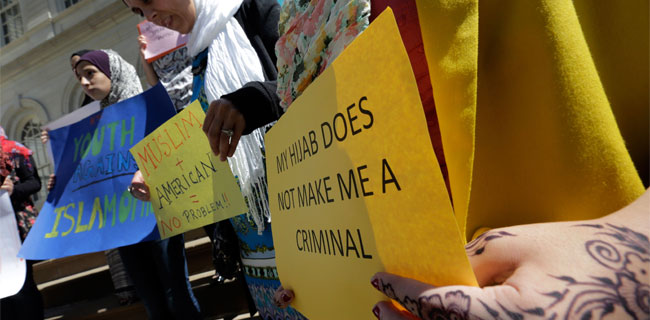
    Students with the Muslim Consultative Network’s summer youth programme gather on the steps of New York’s City Hall on Aug. 14, 2013, to speak out against Islamophobia.
    AP Photo/Richard Drew


    By Erik Bleich, Middlebury & A Maurits van de Veen, William & Mary


    The warm welcome Americans and Europeans have given Ukrainians in 2022 contrasts sharply with the uneven – and frequently hostile – policies toward Syrian  refugees in the mid-2010s.


    Political scientist David Laitin has highlighted the role that religious identities play in this dynamic. As he pointed out in a recent interview, Syrian refugees were “mostly Muslim and faced higher degrees of discrimination than will the Ukrainians, who are largely of Christian heritage.”


    The media provide information that shapes such attitudes toward Muslims. A 2007 Pew Research  Center survey of Americans found that people’s negative opinions on Muslims were mostly influenced by what they heard and read in the media. Communications scholar Muniba Saleem and colleagues have demonstrated the link between media information and “stereotypic beliefs, negative emotions and support for harmful policies” toward Muslim Americans.


    To better grasp the evolution of media portrayals of Muslims and Islam, our 2022 book, “Covering Muslims: American Newspapers in Comparative Perspective,” tracked the tone of hundreds of thousands of articles over decades.


    We found overwhelmingly negative coverage, not only in the United States but also in the United Kingdom, Canada and Australia.


    Negative coverage of Muslims

    Previous research has identified widespread negative media representations of Muslims. An overview of studies undertaken from 2000 to 2015 by communications scholars Saifuddin Ahmed and Jörg Matthes concluded that Muslims were negatively framed in the media and that Islam was frequently cast as a violent religion.


    But the studies they reviewed leave open two pressing questions that we address through our research.


    First, do articles touching on Muslims and Islam include more negative representations than the average newspaper article? Second, are media portrayals of Muslims more negative than articles touching on other minority religions?


    If stories about minority religious groups made it to the news only when they were involved in conflict in one way or another, then they may be negative for reasons that are not specific to Muslims.


    What we found

    To answer these questions, we used media databases such as LexisNexis, Nexis Uni, ProQuest and Factiva to download 256,963 articles mentioning Muslims or Islam – for which we use the shorthand “Muslim articles” – from 17 national, regional and tabloid newspapers in the United States over the 21-year period from Jan. 1, 1996, to Dec. 31, 2016.


    We developed a reliable method for measuring the positivity or negativity of stories by comparing them to the tone of a random sample of 48,283 articles about topics drawn from a wide range of newspapers. A negative value on this scale means that a story is negative relative to the average newspaper article.


    Crucially, this approach also provided a baseline for additional comparisons. We collected sets of articles from U.S. newspapers relating not only to Muslims, but also separately to Catholics, Jews and Hindus, three minority religious groups of varying size and status in the United States. We then assembled stories linked to Muslims from a broad array of newspapers in the U.K., Canada and Australia.


    Our central finding is that the average article mentioning Muslims or Islam in the United States is more negative than 84% of articles in our random sample. This means that one would likely have to read six articles in U.S. newspapers to find even one that was as negative as the average article touching on Muslims.


    To give a concrete sense of how negative typical Muslim articles are, consider the following sentence that has the tone of the average Muslim article: “The Russian was made to believe by undercover agents that the radioactive material was to be delivered to a Muslim organization.” This contains two highly negative words (“undercover” and “radioactive”) and implies that the “Muslim organization” has nefarious goals.


    Articles that mentioned Muslims were also much more likely to be negative than stories touching on any other group we examined. For Catholics, Jews and Hindus, the proportion of positive and negative articles was close to 50-50. By contrast, 80% of all articles related to Muslims were negative.


    The divergence is striking. Our work shows that the media are not prone to publishing negative stories when they write about other minority religions, but they are very likely to do so when they write about Muslims.


    Beyond comparing coverage across groups, we were also interested in coverage across countries. Perhaps the United States is unique in its intensely negative coverage of Muslims. To find out, we collected 528,444 articles mentioning Muslims or Islam from the same time period from a range of newspapers in the U.K., Canada and Australia. We found that the proportion of negative to positive articles in these countries was almost exactly the same as that in the United States.


    Implications of negative coverage

    Multiple scholars have shown that negative stories generate less favorable attitudes toward Muslims. Other studies that looked at the impact of negative information about Muslims also found an increase in support for policies that harm Muslims, such as secret surveillance of Muslim Americans or the use of drone attacks in Muslim countries.


    In addition, surveys of young American Muslims have found that negative media coverage resulted in weaker identification as American and in lower trust in the U.S. government.


    We believe acknowledging and addressing the systemic negativity in media coverage of Muslims and Islam is vital for countering widespread stigmatisation. This may, in turn, create opportunities for more humane policies that are fair to everyone regardless of their faith.


    Erik Bleich, Charles A. Dana Professor of Political Science, Middlebury and A. Maurits van der Veen, Associate Professor of Government, William & Mary.


    This article is republished from The Conversation under a Creative Commons license. Read the original article.


  • The Hindu extends partnership with Taboola

    By Our Staff


    Taboola has announced the extension of its partnership with The Hindu. The partnership has been extended for the next two years which will see The Hindu to earn those extra revenues. And also offer readers – some intrusive and some not-so intrustive content on prime website real estate.


    Said Suhaib Husain, Head Programmatic Digital Sales, The Hindu: “We are immensely excited to continue our ongoing partnership with Taboola. Their product offerings have added value to our publication by driving user engagement, improving experience and grow revenue. We are looking forward to our continued association to drive value for our readers and create new avenues for growth.”


  • HiveMinds wins digital marketing mandate for Kuvera

    By Our Staff


    HiveMinds Innovative Market Solutions, the digital marketing specialist of Madison World ,has won the digital marketing mandate for Kuvera, an investment platform.


    Said Gaurav Rastogi, Founder and CEO, Kuvera: “At Kuvera we are creating a safe space to invest for every Indian. We believe that HiveMinds’ category understanding and strategy can really drive the next phase of our growth.”


    Added Jyothirmayee JT, Founder & CEO of HiveMinds, “Digital investment platforms are driving a sea change in the way Indians invest. Kuvera is riding this wave through product innovation, an agile platform and customer onboarding at scale. We’re happy to be associated with the team and look forward to creating new benchmarks in growth together.”