Author: mxmadmin

  • Cheil launches Olympics campaign for Samsung

    By A Correspondent


    Cheil Worldwide has produced a commercial for Samsung Electronics to mark the London 2012 Olympic Games. The commercials talk about how through Galaxy S III, the anticipation, excitement, and celebration of the Olympic Games are shared with everyone.


    This spot draws on the sense of excitement generated by the launch of the 2012 London Olympic Games and the Samsung Galaxy S III. It shows people all over the world waiting expectantly for the games to begin and then exploding into life when David Beckham launches the games using his Galaxy S III. Ordinary citizens can share the Olympic spirit as much as a professional athlete using the Galaxy S III.


    It embraces all races as an expression of humanity. David Beckham kicks a ball against a drum, signaling the beginning of the world’s biggest sporting event. Then virtually everybody, over the ground and under the ground, gets into the Olympics.


    It is shown that even those who don’t have the tickets can enjoy the Games through Samsung Galaxy S III’s mobile technology anywhere, so the global IT giant invites everyone for the London Olympics. One can even share Beckham’s footage using S-Beam function, a nifty phone-to-phone wireless transfer.


    The English footballer, who is also an Olympic ambassador, has already endorsed Samsung smartphones. Throughout the whole campaign, the mobile brand bases its Olympic marketing activity around an “Everyone’s Olympic Games” theme. Cheil has successfully visualized Samsung’s “humanized technology”, which understands our life needs and can tangibly be experienced in our daily lives.


    “London 2012 is the first Olympics where television will no longer be the dominant medium; our film shows how the new Galaxy S III opens up the games for everyone to enjoy, in a variety of different ways, thanks to the phone’s multi-functions. More than just a sports spot, we aim to show how, more than ever before, it’s ‘everyone’s Olympic Games”, said Wain Choi, Global ECD of Cheil Worldwide.


    “This will be the first truly ‘social’ Olympics. We wanted to use one of the most recognised sportsmen in the world (David Beckham) to invite the world to participate in these games as never before, through the incredible technology inside the Samsung Galaxy S3. Beckham literally ‘kicks off’ the excitement, hitting a huge gong with an amazing long range shot, as all the world looks on,” added Logan Wilmont, ECD of Cheil UK.


  • H&R Johnson rebrands bath-fittings & sanitaryware biz as Johnson Bathrooms

    By A Correspondent


    H&R Johnson (India), the tile, bath and kitchen company, has rebranded its bath-fittings & sanitaryware business as Johnson Bathrooms. This rebranding is part of the company’s efforts to ramp-up the Johnson Bathrooms Business by investing in capacities as well as market reach.


    The rebranding to Johnson Bathroom reflects a definitive shift of H&R Johnson (India) from product marketing to solutions marketing with emphasis on product innovation and after-sales service, a key deliverable towards achieving customer delight. The “solutions marketing” emphasis will form a key thrust area to further boost revenue growth for Johnson Bathrooms division.


    Commenting on the refreshed brand identity of its bathroom products business vertical, Chief Marketing Officer, H&R Johnson (India) Mr R Kurup said: “The rebranding of the bath product business to Johnson Bathrooms is an effort to create a strategic refresh of the business vertical as we seek to scale-up Johnson Bathrooms business through investments in capacity building, enhancing market reach, focus on introducing new innovative products and provide greater impetus to solutions marketing over mere product marketing. As part of this process, we have set-up a pan-India solutions marketing service team.”


    The company has put in place a pan-India service infrastructure team to service the customers’ post purchase requirements. The company has invested nearly Rs40 crores in ramping up manufacturing capacities.


    Further elaborating on the new brand identity for Johnson Bathroom, Mr Kurup averred: “The new brand identity Johnson Bathrooms rides on the strong market equity & service commitment of Johnson brand. The identity mark is designed using Black & Red visuals to signify vibrancy while being coherent to the flagship brand’s identity.”


    During the last fiscal, this business vertical contributed Rs103 crores to H&R Johnson revenues of Rs1,729 crores. The company will support this rebranding exercise with a 360 degree marketing campaign.


  • Brand Rajnikant to move beyond cinemas…

    By Sangeetha Kandavel


    Rajnikant, the movie star who has never lent his name to any commercial activity so far, will do so for the first time with Anjana Reddy, part of the family that owns the Deccan Chronicle group.


    Anjana’s celebrity commerce firm Collectabillia, which is already working on brand tie-ups for Rajnikanth’s upcoming 3-D movie Kochadaiyaan, will extend the Rajni brand beyond the realms of entertainment.


    The appeal of Rajinikanth, 61, the Bengaluru-born bus conductor-turned- hero, goes beyond the boundaries of his adopted home Tamil Nadu and the Tamil film industry. He keeps a very low public profile and has never endorsed any brand. Collectabillia, founded only a few months ago, has tied up with cricket icon Sachin Tendulkar and India’s number one woman tennis player Sania Mirza on a similar mandate, Anjana, 24, said.


    “We are working on extending their brands beyond their respective careers. This doesn’t include endorsements,” she said.


    In perhaps Rajnikant’s first deal, Karbonn Mobiles will launch an exclusive range called Rajinikanth Kochadaiyaan mobile phones, which will hit the market when the film is released. A Karbonn spokesperson confirmed that the Indian mobile handset maker plans to sell about five lakh Rajinikanth Kochadaiyaan mobile phones.


    Anjana, who holds a masters degree in finance from the University of Illinois, is the vice-president for business development at Deccan Chronicle. She is the daughter of Vinayak Ravi Reddy, the vice chairman of Deccan Chronicle that has defaulted on its debt and seen its short-term borrowings being downgraded by CARE earlier this month.


    Over a 35-year career and 150 films, Rajnikanth’s reach spans thousands of fan clubs from the remotest parts of Tamil Nadu to Japan. On the internet, his mannerisms and style have triggered a huge collection of outlandish factoids, much like for American actor Chuck Norris.


    “An example of what we are doing is what the Olsen twins with professional help from Beanstalk have been able to achieve. They have set up a billion dollar business which hasn’t got anything to do with their movies or acting careers,” Anjana said.


    Part of the Omnicom group, Beanstalk is known for its work on brand extensions, including developing actors Mary-Kate and Ashley Olsen’s lifestyle programmes and extending a consumer brand into the restaurant space with the Harley-Davidson Cafe.


    The idea has its genesis in Anjana’s meeting with Rajinikanth a few months ago regarding Kochadaiyaan. “Rajni sir put me on to (his daughter) Soundarya. That’s when this branding idea sparked we wanted to do something different which hasn’t been done in the market so far,” she said. “Rajni is a global brand and I am looking at global sales. He has a market everywhere right from India, to the Middle East to North America.”


    Soundarya is directing the movie, which is slated for a December release. In the West, celebrity-branded products have been around for decades. In the early 1990s, Elizabeth Taylor lent her name to the ‘White Diamonds’ perfume of Elizabeth Arden. Recent examples include rapper 50 Cent lending his name for a vitamin-water brand, former NBA star Yao Min’s launch of his own wine label and Lady Gaga’s association with the Fame perfume brand.


    In India, however, it’s still early days for celebrity commerce. Brand consultant Harish Bijoor said there are some efforts on “but most of them turn out to be celebrity managers who swear by their own celebs and can force-fit any brand offering onto them.”


    Source:The Economic Times

    Copyright © 2012, Bennett, Coleman & Co. Ltd. All Rights Reserved


  • Starcom tops RECMA’s global billings rankings, OMD is #2

    By A Correspondent


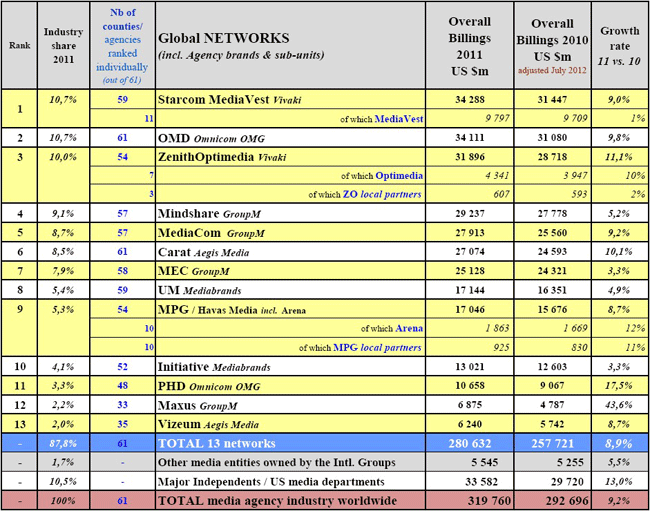
    Media agency analyst RECMA has announced the publication of the 13th edition of its Global Billings Rankings report. As many as 865 agencies in 61 countries were evaluated and all the data (10 different indicators for each agency) were consolidated in a pivot table.


    Industry indicators point to a sustained growth (+9.2 per cent) – a lower rate than in 2010 though (+13.8 per cent) – partly fueled by the continuing development of Digital activities within the agency core business.


    In the global network ranking 2011, Starcom MediaVest Group holds the lead it took over OMD last year but with a very tiny gap (less than $0.2m). SMG increased its billings by +9 per cent (or +$2.8bn) while OMD posted a +9.8 per cent overall growth (or +$3bn).


    Four networks recorded a double digit growth (vs. 11 networks last year): Maxus (+43.6 per cent), PHD (+17.5 per cent),ZenithOptimedia (+11.1 per cent) and Carat (+10.1 per cent).


    As the undisputable industry leader, GroupM showed a below-the-average growth rate with uneven performances across the regions: low billings increase in the USA(+5 per cent vs. +10 per cent on average) but high in Asia-Pacific (+$2.3bn).


    Internal hierarchy of the four WPP media networks remains unchanged: Mindshare, MediaCom, MEC and Maxus. The latter increasing its share thanks to strong performances in the USA (where it has doubled its billings), the UK and Germany.


    On July 12, Aegis agreed to be acquired by Dentsu.  The takeover of Aegis by Dentsu provides is a perfect geographical fit and does not have any impact in the billings tables of this report.


    However the addition of Dentsu Media Japan to Aegis Media’ global billings would allow this new Group to reach the third rank ahead of Omnicom Media Group (statement based on an estimated billing figure of $bn 10 for Dentsu Media Japan (about a quarter vadpends).


    The full report is accessible to subscribers at www.recma.com via My RECMA link.


  • TAM’s set for Digitization: L V Krishnan


    If there ever was a poll in the television industry professionals to name the one entity that impacts their business the most, it will not be the Government of India which has, mercifully, been taking a backseat in recent times. It’s TAM Media Research of course since it manages the ratings. Heading TAM since October 2000 has been LV Krishnan. Other than the owners and a few professionals at some of the networks, he has been one of the few constants in the business. And that puts him in a vantage position as the Indian television industry gets set for its big leap into digitization. Although delayed by four months in the four meros, digitization can indeed alter the course of the broadcast business in the country.


    In an interview with MxMIndia’s Pradyuman Maheshwari,  Mr L V Krishnan speaks on how TAM Media is getting set for the new world, the investments he’s making for the 650 boxes in the four metros and 20% increase in staff and most importantly the opportunities for smaller, niche players post-digitization. For once, we are not publishing excerpts from the interview, but nearly the entire transcript given the nature of the content and the benefit of the industry. Here goes:


    With just a little more 100 days left for the new Sunset Date, how is TAM getting ready for digitization?

    Actually for us, the July 1 was the date when digitization was supposed to happen. So, we expected it will hit that date and things will move forward from there for at least the four cities. We didn’t see the four cities as the big issue clearly because there was a certain percentage which had converted into digital in the last three years as a slow-burning exercise.


    As per a TAM Study, as on Jan 2012, Mumbai already had touched a digital penetration of 25% and Delhi touching with a score of 20%. The other two metros, Chennai and Kolkata were lagging behind.  Interestingly, if we look at those same figures in first week of June 2012, those same numbers for Mumbai had shot up to 35% and Delhi to 26%. Chennai and Kolkata which were lagging behind as of January had by now touched around 24%.


    Awareness in the markets on digitization was really high. In Kolkata there was 90%+ awareness level, Delhi and Mumbai had close to 80%. So, from the awareness and on-going installation perspective it was going very smoothly. Except that there is a gap between the awareness and the actual set-top box induction into homes. So, at TAM, we expected that all will culminate on June 30 when the sudden peak happens. And we expected digitization to hit close to 60% by June 30 if the deadline had been kept in pace and implementation went rampant. So that’s how our panel was also moving forward. The TAM panel hence is already 35-40% digital homes in these markets, especially in Mumbai and Delhi.


    Now once the digitization hits in, we are expecting three things to happen.

    1) The access to long-tail channels (many of them with unique content targeting viewer segments) which means the channels which are not presently seen on TV screens due to bandwidth issues at the operator’s end suddenly jump up. Therefore, the number of these long-tail channels will grow significantly.


    2) There will be an initial 8- to 12-week period when audiences are going to try new genres or new channels before they settle back to the list of favourites.


    3) There is going to be higher growth in time spent in other day parts in various segments of audiences which you don’t see much in the present analog era.


    So, considering these things in our analysis, we have planned out an expansion of the TAM panel in the four metros by an addition of almost 50% of homes. The objective of the expansion is to give a boost to more sample viewers to these long-tail channels, enabling more robustness in the data we provide to users.


    More than 50% homes in Delhi, Mumbai, Chennai and Kolkata?

    Yes. An additional 650 homes.


    And this is in line to the announcement you had made earlier. (see TAM to cross 10,000 Peoplemeter mark soon @ http://www.mxmindia.com/?p=22044)

    Yes, the announcement that we made in the month of June about the expansion of the sample size.


    You just said that 20 days before the deadline, 35-40% digitization was achieved. So if digitization had to happen by July 1, there was a fair distance to be walked?

    Ever since the digitization exercise started on the ground, TAM began to conduct a baseline study. The once-a-year baseline study we release on digital penetration every Jan has now become almost a monthly study from May 2012 just to gauge the digital penetration in the four cities. The first wave encompassing 12,000 homes in the study across the 4 cities was ready three weeks prior to the deadline of July 1. This showed that while the penetration levels in a market like Mumbai were 35%, we were on way to touch a 60% mark of digitization if we had kept the pressure up through the month of June 2012 (since awareness levels for digitization were over 80%). We had the entire month of June left!


    Do you think the path for digitization has slowed down again?

    The growth certainly seems to have slowed down as per our present on-going baseline study.


    Are you optimistic about the Oct 31 deadline?

    There was a clear momentum in May and June because there was communication happening at an overall industry level to consumer about the impending digitization. I haven’t seen any new communication about the new deadline and will have to check the data to see if new communication informing consumers about the new deadline of digitization has started or not. In the absence of the lack of new communication, obviously the demand of those boxes is not going to come up immediately. It will only get pushed from platform owners – DTH or cable operators – to push the box into the home by telling consumers about the Nov 1 deadline. Given that there was 90% awareness in markets like Kolkata and 80% in markets like Delhi and Mumbai about digitization happening on July 1, the conversion could have been much higher if the date had not been pushed. The minute you push the date there is a slack in demand. Now we need to bring back that awareness of Nov 1; it requires that much more inventory-burning from broadcasters to make that awareness. And at the same time, synchronize it at the local level to make the consumer buy into the set-top box. It’s another big task.


    Back to the 650 additional boxes, when will that happen?

    We had kept the time between July and December, keeping in mind the July1 digitization as obviously, all these new panel homes too will be in the digital end of the market. Now with digitization being pushed back to Nov 1, while our present panel will automatically align to the new digital universe, we will have to ensure that for these new additional panel homes being recruited, the profiles we select are in alignment with the new digital universe profiles too (via using our baseline studies again). That may require some additional time. Work is in progress.

     

    You have three levels of data currently – analogue, CAS and DTH, will you now have four levels of data?

    In markets like Mumbai and Delhi, there is already Terrestrial, Analogue cable and Digital (which has representations of Digital cable and DTH). What will happen is that analogue cable will get phased out completely after Nov 1 and what will exist is only Digital cable and DTH. The only interesting fact is that, the DAS is applicable to the city part in the phase I, it’s not applicable to the Urban Agglomeration (UA) part of the city. So for the city part from a TAM perspective, whatever is reported will be for Digital, because any analogue signal will be considered as pirated signal automatically and cannot be reported as per the legislation. How much of the digital happens in the UA part as it does not fall under the phase I exercise, will have an impact on overall city reporting. So if UA part becomes 100% Digital too on Nov 1, then there won’t be anything called analogue data for the 4 cities.


    But it’s going to take some time, right, since UA part goes digital only in 2013?

    Part of UA is in Phase II and part of it is going to Phase III as per the legislation. But we see digital conversions happening in UA part too presently.


    A city like Delhi also has a complex UA…

    Delhi has NCR. So how much of it gets converted after Phase I, we will have to watch through our baseline. My guess is, Delhi is much easier than Mumbai and Kolkata.


    You mentioned about the channels which are in a sense on periphery now in analogue but will now get noticed. How equipped are you for this since the extent of data you will crunch for the larger number of channels will leapfrog?

    Because more long-tail channels are going to become accessible, but those channels base level viewers are going to be minuscule in nature.  So, to bring in more sample viewers to these long-tail channels is why we are boosting up the sample numbers in these four markets so that they also have equal opportunity to grab viewing that mainstream channels have.


    The interesting eventuality of digitization is distribution parity. This itself will ensure that every channel will have equal opportunity to get sampled by the viewer. Now given this distribution parameter as constant, the preference of the viewers will be based on the following parameters:


    1. Inheritance of loyalty – today what I watch is what will get carried over in the digital era given the fact that content is not going to change but it’s only the accessibility that is going to increase.


    2. Marketing and the promotional effect – The one who yells the loudest will get the largest walk-in. The bigger strength of network stations will emerge out in digital phase than the independent stations. Clearly, because the independent stations will not have the bandwidth to talk to larger segment of the population and address it through marketing and promotional campaign.


    3. The buoyancy of viewing – the large accumulation of family members will continue to drive viewing patterns dramatically. Digitization is not going to bring about a revolution in number of TV sets in the home, it’s only going to increase the bandwidth on the same TV sets already accessed by the family.


    So all these things will ensure that on one hand while accessibility is created in distribution, the present set of genres that capture larger set of viewers, will not change dramatically even in the digital era unless and until some of the smaller channels start shaking out of being independent to start joining networks or using the networks to become more dominant.


    Which is what the job of a bouquet is… and we also have a bouquet for independent channels in existence in the form of Prime Connect. To give you an example from print, the magazines crib that the readership survey is unable to monitor niche publications and how they are read and consumed. Given that a lot of niche channels will come up, how well these are going to be measured?

    It will happen in three stages, in order to capture the unique content channel’s viewing patterns.


    The stage 1 is when we are doing the base line studies. We had done this study in June and will continue it in July and August, September, October, November. It will roll on till the end of the year to get an essence of how the things are changing on the ground and we’ll keep reflecting that change in the panel. It will be like a mirror data set.


    In this baseline exercise, we are also capturing the most important data which is called the tier-packages that homes are subscribing to in the digital era. In each tier, we are also capturing the kind of channels that are coming into those tier packages. Now if we start looking at the kind packages that are getting developed and the kind of subscription those packages are fetching, we see that packages are centered either around Kids Content (in only homes with Kids as household members), language (regional flavour adding to it) or lifestyle (which is to do with premium channels per se) or it could do to with functional content (which is to with education, food etc.). So when you look at these tier packages brought into a home, we see that it is centered towards fundamental variables like availability of Kids in the home, Language spoken in the home or the lifestyle that they lead in home. And if these fundamental parameters that are assigned to purchase of tier-packages are already built in the sampling plan itself, then there shouldn’t be any conflict at all between the growth in tier packages vis-a-vis the data we report for Unique Content channels. We already have variables like Kids presence in the Home, Language Preferred in the Home as fundamental variables in our panel home selections.


    And is this data is from TAM study?

    Yes. So, for example, when we do the measurement, we are already planning and selecting homes in such a way that the proportion of families with kids are taken care of in the base sampling. The proportion of different languages in the city of Mumbai is also taken care of. Hence when we have the fundamental variables already in place in the base sampling plan itself, the variables that will affect purchase of tier packages at consumer end is already taken care of. Now what could be happening is that there may not be enough viewers that might exist in the panel while reporting a channel within a small unique content genre. So than you do boosting in specific target segments, keeping in mind the variables we can weight back to the Universe. Hence in a larger sense, these additional set of homes we are introducing in the panel across the four metros post digitization is to give a boost to the base viewers for these kind of unique content genre channels, which we call as the long-tail channels. Eventually, there will be new specialized genres coming up like Auto genre, Fitness genre, International Travel genre etc. trying to reach out to Unique small segments of audiences. The advantage of digitization is that you can talk to segmented audiences without worrying about the spill-over effect to audiences not connecting with that type of Content. As the scenario pans out, the panel is getting ready to capture these kind of future audiences too.

     

    And we are going to have a la carte too so if a neighbour tells me that I should try out Channel X, I can subscribe to just that… Therefore, there could be a boost in terms of reach for a channel after a few months of digitization starts which will also need to be captured.

    Yes. Actually what you are seeing is a trend among the homes that have got digitalized. In fact, most of the homes presently have gone for either the basic tier with language channels or for all the channels that are available. The minute the digitization comes into play full force, they’ll make sure that the channels they want are all there plus any other host of channels the operator is providing, so there is no clear cut-off limit. The reason is that, they might want to experiment with what they like and what they want to explore so after some time, they might go back to the operator and say these are the actual list of TV channels they would want (and not want) and therefore, is there a package you can give us or you want to give us a full-fledged bouquet of all channels put together.


    Presently, from the Digital Homes data, the accessibility of channels have increased tremendously but consumption of these long tail channels haven’t grown in similar proportions.


    As digitization starts maturing and audiences start coming up with preferences according to the likes and dislikes of family members, this is where we are going to see the biggest impact of Digitization and the need to get ready in the future to handle such customers by the Broadcast and Distribution community. Audiences will start selecting channels and creating preferential set of channels they want to watch and those channels may not be mass audience genres in nature. We will be using the baseline data plus the subscription data that comes from operators to tell us that which kind of profile of audiences are choosing what kind of packages and see how we want to make them inclusive in the Peoplemeter study.


    Ok, what if a new channel comes up catering to just Class 10 ICSE students… that’s not going to have pockets in terms of location. How do you plan to grapple with issues like these?

    In the sampling plan, we are ensuring that there is enough representation of homes with kids in the age band of 4 to 9 years and 10 to 14 years age. But it is important here to realize that Peoplemeter measurement is not the only way and the final way of measuring audiences. Hence the reason TAM is already working with couple of Digital TV platform owners and exploring the usage of STB in measuring audience behavior for channels broadcasting Content in Unique genres. Gradually, as Digitization grows and segments get created in viewing patterns, there will definitely be other forms of data available to gauge viewing behaviour from TAM.


    I am not worried about channels that are seeking audiences that are mass segments of population or segments that are language oriented in nature or catering to specific demographic segment of population…because those are things that are already taken care by panel that we have built in already. I am looking at channels that are closeted towards specific kind of audiences. Like a sport that may be among a certain class of audiences who may be playing and watching that particular game – those kind of homes may be too small to get represented fully in a panel. Maybe there are few in the panel that are watching that sport and also playing it but they may not be enough sample size to represent that kind of audience. That’s where we will continue working with Digital platform owners and help in unraveling the behavior patterns of that specific group of audiences. In this regards, we have already taken the first steps towards unearthing these kind of information for future.


    In the case of channel selection to a panel, it is choice made by TAM or does the channel pay for it?

    The fact that the channel in a genre is existing and viewed by specific kind of audiences means that it gets reported in TAM. But in the coming months, the TAM Measurement Science unit along with their international counterparts are giving this rule a hard look. There may be minimum cut-off requirements for new channels and some existing channels in very small genres to qualify for reporting in TAM on a regular basis. The white paper is being presently under discussion and will be discussed with the industry members before it comes into implementation. Of course, subscription to the service of TAM has nothing to do with a channel getting reported or not. The data reporting will continue to be operated as per set international guidelines and norms governed by the Measurement Science team.


    It is just about four metros right now in the Phase I of digitization, but as we go forward, do you anticipate greater complexities?

    In terms of geography growth, yes, it is going to be a much harder task to ensure 100% compliance to digital in hinterland markets. But the interesting aspect of digitization presently is that, its penetration is higher in mmall towns and rural segment of population than in urban areas and the metros. So in a way, by the time the legislation hits these small markets, 50% of homes could have anyway got digitized already. First, we should get this process started in the four metros. The benefits of digitization needs to be experienced and then communicated to help other markets see the exercise in the right light.


    On the consumer front, there is much more homogeneity in the TV viewing behaviour than the heterogeneity we observe in various other segments. Whether it is eating food at home or clothes we wear, there is much more diversity among families in those areas compared to the homogeneity that exists in TV viewing. 80 per cent of what constitutes TV viewing will get constrained by the top 30 or 40 channels, even though the accessibility can go upto 500 odd channels in the home (as per TRAI guidelines). Because ultimately time spent that dictates channel share will actually get compelled to be limited to those 30-40 channels.


    Now, what makes these 30 – 40 channels preferred by the viewers will be depended on the stimuli which will be based on the content that these channels put in, which has led to loyalty over the last couple of years. Second, from the POV of marketing and promotions, and thirdly, on the kind of pricing they offer as a bouquet. So, I do not see any big changes on that 80 per cent of the viewing time spent presently. But, where we see the alterations in terms changes in viewing patterns is between the channels within the genres and within the remaining 20% of the viewing time for the long-tail channels. Those long-tail channels that have accessibility – they will have to start fighting and come into prominence among the viewers’ mindset to say: hey, I am here can you have a look at me and sample me much more effectively than what you are doing in the early analog world. They will need to start edging towards becoming the 38th or 39th channel from the bottom and enter into the mind space of the viewer.  And how they do that will be will be their forte in marketing, programming, scheduling etc. From our perspective, we will be ensuring that, with the panel expansion, these channels will have more sampled homes to benefit from if they create more base viewers for their content.


    To give you an example of say a Bhojpuri channel that has picked up steam over a period of time…

    True. Suppose the Bhojpuri community is about 3 per cent of our population in Mumbai. Therefore, the sampling process itself will have around 3 per cent of the population being built within that community itself cecause language is one of the variables in which the viewing is done. So when Bhojpuri comes into play and becomes a dominant player – to become a dominant player it cannot restrict itself to be a channel that is getting watched within that community because the 97 per cent is larger than the 3 per cent. Hence they will have to start influencing that 97 per cent community to come and watch Bhojpuri channel. From the community that belongs to the Bhojpuri segment, the viewing will be picked up effectively. But if they want to fight the 80 per cent share, they will have to broaden their inputs / stimuli.


    But a golf channel will never appeal to audience not interested in golf…

    Sure enough, but the fact of the matter is that while there may be a golf-loving community, there is nothing that prevents a non-golfer to watch that content provided there are stimulis that garner his interest to watch it. For example if Big B or a Salman Khan inaugurates a golf tournament or even starts playing in a Golf tournament, there is going to be a follow up audiences who are going to come in and tune to that content just because of the star attraction. Hence, branding need not decide who the audience is going to be, it is the weapon of Marketing and Content that will decide who the audiences are going to be.


    But what does all this mean for the TAM organization? You are looking at 650 boxes, but how many humans….

    For us it is an exciting phase beginning next goal of growth largely. It is going to begin from the expansion exercise that we are planning to undertake but, beyond that it is going to much more in trying to unearth new ways to measure a digital mobile audience and in exploring data by building analytical tools for our users to use the data for business decisions.  So the compounding factor will be how the growth rate of digitization will happen and in which form it takes shape.


    There are newer technologies that come into play, that is, technologies which are moving television, out of home. In that case, we are ready to move with picking up data on in-transit devices like mobile phone or a tablet kind of devices. So it is a kind of anticipation game that we are in to see how things are going to move, which curve digital phase moves into and how consumers are adapting to it so that we have the requisite capability to measure those kind of changes that are happening instinctively.


    And in terms of team strength?

    The good thing about technology is that it takes care of growth in terms of team size which may not be proportionate to the growth in which the technology we implement starts growing. It is more of capability rather than sheer no. of hands per se. So the same person handling one meter technology is now equipped enough to handle two different devices to manage across platforms effectively. So, the 650 meter expansion is not necessarily leading to the increase in number of hands but more in terms of capability of the individual to handle analog measurement as well as digital measurement.


    The sheer number of channels you are going to be handling…

    On the client management side and analytics side obviously there will be much amount of hands that will come into play.


    What kind of percentage…

    At least around 20 per cent more which will happen this year and next year.


    Are there more investments coming into that?

    Yeah! But the biggest investment is the meters, the technology itself because fixing the meters will be proportionately close to 25 to 30 per cent of the existing cost. Then there is the variable cost of running the operation for the additional 650 homes, so effectively there will be close to 50 to 60 per cent higher cost that we will have to absorb to make this exercise happen.


    On whether these are met internal accruals?

    It is presently internal because we believe the fact that it is the need of the hour as digitization comes into play. We need to put them in place to ensure that the data continues to be robust and moving forward usable in a practical way for decision making by small channels. At the same time the cost will be spread across a couple of years for clients so it will be a combined exercise.


    Any areas you think are your challenges in this whole process?

    I think the biggest challenge for us is not the metros, it is the expansion into small towns and rural markets, that is, the future rural market. We have already taken the first step in that direction and we will be releasing the less than Class I data from west and North markets in Jan 2013. This is where the biggest challenge is going to lie for us. Presently, we cover 162 cities with addition of less than class one towns, we will be crossing a whooping 225 to 230 towns. It means the fact that we are touching even towns with population of around ten thousand, which means you are talking about towns with just two thousand homes. So when you look at those kinds of towns, where it is so thinly populated, where every neighbor knows not only his neighbor, but the entire town! So there are security issues that you got to take care of and that is one of the biggest and toughest job that we have on our hand presently.


    So, managing security, connectivity and the inventory are the three biggest priorities that we have in terms of focus points. When I say security, it is the management of security at the ground level which means trying to ensure that the home remains confidential by primarily revolving homes continuously. By ensuring code of norms that each home follows in terms for the security.  Acting in whatever possible manner on MIS that we get from ground, from every town regularly. Connectivity is ensuring that the data that gets picked up by the meter gets transmitted to the head end because GPRS connections are not all that stable in all the markets. Ensuring alternate methods exist for data capturing if the real-time connectivity fails at the service provider end. And third, is continuously upgrading technology and managing the inventory of different technologies, that is, technology working in analogue vs technology working in digital homes. Given the power situation in individual markets, even the hardware that goes along the meters needs to be robust to allow for power flux of varying degrees and ensuring proper power supply to those meters continuously. Therefore to manage these inventories and ensuring that we have right equipment for the right place across 225 locations is becoming an uphill task. But with the right well trained team members and the passion to drive this process day-in and out existing within the team and a big support from our two parent companies – Nielsen and Kantar, we have been able to deliver to cater to the market’s expectations for the last 15 years.


    Have you started speaking to channels who will be coming on board…?

    Yes we are in continuous dialogue with many of them in this course of action and the changes that are expected in the market place. Many of them are seeing this point very clearly the enormity of challenges lying ahead of us in the measurement exercise.


    On the need for some amount of education for the channels on the impact of digitization…

    True there is a huge amount of education that we need to prioritize on. In fact we did some road shows with some clients on the impact of digitization on the channels and what it means from the viewer perspective that changes are expected. Therefore what they should be ready for, some of them are already done, some of them are in the process of being done and some of them will be addressed in the second phase of July – August.


    Do you anticipate any significant changes in the complexion of the data released post-digitization?

    Certain changes are expected to happen but at the end of the day, it depends on the extent to which the growth in digitization happens. We can at best be ready for the change. So far when we say that 35 per cent of homes in Mumbai have got digitized, it has happened over three years time and not over a single day. The subtle changes you see in viewer behaviour are hidden with a time lag that happened in that growth rate. Nevertheless when you look at it at a closer level, there are three or four clear directions that are emerging, which may have a much more profound impact if suddenly on a one single week or one single day the penetration shoots up from a 35 per cent penetration to 60 or 70 per cent digital penetration. From that perspective, the postponement of digitization to November 1 really helps if the continuity of growth in digitization happens like the way it has happened in the month of May and June. Because what it allows is the fact that the user to gets settled with the new equipment at home and therefore his behaviour changes not on a single day, but it settles down over a period of time.


    Like for example, the biggest change in going forward in a digital era is the way a viewer lands on a particular channel. Today, in the analogue world, the viewer lands onto the channel or a genre which is on prime band but tomorrow when he moves to digital, he will be choosing the channel / genre he wants to land on as a first channel. So that itself changes the complexion of the channel he will be landing and the channel he would like to watch. So what is going to happen is that there are certain set of genre that will actually diminish a little bit in reach terms but, will have a much more prolonged time spent because the viewer is wanting to be and stay with that particular genre once he enters into it in a compounded manner. So some of the genres like the GEC’s, kids, Movies are increasing in terms of their engagement level and therefore seeing growth level in a Digital home than the Analog home.  It also offers opportunities for genres to clearly market themselves much more strongly. For example, genres like News, Biz News, Sports, etc will see the growth from a very clearly targeted audience segment once they clearly identify that segment and start communicating to them in a stronger way about their available Content.


    The other advantage of digitization is the positioning of the channel within the genre. For example, sports has a distinctive advantage of being present in that particular channel no. for 24 hours and 365 days and not necessarily have to depend on cricket to drive viewership. So it will have the segmented audience for each sport on the same channel. For sports other than Cricket that the audience might have missed out in the earlier analog world where the genre could have got pushed to a hyper band or probably to oblivion once cricket gets over, the Digital world presents a fresh opportunity to them to connect back to audiences.


    In India we are not going to have too much of a price problem i.e. channels will not be priced very high but, that could also be one of the factors which could determine the choice of channels. True?

    True. Internationally price is a very key factor that plays a role in deciding to which tier of packages is the home going to subscribe to. In India at the initial stage of digitization, it will not be so significant wherein the ARPU’s may not go up dramatically. But with time consumers deciding to choose which packages they want depending upon the need of the family, the decision to look at pricing will be very closely linked to the kind of audience that each channel wants to market. So therefore you are bound to see price changes for genres like Sports, Kids, Movies and some GEC’s. While we may see probably some amount of price flux for genres overall, within genres itself we are going to see top three or top four channels which have high brand equity leading the above genre pack with higher price. This may not only happen on just GEC or Movies or Kids but, also on News or music or Regional stations where each one is going to look at how valuable the brand property is and depending on that give a pricing that may be more impactful than the remaining set of channels in that particular genre.


    You mentioned briefly about getting ready for other forms of viewing in terms of mobile phones. What is that stage of development because we see it happening already…

    From our perspective, we are looking at the measurement itself changing in the longer term. Presently we are led with platforms. That is, we measure TAM for television platform, we do RAM for radio platform etc. That’s today’s perspective, based on the way we look at each medium. But, when we look at it from the audience perspective, they are moving seamlessly across these medium and what they are absorbing is something to do with Video, Audio and Text. So for us therefore if we need to cut away from the platform-centric approach and look at it from a consumer perspective, we need to track consumer seamlessly across platforms. Our measurement is also looking at that in a way that we need to move into the future. So it means the fact that whether you watch Video on Television, or whether you watch the same Video content on a Tablet or Mobile phone device, it is only the devices which are different but, the content remains the same. Therefore it will be an accumulation of audiences across the three platforms that we will start to report one day. This means the fact that the viewing will be for the content with an amalgamation of the all platforms rather than today which is segregated as television separately or radio separately.


    For instance, from what Google and Indiatimes have reported, online viewership for IPL has been fairly good…

    What they reported is the reach number… the number of people who came in to watch the game per se which is equivalent to the reach terminology we use on TV or Radio. The engagement factor (Time Spent) was missing from their reporting or probably I might have missed it. From a data user perspective, the engagement factor reported on TV research is more important to understand the value of the Content broadcast.


    The other perspective of the data sets reported today is that we don’t know whether the online viewers who watched in the digital platform are the same audiences who watched it on television or not and what is the extent of duplication between these two platforms. So that’s where the magic lies in, that if we have the same software tracking all these devices,  we could actually be able to say what is the incremental addon by the digital platforms on to the television platform. So no longer are we chasing or measuring platforms but, we are actually measuring content – in the form of video, in form of audio and in the form of text. That’s the future of measurement coming up soon.

     

  • Discovery Tamil now on Dish TV

    By A Correspondent


    Discovery Channel Tamil has announced that it will now also be available on Dish TV. Already available across all analogue homes, Discovery Channel Tamil is one of the most widely distributed channels in Tamil Nadu reaching over 10 million subscribers.  With availability on Dish TV, the channel expands its penetration in India, targeting Tamil speaking viewers around the country.


    Dish TV, being one of the major DTH platforms will drive Discovery Channel Tamil’s to reach viewers throughoutIndia, especially catering to Tamil population inNorthern India.


    Announcing the affiliation with Dish TV, Rahul Johri, senior vice president and general manager – South Asia, Discovery Networks Asia-Pacific, said: “Discovery Channel Tamil has received tremendous response from the Tamil speaking viewers for its attractive look, engaging and unmatched content. The availability of the channel now on Dish TV demonstrates our commitment to reach viewers around the country and offer them enhanced viewing experience.”


    Nearly one year of its launch, Discovery Channel Tamil, the standalone channel for Tamil Nadu market continues to grow ratings month-on-month. Discovery Channel Tamil is a customized product offering for Tamil viewers. The 24-hour factual entertainment channel has programmes scheduled as per Tamil audience tastes and preferences.


    Salil Kapoor, Chief Operating Officer (COO), Dish TV, said: “Dish TV is proud to provide content in regional language. The latest is the addition of Discovery Channel Tamil on Dish TV platform to our subscribers. The launch of Discovery Channel Tamil will provide us with a perfect offering which will help us serve our Tamil customers in a better way. Dish TV has been a trendsetter in offering its viewers the best content, service and quality.”


  • Arena Animation creates country’s first 3D commercial

    By A Correspondent


    Aptech’s education brand, Arena Animation has created the first 3D stereoscopy commercial. The commercial named as ‘Dudolls’ is the first ever TVC produced inIndiathat has undergone a 3D stereoscopy conversion. It means that the TVC can be viewed on any 3D supported device like 3D cinema theatre and 3D monitors.


    ‘Dudolls’ has been created by the reputed production house, Talking Donkeys for Arena. It shows playful animated characters (named Dudolls) in an Arena centre and the backdrop showcases facilities provided by Arena Animation to their students.


    The TVC is already being aired on many national TV channels. However, the 3D stereoscopy output will be seen in multiplexes in 3D movies. It would be seamlessly built into the ad slot during the 3D films. It is meant for any 3D device that includes television and mobile phones. The advertisement is also expected to run on the 3D televisions of the future.


    The concept is to showcase Animation & Multimedia as a fun and rewarding career.

    The concept has been collaboratively built by the marketing team at Arena & the creative agency, Quadrum Solutions.


    Speaking at the launch, Mr. Ninad Karpe, MD & CEO, Aptech Ltd said: “We have moved a step further in the world of animation with our latest TVC in 3D. It will help us reiterate ourselves as leaders in the animation arena and expand in our category. ‘Dudolls’ just reiterates how animation is gaining prominence and has become a coveted career of the youth.”


    Sonya Banerjee, Marketing Head, Aptech added: “We made a 3D commercial foreseeing the trend in 3D content. Planning on this required a foresight to integrate the 3D vision early in storyboarding stage and not as an after thought.”


  • Ranjona Banerji: How TV and print covered Rajesh Khanna

    By Ranjona Banerji


    The death of superstar actor Rajesh Khanna was felt very deeply by the Indian media. Although Khanna had been largely forgotten in the PR driven-celebrity obsessed circus that we now live in – except for his foray into an ad which many found offensive – his death brought out a tidal wave of nostalgia. Everyone tried to look back on their Rajesh Khanna moments and several actually found them.


    On Wednesday, TV followed its normal procedures, which in the current climate is outrage at various discriminatory procedures heaped on hapless citizens by ourselves or others. But once news of Khanna’s death came in, everything else came to a standstill.


    Is there scope for criticism here? There can be no doubt that Khanna was an enormous star and in his heyday, he was so high as to be untouchable. He was also a bit unfathomable, which made him all the more appealing. Many TV anchors – notably Nidhi Razdan of NDTV and Rajdeep Sardesai of CNN-IBN – found it hard to believe that Khanna did not “reinvent” himself in his later years. Their bewilderment is understandable. In a world where everyone endlessly (apparently) craves for fame, this man retreated once the world moved on. Of course, in Rajesh Khanna’s case this is not really true. He did try a few times to come back but it just didn’t work. Then, he retreated. But facts are often difficult to muster when you don’t have personal knowledge and everyone around you is 11 years old.


    Arnab Goswami jumped into the Times Now studio much before the appointed time but he was clearly clueless about Rajesh Khanna’s days in the sun. Most news channels therefore pulled out the guests they could – Shobhaa De, since the rise of Stardust coincided with the rise of Khanna, Shabana Azmi who acted with him later, Mahesh Bhatt who made his name a little later and Javed Akhtar, who wrote some of his films with Salim Khan (who is almost never acknowledged by the media although he is very much around). Sharmila Tagore was interviewed – she was the star with whom he had his biggest hit Aradhana.


    The biggest confusion was between Khanna the actor and the songs in his films. Few TV journalists seemed familiar with playback singing and the fact that Khanna did not sing anything and the songs in the movies had nothing to do with him. Endearing journalistic naivete or the need for a few more celebrity news anchors from Mumbai?


    However, at the end of Wednesday, one might conjecture that there was no need for TV panel discussions on why Rajesh Khanna was so popular. It’s not the sort of subject that needs to be debated the day a man dies. It’s not even a subject for debate really.


    **


    The newspapers the next day obviously did a more comprehensive job, especially the Times of India since it has better archival resources and institutional memory. It is at times like this that the youth tilt in the media at the moment becomes a liability. Wikipedia cannot give you everything you need to know. Also lack of journalistic imagination is a hindrance – although it seems to be very common – and this was evident in both Hindustan Times and DNA.


    Mumbai Mirror carried an informed and incisive piece by De, best qualified to do so. Mid-Day’s front page headline told us that Jatin Khanna is dead while Rajesh Khanna lives on, a play on the transience of life but the permanence of memory. Indian Express treated it like one more news story.


    **


    Since Khanna’s funeral procession saw unexpected crowds, his death practically overshadowed Rahul Gandhi’s ascension to who-knows-what in the Congress party on Friday morning.


    **


    Outlook’s latest cover is on Barack Obama, headlined “The Underachiever”, mimicking the recent Time magazine cover on Manmohan Singh. It may seem funny at first glance – I thought it was a joke, actually – but it is surely a tad childish. Why should an Indian newsmagazine take up cudgels for the prime minister? Time has a right to its opinion and is not Obama’s mouthpiece. Why should Outlook want to look like the PM’s mouthpiece?


  • Suresh Saraiya, RIP. A commentator with passion

    By A Correspondent


    July 18 was a sad day for many as yesteryear superstar Rajesh Khanna passed away. However, there was another man who left a vacuum in the cricket-frenzy nation.

     

    One of India’s best known cricket commentators Suresh Saraiya passed away on Wednesday following a heart attack.


    He made his debut in 1969 and will be missed by all for his love for the game. “He wasn’t a cricketer and it was his passion about the game that made him what he was,” remembers Ayaz Menon, veteran cricket journalist. Mr Saraiya was a public relations officer in the Central Bank of India apart from being a commentator.


    “His sheer dedication towards the game was admirable. He did his homework well before any game and listening to his commentary was like an education in itself,” Mr Memon adds.


    Agreeing with him, Hemant Kenkre, a former cricketer and commentator and a senior communications professional adds, “His sense was preparedness is what everyone should look up to. He would get into details and know nuances about a cricketer and used them as nuggets which made people feel a ‘connect’ with not just the game but the player as well.”


    The cricketing fraternity as well as the fans who grew up listening to him on the radio are mourning the death of the man who covered more than 100 Tests for All India Radio, for whom he worked for more than four decades.


    According to many, Mr Saraiya enchanted the listeners with his smooth voice and unique style when radio commentary was at its peak in the 1960s and 70s before the advent of television. “There is a huge difference between today’s commentary and that in the yesteryears. Today, we have visuals to support whereas in those commentators’ job was not only to give stats but also paint a picture for the listeners which wasn’t easy,” points out Mr Memon.


    Even microblogging platform Twitter was buzzed after the news of him passing came in. Television commentator Harsha Bhogle tweeted, “I worked with so many commentators – few with his desire and preparation.”


    “Unlike today’s commentators who are former cricketers, his style was very different. One could call him a silent-but-deadly man because of his knowledge about the game and players. And he always encouraged others especially new journalists and freelancers and was willing to teach and educate them about how to follow the game,” recalls Mr Kenkre. “I don’t think there is anyone who would have anything negative to say about a man of his stature. His demise is a great loss to the cricketing world.”


    Photograph: Fotocorp


  • PRomise Foundation set up to evangelize PR

    By A Correspondent


    This may well be the beginning of a new chapter for the world of public relations in India. Although there exist a few PR trade associations, unlike its more glamorous cousin advertising and of course the far bigger media sectors, the Indian public relations industry has lacked unity and direction.


    Enter the PRomise Foundation for Public Relations, set up by group of young professionals across PR firms and corporate communications/PR departments of industry segments. Akshar Yadav (CEO, Centronics Support, New Delhi) and Amith Prabhu (Account Supervisor, Edelman, USA) are founder trustees of the PRomise Foundation.


    The founding Board of Advisors are: Indrajit Gupta, Editor, Forbes India, Anant Rangaswami, Senior Editor, Firstpost.com & Founder-Editor at Campaign India, Roma Balwani – Head, Corporate Communications, Mahindra group, Senjam Rajsekhar, Director, Group Corporate Communications, Vedanta, Ophira Samuel-Bhatia, Director – Corporate Affairs (South Asia & Indochina) at Cadbury Kraft Foods and Lloyd Mathias, Founder & Director at GreenBean Ventures.


    The first initiative is a scholarship for full-time PG students of PR for up to Rs 50,000. There are three other initiatives planned in the first phase of the roll-out of the Foundation. The flagship event will be a conference in November. More information on the PRomise Foundation can be accessed at www.promisefoundation.com.


  • BIG plans for regional media: Tarun Katial


    For once, what you are reading is a truly BIG story. Literally, metaphorically and every way you would like to. A lot has been written about the way his empire that has been expanding its tentacles. It’s been a 360-degree approach to media and entertainment with events and activations getting a fair deal of attention as the radio stations and TV channels.


    In fact, there is every reason for the CEO to be delighted with the success of his television channels, network of radio stations and slew of other allied entities. Together, both the BIG networks have been churning out good numbers for RBNL encouraging it to spread its activities across regions in India. Having launched BIG Spark Punjabi and BIG Magic, the emphasis of the network is on tapping the potential from regional settings and that is where they have centred their attention around currently. The next 12-18 months will see the network exploit opportunities in the regional space through both, organic and inorganic route.


    Tarun Katial, CEO, Reliance Broadcast Network Ltd met with Pradyuman Maheshwari, Johnson Napier & Meghna Sharma of MxMIndia, and walked them through the road traversed by BIG thus far. While the discussion on the regional foray was the mainstay of the discussion, he also spoke about the launch of BIG RTL Thrill (to be a Male, Action channel in Hindi), on grappling with measurement issues for niche channels and why he is hopeful of radio pulling it off big time post the onset of Phase III in India. Excerpts from the interview:


    How has RBNL’s growth story been in 2011-12?

    [youtube width=”400″ height=”225″]http://www.youtube.com/watch?v=6PnkBC-d4tQ[/youtube]

    It has been a mixed year for us. I wouldn’t say it was great but there have been some good things that have happened. In an environment like this, you’ve got to make the most of what you can do. To begin with, there were some good things that happened in our radio business. One, we were able to get some advantages out of the Phase 3 regulations. With the policies being announced, we have been able to put together some amount of capital expenditure and operational expenditure rationalisation with that and been able to build a more robust network with that. So, over a period of time, we have been able to build content hubs to build some amount of excellence in the quality of work that was getting done across the country.


    Tell us more about the synergies of the radio and TV businesses…

    Yes, what has been good for the radio business is that over a period of time we have been able to build more and more 360 degree value using both the radio and television platforms together. It’s actually been equally good for radio and television that we got the regional television business. We’ve been able to draw some serious amount of synergies both in terms of marketing & promotion and content and in terms of the value that we have been able to deliver to clients in the region.


    We’ve been able to do some path-breaking work like in UP, MP, Bihar and Punjab we’ve been able to build radio and television content ideas that have done exceedingly well in terms of numbers, revenues and advertiser impact. Also, they go beyond the classic IP that we were creating over a period of time, which comprise numerous regional events, concerts etc to picking up regional insights and building shows and content ideas around it. For example, we created a show in Punjab called the BIG Boli Star which was a huge success and was the number one show on Punjabi Entertainment Television for many weeks. It was an idea that actually played out on radio three months ahead of even television. In Punjab, we have also created the first daily radio and television show live together, where we do the top 20 show from radio live on television.


    Are your synergies inclined more towards regional channels and lesser towards the English channels in your network?

    Yes, the synergies are far more with the regional space. So radio and television have been working exceedingly well together for us. We believe that regional audiences and advertisers like this bundle exceedingly well – any idea that gets created from a point of view that it cannot get amplified but can take a form and shape of a show or content in itself on both the platforms. We created another good platform for kids and mothers in UP, MP and Bihar called ‘Bal Kalakaar’, which we just wrapped up and have just started another series called ‘BIG Memsaab’  in MP, Bihar and Jharkhand. So with these ideas, a lot of these classic FMCG clients who do not have engagement platforms and do not have a 360 degree amplified property are getting exceedingly excited about them. It also helps us to build our brand, build a local connect and build 360 degree engagement for the BIG FM, BIG Magic or BIG Spark Punjabi brands in the region.


    You currently have an all-India footprint with BIG FM and with BIG Magic, Spark Punjabi etc in the North. What about the regions where you do not have a presence?

    For the other regions we end up working with the leading regional broadcaster of that region like Star Vijay in the South or ETV in Bengal, Maharashtra, Kannada…


    Will you be looking at launching regional channels under BIG CBS network?

    I cannot comment any thing on that for now. India is not one India today; it is a mini-continent. I was reading this article recently which highlighted how brands are picking flavours or building variants for regions specifically. The same is true for media platforms too. It is just the start of how regional television is developing; we’ve had some standard ones in the South and even in the Hindi speaking belt, we have seen how Marathi and Bengali have done exceedingly well. We have our eyes firmly set on the Punjab and Hindi heartland space. I think there will be opportunities over the next 12-18 months that we would want to exploit…


    Organic or inorganic?

    Both… we have a firm belief in the regional space. We have seen that very clearly with our radio venture where advertisers now want to boost their noise levels in certain regions but even more so there are consumers who have huge parochial pride who look for local connect and do so very differently with national and regional entertainment mediums.


    You tweaked your offering on Spark Punjabi…

    It started out as a completely international content channel dubbed in Punjabi. We had always planned to do more regional content around it. But as we developed, we have seen that the off take of the local content is also as good. So while the international content is doing well we have supplemented it with very good local content. So there have been shows from Punjab in Pakistan which have worked very well here because of the language and cultural similarities. So there have been some changes that we have added on to the channel.


    Even Spark which was earlier into general entertainment is now more music.

    We do show a lot of youth shows on it but because it is primarily international shows so there is less that you can do on it; there is more music that we play out with it. We are now doing America’s Got Talent that will be simulcast on spark at the end of July. We have done some music shows like the one where we partnered with ArtistAloud called Thank God It’s Rock on Friday, then there is another one called International Music Favourites, then we have just done a show around Justin Beiber…So the essential insight in youth but we have also realised that with youth the biggest insight is music. That’s because their attention spans are very low and they look for snacking/aspirational content. Some of the heavy series content have been restricted to BIG CBS Prime and BIG CBS Love and is slightly focussed towards older audiences.


    And what about Love (the channel)…

    It’s pretty much the same and is performing well. You must have seen our work around Diva Destination – I think it is first of the block. We’ve done an output deal with Fremantle which will give us access to the latest season of America’s Got Talent and a few other shows which you’ll hear about soon.


    Would you be looking at getting more Indian content on these channels?

    We do a fair bit of it… we probably do more than a few others. We run a show called I Love Style, we are planning to do the next season of India’s Sexiest Bachelor and India’s Next Top Model…in conjunction with that we plan to do India’s Next Top Model Expo which is a platform for women and luxury brands to come together based on an international format. It is also a platform where casting calls happen for the show. So essentially these channels will stay international, but we’ve cherry-picked some upper SEC luxury ideas on to the channels.


    What are your plans for BIG RTL Thrill?

    We’ve been doing some good content acquisitions which I believe we have a good winning library. Hopefully, you should see the channel taking off by the end of this quarter. The content will be primarily Hindi but it will have international content as well. It will be a Male Action channel in Hindi.


    And how has the advertiser network grown in BIG CBS stable over last year?

    Our network is unique as it is not a classic one like the Hindi GEC or movies platform. We have built it around the luxurious brands and have unique brands like Kimaya that does a show with us and we believe that because of the kind of content and positioning we build these channels around it gives us an advantage. There is no woman-centric upper-end channel in the country. I believe Love has that unique positioning and that’s why these luxurious brands end up partnering with the channel.


    So is advertiser-funded programming the way to go for you?

    It’s not advertiser-funded but advertiser context programming. It’s not funded by anybody but by us but is contextually relevant to a luxury brand. That is the way to go for us as we believe that outside of the English magazines luxury brands have very little room or platform to advertise on without too much wastage. Television works far better than any other platform to be able to give you that audio-visual appeal.


    And has that worked for Spark too?

    On Spark we have seen a lot of youth off-take like Vodafone 3G, Airtel 3G, Justin Beibers etc. So telcos are the big clients today. When you look at our regional channels, you have the classic FMCG clients who advertise with us in significant volumes. We’ve been able to build 360 degree properties for clients like Reckitt Benckiser, which is known to be a tough advertiser in the marketplace – they did a whole property for us for Big Memsaab in UP, Bihar, Jharkhand etc with Harpic as well as Dettol; HUL has been with us for a long time and so is Tata salt, Godrej, P&G, SC Johnson, Nestle, etc.


    Do you see this move receiving impetus with the onset of digitisation?

    I think the English channels will tend to benefit very well both in terms of availability and subscription revenue. Channels like these are key to any platforms channels list because if they want to draw in ARPUs and if they want significant premium on the English side of the business they need to have enough such channels on the platform. We believe this is really the time for channels such as these to be in the marketplace.


    One of the peeves facing English magazines is that readership studies do not reflect the kind of profile of the audience very well. Do you feel this also applies to niche channels like the ones you have?

    If you look at how TAM does its sampling on the digital base they have an issue on how they do their sampling on the digital base. And when you cut SEC A it is essential to cut digital because if you are hoping for somebody to buy an outfit from Kimaya or high-end luxury items you are safely assuming that he or she has a STB or a DTH box at home. If you start to sample audiences like that you end up getting very small sample sizes and the data pretty much reflects nothing. So obviously there is an issue with the way sampling is done and boosters are put in that profile of audiences. Over a period of time, TAM has been assuring us that they will boost the sample size and change their sampling mechanism but that hasn’t happened yet.


    They are said to be increasing the sample size by 650 meters soon…

    But I do not know how that will help the SEC A profile. Because suppose if I am a sample house and have a DTH connection at my place and I subscribe to a certain pack on it like Platinum, Silver or Gold…now the first thing there is whether my sampling matching the universe of the number of people who are on the Silver pack. So if Dish TV has 100 subscribers and if 60 of them are on the Silver pack then does TAM reflect that 60 or does it reflect nothing? Because as you measure in a digital pay environment it becomes very difficult to sample basis the universe sampling of the DTH box or the STB. What happens in the UK or the US is that measurement does not extend to channels outside of the ones which are on the base line.


    That’s because in a sampling mechanism you will never be able to cover the entire luxury or specialised channels viewers…

    We’ve been engaging with TAM and discussing how these surveys are ought to be done. There is no point getting into a rating platform that does not actually represent the base level on any of these digital platforms. So if I have seven different DTH platforms and seven MSOs and they have different pacts and different universal samples take different pacts, so how does that reflect into the TAM measurement sample? If you get picked up as a sample home, how do you become a sample home? Nobody knows the universe to pick a sample, right? So what gets picked on the sample is most common between all platforms, which is the base channels.


    Guess that’s the way to go for niche channels such as yours?

    In fact you could refer to the survey that is done by BARB in the UK you’ll get a sense of what the others are doing.


    BARC has taken from the BARB model, though it’s taking too much time

    It ought to have been done a while ago. We have far too many diverse interests now.


    There is this whole issue of carriage fees that is obviously expected to take a dramatic turn post digitalization. What are your thoughts on the issue?

    I think it already has changed to some extent. People understand that content that is required by any MSO who has to fill 500 channels is not easy. Are all 500 channels willing to pay that much carriage fee? They need to understand if they want to compete with DTH, they should be able to offer better or at least similar service, if they want to retain customers. And if they are able to communicate that promise effectively then you have to have content on your side.


    You had made your foray in the SAARC region with Sri Lanka this year. How has that been doing?

    Our big focus in the international market is through Big Magic which is to take it across Indian audiences. It is still in its early stages but its strength has been the content. And because of the regional programming has allowed the network to connect with audiences. We have already launched in Canada and we plan to take that to the US, UK and Australia as well. So it gives us a fairly good footprint across the globe. Sri Lanka has our CBS channels, but Hindi channels are going everywhere.


    How is the arrangement with CBS going?

    Good. It’s a JV. They contribute a lot in terms of content, programming. We have four new shows coming up this year including Sherlock Holmes from the US for which we are very excited. It’s the first on Indian television.


    And in terms of films, are you looking at acquisitions?

    We do a fair amount of that but it’s mostly on weekends because it is a series channel and we don’t want to mix and confuse the viewer. Our focus is on America’s Got Talent, American Idol and X Factor which will keep us ahead as it’s going to be relayed live from the US. One side you’ll have Simon Cowell on X Factor, another side JLO on Idol etc…


    So what’s the next big thing from RBNL?

    I think on the radio side, we are very excited about the phase III. We want to go to the deepest part of the country and it will be a big play. We also want sports on the radio. We’ll want to buy ICC’s rights on cricket for radio – live commentary. And we are also very excited about this play between regional TV and radio. The combo has been a really good one for us.


    What are your plans on the regional channels front? Are we going to see more of them in the next year or so?

    There is no given timeline to it. We will now focus on consolidating the two we have. And when RT Thrill is launched it’s going to be 3+3 English channels. Six is a lot. We want to get through that before we decide to launch more.


    Is South an area you are looking at?

    I don’t think so because even are radio stations don’t extend too much to that area. Our strength lies in the HSM belt. Except for Karnataka, we are not very big down south.


    You have various divisions beyond radio and TV channels…

    We did a lot of work on Big Live so we do a lot of live events – about 50-60 of live event formats in the country. Today as per sheer value and volume, we are the biggest IP owners in the country but we don’t speak about it too much. And we are slowly and steadily building over these platforms. We have gone beyond building classic entertainment formats to engagement platforms so we are doing more and more things that matter to the consumer.


    And awards too?

    Yes, we do about 50 awards or more than that across regions. We have also started doing some interesting thing like Big Disha, which is about providing career counselling to tier 3 and 4 college kids. And P&G is actually working with us on it. We do something called Mele Ka Big Star where do big melas and do a kind of talent hunt which eventually comes on to TV and radio. We also do another one which is called Big Aasman which is grooming platform which we created for tier 2 and semi-urban women who plan to move to the metros. We do a lot of this but we don’t talk about it too much. They do well for the brand, for the advertiser and for the consumer.


    Since advertisers also get the benefit of radio, does that cannabalise on the revenue of the radio station or is it all factored in?

    It’s all factored in; they chip the revenue. We don’t put the money of live event or on radio but it’s really more of the 360 degree market share strategy. It ends up delivering more value to the advertiser, which helps us in building a stronger relationship.


    Any big IP events coming up?

    We already have 3-4 of them. We have the BIG Star Entertainment awards that happens at the end of the year on Star; we just finished the BIG Young Achievers awards which will appear on Star Plus next month… Then there is BIG Star IMA awards, Television awards…


    Fair number of tie-ups with Star?

    Yes, three of them are on Star. But we also work a lot with regional guys.


    What about Digital? What is your presence there?

    We do a lot of digital stuff too. We deploy content on as many devices as we can. We also work very closely with BigFlix. We have launched the BigFlix services in addition to Big Magic service in North America. We are doing a dual-play.


    Finally, in terms of revenue ratios, how is the organisation doing?

    I think it’s 70 per cent radio and 30 per cent television, but we want to get into 50:50 ratio. It will take about 18 months from now to get to that ratio.


    With Big Magic Marathi and Bengali channels coming up?

    You can ask me this as many times as you want to… (laughs) But it’s too early to talk.


  • Of ‘Pimple’ and ‘The Phenomenon’

    By Ranjona Banerji

    It was something of a shocker when Rajesh Khanna’s marriage to the young Dimple Kapadia made it to the front page of the venerable Times of India. I can still remember the shock with which my father read out the news to us. Newspapers in 1973 were serious and sober and did not have much to do with filmi matters. It was perhaps a measure of the enormous popularity of the film star that his marriage was worthy of mention in a space strictly reserved for politics and matters of great import. It was only decades later that The Times of India became what it is today. In those days, film stuff was reserved for film magazines and those were read assiduously by all faithfuls. My mother banned me from reading Stardust for some years to protect my young and innocent mind but that doesn’t mean that I didn’t sneak a peek whenever I could.

    Film stars in the 1970s were different and so were film magazines. It was not all PR driven and film journalists were usually bitchy rather than slobbering the way they are now. Filmfare of course was goodie-goodie and nicer than Star & Style and Stardust was irreverent and chock-full of stuff. The subjects of discourse would shock today’s pap-fed journalists as starlets discussed the colour of their nipples and their Playboy days. Katy Mirza burst her way into our lives long before Sherlyn Chopra was a gleam in her daddy’s eye. The fact that Mirza’s assets took her career nowhere was a subject of much sniggering. Cine Blitz came later.

    Rajesh Khanna was also the subject of much mockery. After he married Dimple, the family was often called Pimple (he), Dimple and Simple (her sister, who tried to imitate but failed). He was also dubbed “The Phenomenon”. Devyani Choubal promoted him heavily. And unlike Amitabh Bachchan, Khanna did not declare war on the film press.

    This is in spite of a colourful lifestyle lived openly. First with Anju Mahendroo for years, then marrying this young girl about whom there was already much speculation, the dumping Dimple for Tina Munim… It was as if Rajesh Khanna did not have to succumb to the hypocrisy which Indian society still demands. He was the eternal romantic and needed nothing else. And the press went along with that.

    It is perhaps fitting then that in his death Khanna has sent the media into one of the biggest nostalgia sprees I have ever seen. For anyone born before about 1970 at a vague guess – and there are many in the media of that vintage – Khanna was an inescapable part of the environment, crinkling his eyes and smiling down at you.

    And he’s taken us back to that journey with his death.