Author: mxmadmin

  • A Comms creates a new ‘reality’ for Max New York Life insurance


    By A Correspondent


    The retail media network, Aurora Comms, has pushed its innovation bar even higher with its latest campaign for Max New York Life. Taking the leading insurance provider’s recently launched TV campaign forward into the urban outdoor space, A Comms has created yet another installation that hits the sweet spot.


    Taking over the prime ground floor area of InOrbit Mall, one of Mumbai’s most popular shopping destinations, A Comms brought to the fore some ‘augmented reality’ to create a buzz. The same was also executed at DLF Promenade in Delhi – Bringing to life the ‘devil and the insurance agent’, virtual characters from MNYL’s TV commercial, it created a square, inviting the mall’s many visitors to step into a new experience.


    Once someone is in the square, the devil and the agent would appear in front, thanks to cutting-edge technology. There on, the person would be prompted to punch and destroy the devil in many ways, with the agent interacting and advising too. Coupled with an exciting background score and a reality that dissolves into a virtual world, this became an engaging experience for the participant and the hundreds of onlookers.


    The fact that the ‘insurance company’s advisors are known for giving the right advice’ was to be communicated to the right audiences and A Comms chose a never-tried-before approach that created a dynamic, sharp and credible image of the client. Also, the activity being scheduled at major Indian metros and B towns in-sync with the TV commercial being on air means that this campaign is helping to reach out to thousands of targeted customers.


    On using this medium to communicate, Anisha Motwani, Director and Chief Marketing Officer said: “Max New York Life has always thought of communicating to its audience in an effective and innovative medium. The AR initiative is an extension of our new brand campaign ‘Aapke Sachche Advisor’.”


    Vishakha Singh, Executive Director from A Comms added: “Augmented reality has the capability to engage audience in real size yet virtual world and this is what we designed for Max New York Life consumers. We’re glad this campaign is delivering the communication to the consumers.”


    A Comms and MNYL have planned this activity across metros.


    Aurora Comms, or popularly, ‘A Comms’, isIndia’s largest retail-media network that offers shopper marketing and branding solutions at consumer touchpoints. It works closely with retail stores of all format- lifestyle, food & provisions, electronics, books, entertainment, health & fitness, eateries, multiplexes, spread over more than 300 towns. A Comms pioneered the use of LCD branding at electronic stores in metros and non metros, thereby adding a new dimension to the country’s OOH media spectrum.
  • Katrina Kaif unveils new Nakshatra logo and new brand campaign


    By A Correspondent


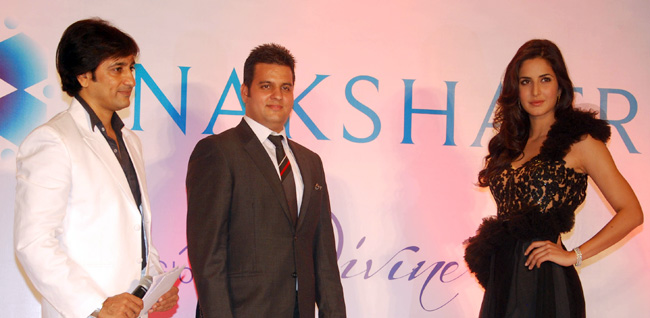
    Katrina Kaif, brand ambassador of Nakshatra, the diamond jewellery brand, on Tuesday, unveiled the brand’s new logo and its latest brand campaign – Glow Divine, in a glittering ceremony at the Grand Hyatt. Also present on this occasion were Mehul Choski, CMD, Gitanjali Group, Shardah Uniyal, VP – Marketing, and Sushil Sharma, VP, International Brands, Gitanjali Group.


    The unveiling was a spectacular ceremony, accompanied by a soul stirring performance by singer Kavita Seth, followed by unveiling of the latest Nakshatra jewellery collection by Katrina Kaif and Mehul Choksi.


    Speaking on the occasion, Katrina Kaif said: “As the brand ambassador for Nakshatra, it gives me immense pleasure to be a part of this momentous occasion. The introduction of a new brand identity and logo simply enhances the divinity and immortality that Nakshatra represents; making each woman feel special and divine – almost like a Goddess. I look forward to a continued great association with Nakshatra and continue to wish the brand all the very best”


    Enhancing the existing and emerging personality of the brand, the new campaign and identity aims to recreate the heavenly hues and the divine glow connecting the brand with the inner beauty that every woman radiates. ‘Divine Force’ is one of the key attributes of the new campaign – a fresh rendition of the “Divine Luck” philosophy associated with the brand, whereby every piece of Nakshatra jewellery carries with it an exquisite beauty that can only be described as preciously divine.


    The new look, feel and thought of the campaign is inspired by the perfection and inner fire that each precious piece of Nakshatra jewellery exudes. The campaign is an expression of this ethereal, goddess like divinity – a divine energy that is sparkling, precious, mesmerizing.


    Commenting on this rebranding initiative, Shardah Uniyal said, “It is a very proud moment for us at Gitanjali, and especially for Nakshatra. The new ethereal identity and logo lends a new dynamic and divine personality to the brand. It not only reflects but profoundly enhances the brands core values and the new avenues that we intend to venture into.”


    The new brand tagline, ‘Glow Divine’, is in keeping with the inner radiance that a diamond emits whilst complimenting the inner beauty that every woman radiates. Keeping in with the philosophy of “Glow Divine” the new brand logo is inspired by the popular floral Indian motif and exhibits eternal beauty and brilliance of constellation in a graphically depicted diamond cluster. The look and feel of the brand logo represents the ethereal beauty of Goddess of divine energy.


    Mehul Choksi, CMD, Gitanjali Group said: “The new logo and identity is yet another remarkable milestone on Nakshatra’s journey in symbolizing jewellery that is beautiful, divine and ethereal, exuding divine energy of perfect creations. It reflects all the values that have been at the core of our brand philosophy as well the vision and direction in which we aim to grow.”


    Nakshatra, one of the most respected jewellery brands inIndia, epitomizes jewellery that is ethereal, infinite, immortal, beautiful and radiant. The pieces are crafted around a unique set of floral designs, using the traditional seven stone cluster. First launched in 2000, as a flagship of the Diamond Trading Corporation (DTC), it was subsequently taken over by the Gitanjali Group, and has been awarded Superbrand status since 2008.

  • OLX India releases its universal iOS Application for iPad and iPhone

    By A Correspondent


    OLX.in, the online free local classified site, has launched iPad and iPhone application (http://bit.ly/olxiosapp) to cater to the rapidly emerging internet population in India, a large portion of which are going to be mobile internet users who will access Internet on their GPRS-enabled phones and Tablets.


    OLX has been the pioneer in mobile classifieds space and has focused on mobile very early with the mobile OLX site available as early as 2008 and OLX mobile apps since 2009. With a growing market of over 55 million iPads globally, 60 per cent market share in Tablets and growth rates of over 150 per cent over last year, it becomes absolutely essential to provide the OLX users an app optimized for their iPads.


    Tapping this expanding segment of Tablets, OLX has innovated further and strengthened its online presence further with the launch of its new app in the Apple Store now optimized for the iPad, the first for any online classifieds site in India.


    iPad users can now download the OLX App in the Apple Store for free and enjoy premium browsing experience and all features of OLX on their iPads.


    “We are excited to release this new universal app to address the booming iPad market. iPad owners have now a great free app to buy and sell everything with OLX,” said Simon Berger-Perrin, VP Mobile at OLX. The new app for iPad is even compliant with the iPad with retina display which makes viewing images of products posted on OLX absolutely clear and with no blurs or distortions.


    Amarjit Batra, Country Manager, OLX India, elated with the launch of this app, said: “Indiais poised to become a large mobile internet market with smartphones and tablets driving the next wave of growth in Internet consumption. OLX.in is already having apps on all smart phone Operating Systems and the launch of the iPad app is a demonstration of our focus on providing Indian internet users the best classifieds experience anytime and anywhere.”


    With increasingMobiletransactions, it becomes important that the buyers have the option of meeting the sellers via a mobile device and vice versa. Being a Universal app, users only need to download one app and it works on both devices; iPhone or iPad. The advantage for the users who own an iPhone and an iPad is that they do not need to download 2 different apps. Even the updates for both iPhone and iPad apps happen at the same time which makes it a very convenient option for mobile users.


    For users wanting to experience OLX on other phones, there are also options to download the OLX Mobile app on Android, Windows, Blackberry and Nokia mobile operating systems.


    OLX.in, the Indian arm of OLX Inc, is the next generation of Online Free Classifieds which serves as a platform to connect buyers and sellers who wish to buy, sell, exchange or trade used goods and services, by simply posting a Free Ad on the website. OLX is present in more than 96 countries and 40 languages across the world and is available in500 cities acrossIndiawith five different languages English, Hindi, Tamil, Telugu and Marathi.

  • Mahindra Retail launches ‘Mother’s World’

    By A Correspondent


    Taking another step in cementing their philosophy of striking innovations that enrich communities and enable people to rise, Mom & Me, the flagship brand of Mahindra Retail is introducing its first ever publishing initiative with the launch of a maternity magazine titled ‘Mother’s World’. This new consumer-centric initiative is an extension to their commitment to provide relevant information, assistance, tips and guidance to the world of early parenthood.


    After their very successful venture into retail with Mom & Me, Mahindra Retail will now focus on providing expecting and new mothers with world class services to care for their bodies and souls during the fragile and overwhelming beginning to motherhood.


    Commenting on the launch of Mother’s World magazine, K Venkatraman, CEO, Mahindra Retail said: “Today’s mothers are highly involved decision-makers and look deeply into every aspect of their babies’ well being. The launch of the magazine marks our commitment to consumer-centric initiatives, and we hope this magazine will be a perfect companion for parents.”


    The inaugural issue offers readers a host of stories, features, tips and advice. It also speaks to three celebrity moms – Sonali Kulkarni, Tara Sharma and Mandira Bedi and their experiences of motherhood.


    Mother’s World magazine serves as an extensive and comprehensive guide for young parents to deal with parenthood and its challenges. With this subscription based magazine for parents-to-be, Mahindra Retail aims to provide insightful information, carefully researched articles and quotes from real parents who share their experiences, besides tips on fashion trends in maternity wear.


    The magazine has been divided into relevant sections covering all aspects of parenthood: conception, infancy, toddler hood and relationships, with all the information verified by in-house experts.


    While Mother’s World magazine adopts a serious approach to parenting, it does have a light-hearted side to it as well with lots of tips, tweets and fun facts about pregnancy on almost every page. It also features a host of relevant products, all easily available to the reader at Mom & Me stores. What also sets the magazine apart is its take on lifestyle and fashion. From maternity fashion to toddler fashion – beautifully taken, theme-based shots give the magazine that classy edge. Occasional celebrity covers, photographs and interviews set Mother’s World distinctly apart from other parenting magazines inIndia.


    Mother’s World quarterly issue will be available on stands across the country from May 14, at a cost of Rs100.


    Mahindra Retail is an extension of the $14.4 billion Mahindra Group’s trading foray in the domesticIndiamarket. The Group believes that this is the favourable time to extend its distribution business into direct retailing, when the organized retail market is expanding inIndia.


  • Marketers ride high on BIG regional music awards

    By A Correspondent


    The BIG Regional Music Awards, when announced recently, saw the industry and marketers alike sit up and notice. An offering from Reliance Broadcast Network’s radio division 92.7 BIG FM and intellectual property division BIG Live, the awards are tailored for the markets of Punjab, Central India, Bengal, Hyderabad, Maharashtra, Tamil Nadu and Karnataka. With the endeavour to recognize the excellence in regional music which will appeal to regional and local tastes, the company has seen some of the biggest brands from across the country associate with it.


    The BIG Regional Music Awards, now in its 2nd year, has the following brands come on board already and are further attracting marketers who see value in the offering:


    Award Sponsor
    BIG Punjabi Music Awards UKStudios: Title Sponsor
    Aircel: Powered by sponsor
    Tata Nano and Nirvana Greens: Associate sponsors
    BIGHindustanMusic Awards Tata Sumo Gold: Powered by sponsor
    Samsung Mobiles: Associate Sponsor
    BIG Bangla Music Awards Exide Batteries and Mashal Oil: Associate sponsor & vertical partner
    BIG Telugu Music Awards Bharathi Cements: Title sponsor
    Narayana: Powered by
    Nuzen: Associate sponsor


    With localization and regional markets being a growing focus for marketers today and with ROI being evaluated for the last buck spent, media platforms have to offer them what best meets their requirements with minimal spill-overs.


    92.7 BIG FM already boasts of a 45 city network, each with a distinct programming in the local language of the region – given that radio is a local medium and the ‘one shoe fits all’ formula doesn’t work. It is with this background that Reliance Broadcast went ahead and launched its regional awards, tailored for respective regions to meet focused and regional approaches of marketers.


    The BIG Regional Music Awards is the only regional awards platform which not only has a wide national reach but also empowers people to recognize regional musical excellence and is a true ‘people’s choice award. The awards will bring a wider reach and visibility to the brands associated thereby accelerating consumer approach.


    Commenting on this occasion, company spokesperson said: “We are happy to have partnered with each of these brands, each with a deep understanding of their target audiences and markets of focus. They have selected the awards basis their focus territories ensuring minimal spill-overs and local audience reach. Our multi-media approach only strengthens our offering and commitment to offer our partners optimal return on investment. We are confident to see more partners coming on board these uniquely designed awards.”


    Reliance Broadcast Network Limited is a multi-media entertainment conglomerate with play across radio, television, intellectual properties and out of home. It is part of the Reliance Group and specializes in creating and executing integrated media solutions for brands.


  • HUL on a roll with Nitin Paranjpe at wheel

    By Kala Vijayraghavan & Sagar Malviya


    When Nitin Paranjpe took over at the helm of Hindustan Unilever Ltd (HUL) in April 2008 at 44, he became the youngest chief executive to head the Anglo-Dutch consumer products giant’s Indian operations. Now Mr Paranjpe has another one for the record books – he is the only CEO in the past two decades to be recommended by the board for a second stint.


    The man, who joined HUL way back in 1987 as a management trainee, has been reappointed managing director & CEO for another five years beginning April 2013. The longest serving head of HUL was Ashok Ganguly, who was chairman from 1980-1990.


    Of course, there is little guarantee that Mr Paranjpe would continue as CEO till 2018, what with previous CEOs – from Keki Dadiseth to MS Banga – going on to assume larger responsibilities at the parent company, during their stints.


    Paranjpe’s imminent second stint is just what the doctor – Unilever CEO Paul Polman – ordered. In 2010, Mr Polman, the first outsider to head the $40-billion consumer goods giant, mandated longer tenures for the top and middle management. Polman’s directive was to ensure greater organisational stability while tackling increasing competition and business volatility. The CEO’s view was that management stability would ensure quicker decision-making and accountability.


    That’s certainly been the case at HUL; and those benefits have translated in creation of shareholder value. When Mr Paranjpe took charge in 2008, the HUL stock was quoting around 230 levels. Today it is 87per cent higher at a little over 430; the benchmark Sensex has fallen 2.8per cent during the same period.


    Over the past two years, Mr Paranjpe added some 4,500 crore – quite literally the size of some mid-sized rivals – to its top line by increasing sales from Rs17,873 crore in fiscal 2010 to Rs22,394 in fiscal 2012 – a compounded annual growth of 12 per cent. “We want to set goals that are so audacious that, even if they are missed, the performance is still heroic,” Mr Paranjpe told ET.


    “There is an obsessive focus on the consumer that goes beyond just slogans and ensures execution. We are now gearing the organisation to future-proof the business through innovation, improving product quality, dramatically raising execution capability and ruthlessly focusing on costs,” he added. And then there’s the supply chain where the CEO says he “wants to be the best at both ends of the market, the top and bottom. There will be no compromises at any end.”


    The relentless consumer focus – the shareholder cannot be ahead of the consumer, avers Paranjpe – manifests itself in initiatives like Mission Bush Fire, an employee-led market execution and customer interaction exercise initiated in 2010 to get the home & personal care giant to connect with the market place. HUL CEO Nitin Paranjpe and every member of the company’s management committee participate in this project to get direct feedback on how HUL brands are faring.


    “Bush Fire has resulted in a 40 per cent spike in sales in stores wherever the initiative has been implemented, according to internal company estimates. And HUL managers say Paranjpe has led from the front. “There is nothing he expects us to do that he has not done himself. Nitin is out on the road making customer visits almost 15 days a month,” said a senior company official.


    Analysts are calling it a dream run. Abneesh Roy, associate director, institutional equities, research, Edelweiss Securities said: “HUL is in a growth phase with Paranjpe leading from the front with vigour and stability. His reappointment is a move by Unilever to reward his performance and execution capabilities as CEO.”


    HUL’s sales have been growing not just by value over the past several quarters, but also consistently recorded volume growth that is ahead of the market. Despite a spurt in input costs and aggressive spends in ramping up distribution, HUL has maintained its 2008 operating margin at 14.1 per cent during the last fiscal year.


    Company watchers say Mr Polman too deserves credit for HUL’s outperformance as it was the global CEO who injected a sense of aggression and put in place a performance culture across Unilever globally by linking rewards to results. For instance, it was Mr Polman’s decision to hike variable pay to as much as 50 per cent of total salary from 30 per cent as this would lead to hefty bonuses for those who deliver and penalise those who don’t. “We want to strengthen our performance culture and be intolerant of incompetence. Consumer centricity must be a non-negotiable in business and so we have put a lot of pressure internally so that we delight externally,” said Mr Paranjpe.


    Source: The Economic Times
    Copyright © 2012, Bennett, Coleman & Co. Ltd. All Rights Reserved


  • Bates boss-to-be plans big


    Sanjay Thapar, Group President, North & East, and member India Board, Ogilvy India is all geared to take one of the most challenging jobs of Indian advertising in the current times – that of reviving Bates India. He is set to take the mantle as the CEO of Bates India. The agency has gone through a lot of upheaval in recent times and Mr Thapar’s job is definitely not a simple one but the man has proved his mettle in his past assignments. Will he be able to pull this one off? Mr Thapar in conversation with Tuhina Anand of MxMIndia, talks about this and more.


    What prompted you to take this role at Bates?

    During my career, I have done many different roles and I have donned multiple roles specific to communication too. Each one has come with different challenges and each challenge brings with it a unique set of opportunities that has given me the chance to learn and grow. I guess I love each one of them, especially if they are different, and this is one of them.


    Don’t you think that after the entire churn that the agency has gone through, you have a tough job to keep?

    As I said, each job or each role has its challenges and this one is no different. Of course, the job is challenging, but that’s what makes it so interesting.


    What will be the tasks on hand once you join the agency?

    Bates has had its share of glory in the past, and currently it is a robust agency with a good pedigree and foundation. My job is to build on its strength and make it shine again. I would love to see the agency double its business in the next 3 years.


    You are an old hand at Ogilvy, though it is within the network, how easy or difficult is the switch for you?

    It’s been 14 years with Ogilvy and that is a long time. Sure, it’s difficult – it’s like moving to a different part of the family. Thankfully, it’s the same family and that’s what made the decision somewhat easier. Being part of the same group, we do share similar values and are culturally alike. That surely helps.


    It is known that Bates didn’t perform in the last year, can you share any strategy that you would adopt to turn around the agency?

    It’s too early for me to comment on this. I take my position with Bates sometime early July and I can only comment once I get there. One thing is clear though, it’s the people who make the place and I am sure we still have many of them at Bates.


    How do you view this opportunity?

    Interesting and Challenging.


    At Ogilvy, what would you say has been your achievement and also share some of your learnings.

    I have played many a parts at Ogilvy. Some of the most significant ones would include the turnaround of Kolkata office, which is also as it was my first role at Ogilvy. Another would be achieving significantly higher levels of growth in Delhi, which brought the office to its current position, both in size and stature. I can also recall helping to set up Ogilvy’s Shopper marketing practice as another achievement and learning.


    Along the way, I have learnt many lessons, which include when to be aggressive, when to be humble, when to accept situations and when to fight them. The most significant of them is the art of collaboration. Our business has so many people, each with different skills/strengths, yet it is a must that they combine well and that is when magic happens.


  • Broadcasters slam TRAI notification to limit ads

    By A Correspondent


    Broadcasters and advertisers have slammed Telecom Regulatory Authority of India (Trai) move to limit the duration of television advertisements to 12 minutes in an hour, and accused the regulator of exceeding its brief.


    A new notification issued by the regulator on Monday limited the amount of advertising on TV channels and disallowed any shortfall in a particular hour to be carried over. According to industry estimates, this could impact advertising revenues of broadcasters by 15-40 per cent.


    “Trai has no jurisdiction in the subject. Advertising is governed by the Cable and Satellite Act and the appropriate authority is the ministry of information and broadcasting,” said Uday Shankar, president of the Indian Broadcasting Foundation, and the chief executive officer of Star India. “The regulator is overstepping its brief,” he added.


    According to Mr Shankar, the low revenues from subscriptions give broadcasters no option but to rely on advertising inventory and revenues to survive.


    An Indian Broadcasting Foundation official said an earlier government guideline stipulated that Trai could issue an advisory with regard to advertising but not a notification.


    Sunil Lulla, managing director and chief executive officer of Times Television Network, which runs Times Now, ET Now and Movies Now channels, too criticised Trai’s decision. “This move is completely ridiculous. Self regulation is the best regulation,” he said.


    “This move will have an immediate impact because right now there is no other big source of revenue for broadcasters,” said Rohit Gupta, president of Multi Screen Media, the company which runs Sony Entertainment Television. The IBF will appeal against this new regulation, he added.


    Barun Das, chief executive officer of Zee News, questioned the timing of the regulation at a time when the entire broadcasting industry was going digital. “We have a limit mentioned in the Cable Act. If at all there is a need for regulating duration of advertising, it possibly could have waited some more time for the digitisation process to settle down.” he said.


    Mr Das said his channel had voluntarily cut its advertising inventory by 30per cent earlier this year. “We realise that too much advertising is a deterrent to viewership. We were not driven by regulations, rather we were driven by market forces,” he said.


    Mr Das said the viewers had choices not only of channels but also of media platforms. “I am not sure if advertising volume needs to be regulated. I would tend to believe that too much advertising would anyway drive away viewers,” he added.


    Sale of television rights have become an important source of income for sports bodies such as BCCI but the restriction on advertising will adversely impact the ability of broadcasters to recoup their investments, forcing them to scale down their bids.


    Source: The Economic Times
    Copyright © 2012, Bennett, Coleman & Co. Ltd. All Rights Reserved


  • Peter Mukerjea: Thank you, TRAI (Now, please enforce it!)

    By Peter Mukerjea


    News today that TRAI have finally put a cap on advertising time per hour for TV channels is a most welcome move in my opinion. I’m sure all broadcasters, other than the savvy ones, will see this as a backward and a retrograde step because it means that they will start to feel the pressure initially, but I can assure them that this is not so, and the effect will be exactly the opposite on their adverting sales revenue line of their P&L sheets.


    First, it’s a simple case of supply and demand economics. Shrink supply and prices should go up. We see that with every product category, be it food, petrol, deisel, cooking gas, etc etc and TV airtime is no different. This will clearly help broadcasters shore up their revenue lines once they’ve managed to get media buyers and clients to understand this logic. That’s not going to be easy, but whoever said that selling TV airtime was a piece of cake.


    Ad sales executives in the numerous stations will now, finally, have to earn their keep, rather than simply earning good money and even better bonuses, simply by pushing in more ads into the breaks of movies, sports coverage and news channels. Programmers will need to work harder to get better deals from content suppliers and movie producers alike, instead of paying grossly inflated prices for movie titles and then having to recover the cost by stuffing the movies with ads, such that the viewer experience is diluted to the point of nonchalance. Of course, broadcasters will be up in arms with this directive from the TRAI and will kick and scream and throw their toys out of the crib like all babies do when they don’t get what they want. It’s not the job of the TRAI to keep broadcasters happy at all times. Occasionally it should be looked at from the consumer point of view, which is clearly the case here. So, thank you TRAI.


    Second, consumer groups that have had to put up with the barrage of advertising breaks in their TV viewing experience, for years on end, should be feeling relieved that finally the regulator has paid some heed to their woes of getting blasted with increased decibel levels in ad breaks, getting masses of drop downs  during live sports coverage and getting news channel tickers carrying branding of all kinds within it, masquerading as news headlines. Enough is enough and this was all done under the banner of self regulation!  In fact, the shoe should be on the other foot now and TRAI should consider setting up a consumer group forum who should be tasked with monitoring the violations to the new standards, as laid out by the TRAI and report these to the TRAI for further action and enforcement. So, thank you TRAI for improving the viewing experience of millions of long suffering TV viewers across the country.


    Sure, there will be several broadcasters who will now be unable to keep carrying more and more ads to secure their bottom line, who will suffer and will be pained by this statute and may well go to the wall and eventually go out of business, but sadly that is the reality of life. Those channels owned by big groups will not suffer at all as they will be able to withstand the initial blips and will come through this just fine. They will then also be at the forefront of the list of beneficiaries in a few months from now, but the smaller ones who do not have the deep pockets to sustain this correction must recognise that this party was not going to last forever.


    They should have read the rule book before they started. If they didn’t then it’s entirely their fault , for the ad time cap has been around for a long time and would have known full well that this free for all amount of air time inventory status quo was going to come to an end one day. That day has come. Far too many broadcasters have started up recently on the basis of a never ending supply of airtime being the way to earning revenues. They then produce below average content which then gets below average ratings and that advertisers pay virtually nothing for. This brings the whole industry down by several notches and attracts below average talent who do the same thing day after day thus creating a downward spiral. Thank you TRAI for improving standards in the industry.


    There is, in case you hadn’t spotted it yet, however a bright future for the industry. The fact is that with an improving revenue line for broadcasters, there will be a growth in corporate valuations over time which will enable them to deliver better shareholder value and see more investments coming towards the category. For sometime now broadcast media companies have been struggling to get their valuations up and have seen so much of their values eroded. This directive from the TRAI will go a long way in correcting that and so for that I thank TRAI once again. So instead of being a bunch of sour pussies, broadcasters should stop whining and get on with the task of putting their businesses back on track and tasking the ad sales teams to get cracking and reforecast their revenues budgets upwards for the rest of this year (or else they should get no bonuses this year , on the basis that they have less air time time to sell).


    Excellent times ahead – thanks to TRAI.


  • Mediaah! Broadcasters suffer with ad restrictions while print & web publishers have fun

    By Pradyuman Maheshwari


    So the TRAI has finally chosen to subject the television channels to its regulation over ad duration in the guise of quality of service. Assorted politicians and consumer groups who’ve been complaining about the ads on telly should be happy, but I would see the development as unfortunate.


    Yes, some of the practices adopted by our broadcasters are reprehensible. They deserve to be damned.  But should the government directly or via a regulator like TRAI be getting into the act? I don’t think it should.


    Market forces will force channels to ensure viewer experience isn’t impacted beyond a point. In fact in the chase for ratings, the entertainment-wallahs have already done that.
     

    My heart goes out to the news channels who are going to be impacted the maximum. Ads in the form of tickers etc amount to revenues of around Rs 100 crore across channels, I was told.


    The battle is going to move to the Courts/TDSAT, I am told. I hope the learned souls there see reason.


    What about other media?

    If broadcasters get carried away with commercials and if the government and/or TRAI sincerely believe that they are taking consumers for a ride, then what about newspapers, radio and the internet?


    Full page ads on Page 1, half-jackets, ads flowing through editorial… etc etc etc. All of this in print.  Radio has ads camouflaged as RJ mentions. On the web: innumerable innovations, site captures, interstitials, awful and annoying innovations done by some of the trade sites.  And then innumerable advertising mailers. I must add here MxMIndia too carries site captures and while we don’t send more 5-6 mailers or at most 10 a day, guess we’re getting there.


    Now, other than our readers cursing the publications in question, there’s no one stopping the print and web players from carrying intrusive adverising. Also, the ad-edit ratio can well exceed 70-30 on big occasions like Diwali or Akshya Tritiya.


    Wanted a top quality lobbyist for TV!

    Perhaps the television industry must hire a top draw bureaucrat to lobby its case to the powers that be. The fact is that the Indian government policies are skewed against the television media. Even on issues like service tax, while advertisers don’t have to pay any levy for an ad in print, they’ve got to cough up the entire 12.36% for TV, the web and I guess radio too.


    Even though television has some rather powerful players, it’s evident that the print folks command more respect. Or at least the government tries to not meddle in their affairs.


    It’s not that established print players don’t have a broadcast interest… we have BCCL, India Today, ABP, Malayala Manorma, Lokmat, Sakal, Mathrubhoomi and Eenadu amongst others, but it’s just that they are more revered for print than television.


    Now that INS president Ashish Bagga also heads up the TV Today Network as CEO of the India Today group and the MCCS channels are better integrated in the ABP group, perhaps the old warhorses must exert pressure.


    Buzz me if you have a story to tell. Confidentiality assured. There are various ways you can reach me:

    pradyumanm[at]mxmindia.com, BBM 23050B5D, Gtalk pradyumanm@gmail.com, Twitter @pmahesh and of course the mobile: 98338 76278.


    Disclaimer: Although he is CEO and Editor-in-Chief of this site, Pradyuman Maheshwari’s views in Mediaah! are not necessarily those of the rest of the team and MxMIndia.com.


  • More Mediaah!: Indian Express, Shekhar Gupta & Co send notice to Open, Vinod Mehta. Demand Rs 500 cr as damages

    By Pradyuman Maheshwari


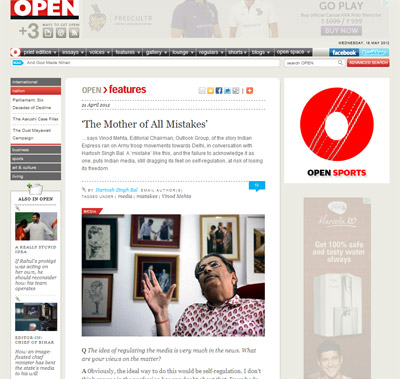
    The Indian Express group and four of its senior journalists (including editor-in-chief Shekhar Gupta) have sent a legal notice to Open magazine, its editor and other professionals. And above all to Vinod Mehta. The reason: in an interview to Open, Outlook’s Vinod Mehta rubbished the Express expose of a coup-like situation in the Capital.


    The Express is also upset with the publication of reactions that the interview elicited.


    I strongly recommend a read of the legal notice (currently posted in a blog that seems to have been created for the purpose — http://nobodyisusingthedword.wordpress.com/2012/05/15/indian-express- shekhar-gupta-threatens-to-sue-vinod-mehta-hartosh-singh-bal-open-magazine-c-repor/ .  Please don’t miss Pages 6 and 7, where the notice highlights a contradiction in Mehta’s statement on how he quit The Independent in the interview (as also made in a speech at the Press Club Bombay awards recently) and his book Lucknow Boy.


    The lawyer has asked for an apology, removal of the interview from the site and Rs 100 crore each for her clients. Note the money must be remitted even after the publication of the apology.


    Mediaah! view: I think the Express should’ve just let the interview be (link: http://www.openthemagazine.com/ article/nation/the-mother-of-all-mistakes). I don’t think the interview is damning the reputation of the Express or its editor-in-chief. And even if there is a belief that Vinod Mehta ought not to have said what he did and Open shouldn’t have published it especially since the coup story hasn’t been proven to be wrong, initiating a legal procedure is perhaps a bit much.


    Moreover, though it has established itself as an independent, gutsy publication, Open isn’t mass-circulated as, say, The Times of India. I must confess that even though I had been told about the interview, I read it only yesterday, after I heard of the notice. There is sure to be a fair bit of buzz in the social networks.


    I spoke to a senior member of the Open team who said the company lawyer was planning to respond to the notice and the magazine has no plans to pull the story off the Web.


    Final words: It’s imperative that while the media subjects everyone to criticism, it must be willing to take the heat whenever it’s subjected to it. Now, let’s hope Mediaah! doesn’t get a legal notice for writing all of this 🙂


    Buzz me if you have a story to tell. Confidentiality assured. There are various ways you can reach me:

    pradyumanm[at]mxmindia.com, BBM 23050B5D, Gtalk pradyumanm@gmail.com, Twitter @pmahesh and of course the mobile: 98338 76278.


    Disclaimer: Although he is CEO and Editor-in-Chief of this site, Pradyuman Maheshwari’s views in Mediaah! are not necessarily those of the rest of the team and MxMIndia.com.


  • The Anchor: Sevanti Ninan on 5 things she’d like to change about journalism today

    By Sevanti Ninan


    1. Its idea of what constitutes national

    Delhi and Mumbai.  At a pinch add Chennai and Kolkata, because Mamata and Jaya are there to provide copy.


    2. Its notion of public opinion

    What Twitter, Facebook and smses on TV are saying.  Get off the computer and hit the streets to find out what’s happening to those who are not on social networking sites? Na, that’s uncool. Besides being too much work.


    3. Its notion of the arts

    Movies, movies, Bollywood, Bollywood. Regional stars in the field of writing, art, music: confined to the regional press unless they know how to make the scene in Delhi or Mumbai.


    4. What makes news

    Political spats, crime, scams.  Social issues are for documentary film makers, unless Aamir Khan comes with the package.


    5. Its notion of what constitutes progress for both India and Bharat

    Sexy industries like telecom and IT. Education reporting means tracking the IITs. Health coverage means celebrity cancer. Primary health centres and anganwadis-what’s that and where would I find them?


    Sevanti Ninan is Editor, thehoot.org and Columnist, Mint