Author: mxmadmin

  • Satyamev Jayate reports gr8 Chrome numbers

    By A Correspondent


    Aamir Khan’s Satyamev Jayate has reported  “unprecedented” launch episode numbers, reports Chrome Data Analytics and Media.


    Says Chrome founder Pankaj Krishna on why it’s unprecedented, “Conventionally, KBCs have premiered on weekday evening primetime when the overall TV viewership is at peak and so have most other big promotables across channels where one shows rides on the back of another during the three hours of evening peak prime (8-11pm) as against a Satyamev Jayate that’s going solo on a Sunday morning.”


    The Chrome Television Panel Audits indicate the following numbers. Note this is only Star Plus and the Hindi Speaking Market (HSM). Since SMJ was aired across various channels and languages, we could see a healthier story if those are taken into account.


    Satyamev Jayate, Sunday May 6, 2012, 11 AM, Star Plus, HSM:


    Show Distribution Availability

    99%

    Show Reach

    11.8%

    Show Average Stickiness per viewer

    39 Mins

    SHOW TVR –

    5.12


    SOURCE : CHROME TELEVISION PANEL AUDITS, C&S 4 +( DIGITAL + ANALOG) – SAMPLE 2847 Individuals, HSM


  • Hindustan Unilever to study how we shop

    By Sagar Malviya


    World’s third-largest consumer goods firm Unilever has set up a Customer Insight and Innovation Centre in Mumbai to study how consumers shop FMCG products – its first such hub in India and seventh in the world.


    The centre at Hindustan Unilever’s headquarter at Andheri will be used by several group companies in developing and emerging markets to understand how people shop in both neighbourhood stores as well as modern trade. This is the first such centre that provides shopper insight for both general stores as well as retail chains.


    “The learning will go typically in developing and emerging markets where traditional trade is big,” said Punit Misra, vice-president, customer development, at Hindustan Unilever. “We have been doing consumer marketing forever where the basic premise is consumers are truly the same,” he added.


    The insight centre will simulate the retail environment of any supermarket or neighbourhood store and then invite consumers to shop the virtual store. A device will scan their retina to track the movement of the eye, and then a map will display the spot that catches the consumers’ attention.


    Simply put, the centre will help the Anglo-Saxon consumer goods maker advice grocers on how category growth, profit per sq ft and availability can be improved using virtual reality tools.


    The company will use the data and insights from the centre to plan packaging design for future products. It will also test new product through virtual reality platform and use the facility for their promotions. So far, the company has engaged grocer outlets with promotions, display materials and margins. The development is seen as a part of Hindustan Unilever’s efforts to increase its sales and widen lead over rivals such as Procter & Gamble, ITC and Godrej Consumer.


    Analysts say the company wants to connect more with the trade at a time when millions of kirana stores it sells products to are being increasingly covered by its rivals too. While Hindustan Unilever still enjoys the country’s largest retail network of over 7.2 million outlets as per Nielsen estimates, its closest rival Procter & Gamble now reaches around 5.6 million outlets.


    “This means the company wants to come as close to the customer as it can get,” said Anand Mour, senior FMCG analyst at brokerage Ambit Capital. “It will not only increase the category but also help in getting more sales of its products since HUL is present in most FMCG categories,” he added.


    But getting millions of kirana stores to sport a look that HUL advises is a challenge. Mr Misra knows that, and feels that the company is ready to overcome that problem. “Modern trade is simpler. General trade is a bit tricky on how do you disseminate a repeatable model to five lakh family grocers,” said Mr Misra. “So we do the creation, the testing, the learning and the models, and then our execution teams on the field convert them into ready-to-use kits which they can take to the retailers,” he added.


    The maker of Lux soaps and Pond’s cream has been taking several initiatives to increase its sales and consumer base in the country. One of the recent such projects was Mission Bushfire – an employee-led market execution and customer interaction exercise initiated in 2010 to get the home and personal care giant to connect with the market place in order to increase product visibility.


    Bush Fire resulted in over 40 per cent spike in sales in store wherever the initiative were implemented, according to internal company estimates. Recently, a company official on condition of anonymity told ET that Hindustan Unilever has set a target to more than double its turnover to Rs50,000 crore by 2015 in a plan christened ’50 by 15′.


    Source: The Economic Times
    Copyright © 2012, Bennett, Coleman & Co. Ltd. All Rights Reserved


  • The Anchor: Naresh Gupta lists 10 reasons why one should go independent

    Naresh GuptaBy Naresh Gupta


    One of the biggest misconceptions people have is that if you work for yourself, you will get richer quicker. If money is all that drives you, then going independent can be a bad idea. Here are ten reasons for which you should go independent


    1.  Build something

    Everyone must build something that is your own. This is a true reflection of your ability, skill enterprise and ideas. There is no better way to self-actualization then to say, I built this. Bragging rights don’t come easy in life.


    2. Nurture your baby

    Every new idea needs careful nurturance. The idea is yours, so one else knows the idea better than you. This is like being a father, only you know what your child wants.


    3. Dream big

    Ambition knows no limits in your own set up. This is truly where your dream and your vision alone control the destiny of your enterprise. There are no approvals to be sought, no forms to fill, just you and your enterprise.


    4. Improve quality

    The buck truly stops at you. There are no approvals to be sought; there are no conflicting egos to be settled. You can deliver truly great work to your client, sharper and quicker. It’s amazing how layers of bureaucracy can dull the edge of even the sharpest sword.


    5. Connect better

    Your connections with your clients are stronger than usual. They are your clients because they like you; you are their partner because you like them. There can be no better way than this.


    6. Challenge yourself

    Doing a job tends to make days monotonous. You follow a routine and if follow it well you would be fairly successful. But when you run an enterprise yourself, every new day brings a new challenge to face. If you never want to do same thing twice, go independent.


    7. Follow your passion

    You remember those days in school when you woke up early to go to cricket coaching classes or something like that? You did it because you loved it; it even made school more fun. You wanted to get up early, even on the coldest morning. That’s something true of an independent venture. You do what you love, and you love what you do


    8.  Greater risk to reward ratio

    This is simple, the risk is yours, and the rewards are yours too. This does not mean that going independent is a get rich quickly scheme. It may be years before you see major financial benefits coming your way.


    9. No retirement planning

    Retirement plans can be put on ice. Your enterprise needs you to do the best for it as long as you can. Every day you will gain experience that will make coming days more promising. There is no point of even thinking of hanging your boots


    10.  Give back to society

    This is where as an independent entrepreneur you can make a small contribution. Work with the society, work with yourAlmamatter, and give back in time and effort. This one singular reason can make going independent worthwhile.


    Naresh Gupta is the Managing Partner at Bang in the Middle


  • Vizeum wins Cholamandalam Finance’s media duties

    By A Correspondent


    Cholamandalam Finance, the financial services arm of the Murugappa Group on Thursday announced the appointment of Aegis Media’s VizeumIndiaas its media AOR.


    Commenting on the win,S Yesudas, Managing Director – Indian Subcontinent, Vizeum said: “This win makes us very proud. The fact that our contributions to other clients from the Murugappa group also paved the way for this is the most compelling credential for Vizeum. We are really excited about the opportunity to work with Cholamandalam Finance in creating and delivering consumer engagement solutions to the drive their business ahead. We are extremely thankful to the client management for considering us worthy to partner them. This business will be handled out of our Chennai Office.”


    Vizeum successfully operates in 55 countries with a philosophy of in-depth understanding of the co existence of lives, brands and media in the actual world, through its process – motivation to media.


    Cholamandalam Finance, a comprehensive financial services solution provider offers vehicle finance, business finance, home equity loans, stock broking and distribution of financial products.


  • India will be key growth engine market: Clive Armitage

    It’s been a modest start for Bite Communications that completed a year of operations inIndiarecently. Still a newbie in the trade, the agency expects to widen its strides as it prepares to take on larger challenges in the communications space. Confident of putting up a stellar show going forward, Clive Armitage, Co-founder & CEO of Bite Communications says that India will emerge one of the hottest growth engine markets for the agency given the unlimited scope it throws up for agencies.


    In conversation with Johnson Napier of MxMIndia, Armitage delves on his agency’s performance in the past year inIndia, highlights a few markets that would help bring growth to the agency and maps out new avenues that would put the agency on a higher pedestal in the months to come. Excerpts:


    It’s been a year of existence for Bite Communications in India. As you look back, how would you analyse your journey thus far?

    There are different ways in which you can measure the growth of an agency – on a financial basis, on a reputational basis or on a service basis. The most important thing that you do when you start an agency is make sure that you start it with a good foundation because it’s the foundation that will decide how your agency will grow or sustain itself in the future. When we came intoIndia, we weren’t sitting here saying that the most important thing for us is to grow very quickly and earn lots of money but what we wanted to do was come into the market and establish a strong team doing really good work. The assumption was that if we do that, it will lead to a good performance on the financial front as well. I think after a year we have done exactly that. We have a good team out here who are working with clients that have a great calibre in the industry.


    Are you content with the way the Indian team has gone about establishing the network in India, especially the manner in which they have attracted clients onboard ?

    What we wanted to do when we started was be relatively selective around the clients that we work with. What we don’t want to be is an agency which is just the arms and legs to a client. We want to be a strategic partner to help the client achieve their goals. All of the client engagements that we have now got, we have been fortunate enough to establish that kind of a relationship. There have been moments when we have turned the client away because they didn’t want to work with us as they weren’t willing to consider digital solutions and other such things. From that standpoint, we have been able to meet our stated objective. The other thing to be stated here is that it is a pretty simple business model: if you hire a bunch of people and you want them to be really motivated and stick around, you have to give them a chance to work around big clients. If they get to work on clients who are just doing low profile jobs the best thing to do is leave. The thing about our team here is that we allow them to do big work with our clients. Obviously, every client is different and you do get challenging clients that are demanding, and we’ve had a fair share of those, but I think the current client base is what we are happy with and are seeing them grow very well. So we have seen a great start but it is just an introductory chapter to the book; there are many more chapters to write and much more work to be done.


    Despite India being a relatively nascent market, how do you see it shaping up as a market of choice for Bite Communications?

    The thing is that we have around 14 offices around the world. So when we have clients elsewhere and when we refer it to newer offices we are always nervous on how that relationship is going to go. The teams have to be strong and reliable enough that whenever we come across an opportunity to expand our relationship with our clients, we have tremendous confidence that we can suggestIndiaas an option and know that the work gets done and the result is going to be superb.


    How do the offices in Asia Pacific and around the globe stack up against each other?

    We have our office inHong Kongthat employs around 40 people. We also have offices inBeijing,Shanghai,SingaporeandSydney. Across the region we have around 100 people andIndiais our newest and favourite child. If I look around the business on a global basis, I have to look at where the growth potential is. Personally for me, the three markets that have the biggest growth potential include North America,ChinaandIndia. North America is a fairly established market already and there is more scope for growth but inChinawhere we have about 40 people and about 8-10 inIndia, we’ve got plenty of potential for rapid growth. That’s how I look atIndiaas a market – it’s one of the engines for the next 5-10 years for the growth of the business. Engine by the following aspects: one, by the sheer headcount and revenues and two, by innovation. Historically, we have a heavy focus on technology and as marketing gradually starts to evolve I seeIndiahaving a great advantage in terms of innovation and starting to deliver on some of the products that we can further use on a global basis.


    While you’re ideally tagged a small agency given the staff headcount, how would you associate Bite Communications as an emerging agency in India?

    We are 250-people strong agency across the 14 offices that we have our presence in. I would define us as being a small global network. Our objective is to be in a business that has a higher headcount across the offices that we are present in. I do not believe in the model whereby you have to have a dot on the map of every city. The challenge to that is you end up losing your overall proposition if you have a network that’s very huge. For us, we have around 14-15 offices that are strong and large enough that they can serve the needs of the clients at strategic locations around the world. Probably the countries where we need to make ourselves felt isBrazilandRussiawhere we work on partnerships and are not present there yet. So the next two years or so would be about those two locations and looking at ways to get into them and also growing smaller and younger offices likeIndiavery quickly.


    What is the role you see digital taking up for you in India?

    We are ambitious about the future and think about digital as once-in-a-lifetime opportunity for the PR industry to get out of the PR silo and get into large and marquee budgets – that’s what we are hungry for. We feel digital will help us become a much larger and bigger agency much quicker than the others.


    The Indian PR market is a cluttered one with more than 2000-odd agencies fighting it out to grab the mindshare of clients. What is the future you foresee for the PR space in India?

    I think there is plenty of scope for growth for PR agencies inIndia. I think it’s a reflection of how clients have become more mature and are ultimately left thinking and have started to fuel the need for working with specialist agencies inIndia. The space has become very competitive right now and it wasn’t the case around 8-10 years ago. I think the agencies that have a clear proposition and remain differentiated will manage to win the trust of their clients. We are not afraid of competition; we welcome it. It only inspires us to be more different and creative than most.


    As you move forward, what is the goalpost that you’ve set for the agency?

    The goalpost for me is not financial, it is going to be based around the type of work we do – increasingly doing more and more integrated communication campaigns. We still are a traditional agency but we want to be winning more awards for our integrated work which demonstrate we can take great content from client’s point of view in the marketplace and then deliver that to a commercial benefit via a host of different channels be it traditional media or digital media. The challenge for the team here is demonstrate that you can do that for the outside market place to gain a reputation – do that and all the financial success and growth will follow.


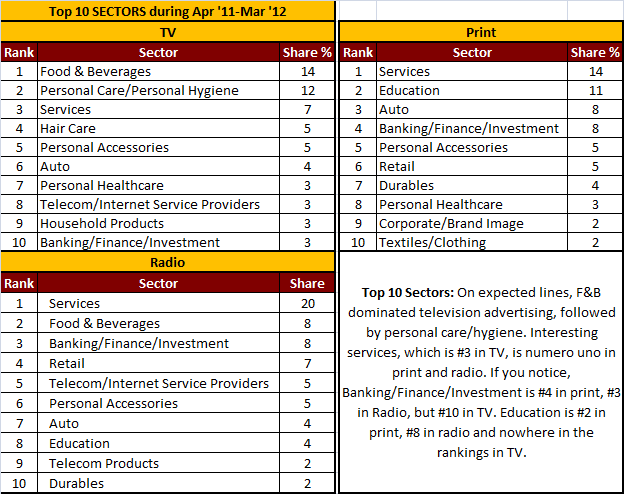
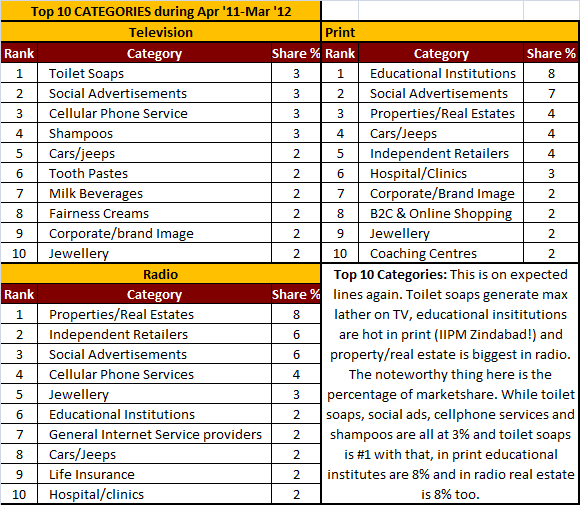
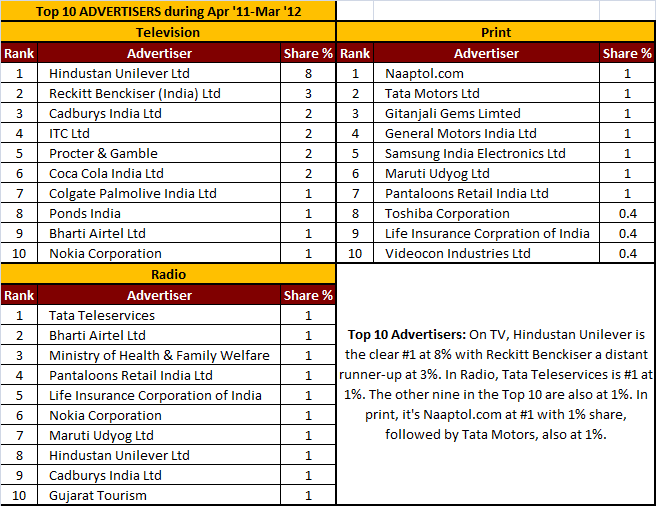
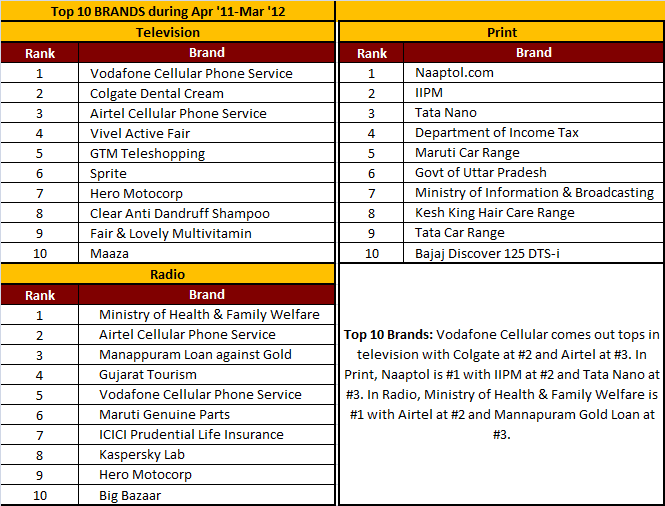
  • AdEx 2011-12: Print grows 14%, TV 11%, Radio 0%


    By A Correspondent


    This is perhaps the shortest Big Story you’ve read in the eight-month existence of MxMIndia. But then more than words, it’s numbers that have got to do to the talking.


    MxMIndia requested TAM Media Research which painstakingly computes data for ad volumes for the television, print and radio sectors. The growth figures are indicative of how these are doing: print isn’t down and out yet with 14%, TV is growing but it’s not as dramatic as we thought it would and Radio hasn’t degrown. In fact we must urge radio practitioners to interpret the 0% in a positive way because there were enough naysayers willing to rubbish the potential of the business.


    Note: the analysis is based on ad , that is duration in seconds/CCMs and excludes promos.


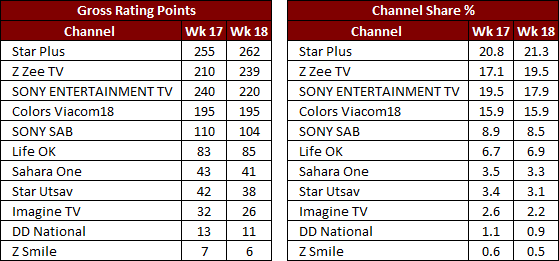
  • TAM Data (GRPs Channel shares of HGECs)- Wk 18’12


    Source: TAM Media Research
    TG: CS 4+ yrs
    Market: HSM
    Period: Wk 17: Apr 22 to Apr 28, 2012
    Period: Wk 18: Apr 29 to May 5, 2012


    About TAM Media Research

    TAM is a joint venture between Nielsen Company & Kantar Media Research. Besides measuring TV Viewership, TAM also monitors Advertising Expenditure of Television, Print & Radio through its division AdEx India. Since 2004, it extended its presence in the PR Measurement & Analysis space for Corporate/Marketing Clients by setting up a separate division Eikona PR Measurement.


    In 2007, the joint venture introduced RAM (Radio Audio Measurement) service to track Radio Listenership for the Indian Radio Broadcast Industry. In year 2009, TAM launched a division, called TAM Sports that specializes in monitoring Sports Sponsorship ROI.


    TAM Media Research’s objective is to fuel media insights that will drive the growth of the Indian Media Industry.


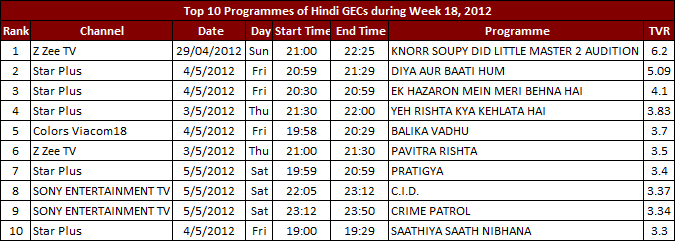
  • TAM data Top 10 programmes on HGEC – Wk 18’12


    Source: TAM Peoplemeter System
    TG: CS 4+ yrs
    Market: Hindi Speaking Market
    Period: Wk 18: Apr 29 to May 5, 2012


    About TAM Media Research

    TAM is a joint venture between Nielsen Company & Kantar Media Research. Besides measuring TV Viewership, TAM also monitors Advertising Expenditure of Television, Print & Radio through its division AdEx India. Since 2004, it extended its presence in the PR Measurement & Analysis space for Corporate/Marketing Clients by setting up a separate division Eikona PR Measurement.


    In 2007, the joint venture introduced RAM (Radio Audio Measurement) service to track Radio Listenership for the Indian Radio Broadcast Industry. In year 2009, TAM launched a division, called TAM Sports that specializes in monitoring Sports Sponsorship ROI.


    TAM Media Research’s objective is to fuel media insights that will drive the growth of the Indian Media Industry.


  • Nearly 10 lakh STBs ready for Kolkata

    By A Correspondent


    The Cable Television Networks (Regulation) Amendment Act, 2011 has made it mandatory for switch-over of the existing analogue Cable TV networks to Digital Addressable System (DAS) by December 2014, in a phased manner. In respect of four metros of Delhi, Mumbai, Kolkata and Chennai, the digital switch-over is to be completed by June 30.


    The ministry is very closely monitoring all the activities for the timely implementation and the quality of the Digital Cable TV service. During the high level review meetings by the Ministry, it was revealed that in the case of Kolkata, out of total requirement of about 35 lakhs STBs, over 5 lakhs STBs have already been installed, about 4 lakhs STBs are available in the stock which are being installed and the orders have already been issued for the balance requirements of STBs.


    Further it came to the notice that all the MSOs already have digital head ends and the existing channel capacity in each of the case is over 200, which is the mandatory requirement as per the Telecommunication (Broadcasting and Cable Services) Interconnection Regulation, 2012. The channel capacity is being augmented by the MSOs.


  • New Samsung home appliance TVC brings in “ek fresh soch”

    By A Correspondent


    Cheil’s new television commercial for Samsung refrigerators has a new take - ‘ek fresh soch’ on how technology works as an ally in the life of today’s contemporary working woman.


    The idea behind the campaign was to introduce the new Digital Inverter Compressor technology in the new range of Samsung frost free and side-by-side refrigerators.


    The entire campaign revolves around “ek fresh soch” that has led to happiness across different families. The films are contemporary, clutter breaking and bring together a vital element that of making both technological and emotional connects with the woman of today. The introduction of appreciation from a child is unique as not only does bring to life product features and the benefits also elaborates sensitivities in today’s home and shows how aware children are of their surroundings and their sense of appreciation of little things in their lives. This coupled with Priyanka Chopra’s role-play as the catalyst of change bringing joy into peoples’ lives makes for a great connect with the audience for Samsung home appliances.


    Speaking on the creative, Alok Agrawal, COO, Cheil Worldwide South West Asia said: “The new line of refrigerators demonstrates Samsung’s contemporary lifestyle technology that is set to provide new experiences for today’s woman. Our treatment of the campaign and the messaging is reflective of the modern Indian woman whether housewife, working or single. Key brand and product features have been translated into an emotional benefit from a child’s point of view, as expressions of appreciation for changing the child’s life. The creative leverages Priyanka Chopra as the catalyst of the change as promised by Samsung Refrigerators”


    Creative credits:

    Client: Samsung Electronics India Limited

    Agency: Cheil WorldwideSW Asia

    Creative Team: Shiva Kumar, Ayon Sarkar

    Client Servicing team: Amit Ahluwalia, Gireesh Gupta, Nitin Mahajan

    Production House: Fleet Ent. Pvt Ltd.

    Directed by: Tarun Mansukhani


    Cheil India has been on an aggressive growth plan over the last 2 years, almost doubling its size in its employee strength and billings. Significant expansion and growth has been seen particularly in BTL and Digital areas, making Cheil one of the largest fully integrated single agencies in India, executing some of the largest cross-functional integrated campaigns, providing 360°implementation across all facets of marketing services.


    Cheil Worldwide Inc is Korea’s largest and one of the world’s leading advertising groups. Cheil offers a full portfolio of marketing communications services including advertising, PR, sports marketing, exhibition and display production, and production of large-scale performance events. In 2011, Advertising Age ranked Cheil as the #11 largest creative agency in the world.


  • Cornelia Kunze is Vice Chair, Edelman APAC

    By A Correspondent


    Edelman has named Cornelia Kunze vice chairman, Edelman Asia Pacific. In her new position, Ms Kunze, presently CEO of Edelman Germany, will support David Brain, President and CEO, Asia Pacific, and the regional team in building Edelman’s fastest growing region. She will be based in Mumbai and report to Mr Brain.


    Ms Kunze will have a particular remit to help develop the consumer and brand planning offer. She will also further develop Edelman’s current stable of German clients in the region which includes BMW, Osram, BASF and TUV SUD. In India, Ms Kunze will support Robert Holdheim, Managing Director of Edelman India, with the rapid development expansion of that business in the wake of the Tata win by Rediffusion/ Edelman.


    Ms Kunze’s placement in Mumbai is a reflection of the growing importance of India in the region for Edelman. Asia Pacific markets are emerging at unprecedented rates and India marks a significant point of growth for the entire region.


    “Cornelia brings with her the understanding that smart companies recognize the need for competitive advantage by being more strategic in their public relations approach. I worked with Cornelia for seven years in EMEA during which time she took our business in Germany from $6 Mio to $18 Mio (2012) and leaves us now with, by far, the most awarded marketing PR offer in that country,” said David Brain.


    “Over the past few years, Cornelia has transformed our offering in Germany into what is arguably the most sophisticated of its kind in the market” said Robert Holdheim. “One piece of this was the acquisition and integration of digital firm GoSub. That experience will be invaluable as we look to continue our development in the Indian market.”


    “Whilst I will miss my fabulous German colleagues and clients, I am really looking forward to this new challenge in Asia and to being based in India, a market I experienced for six weeks last year,” said Ms Kunze.


    A new CEO for Edelman Germany will be announced later this month.


    Edelman is the world’s largest public relations firm, with 63 offices and more than 4,200 employees worldwide, as well as affiliates in more than 30 cities. Edelman India Pvt. Ltd. is part of the global Edelman network with a team of more than 250 professionals across an eleven city network. Edelman India offers Indian and global clients strategic communications and media relations support, as well as Digital Communications, Public Affairs, Health, Technology, CSR and Sustainability communications.


  • 53 Days to D-Day | Govt addresses industry concerns over digitization

    By A Correspondent


    The Cable Television Networks (Regulation) Amendment Act, 2011 has made it mandatory for switch-over of the existing analogue Cable TV networks to Digital Addressable System (DAS) by December 2014, in a phased manner. The digital switch-over is to be completed by June 30 in the four metros -Delhi, Mumbai, Kolkata and Chennai.


    Concerns had been raised by some stakeholders regarding the quality of Set Top Boxes (STBs) and the redressal of grievances of the cable TV subscribers. The necessary provisions have been incorporated in the Cable Television Networks (Amendment) Rules, 2012 to take care of these concerns. As per these Rules, the STBs to be supplied by the Multi System Operators (MSOs) must conform to the quality standards specified by the Telecom Regulatory Authority of India (TRAI).


    The MSOs are also required to devise a mechanism for grievance redressal, as specified by TRAI, and inform the details thereof to the subscribers. The Telecommunication (Broadcasting and Cable Services) Interconnection Regulation, 2012 has a provision that the STBs must be BIS compliant. During a Ministry review meeting with the national level MSOs, it was revealed that out of about one crore STBs required in the four metros, over 22 lakhs STBs have already been installed, about 25 lakhs STBs are available in the stock which are being installed and the orders have already been issued for the balance requirements of STBs.


    MSOs have confirmed that all the indigenously manufactured STBs conform to the BIS standard and the imported STBs not only conform to the international standard but also the BIS standard. Regarding the repair of defective STBs, the MSOs have intimated that within the warranty period of one year, a defective STB will be replaced immediately free of cost. After the expiry of warranty period, a faulty STB will be taken back for repairs by giving a replacement from the available stock.


    The MSOs have further confirmed that the Grievance Cells are being set up for resolution of disputes, if any, and the telephone numbers of the Grievance Cells would be notified.