Author: mxm_india

  • Karthik Lakshminarayan to leverage his TV experience @ Crest

    By A Correspondent


    Madison Media has roped in Karthik Lakshminarayan as COO of Crest to head the AOR of its ITC business. Mr Lakshminarayan has earlier worked with Madison and its homecoming for him. He has essentially been a media agency person, having spent close to 13 years on the agency side with Initiative Media, Starcom, besides Madison. He then crossed over to television where he spent close to four years with Colors and Food Food.


    Talking about the edge he will have because of his television experience, he said, “Having worked closely with the leading channels and even on the production side, I think it has given me first-hand experience of working on the other side of the business. Media planners tend to look at the past data of the channel to predict future and I think having worked in channel has given me an insight to work this premise in a better and meaningful way. It will help in bringing that amount of difference and identify benefit for our clients.


    “Also having worked on the production side has given me fair knowledge of how content can be integrated in a better way to bring a better value to the client,” added Mr Lakshminarayan.


    For Crest, he will be alternating between the Bangalore and Kolkata operations of ITC. In his career, he has worked on a large and diverse portfolio of brands including Godrej, Cadbury, Marico, Asian Paints, Bharti Axa, Infosys, Britannia, Titan, Heinz, Pillsbury and Hallmark amongst many others.


    On his role at Crest, Mr Lakshminarayan added, “Crest has been doing great work for ITC in the last one year and I am looking at further raising the bar of the work being done.”


    Punitha Arumugam, Group CEO, Madison Media, commented, “I am delighted to have Karthik back with Madison Media. The best testament for Madison Media as an organization is when ex Madisonites as talented as Karthik are willing to accept and explore career opportunities with us once again. “

  • Newswatch: Kalpana Sharma on the falling standards in newspapers

    By Kalpana Sharma


    When the new chair of the Press Council of India, Justice Markandey Katju held forth on the competence, or rather incompetence and lack of learning of journalists, we were outraged. How dare a person from outside the media cast aspersions on our competence? Has he any idea how difficult it is to produce readable newspapers and magazines and watchable TV shows?


    Yet what was considered inexcusable only a few decades ago now passes without anyone being hauled over the coals. By this I mean the bloomers one can find almost every day, particularly in print. On TV we now know that there probably are as many mistakes as in print. It took the former chair of the Press Council, Justice PB Sawant to catch one such “inadvertent” mistake and to ensure that it was never forgotten. But in print, the errors jump out at you every day – wrong photographs, captions, erroneous headlines, inaccurate data. Are all these inadvertent or do they reflect a lowering of standards in the media – where the rush to print has introduced carelessness that can sometimes prove costly?


    Earlier, nothing you wrote could find its way into print without passing through several filters, including people who were clued in on the law. Headline writers generally read the whole story before giving a headline. Even these would be checked before the page was passed. Much of this still exists but there is an obvious slackening of rigour. If there is a ‘post-mortem’ the next morning, and many media organisations have dispensed with this altogether, heads probably don’t roll if there is a mistake unless it provokes a legal notice.


    Take just one day in the life of newspapers in Mumbai. On November 28, three newspapers that I read carried stories on the efforts of two NGOs to have a car-free day in South Mumbai. The divergence in the numbers quoted in the reports tells its own story.


    On page 5, The Times of India had the following headline: “8,000 ditch vehicles to celebrate car-free SoBo”. (For the uninformed, SoBo is the fashionable name for south Mumbai.) But while the headline was unambiguous about 8,000 people participating, the first paragraph of the report read:


    “An initiative to reclaim south Mumbai for pedestrians and cyclists got off to a great start on Sunday morning, with around 800 Mumbaikars ditching their vehicles to participate in a walkathon and a bike-a-thon.”


    So who is right? The headline writer or the reporter?


    If you thought reading another paper might yield more accurate information, you would be mistaken. Hindustan Times, on the same day, had a six column headline on page 5 stating, “SoBo’s Car Free Day fails to gather steam” and below that: “Poor response: Only 150 people turn up for event, participants complain of poor arrangements.”


    How did HT spot only 150 people when TOI counted 800? Or 8,000?


    In frustration, I then turned to Express Newsline of Indian Express. It echoed HT’s headline: “Lukewarm turnout, but walkers and cycling enthusiasts have free run”. But unlike the 150 number of HT, Express quoted an organiser claiming that 150 cyclists and 200 pedestrians had participated. So that adds up to 350. So in the end were there 8,000, 800, 350 or 150?


    For those outside the media, this might sound like nitpicking. What does it matter? In any case, people only read one newspaper – that is if they read anything except the entertainment supplement.


    Yet, the fact that a simple report like this could show such variance actually points to a very basic problem in journalism today. The golden rule about statistics and numbers is: if in doubt, leave out. The structure of newspapers is supposed to provide the checks so that inaccuracies are caught. Journalists are supposed to be trained to be especially careful with numbers. And to double- check everything, even the most trivial detail. When something so basic begins to break down, then you are laying the ground for the kind of mistakes that bring in lawsuits.


    So even if Justice Katju’s remarks were sweeping generalisations, I would suggest that they were not entirely off the mark.


    Kalpana Sharma is an independent journalist and columnist.

  • Gouri Dange:The Tower of Babel-Babble

    By Gouri Dange


    It’s not my mandate to talk about the news channels (that is ably done elsewhere on the MxMIndia site), but I couldn’t help snorting my coffee, at the alacrity with which one of the channels tried to cleverly throw in a new coinage, when The Slap incident happened.


    Speaking urgently into the camera (you can see the glee on their faces – after all, they’ve got some easily spreading news, lurid angles, lots of scope to whip up opinion polls and to repeat the incident frame-to-frame, this-and-that angle through the day), one newsperson (oh please, let me just use newswoman) used the word ‘Slapgate’ to label the incident. I mean comeon, “Slapgate”? Grow up, and grow away from the pretend-American phrases, please. Even the Americans don’t us the something-gate label for scandals or shocker incidents anymore.


    Some freshly-minted words and phrases after such an incident, do catch on. For instance, it was the easiest thing to caption the whole Slapping Incident ‘Why this kolaveri, kolaveri, kolaveri di?’ (kolaveri, for those who aren’t caught up by this gone-viral-on-internet song, means ‘murderous rage’ in Tamil). From A list channels to chota-mota papers, anchors and sub-editors instantly thought of asking cheekily (albeit unoriginally, as it turned out): Why this kolaveri…


    But some slapped-together phrases simply don’t make the cut. Chiefly because they don’t roll off the tongue well, though the newswoman concerned did a valiant job of spitting out all the awkward consonants of the word ‘Slapgate’as effortlessly as possible as many times as possible. The Hindi channels lovingly tossed the word ‘thappad’ around all day and well into the night. I didn’t watch MTV, but surely it was a landmark day for them, when their original One-Tight-Slap had suddenly become an official form of protest. The word ‘Slapgate’ didn’t hold, however many times the lady tried to use it with her expert guests also because the incident was dying down in spite of best efforts by mostly the electronic media and the usual suspects in Mumbai to keep it alive. Even TV channels faithfully moving the incident to other geographical locations, with various grassroots heroes putting their foots into their mouths while being asked for their reactions, didn’t quite help to keep the fizz and the buzz going.


    Never mind the various body parts – faces, palms, feet, and mouths. I am so through with watching that other body part – the Talking Head – on TV. And on Indian television, the heads rarely do much talking; they are only ever shouting heads. Some of them in fact seem to be trained and threatened by their handlers (their party, or their social organization) to keep saying whatever they want to say as if speaking into a dictaphone machine. No amount of attempts at interruptions, even by anchor people known to have PhDs in the Art of Interruption, can dam the flow of some of these shouters. It comes from the sad fact that they know how it is on Indian television. That if they pause for breath, some other geezer/geyser will instantly begin spouting, so they must say their say, without any of the natural rules of dialogue or debate being used.


    And in this, I think the Dilliwallahs far outshine the Mumbaiwallahs. In sheer lung power and in the tenacity, to go on talking over anything else being said. The Mumbaiwallah expert-panelist tries, but makes the fatal mistake of stuttering or trying to take an eloquent pause after making a point, only to be completely drowned out by shouting voices, who are not responding to him, so much as upchucking the words that are left in their stomachs, before the anchor begins screaming for a chance again.


    The important thing seems to be to not stop talking. So remember, Mumbai people, if you’re on one of these programmes, ‘Jo darr gaya, samjho marr gaya’, is the rule on Indian TV debates. Learn better breath control, never stop to clear your throat, and don’t make the fatal mistake of pausing to bleat some rhetorical question to the audience like ‘Don’t you agree?’ You’ll just give away your time to more able shouters.


    When we were very little, we played this game that one kid recites Jack and Jill on top of her voice while the other hollers Mary had a Little Lamb. The effort was to make your opponent forget her track and begin to inadvertently recite yours. I find the ‘discussions’ on prime-time Indian TV much like that game. At the risk of being stamped phoren-lover, I would much rather watch something being discussed on western television even if I have no particular interest in the subject, than watch and listen to the Babel-babble, even on relevant subjects, on Indian TV.


    Gouri Dange is a Pune-based counsellor, novelist and columnist. Naming No Names appears every Wednesday

  • J Dey murder case gets murkier

    By Ranjona Banerji


    When journalist J Dey was murdered in the Mumbai suburb of Powai in broad daylight in July 2011, the entire journalistic community came together in shock and horror. The first impulse was to believe that Dey was killed in pursuit of a story or that is, he was killed because he was a journalist. There were rallies and marches and seminars and panel discussions. Some sections of the media called for a special law to deal with attacks on journalists. It was alleged that the police would try and cover up the crime. The chief minister of Maharashtra swore that the administration would work as fast as it could to find those responsible.


    But since then, the story has become murkier. Dey, a crime reporter who had written a book on the underworld, was not killed because of any imminent story that he was working on, that much was clear. That the gunmen who did the deed were part of an underworld gang – specifically that of Chhota Rajan — was also clear. But there were several unanswered questions here as well and rumours amongst the journalistic community started emerging, of all sorts and colours.


    The story has now moved into the realm of the bizarre with another journalist, Jigna Vora of the Asian Age, being picked up for being involved in Dey’s murder – she is accused of passing on some vital information to Chhota Rajan which led to the killing. Although allegations of Vora’s involvement have been the air for a few months, her arrest was a shocker. Once again, many journalists came out in her support and her employers stood with her. But that was the initial reaction. As more details of the case emerged, we now learn that her colleagues are not so supportive any more.


    The journalistic community, which was brought together by Dey’s murder, is no longer a united front. Dey’s death was not of dangers inherent in the pursuit of a story and crime reporting in Mumbai cannot be compared to covering a war zone. The implication of another journalist has soured the waters. Journalists pick up a lot of information and not all of it can be printed. But that doesn’t mean that the information is false: it is sometimes just not possible to corroborate it. Dey’s death and Vora’s arrest fall into that category. The result is that a sympathy wave will now have to make way for the twists, turns and turmoil of a regular crime story. The kid gloves may well come off as friends of the murdered man and the accused trade charges and is it not likely that we will find some very unsavoury happenings at the bottom of it all?


    The implications (and accusations by the police) here are of a strange case of professional rivalry – not in trying to get a better story but in currying favour with your sources or the subjects of your stories.


    In all the discussion about paid news and medianet, perhaps this kind of journalistic corruption also needs to be included.

    **
    This is an aside which is aimed at the PR industry because I am a little curious and would like to know the experiences of other journalists. To put my questions in perspective, my last job was with DNA, where I was senior editor and was on the edit page. I quit in March 2010. But I did continue to write edits, columns and a weekly food review as a free lancer on contract for about nine months after that. In January 2011, DNA shut down its edit page. Soon after my food reviews stopped and in May, all my dealings with DNA ended. I have since then not worked with any other newspaper. I consult with MxMindia and I do a weekly column with Mid-Day.


    One of the best parts of not working for an organisation is that PR people drop you like a hot potato (you can see why I will never become as powerful as Barkha Dutt or Vir Sanghvi). My contact with public relations was limited to a few emails about new restaurants, which soon petered out. But this wonderful peace has been shattered over the past week. I have been called to cover some medical event because I am “the health reporter for DNA”, to write about diamonds for Hindustan Times and to cover art events for Mid-Day. These are calls, not emails.


    I would really like to know how this works. Someone suddenly thought of me in one PR agency and a domino effect started? There are people with the same name and number as me who work in DNA, Hindustan Times and Mid-Day? I have inadvertently entered my name in some sort of PR roulette?
    If anyone can help me, I would be very grateful.

    eom

  • Sai Kumar to replace Haresh Chawla as Network 18’s Group CEO

    By A Correspondent


    The transition is in place. After the surprise exit of Group CEO Haresh Chawla, trusted aide and Group COO B Sai Kumar, 37, has been appointed successor at Network 18.


    This was conveyed to the Network 18 team in an internal circular by outgoing CEO Haresh Chawla. While Mr Sai Kumar will be Group CEO of Network 18, he will also be on the boards of Homeshop 18 and Viacom 18. The respective CEOs of both companies will report to the Board, the memo said, adding that given his (Mr Chawla’s) sharing of time with Viacom 18 in recent times, Mr Saikumar has had rich experience running the Network 18 businesses.


    In his assignment as Group COO, Mr Sai Kumar, led management teams across group companies and works closely with business heads to optimize business value and revenue generation.


    He has been a core member of the group’s business strategy team and through his decade-long stint has been responsible for providing operational leadership and enabling stellar organic growth across the group’s market leading brands. Mr Sai Kumar has also played an integral role in the various inorganic forays of the group across business verticals.


    Prior to joining the Network18 Group, he was with The Times of India Group, where he worked with Times Music, Times Retail and Times FM. He holds an MBA in Marketing and an undergraduate degree in Statistics.


    Adds a communique from Network 18:

    In his new role, Sai kumar will be responsible for the strategic and operational management of the Network18 Group. He would have direct responsibility of the Group’s News, Web, Publishing, Factual Entertainment and allied businesses which would include the IBN General News Network, CNBC TV18/ Awaaz Business News Network, Web18, Yellow Pages, Forbes India, AETN18 and the niche magazine stable among others.


    Sai kumar will also shortly be joining the Boards of Viacom18 and HomeShop18. The current CEOs and Management Teams of Viacom18 and HomeShop18 will continue to report to their respective Boards. Raghav Bahl, Founder and Editor of Network18 is expected to step up engagement with the Management Teams of Viacom18 and HomeShop18 and Sai kumar will be working closely with him on both of these businesses.


    Earlier, as Group COO, Sai kumar was responsible for leading management teams across Group companies apart from being a core member of Network18’s Business Strategy Team. Through his decade long stint, he has been responsible for providing operational leadership and enabling stellar organic growth across the Group’s market leading brands. He has also played an integral role in the various inorganic forays of the Group across businesses.


    On this announcement, current Group CEO, Haresh Chawla, said -“I am absolutely delighted to handover the mantle to Sai, who has worked very closely with me for over a decade, as we built the Network18 franchise. He has seen the Network grow from its very early days across various businesses, which has given him a width of experience that is tough to find in the media business. He is an accomplished leader and a true people’s person and I have no doubt that he’ll take the legacy forward to even greater heights. I will always be available to him as a friend and mentor and wish him success. ”


    Sai kumar added “It’s an honour to lead this world-beating team at Network18. The next phase of growth promises to be exciting and I look forward to it. Building upon the inspiring legacy left behind by Haresh, we have some very ambitious dreams for the future and we intend to see each one of them fulfilled.”


    Sai kumar will be reporting into Founder and Editor, Raghav Bahl in this new capacity.

  • Social Media is here to stay: Jonathan Kopp

    Mr Jonathan Kopp, Partner & Global Director, Ketchum Digital was in India recently to launch its India division with Sampark. The company is betting big on Social Media. On the onset, Ketchum Sampark Digital (Sampark is the Indian affiliate of global communications network Ketchum Inc) will service its existing clients in India, offering digital media services of which social will be a big part.


    MxM India’s Rishi Vora spoke to Mr Kopp on the Social Media scene in India. Excerpts:


    Q: What was the thought process behind launching a digital agency in India now? Have you entered the Indian marketplace a little late?

    I think the timing is perfect. Right now we’re in the era of the social web. There used to be a distinction between digital media and social networks, and now we are in a period where everything on the web is social. So if you have a web plan, or a digital plan, you’ve got to have a social plan as well. Pure play digital agencies are good in creating destinations, but that is not very relevant any more today. What matters the most is how you drive the conversations, what sort of content you require to drive conversations. These are areas which we specialize in. As for the timing of the launch, I think it’s just the right time to be here. Companies and brands are more than willing to go social.


    Q: Do you think Social Media has enough money to sustain itself as a profitable, longterm business?

    I think the growth of Social in India is going to be upward for a considerable period of time. If you think about the penetration of Digital – the numbers are good but percentages are small. So the opportunity is very much there. Whether you succeed as a brand in the social media space is a matter of how you present yourself in that space. Mobile is a potent medium in India. Combining that with video and social, it becomes so much more exciting for users; yet another reason why content should be taken so very seriously – how can you be more creative, more compelling and interesting enough to engage many users online, on to the social networks.


    Q: Is it a big challenge to sell social media to clients?

    There is not a single company in any industry that can afford not to be on the social web right now. So I’m a big believer in the power of social media. If you’re not on it, then you’re losing out a fantastic opportunity to speak with your customers. As a brand, it’s mighty important to be in the social environment because the consumers are out there.


    Q: But they’re not necessarily there to speak to brands.

    Yes, people are not interested in becoming friends or having a relationship with a brand. What they really want is to connect with the people behind the brand and so the personalisation of the brand, bringing forward the humanity – the faces, the voice, the personality – this is critical in the brand’s success in the social space. Authentic and transparent voices. Immediate response to consumers’ queries – things like these can only happen in social media.


    Q: What are the learnings from other markets that you bring to the table for Ketchum Sampark Digital?

    It’s an important question. We have invested an awful amount of lot of time and resources to build the Ketchum Global Digital Network of about 180 digital and social media experts around the world; expertise and case studies working together to really create a global perspective. One of the first things we need to do with our clients is help them understand the power of social media. So social media training is important for us to start, our clients need to understand it. It requires a lot of change – mindset change and structural change. Digital is blurring the lines across traditional communications disciplines. Digital and social media is also creating a potential clash of messages from the organisation to the public. So marketing, advertising and public relations, sales, customer service – are all entering the social space at the same time without coordinating with each other. So it’s a mess in a way. As a company, you may want to hire expertise on HR, Operations etc. Similarly, the time has come for companies to look for social media experts. I don’t think there is enough expertise on things like managing work flows in social media, guidelines, the right approach etc. These are things we have learnt by being in the business for several years internationally, and in India, it is time that we bring our expertise in the marketplace.


    Q: How do you, as a social media professional, handle negative publicity on brands?

    It’s a very good question. One of the ways to try and prevent damage in social space is be there first. You first need to be in the social media space, because when you’re in crisis, it’s not the time to be going around and looking for friends. So we have a base of constituents, a base of supporters going into the crisis and you already have an established network to tell your story. So it is important to be there first. Second, things happen. They happen in traditional media, they happen in the interactive space, they happen offline, events; so you need to respond to them. Where companies go wrong is when they are not direct and as transparent. And if the consumer figures that out quickly, the problem gets worse. So if you make a mistake, apologise and explain the situation, and do it quickly.


    Q: Do you agree that a social media campaign will have minimal impact on a brand’s profitability?

    No, I don’t agree with that. I think social media can be proven to drive revenues. Very tactical small example: Dell has sold laptops through Twitter. When there were discounts being offered, Dell tweeted about them and sold huge numbers of laptops. Social transaction as a trend is only going to grow in the coming years.


    Q: Most of what we’re seeing in social media in India is Facebook marketing. Do you see that changing?

    Facebook is an amazing company and a great platform. Over 800 million users worldwide. Those who use the mobile phone to access Facebook – there are as active as their desktop counterparts are. Facebook is a force to reckon with and it’s admirable and enviable in every regard. At the same time I also believe that it’s never been about the channel. It has always been about the conversation and the content. So yes, today it’s Facebook but it wasn’t that long ago that it was MySpace, and before that, it want too long that it was AOL.


    Q: Social media picked up when Facebook picked up.

    Absolutely. But the first mover is not always the last. So will Facebook continue to dominate? Maybe. But, my concern more as a social media professional is not to be too invested in any one channel; rather it should be driven by where the consumer is. Right now, conversation is being held on Facebook, so it would be absurd to ignore Facebook. We’re going to use Facebook, but there are many other channels that we need to watch and learn from. For example, if you’re looking at corporate communications and executive positioning, Facebook might be important but I would want to look at Slideshare because that’s a perfect platform for you to share thought leadership. Similarly, if your concern is employee recruitment or professional networking, LinkedIn is the place to be on. So it really depends on what the purpose is.


    Q: What do you think about Google Plus?

    Google Plus is a new entrant. It is directly connected to YouTube. If you’ve got video and video is the way you’re telling your stories, then you need to consider Google Plus and YouTube. Just like the numbers tell us India is an important market to be in, the numbers tell you that Facebook is an important platform to be on. But, our job is to look at all of the platforms and all of the technologies that’ll help our clients tell their stories on the social web.


    Q: Do you see Google Plus catching up with Facebook?

    Google takes a very different philosophical approach to social web than Facebook does. It’s just got launched and Facebook has been around for some time now. But I don’t think Google Plus is as important as a standalone social network as it is for its ability to connect content and people across the entire social web. Facebook is about the Facebook platform and selling advertisements on that platform and creating social commerce on Facebook. So I don’t see them competing with each other – they both have a different role to play in the social web.


    Q: Can Social Media be a primary medium of communication for brands?

    I think the way we are going to be moving forward is really about integrating communications. It’s not about social over others. It’s about a consistent message and consistent requirement of content across all the channels where we need to reach the audiences. Broadcasting, print – newspapers and magazines are doing social media but some campaigns are starting in the social space and moving out to traditional. Some are moving from traditional to social. We really need to be everywhere.


    Q: There is a feeling that the medium is not taken seriously. Marketers and advertising professionals are talking about it, but in a way, they are the ones who are not really putting in the time, money and effort vis-à-vis traditional modes of advertising. Is there anything that social media experts need to look into?

    Metrics and evaluation is going to play a big role. The way we evaluate social media today – there is no single measure. TV, there’s GRPs; in traditional PR, it’s impressions. What we are trying to measure in the social space is engagement, and it’s a fuzzy concept right now. Facebook, with its analytics has gone much closer to measuring engagement in a very important way… The analytics behind a Facebook page drives you to not just the number of fans or friends but really the active user and the talked-about and how content is moving and who are the people that are moving it. As that science continues to move forward, I think people are going to be able to put a specific value on social media. You can certainly measure direct ROI if you’re seeing sales through social commerce.

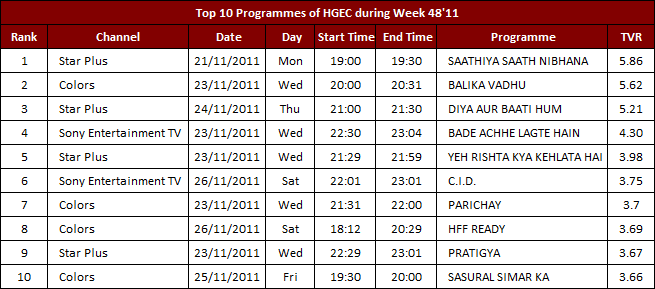
  • TAM data Top 10 programmes on HGEC – Wk 48’11

    Source: TAM Peoplemeter System

    TG: CS 4+ yrs

    Market: Hindi Speaking Market

    Period: Wk 48: Nov 20 to Nov 26, 2011


    About TAM Media Research


    TAM is a joint venture between Nielsen Company & Kantar Media Research. Besides measuring TV Viewership, TAM also monitors Advertising Expenditure of Television, Print & Radio through its division AdEx India. Since 2004, it extended its presence in the PR Measurement & Analysis space for Corporate/Marketing Clients by setting up a separate division Eikona PR Measurement.


    In 2007, the joint venture introduced RAM (Radio Audio Measurement) service to track Radio Listenership for the Indian Radio Broadcast Industry. In year 2009, TAM launched a division, called TAM Sports that specializes in monitoring Sports Sponsorship ROI.


    TAM Media Research’s objective is to fuel media insights that will drive the growth of the Indian Media Industry.

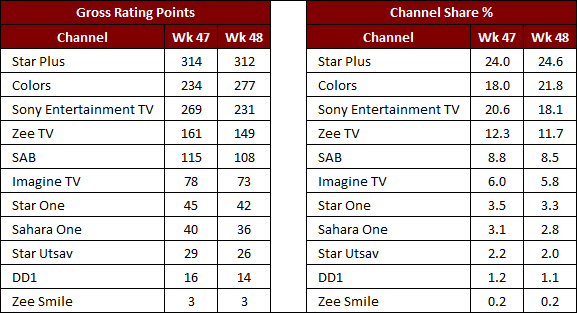
  • GRP Channel shares of HGECs- Wk 48 2011

    Source: TAM Peoplemeter System

    TG: CS 4+ yrs

    Market: HSM

    Period: Wk 47: Nov 13 to Nov 19, 2011

    Period: Wk 48: Nov 20 to Nov 26, 2011


    About TAM Media Research


    TAM is a joint venture between Nielsen Company & Kantar Media Research. Besides measuring TV Viewership, TAM also monitors Advertising Expenditure of Television, Print & Radio through its division AdEx India. Since 2004, it extended its presence in the PR Measurement & Analysis space for Corporate/Marketing Clients by setting up a separate division Eikona PR Measurement.


    In 2007, the joint venture introduced RAM (Radio Audio Measurement) service to track Radio Listenership for the Indian Radio Broadcast Industry. In year 2009, TAM launched a division, called TAM Sports that specializes in monitoring Sports Sponsorship ROI.


    TAM Media Research’s objective is to fuel media insights that will drive the growth of the Indian Media Industry.

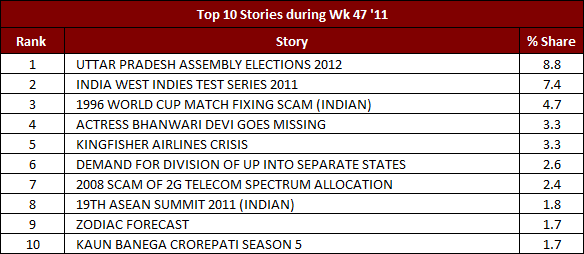
  • NCT Data Wk 47 ’11

    Source: News Content Track – A service of TAM Media Research Pvt. Ltd

    Channels: Aaj Tak, CNN IBN, Headlines Today, IBN 7, India TV, NDTV 24/7, NDTV India, Star News, Times Now, News 24 & Zee News

    Period: Wk 47 – Nov 13 to Nov 19, 2011

    Note : Analysis is based on the Telecast duration


    About TAM Media Research


    TAM is a joint venture between Nielsen Company & Kantar Media Research. Besides measuring TV Viewership, TAM also monitors Advertising Expenditure of Television, Print & Radio through its division AdEx India. Since 2004, it extended its presence in the PR Measurement & Analysis space for Corporate/Marketing Clients by setting up a separate division Eikona PR Measurement.


    In 2007, the joint venture introduced RAM (Radio Audio Measurement) service to track Radio Listenership for the Indian Radio Broadcast Industry. In year 2009, TAM launched a division, called TAM Sports that specializes in monitoring Sports Sponsorship ROI.


    TAM Media Research’s objective is to fuel media insights that will drive the growth of the Indian Media Industry.

  • Of course journos suffer for their mistakes!

    By Ranjona Banerji


    In case Press Council chairman Markandey Katju believes that journalists don’t suffer enough for their mistakes, he can perhaps get some satisfaction from the arrest of senior journalist Gurbir Singh in Mumbai on Tuesday night. Singh was arrested for ignoring a court summons in a “rasta roko” (street protest?) case which dates back 11 years. As a result, a non-bailable warrant was issued against him.


    Without commenting on this particular case, several journalists have cases like this against them and litigants sometimes file them all over India mainly as a form of harassment. The Indian legal system being what it is, the cases drag over years and when the journalist concerned will most likely have a changed a few jobs by then, the annoyance increases. The upshot for Shri Katju: The legal system has its own ways of torturing people.


    **


    I was quite unpleasantly surprised to see a half page feature in the Mumbai edition of The Times of India dedicated to the wonders of probiotics. I looked carefully to see if the page was sponsored but could find no such legend. There was a signed piece by a doctor about how probiotics were essential for a number of reasons and a corroborating article. There was not one single word about contraindications – and there is no substance on earth which does not have side effects. Since probiotics can be dangerous for diabetics – of which India has a substantial number – one would have expected a soupcon of caution from both the doctor and the newspaper.


    **


    Not surprisingly, FDI in retail has been the big subject in the news (even I succumbed, I admit, in my column for Mid-Day), but while newspapers gave us multiple opinions and pros and cons, one yearns for an intelligent discussion on television which does not descend into shouting, blaming and general hysterics.


    Contrast this to the discussions on the just-held elections in Egypt – surely an emotive subject – on Al Jazeera where guests had their say, disagreed or agreed and left un-bloodied.


    **


    One of Indian television’s most popular guests is Suhel Seth. He is known for his emphatic opinions on just about every subject and is as a result a love-him-or-hate-him chap. Seth has just written a sort of self-help book on how to get ahead in life. Those who both love and hate him must read a biting, caustic and very intelligent review of the book by Mihir Sharma for Caravan magazine.


    The Twitter world is full of the review, reactions to it and Seth’s own reactions. Highly entertaining.


    Ranjona Banerji is a Mumbai-based journalist and former editor. She is Contributing Editor, MxMIndia

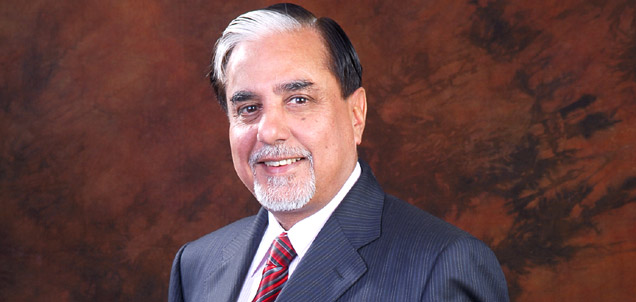
  • Happy Birthday, Mr Subhash Chandra!


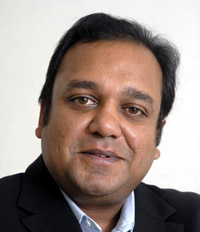
    By Punit Goenka


    Although I was too young in 1992 when Zee TV started, our family was confident of him achieving success in the media and entertainment space.


    * I have been fortunate to work with him. His perseverance, never-give-up attitude, and complete commitment to his work have helped him achieve the status that he has today. It was his visionary abilities that enabled him to foresee opportunities much before others and launch pioneering ventures like India’s first Hindi satellite channel – Zee TV, India’s first Hindi News Channel – Zee News, India’s first direct-to-home company – Dish TV and many more.


    * Zee, under his leadership, has always remained grounded through its journey spanning two decades. Our ability to implement cost-control initiatives has helped us overcome the economic slowdown and achieve further operational efficiencies, which is why Zee has been able to deliver a shareholder value CAGR of over 30 percent since inception. Apart from this, the connect with our viewers and ability to innovate and create successful indigenous home grown formats have helped us sustain our leadership.


    * He has done a lot for all of us. We want to consolidate on the strong foundation he has created for Zee. We are working towards making Zee Entertainment Enterprises Limited one of the leading Media and Entertainment Company from the emerging markets.


    * By becoming the first Indian to be conferred with the prestigious Emmy Directorate Award 2011 recently, he has done the entire Indian M&E Industry proud.


    * His vision when he started was to take entertainment to the home of every Indian. In fact he was able to envision and understand the value chain of the entire TV broadcast business from content creation to content delivery – right upto the last mile. Now he wants to take Indian entertainment to the global audiences.


    Punit Goenka is Managing Director and CEO, Zee Entertainment Enterprises Limited


    As told to Johnson Napier

  • The Anchor: 5 publications you (nearly) forgot but are (often) unputdownable!

    By A N Chorrea


    #1 Caravan
    Published by Delhi Press, would be wrong to call it India’s answer to New Yorker, but a good read nevertheless. Was resurrected by the younger generation of the Naths and with a gora editor in tow.


    #2 Reader’s Digest
    Oh, yes, it’s still around. The format may not have changed much, but it’s the Digest content and attention to detail and fact-checking makes it a great buy.


    #3 Economic & Political Weekly
    You may not get it at all the railway stalls, but get hold of a copy and we’re sure you’ll enjoy it for the quality of content.


    #4 Current
    Resurrected by the late owner-editor Ayub Syed’s son Asif, Current is a super read with some incisive political analyses, often by heavyweights in the biz. Check content on the website, currentnews.in.


    #5 Screen
    Critics may say it exists more for the awards than to serve as the voice of the Indian film trade as it once did, but the bold new tabloid avatar is interesting and easy-to-navigate.One does miss those big broadsheet ads, but this is the age where smallness rules.