Author: mxm_india

  • MTR eyes Rs 500 crore by 2012

    By Tuhina Anand

    Haldirams, ITC, Frito Lays and numerous local players in the Rs 6000 crore snacks category now have competition from MTR, which is known for its South Indian instant food mixes and spices. With its rich heritage, the brand MTR has now forayed into the South Indian snacks category, which can be understood as the category is growing at a rate of more than 40 percent a year. Also MTR has been trying hard to revamp its image post its takeover by Norwegian company Orkla. The company, which was largely restricted to South India, has in the last few years gone national and has revamped its offering, packaging and has been highly visible on the mass media platform. So the move is not a surprise, considering that its arch family rival Maiyya’s too have forayed into the snacks category and at around the same time.

    If one looks at the traditional snacks market, it clocks at Rs 3600 crore, growing at 36 percent, thus clearly the biggest player in this category. South Indian snacks remains a market of small brands or unorganized, as no branded player has seriously ventured into this market. While snacking is a big habit in the South, the branded South Indian snacks is the most under-developed market at 6 per cent value share of the total national traditional branded market. Haldiram’s can be seen as the only national player offering traditional snacks but in their portfolio, North Indian snacks dominate with the South Indian traditional snack category having minimal or no presence.

    Mr Vikram Sabherwal, VP Marketing MTR Foods Pvt Ltd, explains, “While evaluating various future growth opportunities consumer research clearly pointed to a good fitment between South Indian snacks and MTR. Looking at the potential of the market there is an opportunity for MTR to play a role in the ‘South Indian traditional snack category’.”

    “Snacking is heavily entrenched in the Indian food habit and hence there is immense potential in this category. We expect that snacks will become integral to MTR’s product offering and help achieve our target of touching Rs 500 crore by 2012,” said Mr Sabherwal.

    The company will leverage MTR’s distribution strength and use it to effectively cover the snacks outlet universe. Initially the snacks range has been launched in Karnataka and at later date will be extended to other states.

    On these products having takers beyond South India, Mr Sabherwal said, “Food in India is going through many changes. We as Indians are becoming experimentative with our food, hence these product will find national acceptance. Secondly some of our products like chakli already have a national footprint.”

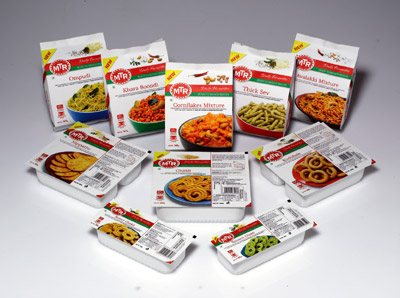
    The products launched under snacks category include Chakli, Butter Chakli, Spinach Chakli, Khara Boondi, Ompudi, Avalakki Mixture, Thick Sev and Cornflakes Mixture. MTR is offering its consumers the promise of crispy and crunchy snacks made with the latest technology in production and packaging. MTR is hoping that with their superior offering consumers will shift from the unbranded to the branded segment, hence expanding the market.

    Meanwhile, MTR has already started advertising the snacks category and has roped in Kannada film stars Upendra and Priyanka to advertise the range.

    Concluding, Mr Sabherwal said, “We at MTR will consistently drive our key categories like mixes, spices and masalas along with snacks. We are also constantly evaluating new products/categories to delight our consumers.”

  • Leo Burnett wins Mahindra creative mandates

    By A Correspondent

    Mahindra First Choice will now be working with Leo Burnett India as their creative agency.

    The incumbent on the business was Quadrant Communications.

    Though there was no official confirmation at the time of writing, agency sources close to the development have confirmed the news to MxM India.

    Mahindra First Choice Wheels Ltd is India’s largest multi-brand pre-owned car company which believes in selling high quality used cars to its customers with hassle-free documentation and car transfers.

    Founded in Chicago in 1935 with eight employees and three clients, Leo Burnett Worldwide, Inc. today operates a global network of over 200 operating units including a variety of specialty marketing services and 94 full-service advertising agencies in 83 countries. Leo Burnett helps build many of the world’s most valuable brands and successful marketers, including McDonald’s, Disney, Procter & Gamble, Marlboro, Kellogg, Samsung and Nintendo.

  • First on MxMIndia: NDTV elevates Barkha Dutt and Sonia Singh

    By A Correspondent


    News television major NDTV has announced the elevation of group editor (English) Ms Barkha Dutt and senior managing editor Ms Sonia Verma Singh.

    Ms Dutt will now will be Group Editor across NDTV and President of the Editorial Board.  Ms Singh will be NDTV’s Editorial Director and President of NDTV’s Ethics Committee.

    Meanwhile, NDTV has also instituted an Editorial Board with Ms Radhika Roy as Chairperson. The Board will be responsible for all standards and matters editorial across NDTV. It will meet once a month to take stock of all editorial issues, including of course ratings. The details of the Board, its remit and its exact constitution, which will include the managing editors of all channels and the head of Convergence will be annouced shortly. On the other hand, the Ethics Commitee: will develop consistent standards and oversee all ethical issues across the organization.

  • Express’s excellent expose of Kiran Bedi’s inflated bills

    By Ranjona Banerji


    The prize for the day must go to the Indian Express and its expose of accounting fiddles by former IPS officer Kiran Bedi. This prominent member of Team Anna, according to the Express report, regularly overcharged NGOs and other organisations for her airfare by travelling cheap and submitting inflated bills.

    TV channels soon picked up and the story and it must be remembered that they have been at the vanguard of the cheerleading squad for Anna Hazare and his movement. By mid-day, Bedi was on air offering a plaintively-voiced explanation and claiming she had done no wrong. Bedi’s answer to the Indian Express follows, without comment as it speaks for itself: “We follow transparent methods of functioning and volunteer to be questioned or audited. Every penny in our work is accounted for and is for the facilitation of causes we espouse… We have been very conscientious of trust and responsibility… And hence punctual and meticulous in our systems.”

    **

    The media, it has to be remembered, flatters to deceive. Too much expectation should not be placed on endless support for any person or movement, no matter how glamorous or well-meaning. The Anna Hazare movement thought it was good PR to go out of its way to thank the media for its “support” – mainly the non-stop TV coverage of Hazare’s fast at Ramlila Maidan in August.

    Unfortunately for Hazare’s team – and unfortunately for the principles of journalism! – the positive one-sided coverage given to Team Anna could only last so long.

    Cynicism and scepticism will usually triumph over adulation – one must remember that the so-called adulation of celebrities is usually PR and marketing driven and will also go the way of all things one day. One suspects that the internet will push that change faster than our little media darlings realise.

    As for the rest of the world, some disgruntlement soon emerges. Poor Rahul Gandhi, who a few months ago was seen as a worthy heir apparent, is now pilloried all over the place and is often portrayed as the font of all problems. Extreme perhaps but inevitable.

    **

    One which note, I was quite happy that the baby shower party for Aishwariya and Abhishek Bachchan completely passed me by. I only got to hear of it through Twitter and haven’t stopped congratulating myself on my escape!

  • One year celebration for Fortune India

    By A Correspondent


    Fortune India, which was launched in October 2010, has created a reputation for being one of the best global business magazines in India.  To celebrate its first anniversary, Fortune India has come out with a double issue.


    Mr Pavan Varshnei, President, Fortune India, said, “The response to Fortune India has been splendid, both in terms of readership and advertising. While we’re a monthly, we still command the highest advertising market share in the premium business magazine segment. Today, Fortune India is the preferred choice among business leaders and advertisers of high end products and services.”


    The anniversary edition promises to be an insightful and enriching read. The cover story ‘How we work’ focuses on the changing Indian work culture. Another interesting story, which is set to spark a new debate among marketers, is Grey Sells, focussing on the 80 million people aged 60 or above, who provide a great new business opportunity. The story on Taiwan’s largest, and the world’s second-largest, chipmaker, MediaTek, shows how it has revolutionized the cellphone market in India and China. Along with the anniversary issue is a Collector’s Edition featuring the best of Fortune India’s coverage of business thought, leadership and practice across India and the neighbouring countries.


    On the occasion, Mr Dibyendra Nath Mukerjea, Editor of Fortune India, said, “When we launched Fortune’s India edition a year ago, we wanted to bring out a publication that delivers depth and breadth in its journalism, giving Indian business leaders actionable intelligence to propel their businesses globally. And, I am happy to share that Fortune India has become the essential read for Industry leaders and influencers.”


    Fortune India has also received global recognition for its design and layout – photo, graphics etc.  It received two merit awards from the Society of Publication Designers, New York, and besides that, a bronze award for infographics at the IFRA Annual Competition, earlier this year. Fortune India 500, Business Person of the Decade, the Green issue and Business of Luxury special are some of the issues that have stood apart in last one year.

  • Hard Knocks: Katju’s unreal expectations

    By Anil Thakraney


    The Chairman of the Press Council of India, Justice Markandey Katju, reminds me of a very strict uncle. You don’t mess with the guy. You quietly listen to him and obey his orders. Or else get ready for some nice punishments. Katju thinks the Indian media tends to be irresponsible, that it’s not doing its job, which is to serve the people. That there’s too much of celebrity journalism. And yes, he gets really riled on the issue of paid news. And yes, he wants to change things around. By carrot or by stick… whatever it takes.


    Of course the man’s heart is in the right place, and he means well. And good luck to him in his mission to clean up the desi media houses. But am afraid it’s not going to work. This issue is too complex and layered to be solved by Katju’s simplicity and good intent. And even threats of punishment won’t work. Here’s why.


    Broadly speaking, the Indian media is run by proprietors and not by editors. Let’s be clear about that. So however honest and diligent the editor might be, the control room is really run by the owner of the publication or the TV channel. And these people are businessmen. They don’t worry about public service, they are focussed on return on investment. They are not in the game to make India a better place, they are here to liven up their own balance sheets. They are not saints, they are suits. In this scenario, dodgy practices is a sad but logical outcome. Because there is too much competition in the mass media. Hundreds of channels and thousands of print brands are chasing the same ad pie. In how many ways can you divide one cake? Mouths have to be fed, no? This then results in excessive celebrity coverage. What to do, everyone wants a piece of SRK! And irresponsible journalism. How can you get eyeballs by following boring rules in the news room? And yes, paid journalism. If the advertisers aren’t gonna entertain me, I have to find other revenue channels, thank you very much.


    Anyway, good luck to Mr Katju. He deserves no less than a Nobel if he can clean things up out here.


    ***


    PS: It’s common sense to me, but I don’t understand why the TV chiefs don’t get it. The ONLY reason some goons hurl chappals and rain punches on important people is to get noticed, to get their 15 minutes of fame. And beaming their actions on screen is playing right into their hands. Just don’t feature these incidents, simply report them. Is that so difficult to understand? There are other ways to get TRPs. Try SRK!

  • Can elite F1 supplant cricket?


    By Tuhina Anand

    with inputs from Rishi Vora and Shubhangi Mehta


    With so much hype surrounding the Formula One Grand Prix at Buddh International Circuit slated to take place at the end of this month in New Delhi, it makes one wonder whether F1 is the sport that can be an alternative to the cricket-crazy nation of India.  So while we have been talking to a cross section of the industry to understand how bullish are they on the F1 and one thing that has emerged clearly is that cricket will always be “the” sport that will rule Indians and other sports, be it hockey, tennis or F1, will remain the poor cousin. Thus cricket will be the game that will be raking in moolah for both advertisers as well as broadcasters, and not to forget the players themselves with multi-million endorsement deals.


    Mr Harish Bijoor, CEO, Harish Bijoor Consults, is clear that there is no sport that can kill cricket, as it is a very democratic game that anyone with a bat and ball can play. But sports like F1 are restricted to a few. Also, he is of the opinion that F1 is an upper end/niche brand, hence the advertisers like Mercedes Benz would benefit from being part of the event but not Uncle Chipps!


    Niche is a word that well defines F1 and is what has emerged from MXM India’s interaction with various industry leaders. Mr Arvind Sharma, Chairman of India Sub-Continent, Leo Burnett too echoes the same sentiment. He said, “Cricket is a mass sport in our country. I do not think that F1 can take over cricket in any which way. The brand that are associating themselves with F1 are a niche brand which cater to a specific audience, which can also be called the upscale society.”


    There are others too like Mr Sambit Bal, Editor, Cricinfo who vehemently says that F1 caters to an absolutely niche market and for F1 to replace cricket in popularity, even after 20 years, is far far-fetched. Mr Ayaz Memon, veteran journalist, reasons: “F1 is an urban sport watched by an elite audience. The popularity of the sport is growing, no doubt. But, I don’t think it’ll kill cricket. India is a cricket-crazy nation, so very unlikely.”


    In fact a broadcaster, who refused to be identified, puts its bluntly, “No, that’s very unlikely to happen. India is a one-sport country. F1 does have some avid followers, but are outnumbered by people in India who think the game of cricket is a religion and not just a sport.”


    As earlier mentioned by Mr Bijoor, the appeal  of cricket lies in it being democratic in nature. One can see young and old wielding the willow in every gully and mohalla hence truly being the sport of the nation. That explains why sportsperson from any other game are still struggling to gain prominence in India barring few that could be counted on fingers but that doesn’t apply for cricket where the entire team and the lead stars find their way to mint money be it through endorsements or even taking up commentary post their innings. Plus the fan following for someone like Tendulkar or MSD is something no other sportperson can even dream of. Rajeev Raja , NCD, DDB Mudra Group  goes to the extent of calling impossible that a sport can replace cricket in India. He said, “The mass appeal that cricket has cannot be compared to any other sport in India. It appeals to almost 900 million people whereas F1 may not even appeal to 100 million people, its only a niche segment that this sport will appeal to and hence we will find similar advertisers advertising with the sport.”


    While it is agreed that cricket will always reign supreme in India and F1 is seen as the sport for the elite niche, one thing can’t be denied – that the hype around the Grand Prix is unprecedented. In fact it is this hype that is making one think that probably if not an alternative but an able competition to cricket is here. Internationally, F1 rakes in the moolah and is very popular. Mr Dhunji Wadia, President, Everest Brand Solutions said, “It has been widely believed that we are slow starters, but once we gather momentum, we race to the finish line quickly. A lot of young people in India want to have an alternative to cricket and perhaps Formula One is the right sport.  The statistics on sponsors and advertising revenue are sounding promising for the first event.  But there is still some way to go and it would at best be an urban phenomenon.  Having said that, no other sport has generated as much enthusiasm over here besides cricket.”


    So at least for starters the prospects for F1 are promising. Mr Darshan M, CEO – I1 Super Series at Machdar Motorsports Private Limited, a company that is looking to bring the IPL format in motorsports to India, explains cricket and F1: “The comparison is like sunrise and sunset here – both are beautiful in their own way. Motorsports is globally very popular and F1 definitely is an opportunity among youth for whom speed is thrill. In fact, the craze can be gauged from the massive turnout in Bengaluru recently to see Lewis Hamilton show his moves. I think there is enough space for another sport other than cricket to make a name in India.”


    Picture: Fotocorp

  • Don’t be scared of the Dolly Bindras in media: Shishir Joshi

    By Shishir Joshi


    This is not in defence of the media. As you read along, you may realize it. In fact, it is quite to the contrary.

    Foremost, let me lay down some of the allegations against the media and some of the prevailing perceptions;

    That the media is a king-maker. That it is corrupt. That it is far away from the realities impacting the society. And that it thrives on sensationalism.

    Partly, it is the media, itself, which is to blame. For the corruption. (Bhrasht-aachar; read, corrupt behaviour.) And for the perception.

    Let’s start with the most recent one. Media as the king-maker. Allegations which have shattered the holier than thou image. And as eminent journalist Arun Shourie put it in a TV show, “Time and again instances have come up where journalists themselves have been responsible for the betrayal.”

    Many, largely unrelated to media, strongly believe media is corrupt. Unfortunately, what they mean by ‘Media’, could really be a handful, but, those who get branded, are just any and everyone who is associated with ‘media’.

    So, to begin with, here’s a dekko to clarify some prevailing misconceptions.

    Very few people really know and understand how a news organization operates. In the fifty-odd people who work, in what is seen by the outside world as the ‘powerful’ editorial of any news organization, a little less than half, say twenty or so, are what everyone knows as Reporters (working Journalists in the real sense).

    They are the ones who have a contact with the ‘outside’ world. Or, that, the outside world really knows about. (The other non-reporter face known to the high and mighty could be the editor, but, increasingly, it is the CEO or the Marketing /sales head who is a far more ‘popular’ face.

    Within those twenty reporters, barely four or five such Journalists deal/interact with those in High places; by this, I mean, with Political heavyweights (by Reporters covering the political beat) film stars (mind you, not any film start, but only the big five of Hindi cinema) and Sports, again, here not just any sport or any sports heavyweight, but Cricket an d the mighty Sachin, no less.

    So now, of an approximate 50 odd, we have come down to the top five in any Editorial, who have the opportunity to rub shoulders with the Rajas (not to be mistaken with Spectrum Raja. And within that, on a rare occasion will one odd Journalist really mis-use his seat or position.

    All this also depends on the reach and impact that the Media house commands, in circulation or readership. (NDTV among policy makers and Hindustan Times in Delhi do count for being heavy weights…umm… what a coincidence). Needless to say, a fancy designation helps.

    So if a Managing Editor of one among many many many media organizations is found to step into grey area or is caught on tape, mediating or promising solutions, this could be just ONE he or she caught in the act isn’t it? Is it then fair to brand all of media as corrupt?

    It may be unfair. But the guilty, is the media itself. And some of these journos in power. And the perception that they have created.

    How often have we seen PRESS stickers adorning two wheelers and cars of media persons. Any self respecting journalist who holds a valid identity card from his organization will tell you that these stickers are not required. Not required unless you are using them to ensure the traffic cop does not stop you.

    Maybe those using these stickers do not know this, but the ‘public’ and the traffic police surely believe this is the reason.

    To say press stickers are by themselves to blame, would be highly unfair.

    We also have a mushrooming number of ‘king-maker’ journalists. Who throw names, host parties and ensure that the bigwigs attend their private dos.

    Rarely does the ‘King’ , either a big-ticket politician or a film star, not oblige. Graciously, he ensures that the journalist is addressed by his first name, and a few back slaps later, the powerful man is back in his den.

    Only a handful would cringe at the thought of a powerful and popular name walk into your living room and back-slap you, chat up your family and share a chai with you. What the action leaves behind is you, the journo beaming from ear to ear, like a fat cat having stolen a bowlful of cream, with the rest of your family, friends and neighbours in a daze.

    Mind you, there is nothing wrong in the high and mighty visiting you.

    But, where the hacks go wrong, is when they start believing that powerful are in love with you the person and not you the Journalist. I promise you, it can’t be further away from the truth, in most cases.

    And as you bathe in the halo of the big one calling you by your first name and your family and some friends gazing at you with renewed affection and respect, you fail to see the rest of the neighborhood, who see you as an ass-licker. That is perception, as it gets created.

    You, in fact are an ass with a big bloated ego, refusing to see the writing on the wall. “You are so dear to me,” says the politician and you glean with pride. What you don’t read between that line is he muttering under his breath that “I accept you only with your designation and organization.”

    The power of a journalist, in today’s age (unless his good deeds speak volumes) is like the hair on the head, the tooth in your gums and the nail on your fingers. It is valued only when it is in its place. Worthless when chopped.

    There was a time when Journalists wielded the power of the pen. The power, by what they wrote. Based on facts and fair play. That was power. Real power laced with absolute respect.

    Today, the power has corrupted. Absolute power (based on a belief that he is the king maker) has corrupted absolutely.

    The far and few, but absolutely corrupt journalist is powerful not by what he is capable of writing, but his ability to WITHHOLD information. The power to conceal a story, often at the cost of a favour, or as seems in the case of the Radia tapes, through an alleged TRADE-OFF makes the corrupt journalist in the lot nothing less than a white-collared extortionist.

    But you hate them, you call them names and yet, you do not speak out against them. What is it that scares people when it comes to speaking up? Or speaking out? Unless it is in hushed tones? Politicians have been hurling abuses at each other, taking names, in the spectrum scam. But no one has dared name the journalist(s) or media houses at all. Only after social media (and later a few magazines) began talking about it, have names begun cropping up. The role of the journalists is beginning to get scrutinized.

    While social media has been active in this case, mainstream media has been largely mute. Be kind to thy comrades for they may one day come and lord over us. Is that the reason why?

    But what stops the rest of the world from talking about these names in public? Two reasonings come to my mind.

    One, Industry captains do not wish to rub India’s much watched English channel(s) and powerful newspapers the wrong way. “I am seen on it, quoted by them and would continue wanting to be seen there” is what they believe. Any rubbishing of the network, or its key stake holders would mean, being blacked out.

    The second, and more real fear is of an unwarranted backlash. I call it the Dolly Bindra effect. Nobody wants to rub Media big-wigs the wrong way. However wrong they may be. They may be paper tigers, but tigers no doubt. Their byte is more poisonous than the (non existent) bite. They have a habit of bouncing back and, like the boxing cushion, slamming right into your nose.

    So, however much you dislike them, hate their guts, have evidence of their alleged wrongs or have taped conversations of political coziness, you would rather shut up and lead your life.

    After all, we all know what happened to Shweta Tiwari and Samir Soni on BiGG Boss season four when they took on Dolly Bindra, right? Shweta was stung in the face, Samir was ousted. And the one who got maximum press, was Dolly, who returned to the BiGG BOSS house with a bang.

    PS: Remaining quiet has never been a solution. Mute spectators to a crime too, are as much guilty as those perpetrating the crime.

    It is time you speak up against those, whom you believe are corrupt under the garb of being honest. It is important too. For others, Citizen Journalism, or social media, is a solution.

    For, isn’t it a commoner like you and me who exposed the Adarsh scam or the CWG or the initial lid of the various scams in recent times?


    Shishir Joshi is the co-founder of Journalism Mentor, and till recently was the Group Editorial Director of the Mid-Day group of publications.
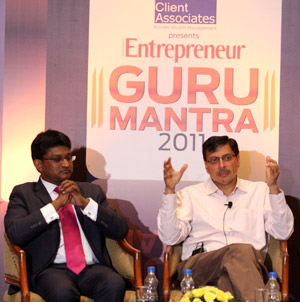
  • Phaneesh Murthy gives second Guru Mantra lecture

    iGate Patni’s CEO, Phaneesh Murthy (right) with Senthil Chengalvarayan of Network 18 group

    By A Correspondent

    Entrepreneur, a monthly magazine from the Infomedia 18 stable, in association with Client Associates, recently organised the second edition of the Guru Mantra lecture series with Phaneesh Murthy, CEO, iGATE Patni.


    Murthy spoke to a select gathering of established entrepreneurs, venture capitalists, and corporate executives about his successful entrepreneurial stint, the challenges he faced in setting up the company, valued today at US$1 billion. He gave insightful tips on how to get the right kind of funding, the recipe for successful scaling, talent management and policymaking, and many other dos and don’ts of entrepreneurship in India.


    The idea behind the series is to celebrate the spirit of entrepreneurship. Planned to be organised at premium venues across different cities, the series provides a knowledge sharing forum for entrepreneurs.


    As part of the format, every session has a successful entrepreneur as the guest mentor who shares their entrepreneurial journey with the attendees, followed by a Q&A session where the attendees get a chance to ask questions specific to their business.

  • The Anchor: 7 ways to keep a viewer glued to your channel

    By Sunder Aaron


    #1 Assortment: A channel needs to offer a variety of content to viewers to keep them coming back.


    #2 Thematic: It is important to be a part of local festivals and important historic days which makes the viewers feel closer to the channel – for example Diwali or Independence Day.


    #3 Original: A viewer today is bombarded with numerous communications all the time – it is more important than ever create a clear differentiation amongst the category to enjoy top-of-mind status with the viewers.


    #4 Young and fresh: Any viewer, young or middle-aged, would like to watch a film which excites him/ her. The best way to this is to keep the appearance of the channel vibrant and fresh.


    #5 Beyond the television screen: Gone are the days when television channels just aired promos and hoped to keep viewers glued – the need of the hour is to create brand extension programs.


    #6 Avoid repetition: Repetition could result into losing a fair amount of eyeballs since there is a sense of disappointment if the viewer has already watched the content.


    #7 Surprise element: Surprise your viewer! Exceed your promise by delivering more than you promise.


    Sunder Aaron is Business Head, PIX.

  • Conde Nast Traveller hits many highs

    By Akash Raha


    Conde Nast Traveller completed its first anniversary in the Indian market. The magazine was launched in India in October 2010. The anniversary issue of the magazine is on stands at a price point of Rs 100. Conde Nast Traveller is the third magazine from the group in India, after Vogue and GQ. Whereas Conde Nast Traveller is concerned, it is the sixth international edition of the brand.  Even though Traveller’s stay in India has been only for one year, it has been there for a long time in UK and US. MxM India got in touch with Divia Thani Daswani, Editor, Conde Nast Traveller to know more about the magazine’s year-long journey.


    Q: Conde Nast Traveller has completed one full year in the Indian market. How has the journey been so far?

    For my part, I can say this has been an incredible first year for Conde Nast Traveller! When we were launching it, we believed this would be a very niche magazine with a print run of about 15,000 copies. Our print run for the anniversary issue is 40,000 copies, just one year in.  It’s a wonderful reflection of the enormous passion for travel that we have in this country—and also the sophistication of the Indian traveller. But numbers aren’t the only thing that matter: the feedback has been tremendous.


    Q: How do you think Conde Nast Traveller has fared vis-à-vis its competitors in India?

    Readers follow us with an acute eye; they read us closely; they love the visuals; they take our recommendations seriously. More so than any other publication I know, Conde Nast Traveller is a magazine people save for years—it doesn’t become irrelevant or less interesting when the month ends. Finally, I’m very proud of the fact that some of the greatest writers and photographers in the world—from Suketu Mehta, Pico Iyer, Amitav Ghosh and William Dalrymple to Julien Capmeil and Prabuddha Dasgupta—have worked with us so enthusiastically. It’s the power of travel, really. It brings out the best.


    Q: What are the content and product innovations you have done for the anniversary issue?

    The anniversary issue is especially close to my heart because it’s our first India Special. This is an idea we’ve been working on for many months; in fact, ever since we started doing our research back in January 2010. We discovered that there’s a collective desire among discerning travellers to discover more of our own homeland. It seems the further away we go, the more we jet-set around the world, the greater the longing to explore India. So this anniversary issue is a tribute to our ‘incredible India’. It’s full of secrets and surprises from each corner of the country, from New Delhi to Tamil Nadu to Bihar to Mumbai. Even the international destinations we’ve covered have been captured by Indian voices. The lineup in this issue is superb; it’s been the collaboration of the great talent and hard work of dozens of people across the world, from Amitav Ghosh in China, Hari Kunzru in Los Angeles and Rashmi Uday Singh in Paris to Michel Figuet in Delhi, Julien Capmeil in Bihar and Ruskin Bond in Mussoorie. And of course, there’s a healthy dash of glamour, with Frieda Pinto, Tina Ambani and Rahul Khanna! Another favourite of mine is the photo essay featuring some of our favourite unseen images from the first year of Conde Nast Traveller—images so glorious we couldn’t help holding on to them. There are other innovations, of course, from a printing and production perspective, but to me, this issue is special because of the dozens of gems inside.


    Q: What are the other campaign initiatives you have undertaken around your product to highlight your brand among others in the space?

    I think the focus has been to create a magazine that appeals and talks to the affluent well travelled  Indian audience which is really been the biggest success story for us. Apart from this we have focussed on a targeted marketing plan via outdoor in key locations, targeted subscriptions program and of course working on the signature event which is the Conde Nast Traveller Reader Travel Awards. We also have a program to reach out to the key influencers in the industry by hosting small events.


    Q: What do you think about the travel magazine space? Do you see it growing in the years to come?

    As far as the travel industry is concerned, the future is India and China. Outbound travel from India is set to grow to 50 million people by 2020. Already we are among the top spenders in the world when it comes to hotels, shopping, food and nightlife—and of course, destination weddings!


    Q: What has been the response to your anniversary issue?

    The anniversary issue is already out and has received an extremely positive response on the newsstand. The cover price continues to be INR 100.

  • Zippo lighting up India. Sales could double in 5 years: David Warfel

    By Shubhangi Mehta


    Mr David Warfel, Global Marketing Director – Zippo Manufacturing Company, is a marketing professional with over 25 years of experience. Mr Warfel oversees the development and management of the Zippo brand worldwide. Responsibilities include the direction of all advertising and marketing communications, product management, trade and consumer relations, and product and retail development.


    The Zippo Manufacturing Company’s products are sold in over 160 countries worldwide and Zippo is one of the most highly recognized and respected global brands. The famous Zippo Windproof Lighter has been manufactured in Bradford, Pennsylvania since 1932. Since that time almost 500,000,000 lighters have been produced and sold.


    In addition to Windproof pocket lighters and fuel, Zippo markets a wide range of consumer products, including candle and utility lighters, writing instruments, watches, fragrance, and outdoor speciality products.


    MxM India caught up with Mr Warfel for a discussion on Zippo and its growth trajectory and plans in India.


    Q: How has growth been for Zippo when it comes to Indian market in the past 2.5-3 years?

    Last year, Zippo witnessed a 69 percent increase in sales volume in India – one of the fastest growing markets for the brand.

    We currently operate in shop-in-shop formats across the country and also plan to open up a Zippo branded store. This shall happen once the entire range of accessories and brand extensions are launched.


    Q: What kind of market do you see India as?

    The brand has been present in the country since 2008 and has seen a strong increase in popularity over the last few years. India is a key market for Zippo. The country views Zippo as a brand, not a product.


    In the last two years, India has become a significant market with great potential and we expect it to be one of the key players in the international market. The growth in India is predicted to be more than double in the next five years.


    Q: Which markets do you consider the best in terms of scope and development when it comes to growth?

    There is a 90 percent brand awareness globally of the Zippo brand. Forty percent of our business comes from North America. Currently, China is our major international market followed by Japan. If the success in the Indian market continues we expect sales to reach similar levels to China in the not-too-distant future.


    Q: What do you think are the attributes that help a brand like yours click and connect in the market especially India?

    Zippo is an iconic American brand. It is aspirational. The lighter is ingrained in the fabric of both American and global culture. With strong India and US connections, constant global traveling, inflow / outflow of Indian students from the US has transferred the qualities / aspirations of an American brand to India. Attributes like these truly connects Zippo with India market making the brand relevant to our target audience.


    Q: How is the consumer behaviour different in Indian markets when compared to global consumer?

    Indian consumer confidence has been consistent during post recession period. The overall optimism pervading the country finds Indians open to spending a little more than they did in the past two quarters. There is also a high level of acceptance, openness to new ideas and cultures, therefore, more confidence towards testing new products.


    Q: What is your growth strategy henceforth?

    In the last few years Zippo has begun to expand its product range into the lifestyle space focusing on men’s accessories and outdoor products. India is the single most important focus right now. We have increased our marketing spends ten folds worldwide in the last 10 years.


    As we are diversifying the product category to lifestyle products and accessories, you will soon witness a lot of the below mentioned products in India. Our windproof lighters have been performing phenomenally well in the India market and are really helping to establish the brand amongst our target audience.


    Zippo’s product line up is divided under four heads:

    Lighters & accessories – Windproof lighters, Zippo BLU, Pouches, chains, ashtrays, lighter fluid, butane gas, flints and wicks

    Home, Hearth & Patio – Candle lighter

    Outdoor line – Hand Warmer, flex neck, emergency fire starter, campfire starter, Windproof lighters

    Men’s lifestyle – Writing instruments, leather goods, watches and fragrance


    Q: Please tell us about your foray into the digital medium and experiments with social media.

    In 2011 Zippo launched a global Facebook page and also Twitter accounts in key markets in order to interact with our core consumers. The Zippo Facebook page now has around 200,000 fans, a number which is growing daily.


    Q: How do you plan to capture your target audience?

    The product range from Zippo has been well categorized for both men and women. We are selling through shop-in-shop formats and regularly engage customers through interesting marketing initiatives. Also, with growing music trends worldwide, the brand Zippo has also built up a strong association with rock music. The brand has been able to play a prominent role in key live rock music festivals across Europe, US and also in India.


    We recently sponsored the Harley Rock Riders concerts in India and were thrilled to see avid Zippo fans waving their lighters in the air in time with the music – a classic Zippo moment!


    We also have Zippo owned music platforms, the Zippo Hot List Tour, in China and Korea as part of our Zippo Encore music programme. This programmme is aligned with supporting emerging rock talent within the local market.


    Q: What are the key challenges before Zippo?

    As legislation gets stronger, it is likely to affect the business and that is why Zippo as a brand has diversified itself into various lifestyle product categories, transferring the Zippo brand’s key characteristics across all new products.


    Also, another major challenge is that of counterfeit products. We are ever vigilant in protecting our intellectual property and have a legal team dedicated to tackle counterfeit issues.


    Zippo enthusiasts know that authentic Zippo lighters carry the Zippo bottom stamp and the Zippo trademark stamped on the lighter insert. The famous Zippo Lifetime Guarantee also accompanies every genuine Zippo lighter.


    The counterfeit goods are both locally and internationally sourced. It is a vicious market for any premium brand and the best way to deal with them is to stick to company guidelines while making any purchase.