Author: mxm_india

  • Discovery’s Curiosity answers those awkward questions

    By A Correspondent

    Non-fiction entertainment biggieDiscovery Channel has announced its new landmark series Curiosity, which seeks to uncover the truths behind life’s most challenging questions. These include: What it would be like if you could live forever? What would happen if aliens attacked? Is there a parallel universe?  How will the world end? Why is sex fun?

    The new special series, scheduled to start airing on October 17 every Monday at 8pm, captures the fundamental sense of wonder and present an engaging visualization of our minds’ search for answers.  Curiosity is designed to tackle the fundamental questions and underlying mysteries of our time in fields such as space, biology, geology, medicine, physics, technology, nature, archaeology, history and the human mind.

    Commenting on the series, Mr Rahul Johri, senior vice president and general manager – Asia-Pacific, Discovery Networks Asia-Pacific said, “Discovery Channel through its programmes empowers viewers to explore their world.  Embarking on a fascinating voyage of discovery, the channel brings a new landmark series ‘Curiosity’ that goes to extreme lengths to seek surprising answers to underlying mysteries of our lives. From the micro to the macro, ‘Curiosity’ delves into most enduring and insightful subjects.”

    Intel, the sponsor of Curiosity, will use the series as a global marketing platform in more than 40 countries, with key partnership elements. Curiosity will premiere this year on Discovery Channel in the United States and in more than 210 countries and territories around the world including Latin America, Europe, Middle East, Africa and Asia-Pacific.

  • The fast and the gorgeous on NDTV Good Times

    By A Correspondent


    The verdict is out and the final 4 speed divas identified in what was truly a sizzling hot finale episode of Force India The Fast & The Gorgeous season 2 on NDTV Good Times. After going through a series of complex tasks, voting sessions, eliminations rounds and facing intense competition Kaizeen Daruvallah and Rani Patel from aamchi Mumbai, Punjab di Kudi Alisha Walia, and Neha Raghuvanshi from New Delhi have emerged as the ultimate speed divas. They will now get the chance to travel the world with the Force India F1 team.

    Smeeta Chakrabarti, CEO, NDTV Lifestyle said, “F1 is coming up in a big way in India, and we believe that it’s here to stay. The second season of Force India The Fast and The Gorgeous has been very well received on NDTV Good Times, and I would like to congratulate the 4 winners and wish them the very best for their journey”.

    Alisha Walia said, “Speed has always thrilled me and now that I have won The Fast and The Gorgeous I am officially a Force India Speed Diva”. Neha Raghuvanshi echoed the same sentiments and added, “I would like to take this opportunity to thank NDTV Good Times for providing such a platform to us and not to forget the beautiful Ambika Anand who has been a friend and guide on this journey”.

    Shot in the exotic Aamby Valley and hosted by the ravishing Ambika Anand, the 13-episode series had 16 gorgeous contestants compete against each other to become the ultimate speed diva and the face of Force India F1 team on NDTV Good Times. The 16 contestants were judged on their endurance, speed and appeal.

  • 94.3 Radio One empowers its listeners

    By A Correspondent

    Taking a leaf out of the current wave in the nation where people’s say cannot be ignored, 94.3 Radio One has also decided to follow this path. The station has just completed five years in the Bangalore market and has initiated a campaign  to give its listeners the power to choose what they want to hear on radio by organizing a public feedback forum for listeners’ to make themselves heard.

    Talking about the initiative, Shyju Varkey, National Marketing Head and Station Head-Bangalore, says, “On our 5th anniversary, we wanted to create an initiative where we could empower the listeners. We want to give our listeners the power to choose what they want to hear and what they don’t’ want to hear.  An initiative such as this has never been taken up by any radio station or any other medium before. “

    Radio One through this initiative will shortlist 600 candidates who are very well versed with Bollywood music to be a part of a research conducted by a prominent research agency.  These candidates will represent the listeners to choose the music they want to hear and decide on the most favorable tracks, which will ensure Radio One plays the music that the public desires. A reproduction of the playlist would then be announced on air after the research has been completed.

    “We were inspired by the various initiatives all around the country where people are striving to make themselves heard.  We being a radio station thus decided that we should do our part in giving citizens a voice through our station by making it completely 100 percent co-created by the listeners, for the listeners and of the listeners,” added Varkey.

  • Choice between lion and jackal: Santosh Bhartiya

    Founder of Chauthi Duniya Mr Santosh Bhartiya is known for unabashed journalism, andhis radical approach to television, especially election coverage. He speaks to Akash Raha about politics, journalism and how the greed of media owners has led to the institutionalization of corruption.


    Q: From being a Member of Parliament to being an eminent journalist, you have been on both sides of the picture. How does it feel now to write scathing commentaries on politics in India?

    In politics, I have realized, no one can do anything positive in India. There is a lack of inspiration to do anything positive. Moreover, we have a “babu system” here in India, where the MP hardly even knows anything about the bill that is been drafted. I am back in journalism because I realized that most of the famous leaders we know today are nothing but middle-men. I think a journalist should stay in the field of journalism and write against corruption and the malpractices that we see in politics these days.


    Q: Internet TV sounds like a very interesting concept. How is it doing and do you have plans for a full-fledged television channel soon?

    Our internet TV has been very successful. The concept is one of a kind and the political subjects that we tackle are doing phenomenally well. Here, we have both live and recorded shows. If ratings are anything to go by, we will give quite a few news channels in India a run for their money. Definitely in the near future we will come out with our own television channel. The pressure from our internet TV viewers to start a 24-hour television channel is immense, as the comments on the site show. We are strictly against PR journalism and this is what our audiences like about us. However, the plan for a TV news channel is still at a budding stage.


    Q: Why haven’t you tried to monetize your online space?

    We are not here to do business, we are here only to earn credibility. We feel that when you have the treasure of credibility, money will come when the time is right. Our promoters are happy this way, and they fully support us in this thought process.


    Q: What do you think of the phenomenon of paid news in the media and how do you think it should be dealt with?

    In the current scheme of things and in our society, corruption is a way of life. And the people sitting in the highest echelons of power are responsible for making it so. When the topmost leaders of our country are corrupt and are sitting at Tihar jail today, what will the rest of the country do but follow suit? Journalism too is no stranger to corruption… Earlier, corruption in journalism used to be small, and there was only a minor case here and there of a journalist taking favours to write a particular story. But now TV owners and newspaper owners are committing corruption at a massive level and are charging huge commissions. I know at least one organization whose owner called a meeting in Delhi and spoke to his employees about ways of making money and to increase profits, obviously through malpractices. The greed of media owners has led to institutionalization of corruption. But like in the case of Anna Hazare, someday the public will stand against media too. Only then will “paid news” stop. Paid news can’t be stopped by seminars and discussion. Public opinion is building against media and it is time they do something about it. Journalism is at the lowest that I have ever seen in India… The concept of investigative journalism, which the 1980s were famous for, is over. This is the age of PR journalism.


    Q: People often say that there is sensationalism in language media. What do you feel?

    There is a difference between English and language publications here which one must understand. English journalism, by virtue of being the language of urban elites, caters to them. Language journalism, since it caters to even the poorest of poor, talks about grass-roots-level issues. What might appear sensational to the urban elite is not sensational in reality, but a part of the rural lifestyle. Rarely have I seen such stories on grass-roots issues in English media since the time of Ashwani Sareen when he did the story on Kamla. But such stories appear regularly in language publications.


    Q: Do you think in this age, where business and economics in media houses are of prime importance, content is still the king?

    Content is and always will remain the king, just as a lion will always be the king of the jungle. The question is whether you want to become the lion or you’re happy being a jackal. There is always a choice… Either you can earn money or earn satisfaction by hard work, doing stories that can’t be contradicted or challenged. Unfortunately today journalists only want to earn money and their stories lack veracity.


    Q: Can you talk about an instance of activism through journalism that Chauthi Duniya has achieved?

    One of the bright examples of this is our show Do Took (in Hindi) which is broadcasted on all Hindi language channels of ETV. We specially make this show for ETV and its idea is unique. There are many shows where there is an interview and the interviewer, but in this show, there is no interviewer and I directly address the audiences. We pick up intriguing and interesting political topics and do a complete show on this. The videos are available on our internet TV site too. There are several other examples of such journalism. I take pride in saying that Chauthi Duniya is known for its credibility and fearlessness in journalism. We aspire to recreate the golden era of journalism in India during the ’80s of which people like SP Singh, MJ Akbar and Pritish Nandy were a part.


    Q: How are your various publications doing? Are there any new publications on the cards?

    We are planning to launch an English weekly magazine soon. It might still take a couple of months before the magazine hits the stand. It will be a hard hitting political magazine with excellent content. We are on our way to building a strong team, after which we’ll launch. Like all other publications and offerings from our group, the English magazine too will become a personification of excellence in journalism. Apart from that, we are at the initial stages of planning for a full-fledged TV channel. Our Urdu weekly publication which was released approximately six months ago is doing well, too. The newspaper is available internationally as well, in countries like Canada, England and the Gulf. The total circulation of the weekly newspaper (both nationally and internationally) is about 45,000 copies. The website hits too are phenomenal.

  • Dude, where’s my page? The flaw that can hack your Facebook

    By A Correspondent

    How easy is it to hijack a Facebook page? Easy enough, as IT security and data protection firm Sophos has demonstrated in a video which reveals a loophole in the social network’s settings. (http://www.youtube.com/watch?v=4LSKEoXJUDY)

    Facebook Pages are an important part of marketing activities for growing numbers of businesses. Big brands have millions of fans signed up to their pages, and this encourages smaller enterprises to take advantage of the huge reach of the Facebook network. Anyone can create a Facebook Page, and popular Pages will probably require a number of additional co-administrators to help run it.

    This is where the problem can arise. While the onus is on Facebook Page creators to be careful about whom they grant admin access to, it is possible for newly appointed administrators to hijack the Page, removing the original creator’s admin rights and effectively taking permanent control of the Page.

    Facebook’s own help pages state that the original creator of the Page may never be removed by other Page admins,  but the Sophos video proves that this is not the case.

    There are two issues here. Even if a trusted friend or colleague is working as an administrator on a Facebook Page, it is possible that their account may be compromised, giving the bad guys a chance to hijack the Facebook Page you’ve created, said Graham Cluley, Senior Technology Consultant at Sophos. The other possibility is that the Page founder grants a stranger admin rights to the Page. While this might not sound like the best idea, there are several services, such as Fiverr, where you can find plenty of people offering to help you to maximize the success of your Facebook Page.

    If you give a cut-price social media expert admin rights to your Facebook Page, you really only have yourself to blame if you’re ousted.


  • ‘Film industry to see new business models, revenue streams’

    By A Correspondent

    Apex business chamber ASSOCHAM has said that the digital revolution is visibly impacting distribution and exhibition of films in India, as the industry marches towards completion of 100 years with a revenue projection of Rs 12,800 crore by 2015, up 56 percent from Rs 8,190 crore last year.

    Rising disposable incomes, growing popularity of alternate delivery mediums, digitalisation of film distribution, and value-added services like movie on demand and pay TV are set to open up new revenue streams and business models, according to a recent study by The Associated Chambers of Commerce and Industry of India.

    Digital cinema will enable worldwide release of films on the day one like television broadcast and shorten the theatrical window. From the demand side, increasing mobile and internet penetration is significantly changing consumption pattern of viewers within the country as well as in the Indian diaspora overseas, it said.

    Over 1,000 films are produced every year in more than 20 languages, with regional cinema  Tamil, Telugu, Malayalam and Kannada  constituting a large chunk. Backed by 12,000 theatre screens, 400 production houses and a huge viewership, the country’s film industry is the world’s largest in terms of number of films produced and ticket size. It employs about 60 lakh workers, and will complete 100 years in 2013.

    Nearly 14 million Indians (about 1.4 percent of the population) go to the movies every day.Box office collections currently contribute about 80 per cent of total film revenues. But technological advancements like digitalisation, onset of next generation networks and availability of sophisticated devices to access media are contributing to a growing chunk of ancillary revenues that comprise about 15 percent of film revenues.

    Indian cinema is undergoing remarkable changes from where it began. The aggressive expansion of multiplexes, access to organised funding, foray of leading corporate houses into film production and exhibition, and popularity of digital cinema prints have been some remarkable changes seen over the last decade.

    The ASSOCHAM study said there is requirement of more than 20,000 screens, and multiplex penetration is expected to improve further with the government allowing 100 per cent foreign direct investments through the automatic approval route.

    Though the number of multiplexes is rising, the average number of screens is extremely low in India at 12 screens per million compared to 117 in the United States. The film industry loses Rs 300 crore to 400 crore a year due to piracy and there is a shortage of world-class institutions to provide training in film and media.

    With growing viewer expectations in terms of content’s quality and variety, filmmakers need to gear up and leverage global audiences as well, besides making efforts to gain mindshare at international film festivals, said the study.


  • Can Sony be GEC #1?


    By Dhara Salla


    It could well be time for Multi Screen Media CEO Man Jit Singh and COO N P Singh to get Sony Entertainment Television Channel to reach the numero uno spot. Sony has been giving a consistent performance over the past five weeks by being No 2 with 271 GRPs this week. With this success they plan to be No 1. Says Ms Sneha Rajani, Senior EVP and Business Head, SET, “It’s heartening to see the growth numbers and we are thrilled to see the amazing audience response to Sony.”

    SET is ahead of Colors with a difference of 52 GRPs and is coming close to the No 1 slot with a difference of 21 GRPs. SET remains on top in the primetime with 165 GRPs, leading by 27 GRPs over Star Plus which scored 137 GRPs. The four-day week primetime average is 153 GRPs, 17 GRPs better than the next best Colors with 133 GRPs.

    According to TAM data, Sony claims their dream run to continue with KBC being the No 1 show on Indian television with an average TRP of 5.4 followed by Bade Achhe Lagte Hain as the slot leader with 3.9 TRPs, Saas Bina Sasuraal averaging at 2.3, CID with 3.1, Crime Patrol at 3.2 and the recently launched Prayaschit averaging at 2.1 GRPs.

    Is Sony’s content beyond KBC now fully capable to lead them to the top spot? Mr Danish Khan, Senior Vice President, Marketing, SET, explains, “Our growth is not only because of KBC; it started before that and it is across all categories. KBC has definitely boosted the growth but other shows have also been on a continuous upward performance.” He further adds, “I can see a steady growth of the channel with the current lineup of shows and also adding to it our new show, Kuch Toh Log Kahenge.”

    What do industry pundits feel about Sony’s eye on the top spot? MXM finds out.


    Ms Anita Nayyar, CEO, MPG South Asia, says, “Yes definitely Sony can be on the number one position but for how long they sustain it is a questions to ask. Star has been there since ages and Colors had taken over but then Star took a great leap ahead of Colors again. Sony has proved that audiences can be won over with the content but for how long, that time will only tell.”

    Ms Anamika Mehta, COO, Lodestar UM, is in agreement with Ms Nayyar, “As we have seen in the last couple of years, positions change hands in the GEC war very often and a couple of good shows can play a significant role in the weekly ranks. Yes Sony is gearing towards the No 1 slot on the back of KBC’s mass appeal and a few other soaps that are favoured by the audiences. Among the top 10 programmes in the GEC space it’s a stiff fight amongst Sony, Star Plus, Colors. What’s working in Sony’s favour is KBC, the old favourite CID and Bade Achhe Lagte. And now with another prime time launch of the famous Dhoop Kinare in two weeks, Sony is a strong contender for the top slot. However what will be tough is to sustain the ratings and position once KBC goes off air and other players come up with their quarter lineup like Bigg Boss etc.”

    Mr Uday Mohan, Vice President, MPG, also feels that KBC is the winner as far as Sony is concerned: “Sony has adopted a very smart strategy of using KBC as a launch platform to introduce/ promote shows which are contextual and more relevant to urban Indians (shows like Bade Achhe Lagte Hain, Saas Bina Sasural). This seems like the current genre of interest and as long as Sony ensures that their other new shows also have the same level of freshness, they should be able to maintain this momentum.”

    After reaching this kind of success, the advertisers’ perspective has definitely changed, Ms Mehta says, “Sony with its programming (eg CID) always enjoyed a certain loyal audience base and therefore advertisers; however with KBC and the success of other soaps it will soon become a part of more media plans.”

    Mr Mohan remarks, “With the healthy numbers that Sony is currently showing, it will definitely be in the high-consideration set in the GEC space.”

    It certainly seems that Sony has set its sights on the top. The channel certainly seems unstoppable – whether it can sustain the momentum is still to be seen.

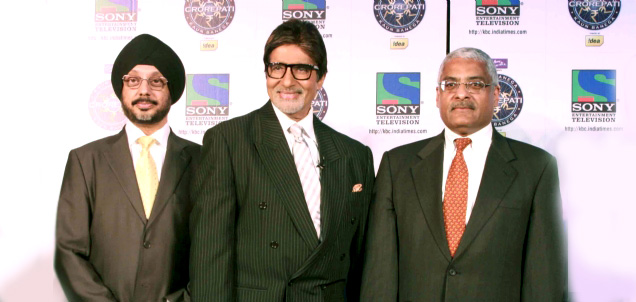
    File photograph of KBC4 launch by Fotocorp

    From l to r: N P Singh, Amitabh Bachchan, Man Jit Singh

  • Freaking News | Making sense of gobbedygook

    A week is a long time in politics said one British prime minister or another and as far as news cycles are concerned, a week could be an eternity. Last week’s newsmakers have vanished as the 2G scam took control of television once more. However, most of what was happening was official gobbledygook as everyone, from anchors to honoured guests tried to make sense of it. Even Arnab Goswami, as he demanded answers for things which India wanted to know, got caught up in dates, memos and LOIs, possibly leaving viewers searching for the remote as the evening’s melodrama had been denied them.

    Early on Wednesday, there was plenty of television excitement over the news that the Rashtriya Swayamsewak Sangh (RSS), the puppet-master of the Bharatiya Janata Party, had informed LK Advani that he was not a potential prime ministerial candidate for the next general elections. By the evening it became clear that no one really cared and no one doubted that the RSS controlled the BJP.

    In any case, it all became about a letter which the finance ministry under Pranab Mukherjee had written which raised questions about the position on 2G taken by the finance ministry under P Chidambaram. But much as TV channels tried to put to the Union home minister in the dock, the government did not bite. And then it all became about dates, LOIs (which it turned out means letters of intent) and memos.

    Internationally, the focus was on the plea to stop the execution of a man convicted in 1991 for killing a police officer in 1989, in the American state of Georgia. Questions had since been raised about the investigation, witnesses had retracted their statements and there appeared to be no physical evidence linking him to the crime. However the US Supreme Court did not stay Troy Davies’s execution. This led to debates about justice and capital punishment. However Indian channels did not find Davies to be newsworthy – although social networking sites were buzzing with it.

    The changes made to Facebook also got international airtime and certainly, both Twitter and Facebook were filled with angry comments from users. You get the feeling that Indian channels keep a close watch on various popularity measuring mechanisms which also tell them how much drama can be milked from a news event and how much jingoism can be added to it. If it fails on these two counts, the event is now news. Therefore one can conclude that possibly erroneous death penalties in other countries and social networking sites do not make Indian blood boil.

    Is it then surprising that The Times of India issued an ad that said that TV was all hot air and only newspapers can shed light on events?

    **

    Newspapers of course tried to explain what the latest 2G revelations mean but even they struggled between dates and memos. With the prime and finance ministers out of the country, further political explanations became difficult. The Supreme Court stepped in to make it clear that its silence on 2G should not be misinterpreted to mean that it is asleep.

    The Sikkim earthquake and the problems of rescue operations got adequate representation (although TV did not forget, it must be acknowledged).

    Also the Planning Commission’s bizarre figures to determine poverty in India got newspaper space and flak. Advani’s little problem was a single column here and there – this is not a new story after all.

    Salman Rushdie’s introduction to Twitter was found to be newsworthy, two days after he took the literati of the twitterati by surprise by showing up there.


    **

    Every time a new film is due, the India media behaves as if a new inhabitable planet has been found. This week, it seems, a new film will be released. One does not know yet whether space suits will be required or it will be one more black hole.

  • Mediaah!: Is Arnab Goswami the “over-the-top anchor” in the TOI ad?

    By Pradyuman Maheshwari


    This is not the first time that someone from within the Bennett, Coleman & Co empire has taken on Arnab Goswami and Times Now. In the past, Prashant Panday went hammer and tongs at Arnab. The post was on Prashant’s Facebook wall, and didn’t beat about the bush. I must say I was quite surprised that the CEO of a group company which runs the very popular Radio Mirchi network could write all of it so openly (read: An open letter to Arnab ).

    The fact that Prashant wrote it and still has his job speaks volumes for the internal democracy that exists in the group. Though my wicked brain thinks there’s more to it… especially when I saw this ad on the sports pages of the Mumbai edition. Chhota 15×3 ad, but very interesting.

    You must read the text… all of it.
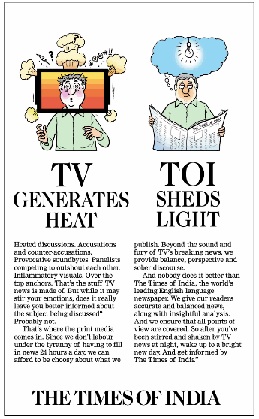
     

    Heated discussions. Accusations and counter accusations. Provocative soundbytes. Panelists competing to outshout each other. Inflammatory visuals. Over-the-top anchors. That’s the stuff TV news is made of. But while it may stir your emotions, does it really leave you better informed about the subject being discussed? Probably not.

    That’s where the print media comes in. Since we don’t labour under the tyranny of having to fill in news 24 hours a day, we can afford to be choosy about what we publish. Beyond the sound and fury of TV’s breaking news, we provide balance, perspective and sober discourse.

    And nobody does it better that The Times of India, the world’s leading English newspaper.We give our readers accurate and balanced news, along with insightful analysis. And we ensure that all points of view are covered. So after you’ve been stirred and shaken by TV news at night, wake up to a bright new day. And get informed by The Times of India.


    Not all of it is untrue. Panelists do outshout each other on news TV. Put Jayanthi Natarajan and Ravi Shankar Prasad in one discussion and there’s more noise and less discussion. Also you can be sure you won’t find all the news on television… esp the private channels. Doordarshan News has a lot more meat, but it is soooo boring.

    What deserves another look and no real reading between the lines is a bit from the first para:

    Heated discussions. Accusations and counter accusations. Provocative soundbytes. Panelists competing to outshout each other. Inflammatory visuals. Over-the-top anchors. That’s the stuff TV news is made of.

    So let’s look at the people who dominate the nightly news on the English non-business news channels, which I guess is what the TOI ad is talking about: Rahul Kanwal (Headlines Today), Rajdeep Sardesai and Sagarika Ghose (CNN-IBN), Vikram Chandra, Barkha Dutt, Prannoy Roy (NDTV 24×7) and of course Arnab Goswami on Times Now. There’s also Rahul Shivshankar on NewsX, but my cable operator doesn’t offer the channel, so would reserve comment on him.

    Rahul Kanwal is aggressive and provocative, but he is not sound and fury. Rajdeep has mellowed (and become very good once again), but Sagarika can go high-pitched. On NDTV, Dr Roy and Vikram C are exceedingly softspoken and can’t harm a fly. Barkha still attempts to ask some tough questions, but like Rajdeep isn’t what she used to be around the time of the Gujarat riots.

    The one man who fits most of the attributes described in the Times (of India) ad is Arnab Goswami. I don’t agree with him being over-the-top, though there are many who believe so. I think he asks the tough questions, and is possibly the only one to do so day after day. Yes, he gets carried away, but needs to be cruel with our politicians. And even as I join others in lampooning Arnab for his the-nation-wants-to-know-line, the fact of the matter is that we all really want to know.

    I do feel that Times Now overstretches itself on issues like Pakistan, China or racism, but heck we need it.  As for inflammatory visuals, I think the print media is also fairly irresponsible. Though the impact of television is a lot, lot more on the common man or woman.

    Let’s keep this discussion on. Email Mediaah! at pradyumanm@mxmindia.com and I will carry the best comment here when I am back on Tuesday.


    Pataudi, RIP


    But for the time when he patted me on the back and gave me an autograph, I’ve never met him. But heard loads about him.

    When the news of Tiger Pataudi’s passing came in last night, almost by reflex I called a colleague to check if we could get someone in adland to reminisce dealings with him for endorsements. Then we tried checking on his connections as editor of Sportsworld and for his stint at Dev Features. The Sportsworld team is scattered all over. There’s an interesting tribute by Derek O’Brien in The Telegraph.

    I called Vivek Sengupta on reading his tweet, and finally convinced him to write a few lines. That was around midnight. Vivek may have turned into a public affairs and PR practitioner for a while, but he’s essentially a journo. He knew I wanted him to write, and sent his copy in an hour.

    Meanwhile, we had no luck with getting an adman to write on Pataudi’s ads. But here are two of his TVC that I found on YouTube (the  first a rather long Gwalior Suitings ad and the other being the recent Lays TVC with Saif)

    [youtube width=”350″ height=”260″]http://www.youtube.com/watch?v=iei989o4l-I[/youtube]


    [youtube width=”350″ height=”260″]http://www.youtube.com/watch?v=dTVIrhnt5x4[/youtube]


    Buzz me if you have a story to tell. Confidentiality assured. There are various ways you can reach me:

    pradyumanm[at]mxmindia.com, 23050B5D, pradyumanm@gmail.com, @pmahesh, 98338 76278.
  • Riot moves to SK&V Communications

    By A Correspondent

    SK&V Communications has just picked up the fashion brand Riot, whose advertising spends are pegged at a couple of crores this year.


    This is the agency’s third win in its first three months. It has already acquired the 360-degree businesses of Saint-Gobain Weber and Gesture Jeans.


    Riot is a part of Suditi Industries, a leading garment manufacturer and exporter since 1991. The brand has grown substantially in the past two years. Within Mumbai one can find Riot stores at R City Ghatkopar, Korum Thane, Center One Vashi and Infiniti Mall Malad. In Nasik, it’s placed at City Center. At Goa, the Riot store is at Madgaon, in Aurangabad at Prozone Mall and in Raipur at City Centre.


    Riot is readying to take on Pune with stores in Phoenix Mall and Pacific Mall,  – Pune. And plans to enter more cities will be unveiled soon.


    According to Mr Harshad Sharma, Partner & Head Creative, SK&V Communications, “When you partner a company that also creates concepts on a daily basis, the most important thing is the meetings of minds. We found ourselves on the same page as the Riot team in most respects –  the way we look at creative, temperaments, priorities etc.


    Ms Dheeraj Vashisht, Partner & Head, Business Development, SK&V Communications, adds, “Fashion brands have always been a passion. My 17 years in the business includes stints as Marketing Head of Killer Jeans and Provogue. We would like to believe that we have a deep understanding of the category.”


    Mr Vibhaas Singh, Vice President Marketing & Creative, Riot, said, “At Riot we believe that fashion is a medium of expression rather than just clothes… and it reflects the voice of the people who subscribe to it. Working with SK&V came naturally because they as an agency are completely clued on to the youth mindset and make our job at Riot effortless when it comes to communicating our brand to the consumer. Denim Ver 2.0 is a new chapter in Riot that they have written for us beautifully. We look forward to a great and long association.”

  • Meteoric rise for UTV Stars

    By A Correspondent


    The recently launched channel UTV Stars – The Official Channel of Bollywood, which went on air on August 19, 2011, has garnered a phenomenal response from audiences nationwide in a very short span of time. In just 4 weeks, UTV Stars has acquired the No1 spot in the Bollywood genre.

    Within four weeks of its launch, the channel is ahead of its competition in the Bollywood Entertainment genre, with 23.5 GRPs (HSM 1MN+ 15-24), which makes it the leader in the genre as per the TAM data for Week 38. From the time of launch, the channel has enjoyed a robust audience loyalty (derived from the TSV measure) which is already 30 per cent above the competition.

    Chalking the achievement up to superior content on the channel, Nikhil Gandhi, Business Head, UTV Stars said: “We got the formula right and implemented it bang on. Right from the brand campaign to the shows, to the eclectic programming mix, we planned meticulously and were therefore confident of becoming leaders.”

    The channel is the sixth addition to UTV’s bouquet of channels in the entertainment space, and aims to bridge the gap between superstars and their fans.

    With Preity Zinta hosting one of the prime shows of UTV Stars ‘Up Close and Personal’ and fans getting to live a starry life on ‘Live my Life’, UTV Stars has caught viewers’ fancy.

  • Are ads crossing the line too often these days?

    By A Correspondent


    Sinful minds must be at work in the advertising world these days. Or we are simply not getting it. Of late, the Advertising Standards Council of India (ASCI) has been deluged with a flurry of complaints about “offensive” ads.


    This year the council has received 777 complaints regarding 190 ads, a steep jump over the 200 received last year about 153 ads. The most vociferous complaint has been about increased sexual content, with parents saying it is difficult to watch the ads in the company of children.


    They cite the recent Tata Docomo ads for their suggestive content and alleged class bias. One of the ads shows a rocking SUV which stops when a cellphone rings. “How do I explain that ad to my daughter when she asks me what it means?” asks mr Sunil Krishnan, a media executive in Chennai.


    Another father, Bollywood icon Shah Rukh Khan, has the same problem with other ads. He says he cracks a joke to divert the attention of his children. “The deo ads can get naughty,” he said. “Like the one that showed a batsman getting out. But the girls run after him rather than the fielder who’s taken the catch, because the batsman’s wearing a particular deodorant.” Incidentally, the star says he “turned down a deo ad because he didn’t like the idea of women chasing him.”


    Obviously, it doesn’t work that way in real life. An aggrieved user, Mr Vaibhav Bedi, took Unilever to court in 2009 saying he’d been using the Axe deodorant for seven years and not one woman had found herself inescapably attracted to him.


    Do the parents have a point? The problem, says Mr Anand Halve of the brand consultancy firm Chlorophyll, is that a number of ads have begun to use sexual attraction gratuitously. He cites an SUV ad in which “the woman is so taken in by the driver that she tries to hide her mangalsutra from him” . He adds, “In such cases the use of sexual attraction is built on the assumption that, ‘Arrey, audience ko sex achcha lagta hai’.”


    But that does not work every time. According to ASCI secretary-general mr Alan Collaco, there’s only so much leeway a company or its advertiser should take. Not for moral reasons, but financial. He cites the earlier Fast Track ads – “which depicted young men and women being promiscuous” – that were shown to college students to elicit their opinion. Mr Collaco says the students turned around and told him, “But that’s not us” .


    Which is why Mr Collaco believes that “an ad which grabs eyeballs when it is first released might at best garner some sales but all future sales will depend on the quality of the product, not the ad” .


    Flying Machine recently ran into trouble with its latest ad campaign for jeans. The tagline said: “What an Ass!” It punned on the word for bottom, then went on to say the “ass” was “the man who didn’t call me after the first date” or “the friends who wanted to give me a makeover” . That wasn’t how women’s rights activists saw it. They protested to the National Commission for Women (NCW) saying the ad was “vulgar” . The complaint is now with the ASCI, which will decide on the case next month.


    Mr Arun Iyer, national creative director of Lowe Lintas, defends his ad for Flying Machine, saying the idea was to grab attention. “The ad is tongue-in-cheek and progressive,” he says. “It shows a woman with attitude.”


    Just as nonplussed is adman Mr Prahlad Kakkar, who was recently sent a notice by the Information and Broadcasting ministry for his tagline in the Lilliput children’s wear ad – “There’s another man in every woman’s life.” Once the suspense has built up, you realise the “other man” in every woman’s life is the son. “I really don’t understand why they’re objecting ,” he says.


    Source:The Economic Times

    Copyright © 2011, Bennett, Coleman & Co. Ltd. All Rights Reserved