Author: Avik Chattopadhyay

  • Avik Chattopadhyay: Foul smells and bad tastes!

    Avik ChattopadhyayBy Avik Chattopadhyay


    Stereotyping and objectifying are two of the critical mistakes brands make. The urge to impose one’s own limited perspective on a larger target consumer is both age old and a pandemic that runs through brand nurturing and communication.


    There is a deodorant brand called Wild Stone that insists on objectifying women in its advertising, be she in the role of an office colleague or one at a restaurant table. The woman is shown as possessed or mesmerised by the perfume making her do acts that are totally ridiculous, but more importantly degrading the social stature of one. While it surely might appeal to the alpha male, I am quite surprised that no one has raised an objection against this objectification. Interestingly, its direct competitor Fogg has decided to take a more mature route of putting its message across, choosing to ask people to stay indoors and take necessary precautions even if the pandemic is in its last stage.


    Why does the typical narrative have to show a submissive woman against a dominant male? Why does there have to be a ruler and a ruled? Why does the woman need to be objectified to pedestalise the man?


    Then there is a recently released web series on Sony Liv called “Rocket Boys”. It is a brilliant attempt at telling the inspiring stories of Homi Bhabha and Vikram Sarabhai, which itself is such a refreshing endeavour. But then it carries a negative character of almost villainous proportions in the form of one Raza Mehdi who attempts to destabilise the plans of Bhabha and Sarabhai. He becomes a Member of Parliament on a Communist party ticket and almost sells his soul to the CIA before his conscience beckons. Firstly, history tells us that there was nobody of that name. The character has been created out of thin air combining the lives of Meghnad Saha and B D Nagchaudhuri, two brilliant nuclear physicists and nation builders who might have had some differences of opinion and professional rivalries with the heroes of the web-series.


    Why distort history in the first place if one is trying to portray an inspiring slice of history? Why does there have to be an anti-hero or villain in the narrative? And if there is the need of a fictional anti-hero, why the typical stereotyping of being a Muslim or a Communist?


    Brands make these classic mistakes, some deliberate and most led by the perceptions and images in the minds of those managing the brand, both client and communication agency / partner. That leads to rampant stereotyping.


    For the North Indian, the South Indian will always be vegetarian.

    For the South Indian, the North Indian will always break into a bhangra.

    The North Indian is a Punjabi, and the South Indian is a Madrasi.

    The Bengali will have to love rosogolla and fish.

    While the Gujarati will always say “Kem chho?”.


    The second issue is that if a brand has to talk about its competitive advantage, it has to do down its competition. If one is ‘white’, the other has to be ‘black’. If one is a hero, the other is a villain. If I am good for you, my competition will have to be bad for you. There are no shades of grey. If I eulogise one personality, it will have to be at the cost of another one. If I put one brand on the pedestal, it is at the cost of bringing down another from the pedestal. It is always this or that, never this and that. I do not have the maturity to offer myself as the better choice. Instead, I present myself as the only offer.


    If Ram is good, Ravana must be bad. The latter has no option of being otherwise as good as the former but for the grave mistake which brings his downfall. The Kauravas can show no graciousness and valour vis-à-vis the Pandavas. Those amongst them who do show have to leave the flock and defect. If a certain period of our history is to be given its due place, another piece has to be derided. It is as if there is only limited space at the top and more than one point of view cannot co-exist.


    As a national culture, we find it very difficult to deal with shades of grey. Our gods and heroes can do no wrong. All shades of grey were repainted as either white or black through the centuries, taking away the fundamental capability to accept ourselves with our defects and fragilities. It is a binary culture code. Good or bad. Black or white. Yes or no. Us or them. Me or you.


    This manifests itself in our communication and narratives. My brand can do no wrong while yours does not stand a chance. Even if I have to misrepresent facts or suppress them, so be it for the cause of furthering my case. And brand managers actually see no wrong in this ‘strategy’ that believes in destroying competition before building one’s own relevance. The Pakistani cricket team has to be lampooned to support the Indian one. It is as if there is no room for mutual respect and recognition of competitive talent. And the fact that we enjoy such narratives is a disturbing evolution of our social fabric. The evolution is getting more intolerant, divided and shrill. That sure leaves a foul smell and a bad taste!


    Avik Chattopadhyay is a senior business strategy consultant based in Gurugram. He writes on MxMIndia mostly every other Thursday. His views here are personal


  • Avik Chattopadhyay: Jo dikhta hai…

    Avik ChattopadhyayBy Avik Chattopadhyay


    Fighting the Covid virus and coming out of it in one piece teaches you one big lesson. That the recovery is more prolonged, tedious and fraught with anxiety than the actual infection is. So, the “negative” report and the visions of dead virus cells conjuring up before us are far from ground reality.


    The old Hindi saying of ‘Jo dikhta hai, wohi bikta hai!’ does not work any more in these pandemic times. ‘Whoever is visible, will sell better’ is a thing of the past. The experiences over 24 months [I expect this pandemic to definitely last that long, if not longer] will establish the truth that ‘Jo karta hai, wohi tikta hai!’ or ‘Whoever is doing, will sustain’.


    People, politicians, governments, sections of society, and brands that have actually worked at the ground level since March 2020 are the ones who the nation now recognises as worthy of respect. For the nation now well realises the difference between “showing” and “doing”, as the 15 months of the pandemic have clearly demonstrated.


    One would assume that after this debilitating second wave and the electoral reversals, the ‘Government of India’ [GoI], one of the nation’s biggest brands, would have learnt its lessons in ample measure. Why would the GoI be a ‘brand’? Why not, as it has a purpose, a promise, a set of values, a bunch of stakeholders to serve and, a logo / symbol / emblem? Everything that carries the Sarnath Lion Capital with ‘Satyamev Jayate’ written below it represents the country. The symbol is also supplemented with a smiling photo of the Prime Minister, and the political party in power.


    Two news items, in a span of four days, took my attention:

    :: Centre to set up ‘BBC-like’ channel to push India view. – The Indian Express, May 20, 2021

    :: ‘Make party visible’, BJP to workers after leaders go missing amid Covid. – NDTV, May 23, 2021


    Prasar Bharati has floated a tender for consultants to come up with plans to set up “DD International”. The Expression of Interest, issued on May 13, as per the news item, states that the objective is to “project India’s point of view globally on contemporary issues of both global and domestic significance” and to “tell the India Story to a global audience”. It also intends DD International to be the “authoritative global media source on India through credible, exhaustive and accurate global news service”.


    Said Prasar Bharati CEO Shashi Shekhar Vempati: “This is something that was something long overdue, to have an international presence for Doordarshan,” comparing it to the “first iteration of BBC or Al Jazeera”.


    So, will that mean that DD International will be fiercely independent in its opinion, state it clearly and get into investigative journalism? Does it mean it will allow programmes on the line of “Yes, Prime Minister!”, “Just a Minute”, and “Top Gear” to be telecast? Or is the catch in the “first iteration” bit which implies a BBC during the Second World War with the single objective of uniting the nation or, a BBC till the 1990s where the MI5 used to be involved in every appointment, keeping leftists and rightists out? Does it mean we are looking at a television channel in the 2020s in the style of the 1920s? Why have only a BBC or an Al Jazeera as a benchmark? Just because it will be run by the government does not mean that independent channels do not do an equally good job! The benchmark, if at all allowed in the era of being ‘Atmanirbhar’, should be on the content rather than the control. This is a classic demonstration of the GoI believing that “Joh dikhta hai…” will still work in a post-pandemic world that wishes to hear the Indian point of view.


    Now on to the second news item. Post a serious review meeting with the RSS top brass, the BJP leadership came upon the realisation that the party was losing out in the hustings when it came to grabbing brownie points on caring for the country in the pandemic. Till now, the party was totally dependent on the One Man to carry the show. Just that the game had changed along with the goalpost! No new gimmicks like lamps and claps happened while the social media team was busy creating ‘manipulated’ memes like showing a football stadium in Qatar as the world’s largest Covid facility set up in Nagpur. When you enter a football game with cricket gear, things don’t usually work out. People consuming content by the gazzilion bytes per minute had learnt to identify and appreciate content backed up by action.


    Hence the momentous decision “make the party visible”. J P Nadda announced that all functions to mark seven years of the Narendra Modi government be avoided on May 30. “Party workers should dedicate themselves in the service of the society,” he commented.


    The objective, it seems, is to make the party “visible”. It could have been to ‘make the party serve more’. The ulterior motive is to create fresh social media content that shows the party doing good, rather than necessarily doing so. Do one act and amplify it a billion times, through edits, voice-overs and copy. Also, if the party was contemplating celebrations of the seventh anniversary of GoI in these times, it was very close to buying its own burial space amidst the unfortunate others on the banks of the Sangam in Prayagraj!


    The pandemic has harshly taught us that all value and trust lie in ground-level action. In a post-pandemic world, mere visibility will not work anymore. In isolation, it is a waste of all resources…time, money, and consumer mind-space.


    We want demonstrable action to do all the talking. We want a higher level of empathy. We expect more transparency in intent and disclosure. We demand a sustainable purpose and promise to lead it all. We do not believe in ‘Jo dikhta hai…’ anymore. We need ‘Swachch, Sundar and Tikaau’ brands to engage with us if they want our eyeballs, footfalls, vouches, and votes!


    Avik Chattopadhyay is a senior brand strategist based in New Delhi NCR. He writes on MxMIndia every other week. His views here are personal


  • Avik Chattopadhyay: A year-full of learnings!

    Avik ChattopadhyayBy Avik Chattopadhyay


    When the editor asked me to write on the first anniversary of the “Lockdown” I found it a very daunting task. There has been a lot written about it already, covering aspects like socio economics, science & technology, business & employment, politics and even cricket. What could I possibly write about that could be useful to the reader, not to pontificate but just stimulate thought?


    Then I came across two pieces of communication that provided the spark. One was a wonderful short video by my friend Gaurav Bhagat on the year gone by. Gaurav summed it up by saying, “Knocked down but not knocked out. Broke but not broken. Hurt but still fighting.” The other was a hilarious meme that I share here. Its in Hindi but I am sure you get the message.


    The last 12 months have been about revelations. I shall make it a point to check if Nostradamus had anything to say about 2020 in any of his “centuries”. We have seen contradictions and opposites co-existing, even stronger than before.

     

    The year has seen the good and the bad sides of human life in equal measure. There have been enough things to feel embarrassed about as well as pat ourselves on our backs. The pandemic and its world-wide disruption and devastation did not see any one side clearly winning. We have behaved, responded and pro-acted to the same situation and stimuli in different manners, driven by culture, belief, economic standing and provenance.


    And that to me is unique learning for any brand as it teaches me to take a clear stand rather than sit on the fence, observe and listen more than always speak and, have the patience for the long-term rather than immediate numbers.


    So, here are certain sets of opposites that have survived the pandemic together till now.


    Heroes and Heroics


    Across the world we got our new “avengers” in the form of scientists, doctors, healthcare workers, law enforcement forces, municipal teams and delivery people. They are the ones who have sustained in their selfless service.


    And then we had heroics in the form of banging vessels, lighting lamps, going to the beaches, and signing songs across balconies. Public frenzy has been stirred up to bizarre levels. And we have had almost every product protecting us from the virus up to 99.99%. Waiting for an automobile brand to make a similar claim soon!


    Democracy and Demagogy


    The US elections was a stellar example of the power of the electorate still the most potent tool in preserving the freedom to choose as well as reject. Money and fear could not be the only factors that would decide results.


    At the same time, we have seen unabated rise in demagogy. Selling fear and pandering to baser levels of entitlement and anxiety have worked quite well around us. Social divides have become deeper on lines of faith and class.


    Religion and Rationalism


    One of the world’s most profitable businesses has been used to the hilt across the world as a cure for the virus. None has held itself back from making claims on being superior to the others in protecting its faithful. Messengers of the almighty have continued to expose people to the virus, from churches to mosques, synagogues and temples, from congregations to holy dips.


    Thankfully, the rational counterforce came out with guns blazing. The occasion, unfortunately, was tailor-made for the rationalists to once again impress upon the world at large that scientific temper and blind faith are not part of the same ‘venn diagram’.


    Social and Hyper-personal


    Being engaged on social media platforms is what kept us engaged through the year, from the serious to the ridiculous. Information evangelists have done a stellar job of sharing useful documents, updates, insights and all forms of help. While the urban middle-class benefited from online links to movies and comic books, the migrant workers got to know details about trains and buses leaving for their hometowns. Proliferation of information also saw a positive trend of people verifying messages and forwards before sharing them. Services like Snopes and Alt News are part of the daily routine now.


    In tandem, going hyper-personal with solutions and services has become a near reality for many brands now that are primarily digital. Conversational AI has finally seen the light of day and the consumer has become a digital cocoon. We are actually comfortable allowing more people pry into our private lives and behaviour in the hope that it brings greater convenience and value.


    Protectionism and Universalism


    Nations have become more inward looking. Trade barriers have been built to protect one’s own turf. One is okay with foreign capital but not goods. There is a race to be self-sufficient, without much thought to how much of that is enough. In most cases, it is more of rhetoric than ground-level investments in education, health and research which form the foundation of a confident and credible nation. Somewhere, this and nationalism have been rolled into one dangerous form to create clones of the erstwhile Iron Curtain and current North Korea.


    Thankfully, just like the rationalists, the universalists have created a counterbalance and demonstrated that there needs to be greater collaboration and openness across nations once the pandemic normalises like influenza. Most of the vaccines have been created by cross-national teams. Countries making vaccines are shipping them across the world in an act of diplomatic bonhomie. Medical teams from one country have gone to others to support. Know-how and designs for critical care equipment have been shared free of cost. It goes to prove that no one nation has the solution to all of her problems by herself.


    Remotely Working and Remote Workers


    The white collar has entered a new work ethic now. The concept of work-life balance has been redefined. A complete industry has evolved to create the WFH eco-system. Hopefully it will be sustainable as we are already experiencing mild backlashes with people wanting to delink workspace from home. New remote workspace models will become established for those who do not an office to return to. Needs to be seen how non-metro and smaller towns take to this change.


    The blue and brown collars have become more vulnerable now. The ‘reformed’ labour laws and growing automation will impact them more adversely than we have calculated and provided for. The new jobs created will be qualitatively inferior to what most of them lost. This will be a people scarred for life for the administration shunned them when they were weakest. Their children will be a generation that will grow up with a grudge, just like when the jute and cotton mills of Bengal and Bombay [Mumbai] were shuttered.


    Anxiety and Activism


    According to Maria Cohut in Medical News Today, the average human being is fraught with increasing anxiety due to layoffs, job insecurity, imbalanced life, home-schooling and coping with a new way trying to make lives secure for oneself and the family. This will see new patterns of responses and behaviour. The same emotions will find different manifestations in consumption. The ever widening wealth gap and ever-growing clasp of big business are surely uncomfortable facts to grapple with.The mind is unsettled for most of us. We need release valves as well as calming corners.


    Thankfully, activism has taken on the task of a huge release valve for the world in these trying times. Across the world, movements like BLM in the US, anti-CAA & Farmers in India, pro-democracy in Russia, Ukraine, Turkey and Myanmar, electric mobility & green tech across the world have kept us awake. Sustainability has become a key touchstone for business. Transparency is being demanded in all aspects of nation building, from governance to non-government social orders. At constant clash with demagogy, one would have imagined that such movements would have taken a back seat. Luckily no!


    A couple of days back, in an interview with Alec Russell of FT Weekend, Yuval Noah Hahari commented that people will forget 2020 soon! Man does not like remembering ‘natural disasters’, though this one has had political overtones. There has been more written about World War 1 that took lesser lives than the Influenza Pandemic, though they were almost concurrent.


    I started off this piece by wondering what could I possibly write and now I have rambled on for 1400 words already. Tells you about the year gone by.


    I end with some stanzas from a beautiful Uriah Heep song called “Love in Silence”. Guess they sum up my feeling far better…


    This is our world, our future

    These are our times.

    I believe we have to see

    In silence there’s no mystery.


    The world is so busy talking

    What do they know?

    They’re missing out on being alive.

    Words are turning into lies.


    Love is the only direction

    That leads to truth.

    Knowing in your heart what’s right

    You’ll walk upon the sea of light.


    There’s something

    In love and silence,

    That you can find

    Know yourself and all around

    Listen to the only sound


  • Avik Chattopadhyay: The religion of festivals!

    Avik ChattopadhyayBy Avik Chattopadhyay


    On the day of Holi, the festival of colours, on March 29, I wished many of my friends “Holi Mubarak!”. An old friend of mine, highly educated and erudite, responded by saying it should be “Shubhkamnayein” and not “Mubarak” as the latter was an Urdu word. On my commenting that Urdu was also Indian and therefore as appropriate, he retorted with a curt “Good night.”


    It disturbed me that an intellectual of sorts in society, whom many would typically look up to, had such a constricted view about the ‘purity’ of a festival greeting. But then, these are truly trying times when we are undergoing an period of inquisition on determining who is good enough to belong to this land called India and who is an outsider. We are recalibrating all things around us to classify them into being originally Indian and being imposed by cultures that do not belong to this land!


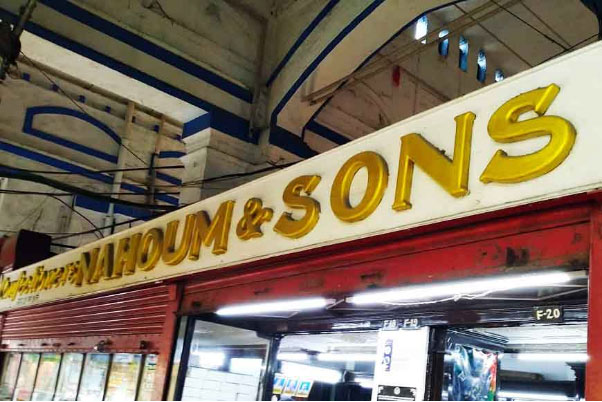
    I grew up in a city called Allahabad where, as a child I heard one cyclist greet another outside my school with “Bhaijaan, aapko Eid ka Ram-Ram.” That is etched in my mind. My parents come from a city called Calcutta where people of all faiths line up outside a Jewish confectionary called Nahoum & Sons where Muslim workers bake some of the best cakes and rum balls for Christmas.


    Nahoum & Sons, New Market, Kolkata since 1916.


    Festivals are some of the biggest ‘brands’ in any economy, impacting sentiments, livelihoods and prosperity more than most businesses.


    They are unique socio-economic-cultural events, more so today than they were a hundred years ago. The Durga Puja is the single biggest economic activity in Bengal. And that involves people of all faiths and beliefs than just the specific religious community. The ardent Hindu looks forward to authentic Awadhi Biryani on the day of Maha Ashtami as much as the Christian kids enjoy ‘pandal hopping’ clicking selfies before the idols of the goddess. When they greet you with “Happy Pujo” or “Puja mubarak ho”, nobody would retort that the greeting should be “Shubho Pujo”. In fact the more the greetings the better as it transcends a religious occasion into becoming a cultural extravaganza!


    The fervour is almost equally feverish on Eid and Christmas which everyone lovingly refers to as “Bada Din” [Big Day], not because of a colonial hangover but because everyone believes it is certainly a big day of collective celebration.


    For us, occasions like Holi, Eid-ul-Fitr, Diwali, Durga Puja, Onam, Ganesh Chaturthi and Christmas were ones where we saw different forms of celebration with their unique rituals and culture codes enjoyed by one and all. Why should a festival be constrained by only religious customs? Most festivals do have their origin in a certain religious event or reason which nobody denies, yet over the centuries they have outgrown this limited role into one of collective enjoyment. After all, the word “festival” comes from the Latin word “festivalis” and etymologically has a close connection with the word ‘feast’ implying a special day of celebration, eating, congregation and rituals. Interestingly, the Arabic word “eid” also means festival. It is due to the vastness of the interpretation of the word that it is used for any memorable occasion or celebration, be it for mangoes or music or Moliere.


    It is the slow but sure openness of a festival that has its origin in a religion that makes the occasion grow into a socio-cultural gala and the religion or faith a globally acceptable and mature one. By the way, the word gala comes from the Arabic “khil’a”.


    The attempt to shackle a festival into mere rituals and methods of greeting takes away all that make it memorable and globally acceptable in participation and socio-economic activity. Try telling the master craftsmen from Chandannagar who light up Park Street in Kolkata every year that their Christmas decorations need to be only with Biblical motifs and they would gape at you in amazement and consternation in equal measure.


    I had to give a befitting reply to my friend’s curt “good night”. So, I connected with friends across groups asking about the history of Holi celebrations over the ages. One kind soul in a group of Urdu lovers did me a huge favour and I share some wonderful bits from his expansive piece.


    Holi is lovingly called “Eid-e-Gulabi” in Indian Muslim literature. Sufi saints like Hazrat Nizamuddin Aulia and Ameer Khusrau have, in their chaste Persian and Hindvi poetry, adored the ‘pink’ festival generously. Aulia also directed his protégée to compose poetry in the language of the commoners and started celebrating Holi at his monastery.


    Khusrau was not only an enthusiastic Holi player but also composed verse for the occasion:


    “Aaj rang hai, maa ri aaj rang hai

    Morey khwaja ke ghar aaj rang hai

    Mohey peer payo Nijamuddin Aulia

    Des bides mien phiri ri, tera rang bhayo Nijamuddin Aulia

    Aaj sajan mila morey aangan mien.”

    (Its colour today, my mother its colour today, my beloved is found in my own yard).


    This tradition of celebrating Holi became such an integral part of Sufi culture that even today, a ritual “rang” is observed on the last day of the annual celebrations at every shrine.


    Holi symbolises the commencement of a new year with a rabi harvest along with nice weather and refreshing air. The Umarahs, the Rajahs and the Nawabs all exchanged rose water bottles and sprinkled it on each other amid the frenzied drumming of the ‘nagaras’.


    More colour to Holi is added as it falls near the Muslim festival of Id-ul-Fitr.


    Jahangir has been shown holding Mehfil-e-Holi in `Tuzk-e-Jahangiri’. Many artists, specially Govardhan and Rasik, have shown Jahangir playing Holi with his wife, Noorjahan. During Shahjahan’s rule in Delhi, Holi was known as Id-e-Gulabi [Pink Id] or Aab-e-Pashi [Shower of colourful flowers].


    Quli Qutab Shah, a renowned south Indian poet, wrote about Holi in his inimitable Hyderabadi Urdu, describing the festival of colours in the Braj and Bundelkhand regions in India’s north. Equally enjoyable are the poems of Mir Taqi Mir who joined the court of Nawab Asaf-ud-Daulah and wrote in praise of Jashne-e-Holi. Poets like Khwaja Haider Ali Aatish, Insha and Taban have written great Holi songs.


    Qayam, an 18th century poet, has famously depicted the real naughtiness of Holi. His importance can be understood through Ghalib’s acknowledgement of Qayam as his “ustad”.

    In his long poem ‘Chandpur ki Holi’, Qayam paints a scene of an inebriated Maulvi who has forgotten his way to the mosque. This is the state of people on Holi. People from all spheres of life whether pious or habitual drinkers, celebrate together and indulge in playing with coloured mud. It makes everyone equal and free. Qayam ends his poem with a prayer:


    “Ilahihai jab takke ye shor o shar

    ho alam mien Holi seybaqiasar.”

    [O God let the festivity of Holi survive till the world does].


    I had enough to flood my friend with and prove a point that festivals have no religion. In fact, there needs to be a new religion of just festivals from across the world, spanning all faiths and cultures and rituals that the world must embrace with open arms.


    I prepared my reply…read it once again and then deleted it. Even if he would read it, he would not possibly accept.


    Holi mubarak!


    Avik Chattopadhyay is a senior brand and strategy consultant based in Gurugram. He writes on MxMIndia every other Thursday. His views here are personal

  • Avik Chattopadhyay: Pioneer or Provider – which is a bigger brand?

    Avik ChattopadhyayBy Avik Chattopadhyay


    Remember the company that invented the smartphone?

    Motorola? Apple?

    It was IBM with the “Simon” in 1994.


    Who invented the steam engine?

    James Watt, of course.

    Sorry, it was Thomas Newcomen in 1712. James Watt improved upon it in 1775.


    Which was the first MP3 player in the world?

    Must be Sony, no? It was the Apple iPod, right?

    It was the “MPMan” in 1998 by a South Korean company called Sae Han Information Systems!


    Who created the first modern electric vehicle concept?

    This has to be Tesla.

    Hold on, it could be Nissan. Or Toyota?

    Surprise!! It was GM with the “Impact” in 1990 finally going into production as the “EV1” in 1996.


    Who invented commercial streaming?

    Simple…Netflix. No silly, it was Napster, no?

    Sorry, but it was a company called StarWorks in 1992.


    So, which brand do we end up associating a product or service with, the “pioneer” or the “provider”? By provider I mean the brand that takes someone else’s idea or invention, improves upon it to make it available to millions of people across the world.


    I am reminded of one of the world’s most prolific inventors and innovators, Thomas Alva Edison. He has close to 1,100 patents in his name, a record impossible to surpass. Interestingly, most of them were for improvements he did on someone else’s invention, either as an improvement in design or performance, or a product extension or simply a process improvement!


    “I start where the last man left off,” he once proudly said.

    He took a lead battery used in early electric cars [yes, they preceded the gasoline ones in the 1890s] and created an alkaline one.

    He took Graham Bell’s telephone and added the carbon telephone transmitter to improve its performance. And also created the phonograph out of it.

    Though he did not invent the light bulb, he improved on it and gave the modern incandescent bulb its eternal design and shape.

    He took a still camera and created the kinetograph [early movie camera] and kinetoscope [early peephole movie viewer].


    Brand “Edison” is not necessarily the inventor but the improver. And that is what makes him such an enduring brand even today.


    The same is true of the brands most of us would have mentioned against the five questions I started with.


    There are very few brands who have invented something and have continued with the same core product or solution till date. One may take the example of Mercedes-Benz. Interestingly, French engineer Amelee Bollee’s “La Mancelle” was the first ‘motor car’ to be productionised into 50 working units in 1878, a full six years before the Benz Patent Motorwagen got its patent #37435 on January 10, 1886! Just that he could not patent his ‘invention’.


    Pharma and software companies may be exceptions, having developed unique molecules and formulations that have manifested themselves in medicines and programmes in use even today.


    Brands that “provide” are the ones we remember better for we experience the inventions and innovations through their offerings. A feasible, usable and sharable solution is what builds an enduring relationship, not necessarily the mere invention or idea.


    Some of the world’s biggest brands have been the best providers.

    Toyota and Unilever are great examples.


    Apart from the famed Toyota Production System designed by Taiichi Ohno and Eiji Toyoda, the company is not typically known for ground-breaking inventions in the automotive world. What they have perfected is a process [TPS] as a precursor of lean manufacturing, basically taking an existing manufacturing system and improving upon it. And the spirit of ‘kaizen’ or continuous improvement makes it evolve for eternity. Toyota is never the first in a market or in a segment. They have perfected the art and science of watching, studying, absorbing and understanding before taking a step, be it a new product or a new market. Not that they have succeeded every time [like the failure of the Etios in India] but when you have a success rate of even 50% in the automobile industry, you are “Toyota San”!


    The same applies to Unilever. They have always known to be cautious players, almost to the point of being seen sometimes as conversative. They take their time to enter a consumer segment but then they do, the rollout procedure is one of the most robust in the world, right from the shelf stickers in the shops to the reach to the remotest village. Their strength lies not in ‘new’ products but ‘better’ products delivered consistently over time.


    And I will say the same about Apple. Sacrilegious, many might exclaim, but Apple is not a great inventor but a terrific ‘improver’. They take an existing benchmark product or software, turn it upside down, apply their intuitive customer insights and create a new benchmark. Hence, even if Sony came with an MP3 player before Apple did, the iPod set the new benchmark.


    I am not against ‘inventor’ or ‘pioneer’ brands at all. They are crucial to the creation of ‘improver’ and ‘provider’ brands. It is almost like a unique unspoken relationship they create, one feeding into the other and the latter almost immortalising the former’s inventiveness. Just that in my personal opinion, inventor brands are not always the biggest in equity, steadfast in terms of longevity and invincible in terms of someone else coming and unsettling them.


    Just that for me, it is better for a brand to be ‘best’ than be ‘first’!

    But the jury is out…

  • Avik Chattopadhyay: What makes us proud?

    By Avik Chattopadhyay


    Avik Chattopadhyay“Pride” – a high or inordinate opinion of one’s own dignity, importance, merit, or superiority, whether as cherished in the mind or as displayed in bearing, conduct, etc. / a becoming or dignified sense of what is due to oneself or one’s position or character; self-respect; self-esteem.


    This is how ‘pride’ is defined in an online dictionary. Certain expressions are important – dignity, merit, superiority, conduct, self-respect, and self-esteem. They are possibly the best barometers or measures of pride.


    The nation is right now gaga over Tesla entering the Indian market. Excitement is at a level as if economic emancipation is on the way and this is a validation of India’s global standing! The same happened when Apple decided to set up manufacturing in India. These are all approvals of our “Make in India” initiative. And they help position us vis-à-vis China as a destination to operate out of. these are occasions that make us “proud”.


    Tesla coming to India.

    Apple manufacturing in India.

    The tallest statue.

    The largest vaccination exercise.

    The biggest cricket stadium.

    The largest temple.

    The largest democracy.


    The measures are simple – quantitative. Be they units, feet, metres, kgs, population or donations.


    Interestingly, there are very few measures that are qualitative -most reliable, best designed, latest technology, highest quality, best service etc.


    We make the most feature films, but it has been years since an Indian feature film has won an internationally acclaimed award. [A few documentaries have.]


    We have the largest number of post offices but not a postal system that had set any global benchmarks.


    We have one of the largest network of roads, but some of the worst maintained and unsafe leading to the maximum of deaths from accidents in the world.


    We have some of the largest IT firms in the world but not one software that is globally regarded as a gold standard.


    The land of Taxila, Vikramshila and Nalanda does not have a single educational institution in the Top 25 in any discipline globally. We feel elated when one features even in the top 100!


    There are many Indians heading global corporations but hardly any Indian brand leading in any global market.


    It sure does make us feel happy to find Haldiram’s products in London or Paris or New York. But they are only in the “Indian” stores. Just like the Martin Luther King Street in each US city typically happens to be in the areas that aren’t exactly inhabited by a very diverse populace.


    We are over the top with Tesla but forget that we had the Reva way back in 1994 which, with sufficient government support, could have challenged Tesla across the world. China has brands like Nio and Xpeng that give the Tesla a run for its money. That is possibly what makes China proud. There is a OnePlus and Huawei that challenge Apple in many markets. That is possibly what makes China proud.


    When working on a project for the state of West Bengal ten years ago, we had recommended to the administration that the focus should not be on quantity but quality. The state should target for the most respected medical college and hospital in South Asia, the best managed public transport system, the most profitable Self Help Group network and world-class seats of education. That is how the state could have built true pride and self-esteem.


    I remember the Paris Motor Show of 2004 when the Tata Indica was displayed as a City Rover to hide the fact that it was from India. The official there insisted that the vehicle came from Birmingham!!


    Tata Motors may have the financial muscle to buy a Jaguar-Land Rover but it can never match the pride of seeing an Altroz on the streets of London. Money can buy you goods, not love!


    But there are a few beacons of hope too in the global market when you see an Apollo tyre saying “Made in India” selling in Frankfurt or Parisians lining up in front of Saravana Bhawan on a Saturday afternoon.


    As a nation, we unfortunately take recourse to our population to justify the numbers while excusing ourselves of the lack of quality. Therefore, the focus on being better rather than bigger is lost on us. A largely impoverished nation is sold the measure of quantity at every stage of our lives right since independence, as if we do not deserve any better. We accept a meal a day without bothering on its nutrition and manner of serving.


    And that leads both how we run our nation and our most of our brands. The obsession with market share is a prime manifestation of the same. Rarely have we heard from a brand that it wants to be the ‘most respected’ or ‘most aspirational’ in the market.


    If we are truly to be Atmanirbhar, then we need to focus on self-reliance rather than self-sufficiency. While the former focuses on capability, the latter is all about capacity. I do not imply that capacity is not required for a country of our scale, but that should be a table-stake while capability becomes the true differentiator.


    In the Hindi movie “Anand”, Rajesh Khanna famously says, “Babumoshai, zindagi badi honi chahiye, lambi nahi.” [Dear Sir, life should be big and not long!]


    Avik Chattopadyay is a senior brand and strategy consultant based in Gurugram. He writes for MxMIndia every other Thursday. His views here are personal


  • Avik Chattopadhyay: Am I “nationalistic” enough?

    By Avik Chattopadhyay


    We are moving close to another Independence Day. The tricolour will be unfurled from the Red Fort, the Prime Minister shall make some big announcements including about some vaccine and the National Anthem will be played. We shall all stand, as dutiful citizens.


    I too shall stand for the 52 seconds more as a ritual than possibly out of actual emotion. For otherwise it is an open display of disrespect to the nation. Forget the fact that most of us do not understand the meaning of the words we simply lip-sync, much like the way we muttered “Jack and Jill went up the hill…” in nursery school.


    I am in a curious state of mind.

    The five Rafales landing in Ambala does not enthuse me.

    The Statue of Unity did not rouse me.

    The failure of the Vikram lander did not really sadden me.

    The Surgical Strike did not inflate my chest.

    The Ram Mandir “shilanyaas” yesterday did not move me.


    And I thought to myself, am I nationalistic enough?

    Why do I not revel in what most around me do?

    Why do I not lament over what most around me do?


    But then, the migrant crisis shamed me.

    The beef-lynchings made me cringe.

    The woes of demonetisation infuriated me.

    The lot of the farmers bothers me.

    The anti-CAA agitation invigorated me.


    And I still think to myself, am I not nationalistic enough?

    Do I align with issues most around me do not?

    Do I identify myself with those that most around me shun?


    I reached out to a piece of work that I usually find solace in in such times.


    Tagore’s “Nationalism”.


    After extensive tours of Japan and the US, delivering lectures and engaging in deliberations with all types of people for over two years, he finally put his thoughts together in 1918 on the subject of nationalism in an India that would gain independence some time.


    The work is more than 100 years old yet so eternally relevant especially in today’s India. I will quote three portions from the 33-page essay to help encapsulate the conviction of the man who also wrote what we ended up choosing as our national anthem!


    “I am not against one nation in particular, but against the general idea of all nations. What is the Nation? It is the aspect of a whole people as an organised power. This organisation incessantly keeps up the insistence of the population on becoming strong and efficient. But this strenuous effort after strength and efficiency drains man’s energy from his higher nature where he is self-sacrificing and creative.” states Tagore.


    Four terms are important here, in their manifestations in society.


    The first is “organised power”. It implies a unilateral and unidimensional setup where every individual has specifically assigned roles and responsibilities from a higher authority, irrespective of personal likes and inclinations.


    The second is “strong”. Strength is a very relative measure and has no finish line. It is an aphrodisiac that keeps the organisation intoxicated in its endless pursuit.


    The third is “efficient”. This is about an organisation only of the fittest, purest and compliant. Differences of opinion, faith and abilities are gradually ‘weeded’ out over time. Inclusiveness is not a typical trait here.


    The fourth is “higher nature.” Is this not the same as the much-glorified management concept of ‘greater purpose’ especially in these times of uncertainty and anxiety? It is about creating a creative, collaborative and sustainable society, wherein all stakeholders co-exist for mutual benefit and even individual pursuit is for collective evolution.


    Tagore goes on to say, “Political freedom does not give us freedom when our mind is not free. An automobile does not create freedom of movement, because it is a mere machine. When I myself am free I can use the automobile for the purpose of my freedom.

    We must never forget in the present day that those people who have got their political freedom are not necessarily free, they are merely powerful. The passions which are unbridled in them are creating huge organisations of slavery in the disguise of freedom.”


    This, to me, is the summit of the essay, where the concept of political freedom being equated with independence is questioned and debunked. What we gained in 1947 was the power to determine our own future. If the same institutions of servitude and slavery are carried on from the previous regime to the new, the entire struggle ends up being pointless. If the poor and oppressed then are the same now, the freedom is reserved for only a few privileged people.


    The analogy of the automobile is so telling. It questions the very purpose of creating unending accoutrements to primarily help us finally ending up commanding our lives.


    Society needs to understand and recognise this fundamental conceptual difference between being free and being independent. Only then can the organisation and the institutions within be challenged and even dismantled.


    Towards the end, he comments, “When our nationalists talk about ideals they forget that the basis of nationalism is wanting. The very people who are upholding these ideals are themselves the most conservative in their social practice.”


    Absolutely and it is in your face! I take the Ram Janambhoomi “movement” itself as a demonstration of this wanting and constrictive conservatism. If the leaders were so bothered about the concept of ‘Ram Rajya’ as Gandhi had espoused, after ‘winning back’ the land from the ‘intruders’ they should have built the nation’s biggest hospital or set up a massive garden open to one and all. That would have been the true interpretation of the concept and a tribute to the “lord prince” of Ayodhya. But as traditional nationalists, their solution was confined to a mere place of worship.


    Nationalism is a menace! We are going through a phase where it is held up as a parameter for being judged as a true “Indian”. Soon, we shall be celebrating the 75th year of our independence. Hoping that at least a serious debate is started on what we really want to be judged against…conformism or the ability to challenge.


    To quote from Tagore once more, into that heaven of freedom, my father, let my country awake!


    Avik Chattopadhyay is a senior marketing and strategy consultant. He writes twice a month for MxMIndia, mostly every other Thursday. His views here are personal


  • Avik Chattopadhyay: Why we need ‘museums’ for brands to tell their stories

    By Avik Chattopadhyay


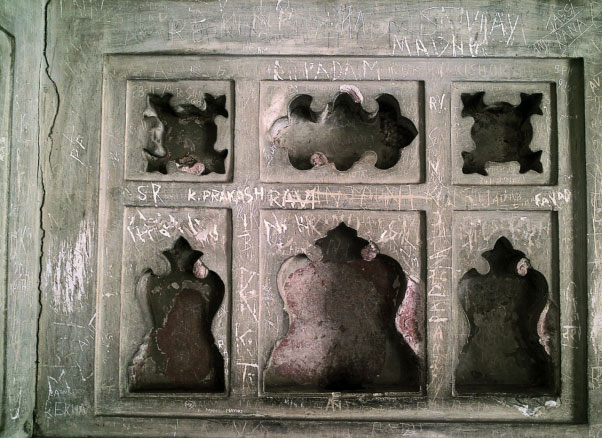
    We Indians simply love our history. And our legacy. So much so, that we do not mind twisting it, rewriting it, misappropriating it, defacing it, and just plain ignoring it. We love it so very much that we do not respect it, preserve it, accept it or cherish it. Visit any old Indian monument and you get first-hand demonstration of the same through people painstakingly carving the names of their loved ones on 17th century monuments, visibly stirred into leaving their marks on the walls of time.


    Defacement of the Agra Fort – picture sourced from the internet.


    The same malaise runs deep in most Indian brands. Somehow, they are very poor in preserving their history, painstakingly chronicling it and sharing it with their internal and external stakeholders. Go into the “About us” sub-links of most corporate websites and you will see a superficial attempt at talking about their ‘glorious and successful past’. They think that creating a ‘history timechart’ is a brilliant attempt at preserving and living their legacy. Sadly, this applies to some of the biggest and boldest of Indian brands.


    Hence, when one comes up with a piece of work that genuinely attempts at living and loving their legacy, it is such a fresh whiff of old perfume! On October 2, Mahindra released a book called “Timeless Mahindra”, a chronicle of the Mahindra Jeep in India right from assembling the CJ3 Willys Jeep in 1954 to launching the new Thar in 2020! Crafted by the renowned automobile journalist and historian Adil Jal Darukhanawala, it obviously took months and months of unearthing the past, meeting hundreds of people, jogging memories of many and diligently putting it all together in words and pictures. This is an example of genuinely cherishing a brand whose progress is so closely entwined with that of the country. While the book costs beyond the reach of most of us, I am hopeful that Mahindra will gradually release a digitised version for all enthusiasts to access and enjoy. Eventually, Mahindra should go ahead and build a “Timeless Mahindra” virtual roadshow, converting the book into a digital 3D spectacle.


    Automobile brands carry some of the most interesting legacies. The stories of engineers, designers, business leaders along with the physical products make a heady combination. India has had its fair share of the same. Remember that cars were imported into our country from the 1890s, soon after the modern motor car was developed by Karl Benz! Yet, not one of the Indian automobile brands either has a proper chronicle of its history nor has a museum that proudly displays all it has done over the years!


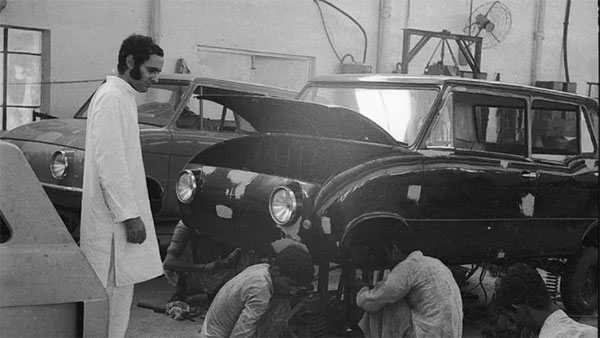
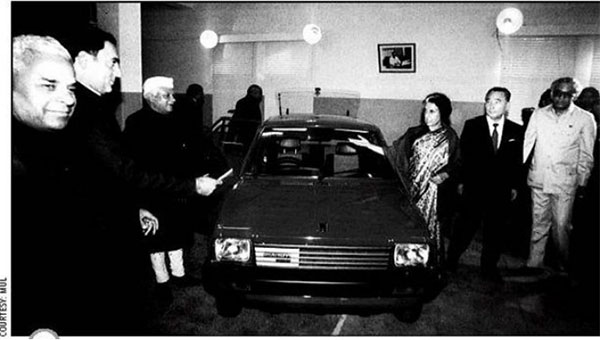
    In fact, some seem quite embarrassed by their history. Maruti Suzuki is an example. For some reason, this shining star of India wishes to hide any traces back to Sanjay Gandhi though there is enough information on the same all over. There is no mention of its history pre-1983 on the official website. There is no such mention anywhere in the Gurugram plant. In fact, all things to do with that phase of the brand’s life have been systematically removed. All photographs of the man were removed. The Tool Room of the Gurugram plant which was his erstwhile office and still had furniture from his days, was demolished in 2002 to make way for a new parking lot. The last few units of the first cars built were also ‘ordered’ to be destroyed before the 20th anniversary of the brand in 2003. In fact, the company considers its birth in 1983 and not 1971 when Maruti Motors Limited was incorporated!


    Sanjay Gandhi with the first batch of ‘Marutis’…sometime in 1974-75.


    December 14, 1983 – Indira Gandhi with the first Maruti 800; notice the photo of Sanjay Gandhi on the wall!


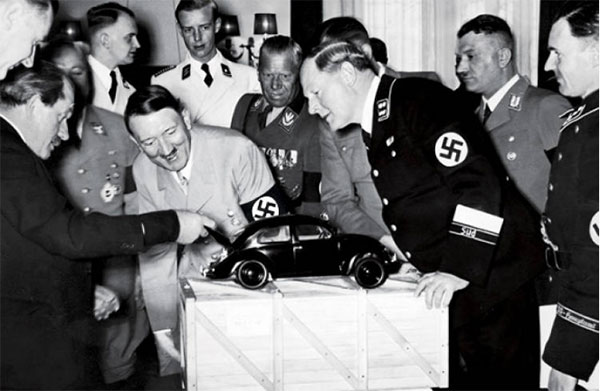
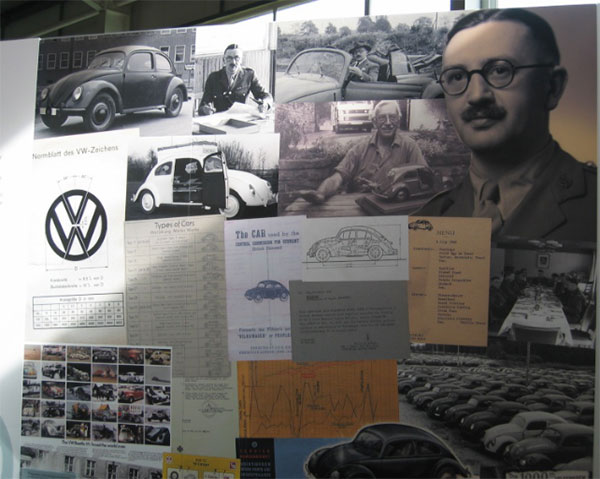
    This is in sharp contrast with Volkswagen, the brand that inspired the conception of Maruti as the people’s car for India. There is no attempt to hide the fact that Adolf Hitler had conceived the German people’s car project and instructed Ferdinand Porsche to work on it. At the AutoMuseum in Wolfsburg there are mentions of the same. Also, there is a fitting tribute to Major Ivan Hirst, the British Army officer who is credited with ‘preserving’ the Volkswagen plant during the Second World War and resuming activities as soon as the war ended. At the Zeithaus in the Autostadt in Wolfsburg there was a statue of Major Hirst when I first visited the place in 2003! Running away from history is as disrespectful as distorting it.


    Volkswagen has two museums in Wolfsburg, one stand-alone and the other as part of the Autostadt complex. Maruti does not even have one!


    Ferdinand Porsche explaining his plans to Hitler – source Fast Company


    Tribute to Major Ivan Hirst


    Tata Motors does not have one. Neither does Mahindra. Nor Bajaj Auto. Or for that matter Ashok Leyland or Hero MotoCorp!


    As an industry India does not have an automobile museum! We could have built one that houses vehicles, memorabilia, documents and events right from the late 1890s / early 1900s. It could have been such a testimony to the role the brands and the industry has played in the nation’s development and progress. It could have been such an inspiration for generations, taking pride in the brands that have done us proud for decades. It is time the entire industry got together to build one, physically as well as virtually.


    And the same applies to many other industries and houses of Indian brands. I would love to visit a “Tata” museum…one that traces the entire history right from the opium trade in 1858-59 to the present day and every milestone that is crossed in the days to come. Similarly, for Parle. And Kirloskar. And Birla. And Infosys. And MRF. Every brand has a duty to share its entire story with its stakeholders, right from employees to consumers.


    In fact, museum is a wrong word to use for such an initiative. This is actually a brand experience zone, both in physical and virtual forms. Such zones can never be static in what they display and share as what happened just yesterday could be important enough to preserve and show tomorrow.


  • Avik Chattopadhyay on ‘The Expendables’

    By Avik Chattopadhyay


    February 2033 has been particularly cold in north India. Delegates coming in for a global conference on blockchains and bitcoins never expected hailstorms and biting cold to greet them. The heavy fog has messed up all flight schedules. And I had been waiting for five-and-a-half hours now to take my guest to the hotel. Some Mr Sorensen from Denmark. This was my third trip for the day and was yet to have one proper meal. Anyway, kept holding the placard at Gate 3, hoping to catch his attention. Ah, there he was. He waved back at me seeing his name.


    “Hello sir, welcome to Delhi.” “Thank you very much! How far is the car?” “You wait at Pillar No 21 and I shall bring it there sir. Let me take your luggage.” “No, let the luggage be with me. You bring the car. I shall be at pillar 21.” “Okay sir, will be back soon.”


    In some time, we were off towards the hotel. The fog was making matters a bit tough as visibility was down to near zero and the cluster of flights landing almost together meant too many cars on the national highway even at quarter to midnight. Switching on the hazard lights and the fog lamps, we crawled along.


    “First time to Delhi, sir?” “Yes. Have been to Chennai before, almost 10 years back. Is it always so cold in Delhi?” “No Sir, this year has been particularly bad. The rain, hailstorms and fog add to the bother.” “You speak very good English. What is your name?” “Thank you, sir. My name is Rajeshwar. You may call me just Rajesh.” “Okay Rajesh, how is your English so good? Does the hotel train all its drivers so well?” “The hotel does give us training, but I am actually a graduate in English language. First division from Ranchi University. Jharkhand state sir, in eastern part of India.” “Wow! You are a graduate and drive a hotel car!? Is this common in India?” “Many graduates drive hotel cars, taxis and buses in India. Being just a graduate does not ensure a better job. But this is still respectable and pays well, so many of us don’t mind driving hotel cars.”


    We were going via Moti Bagh and I decided to go via Africa Avenue as the traffic would be lighter. A bit further down was a police checkpoint. Traffic had slowed down. “Where to? Show licence. Name of passenger?” “Shangri-La. Mr. Sorensen. For conference.” Returning my licence the constable looked at the guest. “Hi, Barry Sorensen. You want to see my passport?” “No need. Please go. Go slow till the ‘Expend Statue’ as there has been an accident. After that the road is clear.” “Okay, thank you.”


    “What is this ‘Expend Statue’?” “Not Expend sir, it is a statue called The Expendables. These guys do not even know the name properly. Many call it the ‘Bachcha Statue’ or ‘Kid Statue’.” “The Expendables! What a name! What is it all about?” “You will see sir…just ahead…” We slowly approached the traffic circle where this statue was. In the fog what looked like a little mound slowly emerged as the form of a child held up by many hands. “This looks interesting. What is this statue all about? What does this mean?” “You want to see it from close sir? Then I need to park the car on the side and you can then walk down and see it.” “Sounds like a plan. Let’s do it Rajesh.”


    We walked up to The Expendables. Barry stood transfixed before it. The lights were tearing through the dense fog creating strange patterns of forms and shadows. I stood next to Barry. The noises from the altercations from the accident seemed far far away. “Do you know about this Rajesh?” “I do sir.” “I see some metal plates with a lot of written matter but can’t make anything out. Tell me please…” “Yes sir. This statue is called The Expendables. Made by a sculptor called Maheshwar Oraon, from my state of Jharkhand. The child is his little daughter Nimmi who died of starvation in her village during the Coronavirus attack. Remember that?” “Of course, I do. Oh man, that was quite a year. Turned the world upside down. We lost many lives in Denmark too, my country. So, why did she die of starvation? And what are these hands holding her up?”


    “Maheshwar was a migrant worker. You know migrant worker? People who leave their homes and travel thousands of miles for jobs. Maheshwar was one, away from his village, in Mumbai. During the virus attack, he lost his job and was stuck in Mumbai. No work and so no salary. And the fear of getting the virus. For five weeks they were under lockdown in Mumbai. What could they do? it was better to return home than live in fear and without any money. Many started walking to their homes, wherever they were. It was terrible sir. Almost 50 million migrant workers started their journeys back home, with basic belongings, without food, water and transport.” “50 million! Incredible! Never read about the scale of this exodus. This must be the biggest ever in human history, no?”


    “It was, sir. You know, a Belgian professor called Jean Dreze used to teach in Ranchi University that time. He had said in a television programme that it was the biggest reverse migration in human history. Anyway, Maheshwar too had started his journey back. Nimmi was his sixth and youngest child. Just 6 years old. His wife had no money or food for almost two weeks. Everybody in the village was surviving on roots and leaves. The little girl finally gave up sir. Just the day before her father reached home. In time to light her pyre.”


    “This is shocking! Did the government not do anything? You have social security here? Food rations?” “No social security for most marginal tribes and people sir. And many of us do not have ration cards. Maheshwar too did not have one. After that virus attack many of us have now been given ration cards. The state government had actually asked the Centre for ration supplies for people without cards but no help came. Then we read on social media that in just three months during the virus attack, our country allowed 65 lakh tonnes of food grains to rot away but none of it was distributed amongst the poor! Can you imagine sir, your own government that you have voted to look after your needs does not give you food when you are starving?”


    “Unbelievable! This is just so sad. What are the hands symbolising?” “There are five hands sir, each hand for a section of society that allowed Nimmi to die. One hand is for the government. Second hand is for the judiciary, for they were mute spectators when this national calamity happened. You know sir, close to 3,500 migrant workers and their family members died in this time period due to lack of food and water. Third hand is for the media for only talking of cities, urban people and rich industrialists without highlighting our plight. Fourth is for the social scientists and trade unions who kept quiet and did not take to the streets to force the government into some action. Remember sir how entire US was protesting against the killing of a black man at the same time?” “Yes, I do. George Floyd. They finally had to pass those bills and make that amendment to the constitution. Yes, I do.”


    “Here nothing of that sort sir.” “And the fifth hand?” “That is us sir. The migrant workers and marginal sections of our society who kept quiet and went through all the torture without raising one banner or placard. We too let Nimmi down.”


    We had gotten back into the car and started off for the hotel after all the accident mess had been cleared up. “So when did this statue come up? Just after the Coronavirus pandemic?” “No sir, this came up recently…in 2031. After the new government came into power. The previous one lasted for 10 more years before we finally uprooted them. This new party of Liberal Socialists have enforced certain labour laws that were created but never implemented. They connected with Maheshwar Oraon and requested him to build this in memory of Nimmi and all the downtrodden.” “So, finally some form of justice Rajesh?” “Just a reminder sir, to each one of us that never again shall we allow this.”


    As I drew the car into the porch and came to a halt Barry shook my hand and said, “Thank you so very much, Rajesh. I shall never forget this. Have taken some photos. Shall go back and tell my family about Nimmi. You seem to know so much…” “I should sir, after all she was my little sister!”


    Avik Chattopadhyay is a senior brand strategist and consultant. He writes for MxMIndia mostly every other Thursday. His views here are personal

  • Avik Chattopadhyay: Lucifer at the Auto Expo!

    By Avik Chattopadhyay


    Lucifer was getting bored. Almost dozing off when God walked up to him and said: “Want to taste a new kind of hell?” “Sure, tell me more…” “Read on social media that the Indian automobile market is hellish.” “Hellish…or actual hell?” “Check it out for yourself. Lazing on that ottoman is making you fat.” “Okay, okay…don’t push it. Where exactly do I start? Heard that country is a huge maze.” “Seems there’s an auto show somewhere up in the north. Good place to start.” “Terrific! Never been to an auto show. Beam me down…now!”


    Oh man! Look at all those people streaming in! Seems the whole world is here. Imagine when they all come up…


    “Excuse me Sir, your pass please. Others are waiting behind you.”


    “Oh yes, here it is. Sorry.”


    So, what do we have here? They call this an SUV. Popular name here. That one there too is an SUV. Didn’t the guys in the previous hall also have a couple of SUVs?! “How is your SUV different from that in the previous hall?” “Oh, theirs is a traditional SUV…boxy. Ours is a coupe SUV. Sleek. We also have a mid-size SUV. There…” Next hall. Now, what do we have here…a tiny vehicle with bug eyes…wait, they are calling this an SUV too! “What SUV is this?” “This is a compact SUV.” As I stepped out I see a very interesting SUV parked outside. Two types of wheels. “Excuse me, what SUV is this?” “This is a tractor!” “Wow, a tractor-SUV!” “Where are you from, weirdo?” How offensive! One can get confused…this thing also has high seats and a high roof!


    Alright, so what do we have here? The description says “face-lift”. What could this be? “Excuse me, which part of the face did you lift?” “Ummmm…well the grille now has two chrome stripes on it…previously had one. Also, the DRL has been repositioned over the headlamp. And…” “Call this a face-lift?! More like a nip and tuck, is it not!” And there are lots of nips and tucks all around. The crowd must be liking all this stuff. A bumper here, a light there.


    And what’s with this “Electric” mania? It’s all over the place. This electricity is blue in colour! Fancy that!! That’s why the blue lightning streaks, outlines, highlights and letters all over. Wonder if red or green electricity works equally well. The red one would surely go with my eyes!


    But, where are those ‘half-vehicles’ …the ones with just two wheels? They were all over on the roads. “Excuse me, where are the ones with two wheels? Do not see them here.” “Oh, there are just a couple here. Most have stayed away. You will find them in Milan and Cologne.” “Close by?” “Where are you from, weirdo?” Now, that’s the second time in a day. Third time and I burn this place down.


    This green stuff on the floor is sure interesting. “That’s artificial grass!” “I see. Whatever for?” “Because we believe in green technology! Can’t you get it?” “Pardon me. You have blue electricity too. Is this the same stuff?” End of polite conversation.


    “You back already?”


    “Yup.”


    “Okay, am all ears…”


    “Do not bother.”


    “C’mon, humour me…”


    “Okay…sample this. They say it’s winter, but I found ladies standing next to vehicles shivering yet hardly wearing any clothes. They say India is a market of 1.3 billion people but when I was beaming down I saw innumerable people on feet asking for money from those in vehicles. Understand?”


    “Oh hell!”


  • Avik Chattopadhyay: The logo is finally flat!

    By Avik Chattopadhyay


    A bat has brought the world to a standstill. Economies are decelerating, stock markets are crashing, cities are getting locked down, travel has stopped and countries are putting themselves into quarantine.


    The world is indeed flat.

    Otherwise, the virus would have slipped off the curve.

    Logos are going flat too.

    Not a very new phenomenon as Apple was one of the early converts.

    But BMW doing something similar is indeed significant news to me.


    You know, automobile brands are too snooty to be messed around with, especially when it is a luxury marque. So when one of the world’s most aspirational brands, across categories, goes into a transformative mood, many of do sit up and start analysing.


    The social media handles were buzzing with BMW’s new logo, unveiled at the sanitised Geneva Motor Show last week. Thankfully, the Covid 19 social media frenzy had not happened then, otherwise this news would have gotten drowned out.


    Most people I sought feedback from do not like what has been done.


    Expected, as most of us do not like shaking the status quo. We call it “tradition” and “ritual”. Therefore, sacrosanct and touch-me-not. But here was a brand like BMW that had already taken the step, shaken the status quo, broken tradition and upset the ritual. There must have been reasons compelling enough to do so. Personally, I find it very clever. And truly disruptive of existing convention and comfort. Hence, my opinion on this developing trend of big brands modifying their logos into a ‘flat’ format.


    Apple. VW. BMW.


    The first and last undertook the transformation of their own volition.

    VW did so as part of their image ‘cleaning up’ act after the Dieselgate scandal.

    The previous versions were these metallic, 3D effect.

    The new ones are simple, clean, lean and 2D.

    Why have these brands consciously decided so?

    For three reasons, I believe…


    Transparency

    A simple and clean logo on your product, sans all frills, depicts a sense of transparency in the brand’s relationship with its stakeholders…customers, employees, partners etc.


    Adaptability

    The fact that the logo does not have a fixed colour palette but allows for including its setting in the form of hues, textures and material shows inclusion as central to its value system, hence adaptability. The brand, through its logo, has the ability to blend and become part of the environment and context it operates in, across cultures and markets.


    Personalisation

    The brands of tomorrow will be post-industrial. Gone are the days when we gaped at large structures and industrial enterprises in admiration and aspiration. Tomorrow’s brands will be personal. They will connect directly and personally to each consumer through new means of engagement and immersive experiences. They will be configured to be consumed and not merely owned. And the logos of such post-industrial will at least not be in 3D with a machined, metallic finish. They will adapt themselves to be expressed most effectively in the digital media that today’s and tomorrow’s consumers most commonly use to interact with the brands.


    The marketing maverick Shunu Sen had once told me, “The brand is a wasting asset!” Very true, Mr Sen, especially in today’s world where consumption outstrips transaction and advocacy outlives mere satisfaction. The logo is but a true manifestation of that world. Transparent. Inclusive. Flexible. And very personal.


  • Avik Chattopadhyay: Brand of the Year – the Indian Student

    By Avik Chattopadhyay


    This is that time of the year when the best of the best are recognised. Person of the Year. Film of the Year. Tweet of the Year. Instagram pic of the Year. And so on. Hence I thought of taking this opportunity to announce my “Brand of the Year”.


    The Indian Student.

    Yes, the Indian student, who has actually helped keep the fabric of this nation more or less unharmed and intact through the year. On various occasions. On various issues. Social. Ecological. Economic. Behavioural. Political. Cultural. Some issues complex, some very fundamental.


    As a brand, they have stayed true to their core purpose.

    As a brand, they have been on course with their promise to deliver.


    The student is the future of any country. The student stands for all that is good, aspirational and ambitious about society. That is not necessarily bound down by convention and ritual but makes the nation proud.


    Because I care beyond myself

    I care about the environment and will take action to reverse damage and preserve what is left. I will make festivals less polluted. I will take to public transport to reduce congestion.


    I care for the unique yet fragile concept of “India” that is only 70 odd years old. I will take to the streets if needed to preserve the national fabric.


    I care for the unwanted and underprivileged. I will go out of my social bindings to stand up for them.


    I care not because I am affected, but because this land I inhabit and this flag I salute is affected. And if I do not care for another, no other shall care for me when I need support.


    Because I have no hidden agenda

    I am typically not driven by agendas and mala fide intentions at this stage of my life. Yes I do have peers who have joined youth wings and student wings of various political parties but they are only a handful. I am still idealistic. I am still inquisitive. I am still a bundle of energy. I still have time on my hands. I am not yet ‘comfortably numb’. I am not yet bound by stereotypes of colour, faith, flags and forms. I still think I can walk over and hand out a rose to a policeman across the barrier. I still think I can upload a video of an unruly lawmaker and shame him / her before the millions. I still think I can share a ‘bread pakoda’ and a ‘chai’ with a peer who completely differs in thought and action. I still think I can bring change…positive, powerful, progressive and for all.


    Because I am the future

    I experiment every new trend as nothing is beyond bounds.


    I will redefine consumerism by experiencing more than merely owning.


    I will redefine freedom of speech and expression by making myself heard.


    I will embrace causes that transcend culture, gender, race and religion.


    I will be my own check and balance as I move forward, into a new decade of challenges and opportunities.


    I will be the India that the world will one day truly admire.