By Kunal Sinha
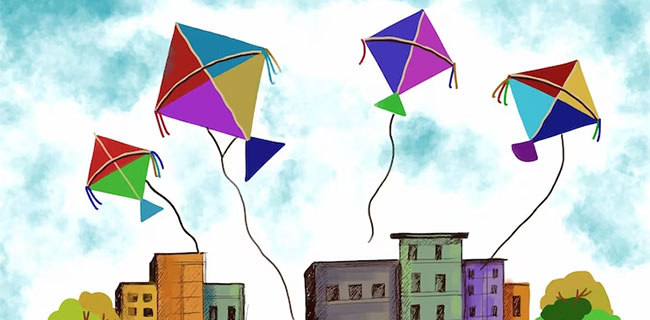
 Today is Makar Sankranti, a day millions of bright kites are taking to the sky. It is also the harvest festival, with Lohri / Pongal / Bihu / Uttarayan being celebrated in different regions of India.
Every year, Ahmedabad hosts the International Kite Flying Festival. According to the chief minister of Gujarat, the kite-making industry had grown to a size of Rs 625 crore, giving employment to 1.3 lakh people of the state in 2023. The state produces 40% of India’s kites.
Production of kites and kite supplies can be seen on the streets of Ahmedabad beginning in November, to get ready for Uttarayan, and nowhere more so than in Patang Bazaar, the special kite market that appears in the old city. For the week preceding the festival, it is open 24 hours a day for all kite-lovers to stock up for the festivities.
This year, 153 kite-flyers from 55 countries, 68 national kite-flyers from 12 states, and 865 flyers from 23 cities across Gujarat participated in the festival.
According to Vinod Joshi, director of Jajam Foundation and a heritage researcher based in Jaipur, Maharaja Sawai Ram Singh, who ruled between 1835-80, brought the tradition of kite flying from the Awadh region to Jaipur. Special kites made of cloth that were called ‘Tukkal’ were made for the royals. As they flew kites from the palace terrace, it attracted the general public, later becoming a community event on Makar Sakranti. On that day, Rajasthan Tourism now organises a festival on the lakeside of Jal Mahal Palace in Jaipur in which the entire city participates in kite flying.
Kolkata’s obsession with kites apparently started way back in 1856 when the last Nawab of Awadh, Wajid Ali Shah, was exiled to the banks of Hooghly and he finally settled in Metiabruz. Apart from kites, the Nawab also brought with him his other obsessions like wrestling and poetry meets. Legend goes that tired of being beaten by rival kite-fliers, the Nawab apparently wanted his kite strings to be coated with diamond dust! Kite-flying was a passion among the “Babus” of Bengal in the early 19th century and this had prompted the growth of several kite-making units all over the city, primarily in the northern fringes of the city.
It wasn’t surprising, then, to find social media awash with kite imagery this morning.
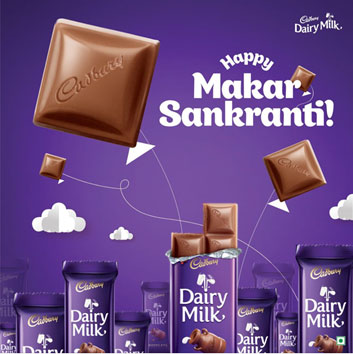
Cadbury and Coca-Cola have gone all out with their brand colours in their posts.
Coca Cola India:
https://www.facebook.com/watch/?v=541281739707896
Reliance Mall combines kites with feasting:
https://www.instagram.com/reel/C14nq2VhvuV/?igsh=MTNhMndqbzJhdXZ0aA%3D%3D
While for Ashirwad Svasti milk, it’s an occasion for traditional food like dahi-chura:
https://www.instagram.com/reel/C2AC20wIgkg/?igsh=MXdxbjNxNXUxeW85dA%3D%3D
Haldiram’s wishes are about festive sweets, with their post featuring sweets like gajak.
https://www.linkedin.com/posts/haldiram-snacks-pvt.ltd._makarsankranti-haldirams-activity-7152164629484314624-Q2pd/?utm_source=share&utm_medium=member_ios
The question that comes to mind is – for festivals such as Makar Sankranti, what is the outcome that marketers expect?
Unlike the Dassera and Diwali festive season, when as many as 84% of Indians increase their shopping budgets, or Karwa Chauth and Akshay Tritiya, which have been turned into shopping festivals for jewellery, fashion, homes and cars, Makar Sankranti / Lohri appear to be purely expressive festivals.
Is the purpose of these campaigns to create and strengthen interesting brand association and build relevance to culture? That might well be the case for Fevicol or Kokuyo Camlin, which are aids to craft and creativity, or Youva, a stationery brand that is all about expression, or Asian Paints – to strengthen its association with colour.
https://www.facebook.com/story.php?story_fbid=789198123247200&id=100064710577423&mibextid=WC7FNe
For other brands, the mere temptation for wordplay / visual puns can end up as howlers. Sample this (from last year’s campaigns):
Happy Makar Snackranti (Pillsbury)
Let your taste buds fly high (Nature’s basket)
Give wings to your dreams (McDonalds)
Don’t let inflation affect your income; invest in SIP (SBI Mutual Fund)
What stands out amongst the Sankranti campaigns is Linen Club’s campaign which pays tribute to the rich culture of Andhra Pradesh. With Sankranti being about letting go of past habits and adopting something new, it celebrates the bhogi ritual in which old belongings are ceremoniously burnt in the fire to make way for the new.
If kite-flying is about craft and creativity, what stops brands from celebrating the artisans who come up with new designs every year? If it about the competition that plays out amongst the patang baazs of Old Delhi, Varanasi and Lucknow, why not tell stories about them?
Aah, that would require creatives to leave their desks, get out into the hustle-bustle of the marketplace, interview folks and document their story. And for clients to actually fund it. Hopefully we’ll see some of that next year!
Wish you a happy Makar Sankranti / Lohri / Bihu / Pongal / Uttarayan!