By Ajay Kelkar, COO
 The year 2015 saw a surge in the range of tools and technologies—from social media to smartphones—making inroads into the life of consumers helping them make informed purchasing decisions. This influx if technology has transformed marketing into an increasingly technical function.
Despite being in the nascent stages of understanding marketing technology, Chief Marketing Officers (CMOs) today are willing to invest in embedding analytics and technology into marketing operations. This has given further impetus to the martech (marketing technology) tools. In fact, the global spending on marketing technology is expected to touch $32 billion by 2018.
And when 2015 has largely been devoted to lay the foundation of martech, 2016 is expected to usher in trends. Here are ten trends for martech that I believe will be prominent in 2016.
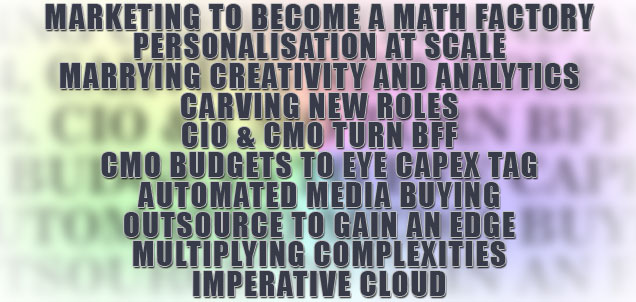
1. Marketing to become a math factory: With open APIs and a lot of technology powered by algorithms marketing will essentially turn more technical with marketers factoring in multiple correlations and pre-empting messages that would engage their target customers.
2. Personalisation at scale: In continuance the aforementioned trend marketers will now gradually scale-up the degree of personalisation in their messages. However, for this they would need assistance of technology. APIs will allow data to flow where it’s needed and decisions would effectively happen in real-time.
3. Marrying creativity and analytics: The creative geniuses and the analysts who previously used to work in silos will work far more deeply together to deliver customisation at scale.
4. Carving new roles: HSBC global head of marketing for commercial banking and global banking and markets, Amanda Rendle, has called out an interesting new role: customer engineers or customer journey engineers. The quandary with new roles and designations will continue.
5. CIO & CMO turn BFF: Three years ago, Gartner predicted that by 2017 CMOs will spend more money on IT than CIOs. All signs indicate that shift is well underway.The good news is that marketing has become more digital and data-driven than ever before — a natural fit for the CIO. In fact, as pointed out by Sherrie Haynie, organisational development consultant at CPP, publisher of the Myers-Briggs Type Indicators: CMO and CIO now share more similarities than differences.
6. CMO budgets to eye Capex tag:Â Traditionally, the CMO’s budget is OPEX (operating expense), not CAPEX (capital expense) but that will now change with CMOs investing in buying more servers and other hardware to drive martech. Marketers need to make technology decisions not only on infrastructure, tools, and techniques, but on the right delivery and engagement mechanisms.
7. Automated media buying: With the huge explosion of data in the ecosystem, marketers would make incessant moves towards programmatic media buying – an instance whereby technology would automatically bid on online display advertising. While marketers could make use of third-party data, and combine it with first-party customer data, and inform marketing messages and content; advertisers would use predictive modelling and lifetime value to display ad content and engage with the customers.
8. Outsource to gain an edge: Internal marketing department have been trying to catch-up and sync their messages with the changing dynamics of its customer. Consequently, CMOs will unequivocally vote in favour of outsourcing parts of the marketing technology and services. This is not just a trend for the coming year, but for the next five years. By 2020, 33% of CMOs will outsource some digital marketing activities under marketing-as-a-service model.
9. Multiplying complexities: Martech now has 1,876 companies working in 43 diverse categories. Based on Y-o-Y estimates, that means the market nearly doubled from 2014-2015. And the market will only get denser. Over the past couple of years, Oracle has spent $3 billion on a martech acquisition spree averaging a company a month. Oracle, once the great advocate of the CIO, now has designs on wooing the CMO directly.
10. Imperative Cloud: Over the last few years, marketing cloud has gained prominence in its value. While a large number of players have entered the domain, it now promises consolidation and distribution of new capabilities such as predictive analytics and omni-channel marketing. This also indicates that major public cloud providers will gain strength, with Amazon, IBM SoftLayer and Microsoft capturing a greater share of the business cloud services market. Maybe, Amazon might become a CMO’s best friend!
Ajay Kelkar is COO, Hansa Cequity