Tag: Ajay Kelkar

  • Hansa Cequity unveils CXPA in India

    By A Correspondent


    Hansa Cequity has launched the local chapter of Customer Experience Professionals Association (CXPA, www.cxpa.org) in Mumbai. One of the early members of the CXPA local chapter is Piramal Group.


    CXPA is a global organisation committed to increase the impact and visibility of customer experience professionals, facilitate effective member-to-member sharing, and establish respected standards and CX tools. Top global organisations across the BFSI, airlines, and retail sectors are members of CXPA.


    With an aim to bring the CXPA community together across the country, Hansa Cequity will support and anchor CXPA activities and local networking forums. CXPA local chapter will host quarterly events for its members with a commitment to connect, learn and grow the customer experience (CX) network in India. The CXPA local chapter launch witnessed participation from over 10-15 companies across different industries such as BFSI, retail and automobile. The members who become a part of the association gain access to some of the best practices, research studies, and professional network of practicing customer experience professionals.


    S Swaminathan, CEO and Co-Founder, Hansa Cequity, said, “Customer experience is no more a department or a siloed function in an organisation. It is a movement that needs CXO involvement and commitment to make a business impact. We are going to promote CXPA through local networking events and drive interest for professionals to join and benefit. Apart from targeting four key cities in India during the year for the events, we are also looking at facilitating in-company programmes. Through this, we aim to bring together CXOs across cities, build a community of CX professionals, build awareness for CX practices, and share best practices amongst each other to build common customer experience standards across organisations.”


    Ajay Kelkar

    Ajay Kelkar, COO and Co-Founder, Hansa Cequity, said, “By partnering with CXPA in India, we hope to create a vibrant community of CX professionals who would lead and implement CX initiatives in their companies. During the Mumbai launch more than 30 companies signed up to participate and know more about CX initiatives.”


  • Hansa Cequity acquires data sciences co, D-Square Solutions

    By A Correspondent


    Hansa Cequity has announced a majority stake in D-Square Solutions Private Limited, a data sciences and analytics company based out of Bengaluru, India. The terms of the deal have not been disclosed.


    In a statement, S Swaminathan, CEO and Co-Founder of Hansa Cequity said, “This acquisition would strengthen our data science expertise and help in building strong capabilities in building cutting-edge artificial intelligence and machine learning capabilities in addition to enhancing our analytics-driven marketing offerings.”


    “Founded in 2009, Bengaluru based D-Square Solutions brings together business analytics products and consultancy solutions to help optimise time spent on informed decisions,” added Swaminathan.


    “There has always been a growing appetite by decision makers for data science,” said Anand Srinivasan, founder and chief executive of D-Square Solutions. The company currently caters to clients in IT & networking, BFSI and other industries across markets. Srinivasan is a thought leader and leading solution specialist in data science. He is an alumnus of IIT, Chennai and has done his Masters in Operations Research from Purdue University. He has also published a book – Business Analytics, which is a definitive guide to many industry practitioners.


    Ajay Kelkar

    Ajay Kelkar, COO and Co-Founder of Hansa Cequity said, “The new acquisition would help leverage on data science in many of Hansa Cequity verticals while giving a lot of focus and cutting-edge capability to the products and platforms that we are developing.”


    Hansa Cequity had raised around $5 million (Rs 30 crore) from private equity firm ASK Pravi in June last year. This is Hansa Cequity’s first acquisition in the India market where analytics start-ups are emerging with niche offerings. “D-Square will operate as a separate entity but will synergize its resources and offerings with Cequity,” informed Kelkar.


  • Discretionary spending to contribute major share of Indian household expenditure by FY21

    By A Correspondent


    With the rise of India’s middle class population, discretionary spending is gradually getting more prominence in the consumption basket, finds a recent Consumer Consumption Insights white paper published by HansaCequity — India’s leading customer marketing company.


    The white paper states that the share of discretionary spending is expected to contribute 56 per cent of Indian household expenditure by FY21. Estimates show food (including processed food) & beverage (42per cent), education (7per cent), conveyance (7per cent), medical (5per cent) and durable goods (6per cent) would find the top spot in household consumption expenditure for 2021.


    The report summarises the key takeaways on Indian household’s consumption pattern, debt and asset position, usage of plastic cards, brief insights on consumer confidence survey along with our estimates and forecasts and attempts to highlight changes happening in India’s consumer economy parallel to India’s growth.


    The white paper also forecasts some key changes with respect to the rural-urban spend. It predicts that in rural areas expenditure on conveyance, education and medical is on the rise, whereas in urban areas conveyance, personal care and medical will account for large part of non-food expenditure in urban areas. This signifies that larger portion of household’s income will be spent on self-care, self-development, and education. It also predicts motorcycle/scooter, mobile phone handset and other durables to show a substantial rise by 2025-26.


    The white paper, however, found that credit cards are still lagging behind in the payment choice. Undoubtedly, cash and debit cards are the preferred choice. High interest rates, pre-screening requirements, security fears by households are some of the reasons for this lag. This leaves a lot of space for mobile payment system (using mobile as card), mobile wallets and other innovative channels of payment (pre-paid, EMI cards by big hypermarkets, retail brands).


    According to various estimates in the market, India’s internet population is expected to reach half a billion by 2018. This presents a huge opportunity for companies to target, segment, interact with their present and future customers. This makes it very important for companies to analyse their customer’s social media preferences to influence them online for their final spending decisions.


    HansaCequity Co-founder and COO, Ajay Kelkar said, “With India’s middleclass population on the rise, the marketers are keen to understand on how much each individual household spend& what are the changing dynamics of these spending patterns. Knowing how the households (rural/urban) are likely to spend, on which product categories, segments and in what proportion, and the underlying dynamics involved becomes ever more important for companies, brands, policymakers and investors.”


    HansaCequity Co-founder and CEO, Swaminathan S. added, “Household consumption data & insights and its changing trends over time show severalinteresting current and future share-of-spends by Indian households, their tastes and preferences, changing socio-economic patterns etc. and therefore their impact in spending patterns & how they are likely to shape in the future. If consumption data is seen from the lens of the basket of what people buy –it clearly points out to on-going larger share of discretionary spends – it also gives a leading indicator of the type of household they are or moving towards.”


    The report, prepared by the research team from HansaCequity Customer Consulting Practice supported by Econometrics Research Team, is aimed athelping marketers navigate the changing dynamics of Indian households’ spend trajectory.


  • 10 Martech trends that will shape 2016


    By Ajay Kelkar, COO


    The year 2015 saw a surge in the range of tools and technologies—from social media to smartphones—making inroads into the life of consumers helping them make informed purchasing decisions. This influx if technology has transformed marketing into an increasingly technical function.


    Despite being in the nascent stages of understanding marketing technology, Chief Marketing Officers (CMOs) today are willing to invest in embedding analytics and technology into marketing operations. This has given further impetus to the martech (marketing technology) tools. In fact, the global spending on marketing technology is expected to touch $32 billion by 2018.


    And when 2015 has largely been devoted to lay the foundation of martech, 2016 is expected to usher in trends. Here are ten trends for martech that I believe will be prominent in 2016.


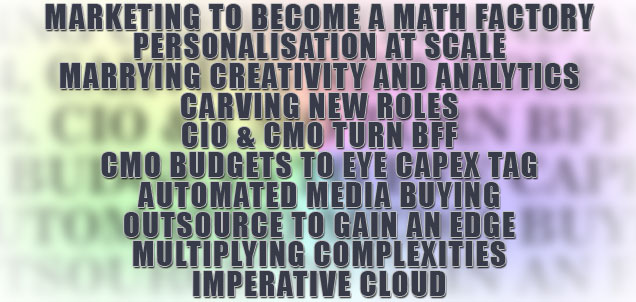
    1. Marketing to become a math factory: With open APIs and a lot of technology powered by algorithms marketing will essentially turn more technical with marketers factoring in multiple correlations and pre-empting messages that would engage their target customers.


    2. Personalisation at scale: In continuance the aforementioned trend marketers will now gradually scale-up the degree of personalisation in their messages. However, for this they would need assistance of technology. APIs will allow data to flow where it’s needed and decisions would effectively happen in real-time.


    3. Marrying creativity and analytics: The creative geniuses and the analysts who previously used to work in silos will work far more deeply together to deliver customisation at scale.


    4. Carving new roles: HSBC global head of marketing for commercial banking and global banking and markets, Amanda Rendle, has called out an interesting new role: customer engineers or customer journey engineers. The quandary with new roles and designations will continue.


    5. CIO & CMO turn BFF: Three years ago, Gartner predicted that by 2017 CMOs will spend more money on IT than CIOs. All signs indicate that shift is well underway.The good news is that marketing has become more digital and data-driven than ever before — a natural fit for the CIO. In fact, as pointed out by Sherrie Haynie, organisational development consultant at CPP, publisher of the Myers-Briggs Type Indicators: CMO and CIO now share more similarities than differences.


    6. CMO budgets to eye Capex tag: Traditionally, the CMO’s budget is OPEX (operating expense), not CAPEX (capital expense) but that will now change with CMOs investing in buying more servers and other hardware to drive martech. Marketers need to make technology decisions not only on infrastructure, tools, and techniques, but on the right delivery and engagement mechanisms.


    7. Automated media buying: With the huge explosion of data in the ecosystem, marketers would make incessant moves towards programmatic media buying – an instance whereby technology would automatically bid on online display advertising. While marketers could make use of third-party data, and combine it with first-party customer data, and inform marketing messages and content; advertisers would use predictive modelling and lifetime value to display ad content and engage with the customers.


    8. Outsource to gain an edge: Internal marketing department have been trying to catch-up and sync their messages with the changing dynamics of its customer. Consequently, CMOs will unequivocally vote in favour of outsourcing parts of the marketing technology and services. This is not just a trend for the coming year, but for the next five years. By 2020, 33% of CMOs will outsource some digital marketing activities under marketing-as-a-service model.


    9. Multiplying complexities: Martech now has 1,876 companies working in 43 diverse categories. Based on Y-o-Y estimates, that means the market nearly doubled from 2014-2015. And the market will only get denser. Over the past couple of years, Oracle has spent $3 billion on a martech acquisition spree averaging a company a month. Oracle, once the great advocate of the CIO, now has designs on wooing the CMO directly.


    10. Imperative Cloud: Over the last few years, marketing cloud has gained prominence in its value. While a large number of players have entered the domain, it now promises consolidation and distribution of new capabilities such as predictive analytics and omni-channel marketing. This also indicates that major public cloud providers will gain strength, with Amazon, IBM SoftLayer and Microsoft capturing a greater share of the business cloud services market. Maybe, Amazon might become a CMO’s best friend!


    Ajay Kelkar is COO, Hansa Cequity

  • Hansa Cequity joins Adobe Solution Partner Program

    By A Correspondent


    Hansa Cequity has announced it has joined the Adobe Solution Partner Program as a Business Level Partner. This will allow Hansa Cequity to work more closely with Adobe to provide digital marketing solutions and integrated technologies to its pan-India customers.


    Hansa Cequity will use Adobe Marketing Cloud solutions such as Adobe Audience Manager (a data management platform), Adobe Analytics (a leading marketing analytics solution), Adobe Campaign (for multi-channel campaign management), to provide integrated customer marketing solutions to its clients in retail, automotive, banking and travel and hospitality domains. In strengthening its relationship with Adobe, Hansa Cequity will receive greater levels of support from Adobe and in turn be able to pass that along to its clients.


    “Hansa Cequity is excited to build our relationship with Adobe, and in signing this enterprise agreement, we will have a great Digital Technology partner in Adobe as we continue to expand as a full service Customer Experience Management Company,” said S Swaminathan, CEO and Co-Founder, Hansa Cequity.


    “With customer centricity gradually becoming an integral part of organisational thinking, marketers are looking to partner who can provide integrated services for enhancing their customer’s experience. And that is what we aim to achieve with this partnership,” added, Ajay Kelkar, COO and Co-Founder, Hansa Cequity.


    Commenting on the partnership Umang Bedi, MD – South Asia, Adobe Systems said, “Hansa Cequity has been one of the pioneers of data-driven marketing in India. This partnership will enable customers to act on the insights to deliver differentiated customer experiences in this rapidly changing digital world.”


    The Adobe Solution Partner Program is designed to create a successful relationship between Adobe and digital marketing companies to help build customer experience solutions and facilitate exchange of resources and support.


  • Will it B #Sale ya #Fail for Etailers?


    By Ravi Balakrishnan


    How brands and big box retailers prepare for festive seasons or sales is, by now, an oft-told tale: extra staff come on board for just a few days, months are spent negotiating exclusive deals, there’s a ‘no-holidays-during-the-holidays’ rule for regular store hands and the shifts stretch from 6 AM to midnight.


    But what of India’s leading ecommerce players? Apart from throwing in discounts every day, many of them are remarkably susceptible to isolating one day (or three) a year when they hope the largest chunk of money spent online by Indians will be on their sites or apps.


    Flipkart’s founders were preparing for a bigger, better ‘big billion day’ as far back as January this year. It wouldn’t surprise us if in the last three months of 2015, there’s a grand orgy of conspicuous consumption, complete with “never before” deals on the apps and sites of Amazon, Flipkart and Snapdeal.


    Online sales have existed for a while: Citibank’s OMG Sale and the Google Online Shopping Festival, for instance. But the one that’s most recalled for reasons good and bad is Flipkart’s Big Billion Day sale last year. It was online Darwinism at its finest. Those with fast net connections, twitchy fingers and instincts honed by last minute bids on Ebay fared well. The ones who were disappointed — and it felt like there were at least a billion — fumed and fretted online till the Flipkart’s Bansals felt compelled to apologise. So, what are etailers to do as they prepare to serve another big billion?


    Be Ready For Literally A Billion Transactions

    Etailers cannot make grandiose claims of serving a billion and then not have the computing power to deal with even half that number. Whether online or offline, infrastructural readiness counts for a lot. Overseas, the main motivation for such sales is offloading stock.


    In India, it’s to get a larger number of people shopping online. Their first experience needs to be memorable. Error messages and products disappearing from shopping carts don’t make for great memories. Rajdeep Endow, MD, Sapient, observes, “No amount of advertising can bridge the gap in how long a product is available for. It’s better to have a live clock ticking, counting down the duration of the deal rather than people finding inventory is over.”


    Throw mobile-based apps into the mix and things get a lot more complex. On the one hand, there’s a walled garden of data to be mined. Observes Kumar Subramaniam, co-founder, Zero:Zero: “We know if the app’s been used to search for shoes, if the purchase was made, if there was an exchange, etc. The ecosystem is rich and etailers are just scratching the surface.” Which brings us to its biggest problem: complex user interfaces with lots of scope for unintended button mashing.


    Subramaniam admits, “Shoddy UX is a big issue that is unaddressed. I guess it’s more painstaking than splurging crores on an ad campaign.” While still on apps, Harshil Karia, MD, Schbang, believes there’s a case to be made for them using data optimally and “compression and resizing of images is a must.”


    Make Shopping Social

    Even online shopping is not a lonesome experience in India. There are phone calls made, links shared, and parallel teams of friends, family and colleagues tracking prices on other sites.


    Ajay Kelkar, co-founder and COO of Hansa Cequity suggests, “I don’t know how many of these sites rely on augmented reality or apps that allow you to share information or deals with friends and family.” He suggests using augmented reality to create a social sharing experience. For instance, trying out a muffler or scarf and buying it off the app instead of going to the store. He believes, “If tech platforms move from managing high volumes of transaction to better experience that would be a game changer.”


    Rely on Big Data. But Not Just On Big Data

    According to Karthik Nagarajan, national director – content and social media, GroupM, “Data influences almost 40% of orders received by the larger players.” While the most obvious use is recommendations, Endow says it’s globally harnessed to project demand and make sure etailers have the infrastructure to meet it, or to create or optimise real time campaigns. Throw in external data and it allows for a more compelling sales pitch. Kelkar observes, “For Ajay a Maharashtrian in Kolkata, Ganesh Chaturthi maybe more important than Durga Puja. It is a more personalised expression of an offer.”


    Have a Good Explanation Ready For The Backlash

    The apology from Flipkart last year was heartfelt but it’s unlikely to have the same impact if used again. There’s always going to be backlash and etailers need to work out what they are going to say well in advance. Consider the number of attackers: Disgruntled customers frustrated by a slower than the norm delivery. Vigilant shoppers tracking whether an etailer inflates prices before discounts. Online smartasses who live for the chance to poke fun at etailers and their dodgy selections – run a search for Hilarious Reactions to the Amazon Prime Sale, if you don’t believe us. Also the parameters of success or failure need to be defined. If stock has sold out, it’s a success, in spite of what angry online critics may say


    Try To Do Things Differently

    At some point, etailers need to figure out if they are really building brands or just coming through as an undifferentiated mass of deal providers. Nagarajan admits, “I’m not sure how much unaided recall people have on one sale against the other since they all come at you via newspaper ads or TV commercials.” One way of making things memorable is by opting out of the big sale rat race. Kelkar suggests: “Like credit card companies give pre-approved offers what stops etailers from giving me preapproved sales rooms?” Given they are not as time bound as brick and mortar stores, it’s entirely possible to have a personalised sale for every customer, perhaps on their birthday. Kelkar says, “It allows people to experience the site in different ways at different times: to fragment the base, from all users coming at the same time for price-offs.” However this approach discounts a very critical aspect: Scoring a deal few others got, that many were in the running for. The bragging rights that accompany buying a Rs 40,000 camera for half the price are often a bigger draw for a consumer than a consummate love for photography.


    Source:The Economic Times

    Copyright © 2015, Bennett, Coleman & Co. Ltd. All Rights Reserved

    Licensed to republish



  • Hansa Cequity’s omni-channel shopper study throws up interesting findings

    By A Correspondent


    Customer marketing company Hansa Cequity released its first omni-channel shopper study to understand customer behaviour and how India shops. The survey received 1,368 responses from 86 Indian cities and towns.


    The report, launched in association with the Retailers Association of India (RAI) during the ‘Cequity Conclave: Data Driven CMO’, revealed that with increased choices, higher disposable incomes and exposure to global shopping formats, the Indian shopper is changing. The findings highlight in detail why data will drive the decisions of the future CMOs.


    According to the study, 74 per cent respondents’ exhibit omni-channel behaviour (they have shopped in all formats -local retailer, large department and online). The research further reveals that around 40 per cent of the urban Indian shoppers’ shop regularly using modern trade, the numbers have more than doubled as compared to 2012.


    The study also revealed that the level of penetration of omni-channel behaviour in the next multi-billion Rupee markets – small towns – is sluggish. However, optimistic signals with some retailers already taking measures to address this latent need of shoppers both by trying to extend the omni-channel experience and by increasing service levels was also observed.


    Commenting on the report Ajay Kelkar, Co-founder and COO, Hansa Cequity said, “The Indian shopper has changed. She is as comfortable haggling with the local vegetable seller as much as she is tapping open apps on her smartphone to scour ecommerce stores for the best deals. As consumers embrace new technologies, the shopping experience has become increasingly sophisticated, enabling new ways for leading retailers to reach their audience. By integrating and aligning channels – stores, e-stores, mobile apps and social media – omni-channel retailing provides a flexible and seamless shopping experience to customers.”


    “With multi-channel shopping interfaces: physical stores, malls, e-commerce platforms, social-enabled shopping experiences, and smartphone app based services consumers have so many ways to discover and buy the things they want to. Our first omni-channel retail study has been aimed at understanding the customer behaviour and tries to capture in the way Indians shop,” said S Swaminathan, Co-founder and CEO, Hansa Cequity.


    Kumar Rajagopalan, Chief Executive Officer, Retailers Association of India added, “RAI is the unified voice of retailers in India and works towards continuous updating of modern retail trade practices in the country. We recognise that today’s customers have multiple channel options to buy and this report reemphasised the need for retailers to adopt an omni-channel approach to interacting with consumers. A nation of shopkeepers, India has been on the high-growth trajectory, and retail in India has seen generational shifts as it modernises and shifts gears. We are glad to be associated with the first research report on the omni-channel retail in India.”