 By Ranjona Banerji
What does it say about the state of the Central government that a day after Prime Minister Narendra Modi’s “summit” with Chinese Premier Xi Jinping, both the media and the PM’s publicity department are more excited about a “plogging” video on Mamallapuram beach? In any ordinary world, the ins and outs of this historic summit would be detailed and discussed threadbare. Instead, we concentrate on optics and stunts. What did India get out of the summit? That China would not interfere in our “internal” affairs”? If you read between the news headlines, what has happened is that like Pakistan and increasingly Sri Lanka, Nepal also prefers China to India as their biggest neighbourhood partner.
But it would of course be anti-national to debate the summit or anything else related to the Modi government’s actions in any great detail.
And therefore, Kashmir. The communication clampdown is apparently over. But it’s been over two months of no communication, of anger, fear, misery, injury. Coverage itself has been curtailed. But fear of reprisal is why you have frightened journalists praising the government for lifting the communication ban rather than slamming it for all the Constitutional abuses since the abrogation of Article 370.
And now we have a Nobel prize in economics to tear into instead. Because an “anti-government” economist is one of the winners. The big questions for the media are: Is the Nobel prize real? Does it matter when anti-national Indians win something? Do anti-national Indians buy their way into awards and other such nonsense. Why do anti-national universities and anti-national parts of India get more such honours than rightwing BJP lovers?
And apart from the rightwing save-Narendra Modi at any cost media, we have the parochial, sexist and rude media. The economics Nobel was given to Abhijit Banerjee, Esther Duflo and Michael Kremer. The day of the announcement, we knew everything about Banerjee, Duflo an economist in her own right was dismissed in a sentence as Banerjee’s wife and Kremer was ignored. It was as if the only thing that mattered was that a man with an Indian name had won a Nobel. The other two were unimportant.
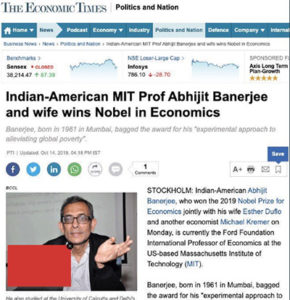 The Economic Times wins the prize with this headline from its website on October 14:
“Indian American MIT Prof Abhijit Banerjee and wife wins Nobel in Economics”
Am ignoring the grammatical error because the rest of the headline is so loathsome.
For all our global pretensions, we remain little frogs swimming about our well.
The big story, bigger even that the PM’s plogging, is the collapse of the Indian economy. After the drama of Union Finance Minister Nirmala Sitharaman’s husband disagreeing with her government’s economic policy, we return to the economic policy. However, perhaps in order to save the government from embarrassment, some media outlets concentrate on the small picture. Like people who have lost their money in the collapse of the PMC bank. Or hidden away in some business pages, rising inflation. Or, how the World Bank has downgraded India’s growth figures.
That a collapsing economy is not constant headlines news is our “new normal”, difficult as it may be to swallow for old-time journalists. As one of them pointed out to me the other day, “It’s not easy to understand why media houses which belong to rich powerful industrialists are so frightened of reporting on the economy.” The pain in this statement aside, we know that this is where we are now. It took the suicide of the owner of the Café Coffee Day chain for a few businesspeople to speak up about tax harassment.
How far we have to fall as journalists before the economy get’s constant top headlines is anyone’s guess. Since we’re into election season again, it will be a long wait.
Ranjona Banerji is a senior journalist and commentator. She is also Consulting Editor, MxMIndia. Her views here are personal