
By Prabhakar Mundkur
WPP shares plunged 13 per cent on the London Stock Exchange because 2017 proved to be the worst year since 2009 showing a drop in net sales of 0.9 per cent.
There seemed no single big reason why the largest communication group was showing weak results. However, the industry has been under pressure with 84 per cent of the digital investment going to the digital duopoly: Google and Facebook. In addition, large global firms like Unilever had cut spends, while others like P&G were trying to cut out the middle man on media by going directly to the digital publishers. Mark Pritchard of P&G told the press: ‘If entrepreneurs can buy digital media, why can’t the brand team on Tide, Dawn and Crest be entrepreneurs and do the same?†This might be a backlash of transparency issues that clients are having with agencies and also the suspicion that agencies are pushing more media money into digital because they are earning larger commissions there compared to traditional media.
Internally, WPP was more than aware that they still function like a few large silos from media, advertising, data and research that don’t talk to each other. This was reflected in Sir Martin’s statement to the press that they would move away from individual companies to a “to a cohesive global team dedicated to the core purpose of driving growth for clients.â€
While communication conglomerates like Publicis, WPP, Omnicom and Dentu went on an acquisition spree to offer a bouquet of services to clients, true integration amongst these disciplines has continued to be a challenge.
In addition, the traditional agency model is antiquated, and the traditional agency has failed to come up with something new that can keep up with the times.
Durex springs a new airy surprise
Reckitt Benckiser is not the most creative client in the world, in fact most of their advertising is downright boring, but Durex seems to always break the mould. Last year, Durex had surprised us with the Durex Jeans teaser campaign which had led everyone to believe that they could expect a new brand of jeans from Durex only to be presented with a DurexJeans a new condom.

Earlier this month, Durex went on to ask people on social media their main reasons for not wearing condoms and then presented the results of their research on twitter.
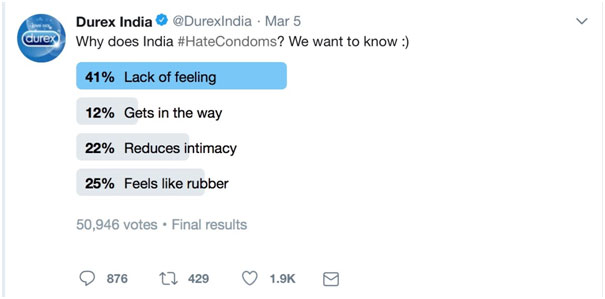
Durex then went on to launch its new Condom Durex Air. As its final tweet said: ‘Finally here’s our solution for all condom haters out there. Presenting to you Durex Air, a condom so thin like it’s not even there. Reach a new level of intimacy and #LoveDurexAir.
Do we need to thank Nike and Apple for introducing Air into our vocabulary to represent product variants which are thinner and lighter? Somehow, I never thought a condom might also ride on the Air bandwagon.
An exam in progressive parenting
Exam time stress for both Indian parents and children is well known. So much is the attention given to it that even our Prime Minister addressed students recently on how to cope with exam stress through “Pariksha par charcha†speech which was broadcast to all CBSC schools. The Prime Minister even published a book called Exam Warriors.
Bournvita did an interesting twist on exam time with their Exam Sale promo.
A stall at a local mall had children selling their guitars, cameras and paint brushes for free. They explained that they were being given away for free because their parents wanted them to focus on their exams. Passersby were surprised and this got an adverse reaction from them about marks and trying for a 90% grade being so important that students had to give up their hobbies.
The message came through quite clearly that marks is not all that good parents must be looking for when evaluating their children.
East India Comedy depicts the truth on advertising
East India Comedy’s recent salvo might be less of a parody and more reflective of how the general content in advertising is depicted. The video launched on Youtube said:“Introducing a new product to help women match up to all the expectations that society places on them. Ab aapbhi ban saktihain ‘adarshnari’!
It suggests that women are being pressurised into buying products to become what society wants them to be.
Maybe there is some truth in that!