By Ranjona Banerji
 Every death which TV journalists do not approve of, now become subjects of discussion. What trained investigators find (even if they do behave like the Keystone Kops sometimes) and what the law says or requires become immaterial. And so it is with the death of actor and mega-star Sridevi, in a hotel in Dubai where she had gone to attend a family wedding.
Initial reports said she died of a heart attack. Later her post-mortem was released which gave accidental drowning as cause of death.
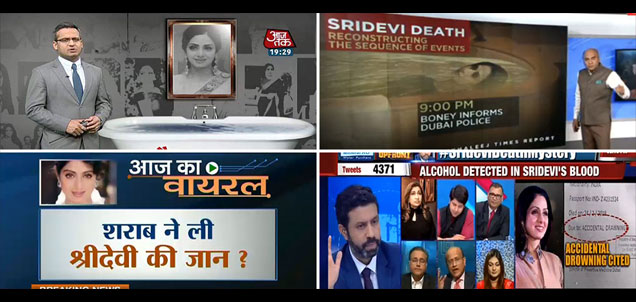
However, as far as television was concerned, Sridevi’s death was not so much about the loss of a creative artiste but the manner in which she may have died. Aaj Tak’s screen ran with the tagline “Bathtub of Death†or “Maut ka Bathtub†while ABP News gave us “Sridevi’s last 15 minutes in the bathroom†with a wine glass in the image because she might have (gasp!) drunk a glass of wine. Aaj​ Tak showed us clips of Sridevi’s “last danceâ€. ABP speculated on whether she had been living under the pressure of lost stardom.
Yellow journalism, tabloid journalism, ambulance chasing, sensationalism, there are enough names for this sort of behaviour by media outlets and by journalists. Television somehow just makes it worse. And for those who imagine that I am unfairly focusing only on Hindi language news channels, far from it. English news channels were as bad at primetime.
All sort of gossip columnists popped up for their moments of TV fame, all of whom knew exactly what had happened, regardless of whether they were inside the bathroom for the last 15 minutes of Sridevi’s life or not. Doctors, who frankly should have known better, were there as well explaining heart attacks, bathtubs and so on. Retired policemen, who are TV regulars, were there to pick up some more TV time, were there as well, weighing in on speculation and what they thought should be done. India is severely short of forensic scientists although some apologies for scientists were seen on TV screens as well.
And in case anyone accuses me of being unfair to the television media and biased towards print, in this instance, the problem started with print and the web as soon as news of Sridevi’s death broke. Since initial information suggested that the cause of death was a heart attack, several journalists and commentators just “knew†that Sridevi’s diet regime, possible plastic surgeries, concern about her weight all led to her heart attack.
In fact, an enormous discussion started around cosmetic surgery and weight loss and gain, all of which seems superfluous in light of accidental death drowning in a bathtub.
One commentator went as far as to suggest Sridevi’s husband, Boney Kapoor’s (stay with me here) former late wife’s ghost may have led to some guilt within Sridevi which led to her heart attack. I know. I can’t get it myself.
I understand that a star’s sudden death is a shock. I understand that the media owes details to fans and a grieving public. I understand that this is also journalism. Celebrity watching has long been a human preoccupation. But what is bad journalism is idiotic speculation, gossip masquerading as “investigation†with no facts to back it up, unreasonable space and time to ghouls looking to get famous on someone else’s death.
Sadly, the loss to cinema – spanning several languages – got lost in all this “excitement†over journalists trying to prove how Sridevi died.
**
I must thank Karnika Kohli of The Wire for this Twitter thread on how news channels covered Sridevi’s death. Read and weep.
|