Tag: ZenithOptimedia

  • Satyajit Sen heads to Indonesia as Havas Media CEO

    By A Correspondent


    The next time you are on the beaches of Bali, don’t be surprised if you run into good ol’ media boss from India, Satyajit Sen. Havas Group Indonesia has announced his appointment as CEO of Havas Media CEO.  Sen takes charge of a position left vacant after the exit of Anwesh Bose in November last year. His mandate is to accelerate Havas Media Indonesia’s journey of transformation and exponential growth with a focus on collaboration, new business and building and leading a team. He will report to Vishnu Mohan, Chairman & CEO Havas Group, SEA, India and North Asia. Sen’s appointment is effective immediately and he is based in Jakarta.


    Sen joins Havas Indonesia from Samsung India where he led the media management function from 2014. Prior to the South Korean giant, Sen was CEO of Zenith Optimedia in India.


    Commenting on the appointment, Mohan said: “Satyajit’s proven expertise in delivering value across the spectrum of media services encompassing digital, content and data coupled with extremely strong leadership skills will build on what we have already achieved in Indonesia, which has a strong portfolio of media clients like Indofood, Grab, and Godrej and take Havas Indonesia forward in its next phase of growth and expansion. His experience encompassing both brand and agency will be huge advantage in a critical market like Indonesia. I am delighted to welcome Satyajit to the Havas family and I am confident that he will propel Havas Indonesia in its next phase of evolution.”


    Added Sen: “This is an interesting opportunity in changing and challenging times. Havas has been a pioneer in integration with its Village model of organisational structure and this multi-dimensional approach to marketing and advertising is exactly what clients are looking for. I am extremely excited to be a part of Havas Group’s futuristic agency model and looking forward to working with the team to start a new chapter for Havas Media in Indonesia.”


    Bali, by the way, isn’t exactly close to Jakarta. It’s around 17 hours away by road given the 1154 km distance. That’s a little less than a couple of hours by air.


  • Media honchos sweat it out at ‘Media keSurtaj’

    By A Correspondent


    The Grand Finale of the second season of ‘Media KeSurtaj’ was held on Friday at Bungalow 9 in Mumbai. It was organised by SPN’s music cluster channels, Sony MIX and Sony ROX HD and hosted by RJ Salil.


    A arkaoke competition amongst media professionals, Media KeSurtaj, brought out hidden singing talent among media agency professionals. The audition rounds were held across Delhi, Mumbai and Bengaluru in agencies like OMD, Carat, Lodestar, Initiative, Publicis, Madison, ZenithOptimedia and GroupM between March 15 to 24, 2017. Elevated levels of enthusiasm and participation were displayed among all the participants and 180 contestants were shortlisted for Friday’s finale.


    The winners were selected in two categories namely, the popular choice and the critics’ choice. Each category had two sub-categories, i.e, Solo & Duet. The video of each participant’s audition is up on display up on the website for an audience poll. The voting closed on April 7, receiving a tremendous response with overall 32000+ votes being registered. The popular choice category winners were selected based on the maximum votes received. The jury for the Critics’ Choice Awards included the masters of the industry including music composer Ajay Singha and singer Ash King, among others.


    Ecstatic at the win, the Popular Choice Solo winner, Pankaj Dobhal from ZenithOptimedia, exclaimed: “I had not expected to win a singing competition my entire life. Doing something beyond your daily routine feels great and I would like to thank everyone who voted for me and had faith in my voice.” With all excitement, Critics’ choice Duet winners, Craig Viegas&PrachiKalkar, GroupM said, “Singing has always been our hobby, never knew that it would get us such a big reward. We would like to thank Sony MIX for this initiative and giving us such a great platform to showcase our hidden talents.” Apart from these, Popular choice Duet category winners were Ashish Rane and Neelam Shridhankar from Carat Media and the Critics’ choice Solo category award was bagged by Gaurav Chopra from GroupM.


    The winners of the popular choice category won prizes worth Rs 20,000 and the critics’ choice category got an all-expense paid trip to Dubai for two.


    Talking about this innovative programme, Neeraj Vyas, Senior EVP and Business Head – Max Cluster and Sony Mix, Sony Pictures Networks India (SPN) said, “I feel, for most of us music is an integral part and one of the key drivers in our daily lives. Hence, we decided to use this musical platform to encourage media professionals to showcase their hidden talent while they get a break from their daily routine. We at SPN were elated with the first season of Media KeSurtaj and extremely overwhelmed with the response received in this second season as well and will hopefully expand to new horizons soon.”


  • Equinox bags media mandate of UrbanClap

    By A Correspondent


    ZenithOptimedia Group‘s Equinox has won the entire media planning and buying mandate, inclusive of out-of-home and digital of India’s largest services marketplace UrbanClap. UrbanClaphas operations inmajor metropolitan cities such as Mumbai, Delhi NCR, Bangalore, Chennai, Pune and Hyderabad.It has over 36,000 professionals on the platform, servicing 4,000-5,000 requests each day across 125 categories.Almost 50,000 customers are using the platform on a monthly basis and this number continues to grow each month.


    UrbanClap is soon expected to venture into newer cities such as Jaipur, Chandigarh and Kolkata. It plans to have more than 2,00,000 professionals on the platform and serve over 1,00,000 customers every day in 25 cities. In September last year, it launched its iOS app for customers, which is a first for the local services industry. It already had Android presence.ZenithOptimediaGroup with its rich roster of e-commerce clients will play a pivotal role in the services major’s expansion plans.


    Hari Krishnan

    Hari Krishnan, Managing Director, ZenithOptimedia says, “The digital medium has re-wired the relationship between consumers and localized service professionals. We are very happy to associate with UrbanClap, which is a well-known on-demand services market place.This is a prestigious win for us.UrbanClap isambitiousand future-facingand is looking at extensive expansion across geographies, categories of services and talent. We will provide them with the right scale, insights and touch points in order to fuel their growth plans.”


    Varun Khaitan

    Varun Khaitan, Co-founder of Urban Clap, “We started this company with the vision of making localized services accessible to the Indian consumer, in view of a fragmented and unorganized industry.UrbanClap is really about convenience and comfort, and more importantly, about trust.  We needed a credible media partner, one that understandsour zeal and approach to the services business and is able to bring in the same kind of fresh thinking to our media plans. ZenithOptimedia has proven expertise in the e-commerce area, and brings in rich consumer insights and data driven planning in order to strengthen our brand further.We look forward to a rewarding partnership with them


  • ZenithOptimedia and Google to host Zoogle Day on Feb 4

    By A Correspondent


    ZenithOptimedia Group and Google have partnered to present Zoogle Day, a first of its kind event on digital and mobile marketing. The event will unfold on 4 February 2016 at Le M’eridien, Gurgaon.


    The ZenithOptimedia leadership, along with top executives from Google will share learnings, insights and case studies where brands have taken the lead in a mobile inevitable world. Some of the subjects that the summit will focus on includes how mobile commerce is shaping up sectors such as banking insurance and telecom, how data driven planning driving programmatic, top trends in ecommerce, the success story of Alibaba and other future-facing business models that are reaping the benefits of a digital economy.


    The conference will also have a key address by Craig Greenfield, Chief Operating Officer of Performics Worldwide. Since 2005, Craig Greenfield’s expertise in scaling large client programs and developing company-wide processes and this has helped Performics successfully transition into the first truly global performance marketing agency. In his current position, Craig leads global technology and innovation; a dynamic network of change agents focused on identifying, evaluating and developing new products, services and systems to ensure competitiveness and improved operational efficiency.


    Craig works in tandem with Performics’s worldwide leadership, client teams and external partners to help clients identify and capture new business opportunities, negotiate strategic partnerships and enhance operational efficiency.


    Anupriya Acharya, Group CEO, ZenithOptimedia said, “ZenithOptimedia and Google host Zoogle Day in many top markets around the world and we are very excited to bring this premier event to India. Given the way mobile is increasingly shaping consumer behavior and commerce, we felt this is an opportune time for us to hold this event. Both ZenithOptimedia and Google are leaders in mobile marketing and have valuable lessons and insights to share on the transformation that India is witnessing.”


    Tanmay Mohanty, Managing Director of Performics and Resultrix says, “We share a long fulfilling relationship with Google and this event cements this relationship further. They, like us, are driven by the Live ROI philosophy, and have unique data driven insights that help clients derive sizeable share.”


    Punitha Arumugam – Director Agency Business India and SEA, Google says “With an estimated 5mn smartphone users being added very month, India’s online populations is expected to cross 500MN by 2018. The Zoogle day chapter we are extending to India is tailored to this reality and will address the mobile and commerce future of this market.”


  • ZenithOptimedia wins media duties of HomeShop18

    By A Correspondent


    ZenithOptimedia has won the media planning and buying mandate of HomeShop18, India’s leading television shopping channel. ZenithOptimedia with its strong presence in the interiors of the country will focus on maximizing the presence of HomeShop18 in the emerging markets.


    Hari Krishnan, Managing Director of ZenithOptimedia says, “This is a sizeable win for ZenithOptimedia India. There are millions of homes that consume content through television, but may not have access to the internet. Home shopping will continue to deliver in mass reach and volume sales, as the cable and satellite footprint expands in the country. HomeShop18 pioneered the concept of shopping from home in India, and made consumers aware of the comfort attached to it. It is a matter of great pride for us, to be partnering with them.”


    Vikrant Khanna, Chief Operating Officer Homeshop18 commenetd, “HomeShop18 has a diverse customer base with a fairly expansive reach through the television channel as well as its web and mobile presence. To reach out to our customers across the country, ZenithOptimedia seemed like an obvious choice based on their trenchant understanding of the Indian market and the ability to tap the burgeoning home shopping segment. We look forward to a rewarding partnership with them.”


  • Indian adspend to grow 15%: GroupM

    By A Correspondent


    GroupM forecasts adspends in India in 2016 to grow 15 percent. In February this year, GroupM had predicted Indian adspends would grow 12.6 percent. Like ZenithOptimedia and Magna Global, GroupM, has also issued its bi-annual global advertising expenditure forecast which predicts ad investment growth of 3.4 percent ($17bn incremental) in 2015 and 4.5 percent in 2016 ($22bn incremental).  These are slight downgrades from GroupM’s predictions at mid-year for 2015 and 2016 which were 4.0 percent and 4.8 percent respectively.  The detailed India numbers are set to be released by GroupM around end-January 2016.


    The forecast is published in GroupM’s biannual worldwide media and marketing forecast report, This Year, Next Year, available at www.groupmpublications.com. The intelligence is drawn from data supplied by WPP’s worldwide resources in advertising, public relations, market research and specialist communications by GroupM’s Futures Director, Adam Smith, who commented, “The outlook remains tough.  Marketers’ constrained pricing power in a deflationary world, a macro trend, prompts ongoing focus on cost control versus investment and this colors our outlook. Continued strength across the majority of the BRIC and Next 11 countries, notably mainland China, is a highlight of the forecast, but the Eurozone is still struggling to find traction.  While our outlook is overall positive, we recognize the downside risks of financial pressures in faster growth markets and the changing profile of China’s external demand.”


    Brazil, Russia China and India, GroupM believes will represent 23 percent of measured global ad investment in 2016, a proportion which has grown every year since they began measuring it in 2000, and GroupM continues adding a point a year for the BRICs in its modelled forecast through to 2020.


    Mainland China remains the largest contributor to global advertising growth, but GroupM has revised downward its 2015 forecast from 8.7 percent to 7.8 percent, and the 2016 forecast is also slightly reduced from 9.6 percent to 9.1 percent.  GroupM has observed that Chinese consumer demand remains strong, supported by wage growth, urbanisation, property wealth and supportive governmental policy. However, on the external side, less demand for primary resources, less foreign direct investment (FDI), less local tourism, and the impact of domestic goods and services replacing imports are among the top reasons for ad market slowdowns in Taiwan and Hong Kong.


    Elsewhere among the BRICS, GroupM predicts that India will be the fastest-growing economy in 2016, and the 2016 forecast is raised by two points to 15 percent.  India is a beneficiary of cheaper oil, as is neighbour Pakistan, which GroupM also upgraded in the forecast. Russia is at risk of another step down in the oil price, but absent another shock, a soft rouble and room to ease rates could assist quick recovery. GroupM expects a short, sharp ad recession of 13 percent in 2015 followed by 2 percent growth in 2016. And despite the Olympic summer, GroupM has revised Brazil’s 2016 down from 9 percent to 7 percent.  There, household spending continues to shrink as unemployment potentially reaches a ten-year high.


    The Eurozone now accounts for only 11 percent of global advertising, and Eurozone consumer price inflation remains near-zero; monetary policy is set to ease just as that of the US may tighten. Zero ad growth is forecast in France in 2016, and German and Italian annual ad growth for 2016 is anticipated to fall only between 1 and 2 percent.  Spain shows the Eurozone’s strongest recovery, but advertising investment in Spain will still be 55 percent smaller in real terms relative to its 2007 peak. In Europe, outside the Eurozone, high employment and other very positive trends make the United Kingdom the fastest-growing mature ad market in the world and the number three contributor to global ad growth in 2016 behind China and the U.S.


    In terms of investments across media types, the shift of advertiser investment to digital, of course, remains the biggest trend.  GroupM hasmaintained its midyear forecast and anticipates digital growth of 14 percent in 2016, commanding 31 percent of global ad budgets. This is a deceleration from the 17 percent growth predicted for 2015. The slower but ongoing strength of digital springs from many sources including organic take-up, technical innovation, advances in value, viewability and validation, automation and efficiency, better creative work, and the mastery of data.


    “Facebook is addressable and targeted at scale with requisite tools and automation that make it easy for advertisers to understand and use; so it is reaping advertising growth of 50 percent globally, including Instagram.  Organic Google website revenue is growing remarkably fast too at 25.5 percent, and they have streamlined YouTube into a complement to broadcaster VOD, even if it is not yet a real challenger on price or quality,” said Dominic Proctor, Global President, GroupM.  “We see that digital’s data and automation capabilities are inspiring the evolution of all media — in all markets across the globe — but digital will continue its powerful growth and market share gains.  This is despite the challenges in the digital space such as viewability, fraud, measurement and currency, all of which we expect to be solved by market forces.”


    According to a communique, GroupM believes 2015 will be the first year that absolute spend in traditional media went backwards in the ‘new world’ (Latin America, Central & Eastern Europe, and Southeast Asia). Only a half-point fall is predicted, but this marks rapid deceleration from the 17 percent growth recorded as recently as 2010. New world newspaper advertising first went negative for growth in 2012, followed by magazines in 2013. China’s advertiser exodus from TV to digital gave the extra push required to make 2015 a negative for traditional media in the new world. These trends are anticipated to ease slightly in 2016.


    Globally, print media’s share of advertising will stand at 18 percent in 2016, according to GroupM.  Print’s long-standing run-rate of annual loss is slowing from two points of share to one, but GroupM notes it is too soon to call it a stabilisation. The medium is embracing digital distribution, but only the strongest franchises are replicating their eminence in the digital domain. Common obstacles include fragmentation, chronic loss of reach, and lack of common standards in audience measurement and trading.


    Traditional TV continues to stand up well.  TV accounted for nearly 44 percent of global ad investment at its peak in 2012; since then it has shed about a point a year. China is responsible for most of this loss because TV advertising became more rationed and regulated while the digital ecosystem grew by leaps and bounds. The USA by contrast is perhaps the least-regulated and most competitive TV ad market, and its TV ad revenue share loss is less than the global average. It would look even healthier if its digital gains were properly consolidated with its traditional linear top line.


    “TV’s share is rising in almost as many countries as it is falling and contributors to the forecast identified three themes of untapped potential: relaxing regulation, improving the quantity and quality of VOD ad inventory, and format innovation. But every medium is in the midst of transformation; some to accelerate growth, others to decelerate share losses; and GroupM, as ever, plays a central role with the voice of the advertising customer to help shape the market to the advantage of our clients,” added Proctor.


    Most of the segment-specific forecast is global. The India numbers are set to be released by GroupM around end-January 2016.


  • Adspends in 2016 to grow 13%


    By A Correspondent


    Leading media agency network ZenithOptimedia says its growth forecast for advertising expenditure in India will be 13 percent for 2016.  Television largely fuels this at 15% and print – newspapers – at 10%. Digital is expected to grow upwards of 20% while all other media are expected to grow at 5-10%. E-commerce, telecom, mobile phones expected to have the maximum growth followed by automobiles and FMCGs.”


    ‘13% growth in adspends is a positive movement’


    Anupriya Acharya, Group CEO, ZenithOptimedia India on her agency network’s global spends forecast as she tells Pradyuman Maheshwari that the actual growth for 2015 will be at 13% as against 12% forecast last year, primarily driven by higher than expected growth on TV at 15%.


    You speak about rational optimism for the year ahead. But given your overall forecast for adspends as 13%, will you say that “achche din aanewaale hain” or would it be that “they could well have been ‘kharaab’, so be happy with this one”?

    The rational optimism is to contrast it with the irrational exuberance that was there last year this time given the new government. But to answer your question… I would say at 13% it’s a positive movement and if we have sustained momentum, it should go up further in the coming years.


    But even as forecast reports such as yours paint a rosy picture, friends in various media sales jobs rue that sales aren’t happening in right earnest…

    That’s right… at an informal level one can get different reports depending on who one is talking to. For example, most sellers will tell buyers that the market is booming and most buyers will tell sellers that it’s a tough market! :))


    Our report however is based on closely tracked data, including inventory sold, impact properties hitting media, annual reports of media companies, secondary research on economic parameters and key categories, actual movement on pricing coupled with market intelligence on key deals.


    Real estate for instance has taken a severe beating…

    That’s right… but actually sometimes that’s when it’s really advertised!


    Your forecast for 2015 was a 12% growth. How has it been in 2015 looking at actual spends. And what about specific sectors… the forecast % v/s actual?

    By the time we close 2015, it looks that the actual growth will be at 13%, primarily driven by higher than expected growth on TV at 15%.


    You’ve mentioned automobiles to see have a good growth, but we have seen modest rise there with very new brands too cutting price?

    Yes, as a category, AdEx on automobiles are quite volatile, say compared to FMCGs which are fairly stable in terms of growth/ degrowth. But this year we have seen a healthy 25% plus growth in automobile spends. New brands cutting price also need to advertise it!


    “In 2018 we expect the internet to overtake television to become the largest single advertising medium,” the report says. Would this apply to India too? And if not, by when do you think will the internet overtake television?

    It does not apply to India at this point in time. But if quite a few things kick in well and collectively like 4G, broadband highways, consumer’s earning and spending potential – and this coupled with the marketer-advertising fraternity accelerating their understanding of this space then it is not impossible to expect it in the next 7-8 years. I must also point out that interestingly, this is not because of slow growth of internet but because in India TV is also growing and far from saturation point!


    Lastly, given that we are the world’s largest democracy, second-most populous country… with a smart and creative advertising fraternity and have very active marketers, isn’t a matter of shame that we are sooooo far behind China?

    Well, China’s GDP is five times of India and their currency ten times stronger! We need to accelerate growth on all fronts in our country and media, marketing and advertising are a subset of it. Collectively, we can and we will 🙂


    ZenithOptimedia predicts global ad expenditure will grow 4.7% in 2016, reaching US$579 billion by the end of the year. This will be a 0.8 percentage point improvement on 2015: 2016 being a ‘quadrennial’ year, when ad expenditure is boosted by the Summer Olympics, the US presidential election and the UEFA football championship in Europe. “The global ad market has enjoyed stable growth since 2011, with growth rates ranging between 4% and 5% a year, and we expect it to maintain this pace for the rest of the forecast period,” the report adds


    Interestingly, while television is currently the dominant advertising medium with a 38% share of total adspend (in 2015), in 2018, ZenithOptimedia expects the internet to overtake television to become the largest single advertising medium. According to the report, one of the reasons for television’s loss of share is the rapid growth of paid search, which is essentially a direct response channel (together with classified), while television is the pre-eminent brand awareness channel – and we expect it to remain so for many years to come.


    Audiovisual advertising as a whole – television plus online video – is gaining its share of display advertising. Television offers unparalleled capacity to build reach, while online video offers pinpoint targeting and personalisation of marketing messages. Both are powerful tools for establishing brand awareness and associations. Audiovisual advertising will account for a record 48.4% of display advertising in 2015, up from 44.1% in 2010, and its share can be expected to reach 48.9% in 2018.


    Also, in 2018 mobile advertising will overtake desktop and account for 50.2% of all internet advertising. Programmatic advertising will account for more than half of digital display advertising (53%) for the first time this year, and will increase its share to 60% in 2016. “We expect programmatic advertising to grow another 34% in 2016 and 26% in 2017, at which point two thirds of global display will be programmatic,” the report adds.


    At regional  levels, Fast-track Asia economies (China, India, Indonesia, Malaysia, Pakistan, Philippines, Taiwan, Thailand and Vietnam) are growing extremely rapidly as they adopt western technology and practices, while benefiting from the rapid inflow of funds from investors hoping to tap into this growth. China accounts for 74% of adspend in Fast-track Asia, so its slowdown naturally has a large effect on the region as a whole. The expectation is for ad expenditure in Fast-track Asia to grow 8.9% in 2015, and at an average rate of 8.4% a year between 2015 and 2018, down from 14.7% a year between 2009 and 2014.


    Adspend growth is slowing down in three out of the four BRIC markets that were responsible for much of last decade’s ad market expansion. India – the only BRIC market – continues to combine rapid growth and large scale, making it a distinct hot-spot of adspend growth. The market is benefiting from sustained, healthy economic growth and strengthening personal consumption. With adspends growing at double-digit annual rates here, ZenithOptimedia expects the market to expand by US$3 bn between 2015 and 2018.


  • Executive summary of ZenithOptimedia Advertising Expenditure Forecasts Dec 2015

    ZenithOptimedia predicts global ad expenditure will grow 4.7% in 2016, reaching US$579 billion by the end of the year. This will be a 0.8 percentage point improvement on 2015: 2016 is a ‘quadrennial’ year, when ad expenditure is boosted by the Summer Olympics, the US presidential election and the UEFA football championship in Europe. The global ad market has enjoyed stable growth since 2011, with growth rates ranging between 4% and 5% a year, and we expect it to maintain this pace for the rest of the forecast period.
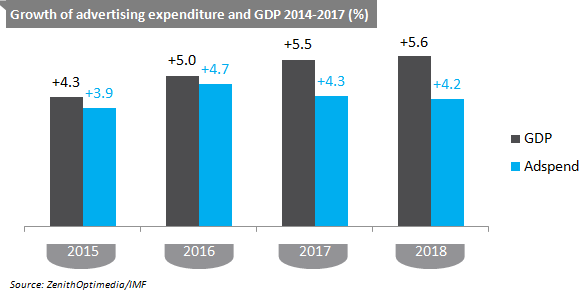
    Forecast by regional bloc

    Since the December 2012 edition of our forecasts we have looked at the growth rates of different regional blocs defined by the similarity of the performance of their ad markets as well as their geographical proximity. This captures the behaviour of different regional ad markets more effectively than looking at regions defined purely by geography, such as Western Europe, Central & Eastern Europe and Asia Pacific. See the end of the Executive Summary for a complete list of countries by bloc. At the end of last year we revised the definition of these blocs. We used to separate the Peripheral Eurozone (Portugal, Ireland, Italy, Greece and Spain) from Northern and Central Europe, because the periphery was substantially weaker. However, the performance of the two regions has now converged, and we have combined them into a single region called Western & Central Europe.

    Western & Central Europe

    For several years the ad markets at the periphery of the eurozone were by far the worst-performing in Europe, which was why we separated them out in a bloc called the Peripheral Eurozone. Between 2007 and 2013, adspend fell 29% in Italy, 38% in Ireland, 43% in Portugal, 47% in Spain and 62% in Greece. However, the last four began to make strong recoveries in 2014. Greece’s recovery went into reverse in early 2015 as the government geared up to confront its creditors, but over the rest of our forecast period we expect Ireland, Portugal and Spain to outperform the average rate for Western & Central Europe, admittedly from their much-reduced base levels. We forecast Ireland to grow at an average 7.6% a year between 2015 and 2018, while Portugal grows by 4.8% a year and Spain by 6.6% a year.

    Meanwhile, France is lagging behind with weak business confidence and household consumption. We forecast French adspend to grow only 0.5% a year on average between 2015 and 2018. This will be the slowest growth rate in the region, with the exception of Slovenia, where increased competition among television broadcasters is pushing down prices, and we expect no growth at all over the three year period. Other slow growth markets include Finland (0.9% growth a year to 2018), Norway (1.3%), Switzerland (1.3%), Austria (1.7%) Germany (1.8%), Italy (1.9%) and Greece (1.9%).

    Outside the eurozone, the stand-out ad market in Western & Central Europe is the UK, which is currently booming thanks to the rapid adoption of internet advertising. We predict UK adspend will grow 7.0% in 2015, and at an average of 6.3% a year to 2018.

    We expect growth in the UK and the peripheral eurozone markets to counterbalance the weaker markets, allowing Western & Central Europe to grow at an average of 3.3% a year between 2015 and 2018.

    Eastern Europe & Central Asia

    Eastern European advertising markets, such as Russia and Turkey, generally recovered quickly after the 2009 downturn and continued their healthy pace of growth, largely (though not entirely) unaffected by the problems in the eurozone for the next four years. Their near neighbours in Central Asia, such as Azerbaijan and Kazakhstan, have behaved very similarly, so we have gathered them together under the Eastern Europe & Central Asia bloc. This bloc grew 11.4% in 2013.

    The conflict in Ukraine severely disrupted the domestic ad market, while Russia has suffered from sanctions imposed by the US and the EU, the sanctions it imposed in response, and a withdrawal of international investment. These shocks have been exacerbated by a sharp drop in the price of oil – which accounted for 70% of Russia’s exports in 2014 – and devaluation of the Ukrainian and Russian currencies. These problems have since spread to Belarus, whose main trading partner is Russia by some distance. We forecast adspend in Ukraine to shrink 44.5% this year, on top of a 37.9% decline in 2014. We also forecast a 17.2% decline in adspend in Belarus this year, following 7.6% growth in 2014. Russian adspend grew just 4.3% in 2014, which was the first year of growth below double-digit rates since 2009, and we expect the market to shrink by 10.6% this year. This is an improvement on the 14.1% decline we forecast in September; Russia’s ad market has been more resilient than we feared, with a slowdown in decline in the second half of the year and recovery in prospect for 2016.

    Overall we expect adspend in Eastern Europe & Central Asia to shrink by 7.5% in 2015. In the past adspend in this region has been volatile, with large declines swiftly followed by rapid gains. In this case, we think the region will be slower to recover, and we forecast just 1.0% growth in 2016, followed by 6.8% in 2017 and 7.4% in 2018.

    Japan

    Japan behaves differently enough from other markets in Asia to be treated separately. Despite recent measures of economic stimulus, Japan remains stuck in its rut of persistent low growth. We forecast adspend growth of 2.7% a year between 2015 and 2018.

    Advanced Asia

    Apart from Japan, there are five countries in Asia with developed economies and advanced ad markets that we have placed in a group called Advanced Asia: Australia, New Zealand, Hong Kong, Singapore and South Korea. We estimate growth here at a disappointing 2.7% in 2015, as Singapore has continued to suffer from a weak property market, and slowdown in China and other emerging markets has hit exports from all markets. We expect growth in Advanced Asia to average 2.2% a year through to 2018.

    Fast-track Asia

    We characterise the rest of Asia as Fast-track Asia (China, India, Indonesia, Malaysia, Pakistan, Philippines, Taiwan, Thailand and Vietnam). These economies are growing extremely rapidly as they adopt Western technology and practices, while benefiting from the rapid inflow of funds from investors hoping to tap into this growth. Fast-track Asia barely noticed the 2009 downturn (ad expenditure grew by 7.9% that year) and since then has grown very strongly, ending 2014 up an estimated 10.7%. However, the Chinese economy – the main engine of growth in Fast-track Asia – is finally starting to slow after years of blistering growth, and the ad market is slowing down alongside it (although with an official target of 7.0% GDP growth in 2015, China’s growth rate remains one most markets will envy). China accounts for 74% of adspend in Fast-track Asia, so its slowdown naturally has a large effect on the region as a whole. We expect ad expenditure in Fast-track Asia to grow 8.9% in 2015, and at an average rate of 8.4% a year between 2015 and 2018, down from 14.7% a year between 2009 and 2014.

    We have not changed the definition of North America, Latin America or the Middle East & North Africa (MENA) in this analysis.

    North America

    North America was the first region to suffer the effects of the financial crisis, but it was also quick to recover, and adspend in North America has been more robust than in Western & Central Europe since 2012. Adspend growth was boosted to 4.7% in 2014 by the Winter Olympics and mid-term elections in the US; in their absence we expect growth to subside to 3.5% in 2015. In 2016 the market will benefit from the 2016 Summer Olympics and the US Presidential elections, but growth will be constrained by ongoing decline in network television adspend as ratings continue to slide. We forecast 3.8% growth in 2016, and an average of 3.4% a year to 2018.

    Latin America

    Latin America’s economies are more volatile than those of Fast-track Asia, but lately it has been restrained by low prices for oil and other export commodities, and recession in Brazil. We estimate that Latin American adspend will be up 6.0% in 2015, and will grow just 4.8% a year in 2016 despite the presence of the 2016 Summer Olympics, hosted by Brazil. Growth should average 4.0% a year to 2018.

    MENA

    For this edition we have thoroughly overhauled our historic advertising expenditure figures in MENA, based on new information on actual spending levels in comparison to monitored spending measured at ratecard. Our new forecasts are all based on these revised historic figures.

    The drop in oil prices in 2014 has had a severe effect on the economies in the region, and has prompted advertisers to cut back their budgets in anticipation of lower consumer demand. We forecast an 11.1% drop in adspend in MENA this year, followed by a further decline of 6.8% in 2016. We then predict a slow recovery with 1.5% growth in 2017 and 4.3% in 2018, averaging a 0.4% decline a year from 2015 to 2018.
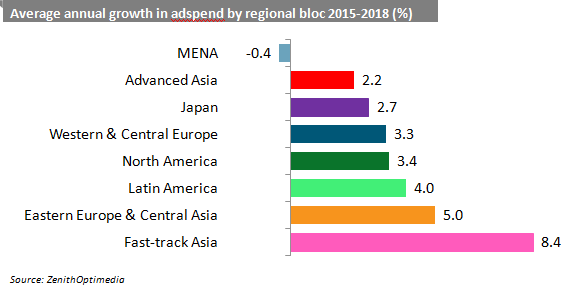
    It is not as easy as usual to divide the different blocs into groups with distinct growth rates. There are two stand out blocs: MENA at the bottom, with no growth between 2015 and 2018; and Fast-track Asia, with 8.4% annual growth. The other six vary fairly evenly from 2.2% annual growth to 5.0%.


    Forecast by leading advertising markets

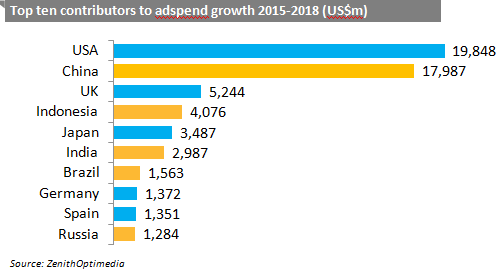
    Despite the rapid growth of the Rising Markets*, the US is still the biggest contributor of new ad dollars to the global market. Between 2015 and 2018 we expect the global ad market to grow by US$77 billion. The US will contribute 26% of this extra ad expenditure, closely followed by China, which will contribute 24%. The UK comes third, contributing 7%, and Indonesia fourth, contributing 5%.

    Five of the ten largest contributors will be Rising Markets, and between them they will contribute 36% of new adspend over the next three years. Overall, we forecast Rising Markets to contribute 54% of additional ad expenditure between 2015 and 2018, and to increase their share of the global market from 37% to 39%.
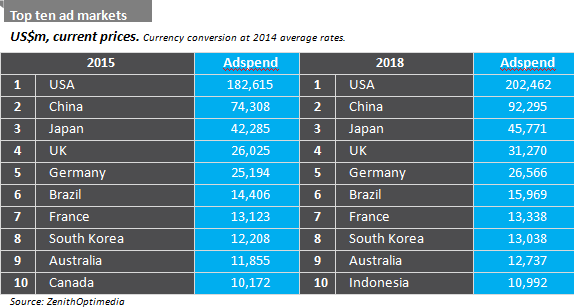
    The ranking of the world’s largest ad markets is currently very stable. The only change we expect between 2015 and 2018 is for Indonesia to displace Canada as the tenth-largest ad market.
    Global advertising expenditure by medium

    The internet is still the fastest growing medium by some distance. We forecast internet adspend will have grown 18% year on year by the end of 2015, and we forecast an average of 13% annual growth between 2015 and 2018. We estimate that the internet advertising will account for 29.0% of global ad expenditure across 2015, up from 25.5% in 2014. By 2018 we expect internet advertising to attract 36.6% of all global advertising, overtaking television for the first time to become the world’s largest advertising medium.

    Display is the fastest-growing internet sub-category, with 15% annual growth forecast to 2018. Here we include traditional display (such as banners), online video and social media. All three types of display have benefited from the transition to programmatic buying, which allows agencies to target audiences more efficiently and more effectively, with personalised creative. For traditional display this transition is slowing down, at least in the biggest markets, and we forecast average annual growth of 7% a year between 2015 and 2018. Online video and social media continue to grow much faster – we forecast annual growth of 20% and 22% respectively over the same period. The amount of time consumers spend watching online video is growing by 17% a year, and content producers are working hard to address the scarcity of premium content. Meanwhile social media is benefiting from its rapid transition to mobile and the introduction of new, engaging ad formats, such as Facebook’s full-screen Canvas ads.

    We expect paid search to grow at an average rate of 12% a year to 2018, driven by continued innovation from the search engines, such as personalising search results, automatically matching search terms to content available on advertiser websites, and enhancing local and real-time search. The latter including integrating advertiser data into search results to improve the customer experience – telling consumers how long it will take to walk to the advertiser’s stores, for example, and how long they can expect to wait to be served.

    Online classified has been subdued since the downturn in 2009; after the initial shift from print to digital, classified publishers have had to compete with new paid-for and free alternatives for matching buyers and sellers. We forecast average annual growth of 8% for the rest of our forecast period.

    Looking at internet adspend by device reveals the dramatic ascent of mobile advertising (by which we mean all internet ads delivered to smartphones and tablets, whether display, classified or search, and including in-app ads). We estimate mobile advertising will end 2015 up 71% year on year, and we forecast an average annual growth rate of 32% a year between 2015 and 2018, driven by the rapid spread of devices and improvements in user experiences. By contrast we forecast desktop internet advertising to grow at an average of just 1% a year.


    We estimate global expenditure on mobile advertising at US$50 billion in 2015, representing 31.5% of internet expenditure and 9.2% of total advertising expenditure (this total excludes a few markets where we don’t have a breakdown by medium). By 2018 we forecast mobile advertising to grow to US$114 billion, for the first time overtaking desktop, which will total US$113 billion. Mobile will account for 50.2% of internet expenditure and 18.4% of all expenditure.
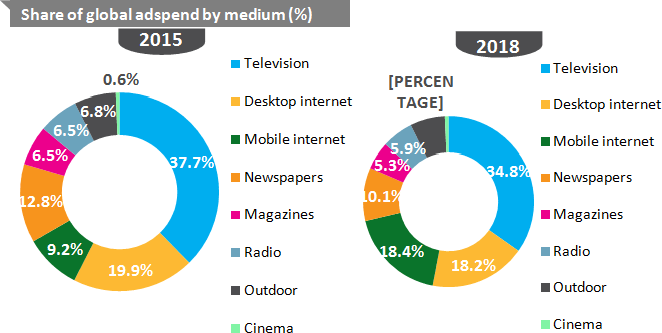
    Since it began in the mid-1990s, internet advertising (both desktop and mobile) has principally risen at the expense of print. Over the last ten years internet advertising has risen from 6% of total global spend in 2005 to 29% in 2015. Meanwhile newspapers’ share of global spend has fallen from 29% to 13%, while magazines’ has fallen from 13% to 7%. Print titles will continue to lose market share as their readership continues to decline, either move to online versions of print brands or other forms of information and entertainment entirely. We predict newspapers and magazines will continue to shrink, at average rates of 4% and 3% a year respectively, between 2015 and 2018, ending with respective 10% and 5% market shares.

    Note that our figures for newspapers and magazines include only advertising in printed editions of these publications, not on their websites, or in tablet editions or mobile apps, all of which are picked up in our internet category. The performance of print editions does not wholly describe the overall performance of newspaper and magazine publishers.

    Television is currently the dominant advertising medium, expected to attract 38% of total spend in 2015. As mentioned earlier, however, we now expect the internet to overtake television to become the largest medium in 2018. Looking at the ad market as a whole, including search and classified, we think television’s share peaked at 39.7% in 2012, estimate it at 37.7% in 2015, and expect it to fall back to 34.8% by 2018.

    However, one of the reasons for television’s loss of share is the rapid growth of paid search, which is essentially a direct response channel (together with classified), while television is the pre-eminent brand awareness channel. Television does not compete directly against search, and indeed the two can complement each other, for example by running paid search activity take advantage of the increase in searches driven by a television campaign. Taking internet classified and search out of the picture, television will remain the principal display medium for many years to come. We estimate television will account for 44.7% of display expenditure in 2015, and 42.9% in 2018.

    If we consider audiovisual advertising as a whole – television plus online video – we see that it is in fact gaining share of display advertising. Television offers unparalleled capacity to build reach, while online video offers pinpoint targeting and the potential for personalisation of marketing messages. Both are powerful tools for establishing brand awareness and associations. We estimate that audiovisual advertising will account for a record 48.4% of display advertising in 2015, up from 44.1% in 2010, and expect its share to reach 48.9% in 2018.

    Mobile is now the main driver of global adspend growth. We forecast mobile to contribute a full 87% of all the extra adspend between 2015 and 2018 (again excluding markets where we don’t have a breakdown by medium). Television and desktop internet will be the second and third-largest contributors respectively, accounting for 13% and 6% of new ad expenditure respectively. The gains made by outdoor, radio and cinema will be outweighed by the continued decline of newspapers and magazines, which we expect to shrink by a combined US$10 billion over the forecast period.


    Appendix


    List of countries included in the regional blocs

    North America: Canada, USA

    Western & Central Europe: Austria, Belgium, Bosnia & Herzegovina, Croatia, Czech Republic, Denmark, Finland, France, Germany, Greece, Hungary, Ireland, Italy, Netherlands, Norway, Poland, Portugal, Romania, Serbia, Slovakia, Slovenia, Spain, Sweden, Switzerland, UK

    Eastern Europe & Central Asia: Armenia, Azerbaijan, Belarus, Bulgaria, Estonia, Georgia, Kazakhstan, Latvia, Lithuania, Moldova, Russia, Turkey, Ukraine, Uzbekistan

    Japan

    Advanced Asia: Australia, Hong Kong, New Zealand, Singapore, South Korea

    Fast-track Asia: China, India, Indonesia, Malaysia, Pakistan, Philippines, Taiwan, Thailand, Vietnam

    Latin America: Argentina, Brazil, Chile, Colombia, Costa Rica, Ecuador, El Salvador, Mexico, Panama, Peru, Puerto Rico, Uruguay, Venezuela

    Middle East & North Africa: Bahrain, Egypt, Israel, Kuwait, Oman, Qatar, Saudi Arabia, UAE


    *We define Mature Markets as North America, Western Europe and Japan, and Rising Markets as everywhere else


    Advertising Expenditure Forecasts is published quarterly priced £495. It may be ordered in hard or soft copy from www.zenithoptimedia.com

     

  • Ajit Gurnani appointed Managing Partner at ZenithOptimedia

    By A Correspondent


    Ajit Gurnani

    ZenithOptimedia India has announced the appointment of Ajit Gurnani as Managing Partner and Branch Head, ZO West.


    Commenting on the appointment, Hari Krishnan, Managing Director, ZenithOptimedia India, says “We are delighted to announce this appointment. ZenithOptimedia is making rapid progress in Mumbai especially with its expanding new-age client list such as Faaso’s, Ziffy, TImesaverz and many others yet to be announced. We needed somebody with rich experience and robust background spanning both agency and client side experience. Ajit, with his experience across markets, clients and verticals was best suited for the role. It helps us to strengthen our offer to all our businesses and prospective clients.”


    Ajit has over 18 years of work experience in the fields of media, brand management and marketing. His media exposure has been with advertising agencies like HTA (now Mindshare / JWT), Rediffusion DY&R (TME), Mindshare and MEC on clients like Unilever, Colgate Palmolive, Aditya Birla Group (including Idea Cellular, Birla Sun Life, Ultratech etc), Mercedes Benz, Nivea, Zee TV & CarTrade. His client side exposure includes Marico Ltd as Media Manager, handling the company’s brands’ media strategy and investment as well as Head of Marketing (Beverages) for IFFCO in UAE where the role entailed demand generation, consumer and trade marketing and new product development acrosss the markets of UAE, GCC, Africa, Levant and other Middle East geographies and the ethnic Indian population in Canada and USA.


  • ZenithOptimedia wins media mandate of Truecaller

    By A Correspondent


    ZenithOptimedia has won the media mandate for Truecaller after a selection process that involved multiple agencies. This mandate covers all aspects of the company’s media planning & buying, and will include Digital and OOH duties as well.


    Truecaller is transforming the phonebook to make it more intelligent and useful. The app allows users to know who is calling them even if the person has not been listed in their contacts. Truecaller has grown phenomenally in India. Currently, at 80 million users in the country, the Indian user base comprises more than half the total global users.


    Kari Krishnamurthy, Vice President, Growth and Partnerships, Asia & Country Manager, India, said, “Truecaller has witnessed an accelerated growth in India, especially in the tier I markets. We were looking for media partners who have a deep understanding of the Consumer Internet space to help us establish strong media touchpoints in the tier II and III markets. ZenithOptimedia impressed us with their strategic framework and ability to execute with speed and accuracy.”


    Commenting on the win Hari Krishnan, Managing Director, ZenithOptimedia, said “This is a significant win for ZO in a sector that is fast growing and future facing. It is indeed a matter of pride for us to be partnering with Truecaller.”


  • ZO names Gareth Mulryan CEO for Southeast Asia

    By A Correspondent


    Gareth Mulran

    ZenithOptimedia announced the promotion of Gareth Mulryan, currently Head of Digital Asia Pacific, to CEO Southeast Asia.


    In this newly-created role, Gareth will work closely with Gerry Boyle, APAC Chairman, and the local market leaders to further develop ZenithOptimedia’s strong communications offering across the Southeast Asia region. Gareth will use his wealth of digital experience to transform and grow these markets over the coming years. He will be responsible of integrating digital specialists within market and will work closely with local and regional publishers and technology partners to create innovative solutions for clients.


    Gareth will also work with Felix Cartoux, Corporate Development Director, to build the ZenithOptimedia’s business in Southeast Asia through external growth opportunities on a local market basis.


    Gareth has been part of the ZenithOptimedia family for more than 10 years and has spent the last seven years in Asia. As well as leading ZenithOptimedia’s digital offering, he has been instrumental in the set-up of ZenithOptimedia’s performance arm, Performics across Asia Pacific.


    Over the last four years the Performics brand has grown significantly and now has 12 offices in the region with more than 300 members of staff. Gareth will continue to support in the growth of Performics in the role of Managing Partner, Asia Pacific.


    Announcing Gareth’s move, ZenithOptimedia’s Asia Pacific Chairman, Gerry Boyle said: “Gareth has done a simply brilliant job in building Performics across Asia. All our markets in SEA are in transformational mode, and Gareth’s digital nous and unswerving client focus will help our market leaders to deliver new solutions and success for our clients.


  • ZO sets up Centre of Excellence for media tech

    By A Correspondent


    Tanmay Mohanty

    ZenithOptimedia’s Performics announced setting up a full-fledged digital media technology Centre of Excellence, a first of its kind in India, out of their Bangalore office. This will provide capabilities on real time segmentation and insights, services across marketing automation, attribution, data modeling, content and commerce. The centre will specifically cater to the Indian sub-continent.

    Comments Tanmay Mohanty, MD Performics, India “This centre is set up to provide solutions for comprehensive and integrated marketing, that will enable marketers to measure, personalize, and optimize marketing campaigns and digital experiences across screens and platforms. As you would know, globally Publicis has partnered with Adobe for these ‘Always On Solutions’ that will power insights and data fuelled planning globally for Publicis. The preferred partnership between Performics India and Adobe is already gaining traction with customers such as Airtel and Tata AIG already migrating to Adobe Marketing Cloud. Many other organizations are showing similar interest.”


    Anupriya Acharya

    Anupriya Acharya, Group CEO ZenithOptimedia group, India elaborates, “This is something that we have been working on for some time and in our assessment, the time is ripe to set up a centre like this. Online video is seeing explosive growth thanks to the explosion of mobile video consumption and the spread of internet-connected devices like desktop computers, tablets and television screens. All key social media platforms are developing their video products; and more online video is being sold by programmatic buying, providing advertisers with more control and better value. We find that currently a lot of clients, especially in the e-commerce and mobile segment have to work with media technology companies that are outside of India and have a hard time getting the time and attention they require. Inside India we will be testing multiple technologies against client requirements.  Both our teams and clients are excited about it.”


    Kulmeet Bawa, Director – Enterprise, South Asia, Adobe says, “Top brands around the world across industry verticals use Adobe Marketing Cloud to reach and engage customers, and our partnerships go a long way in making this possible. We congratulate ZenithOptimedia’s Performics on the establishment of their first centre of excellence for media technologies in India and are certain that customers in India will benefit immensely from this set up.”