Tag: Zenith

  • Wavemaker India bolsters its north leadership team

    By Our Staff


    Dipika Bhasin
    Dipika Bhasin
    Jasmine Sachdeva
    Jasmine Sachdeva

    Wavemaker India has announced key appointments to further strengthen its North India leadership team. The agency has appointed Jasmine Sachdeva as Managing Partner and Dipika Bhasin as Head for Team Reckitt. Sachdeva joins Wavemaker from Zenith, but she has also spent a number of years in GroupM in the past. For Bhasin, on the other hand, this is the first stint in a GroupM agency. She was last with the Dentsu networ.


    In their new roles, both will be reporting to Shekhar Banerjee, Chief Client Officer and Office Head – West, North & East, Wavemaker India.


    Said Ajay Gupte, CEO – South Asia, Wavemaker: “Wavemaker India is currently on a strong growth trajectory. Our goal is to drive positive provocation within the industry and continue to expand our reach across the landscape. I am delighted to welcome two highly experienced leaders to take on critical roles within the organization and drive further growth. Their unwavering focus on clients and people development is truly commendable.”


    Added Banerjee: “I am excited to welcome Jasmine and Dipika to the Wavemaker family. Their impressive industry experience and diverse skill sets make them a valuable addition to our organization. We are confident that their expertise will contribute significantly to our ongoing efforts to drive innovation, excellence, and transformation for our clients. We look forward to achieving great success together.”


  • COMvergence releases New Business Barometer FY 2022 India report

    By Our Staff


    COMvergence an independent research and data consultancy, which analyses media spend investments and produces benchmark studies on new business performances, released its latest New Business Barometer for the FY 2022 for India.


    India saw a lower number of account moves and retentions this year of 246 with media spends estimated to be around $1.5BN as compared to a higher number of account moves in 2021 which were 332 with media spends estimated to be around $2.3BN


    In 2022, 66% of the total pitches held globally were local in nature ( country specific pitches) India was well above this average with 81%  of total pitches being local which is $1286M whereas global and multi- country pitches made up 19% of the pie with  $297M in 2022 for India.


    Mondelez ,Pepsico, ITC, Nestlé, Meesho, Lenovo, Hyundai-Kia, NPCI, Abbott Nutrition, Rebel foods, Truecaller were among some of the  account moves that dominated the Indian market in 2022.


    The Media Agency Groups were led by GroupM with a total new business value of +$332M, followed by Publicis Media Group at +$289M new business value and dentsu International with a new business value of +$194M respectively.


    Zenith from the Publicis Media Group stable and Wavemaker from the GroupM umbrella led the media agencies’ ranking, interestingly the 3rd rank was tied between Initiative,  Havas Media and Spark Foundry ( Publicis Media Group) followed by Madison Media and Carat.


  • No KitKat break. Zenith retains massive Nestle media biz

    By Our Staff


    There are some who would’ve hoped that Nestlé  India would practise what the adline of its bestselling brand Kit Kat preaches: ‘Life Hai. Kit Kat break banta hai’. But no such break in its Media AOR relationship. The Publicis Groupe-owned media agency Zenith India has been retained as Nestle’s agency of record. The business, notes a communique, was won in a highly competitive multi-agency pitch which began in April this year.


    Zenith has been handling Nestlé’s media planning and buying business, across all segments since all of 17 years. It was appointed as the packaged goods company’s AoR back in 2005. The mandate includes the full range of duties – that’s offline media, online media, commerce, SEO and analytics.


    Said Jai Lala, CEO of Zenith India: “We are delighted that Nestlé has once again chosen us as their media partner and it’s a clear endorsement of our strong ROI approach and ability to deliver marketing excellence and innovation. The retention is testament to the rock-solid working relationship we share with Nestlé and indeed we are proud of the industry-leading work we’ve produced for them over the course of many years. Zenith has deep and inherent understanding of Nestlé’s business needs and the strategic direction of its brands. Our teams were able to demonstrate unique insights, integrated approaches and data-driven decision -making. We look forward to harnessing the best of our capabilities, talent, technology and partnerships and helping Nestlé build even more powerful consumer connections.”


  • Tailored digital ads and ecommerce to drive 8% growth in OTC AdEx: Zenith


    By Our Staff


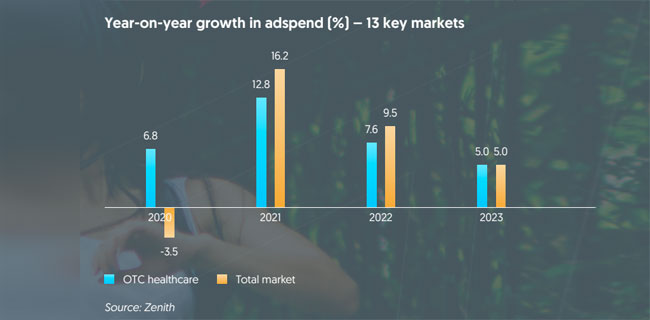
    Advertising expenditure by over-the-counter (OTC) healthcare brands in 13 key markets (including India) will expand by 7.6% in 2022 and 5.0% in 2023, according to Zenith’s new Business Intelligence – OTC Healthcare report, published today. This growth will be driven by tailored digital brand advertising, as well as performance advertising driving traffic to OTC ecommerce platforms.


    OTC advertising grew throughout the pandemic. OTC adspend expanded by 6.8% in 2020 while the market as a whole shrank by 3.5%, as healthcare messages soared in relevance for consumers. Demand for cold and flu remedies sank sharply as social distancing cut their transmission, but most other sub-categories continued to grow, and sales of sleep aids spiked. When the pandemic hit, brands in many categories cut back or even ceased their communications, concerned that their messaging was no longer appropriate, or in some cases counterproductive in the new context. This gave OTC brands the opportunity to use plentiful cheap media to reinforce their contribution to consumers’ health and wellbeing.


    “The continued shift to digital allows OTC brands to use smart segmentation and dynamic creative to market the same products to different people with different needs, within the framework of regulations for digital advertising in this category,” said Benoit Cacheux, Global Chief Digital Officer, Zenith. “The gym-goer with muscle ache, the office worker with a headache and the parent whose child has growing pains all need pain relief, but brands need to talk to them in different ways to persuade them most effectively. This ability to tailor the creative to the needs of the audience gives digital advertising an advantage that traditional media never had.”


    “The pandemic has focused consumers’ attention on their health and disrupted their reliance on traditional OTC distribution channels,” said Jonathan Barnard, Head of Forecasting, Zenith. “Brands will continue to step up their investment in digital advertising as the rise of ecommerce gives it a greater role in driving OTC sales and brand growth.”


    From the communique issued by Zenith:

    OTC advertising then rose a very healthy 12.8% in 2021, though in this case its growth was slightly behind the overall market, which had its lost ground to make up. Zenith forecasts growth in OTC advertising to remain healthy over the next two years, as brands defend their price premiums and ecommerce platforms compete to establish dominance.


    OTC has lagged some way behind the market as a whole in embracing ecommerce, but the lockdowns and other restrictions led to a leap in OTC ecommerce in 2020. Now that more consumers are aware of and comfortable with the option of shopping for OTC products online, it will become an ever more important sales channel over the next few years. This means traditional distributors such as pharmacies and supermarkets are facing new competition from digital ecommerce platforms, and brands have new opportunities to launch new partnerships or even direct-to-consumer ventures. The increased competition for traffic and sales will fuel continued growth in brand and performance advertising.


    Zenith forecasts that OTC healthcare adspend will grow from US$20.1bn in 2021 to US$22.7bn in 2023, 36% above pre-pandemic spending level of US$16.7bn in 2019.


    Shift to digital helps brands tailor messaging to consumers’ specific needs: When consumer first buy an OTC product, they often spend time researching the purchase and discussing it with family, friends and trusted advisors like pharmacists. However, after the first purchase, buying OTC products quickly becomes routine, part of the regular shop. The fundamental role of OTC advertising is therefore to maintain brand awareness at the point of purchase, much like FMCG advertising. Similarly, OTC healthcare makes heavy use of television for its high-impact mass reach. OTC advertisers spent 38% of their budgets on television advertising in 2021, compared to 21% for the average advertiser across all categories. OTC brands also spend more on radio and magazines – radio for its mass reach and magazines for their high impact.


    Until recently, it was difficult to use digital advertising to create emotional connections and lasting brand awareness. The rise of high-quality advertising environments, online video and retailer media – ads that appear on retail websites and ecommerce platforms – means brands can use digital to convey brand values effectively right through to the sale. Brands are also spending more on performance advertising as OTC ecommerce scales up.


    Zenith forecasts that OTC brands will increase their digital adspend at an average rate of 11% a year between 2021 and 2023, while radio grows by 5%, television by 3%, and magazines shrink by 3%. Digital will account for 49% of OTC advertising in 2023, up from 46% in 2021.


    *The 13 markets included in this report are Australia, Canada, China, France, Germany, India, Italy, Poland, Russia, Spain, Switzerland, UK and USA, which between them account for 74% of total global adspend. The report covers medicines and remedies sold over the counter, including cold and allergy remedies, contraception, digestion care, eye care, oral care, pain relief, skin care, sleep aids, stop-smoking aids and wound care.


  • Ecommerce and online video to fuel 11% recovery in global adspends: Zenith

    By Our Staff


    Global advertising expenditure will grow 11.2% in 2021, driven by exceptional demand for performance-led ecommerce advertising and brand advertising on online video, according to Zenith’s latest ‘Advertising Expenditure Forecasts’ report. Advertising expenditure will total US$669 billion this year, US$40 billion more than was spent before the pandemic in 2019.


    Growth in advertising expenditure is expected to remain robust in the medium term, with 6.9% growth forecast for 2022 and 5.6% for 2023.


    The coronavirus pandemic has accelerated the structural shift in the economy from bricks-and-mortar sales to ecommerce, driving more consumers than ever to research and complete purchases online. Brands have responded by forming partnerships with retailers and creating new direct-to-consumer operations, using performance-driven advertising – primarily in social media and paid search – to lead consumers down the path to purchase. Zenith forecasts that social media advertising will expand by 25% this year to reach US$137 billion, overtaking paid search in scale for the first time. Paid search will expand by 19% to reach US$135 billion.


    Much of this is new money to the ad market, coming from small businesses that have had to pivot rapidly to ecommerce to survive lockdowns, and from budgets that brands would previously have allocated to retailers to secure physical shelf-space, which they are now spending on display and search ads on retailer websites. The shift to ecommerce will slow down as coronavirus restrictions lift and economies open up again, but won’t go into reverse. Zenith expects ecommerce to continue to pull in incremental revenues to the ad market, driving 13% growth in social media and 12% growth in search in 2022.


    Audiences continue to migrate online, and online video viewing is growing rapidly, even as traditional television ratings shrink again after a one-off spike when lockdowns began in 2020. Advertisers value online video as a means of maintaining reach while television declines, but it’s an effective form of brand communication in its own right. Demand is strong, although the popularity of subscription-funded video-on-demand has helped limit the supply of high-quality online video available to advertisers. Zenith predicts that online video advertising will be the fastest-growing digital channel in 2021, rising by 26% to reach US$63 billion. Specific numbers for India have not been given by Zenith in this forecast.


    Said Benoit Cacheux, Global Chief Digital Officer at Zenith: “The online video landscape continues to transform, fuelled by the growth of streaming services and connected TVs. Its continued evolution requires a radical rethink of how to build the optimal screen-neutral reach model. The ingestion of new data sources into TV planning also creates further opportunities to further sync TV and video planning.”


    Social media and online video have eclipsed traditional static display, which is forecast to shrink by 15% this year, while online classified grows by just 4%. Overall, Zenith expects digital advertising to grow by 19% in 2021, and increase its share of total adspend to 58%, up from 48% in 2019 and 54% in 2020.


    Most other media are enjoying growth this year, as spending rebounds from the 16% drop in traditional media adspend in 2020. Cinema and out-of-home were the worst affected by Covid-related restrictions, shrinking by 72% and 28% respectively, and will enjoy the fastest recovery in 2021, with respective growth rates of 116% and 16%. Radio advertising, which shrank by 22% in 2020, is forecast to grow by 4% in 2021, while television fell 8% in 2020 and is forecast to grow 1% in 2021. Print will continue its long decline, now in its 14th consecutive year, with an 8% drop in adspend in 2021. In 2023 adspend in all these media will still be below 2019 levels, though cinema and out-of-home will have made up almost all of their lost ground.


    Limited supply and rising demand are stoking media inflation

    This year’s rapid recovery in adspend, coupled with the continued migration of audiences from traditional to digital channels, is fuelling substantial increases in media prices, particularly in television. The cost of television advertising is up 5% this year on average, though the variance between markets and audiences is wide. Television spend is up by 1%, so the volume of audiences reached globally is shrinking. Digital media growth, in contrast, is mainly driven by rising audiences and more extensive monetisation, with online video inflation averaging 7%, and social media roughly flat, compared to their 26% and 25% respective adspend growth rates.


    US to add nearly half of all new ad dollars

    All regions will enjoy robust adspend growth in 2021, ranging from 9% in Asia Pacific to 15% in the Middle East and North Africa, which is recovering from the steepest decline in 2020, of 21%. The strongest underlying growth since 2019 is taking place in North America, which is forecast to grow by 13% this year despite shrinking by only 1% last year. Growth in North America is being driven by the very rapid pace of digital transformation in its industries, as well as strong investment in connected TV and advertising-funded video-on-demand.


    The US will be by far the largest contributor to global growth in 2021, accounting for 46% of the US$67 billion added to the global ad market this year, followed by China with 11%, and Japan and the UK with 6% each.


    “After a very tough year last year, the ad market is enjoying rapid and broad-based recovery, and will end this year well above the level it achieved in 2019,” added Jonathan Barnard, Head of Forecasting at Zenith. “Digital advertising is becoming a more effective tool for brand growth as media and commerce continue to move online, attracting greater investment from large brands and small businesses alike.”

  • Zenith wins Mamaearth media account

    By Our Staff


    Mamaearth, the digital-first brand, has awarded its media business to Zenith following a multi-agency pitch. As a part of the mandate, Zenith will handle the entire gamut of media planning for Mamaearth, including brand strategy, planning, buying and implementation.


    Commenting on the business win, Jai Lala, CEO, Zenith, said: “Mamaearth is committed to its consumers and keeping its brand idea and ethos intact, we at Zenith aim to deliver a focused consumer-driven 360-degree media approach. With our unique ROI plus and digital-first practice, we intend to help the brand reach its business goals in the FMCG category in the market.”
    Speaking on the media partnership, Sambit Dash, Vice President Marketing, Mamaearth added: “As we grow, we are constantly looking to reach out to more and more millennials in India and have meaningful conversations with them about our products and our belief of “Goodness Inside. We have chosen Zenith as our media agency partner because we believe they understand the media landscape as well as our philosophy very well. Zenith will help us achieve our goals by identifying the right media mix and expedite the next step of our growth journey.”

  • Alcohol adspend to beat market with 5.3% growth in 2021 as hospitality opens up

    By Our Staff


    The Zenith’s Business Intelligence – Alcohol: Beer + Spirits has published its report. Alcohol adspend to rise from US$6.7bn in 2020 to US$7.7bn in 2023. Alcohol brands spend twice as much on television as the average brand, but will reduce their spending by 2.4% a year as audiences continue to shrink. Spirits brands have pivoted rapidly to owned online content, to help consumers replicate the brand experience – normally the main driver of sales growth – at home


    According to the report, digital advertising to account for 30% of alcohol adspend in 2023, up from 21% in 2019. Alcohol adspend in 12 key markets will grow by 5.3% in 2021, ahead of the 4.9% growth of the ad market as a whole, as brands recover from a much steeper drop in 2020. Alcohol advertising will then grow roughly in line with the market, with 4%-5% annual growth in 2022 and 2023.


    The pandemic has forced the alcohol brand experience to move online.


    Said Ben Lukawski, Global Chief Strategy Officer, Zenith: “Spirit brands have surpassed beer brands in terms of sales value by offering more premium experiences and rituals around their product and serve,” “With the pandemic taking audiences away from the on-trade we have seen a greater emphasis on bringing these premium experiences in home through owned digital content.”


    Consumers are now much more aware of the available options for buying alcohol online, and alcohol brands now have distribution networks in place to supply them. Zenith expects brands to expand their digital advertising to support alcohol ecommerce even after pubs and restaurants are fully open, fuelling 9.2% annual growth in digital adspend between 2019 and 2023, when digital advertising will account for 30% of alcohol advertising budgets.


    Zenith predicts alcohol brands will reduce their expenditure on television by 2.4% a year to 2023, compared to the 2019 baseline, as traditional broadcast audiences continue to shrink. Out-of-home advertising, by contrast, will grow by 1.1% a year, even taking into account the pandemic-induced reduction in foot and road traffic. Television’s declining reach makes out-of-home’s ubiquity even more valuable.


    Alcohol advertising to recover from 2020 decline by 2023


    Alcohol advertising shrank nearly twice as fast as the overall ad market in 2020, falling by 11.6% compared to 6.4% of the market as a whole, Brand finances were squeezed by reductions in consumption volume, the average price per drink, and profit margins. With bars, pubs and restaurants closed, consumers drank less alcohol, and bought the drinks they did consume from shops where they cost less, with a much lower mark-up. Brands cut back their marketing sharply to protect their bottom lines, and their combined adspend fell from US$7.6bn in 2019 to US$6.7bn in 2020.


  • FMCG adspend expanding by 14% a year in India: Zenith

    By Our Staff


    Media agency network Zenith has forecast that fast-moving consumer goods (FMCG) food and drink brands will increase their ad expenditure on digital channels by 7% a year to 2023, according to its Business Intelligence – FMCG Food and Drink report, published on Monday. That’s well ahead of the 4% annual growth forecasts for FMCG adspend as a whole in the 12 markets included in this report.


    Zenith has forecast that India will be the fastest-growing market by some distance over the next three years, with FMCG adspend expanding by 14% a year. It will benefit from blossoming consumer demand as disposable incomes rise rapidly, coupled with the catch-up expansion of the underdeveloped ad market: advertising accounts for only 0.3% of India’s GDP, less than half of the global average of 0.7%. All of the other markets in the report are predicted to grow steadily at between 2% and 5% a year.


    Said Jai Lala, CEO, Zenith India: “FMCG growth will continue to be robust considering various reasons. Firstly, despite the pandemic, it is one category where the demand is constant, if not seen increasing. Secondly, with evolving consumer demand, FMCG continues to see a slate of new product launches and category expansion. Lastly, with the vast population being in Tier 2 and rural areas – it is one untapped potential market where the FMCG brands continue to increase penetration.”


    Meanwhile, FMCG brands still rely heavily on traditional TV, spending 39% of their budgets on television advertising in 2020, compared to 24% for the average brand. Excluding China, where FMCG brands have already adopted digital advertising as their main form of commercial communication, FMCG brands spent 52% of their budgets in television, compared to an average of 26%. Their principal goal is to maximise brand awareness and reach so they are front of mind at the point of purchase for as many consumers as possible. This is something that TV has historically excelled at, but its declining reach – particularly among the young – is making it less effective.


    “FMCG brands need a new comprehensive approach to reach-based planning,” added Ben Lukawski, Global Chief Strategy Officer, Zenith. “That means combining TV, paid advertising in online video, virtual placement in SVOD platforms and perhaps even a presence in gaming, using first-party and second-party data to prevent duplication and optimise incremental reach.”


    FMCG brands are therefore following audiences to digital channels. Zenith forecasts that FMCG digital adspend will increase from US$12.3bn in 2020 to US$14.9bn in 2023, and that its market share will rise from 46% to 49%. After the pandemic gave FMCG ecommerce its urgent stimulus in 2020, brands will look to support and expand their ecommerce capabilities, channelling consumers to DTC operations or retail partnerships. But the big challenge will lie in using digital to replace television effectively – creating large-scale brand awareness while managing frequency. The rise of Subscription Video on Demand (SVOD), which locks away high-value audiences from direct advertising, will make this even harder, as will the end of third-party cookies.


    Out-of-home is the exception to the declining reach of traditional media. As traffic returns to normal after the COVID-19 slump, the spread of digital displays will make it even more effective at reaching consumers with targeted and relevant ads near the point of sale. FMCG out-of-home advertising is forecast to grow by 9% a year from 2020 to 2023, while its market share rises from 6.1% to 7.0%, slightly ahead of its pre-pandemic share of 6.8% in 2019.


    Ad expenditure by FMCG brands fell more sharply than the ad market as a whole in 2020, shrinking by 10.7% to US$26.7bn. This was not because of any shortfall in demand. On the contrary, demand soared as people stopped eating in restaurants, cafes and bars and shifted consumption to the home. Instead, FMCG companies were faced with the challenge of ramping up production while supply chains were disrupted, and using limited available distribution to get their products onto shelves in stores, or to consumers’ homes. Many FMCG companies therefore cut back on promotional activity for products they couldn’t get to consumers quickly enough to satisfy demand, and invested in distribution infrastructure instead, especially ecommerce operations and partnerships.


    Zenith forecasts that the recovery of FMCG adspend will roughly track the market as a whole in 2021-2023. A bounce-back is almost inevitable in 2021 given the comparison with the sharp drop-off in 2020, particularly during Q2, though it will still be 6% below 2019 levels. FMCG companies face uncertainty over how quickly consumers will return to shops, and how much their behaviours have been permanently affected by the pandemic. However, now that FMCG ecommerce infrastructure is being put in place, brands will need to increase their investment in advertising to support it. Zenith forecasts 4.4% annual growth in FMCG adspend between 2020 and 2023, reaching US$30.3bn in 2023. At this point it will have fully recovered from the pandemic-induced drop in adspend, exceeding 2019 levels of spending by US$0.5bn.


    China stands out as the market where brands have most rapidly embraced ecommerce and digital advertising. In 2020, Chinese FMCG brands spent 71% of their budgets on digital advertising, compared to 46% across all 12 markets. Here, these brands focus on online video, which has a high and broad reach, and is open to commercial partnerships. This can mean advertising in online shows, or special livestreams by influencers, in which viewers can directly purchase the items being demonstrated. They also routinely advertise on ecommerce platforms to drive sales at the point of purchase. Chinese FMCG brands spent 35% of their total budgets on online video and 13% on ecommerce advertising in 2020.


    “Ecommerce will be the key battleground for FMCG brand growth over the coming years,” said Jonathan Barnard, Head of Forecasting, Zenith. “Western brands should look to China for best practice in using digital communication to drive FMCG ecommerce sales.”


    *The 12 markets included in this report are Australia, Canada, China, France, Germany, India, Italy, Russia, Spain, Switzerland, the UK and the US, which between them account for 73% of total global adspend. FMCG food and drink includes all packaged foods and soft drinks.


  • With 11% annual growth, India will be fastest telecom adspends market: Zenith


    By Our Staff


    Zenith forecasts that India will be the fastest-growing market for telecom advertising between 2020 and 2023 by some distance, with 11% annual growth. According to eMarketer, only 31% of the population currently has a smartphone, but thanks to the launch of low-price handsets such as the JioPhone, this proportion is rising rapidly.


    Said Jai Lala, COO, Zenith India: “The telecom sector in India in 2021 is anticipating a robust growth on the basis of an increase in tariff pricing, demand for data, growing number of mobile users and hopefully the launch of 5G in the last quarter. This will lead to a substantial increase in media investments by the key players especially on Television & Digital”.


    Overall, Zenith predicts that telecoms advertising will grow at an average rate of 4.5% a year to 2023 as its recovers from an 8.7% decline in 2020. According to Zenith’s Business Intelligence – Telecommunications report, telecom adspend in the 12 key markets included in the report will rise from US$17.8bn in 2020 to US$18.7bn in 2021, and then return to its pre-pandemic level of US$19.5bn in 2022. The 12 markets included in this report are Australia, Canada, China, France, Germany, India, Italy, Russia, Spain, Switzerland, the UK and the US, which between them account for 73% of total global adspend. Telecoms is defined as services and equipment facilitating the transmission of voice calls and data by land lines and mobile networks.


    Smartphone sales will start to spring back this year once consumers feel more confident in their future. Consumers are becoming more willing to finance and purchase handsets independently from their network providers, giving manufacturers and retailers a greater incentive to advertise handsets themselves. Meanwhile, the networks will seek to recoup their investment in 5G licences and infrastructure through new services and more expensive data packages. All these trends will help fuel healthy growth in telecoms advertising over the next three years. Zenith predicts telecoms adspend will grow 4.7% in 2021, 4.4% in 2022 and 4.3% in 2023.


    Digital platforms help telecoms brands demonstrate relevance to exacting consumers

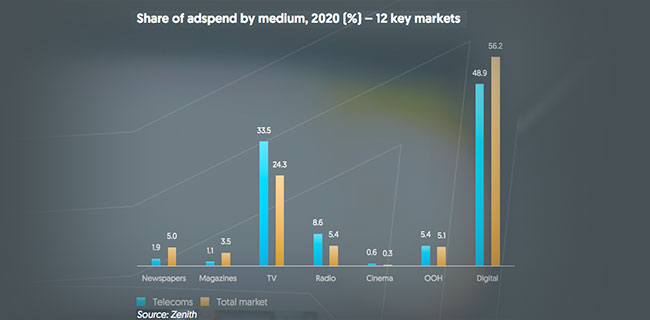
    Voice and data services are commoditised and functionally indistinguishable to consumers, who expect them to work flawlessly in the background and only pay attention to them when they go wrong. High-impact advertising in mass-audience media like television and radio allows telecoms companies to differentiate themselves from others through branding, and makes them more relevant to consumers by promoting their association with things consumers are passionate about, such as entertainment, sport and music. Telecoms brands therefore spend substantially more on television and radio advertising than the average brand – in 2020 they spent 42% of their budgets on television and radio, while the average brand spent 30%.


    But as audiences migrate online, telecoms companies are refocusing on communicating their brand narratives to mass digital audiences. Telecoms brands spend less on digital media than average (49% of their budgets went to digital channels in 2020, compared to 56% for the average advertiser), but digital advertising is also the only channel in which telecoms adspend is increasing. Zenith forecasts that telecoms brands will increase their digital adspend at an average rate of 5% a year between 2019 and 2023. By 2023, digital advertising will account for 54% of all telecoms advertising.


    “Covid-19 has demonstrated how dependent we are on good, fast and reliable internet connections. Telecoms companies have been the unsung heroes of the pandemic, shifting our lives online and keeping us connected to entertainment, work and commerce,” said Ben Lukawski, Global Chief Strategy Officer, Zenith. “Their challenge is to go from being unsung to being acknowledged and appreciated for their efforts. The spread of 5G and the reality of our new-found virtual lives give telecom brands the opportunity to move into the limelight.”


    Telecoms brands are cutting back their spending on traditional television and radio as their reach declines, but less rapidly than brands in most other categories. Zenith forecasts that between 2019 and 2023, telecoms brands will reduce their television adspend by an average of 2.0% a year, compared to a 3.5% annual reduction across all categories. They will also reduce their radio adspend by 2.8% a year, compared to 4.1% a year for the market as a whole.


    Russia as well

    Russia is another market with relatively low (57%) but fast-growing smartphone penetration, and here telecoms adspend is forecast to rise rapidly too, by 8% a year.


    Most of the other markets in this report are forecast to grow by between 3% and 6% a year to 2023. The exception will be France, not because of any inherent weakness in demand, but unlike those in most markets, French telecoms brands actually increased spending in 2020 – by 6% – in response to the extra demand for data. The basis of comparison with 2023 is therefore considerably tougher.


    “The rollout of 5G services will allow mobile operators to supply bundled voice, data and entertainment services to the home and compete directly with landline broadband,” said Jonathan Barnard, Head of Forecast, Zenith. “This will spur greater competition to put together the most attractive services at the best prices and help stimulate a sustained recovery in telecoms adspend to at least 2023.”


    .


  • Adspend is now forecast to shrink 7.5% in 2020, compared to July’s 9.1% forecast: Zenith

    By A Correspondent


    The global ad market has recovered more rapidly than expected from the severe slump in Q2 caused by the coronavirus pandemic and is now forecast to shrink by 7.5% to US$587bn across 2020 as a whole, according to Zenith’s Advertising Expenditure Forecasts, published today. This is a marked improvement on Zenith’s forecast of a 9.1% decline in July.


    Zenith predicts that global adspend will grow by 5.6% to US$620bn in 2021, boosted by the favourable comparison with 2020, as well as the delayed Summer Olympics and UEFA Euro football tournament. Despite this bump, spending will remain below the US$634bn spent in 2019. In 2022, adspend will grow by 5.2% to reach US$652bn, exceeding 2019 by US$18bn, though it will be about US$70bn lower than it would have been if it had remained on its pre-pandemic track.


    These forecasts assume that the global economy will start a sustained recovery as Covid-19 vaccines are introduced in 2021, and are subject to the wide uncertainty over how rapid this recovery will be.


    Zenith predicts that global digital adspend will rise 1.4% in 2020, and increase its share of total adspend to 52%, up from 48% in 2019. The pandemic has forced brands to step up their digital transformation, as ecommerce has proved a vital tool for maintaining relationships with existing customers, mitigating the loss of in-store sales, and even finding new customers. Euromonitor International forecasts that ecommerce sales will increase 25% this year, while in-store sales drop by 5%. Brands have increased their spending on digital media to promote and drive traffic to their own ecommerce operations and to retailer partners. Search and social media, up 8% and 14% respectively, have proved particularly useful for these purposes.


    The growth of ecommerce is not expected to reverse once the world starts to recover from the coronavirus pandemic. Now that brands have proved the value of digital transformation under stress, they are likely to press ahead with it enthusiastically, devoting even more of their budgets to digital advertising. Zenith forecasts that digital advertising will account for 58% of global adspend by 2023.


    Advertising on connected TV is compensating for the rise of SVOD: Consumers’ viewing habits have been evolving for years, but 2020 saw a real step change as online video platforms benefited from a long-term boost to awareness and demand. Forced to spend much more time at home, consumers flocked to existing SVOD platforms like Netflix, which added 25 million new subscribers in the first half of the year, and new ones like Disney+, which achieved its five-year growth target in just nine months.


    Importantly for advertisers, who are locked out of SVOD platforms, demand for ad-funded video on demand (AVOD) has been even stronger, especially on connected TV sets. Between January and April 2020, the reach of SVOD services on connected TV in the US rose by 5%, but the reach of AVOD services rose by 9% to 58.5 million households, or 48% of the total1.


    AVOD combines the premium viewing environment of television with the data-fuelled targeting capabilities of digital advertising. It offers high ad recall, and high reach among young audiences that are hard to find on traditional TV. As it continues to grow over the next few years it will counterbalance the loss of audiences to SVOD and help fuel an average of 8.4% annual growth in online video adspend between 2020 and 2023.


    “Now that it offers mass reach in key markets, it’s the right time for brands to invest in connected TV,” said Christian Lee, Global Managing Director at Zenith. “Brands should use connected TV for both branding and performance, exploiting its high ad recall and full targeting and tracking capabilities to drive awareness and sales conversions at the same time.”


    Retailer media is diverting commercial budgets to advertising: The spike in ecommerce this year fuelled rapid growth in demand for retailer media – display or search ads that appear on retailer platforms and direct users to products available for purchase there. This is a well-established channel in China but is relatively new elsewhere. By promoting products at the point of purchase, it acts more like in-store displays than traditional above-the-line advertising, and brands commonly pay for it from commercial budgets set aside for negotiating with retailers, rather than from marketing budgets. It can therefore grow without cannibalising existing ad expenditure. Amazon is the main supplier of retailer media outside China, and its revenues grew by more than 40% year-on-year every quarter in 2020.


    Retailer media has huge potential for growth globally, given that its market share outside China (3%) was less than a sixth of its market share in China (19%) last year. Zenith estimates advertisers spent US$35bn on retailer media in 2019, and will spend US$51bn in 2020, up 46% year on year.


    “Retail platforms are powering their growth by putting pressure on brand margins. Their focus on bottom out price wars, and enhanced consumer experiences, benefit consumers while brands bear the cost,” said Ali Nehme, Global Chief Commerce Officer, Publicis Groupe. “In this scenario, brands must flex their own power, by selecting retailer partners who offer demonstrable value through transparent data and measurement, as well as the ability to deliver the consumers who will drive much needed category growth.”


    Asia Pacific and Central & Eastern Europe to lead recovery: Adspend is forecast to bounce back to 2019 levels in 2021 in both Asia Pacific and Central & Eastern Europe. The successful containment of Covid-19 infections in many Asia Pacific markets has limited the economic damage and prepared the region for rapid recovery in 2021. Countries in Central & Eastern Europe have generally suffered more, but their ad markets are less developed – accounting for 0.4% of GDP compared to 0.7% in Asia Pacific – and they have a faster underlying growth rate. Zenith forecasts adspend in both regions to shrink by 6% in 2020 and grow by 7% in 2021.


    North America has fared better than any other region this year and is forecast to shrink by just 5.3% in 2020, but that’s partly owing to very heavy political spending in the run-up to the US Presidential election. The absence of political adspend will make the comparison look tougher for 2021, when Zenith forecasts just 3.3% growth. Adspend will then grow by 4.5% in 2022, which is when North America will return to pre-pandemic levels of spending.


    Western Europe, Latin America and the Middle East & North Africa (MENA) are all forecast to shrink by 12.3%, 13.8% and 20.0% respectively this year. Of these, Zenith expects the quickest recovery from Latin America, another underdeveloped advertising region with the fastest long-term growth rate of the three, which will overtake 2019 spending levels in 2022. Mature Western Europe will not return to 2019 levels of spending until 2023. MENA has been shrinking for years as a result of conflict, political instability and volatile oil prices, which the pandemic has only exacerbated. Zenith forecasts that adspend in MENA will still be 4.1% lower in 2023 than it was in 2019.


    “The global ad market has been recovering from its Q2 nadir throughout the rest of this year,” added Jonathan Barnard, Zenith’s Head of Forecasting. “The prospect of multiple effective vaccines gives us confidence that adspend growth will continue in 2021 and beyond, returning the market to 2019 levels in 2022.”




  • Video ent brands in India will spend 19% more in 2022: Zenith

    By A Correspondent


    Media agency network Zenith forecasts that in 2022, video entertainment brands are forecast to spend 19% more in India. Yes, that’s two years from now. Video entertainment advertising will shrink by just 0.2% in 2020 across ten key markets this year*, according to its Business Intelligence – Video Entertainment report, published today (Monday). Video entertainment adspend will far outperform the ad market as a whole, which will drop by 8.7% across these same markets.


    Spain and India to lead growth in video entertainment adspend

    The stable headline figures for growth hide considerable variation between the 10 markets. In 2022, video entertainment brands are forecast to spend 27% more than in 2019 in Spain, and 19% more in India, as mentioned earlier. Meanwhile, spending is expected to decline by 5% in the US and 7% in Australia over the same period.


    Spain and India both have fast-growing appetites for video-on-demand, especially on smartphones in India. India’s television ad market also enjoys rapid long-term growth – unlike in most Western countries – and should bounce back quickly in 2021.


    The US is the only market where video entertainment adspend is expected to continue to decline after 2020, as rising online revenues fail to compensate for the ongoing declines in TV advertising and pay-TV subscriptions, reducing available ad budgets. The video industry is healthier in Australia, but here the ad market as a whole is retrenching after the sudden halt to Australia’s 29 years of unbroken economic growth, so video brands can maintain share of voice without raising budgets.


    Said Jonathan Barnard, Zenith’s Head of Forecasting: “Consumers are currently benefiting from a generous supply of video content from brands vying for their loyalty. This competition is providing a large boost to video entertainment adspend this year. But this level of investment in both content and advertising will prove difficult to sustain for the long-term, and we forecast very little growth in 2021 and 2022.”


    The remarkable resilience of video entertainment adspend in this year of a global pandemic and subsequent recession is the result of increased demand from consumers, increased supply of content, and intense competition among video brands for viewers.


    Faced with spending much more time at home, consumers turned to video content to keep themselves informed and entertained. In France, for example, TV viewing time was 30% higher year-on-year in April, and was still 11% higher in August. Meanwhile online video platforms have invested huge sums in creating content to attract new viewers, forcing traditional broadcasters to up their game.


    Adspend by online video brands has far outpaced traditional television recently. In the US, online video brands increased their ad budgets by 142% in 2019, while television brands increased their spending by 15%. In the UK, adspend by online video platforms increased by 79%, while adspend by traditional television grew 34%. In both markets, television broadcasters and pay-TV platforms pushed up spending temporarily in response to their new competition, but this will prove unsustainable in the face of ongoing decline in their revenues, both COVID-19-related and structural. Meanwhile online video platforms have continued to raise their budgets as they seek to exploit the current window of opportunity to build a loyal customer base. Each platform is spending heavily to ensure that they are top of mind while consumers consider which ones to commit to for the long term.


    “Consumers are now faced with a vast and confusing array of programmes and films vying for their attention,” said Christian Lee, Global Managing Director, Zenith. “Video brands need to cut through this complexity and give consumers entertainment that matches their personal preferences with minimum fuss. Brands that provide compelling experiences and act as more than just repositories of content will be best positioned for growth in the long term.”


    Lockdown has made digital even more vital to video brands

    Video entertainment brands spend more on digital advertising, out-of-home and cinema than the average brand. Their reliance on out-of-home and cinema has posed a particular challenge this year, as they have been forced to compensate for lost audiences from empty cities and closed cinemas. This means even more digital spending, which is forecast to rise from 53% of total video entertainment spend in 2019 to 57% in 2020.


    Video entertainment adspend to exceed 2019 peak by 1.2% in 2022

    While video entertainment is expected to substantially outperform the market in 2020, Zenith forecasts it to underperform over the next two years, with no growth in 2021 and 1.3% growth in 2022. Online video platforms will have less capacity to raise budgets after spending heavily in 2020, and traditional TV broadcasters will be weighed down by shrinking revenues from TV advertising and pay-TV subscriptions. Nevertheless, Zenith expects video entertainment adspend to be 1.2% higher in 2022 than it was in 2019, while overall advertising will still be 0.6% below its 2019 peak.


    * Video entertainment refers to long-form video content, supplied either by conventional television or online, including free TV, pay-TV and online video-on-demand platforms. The markets included in this survey are Australia, Canada, Germany, India, Italy, Russia, Spain, Switzerland, the UK and US, which collectively account for 57% of all global adspend.


  • Zenith launches global culture initiative on Blue Monday

    By A Correspondent


    On January 21, Zenith encouraged more than 6,000 employees across the network to participate in team-building activities that promote good causes and benefit their community. Each Zenith office selected a charity or organization to support. The highlights include helping with the construction of a library, transforming slums into thriving areas, teaching adults with learning disabilities, delivering free coffee and snacks to underappreciated civil workers and collecting leftover food to redistribute to those in need.


    The idea to transform Blue Monday into Zenith Monday stemmed from an agency-wide competition. To celebrate Zenith’s 30th anniversary this past October, a global contest ‘If I were CEO for a day’ asked employees to come up with ideas on how they want to see Zenith evolve. Zenith Mexico won with their idea of Zenith Monday.


    Said Matt James, Global Brand President, Zenith: “At Zenith, we believe in giving back to the communities that support us. By transforming a day of sadness, our brilliant specialists are creating one small way to send positive thinking and acting around our global network.”