Zenith has bagged the media duties of Welspun India’s domestic business. The business was won following a rigorous multi-agency pitch. The mandate includes media investment and strategic partnership across print, television and radio.
Tanmay Mohanty
Said Tanmay Mohanty, Group CEO, Zenith India: “Welspun Group is one of India’s fastest growing conglomerates and we are pleased to be chosen as the strategic partner for the domestic business of Welspun India. Zenith brings in powerful, integrated communications at scale and we look forward to harnessing our rich capabilities in tech, data, content and analytics for them. We were able to demonstrate a strong understanding of Welspun’s consumers and how we can exceed their business objectives. Zenith looks forward to making a real difference to the Welspun brand, and will cement and support their expansion plans.â€
Zenith has won the media duties of India’s leading Jeanswear brand Spykar. The business was won as part of a competitive multi-agency pitch. Said Tanmay Mohanty, Group CEO, Zenith India: “We couldn’t be more thrilled to partner with Spykar which is India’s own home-grown contemporary jeanswear brand and needs no introduction.  Our ROI-focused approach will drive maximum business growth for Spykar, on the back of strong tech, analytics, content and consumer- centric insights. This win is testament to our scale and ability to bring in astute media strategies for powerful, integrated brand campaigns.â€
Added Sanjay Vakharia, CEO, Spykar:  “Spykar has been India’s leading denim brand for 25 years. Great product coupled with widespread distribution has given us exemplary growth. In the last 3 years, our revenues have doubled. This has encouraged us to pursue aggressive growth plans and we were looking for a partner who can help  us in achieving our goals. We have selected Zenith after a comprehensive pitch process. They have dived deeply into our business and impressed us with their vision and proficiency in delivering effective, data-driven, personalised plans.  Lifestyle clothing is a dynamic, high-growth business and we are sure that Zenith’s strategic insights  will unlock new opportunities for us. Their culture of innovation is akin to our own and we look forward to working with them.â€
Zenith has been selected as the agency of record (AOR) for HDFC Life. This is for the entire traditional media mandate. The digital duties already lay with the agency’s Performics.Resultrix division.
Said Tanmay Mohanty, Group CEO, Zenith India:“This win is a matter of great pride for us and an extension of our existing, very fruitful digital relationship with HDFC Life. Our teams were able to demonstrate an effective ROI-focused, data-driven approach to media. Zenith’s strong suite of tools, proprietary research and analytics will unlock new consumer connections for HDFC Life and will deliver on seamless, integrated communications.â€
Added Pankaj Gupta, Chief Marketing Officer & Executive Vice President, Strategic Alliances, Bancassurance & Specialty Sales, HDFC Life: “We are happy to associate with Zenith and believe that it would be an exciting partnership, since Zenith’s view on the brand mirrors that of ours. Zenith exhibited fresh thinking and insights on the life insurance category during the pitch. Hope that through its forward-thinking and disruptive approach, Zenith would help us stay ahead of the curve in a dynamic media environment; thereby, deepening our market presence and highlighting our customer-centric value proposition.”
The spread of mobile devices and rapid mobile data networks has transformed global media consumption in recent years. As much as 24% of all media consumption across the world will be mobile this year, up from just 5% in 2011, according to Zenith’s Media Consumption Forecasts 2018, published today (May 30). “By 2020 we expect this proportion to reach 28% as the mobile internet takes share from almost all other media. The rise of mobile is also forcing brands to transform the way they plan their communications across media, focusing less on channels and more on consumer mind-set as the distinctions between channels are eroded,†the report adds.
This is the fourth annual edition of the Media Consumption Forecasts, which surveys changing patterns of media consumption since 2011, and forecasts how the amount of time people allocate to different media will change between 2018 and 2020, in 63 countries across the world.
The rise of mobile
Mobile internet use has eroded the consumption of almost all other media. Newspapers and magazines have lost the most. Zenith estimates that between 2011 and 2018 time spent reading them has fallen by 45% for newspapers and 56% for magazines. However, this refers only to time spent reading printed publications. Time spent reading newspapers and magazines online is included in the internet total, and for many publications the time they have gained online more than makes up for the time they have lost from print.
Television channels and radio stations have gained audiences online but they have faced stiff competition from native digital platforms such as YouTube and Spotify.
From channel to mind-set
The rise of mobile has blurred the boundaries between different channels: it can be used for entertainment, news, information, research, socialising and communication. For brands it can play the role of building awareness, creating direct responses, allowing one-to-one communication, or generating earned content, depending on how the consumer is using the device, and in particular their mind-set while using it.
A consumer who is actively searching for specific information is in a very different mind-set from one who is sharing holiday photos with friends, or leaning back and enjoying a video. Brands need to understand the signals a consumer’s activity provides about their mind-set, and therefore what forms of communication are appropriate.
Focusing on mindset also dissolves the distinction between traditional and digital media: it’s more important that a consumer is reading news, than whether they are doing so using a printed newspaper or newspaper websites. People who are watching video content on television sets, laptops or smartphones have much in common, though people watching long-form entertainment can have quite different mind-sets from people scrolling short-form content on social media. Brands need to decide the role each platform plays in their communications strategies,however the consumer happens to access it.
Media consumption continues to grow
The rapid expansion of mobile internet use has increased the amount of time the average individual spends consuming media, by giving people access to essentially unlimited content almost everywhere, and at any time of the day. “We estimate that the average person will spend 479 minutes a day consuming media this year, 12% more than in 2011. We forecast the total to reach 492 minutes a day in 2020,â€Â the report adds.
Time spent at the cinema actually increased 3% between 2011 and 2018 as cinema owners have invested in more screens and a better experience for visitors, while studios have marketed their films more effectively at international audiences.On average, though, people spend much less time at the cinema than they do with any other medium – just 1.7 minutes a day in 2018. We expect this to rise to 1.9 minutes in 2020.
“Under traditional definitions, all other media are losing out to the mobile internet,†said Jonathan Barnard, Zenith’s Head of Forecasting and Director of Global Intelligence. “But the truth is that the distinctions between media are becoming less important, and mobile technology offers publishers and brands more opportunities to reach consumers than ever.â€
Added Tanmay Mohanty, Group CEO, Zenith India: “The mobile medium continues to accelerate in India and across the world, blurring lines on channels and delivering sharp ROI for brands. The mobile handset is powerful, personal and immersive and India holds steadfast as one of the top smartphone markets. The media consumption forecast reveals that brands have huge opportunities that they can leverage across mediums and the mobile phone is in many ways, a facilitator. Smart targeting is possible through artificial intelligence (AI), data and ad technology, mapping the consumer effectively across media touch-points. Brands can benefit from visible, tangible returns, once they understand the consumer mind-set and journey and their place in it.â€
Zenith has published a special edition of its data & insights publication, Global Intelligence, focused on eight key areas of focus for marketers over the coming year. Called 2018 The Year Ahead, builds on Zenith’s previous annual trends reports, this year acknowledging that many areas of real opportunity for marketers have been developing over the past couple of years.
Zentih has clustered these areas of emerging of opportunity and focus under four headings:
Trust:Â Brand communication in a post-truth world and Blockchain driving trust and transparency
Inclusivity: Brand purpose in an era of social protest and Rethinking targeting: the rise of perennial marketing
Immediacy: On-demand brand experience and AI powering consumer engagement
Seamless Interaction: Shopping from live-stream content and The impact of voice technology
Said Tanmay Mohanty, Group CEO, Zenith India: “There is a rapid shift in the pace of consumers and business dynamics over the last few years and Zenith stands at the forefront of Industrial Revolution 4.0, leading the way in automation, machine learning and data-driven advanced communications. [The] Global Intelligence: 2018 The Year Ahead report provides a comprehensive summary on consumer and tech trends. The report strongly reflects our thought leadership and will no doubt arm marketers in times of great disruption, opportunity and seismic change. Brands that win will be the ones that offset powerful triggers and bring in moving experiences.â€
The Post-Truth World: From Fake News to News Clean-up
Predictions for 2017
The concept of post-truth has been in existence for decades, but there was a huge spike in fake and fabricated news in 2016 resulting in ‘post-truth’ being declared as the ‘International Word of the Year’ by Oxford Dictionary. In 2017, we entered the post-truth era. Following the vote for Brexit and the election of Donald Trump as US President, we are now living in a world where emotion and populism win out over facts and experts. It’s a place where public opinions and government policies are being shaped by those whose words provoke the most hysteria. What happened in 2017? The continuation of intense and pervasive social media activity amplified post-truth in 2017. The rise of ‘fake news’ was facilitated by social media platforms such as Facebook and Twitter – 62% of Americans now regard social media platforms as places where they consume news, rather than place where they are directed to new sources. This means that vast audiences are at the mercy of Facebook’s algorithm, serving them news from like-minded viewpoints. Confirmation bias – interpreting new evidence as confirmation of one’s existing beliefs – has driven the click-by-click spread of fake news and misguided information. So, it is no surprise that trolls and other unscrupulous individuals are taking advantage of the ease of which they can distribute fake news to further their agendas, including turning it into a money-making business with the distribution of sensational fake news.
What’s next?
The reality is the world is neither ready nor willing to say goodbye to truth. But the popular opinion now is somehow being easily swayed by emotionally charged rhetoric and fake news having no factual basis. It requires deliberate action to drive social scrutiny and to encourage people to be more focused on evidence and rational thinking.
In 2018, we can expect more scrutiny and vigilance to expose organisations to reveal the truth and curb those hustlers from distributing fake news. Google and the other social media networks are starting to take action to stop the fake news distributors from using their services to target specific audiences. For example, Google announced in November 2017 that sites that misrepresent themselves would no longer be able to use AdSense and in the same month, Facebook said the fake news sites would not be able to use the Facebook Audience Network. Unless strong regulations are in place, we believe this news clean-up will still continue to be a challenge in 2018.
What does this mean for marketers?
The rise of fake news has had a major impact on the biggest global media platforms, such as Google, Facebook and Twitter. The organisations generating fake news have been leveraging social and video platforms and search engines to optimise their distribution and content consumption. This has increased the likelihood of advertising content from legitimate advertisers being featured close to fake news, which, in turn, can generate significant negative PR for a brand. The importance of brand safety for all advertisers came up time and time again last year and the continued rise of fake news should put this topic at the top of any marketer’s agenda.
We believe advertisers should do the following:
:: Build a strict set of guidelines for brand safety outlining how brands should be able to block any type of exposure in non-brand safe environments with a clear compensation policy, should any issue arise.
:: Implement 3rd party brand safety tools to cover all advertising likely to be affected by brand safety issues. The recent additions of Fake News blocker by DoubleVerify is a valuable development allowing advertisers to block exposure on Fake News websites with more than 75 brand safety filters.
:: Reduce advertising in areas where 3rd party brand safety tools are not able to operate and provide the relevant brand safety controls.
:: Implement comprehensive white lists to control where ads appear.
:: Work closely with global platforms to help them improve safety controls on their platforms. • Conduct regular reviews of where your ads feature.
So what is an essentially account retention move doing as the lead story on MxMIndia today? Because one, it’s our biggest story of the day. And two, we are committed to tracking the media agency business beyond just news on movements. But, most importantly, it means a lot for Zenith (earlier called Zenith Optimedia)… it is Zenith’s biggest account in India, estimated to be in the region of Rs 650 crore annually.
India is #4 in the Top 10 contributors to global adspend growth 2017-2020. But that’s perhaps the only statistic that indicates ‘achche din’ for adspends. India, btw, is not in the Top 10 adspend markets. Neither in 2017, and not even in 2020. But that’s a headline you’ll possibly read elsewhere. Let’s examine the real thing.
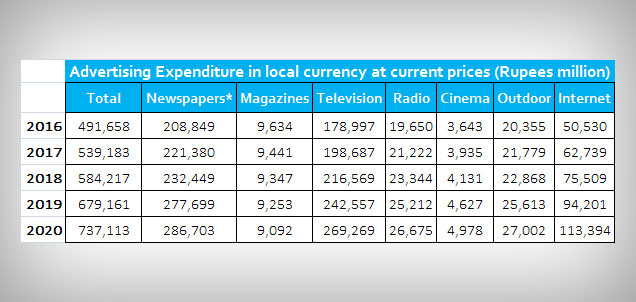
First, take a closer look at the table above. Total adspends, according to Zenith, were Rs 491,658 million in 2016, Rs 539,183mn in 2017 and the forecast for 2018 is 584,217mn. Since we are still in early December 2017, one presumes the 2017 number of 539,183 is an estimate. But given that number, the adspend growth is 9.7% as compared to the forecast of 11.2% made last year. The forecast for 2018 is 8.4%, even lower than the estimated growth for 2017.
Yes, you read it right. Zenith (eka Zenith Optimedia) believes that adspends will grow 8.4% next year in comparison to 9.7% this year. Remember, we are supposed to have seen the worst of the worst in 2017 given demonetisation last November and GST just ahead of the festive season. So why the not-so-achche din in 2018?
Here’s what a communique says: Year 2017 will close atRs 53,918 crore, registering a slightly slower pace of growth is on account of demonetisation introduced in November 2016. Total AdEx for India will climb up to Rs58,422 crore, growing  at 8.4% in 2018, led by television. Growth rate for television is pegged at 9% while newspapers will grow at 5%. Radio will grow at 10%, while cinema and out of home will grow at 5% respectively.
Tanmay Mohanty
Said Tanmay Mohanty, Group CEO, Zenith India: “Growing Internet penetration accelerated by operators such as Jiowill significantly enhance digital adspends in India and give access to previously untapped markets. India has seen some fluidity in overall ad-expenditure but remains one of the fastest growing advertising markets globally. With the dust settling down on demonetisation and GST, we expect a measured recovery on ad spends. Consumer confidence is definitely on the rise. In 2018, mobile handsets, FMCG, automobiles, BFSI, travel and tourism and political ads will drive up the pace on adspends.â€
Here’s more from the communique we received:
Amid growing debate as to whether brands are overspending on digital media, Zenith research has found that the effectiveness of internet advertising has now caught up with digital adspend.
Until 2015, brands struggled to make effective use of internet advertising, and their spend was not matched by the resulting ‘brand experience’(an accurate proxy of market share*). However, by 2016 internet advertising accounted for 34% of global ad budgets but produced 35% of brand experience.Internet advertising is now therefore working harder than advertising in other media.
For many years Zenith’s Advertising Expenditure Forecasts reports have consistently reported sizeable increases in the internet share of advertising budgets. The December 2017 edition of the report is published today. For the first time Zenith has been able to demonstrate the ROI of internet adspend, not just its scale. We used our proprietary Touchpoints ROI Tracker tool to compare internet adspend to internet brand experience over the past few years.
In 2014 advertisers spent 27% of their budgets on internet advertising, which produced only 21% of brand experience. By 2015, though, brands were using internet advertising more effectively: it accounted for 30% of both budgets and paid brand experience, before tipping over in 2016, when brand experience exceeded budget share.
We expect internet advertising’s share of global adspend to continue to rise, reaching 40% in 2018 and 44% in 2020. Its value will rise from US$203bn in 2017 to US$225bn in 2020. The share of advertising expenditure allocated to internet advertising varies widely across the world. In the most advanced markets (Sweden and the UK) it will account for more than 60% of total expenditure next year, and it will account for between 50% and 60% in another six (Australia, Canada, China, Denmark, Norway and Taiwan).
India is placed No 4 in the Top 10 contributors to global adspend growth 2017-2020.
India follows USA, China and Indonesia in that order. (See executive summary)
Between 2017 and 2020 we forecast global advertising expenditure to increase by US$72 billion in total. The US will contribute 27% of this extra ad expenditure and China will contribute 20%, followed by Indonesia, India, the UK and Japan, which will contribute 4% each.
Five of the ten largest contributors will be Rising Markets* (China, Indonesia, India, Brazil and Russia), and between them they will contribute 33% of new adspend over the next three years. Overall, we forecast Rising Markets to contribute 54% of additional ad expenditure between 2017 and 2020, and to increase their share of the global market from 37% to 39%.
In India, internet adspend will capture 11.6% of the market in 2017. India is therefore a leading digital market/keeping pace with global developments/has a lot of scope for growth in internet advertising. We forecast 20.4 % growth in internet advertising in India in 2018, compared to 8.4% growth for the market as a whole. By 2020, internet will account for 15.4% of total adspend in India.
The rise of the internet has had huge consequences for the other media, which are covered in detail in the executive summary.
Big platforms are capturing digital growth
The internet is driving the great majority of global growth in advertising – it will account for 94% of the growth in adspend between 2017 and 2020. And most of this will be captured by just five big platforms – Google and Facebook, plus the Chinese platforms Baidu, Alibaba and Tencent. Between them these five platforms increased their share of global internet adspend from 61% to 72% between 2014 and 2016, and captured 83% of the growth in internet adspend over that time. Baidu, Alibaba and Tencent accounted for 54% of the growth in internet adspend in China, while Google and Facebook accounted for 96% of the growth in internet adspend in the rest of the world. Between them Google and Facebook accounted for 76% of internet adspend outside China in 2016.
Big countries are adding most ad dollars
In dollar terms, most of the growth in global adspend is coming from a few big markets. We forecast that just two countries – the US and China – will contribute 47% of new ad dollars between 2017 and 2020. The five biggest markets – the US, China, Japan, the UK and Germany – will contribute 57%.
Big cities are driving global adspend growth
Big cities are driving global adspend by concentrating growth in productivity, innovation and trade. We have conducted a unique study that attributes adspend to individual cities by estimating the value of their inhabitants to local, national and international advertisers. We forecast that the top 10 cities alone will contribute 12% of all global adspend growth this year, and that the top 725 will contribute 60%.
We predict that between 2016 and 2019, adspend in the 10 biggest-contributing cities will grow by a total of US$7.5bn, representing 11% of growth over these years. These ten cities will be, in descending order: New York (where adspend will grow by US$1.4bn), Tokyo, Jakarta, Los Angeles, Shanghai, Houston, Dallas, Beijing, London and Chicago (which will grow by US$0.6bn).
Advertisers feel the pressure from digital transformation and polarisation of growth
Advertisers are feeling pressure from the rapid transformation of their businesses, exemplified by the rapid shift of marketing communications to online media in response to changing consumer behaviour, and the polarisation of growth to big platforms, big countries and big cities. At the end of November we conducted the third in our series of exclusive surveys about brand growth among key Zenith clients. On a scale from 0 to 100 – where 0 means everyone expects decline in 2018, 100 means everyone expects growth, and 50 means the average expectation is for no growth – the average response was 57, down from 67 this time last year. Food and drink brands have been the least affected, with a score of 66 this year, down just a point from 67 last year. Packaged goods, retail and telecom brands have all fallen to 50, expecting no growth, down from positive scores last year.
“We are seeing a battle played out in business, marketing and media between big players and small players,†said Vittorio Bonori, Zenith’s Global Brand President. “Growth is coming from big countries and big cities, and being captured by big platforms. Brands should focus on upstream strategy, data-informed UX planning and downstream automationâ€.
“Internet advertising is the biggest advertising medium in the world and the biggest driver of growth,†said Jonathan Barnard, Head of Forecasting and Director of Global Intelligence at Zenith. “Our unique research shows that brands are starting to use it effectively after struggling to adapt over the last few years.â€
*Brand experience is a combination of two factors: reach (how likely consumers are to encounter brand messages at eachtouchpoint) and influence (how likely each message is to consumer attitudes or behaviour). It covers all touchpoints across paid, owned and earned media, but because we were comparing it to advertising expenditure, here we measured only the brand experience of paid media.
Touch points ROI Tracker is Publicis Media’s brand contact measurement and planning tool, based on more than 950,000 consumer interviews since 2004.
The campaign urged consumers to break free from popular trends and display their original, unique selves. They could post on an activity which sets them apart from popular trends. The gratification lay in the fact that Maggi Hotheads made people trend on Twitter.
Tanmay Mohanty
Said Tanmay Mohanty, Group CEO, Zenith India: “We are delighted to be at the forefront of this innovative and exciting campaign.  #UntrendLikeHotHeads hits the mark because it is fun, quirky, engaging and resonates with the Indian youth. There is an instant connect with the Maggi  Hotheads brand, also known for its distinct positioning and taste. The campaign is a resounding success. It has sparked off viral conversations, amplified brand messaging, and generated rich insights. #Untrend has significantly added to the followership and popularity of Maggi  Hotheads.â€
Added Taranjeet Singh, Country Director, Twitter India: “Our endeavour has always been to create enriching experiences for brands to connect with their fans on Twitter. Nestle’s #UntrendLikeHotHeads is a breakthrough idea, the collaboration saw extraordinary participation on the platform and enabled Maggi to be what’s happening on Twitter. We look forward to working closely to be part of more of such creative, strategic partnerships.â€
Zenith has won the media duties of the air purifier line of business of Honeywell.
Tanmay Mohanty
Said Tanmay Mohanty, Group CEO, Zenith India: “We are delighted to have won the business of Honeywell and look forward to driving market leadership for them. The company with its 80 year old lineage is no stranger to India and the Honeywell air purifier is a product that is unique and unparalleled. Zenith is an agency that embraces both technology and invention. Our ROI+ approach with advanced communications models and strong focus on personalisation and automation will further fuel Honeywell’s expansion plans across all the right markets and touch-points. Our pulse on the Indian consumer and new insights on the category have helped us win this business. This is a significant addition to our client roster.â€
As part of a global multi-agency pitch, Zenith has won the media duties of French dairy giant Lactalis.
Zenith now handles the business in 26 countries, which includes India. Lactailis is better known as the world’s largest cheese company and is into assorted dairy products including milk.
Tanmay Mohanty
Said Tanmay Mohanty, Group CEO, Zenith India: “We are pleased to have won the business of Lactalis, a renowned global name in dairy products. The company shares our values, ambition and drive. Lactalis has a long-term vision for the Indian market; it stands for quality products and we would love to partner with them in building this category and market leadership. Our newly launched ROI+ proposition with advanced communications models and sharper focus on analytics, tech, data and consumer insights will take Lactalis even further in a high growth Indian dairy market. This win adds tempo to a great year where we have won significant businesses and consolidated operations.â€
Media agency network Zenith has unveiled a new global approach to communications, supported by a relaunch of its brand identity, proposition and platforms. Led by Zenith’s Global Brand President, Vittorio Bonori, the move carries forward Zenith’s ROI Agency positioning in 2002.
Called ROI+, the new approach is designed to solve business challenges though advanced communications models, notes a communique, adding:“The approach has three key client benefits. First is the creation of ‘upstream’ strategies that deliver greater ROI through business transformation. Second is a focus on the full consumer journey in order to design personalised communication at scale. And third is maximising ‘downstream’ efficiencies through market-leading automation, such as machine learning. “
Said Vittorio Bonori, Global Brand President, Zenith: “We have a vision for delivering transformational growth for our clients and this required a new way of working that embraces both technology and invention. I believe that Zenith’s new proposition and brand identity builds on our distinctive ROI positioning and sets us further apart from the competition.â€
Added Tanmay Mohanty, Group CEO, Zenith India: “Our first pillar is our ability to create upstream strategies that deliver business transformation. For example, in ad-tech consulting, our upstream strategic development is greatly enhanced through ROI+. Second is our focus on the full consumer journey to deliver more effective communications strategies. And third is our market leading approach to maximising downstream efficiencies. ROI+ enables us to apply sophisticated automation through AI and machine learning techniques.â€
Zenith, part of Publicis Media India, has strengthened its organisational structure and announced three senior-level hires.
Atul Sharma has joined Zenith as Senior Vice President in New Delhi and will be the business head for SBU that includes Nestle, Truecaller, Yatra, Hotels.com and others. Love Guglani has come on board as Senior Vice President for Zenith, based again in New Delhi, to lead the other SBU for Cargill, LVMH, Jabong, Micromax, Hennes & Mauritz (H&M), Aviva amongst others. And the third hire is Swati Jha. She has joined Zenith as Senior Vice President to head the agency’s West India operations and will be based in Mumbai.
Tanmay Mohanty
Said Tanmay Mohanty, Group CEO, Zenith India: “Our best-in-class data, tools, insights and strategy have led to a high pitch win rate and great performance on existing businesses. We are pleased to announce these three senior-level hires for Zenith who will help us upscale our operations, in line with our accelerated growth and momentum. I look forward to our new appointees bringing in fresh vigour, enthusiasm and passion to the organisation and embracing Zenith’s unique and highly differentiated offering.â€
In India, Zenith’s key clients include Nestle, Parle Products,  Micromax, LVMH Group, Toyota, Bombay Dyeing, H&M , Singapore Tourism Board, Fox Networks, BASF and Singapore Airlines among others. Through Peformics.Resultrix, we handle digital duties on Airtel, ICICI Bank, Star India, Birla Sun Life Insurance, Tata AIG General Insurance, AirVistara among others.