Tag: Zenith India

  • India Shining, in Adspend Growth Projections


    By Our Staff


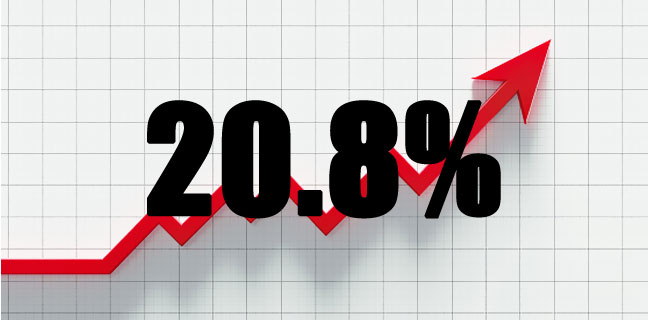
    India is in fifth place of adspends, accounting for 4.6% of the growth this year, even though it is only the twelfth-largest ad market. India will be the fastest-growing market in percentage terms, expanding by 20.8%, driven by election advertising and the resumption of festivals that were cancelled at the height of the pandemic.

     

    Jai Lala
    Jai Lala

    Said Jai Lala, CEO, Zenith India: “India continues to have a robust AdEx growth on the back of Digital and TV. Key categories continue to be led by FMCG and the new app-based clients in the area of Fintech, Edutech, Foodtech amongst others.”


    Global adspend is forecast to increase by US$58 billion in 2022, rising to US$781 billion from US$723 billion in 2021. Most of the new ad dollars will come from the US, which is forecast to expand by US$33 billion in 2022, driven by continued, rapid digital transformation, accounting for 57% of all the money added to the ad market this year. China, Japan, and the UK come next, supplying 9.1%, 6.2%, and 5.8% of new ad dollars, respectively.


    Global advertising expenditure is forecast to grow 8.0% in 2022, according to Zenith’s latest Advertising Expenditure Forecasts report, published today (June 8). This represents a minor downgrade from the 9.1% growth rate Zenith published in December 2021. Growth will be supported by the Winter Olympics, mid-term US elections and soccer World Cup, which for the first time will take place in the most advertising-intensive period of the year in the run-up to Christmas. Faced with this tough comparison, growth will slow to 5.4% in 2023, before the Summer Olympics and US presidential elections help boost it to 7.6% in 2024.


    Zenith’s forecasts for North America, MENA and Western Europe this year are unchanged at 12%, 7% and 6% growth respectively. Latin America was downgraded slightly from 9% to 8%, but Asia Pacific was upgraded from 6% to 7%, thanks to a very strong performance from India. Severe disruption in Russia and its closest trading partners after the invasion of Ukraine will lead to a 26% decline in adspend in Central & Eastern Europe, even though most other markets in the region will continue to grow.


    Adspend has remained on track despite the macroeconomic headwinds that emerged this year. High inflation, concentrated in essentials like heating, petrol, and food, is forcing consumers to reprioritise their spending, particularly the less well-off, and has led to a drop in consumer confidence. But for now, consumer spending continues to grow, as consumers demonstrate their strong appetite for the travel and entertainment experiences that were denied to them over the pandemic. Business confidence is generally high, and corporate investment is rising, and there is little evidence of widespread cost-cutting.


    Higher prices in traditional channels accelerate shift to digital alternatives

    The sustained growth in demand from advertisers is pushing up media inflation, particularly in television, where the supply of audiences is falling steadily as viewers switch to alternatives. Price rises vary widely for different audiences in different countries, but the global average cost of television advertising across all audiences is expected to rise by 11%-13% this year. Online video prices are expected to increase by about 7%, although in this case the supply of audiences is rising. Other digital channels where supply is climbing and volumes are flexible are inflating only modestly, with 3% average price rises forecast for social media and other digital display. Out-of-home and radio prices will go up about 4% this year, while print prices will remain stable, because demand for advertising in printed publications is falling as rapidly as readership.


    Brands that simply buy broad audiences to achieve reach targets will not be able to avoid having to spend more to reach the same audiences. But brands that use first-party data to identify their most profitable customers, and combine it with third-party data to target their best prospects in the most efficient channels, will be able to mitigate much of the effect of media inflation. The huge and growing volume of digital content consumption is making it more effective for brands to scale by aggregating digital audiences. Zenith predicts 62% of ad budgets will be spent on digital media in 2022, up from 59% in 2021, and that this proportion will reach 65% in 2024.


    “In a world where trading is becoming dominated by auctions, competitive advantage is achieved not by scale, but by data,” said Ben Lukawski, Global Chief Strategy Officer, Zenith. “Inflation will hit cheap reach buyers hard, but brands that make smart use of their data will manage costs and grow their business at the same time.”


    Online video overtakes social media as the fastest-growing channel for the first time in past decade

    Online video is now predicted to be the fastest-growing channel over the next three years: Zenith forecasts it will grow 15.4% a year on average between 2021 and 2024, driven by the rapid development of connected TV, ad-funded video-on-demand, streaming and other video formats. Connected TV is now a mainstream video platform in the US, with a higher penetration than cable TV, and is becoming established in other markets, especially in Western Europe and Asia Pacific. The introduction of cheaper ad-funded tiers by SVOD services like Netflix and Disney+ will boost growth further by providing new high-quality environments for brand communication. Mixed video-on-demand models that combined subscriptions with advertising will also help online video audiences continue to grow across the world by recruiting consumers unwilling or unable to afford the growing roster of subscription-only services. Zenith expects online video adspend to rise from US$62 billion in 2021 to US$95 billion in 2024.


    Online video will overtake social media, the fastest-growing channel for the previous nine years. Social media adspend (which includes video ads in social media feeds) is still forecast to grow at an average rate of 15.1% a year between 2021 and 2024, propelled by rising competition among platforms that is driving continued innovation on formats and closer integration with commerce. Meta’s share of social media adspend outside China has been falling steadily since it peaked at 89% in 2019, reaching 85% in 2021 as TikTok, Snapchat, LinkedIn and Pinterest gained market share. Zenith forecasts social media adspend will rise from US$153 billion in 2021 to US$187 billion in 2022, when it will account for 25% of expenditure on advertising across all media.


    Cinema and out-of-home will take third and fourth place among the fastest-growing media, averaging 11.9% and 8.0% annual growth between 2021 and 2024 respectively. These are still recovering from the deep losses they suffered in 2020 and 2021 when cinemas were closed, and consumers were confined indoors. Cinema and out-of-home have a lot of ground to make up, however, and are taking their time to do so. Many brands that were forced to find alternatives, often digital, have found them effective, and see little need to shift their budgets back again. Zenith expects cinema adspend to reach US$3.9 billion in 2024, well below its pre-pandemic level of US$4.8 billion in 2019, while out-of-home will reach US$45.0 billion in 2024, exceeding the US$42.3 billion it achieved in 2019 for the first time.


    Linear television advertising is forecast to grow by 1.1% a year on average between 2021 and 2024, from US$173.6 billion to US$179.2 billion, as price rises continue to compensate for loss of audiences. This ongoing decline in reach and efficiency will drive brands to digital channels, however, including online video. Television’s share of total adspend is forecast to fall from 24.6% in 2021 to 20.8% in 2024, while online video’s share increases from 8.8% to 11.1%.


    “Online video is growing by creating new opportunities for building brand awareness, complemented by social media’s capacity for cost-effective targeting with low barriers to entry,” said Jonathan Barnard, Head of Forecasting, Zenith. “Online video is steadily narrowing the spending gap with television, and will be half as large as television by 2024.”


     

  • No KitKat break. Zenith retains massive Nestle media biz

    By Our Staff


    There are some who would’ve hoped that Nestlé  India would practise what the adline of its bestselling brand Kit Kat preaches: ‘Life Hai. Kit Kat break banta hai’. But no such break in its Media AOR relationship. The Publicis Groupe-owned media agency Zenith India has been retained as Nestle’s agency of record. The business, notes a communique, was won in a highly competitive multi-agency pitch which began in April this year.


    Zenith has been handling Nestlé’s media planning and buying business, across all segments since all of 17 years. It was appointed as the packaged goods company’s AoR back in 2005. The mandate includes the full range of duties – that’s offline media, online media, commerce, SEO and analytics.


    Said Jai Lala, CEO of Zenith India: “We are delighted that Nestlé has once again chosen us as their media partner and it’s a clear endorsement of our strong ROI approach and ability to deliver marketing excellence and innovation. The retention is testament to the rock-solid working relationship we share with Nestlé and indeed we are proud of the industry-leading work we’ve produced for them over the course of many years. Zenith has deep and inherent understanding of Nestlé’s business needs and the strategic direction of its brands. Our teams were able to demonstrate unique insights, integrated approaches and data-driven decision -making. We look forward to harnessing the best of our capabilities, talent, technology and partnerships and helping Nestlé build even more powerful consumer connections.”


  • Zenith wins Zoomcar mandate

    By Our Staff


    Zenith, Publicis Groupe agency, has been awarded the media mandate for Zoomcar, the car sharing platform. Zenith India has won the mandate after a successful multi-agency pitch. As a part of the mandate, Zenith will handle the entire gamut of media planning including brand strategy, media buying and implementation. The scope of work will be ROI-driven with data analytics as its core. Through this association Zenith expects to help expand Zoomcar as a brand to a larger audience and build a strong media presence in the market.


    Jai Lala
    Jai Lala

    Commenting on the business win, Jai Lala, CEO, Zenith India said: “In a progressing market, we aim to give the best data analytics experience to our clients. We are delighted to have partnered with Zoomcar, the world’s largest emerging market focused car sharing platform. Our ROI led strategic media approach will aid to company’s growth in India.”


    Speaking on the partnership, Nirmal NR, CEO, Zoomcar India added: “We are happy to partner with Zenith to help bolster our marketing strategies in India. We look forward to a fruitful association and believe that the agency with its innovative ideas and inherent data analytics, media planning and buying knowledge will help with our business growth”


  • Zenith appoints Priyanka Kapur as Vice President

    By Our Staff


    Priyanka Kapur
    Priyanka Kapur

    Zenith India has appointed Priyanka Kapur as Vice President to lead its Nestlé business. She will be responsible for media planning, relationship management and supervising the complete and integrated offering for the client. Her key focus will be on strategy, digital transformation, data, analytics, implementation and buying.


    A postgraduate from NMIMS, Kapur has over 18 years of rich experience in media and marketing. Her last assignment was with Lodestar UM for almost 10 years as Connections Lead for its key client Coca-Cola. Her role involved spearheading the strategic planning product across portfolio brands and in crafting solutions, connecting brands to consumers. She was also responsible for research, insights and staying updated on the latest consumer trends and building them seamlessly into  solutions for brands.


    Announcing the appointment, Jai Lala, CEO, Zenith India said: “I am delighted to have Priyanka on-board.  Priyanka’s diverse work experience in the field of media and strategic approach towards the  business will help provide impactful and effective solutions to our clients, in an evolving media landscape.”


    Added Kapur: “I am really excited about Zenith’s unique ROI plus and digital-first approach that delivers maximum business results for clients. Also, I am delighted to be part of  Publicis Groupe and look forward to the PowerOfOne advantage.”


  • Linu John joins MotoCorp business at Publicis Media

    By Our Staff


    Linu John
    Linu John

    Publicis Media has announced the appointment of Linu John as head at Platform HMCL. Platform HMCL is built to cater integrated media offerings for its client Hero MotoCorp. The unit consists of a team that manages media planning and buying, along with providing dynamic content, analytics, data, activation, performance and programmatic solutions.


    Said Jai Lala, CEO, Zenith India: “Platform HMCL aims to deliver strong business outcome and grow brand impact. Given the dynamic nature of media environment it will be crucial to continue driving experimental solutions backed by data, technology and analytics to provide business outcomes. Known for her extensive skill sets and experience, we are confident that Linu will lead the mandate by concentrating on integrated planning, business growth of HMC and digital transformation for HMCL.”


    Added John: “Being agile in learning helps people to evolve in life and overcome difficult situations. It’s the mantra that helps me to be competitive and impactful. With the same aim, I join the Hero MotoCorp business at Publicis Media. I look forward to expanding Platform HMCL capabilities and drive high momentum for the business.”


  • With 11% annual growth, India will be fastest telecom adspends market: Zenith


    By Our Staff


    Zenith forecasts that India will be the fastest-growing market for telecom advertising between 2020 and 2023 by some distance, with 11% annual growth. According to eMarketer, only 31% of the population currently has a smartphone, but thanks to the launch of low-price handsets such as the JioPhone, this proportion is rising rapidly.


    Said Jai Lala, COO, Zenith India: “The telecom sector in India in 2021 is anticipating a robust growth on the basis of an increase in tariff pricing, demand for data, growing number of mobile users and hopefully the launch of 5G in the last quarter. This will lead to a substantial increase in media investments by the key players especially on Television & Digital”.


    Overall, Zenith predicts that telecoms advertising will grow at an average rate of 4.5% a year to 2023 as its recovers from an 8.7% decline in 2020. According to Zenith’s Business Intelligence – Telecommunications report, telecom adspend in the 12 key markets included in the report will rise from US$17.8bn in 2020 to US$18.7bn in 2021, and then return to its pre-pandemic level of US$19.5bn in 2022. The 12 markets included in this report are Australia, Canada, China, France, Germany, India, Italy, Russia, Spain, Switzerland, the UK and the US, which between them account for 73% of total global adspend. Telecoms is defined as services and equipment facilitating the transmission of voice calls and data by land lines and mobile networks.


    Smartphone sales will start to spring back this year once consumers feel more confident in their future. Consumers are becoming more willing to finance and purchase handsets independently from their network providers, giving manufacturers and retailers a greater incentive to advertise handsets themselves. Meanwhile, the networks will seek to recoup their investment in 5G licences and infrastructure through new services and more expensive data packages. All these trends will help fuel healthy growth in telecoms advertising over the next three years. Zenith predicts telecoms adspend will grow 4.7% in 2021, 4.4% in 2022 and 4.3% in 2023.


    Digital platforms help telecoms brands demonstrate relevance to exacting consumers

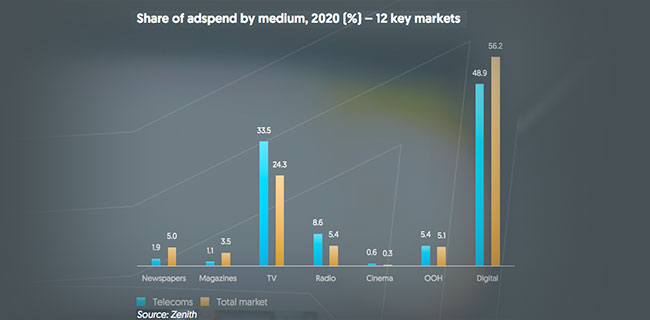
    Voice and data services are commoditised and functionally indistinguishable to consumers, who expect them to work flawlessly in the background and only pay attention to them when they go wrong. High-impact advertising in mass-audience media like television and radio allows telecoms companies to differentiate themselves from others through branding, and makes them more relevant to consumers by promoting their association with things consumers are passionate about, such as entertainment, sport and music. Telecoms brands therefore spend substantially more on television and radio advertising than the average brand – in 2020 they spent 42% of their budgets on television and radio, while the average brand spent 30%.


    But as audiences migrate online, telecoms companies are refocusing on communicating their brand narratives to mass digital audiences. Telecoms brands spend less on digital media than average (49% of their budgets went to digital channels in 2020, compared to 56% for the average advertiser), but digital advertising is also the only channel in which telecoms adspend is increasing. Zenith forecasts that telecoms brands will increase their digital adspend at an average rate of 5% a year between 2019 and 2023. By 2023, digital advertising will account for 54% of all telecoms advertising.


    “Covid-19 has demonstrated how dependent we are on good, fast and reliable internet connections. Telecoms companies have been the unsung heroes of the pandemic, shifting our lives online and keeping us connected to entertainment, work and commerce,” said Ben Lukawski, Global Chief Strategy Officer, Zenith. “Their challenge is to go from being unsung to being acknowledged and appreciated for their efforts. The spread of 5G and the reality of our new-found virtual lives give telecom brands the opportunity to move into the limelight.”


    Telecoms brands are cutting back their spending on traditional television and radio as their reach declines, but less rapidly than brands in most other categories. Zenith forecasts that between 2019 and 2023, telecoms brands will reduce their television adspend by an average of 2.0% a year, compared to a 3.5% annual reduction across all categories. They will also reduce their radio adspend by 2.8% a year, compared to 4.1% a year for the market as a whole.


    Russia as well

    Russia is another market with relatively low (57%) but fast-growing smartphone penetration, and here telecoms adspend is forecast to rise rapidly too, by 8% a year.


    Most of the other markets in this report are forecast to grow by between 3% and 6% a year to 2023. The exception will be France, not because of any inherent weakness in demand, but unlike those in most markets, French telecoms brands actually increased spending in 2020 – by 6% – in response to the extra demand for data. The basis of comparison with 2023 is therefore considerably tougher.


    “The rollout of 5G services will allow mobile operators to supply bundled voice, data and entertainment services to the home and compete directly with landline broadband,” said Jonathan Barnard, Head of Forecast, Zenith. “This will spur greater competition to put together the most attractive services at the best prices and help stimulate a sustained recovery in telecoms adspend to at least 2023.”


    .


  • Zenith India appoints Ramsai Panchapakesan

    By Our Staff


    Ramsai Panchapakesan
    Ramsai Panchapakesan

    Zenith India has appointed Ramsai Panchapakesan as National Buying Head. He will be incharge of the company’s pan-India media operations, working within Publicis Media’s investment practice, PMX, to leverage scale and clout in the local marketplace.

    Said Jai Lala, COO – Zenith India: “We are continuously strengthening the media buying vertical at Zenith and with the on-boarding of Ramsai Panchapakesan we are confident of reaching our evolving objectives. He has been a steady force behind establishing the business process in sales and buying functions across his clients in the industry. His work experience and solutions-oriented approach will add great value to our organisation.”

    Added Panchapakesan: “I am excited to be a part of Zenith and I look forward to the new role. With my core expertise and skillsets, I look onward to bring significant value to the company.”


  • Zenith honoured with Honor mandate

    By A Correspondent


    Pardon the forced play on words in the headline but perhaps that was the only way to differentiate ourselves from the 20-other publications that you’ve read the same news.


    So here’s the juice: Zenith has won the media mandate of smartphone brand Honor. This includes the mainline media and digital duties of the brand. The business was won after a tightly contested multi-agency pitch.


    Speaking of the appointment, Winston Li, CMO, Honor India said: “It was a comprehensive pitch process and among other agencies, we were impressed with Zenith’s approach to drive business results. As a TechChic brand, we were looking for innovative ideas and fresh thinking that matches our style of working, brand and product proposition. We look forward to work with them.”


    Tanmay Mohanty

    Added Tanmay Mohanty, CEO of Zenith India and Head of Global Partnerships for Publicis Media India: “We are tremendously delighted at the win. Zenith will look to leverage its strong ROI+ proposition and expertise in digital marketing to building market leadership for Honor. Our focus on the full consumer journey and a single view across touchpoints will unlock new opportunities for the brand.”


  • Publicis Media bags Hero MotoCorp mandate

    By A Correspondent


    Two-wheeler major Hero MotoCorp has appointed Publicis Media as its media agency for both traditional and digital media duties.


    Publicis Media has created a bespoke platform – ‘Team Hero MotoCorp’ (Team HMC) – that will be in charge of the account and will harness talent from across the organization, both for the mainline and new-age mediums.


    Said Gurinder Singh Sandhu, Head of Marketing, Hero MotoCorp: “Publicis Media was selected after a very thorough and competitive pitch process with strong presentations from several agencies. We are excited about this new partnership and the potential of ‘Team HMC’ in helping us drive even stronger consumer connect and grow brand impact.”


    Added Tanmay Mohanty, CEO of Zenith India and the executive sponsor on Team HMC: “Hero MotoCorp is one of the most prestigious accounts in terms of both scale and complexity. We are excited to partner Hero MotoCorp in their marketing journey where data and tech will complement the strong strategy, planning, buying and content verticals to further strengthen the Integrated Marketing play. ‘Team HMC’ will mobilise the most apt talent and capabilities from across Publicis Media globally, for this partnership. We look forward to delivering strong business outcomes for them and unlocking new consumer connections across social, digital and traditional mediums.”


  • Nestlé partners with media entities to create inspiring brand narratives

    By A Correspondent


    Nestlé is partnering with India’s top media companies to produce inventive and creative brand solutions, through a first-of-its-kind initiative called Media Hive. Some of the big-league media and entertainment firms that participated in the Media Hive included Times Of India, Star, Zee, Viacom18, The Hindu, Big FM, Radio City and Arre.


    The focus was on immersive solutions that put media as the centre-piece of communications. This landmark initiative was the collaborative effort of Zenith & Nestlé.


    As many as 19 briefs came from Nestlé brands such as KitKat, Maggi, Munch, Polo, Nescafe, Milkmaid, Ceregro, Milky Bar etc to 42 media partners. Around, 354 ideas were generated in total. The Nestlé brand teams, after careful consideration shortlisted 72 ideas which were presented at the Media Hive event in New Delhi.


    Media Hive included the top leadership of Nestlé and Publicis Media. The inaugural address was by Suresh Narayanan, Chairman and Managing Director of Nestlé.


    Said Rashi Goel, Director Communications at Nestlé: “Nestlé was looking for inspiring media narratives for its brands that go far beyond the 30-seconder. Through Media Hive, we have paved the way for a new era of moving, compelling and evocative brand experiences which captivate and involve consumers. The powerful ideas generated in the Media Hive, will bring alive our brands in subtle yet, engaging ways. This is an entirely new approach to energising our brand stories and we thank Zenith for this very successful partnership.”


    Added Tanmay Mohanty, Group CEO at Zenith India & Head Of Global Partnerships at Publicis Media India: “Attention is a scarce resource today. In this context, there is a real need for enriching, long-lasting media experiences. Efforts that appeal to people’s emotional sensibilities. Media Hive brought many such striking, impactful ideas to the fore where brands can be introduced in non-intrusive ways. Though Media Hive, we are also to trying to evolve and grow the larger eco-system.”


  • TV dominates media consumption in India: Zenith


    By A Correspondent


    People around the world will spend an average of 800 hours using the mobile internet this year – that’s equivalent to 33 days without sleep or pause, according to Zenith’s Media Consumption Forecasts, published today. By 2021 the total will rise to 930 hours, or 39 full days.


    This is the fifth edition of the Media Consumption Forecasts, which surveys changing patterns of media consumption since 2011, and forecasts how the amount of time people allocate to different media will change between 2019 and 2021. Across the 57 countries that were surveyed, people will spend a collective 3.8 trillion hours using the mobile internet this year, rising to 4.5 trillion hours in 2021.

    Since the first edition was published in 2015, the average amount of time people around the world spend accessing the mobile internet has risen from 80 to 130 minutes a day, at an average rate of 13% a year, spurred on by the availability of affordable smartphones, faster connections, better screens and app innovation. Growth is slowing, though, now that most people in the developed world who want a mobile device have one, and ownership is becoming common in developing markets. We forecast an average of 8% annual growth in time spent on mobile internet devices between 2018 and 2021. We expect mobile internet use to account for 31% of global media consumption in 2021, up from 27% this year.


    Television remains the most popular global medium

    Television remains the biggest medium globally, attracting 167 minutes of viewing each day in 2019. Television viewing is predicted to fall slowly to 165 minutes a day in 2021. Television will remain the world’s favourite medium throughout our forecasts, accounting for 33% of all media consumption in 2021, down from 35% in 2019.


    Mobile internet has eaten into the amount of time people spend with some – but not all – rival media. Between 2014 and 2019, the average amount of time spent reading newspapers has fallen from 17 minutes a day to 11, while time spent reading magazines has fallen from 8 to 4, and time spent watching television has fallen from 171 to 167. Desktop internet use has also fallen, from 47 minutes a day to 40. However, consumers’ appetite for radio and cinema has remained robust, with radio listening rising from 53 minutes to 55, and time spent at the cinema rising from 1.8 minutes to 3.0 minutes a day on average, driven by a boom in cinema attendance in China.


    Note that in this report, time spent with newspapers and magazines only includes time with the printed editions of these publications, while time spent with television and radio only includes time with traditionally broadcast channels and stations. Time spent with online platforms owned by publishers or broadcasters is counted as internet consumption.


    Total media consumption rises to eight hours a day

    The mobile internet has expanded the amount of time people spend consuming media: consumers will spend an average of 479 minutes a day with media this year, up from 420 minutes in 2013. By 2021 we expect the average consumer to spend 495 minutes a day consuming media.


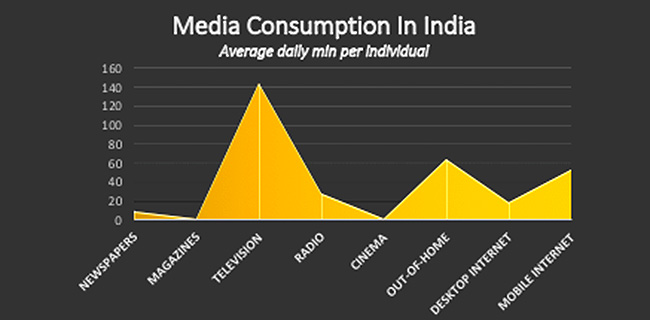
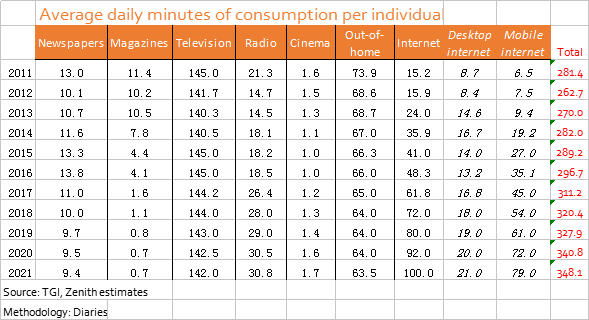
    In India, consumers will spend an average of 320 minutes a day with media this year, up from 270 minutes in 2013. By 2021, Zenith estimates that the average consumer will spend 348 minutes a day consuming media. Television remains the dominant medium — consumers on an average spend 144 minutes daily on television, up from 140 minutes in 2013.


    “Mobile internet technology has expanded both the amount of time people spend with media, and what counts as media,” said Jonathan Barnard, Head of Forecasting at Zenith. “Media now means comparing prices on the high street, sharing jokes with friends and booking your next holiday, opening up new opportunities for brands to connect with consumers.”


    “To take advantage of this abundance of media, brands need to communicate with consumers in the environments that best matches their values, and at the times when consumers are ready to move along the path to purchase,” said Matt James, Zenith’s Global Brand President. “This requires investing in talent and technology to unlock the value of data and create personal brand experiences.”


    Mirroring global patterns, time spent on mobile internet shows remarkable growth in India as well. Media consumption on mobile internet has gone up from 9.4 minutes daily in 2013 to 54 minutes this year and is expected to reach 79 minutes by 2021.


    Tanmay Mohanty

    Tanmay Mohanty, CEO of Zenith India & Head of Global Partnerships (India) said, “While television remains the dominant medium, internet consumption led by mobile shows the fastest growth. There is nothing more personal to the consumer than the handset and for many in India, the first taste of media consumption comes from the small screen. Mobile consumption is only expected to go upwards with falling data prices, increased mobile penetration in tier 2 & 3markets, availability of low-cost handsets, entry of 5G networks and explosion in vernacular content formats.  Marketers who adequately invest in mobile technology and mobile-first strategies will reap the rewards.”


  • Zenith refreshes top deck. Jai Lala is COO, Gurnani is Chief Client Officer

    By A Correspondent


    Media agency network Zenith India has announced new appointments at senior levels. Jai Lala has joined for the newly created position of Chief Operating Officer (COO) at Zenith and will oversee operations, structure and expansion in addition to the scaling up of specialised, future-facing offerings for the agency. Focus will be on areas where Zenith is already market-leading such as Data, Dynamic Content, Tech, Analytics, Performance and Programmatic.


    In addition, Zenith has elevated its Managing Partner and Head, West & South Ajit Gurnani to the newly created role of Chief Client Officer. He has already had a great role in firming up client relationships for Zenith and will continue to interface with key clients, bringing in new and critical perspective on businesses and enhancing Zenith’s overall strategic product and delivery.


    Lala has over two decades of experience across across Media Planning, Buying, Research & Sales. He is has worked in organizations such as UTV, ESPN Star Sports and was last with Medicom as Chief Strategy and Growth Officer. He has serviced clients across the country such as Unilever, PepsiCo, GSK, ICICI, Castrol, Lenovo, USL, Coke, Marico and many more in various capacities. Jai is also a visiting faculty at ISB & MICA.


    Elaborating on the appointments, Tanmay Mohanty, Group CEO of Zenith India said, “Zenith stands at an important growth juncture; we have witnessed an absolutely spectacular year so far in terms of new business wins and performance on  key client businesses. In our endeavour to build further on our ROI+ offering, delivering transformational growth to our clients, we are announcing two big appointments at senior levels. Jai Lala needs no introduction and has over 20 years’ experience in media planning and buying. He will aid me in client deliveries,  keeping up the scale and momentum of operations,  integration of  existing talent and new hires and the  expansion in overall footprint for Zenith. Ajit on the other hand has been with us for over three years and  brings in huge expertise and value to every client conversation. He has transformed the way we deliver to clients and will shape our client relationships further. Both these appointments will help Zenith put out passionate, exciting and compelling work.”