Tag: WPP Group

  • 15- to 34-yr-olds captive for multiplexes & theaters: Interactive TV report


    By A Correspondent


    As cinema advertising gains momentum in the media mix, Interactive TV, the cinema advertising unit of GroupM India has released a report to track the urban cinema-going audience. The report, called ‘At a Theatre Near You’, is in collaboration with Kantar IMRB, also a part of the WPP group.


    ‘In a Theatre Near You’, notes a communiuqe, studies the urban cinema consumer and correlates their lifestyle and purchase habits with their film viewing habits. The report looks at audiences across eight cities in India, and buckets them into heavy, medium and light cinema goers.


    Speaking in the launch of the report, Ajay Mehta, Head, Interactive TV said, “The cinema medium had a lack of scientific data for planners and marketers. Being the leaders of cinema advertising in India, we are trying to make cinema advertising more transparent and accountable. This report is Interactive TV’s most ambitious initiative with the aim to down some measurement parameters for the medium and help brands understand and exploit the potential of this medium.”


    The report states that 57 per cent of the audience base watches a movie in the theatre at least once in six months, and of these 71 per cent are between the ages of 15 and 24. The gender gap is also decreasing with the urban cinema audience, as 53 per cent are women. Going to a movie in the theatre continues to be a social phenomenon as it ranks high as a family and social activity.


    Even though cinema advertising is a small part of the advertising expenditure in India, over the last few years it has been tremendous growth of over 20 per cent. Brands and marketers are realising the potential of the medium and its ability to work well with other media. 76 per cent of urban cinema goers own a smart phone and 45 per cent have the latest apps installed. This is a huge opportunity for marketers to creatively synchronise digital and in-cinema campaigns to maximize effectiveness of the both media.


    Another important point from an advertiser point of view is that 50 per cent of this audience is open and willing to consume advertisements before the start of the movie and during the intermission. Moreover, average consumers reach the movie hall 15 minutes before the show time, which allows enough and more branding opportunities for advertisers.


    At A Theatre Near You Summary


  • Jennifer Aniston makes a memorable return in latest ad for Emirates

    By A Correspondent


    Hollywood actress, director and producer Jennifer Aniston makes a return to the Emirates A380, and makes a new friend, in a new global digital and TV advertising campaign for emirates. The ad builds on the success of the first Emirates-Jennifer Aniston ad launched last year, a much talked-about campaign which quickly went viral.


    In a similar vein to the first light-hearted TVC, Jennifer brings her distinctive personality, classic style, and a touch of humour, to showcase the A380. In the ad, Jennifer befriends Cooper, a feisty young boy who she finds playing in her Private Suite in the Emirates First Class cabin, while she was freshening up in the Shower Spa. The two strike up a conversation and build rapport, as they stroll through Emirates’ Business Class cabin and Onboard Lounge. Sitting on the stairs between the lower and upper decks of the aircraft, Cooper tells Jennifer about his aspirations to become a pilot – of ‘this plane’, pointing to his model Emirates A380 aircraft. In Economy Class, Cooper is finally reunited with his surprised parents where Jennifer chooses to remain and enjoy Emirates’ ice inflight entertainment system with Cooper. The ad ends with Cooper’s mother relaxing in Jennifer’s Private Suite, having exchanged places with the Hollywood star.


    Boutros Boutros, Emirates’ Divisional Senior Vice President, Corporate Communications, Marketing & Brand explained: “A year ago, when we launched our first ad featuring Jennifer Aniston, we were overwhelmed by what a social phenomenon it became. The humour resonated with audiences around the world, and the ad was viewed by millions of people, generating thousands of conversations. Fans of both Emirates and Jennifer loved her effortless charm and humour, and enjoyed a story that deviated from traditional airline advertising. This new ad perfectly captures the fun, spontaneity and glamour of flying on Emirates, and we are confident audiences will find it as memorable as the first.”


    The TVC was directed by Oscar-nominee Bryan Buckley, who is acclaimed for his numerous Super Bowl ads. The script and creative concept was a collaboration between Buckley and Emirates’ in-house advertising team and produced in conjunction with the WPP Group.


  • Much influence of Big Data on Research


    By Moinak Mitra


    The late Steve Jobs famously eschewed market research arguing that customers don’t know what they want. It’s a viewpoint many chief executives may not see merit in but the jury is out on this question: Is Big Data killing market research? After all, why should companies spend time and money on market research to understand how customers feel about a product when they are out there on Twitter and Facebook, speaking their minds for free?


    We put that question to Richard Ingleton, CEO of TNS, a wholly owned subsidiary of Martin Sorrell’s WPP Group and one of the largest market research firms in the world. A former consultant with EY & Accenture, Ingleton believes that though its contours are being changed, market research still has a place in the world of business. Edited excerpts.


    How is market research changing as things go digital?

    The research industry is here to help people make decisions. So traditionally, we’ve asked people to punch in data by asking questions— what’s my brand equity, should I launch this product, are my products doing well? The way of answering is slightly different now. I can get data through a survey but I can also get it through search and social media.


    Market research is becoming much more real-time. There are two things that are driving that— social media and mobile. With social data, the ability to ask questions in the moment means we can give our clients a much more accurate answer than any of the traditional techniques. They’re still asking the same questions, we’re just answering them better—more quickly, more accurately and more relevantly.


    What about visualisation tools and apps available today at a fraction of the cost?

    You can argue that market research was the original big data business. We’re paid for finding insights. And if it can be automated and you don’t need a human being, we’re fine with that. When it comes to understanding why my brand’s moving or product innovation, you still need people to interpret that.


    And you also have to understand that there is a big part of our industry which we call qualitative research — which uses tools that computers can’t—to get into the human psychology. If the gathering of data becomes cheaper, that might affect our revenues, but not our profits. We used to have thousands of people in the field. That moved to call centres calling people up, then online and now to mobile. So the amount of money we’ve made from gathering data has gone down.


    Big data is helping us to bring it down further. It just makes it cheaper for clients, which means where we really make our money is in the research expertise, asking the right questions, the storytelling. I’m less concerned with revenue, more concerned with the margin. If you are a consultancy and if you have a business like ours, which is half the price of a consultancy on a daily rate basis answering these questions, maybe we’re a threat to the consultants. Big Data is helping and threatening us.


    How are clients viewing this shift?

    Our clients too have researchers and they’re much like us. So this understanding of how research is going to be done in the future with the two coming together helps. But we’re a little bit ahead of the clients because we’re doing it in 80 countries for 26,000 clients, while they’re doing it in their country for themselves. So hopefully we’re there before them on average, if not in one particular case. So we’ve got an education job helping our clients understand there are faster, better, cheaper ways of doing what we’ve always done.


    It also depends upon the study. For example, big data just won’t help if you want to understand some complex social issues, like how do I get people to use toilets, how do I get kids to go to school, how do I get adults to use contraception? For governments, there are important questions that are never going to get answered from social media.


    Where does TNS figure in the new scheme of things?

    We’re using social media and search data to help in our research. We’re using mobile as well as online communities. The combination works for us.


    With all this digitization, isn’t there a tipping point in the horizon?

    There’s Ray Kurzweil, who was professor at MIT’s Media Lab and invented the Kurzweil synthesizer. He’s written a book called Singularity. He says computer intelligence is scaling so quickly, there will come a point where computers will be as intelligent as humans. He estimates that point to be 2040-42.


    That point is called singularity, beyond which we don’t know what will happen. But two years later than that point, those computers will be twice as intelligent as humans, and it will grow accordingly. So when you talk about humanoids or computer intelligence or one-man businesses, you never know what will happen.


    Can computers understand us better than we can?

    Computers will be able to understand what people think about a brand by observing them through their online behavior, which means we won’t need people to go to the market and ask questions. At the other end of the spectrum, complicated math like discreet choice modeling (which needs very good statisticians) can be done at the press of a button.


    So at one end of the scale we’ve got low value activities being undertaken and at the other end of the scale, we’ve got complex math and difficult statistics. Computers can do them too. Humans become designers and managers of the process. In 20 years, I’m sure it will get to genuine artificial intelligence in which it will be able to interact in a way which is completely indistinguishable from a human being.


    What do clients want more of?

    They have all of this social data, internal data, survey data and they have to put it together to get some kind of insight. So we have data integrators, which collect data from all sources and put them together to ask appropriate questions.


    For example, we have done some work for Holiday Inn. We’ve surveyed 5,000 people who travel through Holiday Inn: what they wear, what they drink, age, mode of transport. We’ve built a very detailed profile of them. Then you use that profile against a data set of 50 million people.


    Why such a large universe?

    Because it is a large hotel chain across so many continents. If I get a database of 50 million people, I will get at least 15 million people who are more likely to go to that hotel brand with targeted advertising. So you go from a survey to build a profile. You apply that profile against a massive database. Then you do targeted advertising against that super-set of people


    And what was the outcome?

    There was a 34 per cent increase in consideration, which is a massive increase in people who are likely to stay at Holiday Inn.


    So let’s say the hotel is automated and all data is being captured on an integrated dashboard, where my software tells me exactly what I need to do. Do I reward the market researcher or the IT guy?

    The difference between market research and IT is getting smaller and smaller. We’re using IT to do research. So I think you reward both. In what you defined as your smart hotel, somebody designed the questions to ask your customers, somebody designed the profile of your customers for you to target, somebody designed the pricing and promotional models that you used. So you put all of that research into your process, and you merged your business.


    The IT guy doesn’t know anything about how to ask a question. Behavioral economics, which is a big part of what we’re about, is about skillful question asking. This is the thing we’re selling and computers can’t do yet.


    Is the talent required in market research different from the past?

    Not massively different. I think we’re looking for people who’re curious about the human condition—psychologists, philosophers, statisticians. To understand regression and other drivers, we need analytical people too.


    Daniel Kahneman, a psychologist who won the Nobel for Economics, has identified what he calls ‘thinking fast, thinking slow’. He is actually saying the brain is not rational. The math guy is very logical, very rational. But human beings are not logical. So, on average, what you say is true, but in particular, it’ll be wrong. This is where behavioral economics comes into play.


    That is why 60 per cent of our business is creative and analytical together, the things computers can’t do now. It’s quite hard to identify the irrational motivations of behavior and to ask questions in a way people understand. That is why I don’t feel our industry is under threat.


    So how much would you say is that mental part to your business in per centage terms?

    The money we make from that thinking part is about 60 per cent of our business. The rest is gathering data in all sorts of different ways. The big data guys have a point but it’s still about the quality of data and about the truth.


    You’re a philosophy student. Draw a parallel between philosophy and market research?

    Philosophy is about understanding big subjects, great unknown questions. And that’s what market research does. And the philosopher who demonstrates that best is Socrates, the grandfather of great questioners. If market research were a philosopher, it’s got to be Socrates because he was the greatest questioner.


    Where is big data being used today?

    Accenture’s ‘Big Success with Big Data’ report focuses on companies that have implemented one or more big data projects. For the study, Accenture Analytics interviewed more than 1,000 experienced users of big data from 19 countries and seven industries, including Banking, Communications, Consumer Goods & Services, Energy, Healthcare Providers & Payers, Insurance, Retail.


    In India, 65 per cent of the companies sampled are using big data to analyse customer behaviour while 59 per cent rely on big data to improve customer personalisation. Only 14 per cent use big data as a tool to get a grip on cost. Incidentally, most of these areas are core areas of enquiry for market research firms.


    Source:The Economic Times

    Copyright © 2015, Bennett, Coleman & Co. Ltd. All Rights Reserved

    Licensed to republish


  • Bates CHI&Partners to acquire Temple Advtg. Temple co-founders to manage Bates

    By A Correspondent


    The WPP group’s Bates CHI&Partners has announced the acquisition of the business and assets of Bengaluru-based Temple Advertising. But like in the case of the Publicis Groupe’s acquisition of Law & Kenneth, and the L&K taking management control of Saatchi & Saatchi.


    Said David Mayo, CEO, Bates CHI&Partners. “In developing our strategy in India, we are building a creative network with scale. Temple is a renowned creative agency with a strong reputation and a broad vision of the world and with them around the table, we will deliver on this promise.”


    Temple was co-founded in 2004 by Manmohan Anchan, Vidur Vohra and Srikanth V S. Srikanth VS will become CEO and Manmohan Anchan will become CCO of Bates CHI&Partners in India and they will jointly assume the role of Managing Partner of the Group overseeing all five Bates CHI&Partners offices in Mumbai, Delhi, Bangalore, Kolkata and Dhaka.


    Srikanth V.S. said, “We are incredibly excited to be part of a new agency set up in a new India environment and we hope to capture this new mood to build our business.”


    To underline the partnership and collaboration principles of this company, the agencies in Bangalore will merge and become Bates CHI&Temple, with the rest of the network retaining the original Bates CHI&Partners branding.


    Said Manmohan Anchan: “At Temple, we pride ourselves on our work. If it sells, it’s working. If it builds a brand, it’s working. We don’t create work for clients or juries, we create work that works. The time is right for a new agency in India to give variety to the current order of things.”


    Temple has worked with clients across diverse categories such as Automotive, Education, Fashion & Retail, FMCG, Foods, Media & Entertainment, Real Estate and Technology. Its clients include Embassy Group, eTV Kannada, Future Lifestyle Fashions (including Indigo Nation, Scullers, Manchester United, Jealous21), Pearson Education, Reliance Trends, Sumeru Frozen Foods, TVS Motors, Vaswani Group and Wipro Technologies.


  • Wow! Ogilvy Mumbai is Most Effective Agency Office globally as per Effie Index


    By A Correspondent


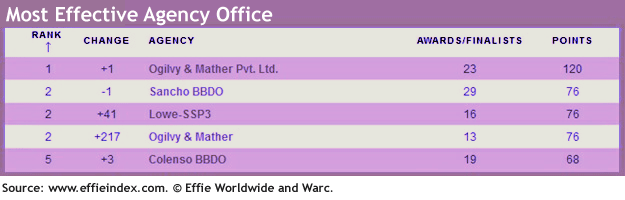
    It’s decidedly one of India’s creative agencies and has also been very widely hailed as doing some exceedingly effective work for its clients. It wasn’t much of a surprise hence that when the global results of the Effie Effectiveness Index were released by Effie Worldwide and Warc yesterday, Ogilvy Mumbai was declared the Most Effective Agency Office globally in 2012


    The index, launched in 2011, recognizes the architects of the most effective marketing communications ideas from around the world.


    Talking about the recognition, Hephzibah Pathak, President, Ogilvy & Mather Mumbai, said: “This is brilliant news. A wonderful reward for the champions in Mumbai office and our great client partners and another testimony to the twin peaks of creativity and effectiveness.” Ogilvy & Mather Mumbai is the only Indian agency office to rank in the top 5 agencies globally.


    Said Kawal Shoor, Head of Planning – Ogilvy Mumbai: “This recognition makes us even more proud of the stuff we do. We’ve always believed that to be truly effective you need to have an outstandingly creative and insightful piece of communication. This is a vindication of the relentlessness of our people, the confidence of our clients, and the sheer width and variety of the office’s skillsets.”


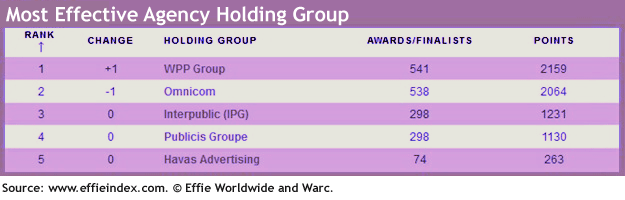
    For the second year in a row, the WPP Group is the Most Effective Advertising holding company while Ogilvy & Mather is the Most Effective Advertising Agency Network.


    Ogilvy Mumbai was also declared the Most Effective Individual Agency office in Asia Pacific in the 2011 Effie Effectiveness Index and ranked number 2 worldwide.


    Meanwhile, Unilever is the most effective advertiser and McDonald’s is the most effective brand, for the second year in a row. McKinney (USA) is the most effective independently held advertising agency.


    O&M Mumbai leads in the global individual office ranking. Sancho BBDO from Bogota, Colombia, which led last year, slipped to number 2 followed by Lowe-SSP3 (also from Bogota) and Ogilvy & Mather (New York). The top 20 also includes agencies from countries as diverse as China, Hong Kong, Australia, Argentina, New Zealand, Egypt, Peru, Ukraine and Israel.


    WPP leads as the most effective holding company to be followed by Omnicom, IPG, Publicis Groupe and Havas Advertising.


    While Unilever is the most effective advertiser, Procter & Gamble has lost its top position since last year and slipped to number 2. Nestle is at number 3 followed by McDonald’s at number 4 and Pepsico at number 5 in the list of top 5 most effective advertisers.


    As for the brand, McDonald’s retains its numero uno position. Surprisingly, a technology company, IBM is the second most effective brand. Coca-Cola is at number 3 followed by Axe at number 4 and Pepsi at number 5.


    The Index was launched in June last year and is led by Effie Worldwide.  It is said that the Effie Effectiveness Index will become the industry standard. The Effie Effectiveness Index identifies and ranks the marketing communications industry’s most effective agencies, advertisers, and brands by analyzing finalist and winner data from Effie Worldwide competitions. It is the world’s most comprehensive ranking of agency and advertiser performance and a valuable resource for anyone interested in marketing effectiveness.


    The 2012 Effie Effectiveness Index is derived from almost 2,000 finalists and winning entries to Effie Award competitions worldwide between June 13, 2011 and June 12, 2012.


    The Index is constructed by converting every Effie award and finalist into points – 12 for a Grand Effie, eight for Gold, six for Silver, four for Bronze and two for a finalist (with contributing agencies receiving half these points). In a change from the inaugural year, if several agencies from the same agency network or holding group worked on a campaign, the network and holding group only receives one set of points for each winning effort.