Tag: WPP Group

  • We’ve built a fabulous place. We’ve grown, hired talent, got clients…


    It’s not easy doing an interview with Rana Barua, Group CEO, Havas Group India. He reads your mind, and has perhaps guessed all the questions you are going to ask. But that’s why it’s challenging interviewing him, as we revive a new series of power interviews with industry captains. Excerpts from a freewheeling interview with Rana Barua.


    Let’s start by taking a stocktake of how things have been since the last time we interviewed you. How has it been since then?

    Honestly, we’ve probably surpass the expectations of the group in terms what India could overall build or achieve. Every global media company has a certain ambition when you are literally starting from a certain base or scratch. I think we have built a fabulous place-we have grown, we have built, we have created, we have hired talent, we have got clients.

    We have got an ecosystem where we currently have close to 15 agencies under the three verticals of creative, health and media. We are over 1200 people. We have become a very strong ecosystem where we have acquired agencies, we are doing well our creative and media are independently doing very well, and health is been quite steady. So, I think where we have reached a point where we are now only going to get bigger in our own ecosystem of Havas Group internally. We are setting much higher targets within the Group for ourselves and the global team is supporting us.


    You spoke on expectations – were the expectations high or low given that even though it’s been a while since Havas has been around in India, it has never really been among the top flight agencies.

    Havas Group, a French network, had not really invested in India. They were testing waters carefully and cautiously, which is why Bobby and I were brought on board to help turnaround the network. That’s what a lot of international companies have done – they have come to India, they have seen, they have tried and if it’s not happened, they have quietly left. Or some people have reduced their investments or some people have stayed there because of whatever reasons.


    You’ve spent some time in the recent past with the WPP Group. What is the key differentiator between WPP and Havas? The WPP Group is said to be run by accountants. What would you say is Havas?

    So, the WPP Group was naturally very finance-driven, very clear about the bottomline and numbers and all. I think the clear difference between WPP, and I think that is why I am enjoying my time at the Havas Group, is that Havas  is very entrepreneurial-led. Of course numbers are important, profitability is key, and why not? We are not a charitable institution – we are all running a business. But it allows you take a lot of risk, t allows you take a lot of decisions on your own.


    They allow you to make mistakes?

    Yes, of course. Absolutely.


    Anything that you can give an example of that perhaps as you look back may have been a mistake and they have said screw it, it’s all right.

    So, I wouldn’t call it a mistake. One of our acquisitions  didn’t work out for cultural reasons, for the reasons of the business model changing post-Covid. Before Covid, there was a reason why we had bought a certain agency with expertise on digital and we thought that this is how we are going to integrate it into the system. In the Covid years, we realised that it was very tough, things changed and the model changed. There were different conversations. So, culturally, we drifted.  But we moved apart beautifully. No clients got impacted. We are rebuilding and we have started looking for newer acquisitions which fit our culture.


    Would you look at another acquisition in the same space?

    Absolutely in the same space. The agencies that we are talking to are aware of everything. I think one of the big conversations that happen in our group is reputation. What is your reputation in the market? And that is something which is tougher than deliveries on financials.


    On a scale to 1 to 10, how would you rate the agency since you joined

    There are two ways to look at it. We see it one is as per your external environment — how you are doing in India vis-a-vis people and competition. And the other is your internal benchmarking. So, if I do an internal benchmarking, let’s say at a time when we came in, it was a 2 or 3. Are you part of the global team? Are you part of the global council? Are you part of the G9 or G10 as we call it as the best companies? No, we were not anywhere near that. There was no global reporting, we would never have any direct interactions and all. So, let’s say we were at a 2-2.5-3 out of 10 which probably has moved to 6-6.5 internally or a 7 which is a great place to be. Because now you are among the Top four-five countries where investments are happening, conversations are happening, centres of excellence are being formed, expansion plans are happening, acquisitions are happening. We didn’t have clients then and were probably at 2-2.5 to 3. We have done a fab job, So a 5.5-6. .


    On creative output, on creativity?

    5.


    And where were you earlier before you came?

    I don’t think we had any value. I don’t think we were even known, Now there are so many new clients who have come on board. I am not saying that the last two years has been very easy for the industry. So, I would say that we have raised the bar to a certain quality from where we were, and the investments have started.


    Investments?

    In terms of people and quality that we are hiring we have just announced few days back that Anupama (Ramaswamy) has joined us as the CCO with Bobby. We are going to be investing in a very strong CSO very soon. I think we realised that we probably invested a bit too early on a senior strategy head maybe we should have got the ecosystem right and then have someone.


    And awards? Not too many awards so far.

    No. Not at all.


    So, when do you think they will happen…

    From next year we will definitely see some…


    Your budget on sending entries will increase?

    Yes. Absolutely.


    Will you sending some 500 entries?

    No, not so many.


    That’s the shortcut to get many awards.

    Now, you are taking me to a heavy discussion.


    No. Fine. At the end of the day, awards are important for a creative agency

    Very important. When I joined, I said let’s give it three years. But then the pandemic happened. I have now done four years now, so in my fourth, fifth, sixth year is when we will see a lot of these recognition, awards and proper movement into a higher zone of growth and size and everything that’s now.


    Would you say that in the next two years you should be getting a good amount of awards?

    100%.


    A creative agency is looked at by the kind of work you do, and the awards you get?

    Yes, and that’s the same focus for media also we are looking at Emvies and Effies in a much bigger light. If your client list has moved up from two or three or four. If you look at the media client list or the creative clients list it’s now into 40s, 50s, 60s there are too many clients now they are all going to ask for recognition in any form.


    What is the pitch you give a person who is with another agency – why should they select Havas? Or, why should a start-up come to you?

    I think one of the main conversations we have on is the philosophy. It’s for everyone to see that people have started investing in this brand. So, if you look at the Havas brand, in the last few years, it has suddenly become a brand of choice for many people. They are seeing a very positive ecosystem which is delivering effective results. We have zero attrition in media, not a single client drop out in creative. There is a genuine effort to get the product right for the client, there is a partnership intent. I am actually telling people: invest in Havas and you will see the difference. If you ask me, what number am I? I will say I am number 4, 5, 6 whatever you tell me. But we are a very big number in our scheme of things, which is giving us the confidence to taken on large clients. We are invited for some of the largest pitches in the country. We may be winning some, we may be losing some… but we are striking gold in many places. We have got a lot of Tata work in… Tata CLiQ, Tata Luxury, Tata Beauty, Tata… we are part of most of the Tata pitches that are in the market right now. In media too, we are doing very well.


    How is the status of your acquisitions? Anything new coming up?

    I would like to first integrate and then look for newer ones and not just keep adding on agencies. Because one of my core philosophies is that you don’t grow on acquisitions, you need to have your own code and then add the acquisition. You can go buy 35 companies and you will have a number, but you will not have a culture. You won’t have a Havas Group. You will have a plethora of agencies which form a group. So, that was never the intent and that was one of the clear beliefs.

    I have always maintained that in India you have to build an ecosystem around creative and media.. So, while there were few acquisitions which came in under the creative banner, it took us two three years to fully integrate. There is absolute clarity on where we are headed, we are looking at an acquisition in performance marketing, we are definitely looking at a PR agency.. we are  looking for a digital agency. A B2C, hardcore, an integrated one and we are also looking for size. That’s the big difference from three years back. We are also looking at consumer experience journey, content, data…


    And how is activation and events agency doing?

    Very well.


    Even though the last two years were bad…

    Yes, Shobiz has done a phenomenal job this year.


    Since you are talking about Havas Integrated, is the money more on digital or is the money more in traditional advertising?

    In terms of media spends?


    Yes.

    In terms of media spends, it’s pretty much I would say 60-40. When you say traditional means you are talking about TV and all offline mediums right? It’s still 60%-65% there in media. But your returns on that 65% might be very little because you know how the commission model works. Your returns on that 35% would be much higher because that’s what digital allows you to do. In sum, if you look at the mix, India is still very skewed towards traditional formats.


    If we interview you a year from now what are the two three things that you think we will be talking to you about

    I think one will be on awards. And when I say awards, it means it just not one creative award it can be you won a lot of Emvees or you won a lot of Effies or you won an international award or something. So, I think that is one thing you are going to definitely talk about, is did you move the needle at all? The ecosystem is now on track. You can’t pull it back because the foundation has been created, people have come, system has been created. It’s in a great place now…



  • IDFC Mutual Fund appoints Mirum as digital partner

    By Our Staff


    Mirum, the full-service digital solutions agency from the WPP Group, has won the digital duties for IDFC Mutual Fund.


    As part of the mandate, Mirum will deliver a bouquet of digital services for IDFC MF. Mirum will provide brand strategy, creative services and manage social media platforms for the brand. Mirum, a Salesforce Crest Consulting Partner, will implement Salesforce Marketing Cloud and provide managed services for a seamless marketing automation solution. IDFC MF will also be utilizing Mirum’s technology services for web development, UI/UX and SEO. The account will be serviced by Mirum’s in-house teams from their Mumbai office.


    Commenting on the win, Mihir Karkare, EVP, Mirum India said: “We are happy to partner with IDFC Mutual Fund. It is a proud moment for Mirum to win such a large digital mandate and bears a testimony for our digital capabilities. We look forward to service the IDFC MF account and are confident of delivering a seamless solution.”


  • Mirum India & Resulticks announce partnership

    By Our Staff


    Mirum, a Wunderman Thompson company and a part of the WPP Group, has announced a strategic partnership with Resulticks.


    As a part of this collaboration, Mirum and Resulticks will work jointly to enable brands to enrich their customer experience. Mirum will be a solution partner for Resulticks and help the ‘real-time conversation marketing cloud’ platform to implement and integrate their martech stack for customers across industries and geographies.


    Commenting on this alliance, Mani Gopalaratnam, CEO and CTO, Resulticks said: “We are happy to partner with Mirum, one of the leading digital and martech solutions agencies. Resulticks is a comprehensive, data-driven, and omnichannel marketing automation platform that supports all digital marketing requirements and gives users the ability to automate their core marketing activities. With the expertise of Mirum India added to the partner arsenal we are confident of delivering best-in-class managed services along with our platforms.”


    Added Hareesh Tibrewala, Joint CEO, Mirum India: “At Mirum, we understand the nuances that brands face while implementation and integration of a Martech platform. Resulticks is truly an omnichannel platform that allows marketers to plan, develop, deploy, and manage campaigns across channels like email, mobile, web, and social media while automating real-time & responsive communications. With our experience of over 12 years in ceaselessly delivering implementation projects, we are excited and look forward to our partnership with Resulticks.”


  • Mirum India wins mandate for Berger Paints

    By Our Staff

    Berger Paints has given the social media mandate for corporate communication to Mirum India, part of WPP Group. Mirum has been tasked with building the corporate brand on social media and highlighting the key achievements going forward. The account will be serviced from Mirum’s Mumbai office.

    Said Abhijit Roy, MD and CEO, Berger Paints India: “With the wide propagation of Social media, companies now need to reinvent their communication strategies to reach out more efficiently to their consumers, investors and other key stakeholders. We are sure that the association with Mirum India would help us in strengthening our corporate brand and create enhanced stakeholder engagement avenues in the current times.”

    Added Sanjay Mehta, Joint CEO, Mirum India: “Social media is the future of corporate communication. It plays the role of an image builder, an enhancer and a maintainer… all rolled into one. Berger Paints is one of the respected companies in the Indian market and comes with a rich brand legacy, which we look forward to amplifying through social media. Our experienced team is confident of delivering a solution which the brand deserves.”


  • Mirum to provide Salesforce to Careers360

    By Our Staff


    Mirum India, the digital marketing solutions agency from the WPP Group, will implement Salesforce Marketing Cloud services for Careers360, the educational products and services company run by Maheshwer Peri.


    Mihir Karkare

    Said Mihir Karkare, EVP, Mirum India: “Mirum is a Salesforce go-to partner for Marketing Cloud implementations in India and has a great experience in implementing marketing automation solutions in the EdTech space. We are excited to work with Careers360 and eager to collaborate with them on this project.”


  • Mirum to provide social listening to Bajaj Finance

    By A Correspondent


    Bajaj Finance Ltd, the lending and deposits arm of Bajaj Finserv, has appointed Mirum, a digital solutions company from the WPP Group, as the social listening partner.


    Said Hareesh Tibrewala, Joint CEO, Mirum India: “Winning the Bajaj Finance account is a feather in the cap for Mirum India. We are the pioneers in Social Listening space in India with nearly a decade of experience. We aim to bring all our expertise to the table to provide a seamless Social Listening solution to Bajaj Finserv.”


  • Greenlam’s talks about the ‘new inclusive normal’

    By A Correspondent


    Greenlam has launched a new digital campaign #InclusiveNormal to introduce its new range of what it claims are Covid-resistant laminates. The campaign was creatively led by Mirum India, a digital solutions agency from the WPP Group.


    Said Arvind Nair, Regional Director, Mirum India: “This year has led us to rethink the way we look at our cities, workplaces, homes and how we interact with each other. In these times, we have unknowingly built a “new normal” without keeping in mind those who are dependent on social interactions and touch. Our aim was to bring out these instances and as we rebuild a safer world, to make it be more inclusive. “


    Added Parul Mittal, Director, Greenlam Industries: “We are all aware that COVID-19 has changed our ‘normal’ way of living. And while we are all slowly and steadily adapting to this ‘New Normal’ of social distancing, contactless services and business, for the visually impaired community, however, it has been a time of unimaginable uncertainty and difficulties. The new normal has robbed them of the sense of touch which is highly important for their mobility and navigation. Through our latest campaign, Greenlam has thus pledged to contribute Re. 1 from each of our Greenlam Laminate sales, pan India. It also pleases me to share that Greenlam will now be able to offer laminates & compacts resistant to Severe Acute Respiratory Syndrome Coronavirus 2 (SARS-CoV-2). We will continue to work towards our commitment of providing technologically superior quality surfaces that ensure the spaces our consumers build, are safe from viruses, bacteria and other unhealthy contaminants.”


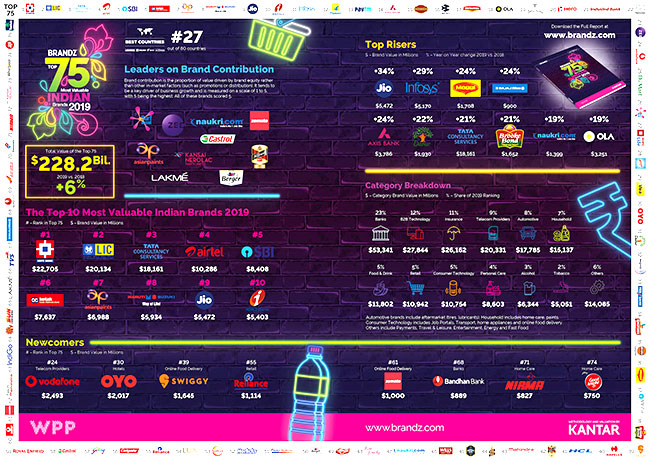
  • HDFC stays as #1 in BrandZ ranking


    The BrandZ study, which is the only brand valuation ranking to combine companies’ financial data with consumer insight and opinion, shows that trust is key to develop the stability required for long-term success; highly trusted brands in the Top 75 are worth 129% more than less trusted ones.


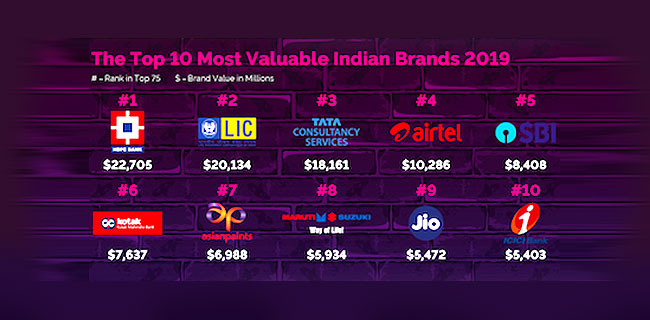
    BrandZ Top 10 Most Valuable Indian Brands 2019

    Rank 2019 Brand Category Brand Value 2019 ($M USD) Brand Value Change
    1 HDFC Bank Banks 22,705 +5%
    2 LIC Insurance 20,134 +2%
    3

    Tata Consultancy Services

    Technology 18,161 +21%
    4 Airtel Telecom providers 10,286 -10%
    5 State Bank of India Banks 8,408 +7%
    6 Kotak Mahindra Bank Banks 7,637 +15%
    7 Asian Paints Paints 6,988 +14%
    8 Maruti Suzuki Automobiles 5,934 -14%
    9 Jio Telecom providers 5,472 +34%
    10 ICICI Bank Banks 5,403 +11%


    Notable brands include ecommerce site Flipkart (No. 12), which increased its brand value 14% to $4.7 billion, while unicorn brands hotel booking site Oyo ($2.0 billion), online food ordering service Swiggy ($1.6 billion) and online restaurant marketplace Zomato ($1.0 billion) are newcomers to the ranking at No. 30, No. 39 and No. 61 respectively.


    The fastest riser in the 2019 ranking is telecom provider, Jio, which climbed one place to No. 9 with a 34% increase in brand value to $5.5 billion. Its disruptive business model has made internet access available to many Indians who were previously unable to afford it, thereby opening up access to digital platforms and services. Vodafone ($2.5 billion) meanwhile was the top-ranked newcomer at No. 24.


    Both digital and offline brands such as D-Mart (No. 25, $2.4 billion) have found success as a result of the rise of ‘middle India’; the growing number of people in the country’s second, third and fourth-tier cities and towns that are changing India’s traditional urban-rural divide.  These previously poorly-served segments increasingly have access to a variety of online services, with Swiggy and Zomato building much of their growth on this shift.


    Said David Roth, CEO of The Store WPP EMEA and Asia and Chairman of BrandZ: “As India flexes its muscles on the world stage, it faces increased macroeconomic headwinds which have combined with a rise in global trade tensions to create a challenging environment.  Successful Indian brands are adapting to these challenges and recognising that longevity requires them to do more than just disrupt the status quo; long-term brand building requires new strategies that major on stability.”


    Added Preeti Reddy, CEO South Asia, Insights Division, Kantar: “Consumer trust is a common thread among successful brands. However, it is concerning that only a few have succeeded in growing trust over the last five years. Those who done so, have done it through open and honest conversations with their customers. Brands would do well to consciously work at building consumer trust – it is the shield that gives a brand the resilience to face headwinds in uncertain times.”


    Said Vishikh Talwar, Chief Client Officer, Kantar Insights Division: “The rise of ‘middle India’ combined with rapid growth of the mobile internet is providing unprecedented opportunities for brands.  But, with an almost overwhelming choice of products and services to buy, consumers are increasingly discerning; the Indian psyche requires that brands cater for local needs with offerings that genuinely improve daily life. Today that’s as much about providing comfort and reliability as it is about generating new experiences.”


    Key trends highlighted in the BrandZ Indian Top 75 study include:

    :: Mobile internet access:Smartphone user numbers in India increased by 18% in 2018 (the fastest rate of growth in the world), mainly due to a combination of Jio’s own low tariffs and the renewed competition causing other telecom providers to reduce their rates.


    :: Buying power:Retail is the second fastest growing category, with online and offline both growing strongly. New entrant Reliance Retail (No. 55, $1.1 billion) opened  nearly 500 new stores and used Jio’s service to connect retail shops with grocery deliveries, while D-Mart ($2.4 billion) focused predominantly on offline, rising two places to No. 25.


    :: The Amazon effect: Amazon and Flipkart compete with many Indian brands across several sectors, with Amazon also opening its largest campus yet in India.  This has increased competition and driven brands to step up their operations to ensure they are meeting customers’ needs.


    :: A confident country: The success of unicorn brands such as Swiggy, Zomato and Oyo is fostering a new-found confidence in India. This is augmented with the increasingly global outlook of these new brands as they actively seek to expand their operations outside India.


  • Prabhakar Mundkur | Bay99: Collective Spaces means Collective Intelligence

    By Prabhakar Mundkur


    Bay99, the new WPP campus in Mumbai, is a wee bit late considering that they have opened the WPP campuses in all the major cities of the world like Amsterdam, Hamburg, Lisbon, London, Madrid, Milan Bogota, Mexico City, Sao Paolo not to mention all the North American cities including New York and Chicago.


    All credit of course for creating a collective space called the WPP Campus must rightfully go its founder Sir Martin Sorrell. Sir Martin had been doggedly pursuing the idea of a horizontal offering for at least ten years now.  Having been a holding group that acquired various pieces of business over the years, Sir Martin abhorred the idea of vertical silos that often became the primary enemy of agency companies, defeating all efforts of consolidation and cooperation.


    Technology and the internet have in many ways spoilt us. Because it made us believe that the solution to getting everybody to work together was IT infrastructure, intranets and cloud-based file sharing systems.  But there is nothing better than working out of the same space to create true cooperation and collaboration amongst companies. Collective intelligence is not a problem unfortunately that only technology can fix.


     

    What might have been the trigger for creating common working spaces for WPP companies? Certainly, on one hand client demands for better consolidation because clients wanted to take advantage of the scale of WPP.  But also, because there is a constant demand for coordination between the different companies and the parent group.  Sorrell once said “WPP’s 205000+ individual brains represent the planets greatest store of marketing services insight, expertise, creativity and experience.”


    So Bay99 represents the collective intelligence of the WPP companies in Mumbai.  The companies of course might have to think a little differently.  For years Ogilvy, JWT, and other agencies in the WPP group saw each other as competition.  Now they might have to see each other as collaborators when they meet each other in the elevator every morning.  Not an easy task but they better get used to it.


    WPP Mumbai HQ
    The lounge area at Bay99, the all-new WPP headquarters in Mumbai. Source: Twitter

    Bay99 is an interesting name.  Firstly it brings back memories of Bombay, and of course the 99 for old city dwellers gives an approximate indication of its location.  WPP’s objective has always been to be the anchor tenants on a piece of property. And so, it will be the anchor tenant with Bay99.  Situated within The Orb, a brand-new complex next to the international airport in the Sahar area, the location offers various amenities, including convenient transport and social options. The Orb complex will also offer more than 40 dining and entertainment options within walking distance for staff to enjoy.


    In a first for WPP’s India offices, the co-location will bring together more than 16 companies under one roof, with a space of 380,000 square feet over a 10-year lease.


    Bay99 then will be the best manifestation of the horizontality mantra first made famous by Sorrell.


  • Finally, J Walter put to rest!


    By Prabhakar Mundkur


    J Walter Thompson the agency which was first established in 1864, and celebrated its 150th anniversary with aplomb in 2014 is finally putting James Walter Thompson the founder to rest. In 2005, the agency tried to rid itself of any connection with its founder by rechristening the agency to its initials JWT, which involved a logo change from the earlier famous signature of its founder.  That seemed like an effort to tear away from its past.  In the process it might have lost some of its charm.  But on its 150th anniversary good sense prevailed and Sir Martin Sorrell decided to rechristen the agency as J Walter Thompson because he thought the name was immensely powerful.
     

    Now finally with the merger announced yesterday by WPP with Wunderman to make it Wunderman Thompson, the ad agency finally puts the first two names of its founder to rest.  In some ways, the merger and the double-barreled name reflect changing times for the ad agency business.  It is no coincidence that the merged entity has been named Wunderman Thompson rather than Thompson Wunderman.  Neither is it a surprise that Mel Edwards earlier CEO of Wunderman is the global CEO of the merged entity and will have operational control of the merged entity. And Tamara Ingram the global CEO of JWT has been relegated to the position of Chairman of the combined entity, always a less active and more ceremonial role.   It is a clear signal to the marketing industry that the ad agency is now playing second fiddle in the communication business.


    WPP earlier did the same with Y & R when it merged it with VML a digital marketing agency in the WPP group.  By calling the new entity VMLY&R it reiterated that the ad agency was probably no longer as important as it earlier was.


    But with this new merger and name change, we lose over 150 years of the J Walter Thompson heritage.  Its culture, its many innovative firsts in the advertising business, its prominent place as the University of Advertising and last but not least its status as the inventor of strategic planning thanks to the famous Stephen King.


    So, what does the future hold?


    Certainly, it does seem that Wunderman will lead the merger.  Wunderman was founded in 1958 by the Wunderman brothers and has over the years transformed itself from a direct marketing shop to a modern digital agency. Mike Reed now CEO of WPP, is known to have steered Wunderman to its current position of ‘creative driven, data inspired’ in his earlier stint as CEO of Wunderman.  His affection for Wunderman is therefore quite natural given his earlier acquaintance.   He once defended the onslaught of the consulting businesses into the communication arena by differentiating Wunderman as, “We are different from Accenture. We are creative”.


    In many ways, the new merger in theory at least would be a very powerful entity with both digital and traditional marketing skills.  But the advertising business has yet to prove beyond doubt that integrating balance sheets necessarily lead to integration of diversity in communication skills. Sir Martin’s famous coinage of “horizontality “has remained more or less an admirable mission rather than transformed into regular practice.


    One can’t therefore help but wonder if JWT and Wunderman continue to operate as two different silos under one merged name.  It would certainly be a pity if it did.  What is intriguing is that if this is the model of the future for communication businesses, will the other large groups like Publicis, Denstu Aegis, Omnicom and Interpublic follow?  That’s a million-dollar question.


    We will need to wait and see!


  • Return of The Sorrell


    By Prabhakar Mundkur

     If you thought that Martin Sorrell’s exit from the WPP group was the end of a great career you were wrong. Sorrell now 73, who stepped down from WPP a few months ago, is making a comeback with a new advertising (and marketing services) venture.


    With his experience of taking over an unknown firm called WPP which was largely a shell company 33 years ago, it was natural for him to try his hand again at a similar experiment.


    Sorrell now is taking charge of another shell company – Derriston Capital – which he intends to turn into an advertising venture. Confirmation of the Derriston deal was confirmed first by Sky News.  Derriston as a company has been on the New York Stock Exchange since 2016.


    In this first interview with Anant Rangaswami on CNBC last night at Zee Melt, Sir Martin spoke on a number of issues with his usual eloquence. For those branding experts who are wondering about the significance of S4, it stands for four generations of Sorrells in the UK. (His grandparents came to the UK from Eastern Europe in 1899.) He quoted Brian Whipple the CEO  of Accenture Interactive while speaking about how competition from consulting might affect the advertising agency business.  Quoting  an interview that Whipple gave he said: “the consulting companies don’t compete with the agencies head-on.  They go above the agencies to the CEOs and CFOs, the CMOs and the CIOs and CTOs. And they say to them you are going through significant change, they might describe it as a digital disruption. You are spending a lot of money. Let’s look at it as one and let’s see how we can improve your productivity, improve your technological response, digitise your company, transform your company and at the same time spend less money. And by the way pay us on the basis of what we save. Which is a very alluring concept”.


    Whipple has led Accenture Interactive’s disruption of the traditional agency landscape by creating a new service model.  Whipple is known to have said “[Holding companies] are changing, but the pace of change is woefully slow. And it’s not because of the intent. It’s because of the structure and the culture.”  One couldn’t help feeling that Sir Martin is welcoming the fact that by starting on a clean slate he might be able to do things differently with S4 than what he could do with WPP.


    As a new way of doing business Sorrell said in the interview that S4 would not only like to sharpen its tactical response but also develop its strategic response at the higher levels of the company.  He reiterated the need to be ready for change, whether cyclical or strategic.


    But what shape might Sorrells new venture take?  Given his penchant as a ‘math man’ and his various criticisms of the ‘mad man’ era of advertising he is likely to be more interested in the world of data and digital.  It is quite likely that Sorrell’s new venture might be devoid of the traditional advertising agency.  In any case revenues of all his advertising agencies put together in WPP were much smaller than the media company or the research company.  Which goes to show that he perhaps thought that advertising was really an old-world phenomenon.  Sorrell is putting in his own personal investment of £40 million into the new venture.  Institutional investors include Lombard Odier, Miton, RIT Capital Partners, Schroders and Toscafund would add a further £11 million.


    That of course does not mean that the new venture will be devoid of creativity in other forms.  Sorrell always believed in creativity and the power of ideas although he is often accused of marginalising creativity.  Sorrell always said that the definition of creativity needs to change because he said “we are not in the advertising business anymore”.  Sorrell in the past has also said “75 per cent of what we [WPP] do now, Don Draper and maybe even Sir John Hegarty wouldn’t recognise.”


    So what might we expect from Sorrell’s new venture is perhaps a smaller WPP minus traditional advertising and the traditional way of doing business by holding companies.  But like WPP it would grow through acquisition.


    To go back to Whipple he is known to have said that for agencies to survive they must leave the founder’s culture behind.  In the case of Sorrel it might well the opposite.  A case of the founder leaving his agency’s culture behind.


    Prabhakar Mundkur, better known as Prabsy, is a veteran advertising agency professional, having led agencies in India and globally. And if he’s not thinking brands and strategies, he’s into music, cycling and writing. A prolific writer, he was LinkedIn’s most influential voice in 2016. He also writes ‘Ad Buzz’, a weekly column on MxMIndia.


  • Is Arun Nanda buying WPP stake in Rediffusion?


    By A Correspondent


    Is Diwan Arun Nanda buying WPP’s 26.7 per cent stake in Rediffusion Y&R? According to (reasonably reliable) sources, advanced levels discussions are on for the buyback of the Y&R and Dentsu stakes in Rediffusion Y&R. Together, the two global majors own 40 per cent of the 45-year-old Rediffusion Y&R. Or what’s officially called Rediffusion Dentsu Young & Rubicam Private Limited.


    It may be remembered that until recently it was WPP that was keen on buying out the 60% owned by Nanda and Ajit Balakrishnan. But that was the WPP run by Sir Martin Sorrell. Now Nanda is reportedly keen on buying the WPP stake. And not just that, the Dentsu stake too.


    Not many think it’s a wise move as this will allow Y&R to enter the country on its own and pose fresh competition in what is clearly a tough market for creative advertising agencies.


    While Rediffusion recently bagged the prestigious State Bank of India mandate, the creative advertising business overall has been under a cloud over the last year-and-a-half. Even some of the bigger named agencies, including those from the WPP group, have been facing a squeeze on earnings.


    According to our sources, post the buyback of the shares, a merger of Rediffusion, the agency, and Rediff.com, the general interest internet-based portal, is also being mulled.


    While our sources do not reveal the deal size, and whether it’s in line with the estimates of a Rs 100 cr valuation for the 60 per cent stake owned by Arun Nanda and Ajit Balakrishnan of a few years back, given the changed business scenario, the 40 per cent equity could well be valued at a low Rs 20 crore.


    Part of the current Rediffusion Y&R fold is the Made-in-1946 agency Everest Brand Solutions, Rediffusion-Wunderman, Sudler& Hennessey and the PR wing.


    As per the Rediffusion Y&R website, the story goes that “one evening in 1973, three leading stalwarts of advertising came together to discuss the state of creativity in advertising. They wanted to do something about the mediocrity, the contentment with the status quo, the inertia that seemed to pervade agencies and people. The three people, Diwan Arun Nanda, Ajit Balakrishnan and Mohammed Khan, came up with a gameplan – to start their own advertising agency, Rediffusion. An agency that would be passionate and bold; an agency that would take ownership of clients and their work to new heights; an agency that would create fearless, category-busting work.


    That was a different era. Forty-five years ago. The rules of the game have changed dramatically. The dramatis personae of the advertising business have changed. Will it be achche din yet again for the two Big As of the Media business – Arun and Ajit. Time will tell.