Tag: world cup

  • World Cup cricket advertising in the times of digital


    With apologies to none at all

    By Vikas Mehta


    Vikas MehtaLast week and this week, am on the road and as such am watching the World Cup cricket, streaming on my phone or laptop. So, after a long time I am actually cut off from the traditional DTH media and have a unique opportunity to assess the state of advertising in a digital world. Let me start with my observations:

    It didn’t seem to be a Cricket World Cup event. Because I actually saw more cricket than ads.

    It was unbelievable that sometimes no ads were shown for 3-4 consecutive breaks. Can we even call them ad breaks anymore?

    Earlier Hero, LG, Pepsi were “traditional” advertisers and sponsor of global cricketing events. Then came the new age brands like Cred, Groww and Byju’s. Also: the online gaming brands like Dream 11, My Circle 11. Hardly anyone of these survive today as a mega event advertiser or sponsor.

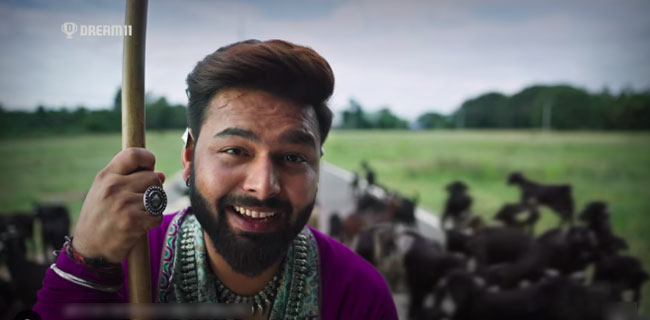
    And am I glad that Dream 11 is an exception that survives. Because it’s the only piece of communication which stands out with a good thought ”Uthana hai to uthana padega” (If you have to lift, you have to get up), alluding to the cricket heroes having to make an extra effort to lift the cup.

    Not only is the thought interesting its execution is also spot on by using the out-of-sight-out-of-mind Rishabh Pant as the anchor exhorting his teammates.

    Or does it point to the fact that Rishabh Pant is the next Virat Kohli or Dhoni in terms of his status and acceptance by the Indian public?

    Talking about execution there were two ads that I saw which had interesting thoughts. But the execution left a lot to be desired. First was Oreo. The thought of ‘mat bol’ (do not speak) captures the Indian thinking of ‘nazar lagna’. Of not talking about something because if we do then it won’t happen. It will be jinxed. And it sounds eerily true if one looks at all the campaigns run in the last decade which were in the hope and build up to India winning the world cup. But the straightforward mouthing of the concept by Dhoni and no creative leap points to a wasted opportunity

    The second one is Kit Kat. They have used the thought of fingers crossed. Though, my first thought was “fingers crossed” Indian enough for the masses to understand? The execution was better than Oreos straightforward narration but this too was a case of missed opportunity.

    But wait, I discovered that Kit Kat had done an exactly similar campaign in the UK in 2010 hoping England will win the Football World Cup. Well, so much for originality and creativity. And the gall to use a jinxed thought!!!

    It may also point to the fact that account planners are playing a bigger role in brand strategy. But were these ads also scripted by account planners? Oreo sure looks like one.

    On Kit Kat, one thought. Why doesn’t Nestle use Mrs Rohit Sharma? In almost all matches, not just at World Cup but even much before, my lasting image of hers has been sitting with her fingers crossed on both hands. She will be the best brand ambassador for fingers crossed. You read it here first, Nestle.

    And Dhoni is still endorsing more brands than the Rohit Sharma. Does it mean that Rohit is not as bankable, even though he is breaking records and is the Indian captain?

    I daresay that Bumrah seems to be more bankable than even Rohit. After Kapil, Sachin, Dhoni and Virat he is the next Boost endorser. And also Thums Up. Now, which brands have I seen Rohit Sharma endorsing? Hmm, let me think. An airline… was it Emirates? I think I saw him in a frame of Bookings.com too. But I saw Rahul Dravid also being used. And not many brands used Rahul, even during his heydays. You draw your own inference.

    Then brands like Booking.com and Mak Lubricants were desperate to connect to cricket. Howzatt for the perfect stay. Huh! Seriously?

    There were Parle brands like Kisme, Kacha mango bite, platina… but I forget what they were all about. Same for Sting. Or MRF. All eminently forgettable. And guess what, Sachin has ditched MRF for another tyre brand. Was it Apollo? Or did MRF ditch Sachin? Musical chairs, I say.

    But the other brand which caught my eye was Herbalife. Not for its insight, nor for its strategy and definitely not for its execution. But for the fact that it has used varied sports stars giving them equal prominence and weightage. Manika Batra, Mary Kom, Smriti Mandhana and Virat Kohli. It has also used Ronaldo for a long time. It was not a Kohli-dominated ad and Kohli just happened to be in it like all others. Brave decision. Because I am sure it must have paid many more times the amount paid to Kohli than others and still to resist the temptation not to give him a higher exposure is commendable.

    Amul must have been worried that it’s a jinxed sponsor given the results of Sri Lanka and Afghanistan. But last night’s result would have given it some relief. And of course South Africa is its trump card.

    My reckoning is that Disney Hotstar, did not anticipate the India-Afghanistan match to last for 85 overs. What otherwise explains the fact that close to end of the match, when 2 crore people had switched on the live streaming, they ran out of advertising inventory. While, when Afghanistan was batting and at the start of the Indian innings, with live streaming figure fluctuating between 90 lakh to 1.5 crore most of the advertising was scheduled. Go figure.

    And for the India-Pakistan match, I had both my laptop and my mobile switched on to Disney Hotstar and both had different inventory of ads. How does this happen? Different streams within digital too?

    So, are there any conclusions. Yes, one big one. Advertising in the times of digital is getting swayed by all digital parameters. It’s about measurements. It’s about brand presence. Disney Hotstar displays a figure of how many people are watching the livestream next to their logo on the top right-hand corner. And I think brands reach orgasam with such figures. Big metrics which run into crores of viewers (read measurable metrics) means everything. What happened to brand building? What happened to storytelling? Did those crores of people even register your brand? Or did they even connect with it?

    What else explains that almost all ads were straightforward presentation of benefits. Statement of facts. The types of services offered. So Lendingcart.com ad had no differentiation. No insight. No emotional benefit. It could have been and ad for Groww for all you know. That’s what Oreo did. Got Dhoni to mouth some superstition and then tried desperately to connect with the brand. There were some big brands. MRF, Parle, Pedigree…none tried any bonding with its target group. None tried to connect. No story telling techniques like twist at the end, stimulus response or even building momentum was used.

    Some brands may not feel the need to build a brand or differentiate. They may think they already have a strong positioning and they need to be just reminder brands. Maybe that’s why Finolex Pipes or Avalon cycles just used static presence of the brand name and maybe a line. But do all brands fall in this category? Categorically, no.

    And then the industry moans that it is losing relevance and not attracting talent or not getting enough remuneration. What you dish out is what you get. It’s not a chicken or an egg syndrome. It’s not a vicious cycle. Break the cycle. Start building brands. Rediscover the art of storytelling.

    Maybe I am jumping the gun. Maybe the next few weeks will prove me wrong. I did see some new ads in the India-Pakistan match from Credit Bee, Thums Up and Snickers. More about the same next time.


    Vikas Mehta is a senior marketing services and business strategist and educator based in Dehradun. He writes on MxMIndia every other Monday. His views here are personal.
     

  • Cheil’s Experience Commerce bags MRF mandate

    By Our Staff


    Experience Commerce, the digital marketing arm of the Cheil Digital Network, has announced winning the World Cup 2023 Media mandate for MRF Tyres on Hotstar. As part of the deal, Experience Commerce (EC) will provide its creative and media services to MRF.


    Notes a statement attributed to Team MRF: “This partnership signifies a significant milestone in our journey to engage with a new generation of consumers and highlight the outstanding features of MRF Tyres. Experience Commerce’s innovative approach and digital marketing expertise are perfectly aligned with our objectives. Together, we aspire to create a lasting impact and elevate the MRF brand to new heights during this World Cup.”


    Added Umesh Bopche, CEO of Experience Commerce: “I have a profound love for cricket, and this being the biggest cricketing tournament (the World Cup), makes this deal exceptionally significant to me. We are ecstatic to announce our resounding triumph in securing prime advertising real estate on Hotstar for MRF Tyres during the highly anticipated World Cup 2023. Our vision is to achieve unparalleled brand recall and reach new heights with our strategically placed ads. Watching MRF ads during the matches will undoubtedly evoke that familiar feeling of trust, legacy, and dependability. MRF has entrusted us with their vision, and we are committed to elevating the MRF brand to iconic status, leaving an indelible mark in the hearts and minds of millions of viewers worldwide.”


  • Utterly Butterly World Cup-ilicious


    As India takes on New Zealand in the semis today, we do a quick recap of the World Cup so far via our favourite Amul ads. Watch on…


    India Vice -Captain breaks World Cup record! – (July’ 19)


    Rohit Sharma, first Indian to score four centuries in a World Cup! – (July’ 19)


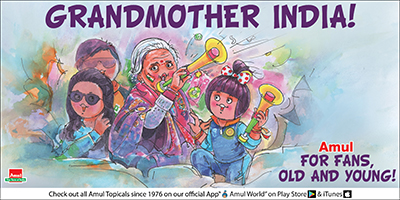
    87 year old Super Fan cheering Indian cricket team makes social media waves! – (July’ 19)


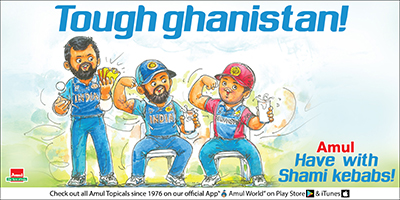
    India pip brave Afghanistan via Shami hattrick! – (June’ 19)


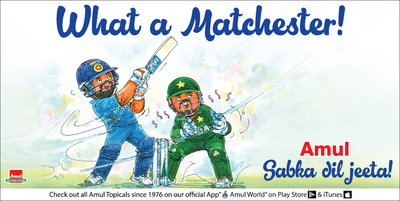
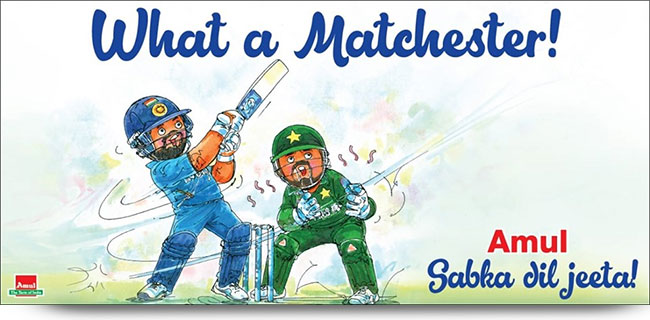
    India convincingly beat Pakistan in CWC 2019! – (June’ 19)


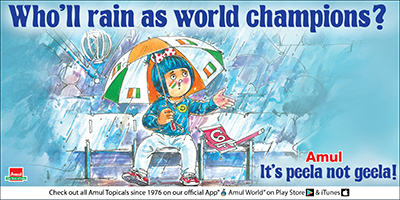
    Matches washed out at CWC 2019! – June’19

  • Co-creation is the need of the hour!


    By Sanjeev Kotnala


    Is it time to co-create? You have to decide. Are you going to leverage the potential of co-creation NOW or willing to regret later?

    The IPL is over, rains are settling in, and the World Cup is reaching towards its climax. And the festival period is still some time away. The Cannes Advertising Festival is over. The party and congratulatory messages will dry out soon. The fire for missing out will die quickly. There is no better time than now to start afresh.

    The month of June has ended and the brands are busy firming up their strategies. The proactive ones are briefing their agencies. The real smart one is getting into research to evaluate creative.

    Soon the laptops and servers in media agencies will start heating up. The media owners will start racing up to client and agencies for their share of advertisement investment.

    The silos working within the industry silos will come alive with a heightened buzz. They will create an illusion of working as well-oiled machinery.

    Everyone across brand ecosystem is interested in getting his or her point of view in the final brand strategy and execution. The ego will start popping up uninvited. The bitching will start. Idea ownership and emotional attachment to the ideas will further deepen the gap between silos and define the new turf.

    Soon the year will be over. The independent units in the ecosystem of interdependence would have once again failed to co-create. You have to decide. Are you going to leverage the potential of co-creation NOW or willing to regret later?

    Management will haul HR. Some of them will get a consultant to speak and introduce Co-creation and celebrate it as a contribution of learning and development programme.

    Co-Creation is a must for the brands?

    Come to think of it. Co-creation is the basis of life on the planet. There is hardly anything ever created, destroyed, administered, implemented or achieved without co-creation. It is almost like nature has been serving you the secret of sustained success and growth. But that is the discussion for some other day.

    Failure to co-create is a disservice to the brand. In absence and resistance to co-creation, the brand continues to remains chained to creativity as experienced, expressed, exploited and explored in our area of expertise or profession by the brand custodian and team. Newton’s law of communication.

    Co-creation helps to get leveraged cross-pollination of ideas. It allows for positive evolutionary mutation. Darwin theory of evolution.

    Co-creation uses every creative superpower of Making, Hacking, Teaching and Thieving. It builds on the medium and brand promise with Saam (Logic, rational, inference), Daam (Price or opportunity), Dand (Penalty, constraints, frugalism) and Bhed (differentiation, uniqueness, relevance doubt) philosophy.

    Co-creation raises questions and seeks collective wisdom to make things possible. Collective wisdom is a level of knowledge, understanding and wisdom that is impossible to be accessed by any individual. Just having people in the room does not evoke collective wisdom. Collective wisdom is only in operation in groups responsible for a joint action addressing singular probortunity wit complete freedom and empowerment.  It stretches the capabilities and breaks the barriers for the best results.

    Co-creation is omnipresent in the advertising-marketing arena.

    The creative agency and the client co-create the campaign, and research, insight and concept testing represent the consumer. The media, event and activation agencies play an essential role in co-creating the whole experience and engaging the desired audience.

    In all of this process, one critical silo remains traditionally unengaged. The media. And in the process, the brand is ultimately losing out on the chance of co-creating some unique media solution.

    Involve Media In Co-Creation!

    It’s rare when the clients and agencies include media in the co-creation process. Maybe they find media entirely transactional. The media is always fighting the war for a share of wallet. They have rarely shown interest in understanding the brands probortunity.

    No doubt, the client and creative agencies have not considered them worthy of a brand communication discussion. Most in media have no experience of the fun, charm and fruits of inclusive co-creation through multi-functionary teams?

    However, people in media know how the brand strategic direction can be best leveraged in media through innovative usage and representation.

    Can Media Take The First Step?

    Maybe the media can take the first step. Perhaps it is time for media owners to work with their most innovation savvy, creatively inclined, quick decision making clients and brands. Time to experiment with co-creation.

    This is best done with a classical cross-functional team in a two-day offsite workshop. Workshops like InNoWait and ideal harvest, and the one based on designing thinking, constraints breaking, collective wisdom and/or brain-swarming in a liberate framework works the best.

    I personally swear by the controlled positive rivalry infused in these cross-functional teams. Each of them pushed to explore the possibilities. The results are nothing short of being magical.

    Ideas left at directional developmental stage usually die archived in presentations that are never reassessed. Hence, I suggest co-creation events and workshop take that extra leap of faith and complete the loop by developing the whole idea, including implementation routes.

    It does cost time and money, but the results you get are disproportionate. Efficient communication, lowered media weights, revenue and enhanced brand imagery, are some of the by-products.

    Co-Creation Team.

    The most effective co-creation team has a comprehensive representation. It is an inclusive team with consumer, influencers, research, client, creative, media agency and media owner team as members. Getting media production department representation further strengthens the team.

    More To Co-Creation?

    Co-creation expects that all the members be on the same page on probortunity (Problem or opportunity) definition. This includes brand positioning, strategic intent, experience and possibilities.

    The members are chosen not for their designation and seniority, but for the mind-set, attitude and passion.

    Co-creation is like the roulette table. You need to play big to win big. Most importantly, you are empowered to make the call.  The decision makers are at the site as an unbiased observer.

    Get An External Pied Piper For Co-Creation.

    That’s the final requirement. The Facilitator.

    You need a Pied Piper to excite the child inside the participants. One who will ensure that the game is played with complete transparency, honesty and curiosity?

    The facilitator job is to channelize ideas and keep the heat on. The facilitator ensures participants are not trapped within the coordinates of constraints and excuses. The ideas are not killed in mind. The participant continues to indulge in a childlike curiosity allowing them to question all barriers with a simple ‘Why Not?’ Hence, the facilitator must not represent any of the participating silos.

    Co-Creation Is Collective.

    Co-creation is format, category and media agnostic. It can be used for a tactical or thematic purpose. It can lead the communication or act as a support.

    The real fun of co-creation is that everyone is creative and curator. The best idea emerges with collective ownership and increased passion pushing its chances to succeed.

    PRINT Can Best Benefit From Co-Creation.

    Though co-creation can happen across every silo in the brand ecosystem of a brand. In the advertising arena, Print media, both newspaper and magazine are the most promising area for co-creation and its benefit.

    Co-Creation – Don’t Kill The Golden Goose.

    Co-creation works when all the participants have a singular objective. In the business of communication, that is the universal uniting force, the best for the brand. In such a situation, the frame of mind needs to be of expanding the range of possibilities.

    The associated Media should be set reasonable charges for execution; they should freely help execute the idea in another media. It’s tough, but in an idealistic situation, if it seems so, they should willingly acknowledge that the brand would benefit more when the idea is executed in a different media. The ‘Go-Giver’ attitude is something that will be appreciated by anyone and sooner or later benefits the brand and the media.

    Caution

    Co-creation is for equal accountability and responsibility. If you get credit for the excellent work, the team collectively must be willing to take it on the chin when the idea fails to give the expected results. Also, do remember that neither advertising nor co-creation is the answer to every probortunity.

    How To Fail In Co-Creation?

    It is easy to fail in co-creation. Carry your ego inside the co-creation room. Create a situation of negative rivalry among teams. Make it a place to demonstrate capabilities. Seat, talk, discuss hierarchically. Make a singular department responsible for co-creation. And then the absence of engaged senior with decision-making capabilities are some of the ways to make it ineffective. Otherwise, just follow the nature secret- Co-Create.


  • India-Pakistan Ratings: Busting the Fragmentation Myth

    The Amul ad on the India-Pakistan World Cup match


    By Shailesh Kapoor


    The ratings for the India-Pakistan World Cup cricket match on June 16 are out. The hopelessly-one-sided game scored a whopping 18+ TVR (Urban All India). Ratings nearing 20 can only evoke nostalgia for those following the Indian TV market over the years. It’s in the first half of the decade of 2000s that one would see such numbers for daily shows, with Kyunkii… and Kahaani… leading the way for a while. Thereafter, the numbers progressively dropped, a trend that’s generally believed to be an outcome of the launch of more channels and the resultant fragmentation of content choices available.


    The top Hindi GEC show moved from the 20-mark in early 2000s to the 10-mark late in that decade. In the first half of the decade starting 2010, the 5-6 level was aspiring enough. Today, even a 3-level is gold.


    Movie ratings have also shown a downward trend, but nowhere close to soaps. The top movie could do 15+ rating about 15 years ago, the equivalent of which is a 7-8 rating today. That’s a 50-60% drop, vis-à-vis an 80%+ more drop when you compare the top Hindi GEC shows across the same two periods.


    The popular belief has been that with the expansion of the measurement universe over the years, the true heterogeneity of the Indian market has a more and more significant impact on the TV ratings. That, combined with a multiplication in the number of channel options, would mean that fragmentation, and the resultant creation of a long tail, is inevitable.


    The India-Pakistan match ratings challenge this notion head on. The message from the audience is clear: If there’s content that carries a certain level of appeal and viewer pull, India can be fairly homogenous after all. Yes, there are more options and more diversity in the universe today. But there’s always content that cuts through, because it enjoys that broad-based appeal. And hence, justifying sub-3 numbers as the best-case scenario is only a self-fulfilling prophecy, whereby content creators and broadcasters are justifying low ratings as a market behaviour, than questioning them as symptoms of a loss in the collective ability of the industry to make truly mass, pan-India shows.


    One may argue that big-ticket sporting events have the ability that genres like drama, comedy and non-scripted content lack. That’s a fair argument too. But one is not expecting the top show to deliver 18-rating. Even the inert and one-sided India-South Africa match touched the 6-mark (averaged over more than seven hours, no less!). That’s surely a level a top Hindi GEC show should aspire to achieve. But today, even half of that is being celebrated as an outright success.


    If these signs continue, we may soon be a television market where sports, news and movies become the staple, and drama the alternative. It has already started happening during events like the IPL, the elections and now the World Cup. It could be a matter of time when more routine days begin to exhibit this trend too.


    If all the content creators can take a week’s break from their OTT pre-occupation and think about this, I’m sure they have the collective ability to come up with something worthy. The real question is: Do they have the will? Or has television already been reduced to a fuddy-duddy medium that’s not even cool to ideate about?


  • Cricket World Cup So Far: Still Waiting to Launch?


    By Shailesh Kapoor


    It’s three weeks since the ICC Cricket World Cup started in England. 22 days and 26 matches later, the excitement is still waiting to build up. A multitude of factors have ensured that this probably the least exciting Cricket World Cup in a long time, from a cricketing perspective.

     

    From a marketing and media perspective though, there are no such concerns. India matches have rated very well, and the India-Pakistan ratings, which will come in next week, are likely to hit the roof anyway. Brands have piggybacked on the once-in-four-years tournament well, and the match timings are highly conducive to India, making the Cricket World Cup a highly lucrative media event.


    But all of the above is an India story, and an off-field story too. On field, the tournament has struggled. Four of the 26 matches have been rained off so far. Thankfully, the rains have relented over the last one week, preventing this World Cup from becoming a farce purely on grounds of poor weather.


    But even as the rains relent, cricket fans wait for exciting games. Only 3-4 games have reached a point where the winner is not evident with 10 overs to go in the second innings. It seems only five teams have really turned up, prepared to play hard. Four of these – Australia, England, India and New Zealand – are near certain to be the four semi-finalists, while the fifth – Bangladesh – has put up better fights than more seasoned teams like South Africa, Pakistan, Sri Lanka and West Indies.


    It’s a format tailormade to enable tight scenarios on the points table, where one can be waiting till the last few games to know the final composition of the semi-finalists. It happens in IPL every year, and happened in the 1992 World Cup too, when this format was last used. Pakistan, the eventual winners, had to win virtually everything in the second half of the league stage to qualify. And they did!


    But so far, chances of any such drama happening in the last one week look very remote. It seems that the next two weeks will only decide who plays whom among the four near-certain semi-finalists. And that is sure to rob the World Cup further of excitement.


    Now, a lot of this is not in ICC’s control. You cannot worry about South Africa looking sub-par and not being able to win more often, for example. But much as ICC can’t control it, there is enough and more for them to reflect upon. Attendances at the Asia matches have been very good, with Indians and Bangladeshis in particular packing the stadia. But this sub-continental colour that cricket is acquiring surely cannot be healthy. I was in the UK for the first 10 days of the World Cup, and there was no buzz or talk about the tournament at all. The local newspapers dedicated 2-3 full pages to football, vis-à-vis half a page to an England game in the Cricket World Cup. You could drive around the city of London for 2-3 hours and stare pointedly at every hoarding, and yet, not know that there’s a big cricket event going on here.


    Cricket has faced the globalization challenge for years now. While Afghanistan and Bangladesh have come in stronger over the last few years, there hasn’t been much progress in the rest of the world. 50% of the teams in the World Cup are from the sub-continent. Surely, this cannot be a right step in the direction of globalization. Something for ICC to worry about deeply.


    It’s perhaps also an issue with the 50-over format itself. Eight hours of viewing is not a premise on which you can grow a sport in today’s age. Perhaps T20 needs to take the centerstage after all, and Test cricket can be the variant for the connoisseurs. ODIs seem to have a questionable future at this point of time. But these are difficult calls, and the playing nations will be understandably reluctant.


    We may still see a late surge by one of the weaker teams, and this World Cup could suddenly light up. And eventually, in the last one week, it will be about what India’s final outcome is. That’s the beauty of sport and the passion it evokes.


  • Livguard joins in WCup chorus with #LeAaoGhar

    By A Correspondent


    Livguard has unveiled its latest campaign #LeAaoGhar to cheer team India. Through its digital film, the brand focuses on the emotions of every Indian across varied walks of life, be it a school-going kid, an army officer or a corporate employee connected with their family and reminiscing the moment spent with their loved ones.


    Commenting on the initiative, Gurpreet Singh Bhatia, CEO, Livguard Energy Technologies: “Since the cricket fever is so high during the World Cup, we are delighted that we could contribute our bit through these initiatives. The campaign is designed keeping in mind the unity and enthusiasm that the nation bleeds during the World Cup. With #LeAaoGhar, we are supporting the spirit and fervor of every Indian towards encouraging team India to bring the cup home with pride.”


  • Ariel supports team India with #2011Dobara ad campaign

    By A Correspondent


    Ariel has launched a campaign around the upcoming World Cup re-enforcing the faith in Team India that we can repeat the 2011 victory.


    Notes a communique: “Ariel’s #2011Dobara takes viewers down memory lane when India won the World cup in 2011. The ad film touches the sentiment that we as Indians are superstitious by nature and consider things to be lucky for the match. Ariel’s new campaign hopes to repeat the magic of 2011 win and at the centre of all this is the lucky jersey that people hold so close to them.”


  • MSM makes most of IPL ‘mauka’, nets 9 sponsors

    By Ravi Teja Sharma


    Multi Screen Media, the official broadcaster of the Indian Premier League, has managed to sign up nine sponsors for season eight even as the ongoing Cricket World Cup is giving it stiff competition. The league has signed up Amazon and Vodafone as presenting sponsors this season and advertisers including Hero MotoCorp, Intex Mobiles, Cardekho.com, Pepsi, Vimal Pan Masala and Paytm as associate sponsors, according to Rohit Gupta, president of Multi Screen Media.


    Rohit Gupta

    “We had eight sponsors last year but this year we might have to increase our sponsorship slots to 12,” said Gupta. Although Gupta declined to comment on the revenues that Multi Screen Media expects to get from IPL 8, industry executives indicated that the broadcaster could make up to Rs 950 crore from advertising this year, coming close to its revenue figure in 2013, when the league had 76 games.


    With 60 games, IPL made about Rs 800 crore last year. IPL has been riddled with controversies over the past few years, especially the spotfixing and betting scandal that rocked it in 2013. However, Gupta said such controversies do not impact viewership.


    “For consumers, it is the best cricket being played and till the cricket is good, viewership won’t drop,” he said.


    In 2014, despite the controversies, a watershed election and the first half of IPL being moved to the United Arab Emirates, the tournament saw its viewership grow 7% from that in the previous year, to 192 million from about 175 million.


    Ratings for IPL, according to Gupta, have been stable for the past three to four years.


    With the IPL coming close on the heels of World Cup, advertisers were cautious initially, Gupta said. “But we were able to convince them because we had ratings to back us.”


    Vinit Karnik, national director, sports and live events at GroupM ESP said it was never an either-or situation between the World Cup and IPL for advertisers.


    “India has an appetite for both, which is what was proven in 2011 as well,” he said, pointing out that IPL is a seasonal league and people have planned marketing campaigns around it. “It is part of the calendar for marketers now,” he added.


    Controversies have, however, impacted the brand value of the league.


    According to brand valuation consultancy Brand Finance, IPL’s brand value peaked in 2010 at $4.13 billion but dropped to $2.92 billion in 2012. It picked up again in 2013 to rise to $3.03 billion.


    Another brand valuation firm American Appraisal India pegged the value of the IPL at $3.2 billion before the start of the 2014 edition of the tournament.


    Source:The Economic Times

    Copyright © 2015, Bennett, Coleman & Co. Ltd.

    All Rights Reserved, Licensed to republish


  • More ads go digital as ICC World Cup action shifts to sites, apps

    By Vijaya Rathore & Ravi Teja Sharma


    The morning and working hour timings of matches in the ongoing cricket World Cup have made millions of sport lovers follow the action on dedicated websites, apps and social media, prompting several big and small brands to latch on to digital advertising like never before.


    Brands across industries, including Lufthansa, Accenture, Tissot and Hero are looking to catch the on-the-move consumer on a variety of platforms including official broadcaster Star India’s starsports.com, social media sites, cricket portals and apps such as Hotstar.


    “Some of our clients have looked at digital very seriously. Hero, for instance, has bet heavily on digital and it is really doing well for the brand,” said Praseed Prasad, national director for digital trading at media buying firm GroupM India. Another client of his, Pepsi Lays, has chosen to do more on the digital side and only advertise on television during select matches in the World Cup this year.


    A spokesperson for Star India says they have seen an exponential growth in consumption online. This World Cup, Star has got around 35-40 advertisers, including Lufthansa, Accenture, CarTrade, Tissot and Hero for its online platforms, with about 20% of those exclusively on the digital medium. “Revenues from digital will be significant this time,” the person said.


    Hero is the co-presenting sponsor of the World Cup 2015 digital. “The medium has seen exponential growth in terms of traffic,” a Hero MotoCorp spokesperson said. It is the lead sponsor on the property with branding/inventory in terms of video inventory, logo presence, banner ads, special sections such as replay and match insights, and has also launched a dedicated app, Hero Super Skipper, the spokesperson said. “This association is a strategic move, owing to a perceptible shift in viewership patterns in favour of digital medium.” The India-Pakistan match at the beginning of the tournament, for example, got over 25 million views on Star’s digital platforms, the highest in the world for a single game.


    Firms such as DishTV have created fresh campaigns around the World Cup. “Most digital campaigns are either in the form of graphics or extension of TV campaigns but we created one especially for the digital medium and that has helped us reach the young consumers, the millennials,” said Salil Kapoor, COO of DishTV.


    He said the interactive nature of the digital space helps consumers to make purchases by routing them to the firm’s call centres if they wish to. Also, a television ad campaign costs at least 3-4 times more than a digital campaign, Kapoor said. DishTV has shot a campaign with brand ambassador Shah Rukh Khan to promote their HD channels during this world cup.


    Digital adoption by brands is on the rise with large companies now allocating significant spends to this medium. “From about 2-3% of a large company’s marketing budget, digital is now in double digits,” says Ahmed Naqvi, CEO at digital and social media agency Gozoop.


    Source:The Economic Times

    Copyright © 2015, Bennett, Coleman & Co. Ltd.

    All Rights Reserved, Licensed to republish


  • Bonding takes a new meaning in Fevikwik’s latest TVC

    By A Correspondent


    Fevikwik unveiled its new TVC campaign titled Fevikwik ‘Todo Nahin, Jodo’. Launched during the India vs. Pakistan match during World Cup, 2015 the campaign incorporates humor to promote the message of peace and harmony using the theme of bonding. Titled as ‘Parade TVC’, it subtly weaves in the brand attributes of Fevikwik as an instant adhesive promoting the broader message of strengthening bond between people.


    Vivek Sharma, Chief Marketing Officer, Pidilite Industries Ltd, said, “Fevikwik as a brand is known for its instant adhesion quality. In line with Pidilite’s tradition of using humor in its advertising, the new TVC takes a witty perspective on human bonding. We launched the campaign with the India-Pakistan match at the World Cup 2015 because cricket, like Fevikwik, bonds people together. We believe the new Fevikwik TVC elevates the brand attribute of bonding from a functional to emotional level.”


    Commenting on the campaign, Piyush Pandey, Executive Chairman & Creative Director, South Asia- O&M said, “Fevikwik is about solving problems. Fevikwik is about bonding.  Fevikwik is about bringing a smile on the face of everyone in the world.”


    The TVC will be aired during the World Cup across key Hindi speaking and regional markets.


  • Weekend blues: Less than 10 days to go & Star Sports doesn’t have lead sponsor for the World Cup!

    By John Sarkar


    India’s dismal performance in the recently concluded tri-nation series Down Under has left advertisers uncertain. With less than 10 days left for the ICC Cricket World Cup, Star Sports, which will broadcast the tournament, has not yet found a lead sponsor.


    With 90% of TV viewers in the country having watched the previous edition of the World Cup, advertisers expected that the flagship tournament of ODI cricket would garner millions of eyeballs. But India’s poor form, lack of star players, the waning appeal of ODIs, non-primetime telecast and the impending IPL has made advertisers play safe. They would rather prefer to sit on the fence and wait for the right moment.


    “We will look at it match by match. Depending on India’s performance, we will decide whether to buy on-air advertising slots or not. We don’t want to put all our eggs in one basket. The IPL starts right after the World Cup and the return on investment for it doesn’t depend on a single team’s performance, like it does on India’s in the World Cup,” said a senior executive with one of the world’s largest FMCG firms.


    According to people familiar with the matter, most on-ground sponsors (commercial partners) of the World Cup, such as PepsiCo India and Hyundai India, have not yet bought on-air advertising spots. When contacted, spokespersons from PepsiCo India and Hyundai India declined to comment.


    However, a Star Sports spokesperson said that on-ground sponsors too have plans which include on-air, digital, activations, screenings, though he refused to divulge any names.


    Lead sponsorship for all feeds and languages is being offered at around Rs 60 crore, the associate sponsorship for over Rs 40 crore for all feeds and over Rs 20 crore each for English and Hindi feeds, and about Rs 10 crore for HD feed.


    “We already have confirmations for over 80% of our inventory for the opening match of India vs Pakistan, with many more confirmations to be closed over the next 10 days. Considering the response, we might have to drop at least 20 to 30 spots in the very first match. We are almost sold out for the top 13 games (all India plus knockout games) and are in the process of closing the balance,” said the Star Sports spokesperson.


    Market experts say not everyone is sitting on the fence though. Many first-time World Cup sponsors, including Nestle, Marico, Yepme, Paytm and Raymonds, have signed up. A lot of advertisers are eyeing digital feeds that allow online streaming and is more affordable than TV ads. But media buying experts said on the condition of anonymity that a significant amount of total ad inventory is still sitting idle.


    Source:The Economic Times

    Copyright © 2015, Bennett, Coleman & Co. Ltd. All Rights Reserved

    Licensed to republish