Tag: Thums Up

  • Thums Up salutes Paralympic Athletes

    By Our Staff


    After its #PalatDe campaign at the Tokyo Olympics 2020, homegrown cola brand Thums Up has now partnered the Tokyo 2020 Paralympic Games. Through this partnership, Thums Up aims to encourage inclusion and salute the real heroes of Tokyo 2020 which started yesterday (August 24) and is on till September 5.


    Announcing the partnership, Arnab Roy, Vice President and Head-Marketing, Coca-Cola India and South West Asia said: “We are extremely proud of this strategic partnership with Tokyo 2020 Paralympic Games and the Paralympic Committee of India, it is our way of standing in solidarity and saluting the sheer grit and determination of these athletes who have come from different walks of life but showcase the same heroism against all odds and challenges. As an extension of the Olympic Association, we treat the Paralympians at parity with any other athlete fighting their naysayers and representing India at this global sporting event.”


    Added Sukesh Nayak, Chief Creative Officer, Ogilvy India: “#TaanePalatDe is our ode to the heroes of Team India who have overcome all odds to represent India at the Tokyo 2020 Paralympic Games in Japan. With this campaign we are saluting their courage to #PalatDe all the naysayers who had only one thing to give them, Taanas.”


  • Is Thums Up losing its Thunder?


    By Prabhakar Mundkur


    When Coca-Cola launched Thums Up Charged with great fanfare two years ago, they might have consciously ignored what was happening to the cola market in general.  The signs of decline in colas has been a global phenomenon for some time now. An increasingly health conscious population, especially amongst the millennials, has meant that colas in general might not be the preferred beverage. Consumers are increasingly moving to juices and non-cola beverages and colas are no longer as ‘cool’ as they were even a decade ago.  The logic of therefore launching a extra fizzy Thums up Charged defied the logic of a cola market already under pressure. If fizz was unhealthy then extra fizz was likely to be even more unhealthy!


    The government has also held the health banner to cola products by classifying them as ‘sin products’ and have taxed them heavily.  As with most other harmful products like tobacco, colas attract 28% GST and a 12% cess or ‘sin’ tax. It is unlikely that colas could have carried this new burden in addition to a shift in consumer attitudes to more healthy beverages.


    So the prediction of $1 billion revenue announced with the launch of Thums Up Charged may have been a little premature.  The company has not yet announced if it met that target.


    So, what happens when brands don’t do as well as they are expected to? Typically, they change agencies. After all advertising agencies are the easiest scapegoats for CMOs when they have to answer to their superiors.


    What then might have taken the Thunder out of Thums Up?  Toofani Thanda or Taste the Thunder which evolved to Main Hoon Toofani,  Live the Thunder and Aaj Kuch toofani karten hain was a classic positioning that the brand has held for years and made it the leader in the market for the last few decades since it was first acquired by Coca Cola in 1993. Thanda in Hindi has been the generic label for all colas.


    The Thums Up Masculinity Model

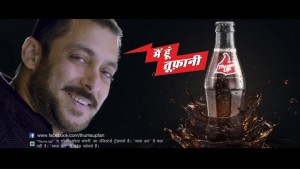
    The earlier masculinity model projected by Thums Up represented pure machoism with Salman Khan. There was something raw about it.  In this, model men were expected to be muscular, drink a few gallons of alcohol without getting intoxicated and strong enough to be heavy smokers. Ian Fleming’s James Bond in his books represented this kind of raw masculinity. Typically, men projected toughness and independence and seemed invulnerable.  Brands and marketers projected this masculinity by finding appropriate role models and celebrities and for Thums Up it was Salman Khan. For other brands like Cinthol in the old days, it was Vinod Khanna that represented this kind of masculinity.


    https://www.youtube.com/watch?v=cCqG3FTdEMw


    When Thums Up made the change from Salman Khan to Ranveer Singh, they made a conscious effort to change the original masculinity code of Thums Up.  The launch of Ranveer Singh with Main Hoon Toofani theme, had Ranveer in a feat where he helped schoolchildren out of a bus that was about to fall in to a gorge.  Heroic and a social do-gooder yes, but was it masculine enough? Probably not.  Earlier commercials for Thums Up had shown Salman go to any lengths to get his bottle of Thums Up and in the process overcome several hurdles.  In comparison the new Ranveer film did not have the same purpose. Also, variant advertising is not easy. How do you differentiate variants adequately in advertising so that the classic variant is different from the new variant?  Did the Ranveer commercial achieve this distinction of differentiating Thums Up Charged adequately from the classic Thums Up? I am not sure.  It was not clear what the emotional benefit the extra fizz resulted in for the Ranveer commercial.


    https://www.youtube.com/watch?v=CgEVNWdfIEo


    Cutting to the latest commercial in November 2018 for Thums Up lacked both a theme and any substance.  Ranveer Singh seemed to be running away from thugs and finally escapes them with a swig of Thums Up before he jumps into some rapids.   Heroic again but not particularly masculine.


    https://www.youtube.com/watch?v=KPjy_6pX9wA


    Contrast all this advertising with the Salman Khan advertising of yore.  Maybe it was time to bring the real Toofani back to Thums Up. Which might explain the change of agencies from Burnett to Lowe.


  • Lowe Lintas bags creative mandate for Thums Up

    By A Correspondent


    Leading cola brand Thums Up has appointed Lowe Lintas to handle its creative duties. The mandate comes after an intense multi-agency pitch involving leading agencies in India.


    Said Naveen Gaur, Deputy CEO, Lowe Lintas: “We are thrilled to have won Thums Up, the iconic cola brand of the country. Lowe Lintas is known for creating and nurturing leader brands. To be awarded a brand like Thums Up that is already India’s icon is a great compliment to our brand building capabilities.”


    Said Shrenik Dasani, Vice President, Sparkling Category at Coca-Cola India & South West: “For over 40 years running, Thums Up has brought the taste of thunder to Indian taste buds. It has always been a unique icon of masculinity which reminds us that heroism is a choice, that we can unleash our true potential if we only choose to push the boundaries of self-belief.  We are very excited to continue finding refreshed expressions of this thought, now with our new partner – congratulations to Lowe Lintas on winning the pitch and agreeing to join hands with us. This partnership comes at a truly epic stage of our journey, as we move ever closer to reaching the 1 billion-dollar mark, and as the brand begins to expand beyond India, into South-West Asian markets. We couldn’t have thought of a better ally to help us take the thunder deeper into Indian youth’s hearts and minds.”


  • Coca-Cola launches campaign for no-sugar variant of Thums Up

    By A Correspondent


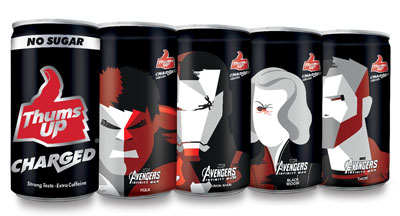
    Coca-Cola India announced the launch of Thums Up Charged No Sugar, its home-grown beverage to be offered in a no sugar variant


    Commenting on the launch, Ishteyaque Amjad, Vice President, Public Affairs & Communication at Coca Cola India & South West Asia, said, “Coca-Cola India is accelerating its strategic evolution to become a total beverage company by offering innovative and localized beverage choices to consumers. The launch of Thums Up Charged No Sugar not only marks the expansion of our product portfolio but also demonstrates our efforts to innovate products locally that meet changing consumer tastes and preferences. This is a significant milestone for us in our sugar reduction strategy and I am delighted to announce that leading this journey is our very own home grown brand Thums Up.”


    Added Vijay Parasuraman, Vice President-Marketing at Coca-Cola India & South West Asia: “Last year, we introduced Thums Up Charged to celebrate the forty thunderous years of the iconic brand Thums Up and were elated to see the love amongst our consumers. We are now eager to take the iconicity of this brand to the next level with Thums Up Charged No Sugar and recruit more consumers in our journey to make Thums Up the first home-grown billion-dollar beverage brand. The no-sugar, no-calorie variant is aimed at consumers who want to balance their sugar intake and enjoy their favorite drink as well. Additionally, we are supporting the brand by going beyond the traditional marketing practices and directly engaging with the consumers through interactive platforms and innovative formats.”


    Commenting on the TVC, Sainath Saraban, Creative Head, Leo Burnett, said, “Just like the effervescence that rises to the top in a bottle of Thums Up Charged No Sugar, the heroes too rise when it is time to prove themselves. Thums Up Charged No Sugar is a metaphor for the display of inner strength that superheroes demonstrate. Through this TVC, we have tried to achieve this in a visually gripping manner. The film is an association between two huge and exciting brands – Marvel Avengers and Thums Up Charged No Sugar. There is a palpable excitement, energy, action and joy that both bring to their fans.”


  • Introducing Ad Buzz, a new column by Prabhakar Mundkur


    Adperson, musician, bicyclist and someone who doesn’t hesitate to speak his mind…. every Thursday on MxMIndia.


    By Prabhakar Mundkur


    Prabhakar Mundkur

    The year-end was full of the cacophony of writers making predictions for 2018, or mundane reviews of 2017, in spite of the fact that a calendar year has no particular statistical significance for trend spotting.  Change is always continuous and never separated by any discrete intervals, especially an interval that lasts exactly twelve months. In some ways, 2017 may have just stolen the thunder from 2018, with the strides in artificial intelligence in the form of Sophia the Robot, or personal assistants like Alexa making a major impact in our lives towards the end of the year.


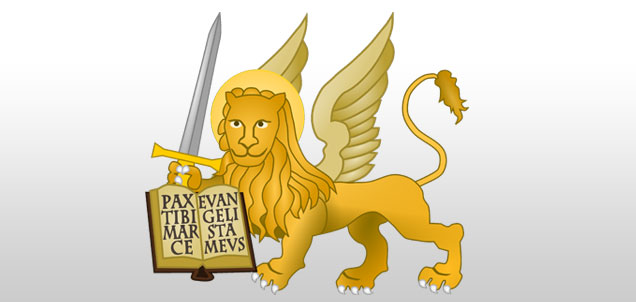
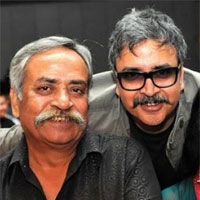
    But one bright spot for December was the Lion of St Mark awarded to the much-deserved Pandey brothers.  They have truly raised the bar of creativity to a global standard, besides putting India firmly on the advertising creativity map.   Showering undue adulation on our stars is an Indian trait and we do it constantly with all our stars, whether they are from cinema, sports or any other field.  We may just have added ‘advertising’ to the adulation list.


    With this award, Piyush and Prasoon Pandey join an illustrious band of creative people around the world that has included David Droga, Marcello Serpa, Bob Greenburg, Joe Pytka, Lee Clow, Dan Wieden and Sir John Hegarty.  Not everyone might be aware of the work created by these distinguished gentlemen, or even knowwhere they work.The Lion of St Mark is one of those awards that lets the winner soak in humility and pride so deserving of a life time award, which by definition implies that it can only be won once.


    St Mark incidentally is the evangelist pictured in the form of a winged Lion holding a Bible and is symbol of the city of Venice where the first Cannes was held in 1954.  But the significance of all this may be lost to many, or otherwisedismissed as unimportant.  At least one of our advertising weeklies, which covered the event exclusively, could well have educated their readers on the significance of the award.


    ~~


    For the marketing intellectual, the introduction of Thums Up Charged might hold room for an interesting debate.  Variants according to textbook marketers can endow the mother brand with rewards ranging from increased market share to a longer life.  But how does that augur for a category like colas, which is increasingly being seen as unhealthy?  And Thums up Charged might well be dubbed an even unhealthier variant given the extra levels of caffeine and the heightened aeration.  So how will an unhealthier variant of an already unhealthy brand perform?  Of course, to its credit, Thums Up remains the market leader in a market which has the world’s leading colas.  Another point to debate might well be how will the two variants will be differentiated in the advertising.  Will it be differentiated enough for the consumer to know which variant is being advertised or will the consumer just see it as another Thums Up ad? This often is the acid test for variant advertising.


    ~~


    If the rumour mill is to be believed at least one leading ad agency of earlier years shut down its Delhi office on Dec 31.  What a way to close 2017.  I believe the agency is managing its Mumbai office on skeleton staff.  Another well-known agency that at the turn of the millennium was threatening to hold the creative high ground is being absorbed by another agency in the same communications group.  As an ad guy, I find this kind of news depressing.  Partly because I always questioned the soothsayers and never wanted to believe in the death of advertising that has been a hot topic of discussion for some time now.


    For those of us who were celebrating the close of the old year, I am sure this is a week for sobering up and reflecting on what the new year holds for all of us.  The first week of a new year always feels like the end of one journey and the beginning of another.


    Having spent nearly four decades in the advertising business with companies like JWT, Havas and Y & R in India, Africa, and Asia, veteran adperson Prabhakar Mundkur is Chief Mentor at HGS Interactive, a part of Hinduja Global Solutions. He was LinkedIn’s Top Voice in India in 2016 and is a prolific writer. He recently set up PrabhakarMundkur.com as homebase for his writings. Ad Buzz will appear weekly on MxMIndia.com. The views here are his own.


  • Thums Up Charged inspires you to #TakeCharge with its new campaign

    By A Correspondent


    Thums Up has unveiled its new #TakeCharge adfilm with actor and Thums Up brand ambassador – Ranveer Singh.


    Commenting on the launch of the new campaign, Ajay Bathija, Director, Colas Marketing, Coca-Cola India & South West Asia said: “Thums Up TVCs are all about seeking thrill, adventure, exhilaration and excitement and Ranveer Singh as a brand ambassador embodies all of that perfectly. The ‘#TakeCharge’ campaign is about taking the controls of life in one’s hands and overcoming adversities by not giving up hope. Our TVC captures this attitude and we are confident that the campaign will resonate well with all Thums Up lovers.”


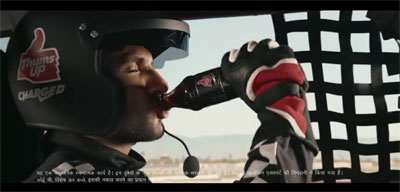
    Speaking on the TVC, Sainath Saraban, Creative Head, Leo Burnett, said: “Thums Up Charged is Thums Up with extra thunder in it – just the kind of push that somebody needs to take his or her achievement to the next level. Even though the story is set in a massive car race that makes for grand theatre, it is an intensely personal journey about how a huge victory starts within your own self. When I wrote this film, I wanted to leave the viewer with a message that worked at a product level and was inspirational as well. If there’s one thing we want people to do after being exposed to this communication, it is to – #TakeCharge.”


  • After Salman, Thums Up gets Ranveer Singh for a ‘Toofani’ act

    By A Correspondent


    Topselling cola Thums Up released its commercial starring actor Ranveer Singh, continuing with the ‘Toofani’ theme which had megastar Salman Khan as brand ambassador. The ‘Main Hum Bhi Hoon, Aur Khaas Bhi’ campaign is the second rendition of the creative expression – ‘Main Hoon Toofani’ which was launched early this year, notes a communiqué, adding: based on the idea of celebrating the ‘Khas’ in ‘Hum’, the campaign seeks to inspire its consumers to unleash their toofani or heroic spirit. It may be recalled in October this year, it was revealed that Salman Khan will no longer be endorsing Thums Up. Both Coca-Cola India, owners of the Thums Up brand, and Salman Khan had then issued a joint statement noting that since Salman Khan was committed to an existing relationship with a daily TV show, which this year happens to be sponsored by a brand that competes with the Coca-Cola India product portfolio In light of this, both parties have mutually decided not to renew their current contract.


    Launching the new Thums Up campaign, Debabrata Mukherjee, Vice President, Marketing, Coca-Cola India and South West Asia said, ‘Thums Up advertising is set apart by its energetic, fast-paced and stylishly rendered action. Ranveer Singh, with his palpable energy and inimitable style, will help amplify the aspirational quotient of the brand. Ranveer embodies the Thums Up philosophy in his personal life – an uncompromising attitude towards achieving one’s goals. We are confident that this partnership will work towards fulfilling the brand’s objectives.”


    The campaign has been conceptualised by Leo Burnett, led by National Creative Director Sachin Das Burma and has been launched through a film directed by acclaimed Hollywood director Simon West. West is known for his work in blockbusters like Con Air and Expendables 2.


    Commenting on the campaign, Burma, said: ‘It is a fact that nobody is born a Toofani, it is what you do in the face of adversity that makes you one! Real Toofani exists in everyone, it’s just that we need to recognize it and work towards achieving our goals. Following the brand’s philosophy of believing in oneself and inspiring people to unleash their true potential, the campaign focuses on the hero spirit that resides in every Thums Up drinker. It was a great learning experience working with someone of Simon’s caliber, as all the action sequences in the film are live and look nothing short of an action-packed rollercoaster ride.”


  • Salman will not endorse Thums Up any longer

    By A Correspondent


    Salman Khan will no longer be endorsing Thums Up. On Wednesday evening, the Coca-Cola India, owners of the Thums Up brand, and Salman Khan issued a joint statement noting: Salman Khan was committed to an existing relationship with a daily TV show, which this year happens to be sponsored by a brand that competes with the Coca-Cola India product portfolio In light of this, both parties have mutually decided not to renew their current contract.


    There have been rumours that Salman Khan was being re-considered for the endorsement given the need for a younger star like Ranveer Singh.


    The rival brand that the Coca-Cola India statement hints at is Appy Fizz which is one of the key sponsors of Bigg Boss, the nightly reality show on general entertainment channel Colors.

  • Thumbs Up to Ramesh Chauhan’s new innings!


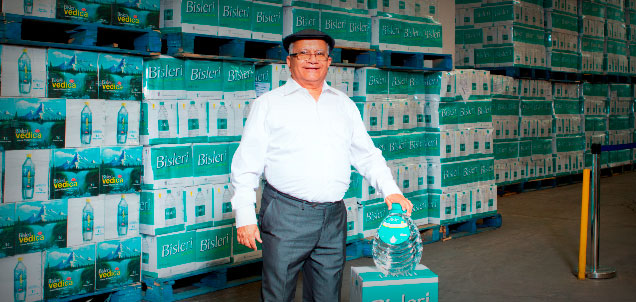
    More than two decades after he sold Thums Up, Limca and Gold Spot to Coca-Cola, Ramesh Chauhan, founder of India’s largest bottled-water brand Bisleri, is planning a comeback with a new range of soft drinks. He speaks to Pradyuman Maheshwari about his latest offerings, his strategy and why incompetence and complacency are the silent killers for any business


    Some 23 years after you sold the famed Thums Up and other carbonated drinks, you are returning to soft drinks. How does it feel to get back to the market you loved so much?

    We are not entering the same market. I’ve been trying to impress upon everyone, that we are doing some variance. Our cola is different; it’s a spicy, masala cola. Someone who has a spicy cola would find it hard to switch to a regular one. A lot of people today take a cola and add some spice to it, some masala, so we observed that this is what we need to do. The Pina Colada is a completely novel product for most people in the market, and I would have thought that it would be difficult to sell it. It seems to be the hottest selling product.


    What’s your favourite flavour?

    I’ve said very clearly to everyone that nobody should have a favourite because I don’t want to have a bias. All four should be able to run in a parallel manner.


    Your non-compete clause with Coca-Cola ended in 2008, so what took you so long to enter the market?

    It’s not an easy thing to jump into any business. You don’t get into a business based on your past love and passion. You have to have infrastructure, a distribution system. The earlier infrastructure is gone, so we have had to start from scratch. In ’95 when we started building up Bisleri, and in the 20 years since, we’ve got a significant number of people in the field as well as contracts with retailers.


    You’ve been asked this question several times before, but as you look back, do you have any regrets about selling out to Coke 23 years ago?

    No.


    Tell us more about Bisleri Pop, the Limonata, the orange drink, the Pina Colada and the Spicy Cola. How did these come about?

    I have talked about the Spicy Cola, but the Limonata is different from any other lemon drink which is there in the market. This is a lemonade with lime, not a lemon, which is very different from a lemon. The Fonzo is a mixed fruit drink, it’s not just a mango or an orange. Are four are uniquely different.


    I still remember the old Thums Up, Limca and Gold Spot ads. Advertising paid a huge role in your products becoming as big as they did, so how do see the role of adverting in the soft drinks market?

    It’s very important. Without advertising, all these brands are meaningless. Today, advertising no longer means just television or print. You have the electronic and social media, which lends ample opportunity to promote your products in ways that are different from what you were doing before.


    And for these four flavours, you have a creative and a digital agency. So how big is the advertising offensive for this?

    Not as much as people think we should do. What we have seen is that the product acceptance in the market, with the retailer and the consumer is fantastic. We didn’t expect this kind of welcome from retailers, distributors and consumers. I haven’t come across a single person who says ‘I don’t like the flavour or taste’.


    But in this range, apart from the regular cola and the lemon drinks, there are a lot of variants in the market from not-so-well known brands. There are jeera colas and the like, so where do you think you fit into the market?

    The jeera cola is the one that got us talking about the spicy cola. But the jeera cola has got nowhere, with only one manufacturer and not much structure to support it.


    Rim-Zim your brand, right?

    Yes.


    So you have been in this kind of space before?

    Yes.


    And this cola is spicier than Rim-Zim?

    I wouldn’t say that. It’s different. It’s like a Rim-Zim and cola put together.


    How critical is advertising for the success of a product? A lot of people say it is the product’s quality, its taste, and finally it’s distribution that matter. Having tracked this business for so long, what do you think about advertising vis-à-vis distribution and product quality?

    Distribution is a must. Without distribution, you can’t sell. Your product must be available. Besides, the advertising can’t be the traditional kind only, it has to include digital and social media advertising. What is fantastic is retailers have a communication system among themselves as well. Like in Mumbai, we started around our plant in Andheri and Vile Parle, but retailers in South Bombay were asking ‘why are you are not talking to us?’. So communication within the trade is very high and especially now, with mobile phones. In fact, the people in Andheri probably have a branch or an associate running an outlet in South Mumbai.


    Thums Up as a brand has done very well in northern India. Do you anticipate any specific geographical domination of your current lot of drinks?

    We have four drunks, but we don’t know which will dominate in which part of the country.


    How is Bisleri doing? It’s been there for many years, and is a leader in the bottled-water segment. What are your plans for it?

    Bisleri is doing very well, it’s growing at a healthy 32per cent. We feel a bit guilty not spending enough time and money on promoting Bisleri, but we are struggling to get more and more outlets and more and more production to support the growth.


    And Urzza, which you launched as an energy drink?

    That is on the backburner now. We will take it up once we are comfortable with Bisleri Pop.


    You had once said, or written in your book rather, that our biggest competitor is our incompetence. Do you still believe that?

    Yes.


    So how do you ensure that in your company, you are able to overcome it?

    In India, the market is huge and the population is also so large that it gives us immense satisfaction to be growing at 22 per cent. But is there more we can do? The market is much bigger and we can do better, but people tend to say, ‘this is enough’.


    You have launched four drinks now. Is there a plan to launch more in the near future?

    Of course, but I think we need to see how these four drinks move. I don’t think we can think about adding anything for at least another three months. We first need to get feedback from everywhere.


    So assuming the feedback is good, would you look at adding expanding your portfolio of drinks?

    Not necessarily, because if the feedback is good, you are going to concentrate on making that product even more dominant. Sprite, 7Up and such are top-of-the-mind recall, and for us to reach that level of brand recognition and that kind of demand, it takes a lot of time.


    I know it’s an unfair question to ask, but can you comment on how the other drinks are doing now — the drinks that you sold versus the other drinks that have entered the market?

    The drinks which we sold, are doing very well. But you cannot leave it to the drink. It’s the people who drive it – how much attention they are paying, what are their inputs, because it’s a helluva job trying to sell so many different products of so many different sizes.


    With drinks such as yours entering the market and the fact that you are looking at achieving a fairly stiff target in the next five years, do you see the soft drinks market – which is around Rs 14,000-crore or so– growing to a bigger extent?

    That’s a big question. The market is now shrinking and the juice market seems to be growing much faster, and water even faster still. So it’s different. We haven’t paid attention to the soft drink market as such.


    One last word to people who are your observers, who have tracked you for so many years, and now your re-entry into soft drinks: What should they look forward to from you now?

    They should look forward to innovation and of course, a good, high-quality product. Because whatever we have introduced till now, was always of high quality and consistency.


    This interview first appeared in BrandStand on March 12 and 13 and in dna of brands on March 14
     

  • Thums Up brings back toofani thunder with Salman

    By A Correspondent


    Popular cola brand Thums Up has unveiled a new TVC-led campaign titled, ‘Main Hoon Toofani’ that is in line with its long-running creative message of adventure and machoness.


    The ‘Main Hoon Toofani’ campaign seeks out the new generation that has the attitude, commitment and potential to bring out any positive change, notes a communiqué. The TVC has been created by Leo Burnett, led by Sachin Das Burma. Commenting on the campaign, Burma said: ‘Thums Up has always been the drink of people who have a sense of restlessness and thunder within. Restlessness to get what they want, to go beyond, to achieve what they set their hearts and minds to. This year too, the campaign reflects the attitude of the brand, and the people who have made it the numero uno cola in our country. The narrative this year is to showcase ‘I will not settle for anything less’ and the no-compromise belief of the Thums Up drinker. This is where the ‘Main Hoon Toofani’ philosophy comes alive.”


    The new 360 degree campaign leverages mass media on OOH sites in the core markets of Thums Up. The campaign also leverages key social media platforms of Youtube, Facebook and Twitter.


  • Dabur, Thums Up to be sponsors of the Pro-Wrestling League

    By Arka Bhattacharya


    After the successes of the IPL, the ISL and the Pro-Kabaddi League, corporates have queued up to become sponsors of the brand-new Pro-Wrestling League, scheduled to start on December 10.


    Kartik Sharma

    Kartikeya Sharma, CMD, Pro-Sportify Ltd, which started the PWL, says that they have four main sponsors for this year. The title sponsorship has been picked up Dabur Chawanprash while Thums Up is the ‘Powered By’ Sponsor. Other sponsors associated with the league this year are Jaguar Lighting and Dabur Red Toothpaste. The cumulative amount of sponsorship that has poured in is estimated to be around Rs 22 crore.


    Says Sharma, “When one of the largest brands, Coke has sponsored you, you know it is going to be big. Year-on-year, we’re looking increase the marketing spend and we’ll change the way brands derive ROI from sporting properties and the way they want to get value out of sports.”


    The success of the existing leagues in India has convinced the founders of the PWL that the league will be immensely successful in the years to come. Sharma said that the sponsorship for season 2 is already being planned and is estimated to show an 81% increase to Rs 40 crore.


    The net marketing spend for the league is upwards of Rs. 20 crore. Vishal Gurnani, Director, Pro-Sportify says that almost 70% of this budget has been poured into television media, and the rest mainly into radio, print and outdoor campaigns. Gurnani says that they have about 600,000 seconds of inventory footage for the promotion of the league and massive outdoor campaigns have been undertaken in Bombay, Delhi, Gurgaon, Ludhiana.


    When asked if the league would expand next year, Gurnani replied in the affirmative. He said, “The PWL might add two franchises next year. A lot of cities and a lot of corporates have shown interest this year, but due to logistical challenges, we decided to restrict the number of teams to six. We are looking ahead to next year, where we are expanding this to eight teams with the most likely cities being Ahmedabad and Hyderabad.”


    Pro-Sportify are also looking at introducing merchandising post the league’s completion. Gurnani said, “We’ll looking at building up the brand during the league and selling our merchandising at online platforms and airports afterwards. We’re coming up with interesting and quirky merchandising with lines like ‘Real Men deal with it on the mat’ and ‘Asli Mard Akhade Waala Baaki Sab Chauhare mein’.”


    The other partners of the league include the hospitality partner – Picadilly hotels, Radio partner – Big FM, Outdoor partner – Bright Outdoor and Ticketing partner – BookmyShow.


    Source:The Economic Times

    Copyright © 2015, Bennett, Coleman & Co. Ltd. All Rights Reserved

    Licensed to republish


  • Saare Jahaan Se Achhca…


    It’s Independence Day on Saturday. There are several brands which have done some splendid work in independent India, but there are some which stand out amongst these. Presenting a selection of these…


    Why Airtel wants to be everybody’s friend


    By Ravi Balakrishnan


    Airtel may want to be remembered for its snazzier, youthful advertising, but one of its definitive commercials is the barber’s shop ad from the mid-2000s. As the trademark Airtel ring tone sounds, customers and the barber hastily reach for their phones. But the call is actually for the chaiwalla, subtly establishing the brand’s ubiquity and ability to cut across classes.


    Over the last two decades – Airtel turned 20 this July – it has grown to be India’s largest mobile network. For lakhs of Indians, it’s been the first telephone connection of any sort. No mean feat in a hyperactive market that at one point in 2009, had close to 10 players and has been through supposedly giant slaying trends like mobile number portability.


    According to Srini Gopalan, lead – consumer business, Airtel owes it all too keeping its core essence intact. He explains, “Human connections are at the heart of the brand. Over the years, we’ve been able to capture this in multiple memorable ways.” For instance, Express Yourself starring AR Rahman to the more recent Har Ek Friend which acknowledged that friends were a new form of family. It’s a singleminded stance at variance with many newer entrants who initiated price wars or took potshots at other players. Says Gopalan, “While others have obsessed about specific technology or the competition, we have obsessed about customers, providing a great network and service.”


    Of course, there’s a lot more to Airtel than a few well-liked ads. It has tailored itself to various target audiences offering internet and videos at Rs 1 for the population that’s getting online for the first time. It claims to have started providing 4G to its 3G subscribers at no extra cost. Gopalan explains: “I don’t think the basic formula has changed from when Sunil Mittal started this business. We’d rather keep that intact and customise product, communication and service rather than be different things to different people.”


    How Amul, the taste of India, buttered generations of toast


    By Ravi Balakrishnan


    Few brands can stake as much of a claim to literally having fed India as Amul. Its ubiquitous butter shows up in bread baskets at fine dine restaurants and at streetside sandwich and snacking stalls that advertise their ‘made with Amul’ credentials on large chalk boards as an assurance of quality.


    Amul Butter came into its own in 1966 when its agency DaCunha Communications, perhaps unwittingly, created what would go on to be one of advertising’s longest running campaigns. The Amul Butter girl was initially a foil to a sexy milkmaid mnemonic of arch rival Polson’s. Topical ads were introduced a year after the Amul girl first appeared and continue to date.


    Along the way, the campaign has become less about butter and more about what Amul stands for. A good move since butter is no longer Amul’s flagship product, accounting for a mere 10 percent to 11 percent of its Rs 21,000 crore turnover of which 50 percent is cornered by milk. It’s arguable if the campaign flogs more product. But the ads – now also freely available via Facebook – have become an amusing, sometimes sentimental, sometimes sardonic document on life in India over the last five decades. Rahul DaCunha, director, DaCunha Communications observes, “The advertising has stayed consistent and the Amul girl has truly become the daughter of India: there’s a possessiveness people have about her. Too many advertisers let go of concepts too soon. That we’ve stayed consistent while updating the campaign every year has helped.” While hoardings are still a mainstay, on Amul’s Facebook page there are sometimes new topical ads every day that are eagerly discussed and shared.


    Amul has staved off competition, which has intensified particularly over the last decade and a half. According to managing director RS Sodhi “Our business strategy evolved 68 years back by Dr Veghese Kurien is C2C or cow to consumer. When both producers and consumers are with you, you are not afraid of competition. We do not replace expensive natural ingredients with synthetic cheap ones like other companies.”


    Which explains why Amul and its moppet are one of the few Indian brands that have survived the slog from pre to post-liberalisation India, a culling that consigned many former market leaders to history books.


    Ambassador – the first Indian car still lives


    By Delshad Irani


    In May 2014, Hindustan Motors stopped manufacturing the car with Sophia Lorenesque curves, the Ambassador, due to fast declining demand. For almost six decades, the Ambassador traversed across India, carrying multiple generations of Indian families. She’s still around, though, thanks to government and military officials, taxi drivers ferrying natives and tourists and Amby aficionados.


    The story of the first Indian car began in 1957, when BM Birla owned Hindustan Motors (established in 1942) manufactured the first Ambassador, modelled on the Morris Oxford. It was a matter of prestige to own one, especially after a five-year waitlist. She was a symbol of a liberated, new India, forging ahead in nothing less than a beautiful tank, so to speak. You couldn’t find a tougher passenger car. And still can’t. In 2013, the BBC show Top Gear put this to test – before Jeremy Clarkson famously punched his way out of favour. The Ambassador went up against Maruti Suzuki, Hyundai, Toyota and Honda, all in service as cabs around the world, in a deadly taxi shootout. While the rest emerged dismembered, the Ambassador crossed the finish-line intact and in good spirit. The irony: It was the advent of the Maruti 800 in the mid-80s and 90s that heralded the decline of Ambassador as the queen of Indian roads. Of course, changing consumer likes killed the Ambassador, too. Unchanged over the years, a car reminiscent of the bowler hat isn’t everybody’s cup of tea. And competition grew from two (Premier Padmini and later the Maruti 800) to today’s smart sedans, SUVs, MUVs, hatchbacks for every taste and type of Indian clan. Just 2,200 Ambassadors were sold in the year ended March 2014, according to reports.


    However, the Ambassador’s legacy is one adopted by others as their own. Even before Maruti pitched itself as the “people’s car” with an outpost in every cranny, it was the Ambassador that could be mended by the sides of highways with a spanner and some ingenuity. Today, however, Ambassador parts are increasingly rarer, expensive and harder to source. The Amby is also the original ancestor of supersize, utility vehicles, which can accommodate the entire family, pets and luggage for holidays through temperamental terrain. With room to spare for Ego. So, you see the Ambassador’s not quite dead. Long live the Queen.


    How Bajaj scooters gave Indian middle-class its first two-wheeler


    By Shephali Bhatt


    If you lived through the 80s and 90s without witnessing a family of four (man, wife and two kids) on a Bajaj Chetak, it’s safe to assume you weren’t living in India. Bajaj Auto gave India its first family car: only it was actually a scooter.


    The journey of bringing mobility to people in a country marred by poor transportation began in 1961. Bajaj got a licence from Italy’s Piaggio to manufacture and sell Vespa in India. Around early 70s, Piaggio went ‘No can do’ on renewing licence which led to the launch of Bajaj Chetak. In 1977, Chetak raced ahead of every other player in the two- and four-wheeler category securing sales of over 100,000 units in a year. Ten years later, this number had soared to 500,000 and by the time we hit the 90s and liberalisation set in, Bajaj Auto was selling 100,000 scooters per month. The brand had practically attained the status of ‘Chunnu Munnu de Pappa di Gaddi.’


    Bajaj scooters succeeded because they were active in a scarcity economy, says Suman Srivastava, founder of Marketing Unplugged consultancy and CSO of FCB Ulka. Incidentally, it’s the first brand he worked on. “The 70s was a rationing era which made Bajaj the undisputed king. They had a product at a reasonable price and the consumer badly needed it. You had to wait for a decade to get a Chetak,” he recounts. “When Rahul Bajaj, then MD of Bajaj Auto (now chairman) took over the reins and started focusing on scooters, his main fight was with the Bombay Club to grant him licence to expand capacity, to sell overseas. The product was always in short supply,” Srivastava adds.


    So what if Lintas’s marketing genius of ‘Buland Bharat ki Buland Tasveer -Hamara Bajaj’ was only a holding operation, acted upon when scooter sales were plummeting in the wake of 100cc bikes? It did its job. With confirmed reports of Bajaj Chetak making a comeback next year, one can be certain the scooter’s success wasn’t a flash in the pan. It is a ‘Lambi race ka ghoda’ indeed.


    How Thums Up still manages to be the king of colas


    By Amit Bapna


    There are people who won’t drink their favorite rum, Old Monk, if it’s not served with Thums Up, leaving many a barman wondering if the tippler’s loyalties lie with the rum brand or the cola? Launched in 1977, Thums Up continues to have a hold across the length and breadth of the country and remains an enigma that marketers, over the years, have tried to unravel on the success recipe of the brand. It also remains a case study for the Atlanta based Coca-Cola company that has not faced such a situation anywhere in the world – of having a homegrown brand take on the might and muscle of the big brother (Coca-Cola) and continue to be the winner. According to Debabrata Mukherjee, vice president, marketing & commercial, Coca-Cola India and South West Asia, “Thums Up has had a clear ‘masculine cola’ positioning and the brand has continuously adapted to the relevant codes of masculinity over the years that have worked very well for it.”


    The brand launched by the maverick Ramesh Chauhan was already a force to reckon with when it was acquired by the Coca-Cola Company in what was possibly the most famous deal of the early 90s. A person familiar with developments of the deal says on condition of anonymity, “Coke by buying the largest cola brand in the country was hoping to get the entire cola equity transferred to it.” That it didn’t pan out that way was something that the cola giant had not bargained for while closing the deal. Says KV Sridhar, chief creative officer, SapientNitro, “In a country like India it is not cola that is culturally rooted: what is rooted is the strong taste of Thums Up – a product made for the Indian palate.”


    Neither pulling the plug by reducing distribution strength nor scuttling advertising budgets – something that the parent Coca-Cola has known to have tried many times – worked in the case of this brand that continues to own the mind and heart space for millions in the country. Points out Sourav Ray, chief strategy officer, Havas Worldwide, “Relative to Coca-Cola, Thums Up had more freedom but less budget which worked as the perfect tonic for the marketing team to create a differentiated positioning for the brand, focus, think out of the box and freely express themselves.”


    Source:The Economic Times

    Copyright © 2015, Bennett, Coleman & Co. Ltd. All Rights Reserved

    Licensed to republish