Tag: Tata

  • Tatas say Hello to wooing Consumers


    By Kala Vijayraghavan & Lijee Philip


    One recent afternoon, Harish Bhat, a member of the Tata Sons group executive council, a body of young leaders that provides strategic direction to the conglomerate, showed up at Phoenix, a mall in south Mumbai that is always teeming with shoppers. Bhat wasn’t there to shop but to watch people shop. He was curious about what consumers purchase and what they do before deciding to buy something. Bhat has been making frequent visits to Phoenix in recent days.


    “This mall brings in a blend of consumers from all walks of life… it has some of the biggest luxury brands and a Big Bazaar,” he says.


    Bhat’s visits to the mall and his recent nosiness for consumer habits are all closely tied to the wave of changes sweeping across the Tata group, one of India’s largest business houses. The Tatas want to radically change the way they approach consumers. The group wants to get closer to the consumer — become a little more humble, if you will, in the process. It not only wants to understand consumer behaviour but also address their grievances.


    The renewed attempts at sharpening the consumer focus have come under the direction of Tata group chairman Cyrus Mistry and Bhat is in charge of the task. “Consumer trends are top of his (Mistry’s) mind today,” says Bhat.


    On Mistry’s recommendation, CEOs of Tata companies are reading Decoding the New Consumer Mind, a book written by award-winning consumer psychologist Kit Yarrow. The book offers fresh insights into the new motivations and behaviours of shoppers.


    Some are trying to find out on their own. Harit Nagpal, CEO, Tata Sky, enrolled in a Facebook page set up by 100-odd disgruntled consumers who were upset with the unevenness in the signal quality of the direct-to-home television services company. “Just 10 turned out to be genuine customers with problems,” says Nagpal.


    These days, the first thing that Nagpal does every morning is check his mail for consumer grievances. He personally attends to about 20 complaints a day. “When an aggrieved consumer gets a call from the company within 15 minutes of sending a mail to the chief executive and the problem is solved in an hour, that person becomes a promoter of the company,” he says.


    His counterpart at Titan Company, Bhaskar Bhat, has been turning up unannounced at the watchmaker’s showrooms to do the same. “The on-ground staff are the closest to the consumers and have a lot of insights to offer.”


    Similarly, employees at Tata Chemicals’ consumer business spend whole days with housewives observing their behaviour both at home and in shops. These are followed by ideation workshops.


    Cultural Shift

    Through these efforts, the Tatas are looking to radically transform its organisational culture. A former Tata group official says the DNA of the group has always been more inclined towards sourcing technology than heeding to customer feedback. “The group is trying to find a paediatric solution for a geriatric problem.”


    A top Tata official says the portfolio of the group has been largely dominated by B2B (business-to-business) more than B2C (business-to-consumer) companies. “For good or bad, the mindset has been tuned toward a B2B culture. In the past, the group has had some brilliant successes such as Air India (in its earlier avatar), Titan and Tata Tea. And there have been not-so-great businesses such as Tata Motors and Tata Telecom.” But those successes belonged to a different era. In recent years, products or ventures from the Tata stable such as the low-cost car Nano and NourishCo, a beverages joint venture with PepsiCo, have struggled.


    Raghu B Viswanath, a former employee of Titan, and now MD of Vertebrand Management Consulting, says the Tatas succeeded in a monopolistic regime and the group will die if it doesn’t get consumer centric. “Nano today is an apology of a vehicle because they misread the consumer. Voltas was a one-time leader; it failed to be relevant to the consumer. Titan tried to dome things which were too little, too late. Tata Tea could do with more innovation — after all it did unseat HUL once.”


    The issue facing the Tata is not complacency, but cultural, according to Viswanath. Indeed, some Tata companies have been slow to embrace change. Take Tata Tea. Company watchers say the company has done little on innovation and at least five years have passed since its last launch, Tata Tea Acti Green, a green tea offering, and the re-launch of Tata Tea Gold.


    Innovation has been sluggish at a group level too. In recent few years, Tata group’s R&D expenditure has been stuck at over 2% of the total turnover.


    How the Tata group evolved was in a different India, says the Tata official, adding that the consumer was not really a concern. “Tata is now catering to a young India with better purchasing power, with hundred more options and in a digital world. And that is the reality that every company is today waking up to.”


    Winds of Change

    But change is underway. Individual Tata companies have identified talent in the group and after handing out designations such as chief culture officer, chief transformation officer or customer champion, are trying to get the consumer-centric culture embedded in the organisation.


    It is a big task. The group is present in almost all the sectors of the economy. It is not for nothing that Tata is known as the salt-to-software conglomerate. But lately, the group has identified four pillars-realty and infrastructure, defence and aerospace, consumer and retail and financial services – to drive growth.


    This adjustment though should not be hard to accomplish. Viswanath says the Tata group has been very democratic in letting each company chart its own path.


    Some companies are already attuning themselves to new market realities. Tata Chemicals is repositioning itself as a specialty and consumer product company, necessitated by a drop in net profit triggered by plant shutdowns and forex losses. Like other commodity based businesses, Tata Chemicals is hobbled by softening demand and increasing energy prices. Tata Power, the country’s largest integrated power producer in the private sector with 8500 MW in generation alone, has put the brakes on expansion as it finds the present economic climate not conducive. Titan, meanwhile, has been facing pressure of sales and margins in the watches and jewellery business.


    In a sharp departure from turning to company veterans, the group record recent hired Rakesh Sarna to head the struggling Indian Hotels, but Tata Motors has been without a CEO for two years as it attempts to regain its top position in a fiercely competitive car market.


    “The Tata group faces epic challenges in its next level of growth,” says Unni Krishnan, founder of LongBrand, a wealth creation advisory firm based in Vienna. “There is a false pride and ego that have crept into the group fabric and it needs to inculcate more humility.” Viewed against this grim backdrop, the consumer push is significant.


    Peeyush Gupta, vice-president steel (marketing and sales), Tata Steel, says the company has formed customer service teams for top clients. “There is a universal advantage here,” he says. “First you influence a large organisation to become more customer centric simply through having to confront customer issues. Second, even if the frontline people in both organisations change, there is no effect on the bond with the customer. Longevity is thereby built into our relationships”.


    Tata Steel’s share of business has increased at a faster pace where service teams have been deployed. “We are supplying better products and providing effective solutions. The biggest challenge changing organisational mindset. The sales team would not allow somebody else to come into their domain, the purchase guys would not allow us into their domain and so on. The customer team concept changed all that,” says Gupta. Many of the B2B companies in the Tata group straddle the business and consumer segments. Even so, long-time Tata watchers say the B2B companies have been more aggressive than their in pushing consumer centricity than their B2C counterparts.


    “Some of the B2B businesses are facing pressures from commodity prices, which is incentive enough for them to push their consumer centricity initiatives,” says Krishnan. The problem that Tata, like most Indian companies, faces now is, keeping pace with the changing nature of consumer demand, as demand becomes more sophisticated. There are no easy answers. And this is not a problem unique to the Tatas. Indian business houses like Reliance Industries that have thrived in B2B environments have struggled while directly dealing with consumers.


    Even so, “one has to be careful about describing Tata Group as slow to embrace change,” says Morgen Witzel, a UK-based management writer and author of Tata: The Evolution of a Corporate Brand. “It was only a few years ago that Tata Group was rated as one of the world’s ten most innovative business organisations. Nor do a few brand failures mean that a company is no longer innovative. Tata Motors learned a lot from the Nano project in particular, and that learning may well filter into future projects. Tata is adjusting to some massive shocks at the moment, particularly its transition to a multinational corporation.”


    History offers some clues. In the nineteenth and twentieth centuries, Tata’s attitude to consumers was much like its attitude to its employees, a benevolent, caring paternalism, according to Witzel. He says the company made what it thought consumers needed, and by and large got it right, adding that under Ratan Tata’s (Mistry’s predecessor) stewardship a much more modern and customer-focused attitude to marketing emerged. “I think that approach is still largely present, but Tata is trying to work out where consumer demand is going,” he says. “That problem is not unique to Tata, or to India.”


  • Tata most valuable brand, Flipkart and Micromax in top 100: Brand Finance India 100 study

    By Kala Vijayraghavan


    Tata remains the country’s industrial titan, this year its brand value exceeded US$15 billion for the first time. Brand value was a little slow this year however, with a 4 per cent  increase on 2014. Tata is the world’s 65th most valuable brand. Tata is India’s leading brand by a long way on almost every measure. It is the only truly global megabrand originating in India, but there is a new generation of Indian brands following in Tata’s footsteps.


    The Brand Finance India 100, released on Friday, is an annual study conducted by leading brand valuation consultancy Brand Finance. India’s biggest brands are put to the test and evaluated to determine which are the most powerful and most valuable. Among the top 10 includes Tata followed by SBI, LIC, Airtel, Reliance, Indian Oil, Infosys, L&T, HCL and ONGC.


    Twenty per cent  of the brands in this year’s Brand Finance India 100 are new entries. They come from a wide range of sectors; E-commerce, Pharmaceuticals, Automobiles, Telecoms, Heavy Engineering and Banking. This bodes well for the success of Indian industry and demonstrates a growing competitiveness, though established, top-ranked companies will now have to pay ever closer attention to the value of their brands. Continued investment in customer relationships, technology, advertising and brand strategy will be imperative to stay on top.


    Commenting on the results, Brand Finance India’s Ajimon Francis stated, “There is increasing competition for places in the Top 100. Emerging sectors like E-commerce, telecommunications, technology companies, banking services are particularly competitive. Staying in the premier league of brands will require a world beating product or service, differentiation and a strong vision and mission, including a strong ethical stance. Royal Enfield, Flipkart, Micromax and Sun Pharma are all potentially world beating powerhouse brands.”


    Source:The Economic Times

    Copyright © 2015, Bennett, Coleman & Co. Ltd. All Rights Reserved

    Licensed to republish


  • It’s a deal! Ratan Tata invests in Snapdeal

    By A Correspondent


    Ratan Tata, chairman emeritus at Tata Sons, has invested in Delhi-based online marketplace Snapdeal. The company did not disclose the amount invested. The announcement comes a day after Snapdeal entered into a partnership with Tata Value Homes to sell apartment units of projects spread across five cities, namely, Bangalore, Chennai, Pune, Mumbai and Ahmedabad.


    Snapdeal’s cofounder and chief executive Kunal Bahl termed Tata’s investment a validation of the company’s growth. “An investment by a legendary and respected figure like Mr. Tata is an excellent validation of our focused strategy on building a long term enterprise and marks the start of a very important phase for the company,” said Bahl.


    This investment also underlines the growing interest shown by India’s traditional industries in the fast-growing ecommerce sector. Recently traditional retail majors like Reliance and Arvind have made forays online.


    The sector has also attracted large investments in the past few months. Snapdeal raised over $233 million this year in two rounds from investors like eBay Inc, Singapore-based Temasek and Wipro chairman Azim Premji’s family office Premji Invest. Market leader Flipkart too raised two rounds of funding this year. In July it raised $1 billion from existing investors and Singapore sovereign wealth fund GIC. Global major Amazon also announced a $2 billion investment for its India operations in July.


    Snapdeal, which is estimated to have crossed $1 billion in sales this year, is rapidly adding new categories of products. Apart from apartments, it has launched a catering supplies segment recently. In the next few months the four-year-old platform is planning to add 10 more categories.  Bahl has stated in the past that the company will focus on adding new merchants, new categories and focus on mobile commerce to ensure growth.


    Source:The Economic Times

    Copyright © 2014, Bennett, Coleman & Co. Ltd. All Rights Reserved

    Licensed to republish


  • This Tata forges welcome to Tesco


    By Suman Layak


    Rajiv Gujral, a former honcho at the Taj group of hotels, ran into Noel Tata at Bombay House on a Saturday evening last month – he rarely gets that privilege these days. Mr Gujral recounts how Noel let on that he’s been travelling 25 days a month, and finds little time for anything else.


    The younger half-brother of Ratan Tata – and now the only member of the top brass with that surname in the group, Noel is managing director of Tata’s trading arm Tata International. But that’s not the only hat he wears; also keeping him on his toes are the vice-chairmanship of retailing arm Trent Ltd – where Noel was managing director till three years ago – and the chairmanship of Tata Investment Corporation, a non-banking financial company that makes long-term investments.


    FDI Hurdle.

    If Noel is hard-pressed to find time to race down highways in a Tata Safari – his passion five-six years ago – it’s because he’s as busy plotting Tata International’s growth (particularly in Africa) as he is ironing out the Tatas’ partnership with British retailing giant Tesco.


    Consider: In the first week of May 2013, Noel and Tesco CEO Philip Clarke met Union commerce minister Anand Sharma. The goal was to seek some leeway from the minister on the stiff norms set for foreign direct investment in multi-brand retail in India.


    In India, the Tatas and Tesco have been partners since 2008 in the limited sense of partnership that was allowed in retail at that time. Tesco’s wholesale business supplies merchandise to Star Bazaar, the hypermarkets of Trent.


    In December 2012, Mr Clarke had hurried down to Mumbai to meet Ratan Tata in the last month of his tenure as chairman of the Tata Group. Mr Clarke was also upbeat after Mr Sharma’s announcement two months before Tata’s retirement that FDI norms in multibrand retail would be relaxed.


    A little over a year has passed since Mr Sharma’s announcement, and Tesco has yet to make its move. In fact, the norms are so stiff that no foreign retailer has made a move in multi-brand retail as yet. However, after the Walmart-Bharti split, all eyes are on the Tesco-Tata partnership.


    In May, a week after Noel Tata and Mr Clarke met Mr Sharma, the Department of Industrial Policy and Promotion (DIPP) gave Tesco a major boost. It said that although multibrand retailers with FDI in India will have to source 30% of their products from medium and small-scale manufacturers, the norm would not apply to farm produce and dairy. Tesco had sought clarifications as it claimed that almost 85% of its offerings would be in the farm and dairy category. That was a win for the Tata-Tesco team.


    However there are many more hurdles to go before FDI can flow into the partnership for multi-brand retail in India and sources say that Noel has been a frequent visitor to the DIPP offices in Delhi in recent times.


    Growth of a Salesman

    At Trent, where Mr Tata gave up his executive role in 2010 to move to Tata International, he is still the moving force as vice-chairman. The company has a CEO in Philip Auld who has been deputed by Tesco and there are other people running the show on deputation from Tesco.


    “Noel Tata is a pucca retailer,” says an executive who has worked for the group when Tata used to lead Trent as managing director. “He is someone who would happily spend hours at a store, tinkering, observing and even selling. He has grown up in the retail business unlike someone moved into it at a strategic level. He immensely enjoys retailing.”


    When the Tesco-Tata partnership was forged in 2008, while Tesco people took on the task of managing the stores and the front end, the Tatas managed the areas that needed local knowledge – real estate and property as well as warehousing and human resources. Noel continues to oversee these functions.


    And then to live out his retail dream a little more, at Tata International Noel started footwear retailing in India through a chain named Tashi. Tata International also acquired a Portuguese footwear retailer Move-On that has a presence across Europe. However, the Tashi chain had to be closed and the company is now thinking about focusing on footwear branding and distribution instead.


    African Safari.

    Sources indicate that Mr Tata intends to take his retail business to Africa too, where Tata International is the distributor and after sales service provider for Tata Motors.


    It also owns hotel assets in major locations like Cape Town that are managed by the Indian Hotels Company Ltd. The Africa plans are clearly keeping Mr Tata busy, too and he has been travelling frequently to that continent.


    Noel, who was once considered a contender to succeed Ratan Tata – he is married to Aloo, sister of Tata Sons chairman Cyrus Mistry – today has a wide canvass of businesses to oversee, a chunk of it in Africa.


    Tata International’s largest subsidiary, Tata Africa Holdings, is headquartered in South Africa and has led various Tata businesses into that continent, from luxury hotels to commercial vehicles. And then there’s the retail push back home – at least till Trent-Tesco can gets its frontend act together.


    Source:The Economic Times

    Copyright © 2013, Bennett, Coleman & Co. Ltd. All Rights Reserved

    Licensed to republish


  • Nokia, Tata star in India’s most trusted brands report

    By A Correspondent

    Trust Research Advisory, the authority on the measurement of Trust among brands, is out with the Brand Trust Report 2012, the much anticipated results of India’s Most Trusted Brands.


    The Brand Trust Report, India Study, 2012 (BTR 2012), lists India’s 1,000 Most Trusted Brands even though it studied over 17,000. The report is the result of a comprehensive primary research conducted on 61 components of trust – a proprietary tool of Trust Research Advisory. The research was conducted with 2,718 ‘influencer’ respondents from 15 cities, generating more than 2 million data-points from 12,000 hours of research.


    The research was done on salaried SEC A population as they have more engagement with people and brands. Other detailed parameter of the audience chosen for the survey also exists. According to Mr. N Chandramouli, CEO of Trust Research Advisory, rigorous back checks were done to eliminate any anomalies that might appear in the survey and the parameters were set very high for the research.


    He said, that according to an AC Nielsen report, $1 trillion was spent on communication last year… Considering the huge amount of money, it is of paramount importance that the money is used correctly. Mr. Chandramauli said that even though the top positions have not drastically changed over the last year, yet the trust index pattern has changed. In 2011 report, the top two brands had the trust index equivalent to the next 65 brands. However, this figure has dropped down to the next 6 brands in 2012 report. This means that the gap between the top players is decreasing and in the upcoming years one can see a drastic turn around.


    Talking about research methodology Mr Chandramauli said “If you want to focus on trust, we can’t focus on trust but the ingredients of trust… The survey studies such 100 trust metrics in extraordinary details.” The three components of trust are the tactile, the vicarious and the imagined concepts of trust.


    Nokia and Tata retained their first and second positions as India’s top two Trusted Brands this year. Sony, the Japanese electronics leader, slipped to fifth position, outranked by the two aggressive Korean chaebols, LG at 3rd position and Samsung at 4th position. Maruti Suzuki improved its position by one notch and is India’s 6th Most Trusted Brand this year. Bajaj, ranked 7th, is a new entrant this year in the Top 10 (last year it was ranked 12th); LIC and Airtel’s positions are unchanged from last year at 8th and 9th rank respectively. Reliance slipped to 10th Most Trusted Brand this year (from sixth last year).


    Among 22 personalities listed among in BTR 2012, Anna Hazare has gained the nation’s trust ahead of Sachin Tendulkar, Salman Khan, Amitabh Bachchan and Aamir Khan, featured in that order. Most Trusted leaders in some other categories are Armani in Branded Fashion, DLF in Construction, NIIT in Education, ONGC in Energy, PVR in Entertainment, Pepsi in F&B, Dabur in Healthcare, Taj Hotels in Hospitality, Google in Internet, ACC in Manufacturing, Thomas Cook in Services, Being Human in Social Sector, Hewlett Packard in Technology, and Air India in Airlines.


    Mr Chandramouli, said: “In life, without trust, there is nothing. Each time a human engages with anything, the basis for all decisions is trust. Be it brands, other humans, or just ideas, one will react to them on the basis of the trust it generates. Last year was tumultuous for several brands, but those which focused on trust, have gained market-share, revenues and profits. On the other hand, the brands which have focused only on the latter, have invariably lost both. Focus on building trust and all else will follow automatically.”


    Anand Mahindra, Vice-Chairman and Managing Director of Mahindra & Mahindra, has elaborated on Trust is Everything concept for the Mahindra brand in the report: “No great secret lies behind the highly-trusted Mahindra brand. Consistent delivery against every promise is the single biggest driver of trust for our brand. Apart from this, factors like high quality products and services, adherence to highest standards of corporate governance, the very high integrity of the leaders who run the company and adherence to a set of values in conducting business have helped the Mahindra brand earn the trust of all its stakeholders.”


    The report, priced at Rs10,000, is available exclusively at TRA offices.


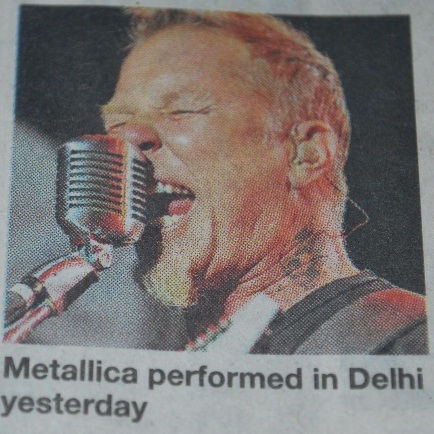
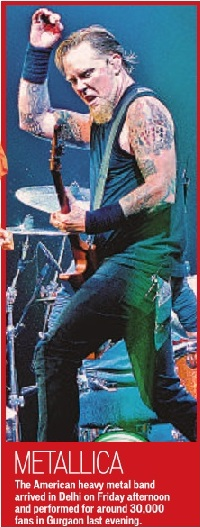
  • Mediaah!: When Delhi Times and HT Cafe reported that Metallica performed

    By Pradyuman Maheshwari

    The Delhi Times clip
    The HT Café photo-story

    It’s not something that’s not happened before. I recall Time magazine doing it in the late 1970s when it reported that an Indian politician had visited China when in fact he had called off the trip last-minute.

    I was alerted on this thanks to a Facebook post by a former colleague, Narendra Kusnur. The city supplements of both the Hindustan Times and Times of India in Delhi reported that the Metallica concert had happened on


    Friday. While the front page of the main paper did make a mention of the chaos at the venue, that of their supplements – which Kusnur believes happened because of an early deadline – was incorrect.

    I am sure this is more than just a severe embarrassment for the editor and management of both publications. It’s not the case of an error in reportage or a typo or even a wrong picture that was printed. And mind you it doesn’t appear to be an inadvertent error.

    Here was a case where the paper’s editors cheated their readers by deliberately printing incorrect information. We got to know about it thanks to a vigilant reader and also because it was a much-hyped event.

    But my worry is what if the editors do such acts habitually, with other events too. Also a cause of concern is that the city supplements of the two leading newspapers in the capital carried a similar error. The Times of India blanked out the news item on the epaper, while HT didn’t do that. So obviously the decay exists not just in one publication.

    I went through the front page of HT City and Delhi Times on Sunday to see if there’s any apology. I didn’t see any in the epaper edition. Times magazine, btw, had apologised for the error.

    This only further accentuates my distress that the reader is being taken for a ride and no one really appears to care.


    The Niira Radia exit. Good riddance or sad to see her go?


    I still remember the days when Vaishnavi was setting up. The Tata group accounts were consolidating under an agency with a name unlike the other PR agencies. In the early days, the folks were working out of makeshift office at the Taj Mahal hotel and the Army and Navy Building in Mumbai.

    But the proof of the pudding is in the eating, and I found it very pleasant interacting with Vaishnavi staffers. For a period when I was with the Dainik Bhaskar group, we had recruited Vaishnavi with an assignment which again was executed very well.

    The PR industry grapevine always had assorted stories about how the Vaishnavi bosswoman Niira Radia had managed to net the entire Tata group account. Needless to say most of it was out of jealousy. Guess they found some merit in getting the entire business group to go to just one agency for PR just as you tend to do for, say, media buying.

    My sense is that this policy doesn’t work. It’s always good to get a few different players, given their strengths in various business areas and have experience professionals available in the locations you want them.

    Two questions: now that she’s gone (well, as of close of business today), what’s the view. How would the world remember Niira Radia? High profile lobbyist or a quality communications professional? Lobbyist yes, but perhaps incorrect to stretch it to her being a wheeler dealer.

    There’s a lot that exists as part of the deliverables under public affairs, and there’s nothing wrong if the influencing has to happen beyond media folk. For instance, if a senior politician from Kerala thinks he or she is not being recognised by the powers that be in Delhi, then there’s nothing wrong in pushing your way around in Delhi.

    And if there’s a journo or bureaucrat who is amenable and can get influenced, it’s surely not the crime of the practitioner.

    That both the Tatas and Reliance groups entrusted their responsibility to Radia speaks volumes for her skills.

    There is a lot on Radia that the various enforcement agencies are busy with. I don’t see anything happening to her. She has enough contacts to get her out of any mess and has enough dirty stuff on people to pull the trigger if anyone gets naughty.

    Question 2: were the Tatas wise by going in for Rediffusion? I would be interested to know what swung it for Arun Nanda. After all, he doesn’t have the best PR brains with him any longer.  Perhaps that’s why tied up with Edelman.

    But then 10 years back when the group went in for Vaishnavi, similar questions were being asked. Radia’s team put up a decent show. The Tatas can obviously spot talent where not many of us can.


    PostScript: Are news media professionals worried about the mutterings of Press Council chief retired Justice Markandey Katju. Read this hilarious account on Legally India. Must-read. More on Katju’s comments on the media next time (which I promise you won’t happen after three weeks!)