Havas Play India, the activation arm of Havas Media Network, hosted the Tata.ev Pickleball Weekend Fiesta (September 22). Nearly 200 picklers from across Delhi and NCR participated in this open team-format tournament.
Commenting on their association with the Tata.ev Pickleball Weekend Fiesta 2024, Vivek Srivatsa, Chief Commercial Officer, Tata Passenger Electric Mobility Ltd., said: “For Tata.ev, the Pickleball Weekend Fiesta perfectly embodies the blend of community, sustainability, and technology—values that lie at the heart of our mission. As one of the fastest-growing sports globally, Pickleball is gaining remarkable traction in India, with over 10,000 active players and an impressive annual growth rate of more than 30%, both in participation and court development. The sport’s unique blend of accessibility, low environmental footprint, and emphasis on inclusivity deeply resonates with our commitment to a greener, more inclusive future. By supporting events like this, we not only foster healthy, active communities but also promote collaboration that drives meaningful progress for both society and the planet.”
Zoya, the diamond boutique from the House of Tata, has launched a brand campaign featuring its ambassador Sonam Kapoor.
Centred on its autograph collection, ‘My Embrace’, an iconic collection, it embodies the brand’s homage to its timeless muse – the Zoya woman.
Said Amanpreet Ahluwalia, Business Head of Zoya: “At Zoya we have always believed that women should be able to celebrate the joy of being just who they are, irrespective of the many roles they play in life. This collection journeys through the very soul of Zoya, a word which means ‘alive’. ‘My Embrace’ becomes an iconic symbol of self-acceptance, because you feel truly alive when you embrace who you are and are comfortable in your own skin.”
Overseen by Creative Agency Spring Marketing Capital, the campaign builds on previous successes exploring and celebrates every heroine’s love for her being.
Added Arun Iyer, Founding Partner, Spring Marketing Capital: “Zoya’s design philosophy, inspired by the shape of an embrace, remains at the forefront. We’ve crafted this campaign around life’s authentic, joyous, and simple moments, set against expansive outdoor landscapes, which act as a blissful getaway. Collaborating with Sonam Kapoor gave us an opportunity to authentically showcase her joy in spaces synonymous with the Zoya brand.”
Air India Express and AirAsia India, both subsidiaries of the Tata-owned Air India, have unveiled a new brand identity and aircraft livery, alongside network expansion with flee induction.
The livery of the first new Boeing 737-8 aircraft showcased at the launch, draws inspiration from the Bandhani textile design. The upcoming aircraft being inducted will feature designs inspired by other traditional patterns including Ajrakh, Patola, Kanjeevaram, Kalamkari, etc., showcasing India’s artistic diversity.
Sid Campbell Wilson, Chairman, Air India Express, said: “With the merger of Air India Express and Air Asia India now in the final stages, we are also seeing the transformation of the aviation landscape. We are proud to present the new brand of Air India Express, a vitally important part of the new Air India Group, charged with providing the best value, accessibility and domestic and regional connectivity to every Indian, and to become the airline of a new generation. The broader ambition of these efforts is to better connect India and Indians, to each other and to the world.”
Taneira, a Tata product, has unveiled a special campaign titled ‘The Homecoming’ for its range of sarees.
Sharing his thoughts on the campaign, Ambuj Narayan, Chief Executive Officer, Taneira said: “Sarees are a 5000 years old category and a traditional ensemble which receives comparatively higher interest during the peak of the festive season. Our aim is to encourage the audience to embrace their traditions in their own ways and celebrate the festivities with their loved ones. With the launch of ‘The Homecoming’, we invite all the women in India to embrace the beautiful six yards this Diwali with Taneira’s extensive range of festive sarees that are design differentiated and suit the choices of women across all age groups, presenting them with unique looks for all kinds of festivities.”
Voltas Home Appliances from the house of Tata has welcomed Navratri in a digital avatar.
Commenting on the occasion, Pradeep Bakshi, MD & CEO, Voltas Limited, said: “The festive season gives us an opportunity to give customers a unique way to engage with the brand and get a first-hand experience of the products. Our customers are becoming increasingly digital savvy and who better than content creators and Influencers can help us showcase our experience zone and products through their social channels. We are focusing on creative ways to attract our customers to the Experience Zone which will provide our customers with an opportunity to experience our latest and futuristic range of home appliances. As pioneers in innovation when it comes to home appliances, this new experience zone gives an immersive experience and showcases our product range in a way that customers can relate to.”
So goes one of the many WhatsApp messages since BCCI announced that Tata will be the title sponsor of IPL from next season. There is a GIF too being circulated done by someone called Outcry Entertainment which shows the batsman in the IPL logo whacking Vivo out and the Tata logo emerges to the signature tune!
This is certainly big news, beyond just the world of sports as India’s “most trusted” corporate brand chooses to play tag-team with India’s biggest sporting brand. What would have made this happen?
After Galwan and Doklam, BCCI needed a non-Chinese brand to be the title sponsor for its marquee annual entertainment event. The optics were not good for the government and BCCI. Here you have skirmishes every month, chest-puffing galore and even the 14th round of talks breaking down while there you have a Chinese brand sitting proudly on the IPL trophy. Terrible paradox! It had to change. Dream 11 did not apparently have the shareholders’ nod to carry on with such spending beyond a year. The solution had to be more sustainable. Adani and Ambani are not the best brands to reach out to if you do not wish the opposition to have a field day. So, what are you left with? The Tata brand. You have returned Air-India to it. You have awarded it the Central Vista contract. Over the last few years, it has been cosying up to you for a significant pie of ‘Atmanibhar Bharat’. The brand is the talisman of trust and respect. Nobody will ever raise a finger at you.
For the Tata brand wanting to appeal to the digital WFH generation, IPL is a terrific platform to ride. Given its forays into more D2C businesses like BigBasket, 1mg and Cliq, it can get a hold on the Indian family sitting in front of television watching their superstars create magic. Non-metro India can be reached even better on the mobile phone through the IPL platform. The brand wants to markedly shun its image of being big and bulky and behave young and connected. Also reach out to the diaspora who celebrate their biggest annual festival in IPL. The brand has had a long association with sports in general, having invested in football [TFA and FC Jamshedpur], archery, marathons, Formula 1 and a few more. One cannot forget the fact that one end of Wankhede Stadium was called the Tata End. Only that given the stature of the brand, I would have expected them to go more grassroots in sport development rather than join a filthy rich sport and make it richer!
This looks like a win-win.
BCCI has saved itself the blushes and finally turned nationalistic.
Tata might have finally found the right vehicle after all these years!
When someone including me asks What is wrong with Tanishq? There is a counter-question, what is wrong with us? And What’s Your Problem? And the answer is: Everything.
Tanishq, like every other brand and organisation, is a social entity and by definition, needs to be exceptionally sensitive to the ecosystem it operates in.
Why?
It takes too much of a strategy, guts or stupidity to do it again and so soon.
To antagonise the community during the festival when you expect large sales to happen.
So, here are a few possibilities:
• Buoyant with the last BUYCOTT and buzz it created, the brand now uses it as a strategy. Release an advertisement. Withdraw it.
• The brand does not bother with the boycott calls on social media. It knows that as a trusted brand, people will still buy from it. Which did happen last time.
• The Tanishq team at the client and the agency’s end, including the consultants, have a long learning curve.
NOTHING WRONG!
On the other side, there is nothing wrong with the Tanishq Diwali Advertisement.
Many brands could have taken this No Crackers as a CSR communication. Quite a few more may do so and not have a backlash.
What did the ad say?
The simple and good-in-its-intent Tanishq Diwali ad has four well-known women talking about how they will celebrate Diwali this year.
Sayani Gupta tells how she is hoping to meet her mum after really long, and she is definitely not going to burn any firecrackers. She even adds – ‘I don’t think anyone should light any firecrackers. Lot of diyas. Lot of laughter hopefully and a lot of positivity’.
Alya says she will eat a lot of sweets and food. She will spend time with her family and close friends. Neena Gupta says she will dress up and wear nice jewellery. Then finally Nimrat Kaur tells you that how this year it’s all the more important to be with family.
The last outing with Love Jihad.
The last time Ekatvam faced Love Jihad. Call for the brand to be sensitive was loud and clear. The brand withdrew the advertisement. And the brand was criticised by people, who believe that taking down the ad was a sign of weakness. And maybe the brand did not believe in what it was saying.
The Cracker-free Diwali
Some states have banned firecrackers. A few have banned bursting firecrackers in public spaces. The new generation is quick in adopting green initiatives and is sensitive to the pollution issue. The cracker-free Diwali message should have been okay.
Brands must have its ears to the ground
However, if the brands have been using their digital listening tools properly, they would have got a hint of resistance. These are definitively charged times. Hindus as a community are fed with multiple messages that question the treatment they get in a state that they believe should not have been secular but a Hindu Rashtra. They feel they are singled out in the politically and socially. They hate the temples controlled by the government when other religious places are mostly free from such governance. They see only their festivals, rituals and traditions questioned. They see the need to prove their faith.
Any Spark would do
The Hindu feel weak not in the number but in unity, in protest and acts. They believe that as a majority, they have the right not to be questioned for everything. They see how some other communities and religious groups can semi-dictate the agenda and their demands. How being a majority works against them? This is a charged environment. Anything and everything can be the spark that can socially have an equivalent of the Beirut Ammonia Nitrite blast.
The brands have to realise it and be sensitive. No one would have said anything if it was burn crackers responsibly, burn less.
A Suggestion
The concept of Ekvatm is excellent for the time. Somewhere it has been lost or robbed of its sheen because of few pieces of communication being interpreted differently.
Maybe the brand could do well to bring alive what is hidden in its websites. The collectivism of multiple artesian, jewellery styles like Meenakari, Laser, Stamp etc. to create and celebrate Ekatvam.
Sanjeev Kotnala is a senior marketer, business strategist and educator. He writes for MxMIndia weekly, on Wednesdays, and also on many other days. His views here are personal.
It is the festival and marriage season. And gold is crossing all known limits. It’s also Tanishq time.
It is natural for the middle-income household to be doubting purity and buyback values of their gold that they are buying, exchanging, repairing or melting.
Karat meters are working overtime across more than 280 Tanishq showroom across the nation are busy shaping dreams.
Diamonds after Nirav Modi are failing to find favour among jewellery buyers. But at Tanishq, it’s a bit different. There is trust which gets amplified with the 100% buyback on them at current prices. Diamond start getting a new sparkle.
TANISHQ HEARTFELT GOLD.
I recently saw these three beautiful films on the Tanishq website. I have not seen them on TV, and not much is spoken about them on social media. Maybe I missed them. They seem to evoke the right emotion and reactions from consumers and people I could check. wit
What I was interested was in seeing how far does the brand take what it promises on its site. And that took me to the showroom at Borivali and Oberoi Mall in Goregaon.
I was suitably impressed by the near-templatised humanly perfected identical treatment. I can endorse what Tanishq says about their customer service. “We strive to ensure that every employee at Tanishq is welcomed into the folds of our protective family with their best interest being one of our main concerns. Our Karigars are provided with world-class facilities, a safe and supportive environment and are well taken care of with benefits like health care and financial aid. With the advancement of jewellery making equipment and technology, our workers also gain training and access to these top-of-the-line machines to aid in the creation process of their masterpieces.”
TANISHQ JEWELLERY MAKING CHARGES.
Tanishq has become a benchmark of purity and customer service in gold jewellery. People, after experiencing carat deviation between claimed and actual on their old jewellery, have shifted. They are now willing to pay a premium on making charges once they are assured of the purity and carat of the gold they are buying. Though Tanishq talks of every jewellery piece being crafted to give it a signature finish and the availability of a wide range of gold jewellery where the making charge start at 8% only. Now, this is the standard ploy; you hardly find much jewellery at 8% making charges. Mostly it is around 18-20%. Maybe a Tata brand could be a bit more transparent than starting at 8% gimmick.
PUSHING THE PURCHASE VALUE.
The team of salesperson take good care and keeps you engaged. It is their role to push the value of the purchase. Hence if you say you want a jewellery costing Rs 1 lakh, they will show something starting at 1.5 lakh. This strains customers from the middle-income household who walk in after doing their complete maths.
The customers finds themselves constrained in the ambience of the showroom. They feel hesitant voicing their concern. Their body language closes out. There would be a feeling and a question if they were better at the family jeweller.
The joy of buying gets threatened. Maybe it is nice to show 1.5 lakh but please show then the lakh piece too.
THE KARAT METER MAGIC AND ISSUES.
The state-of-the-art Karatmeter present in every Tanishq store is a very accurate way of measuring the purity of Gold. I have personally experienced the trust it evokes and has seen it tilt discussion in favour of Tanishq.
THE MELT BEFORE YOUR EYES MAGIC.
When a customer brings old gold for exchange at Tanishq, he or she sees the old gold melt in front of their eyes. The pre-and-post melt weighing is done right in front of you. The result, the weight and the karat reading are always right.
THE MATHEMATICAL CHALLENGE CUSTOMER.
Here is what I witnessed at one of the Tanishq showrooms. The Tanishq team takes the pain to explain to mathematically inclined jewellery exchange couple how a 40 gram 23-Karat and a 10 gram 20-Karat gold after melting can become 50 gram of 18.3-Karat. They are convinced only when another customer who is watching the argument and steps in to explain. It is all about soldering – tanka in the old jewellery.
The couple understands and compliments, saying they have got their old jewellery checked in two towns across three Tanishq showroom getting precisely the same reading. Maybe some amount of pre-explanation is required.
THE GOLD HARVEST SCHEME.
You should see how the salesman, while selling a small piece, is busy upselling dreams. He is pushing the Gold Harvest Scheme. Where one can accumulate money over a period of time and at the end of the period, buy the jewellery they want. With the Tata brand, the security of money is guaranteed. I would presume Tanishq showroom at least the one I visited on that particular day was showing a minimum of 50% GHS subscription.
BIG HEARTED RELATIONSHIP.
Tanishq is taking personalisation and emotional touch to a new level. When you unsubscribe to their mail, what you read before you say click is so endearing. “We’d be terribly sad if we can’t send you emails any more. But if you’ve had enough, with a heavy heart, we say this. Click here to unsubscribe.”
This service standard is apparent across Tanishq, Zoya, Mia, Caratline, Helios World Of Titan, Fastrack, Titan eye plus Skinn. It is how the complete brand trust is retained and strengthened.
TANISHQ, BEYOND GOLD AND SELLING.
It feels good to know some more facts about Tanishq sincerity. So, what if my source is just its website. I will trust the brand to tell me the truth.
Over 70% of the water used in manufacturing is recycled.
30% of the energy used in manufacturing is renewable.
40% of the Gold used comes from recycled sources.
The Titan Kanya Initiative helping educate more than 34,000 girls.
Interbrand, the Omnicom-owned brand consultancy has named Tata, Reliance and Airtel as the three most valuable Indian brands of 2019. In its sixth year, the Best Indian Brands ranking saw retail make its presence felt in the league table, which was otherwise dominated by Automotive, Diversified Businesses & Financial Services sectors. Interbrand, it may be noted, only looks at the homegrown Indian brands, so the MNC brands are missing, even though they are popular, bestselling and trusted.
The Auto sector shifts gears to drive top growth. Mirroring the brave global brands more than any other sector, the auto brands showed the way to the rest this year. Royal Enfield, Bajaj Auto, Ashok Leyland, Hero, Maruti Suzuki and Mahindra demonstrate growth higher than average.
This year’s table features three new entrants. Big Bazaar joins at #33 (INR 26.86 Bn), DMart at #37 (INR 20.15 Bn) and Nerolac Paints enters the table at #39 (INR 19.19 Bn) for the first time. On the other hand, Reliance Group (R-ADAG; last on in 2017, INR 46.56 Bn) and Canara Bank (last on in 2017, INR 19.73 Bn) exited the list this year.
The combined value of the Top 40 brands was INR 5.03 trillion, which represented a 5.2% growth in value over the previous year. Tanishq, Royal Enfield, Kotak, Bajaj Auto, Ashok Leyland and Britannia were amongst the fastest growing brands.
Ever since its inception, Tata has continued to hold the top position in the Best Indian Brands table. However, Tata’s brand value grew by a modest 6.5% – contributed significantly by its tech services business TCS. In the same vein, Reliance, which after taking over the #2 spot from Airtel last year, consolidated itself as a strong #2 with a growth in brand value of 12%. This performance was bolstered by the phenomenal growth of JIO. HDFC Bank, LIC, State Bank of India, Infosys, Mahindra, ICICI Bank and Godrej round off the Top 10.
Financial Services and Auto contributed the most to this year’s Top 40, at 27% and 13% of value.
Said Ashish Mishra, Managing Director, Interbrand India: “Most Indian businesses looked at change as a big risk to their existence. But to them we would say: Risk is no longer in changing. But in not changing. And challenge is no longer just the competition or the ever-changing business environment. It’s our own inertia. Our fear of the new, of the unknown. And yet, most inevitably fight that change, trying to bend a fast-changing world to their obsolescence. What’s really encouraging is that we are now seeing the progressive few accept that the world is changing and making attempts to change. They acknowledge the new consumer preferences. They accept the new desire for experiences and respond positively. Replacing complacency with competitiveness. To reinvent themselves before they reinvent their categories. And remain unafraid of the change to drive brave growth. That, in sum, is the secret behind this year’s Top 40’s success.â€
Providing a global perspective on the Best Indian Brands 2019, Rebecca Robins, Interbrand’s global Culture and Learning Officer, added: “In a fast-changing world, brands are the only assets that companies can fall back on, to navigate the challenges. Indeed, brands are the crucial interface between technology and consumers, that channel an organisation’s efforts to engender growth. Globally, the one category that has managed this well, to constantly evolve; to lead new ecosystems; to craft highly personalised and meaningful micro-experiences while still being rooted in a larger purpose, is luxury. No wonder then, that the world’s and India’s top change drivers are taking a leaf out of the luxury playbook, to grow by adopting a “luxury mindsetâ€
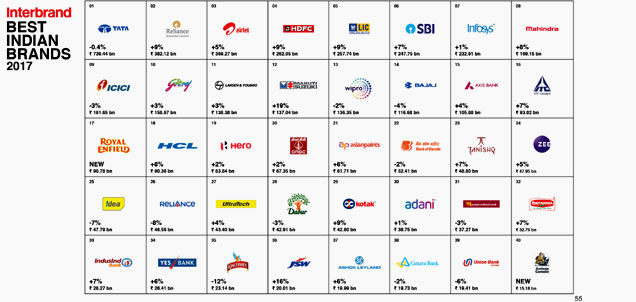
It’s that time of the year when the Omnicom Group’s Interbrand releases its Best Indian Brands report. For five consecutive years, Tata Group has continued to hold the top position. And while Airtel continues to play strong at #3, Reliance is now a strong #2 on the back of Jio’s omnipresence amongst telecom service providers.
Following Airtel is HDFC Bank at #4, and then Life Insurance Corporation of India (LIC),State Bank of India, Infosys, Mahindra, ICICI and Godrej round out the Top 10.The best growth performances belonged to Maruti, Reliance, HDFC, JSW and Kotak highlighting the relevance of Purpose Centricity, Technology and Brand in driving their growth.
Interestingly more than 50 per cent of the Best Indian Brands come from five sectors: Automotive (5), Diversified (10), Financial Services (12), Telecom (2), and Technology (2). Automotive is one of the top growing sectors, leading the change is brand Maruti Suzuki, which posted a 19% increase in brand value versus 2016.
Breaking into Best Indian Brands for the first time at #17 is Royal Enfield and Ambuja Cement at #40.
Said Ashish Mishra, Managing Director, Interbrand India: “The Best Global Brands understand that brands are the platform for growth. A quick look at the top growing brands confirms how outgrowing the now and changing at the speed of life creates admirable value growth.  Encouragingly, the top growing Best Indian Brands too have begun to understand and demonstrate the levers that drive growth and value. Maruti Suzuki, our top growing brand for the second year in a row has done an exemplary job with Reliance, Kotak, JSW, HDFC and Ashok Leyland not far behind. Our analysis of the Best Global Brands reveals some simple truths. Truths that are useful for Indian Brands to consider while driving growth in our rapidly changing market.â€
Also present at the launch of the 2017 report was Gonzalo Brujo, Chief Executive Officer of Interbrand EMEA, Latam and India. And this is what he said: “We are living in one of the most exciting periods of change—societal, technological, industrial—that impacts every aspect of commerce and life. In this ever-shifting context, to grow, brands need to outgrow. Outgrow barriers, challenges, markets, competition, mindsets, technology and potential. Which is why businesses need brands more than ever. The Best Indian Brands understand this value  in belief systems and purposes, and hence propel this change without losing the way.â€
The Top 40 Indian Brands have a combined total value of INR 4755.7 Bn, an increase of 5% from 2016. For the complete Top 40 ranking and the report with comprehensive analysis of growth, sector and industry trends, click here
Has Brand Tata been adversely impacted or tarnished because of the Cyrus Mistry ouster? Even as all may not have always been very well at the group, it has been India Inc’s most trusted business group over the years. Will a possible backlash from the Cyrus Mistry camp lead to a further devaluation of Brand Tata? We posed this question to a few brand gurus for their views:
Harish Bijoor
CEO, Harish Bijoor Consults
The brand Tata has a rather deep equity and a change in the Chairman or a change of a Director does not hurt the image of Brand Tata as much fundamentally because it is all about the fact that the equity of brand Tata. It’s a Rs 100bn+ company and is in operations in 100+ countries and in the corporate world these kind of things are accepted. People get excited about it and then they forget. It will be seen as a corporate activity.
Trust is a macro issue and trust happens over 100 of years and decades. Trust happens with your experience with the brand. Consumers statically interact with brands and not necessarily with corporate brands. So the Tata brand has got a front-ended facet which is far and wide. When you pick up a Titan watch you are interacting with the Tata brand, when you pick up Tata Coffee packet or Tata Tea packet you are interacting with the brand, never mind what happens behind. If you take the corollary of Kingfisher brand, people have asked me if the brand Kingfisher – the beer is affected because of Vijay Mallya and everything that happened I say, not at all. Anybody who is interacting with Brand Kingfisher and drinking the beer will continue to do so with a great degree of gusto. Tata is a consumer company by and large, whether it is a Tata truck, Tata bus, Tata car or Tata coffee, people are touched by these brands on a continuous basis and these brands are the ones that evoke trust. I really do believe that this will be seen as a corporate hiccup rather than a corporate turmoil.
Avik Chattopadhyay
Co-founder, Expereal
The Tata brand has been a benchmark for business propriety, professionalism and patience. But it seems the old guard got rattled by Cyrus’ plans of restructuring the organisation. His direct, no-nonsense style questioned a lot of deadwood, emotional baggage and personal ego-trips. The group went through a same phase of restructuring when RNT had taken over around 25 years back, but nobody objected then and obediently went through the slash and chop. Guess an ‘outsider’ did not help matters. And this episode does not help the Tata brand either. Bombay House is back to incandescent lightbulbs from LEDs. And its corridors shall be a bit darker now!
Alpana Parida
Managing Director, DY Works
There is widespread consternation about this move. The belief- right or wrong – is with the establishment as correcting  a trajectory that was at odds with its value system. The true equity of the brand has not been so much its size or success- which apart from TCS and JLR – seems to be in question. The real reason for the Tata equity has rested on its value system. Both as a corporate citizen and as an employer.
Tata has been the tall face of Indian global corporate ambitions and a move such as this has the country taking sides. Amrita Chowdhury
President, DY Works​
Clearly this is a dramatic move for a heritage- and values-driven firm. We have seen such high profile ousters in companies like HP or even Apple, driven from a divergence in the beliefs of the CEO/Chairman and the Board.
When we think of Tata Group what remains in our minds is its brand value. Their challenges in innovation or quality or profitability are systemic in nature. Recalling Lou Gerstner’s stories on the remaking of IBM, such transitions can be brutal. Or it could be steered over a long period of time. What is the right strategy for Tata Group in an Indian and Global context remains to be seen.
Tata, one of India’s largest conglomerates is ranked as India’s Most Creative brand by TRA Research Pvt. Ltd., (formerly Trust Research Advisory), a Comniscient Group company. The revelation was a part of a study conducted across 16 cities by the brand insights company. Creativity is the strategy ability to cope with situations to create better or new solutions combining innovating thinking and efficacious application. Contrary to general perceptions Creativity is one of the three operators under “Rational Appeal†in TRA’s proprietary Brand Attractiveness Model.
The South Korean multinational company Samsung Mobiles ranked second on Creativity followed by LG and Sony respectively. Honda was ranked in the fifth position, succeeded by technology giants Hewlett Packard (HP) at sixth and Dell at seventh. The eighth, ninth and tenth ranked brands feature Nokia, Maruti Suzuki and Bajaj respectively.
N Chandramouli
Commenting on Tata’s status as India’s Most Creative Brand, N. Chandramouli, CEO, TRA stated, “Creativity is not just viewed from a point of novelty, entertainment and utility alone, but from a position of future risk amelioration and protection. Tata is a pioneer, one willing to take risks and go through unchartered territories to deliver better or new solutions. When brands display Creativity, they demonstrate an ‘intellectual’ ability to deal with the future better.â€

 New terminology at IPL…
 When someone including me asks What is wrong with Tanishq? There is a counter-question, what is wrong with us? And What’s Your Problem? And the answer is: Everything.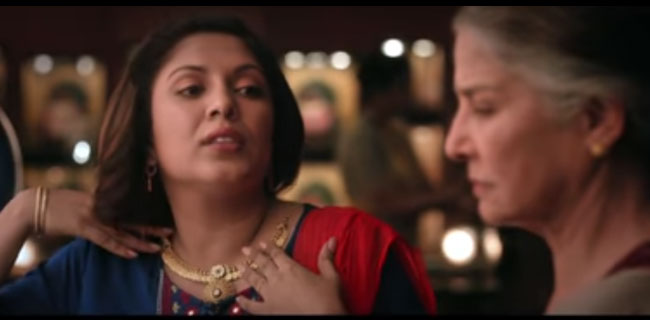
 It is the festival and marriage season. And gold is crossing all known limits. It’s also Tanishq time.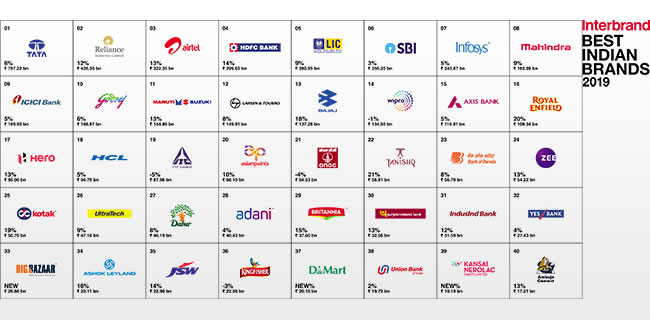
 The brand Tata has a rather deep equity and a change in the Chairman or a change of a Director does not hurt the image of Brand Tata as much fundamentally because it is all about the fact that the equity of brand Tata. It’s a Rs 100bn+ company and is in operations in 100+ countries and in the corporate world these kind of things are accepted. People get excited about it and then they forget. It will be seen as a corporate activity.
 The Tata brand has been a benchmark for business propriety, professionalism and patience. But it seems the old guard got rattled by Cyrus’ plans of restructuring the organisation. His direct, no-nonsense style questioned a lot of deadwood, emotional baggage and personal ego-trips. The group went through a same phase of restructuring when RNT had taken over around 25 years back, but nobody objected then and obediently went through the slash and chop. Guess an ‘outsider’ did not help matters. And this episode does not help the Tata brand either. Bombay House is back to incandescent lightbulbs from LEDs. And its corridors shall be a bit darker now!
 There is widespread consternation about this move. The belief- right or wrong – is with the establishment as correcting  a trajectory that was at odds with its value system. The true equity of the brand has not been so much its size or success- which apart from TCS and JLR – seems to be in question. The real reason for the Tata equity has rested on its value system. Both as a corporate citizen and as an employer.
 Clearly this is a dramatic move for a heritage- and values-driven firm. We have seen such high profile ousters in companies like HP or even Apple, driven from a divergence in the beliefs of the CEO/Chairman and the Board.