Tag: Tarun Katial

  • RBNL’s Big Magic goes for a new look and identity

    By Dyanne Coelho


    Comedy in India is a serious business and as a genre is picking up at a fast pace. Keeping this in mind, Reliance Broadcast Network Limited has rebranded its comedy entertainment channel Big Magic with a fresh new look and channel identity. Viewers can look forward a renewed focus original content, sitcoms, non-fiction shows, among others.


    Speaking at the unveiling of the new brand identity, Tarun Katial, CEO, Reliance Broadcast Network Limited said, “It’s going to be topical, it’s going to be contemporary, it’s going to be refreshing. We believe that comedy as a factor will predominantly factor in males and we believe that male entertainment is starved from anything but news and sports. Our attempt with the new identity is largely to be able to capture urban India and to make India laugh.”


    The logo unveiling earlier this week at the Canvas Laugh Factory witnessed the presence of popular Big Magic stars including Kiku Sharda who plays the role of Akbar in Akbar Birbal, Dalnaz Irani aka Rani from the same show and Saloni Daini, Ami Trivedi, Iqbal Azad, Dharmik Joisar and Sushant Mohindra of Tedi Medi Family as well as Upasana Singh and Gaurav Sharma from Total Nadaniyaan.


    “The plan is to make Big Magic the ultimate comedy destination of India. We’ve been getting a great response from viewers, and hence we’re moving to better sets etc, to improve our content. ‘Tedi Medi Family’ is an adaptation of the Warner Brother’s show ‘The Middle’, Akbar Birbal has also received a lot of praise, and we have many more shows planned for the future,” Paritosh Painter, Network Creative Director, RBNL expressed.


    Shalini Gupta, CMO, Big Magic TV Network, RBNL revealed the marketing mix behind the channel, “Comedy is a relatively new genre in India, at the same time it is extremely popular and is growing. Our marketing strategy targeted areas where people don’t laugh, because we wanted to make people laugh. Hence we do a lot of BTL activations. Digital marketing is increasingly becoming a very important part of our strategy. Earlier it was a meagre two to three percent, and it has now grown to about six to seven percent of the budget and will be improving a lot more.”


    The channel was a light entertainment channel a year ago, but the team at the front wanted to sharpen the position of the channel to a comedy network. “There is a definite vacuum in the comedy space in India aside from a few shows on Colors and &TV. We wanted to cater to the absolute comedy market, to the audience that loves comedy. So we’re making sure that all our shows even in the future have got a lot of LOL moments,” Painter explained.


    The content offered on Big Magic will be platform based agnostic with a large play in the digital and mobile medium. The channel is available across all DTH players including Tata Sky, Videocon, DD Free Dish, Dish TV, Reliance Digital TV and with all cable operators as well.


  • Reliance Broadcast Network integrates leadership team across Radio & TV. Lavneesh Gupta quits

    By A Correspondent


    Tarun Katial

    Reliance Broadcast Network Limited has announced an integration of its senior management tea to work across its radio and television divisions.


    The executive leadership team with Tarun Katial at the helm as Chief Excutive Officer will comprise:


    Asheesh Chatterjee as Executive Vice President and Chief Financial Officer, looking at new opportunities and expansion plans in addition to Finance and Regulatory


    Ashwin Padmanabhan as Executive Vice President and Business Head will oversee television channels – BIG Magic and BIG Magic Ganga, in addition to handling his existing role as Business Head for 92.7 BIG FM


    Sunil Kumaran as Chief Strategy Officer across revenue and product as well as marketing for both mediums


    Paritosh Painter as Network Creative Director across both mediums


    Lavneesh Gupta

    Meanwhile, Lavneesh Gupta, who had joined RBNL as COO in December 2013, is moving on from the organisation. Said Mr Katial in a statementt: “In order to build a future ready organisation, we want to build a team of lateral leaders. Their focus will be on developing skills of the team in the areas of innovation, creativity, risk taking and adopting an entrepreneurial approach. I am certain that the team will deliver and continue to successfully drive the growth story for the Group.”


    Meanwhile the company has also announced a topline growth of 25 percent and 60% growth of EBITDA in radio.


  • So what was the Budget like for M&E?


    A cross-section of captains of media and entertainment companies tell us how they found Budget 2015


    Punit Goenka, MD & CEO, Zee Entertainment

    This is indeed a futuristic and growth-oriented Super Budget presented by Finance Minister Arun Jaitley. It has addressed both the overall tax concerns, and portrayed a positive picture for the investor. It is a Budget to remember for the common man as well, since it has addressed all key aspects, like housing, jobs and education. Congratulations to Jaitley for wonderfully addressing the nation’s concerns through the Budget, and for setting some key goals for 2022


    Tarun Katial, CEO, Reliance Broadcast Network

    The Budget is positive, realistic and progressive in nature. Overall, it seems to be well thought of, with a holistic approach, and some key announcements for the services industry. The proposed reduction in corporate tax over the next four years is encouraging, as it will result in higher investments, growth and more jobs. The move to increase the service tax, however, will put smaller advertisers under pressure, and hamper advertising spends. The move on CSR is good, and radio can be used effectively as a catalyst for social transformation in initiatives like Swachh Bharat, since it reaches even the remotest of the corners [of the country] where no other medium can. This will be especially true with Phase III and deeper reach in radio.


    Sudhanshu Vats, Chairman, CII M&E committee & Group CEO, Viacom18 Media

    Two words sum up the essence of Budget 2015: Balance and clarity. Finance Minister Arun Jaitley walked the tightrope by staying away from Big Bang announcements that might have strained the fiscal position, while taking substantial steps on matters of tax, social security and public investment (especially in infrastructure). On the reduction in corporate tax rates to 25%, the four-year implementation roadmap is a welcome addition. This is the clarity the corporate sector needs so far as tax policy is concerned. While personal income tax slabs remain unchanged, higher exemptions are targeted towards savings and would add to retirement income in taxpayers’ wallets. These ‘wallets’ too, will have a different connotation given the FM’s vision for a cashless society. The reduction in withholding tax rates (to 10%) on royalty and FTS payments to non-residents has finally been granted. The increase in service tax is probably to bring the rate closer to the rates expected under the GST regime. In that context, the step is the proverbial bitter pill for our industry.


    Smita Jha, leader, Entertainment & Media Practice, PwC India

    The Budget has many references to the entertainment and media industry though there are no large announcements. The GDP growth target of an expected 8-8.5% will provide fillip to growth in the advertising industry. Clarity in the GST timetable is also significant, as entertainment tax being subsumed into GST will not only help bring uniformity in taxes across states, but also bring transparency in box office collections. There are many small reliefs provided to the industry, like exemption of the film exhibition industry from service tax thereby removing the possibility of dual taxation with the entertainment tax. Reduction in customs duty on import of digital cameras and accessories used for film production, will also help curtail production costs. The removal of certain entertainment activities from the negative list may, prima facie, seem unfavourable, but this will bring uniformity in taxation and thus be beneficial to the industry in the long-term.


    Zafar Rais, CEO, MindShift Interactive

    The new government’s maiden budget proposes to levy service tax for online and mobile advertising, which we believe will adversely affect the industry’s growth. It reflects differentiated treatment, as traditional print media remains unaffected with respect to the tax purview but the new, digital media that is actually driving innovation, will have to bear the brunt. Currently, India’s exponential mobile penetration and app consumption patterns are driving the growth of the mobile advertising industry, and this tax could hamper the innovation efforts of the entire ecosystem comprising mobile development startups, advertisers and publishers. We would have preferred a more future-focused policy regarding this particular aspect.


    Sumit Jain, Co-Founder & CEO, CommonFloor.com

    The move to allot Rs 1,000 crore to tech start-ups is only a reiteration of the government’s intent and purpose. The corpus, as such, is not substantial and we can only hope that there will be a fast and efficient disbursement of this fund. Jaitley also referred to a more liberal system of raising global capital and the ease of doing business, which are encouraging and would eventually create employment opportunities in the country.


  • First Leader,First Mover Advantage with Retro

    Quick Takes with 2014 Stars


    Beginning a four-or-more-part series of interviews with A quick Q&A with Tarun Katial, CEO of Reliance Broadcast Network Ltd whose 45-station 92.7 Big FM climbed the ratings roster after it switched to a retro music format in some of its key markets.


    Do talk us through the Big switch to retro

    We were in the business of radio for about four to five years before we took the plunge. We realised that just being one of the pack doesn’t work. Some of our competitors were in the market for 10-odd years. While the station did really well initially, the growth had plateaued. Being in radio, we’re also in the business of consumer insights. We realised there was a clear gap in the market and a market in the gap. Our research told us that a large number of 25-plus discerning, paying consumers  were now present on radio in large volumes. A combination of putting the consumer at the centre and understanding what the competition would and wouldn’t do and what were the possible unique gaps in the market made us decide to go retro.


    Did the dispute with T-Series have a role to play in the switch?

    No, it was largely driven by consumer insights and a deep-ended research conducted by a couple of agencies. I won’t link it to T-Series but what we also saw was there was a high amount of fatigue and low amount of involvement with interest in new music. Music was burning out quicker and was not engaging listeners as much. The number of music hits is reducing year-on-year. Even the biggest movies don’t have some very big music song hits anymore. The shelf-life of that music is reducing from six months to just four to five weeks.


    Wasn’t there a worry that you would alienate young listeners?

    When we did our research with both young and old listeners, we realised that everlasting or all-time favourite hits were popular across age groups.


    And what about teenyboppers?

    There were 50 to 60% of them who voted for the retro positioning. Also, we believe that the discerning and paying audience was largely in the 25-plus age bracket. Most advertising categories focused there.


    But as you go along, you’ll need to incorporate newer music

    Most radio stations in our position worldwide add another five years in their music library every two or three years.


    Has the issue with T-Series been resolved?

    We don’t really need them so where’s the issue?


    But five years from now, you’ll need them.

    Then we’ll take them because we’ll do what is right for the consumer. Needless to say, there have been fairly big competitors in that space. Zee, for instance, has done very well with music and we’re working with them in several of our geographies where we don’t do Retro. They’ve released large volume of new music which has done really well and we do play it.


    How has the retro switch worked for your revenues?

    Exponentially and I think both our volumes have increased significantly. We’ve seen at least over 25% year-on-year growth on both topline and bottomline.


    What next on the current offering?

    The effort to innovate within the format is going to be continuous. We’ve launched Anup Jalota in our morning band which is a first on radio. That kind of talent is rarely seen on Indian media, let alone, radio. So, a combination of Neelesh Mishra, Annu Kapoor and Anup Jalota is quite powerful. We’ve also launched Richa Anirudh, the famous TV journalist who did Zindagi Live on our daily station as our morning show host. We’ve got veteran journalist Bhawana Somaaya, full-time as our entertainment editor and all of these are enriching the content and making it well poised and well positioned.


    Phase 3 has taken a long time. Are your plans for it still on?

    With Phase 3, radio will be one of the segments that will probably grow the most in 2015 among the various media categories. The hope is not only will the base of radio advertisers and the inventory will grow, but also radio will appeal more demographically and geographically in this country.


    Once Phase 3 is in, you could also have competition in the radio space.

    May be we will, may be we won’t, depends on what whose plan and strategy is.


    Independent news continues to be a no-no on private FM?

    We’re hoping that there will be final news guidelines very soon and that they will be more liberal than what we’ve heard.


    Now that others have seen your success, the same thing that happened in the hit music space may happen with retro…

    We have the first leader, first mover advantage here that we didn’t have there.


    A shorter version of this interview appeared in ‘dna of brands’ on January 5, 2015


  • BIG Magic Ganga: No 1 channel of the region: Tarun Katial

    BIG Magic Ganga delivers to audiences an authentic, highly engaging entertainment destination which has made it the No 1 Channel of the region. Our production set up in Patna is part of our long-term commitment to grow this regional market while creating excellent opportunities to hone skills of local talent. It remains our endeavour to offer audiences exceptional television engagement, and marketers a great platform to ride on.”

    - Tarun Katial, CEO, Reliance Broadcast Network


  • 5th edition of Big Star Entertainment Awards announced

    By A Correspondent


    Having collaborated jointly over the past four years, 92.7 BIG FM and Star Plus have announced the rollout of the fifth edition of BIG Star Entertainment Awards in Mumbai. The awards ceremony will acknowledge and celebrate the biggest entertainers of the year across the fields of Bollywood, Television, Music and Sports and their contribution to the entertainment industry.


    The awards have grown in popularity over the years. Like in previous years, the first awards of the season will be a 100 per cent people’s choice offering, right from the nominations to the final winners. The robust voting process will see radio, television and digital being enabled for audiences to vote for their most deserving artist.


    The award function will also be marketed across radio, television, print and social media to ensure maximum tune-ins on New Year’s Eve on Star Plus.


    Tarun Katial

    Speaking of the 5th Edition of the BIG Star Entertainment Awards, Tarun Katial, CEO, Reliance Broadcast Network stated, “The award and our partnership with Star Plus has matured wonderfully and we are happy to once again bring together a congregation of the finest entertainers from across industries. This is part of our endeavor to empower audiences with a democratized award which allows them to choose their most favorite entertainers. We look forward to celebrating the evening with the industry and offering audiences an engaging watch on New Year’s Eve.”


    Mystifying the viewers with nominations and providing them with edge-of-the-seat excitement as the biggest stars come on stage to receive their awards, the BIG Star Entertainment Awards in its continuous effort to recognize and felicitate some of the most accomplished members of the industry, is ready to engage audiences and entertain them all over again this year.


  • Tarun Katial: What the new government (and MIB) must do for Radio


    By Tarun Katial


    1. Foreign Direct Investment (FDI) in Radio Broadcast Sector

    Key Issues:

    :: The current FDI limit in the radio broadcast sector is restricted to 26%.


    :: In respect of television broadcasting sector, the FDI limits are as below:


    Non-news content – FDI is permitted up to 100%; and

    News & current affairs content – FDI has been restricted to 26%.


    TRAI Recommendation:

    :: TRAI on August 22, 2013 recommended that FDI limit for radio sector should be enhanced to 49%.


    Requests:

    :: There should be parity in the FDI limits for the television and radio broadcast industry.


    :: For FM radio broadcasters airing news & current affairs, the FDI limit should be increased to 49%.


    :: For all other FM radio broadcasters airing non-news content, the FDI limit should be increased to 100%.


    2. Deferred payment mechanism for Non refundable One time Entry Fee (NOTEF) and Migration Fee

    Key Issues:

    :: Based on current guidelines the migration fee payable by existing players to migrate to new regime and NOTEF by successful Phase 3 bidders has to be paid upfront and in full.


    :: It is estimated that the FM radio broadcasting sector will require additional capital investment of Rs. 3,000 crores or more for meeting the outgo on account of migration fees, Phase 3 auction license fees and capex for the creation of infrastructure.


    :: This additional capital investment of Rs. 3,000 Crores amounts to 200% of the annual revenue of the radio industry.


    :: The telecom industry which is much larger than the Radio Industry and which has an annual turnover of Rs. 3,00,000 Crores has already been allowed a deferred payment mechanism for the recent spectrum auction in 1800MHZ and 900 MHZ Bands. It is pertinent to note here that the total spectrum fee in the auctions was Rs. 61,000 Crores, which when compared to the annual turnover of Rs. 3,00,000 Crores,  amounted to only 20% of their annual revenue.


    Request:

    :: On the lines of the recent spectrum auction polices for Telecom, we request a deferred payment mechanism for the migration fee and NOTEF as under:

    Upfront – 25%

    Moratorium – 2 years

    Balance payment – Annually over the license period


    3. Migration of Phase 2  to Phase 3 regime

    Key Issue:

    :: With licences of Phase 2 expiring from March 2015, the migration to Phase 3 is the critical concern of the Radio industry.


    TRAI Recommendation:

    :: TRAI on February 20, 2014 recommended that the policy of migration of existing operators to Phase 3.


    Request:

    :: We request that the Government accept TRAI’s recommendations and announce the migration policy at the earliest.


    4. Channel Spacing

    Key Issues:

    :: Limited number of FM channels available in various cities and high license price makes it difficult to shift the focus away from mainstream film music. Consequently there is lack of content plurality thereby affecting radio listenership.


    :: The additional capacity could provide a platform for special focus genres, regional/folk content, dedicated channels for sports and news, etc.


    TRAI Recommendation:

    :: TRAI on April 19, 2012 recommended that it is technically feasible to reduce the channel spacing to 400 KHz from the current 800 KHz and thereby, double the number frequencies in A/A+ and B category cities.


    Requests:

    :: TRAI’s recommendation of reducing channel spacing from 800 KHz to 400 KHz should be accepted.


    :: The government should announce immediately the proposed number of additional frequencies that can be auctioned in A/A+ and B category cities and the associated time frame for their auctions.


    :: This will enable industry players and incumbents to take informed decisions during Phase 3 bidding.


    5. Reserve price for cities undergoing auction for the first time in Phase 3

    Key Issues:

    :: In Phase 3, 228 cities (707 frequencies) out of a total of 294 cities will be undergoing auction for the first time. The Ministry has proposed the following methodology to calculate reserve price for cities undergoing auctions for the first time as under:

    >> Highest bid price received during FM Phase 2 for that category of cities in that region.

    >> In case the benchmark from Phase 2 for a particular region is not available, then the lowest of the highest bid received in other regions for that category of cities may be taken as the reserve price


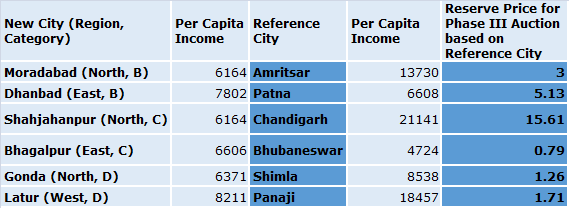
    The table shows the reserve price in some of the cities based on the rules provided in Phase 3 guidelines:

    Ministry of Information and Broadcasting; Census 2011


    :: In view of the table above, it is unreasonable to expect, that the price set for Chandigarh, a C category city in North region and the city which received the highest bid of Rs. 15.61 Crores during Phase 2 auctions with per capita income of Rs. 21,141, is a fair reserve price for Shahjahanpur with per capita income of only Rs. 6,164.


    :: Similarly, the reserve prices for most other fresh cities look unreasonable. For instance, Moradabad a B category city in North region with a per capita income of Rs. 6,164 cannot be compared with Amritsar, which received the highest bid of Rs. 3 Crores and which has a per capita income of Rs. 21,141.


    TRAI Recommendation:

    :: TRAI on February 20, 2014 recommended that the methodology for determining the reserve price for fresh cities in Phase 3 should be reconsidered.


    Request:

    :: In case of cities going for auction for the first time, the reserve price should be ‘Average bid across all regions in the country for the same category of city’. This will eliminate any outliers and e-auction will allow fair price discovery of each city.


    6. Expedite Empanelment with DAVP (Directorate of Advertising & Visual Publicity) of some radio stations

    Key Issues:

    :: The revision of DAVP rates for FM has been pending since last 3 years


    :: Empanelment of radio station of some radio broadcasters, which is pending since 2008.


    Requests:

    :: DAVP rates/policy be revised appropriately based on the growth of FM listenership across India


    :: Expedite empanelment of radio station of some radio broadcasters to ensure fair allocation of funds by DAVP.


  • BIG Magic appoints Uditanshu Mehta as CD

    By A Correspondent


    BIG Magic has announced the appointment of Uditanshu Mehta as Creative Director. Uditanshu who brings with him an extensive and impressive portfolio of work in the media and entertainment space will be responsible for all the on-air programming elements on BIG Magic ensuring engaging comedy content for audiences. In his position, Uditanshu will report to Tarun Katial, CEO, Reliance Broadcast Network Ltd.


    Backed with honors in Political Science from the Delhi University and a diploma in film making from FTII, Pune, Uditanshu comes with 16 rich years of diverse experience in the television and film industry which comprises of leading media and production houses, Miditech Pvt. Ltd., UTV and SAB TV. Leading the programming function as part of the core team at SAB TV, Uditanshu was instrumental in changing the channels positioning from an entertainment channel to a comedy channel.


    Tarun Katial, CEO, Reliance Broadcast Network spoke of Uditanshu Mehta’s appointment, “Uditanshu brings with him diverse experience and understands the pulse of audiences seeking comedy entertainment. We look forward to have him work closely with the team and lead the product to its next level of growth.”


    Speaking of his appointment, Uditanshu Mehta stated, “I’m looking forward to my new role. Nothing is more satisfying than to have audiences enjoy a television viewing experience layered with laughter. Am glad to come on board BIG Magic – the brand that allows me expression in the genre that I love best – comedy.”


  • 92.7 will be a 100-plus radio networks soon: Tarun Katial


    Buoyed by the success of some key stations going retro, Reliance Broadcast has Big plans for 92.7 FM. In a wide-ranging interview with Pradyuman Maheshwari on the radio business at his company’s headquarters in north-west Mumbai, Tarun Katial, Chief Executive Officer of Reliance Broadcast Network spoke on the switch to retro, his plans for Phase III and news on private FM radio.


    You must be proud of the way 92.7 Big FM has grown in leadership. The retro strategy has worked wonders, right?

    We researched that all radio consumers are not the same, all tastes are not the same and we will go region by region, city by city to decide the format and we put our radio station in buckets so there is the retro bucket where all stations that we saw that the liking for retro music was high, we’ve taken the ‘hit thhe, hit rahenge’ positioning in all those stations. There are some stations where we continued to run as contemporary hit radio but they are in a bucket of regional plus contemporary so there is Bangalore, there is you know the whole Punjab belt, there is Chennai. Chennai is actually different, there is Hyderabad, and some of the others which are regional contemporary hit radio. So they primarily belong to that region and to the music of that region and contemporary music of that region.


    Going retro has obviously been successful but did you think that it would alienate the youth?

    We did extensive research in all target audience groups and was quite surprised to see the results. New music has so little shelf value even among the youth that beyond eight to ten weeks, a song fades away and never comes back. That’s the maximum period that a song stays on the charts today.


    How’s it done for your revenues?

    The money today is in categories like auto, insurance and FMCG. And these all talk largely to 25+ male or female consumers. Even though you may worry about our youth ratings which are very, very big and competitive when compared to others, it is in the 25+ audience largely where all the advertising money gets spent. We are clearly the No 1 here. So it has impacted our revenues extremely positively. Our Mumbai station which was priced anywhere between Rs 6-700 bucks has nearly doubled its price, its ARPUs and its volume going up extensively…


    In terms of overall revenues, what has been the kind of growth?

    If you look at our last six months which is where we’ve really gone retro, we’s seen a near-15-20 percent rise.


    While you were always known to be the large 45-station network, given your leadership status in the two key markets of Mumbai and Delhi, you must be now calling the shots in the radio genre?

    I think most large advertisers realise that we deliver very good value and they’ve started to work with us far more extensively than they ever did in the last one year. A few of the larger ones have actually gone and done some really innovative work with us. So we’re seeing larger marketshare shifts towards us. We’re also seeing advertisers finally getting conscious about where they spend their money because spends on radio are going up after the cap of ad time on TV and so we’re seeing people holding themselves and their agencies far more accountable in terms of RoIs. Advertisers are increasing looking at RAM data. Around 70-80 percent of adspend is in the four metros which are measured by RAM weekly.


    An aside: radio players do not seem to have too much of a problem with RAM as the televisionwallahs have had with TAM.

    I think even radio players want RAM to upgrade itself. Baselines need to be updated, data needs to be looked at for challenges that it has. So there are issues with RAM and we want to move towards electronic from diary, but it’s far better than an IRS kind once-in-a-quarter, once-in-six-months, once-a-year kind-of study and now with IRS not come since 2012 that data is virtually redundant now.


    With BARC a reality, now from October onwards, presumably TAM will be off so they will only have RAM.

    I don’t know whether TAM will be off or we’ll have two sets of ratings….


    Huh?

    The jury is not out on whether TAM will be off.


    Yes, but they need to have enough subscribers to be able to fund that kind of research.

    Yes, but I think everybody is going to look at the stability of the BARC data for the first few months before we all switch off TAM… which is an eventuality


     Assuming that happens whenever, are you worried about research because that company will only have RAM as a business proposition in the field of audience measurement?

    Internationally there are enough companies that do both radio and TV research. The good part in RAM is that it’s a commissioned study by the radio broadcasters. Unlike TAM which is a subscribe-to data, this is a commissioned data and as a radio body we can commission it to any other research company we think fit.


    So will you continue with RAM for the moment?

    For the moment, yes, I think the radio industry is going to be with RAM.


    Coming back to 92.7, from what you say the people who matter for revenues – the adult listener – listens to retro and hence the switch to retro has been rewarding. It now appears to be a no-brainer, so why didn’t you do it all these years?

    I think everybody likes to believe that there is safety in majority and you try to do what  everybody else is doing and try to make the marginal delta difference of what you and the other player are. You realise that the marginal delta difference only gets you that far and you’re all pretty much aping each other and the only way to stand out is to break free from the clutter. So we decided that you have to take some slightly bigger risks to get some slightly bigger results.


    We took some risks, some aggressive ones and that paid off quite well and we also took these risks with a good execution strategy behind it. So not only have we gone retro, we’ve gone retro with some very pathbreaking shows.n Suhana Safar with Annu Kapoor is just one of that. What it’s done to radio is that not only is it the No 1 show but its added to new listeners on radio. And very few products or shows on radio or on TV can add to the base of viewers or listeners. There isn’t anybody who you would talk to around who listens to radio or listens to our network who wouldn’t have consumed Annu Kapoor today.


    What next? People are trying to replicate what you’re doing.

    What we have been able to do is that we’ve built a format with talent around it which you can’t replicate. You can replicate the music but not the talent around it and the insights that we’ve been able to do with music. We have actually had a panel of serious musicians help us classify our music. We haven’t done it with little knowledge like most other radio stations including us have about music. We actually brought in experts. I think the next step would be to add more formats within the retro format, to add new talent and new shows. We’re in the process of talking to two very big artists. You can replicate music, but not talent.


    But talent can be poached.

    Well, you can poach talent but you can’t replicate it.


    What about the attraction of associating with new films like a Humpty Sharma?

    You have to make some sacrifices right? You have to stay true to your format. We have not done any such movie tie-ups in a long while. Yes, we do interviews because we’re not away from the current world so they all come to us. They come and talk to them about the legends and the retro music they’re in love with.


    Given the success that you’ve had with retro, what are you plans for Phase III?

    I think Phase III will be a great opportunity for us to refine our formats even better so in places where we get multiple frequencies. Having succeeded with different shades of work with retro which a lot of people including some people on our Board said was doubtful and questionable, we’ve got some two-three formats up our sleeves that we want to test in Mumbai and Delhi and some of the other markets.


    Is there anything that you could make public right now? Would  you look at classical music at all in the future?

    While we haven’t done classical music but we do classify our music for ragas and we do play our music by day parts according to ragas.


    So Phase 3… how many licences are you looking at? 

    We’ll go for max. Max in terms of whatever is possible so I think from a 45-station network you can expect us to be a 100-plus network.


    But, of course, there’s still some time before Phase 3 happens.

    It should happen. I think the government will do it before December, I would think.


    Will you possibly look at regional also like in a city like Mumbai?

    Why don’t I just write the format strategy and give it to you? (laughs)


    Okay, what about news? Is that something that you will get into?

    Well I’m excited about it.  I think it’s almost archaic to not have news on free radio and not allow the consumer to be able to make himself aware on what his happening on the world around him on free radio. It’s not fair and I think this government had finally woken up to that reality I think we spent five years representing to the last government or more. I was so hopeful that they would have done something under the last regime. But I hope this regime will come and I think the statements from the I&B minister are very positive.


    This is independent news, not AIR news.

    We’re hoping that some of the leading news agencies will be allowed.


    But why don’t you still pitch for independent news?

    Definitely! And that’s our argument. We are still hopeful that the minister will stay true to his earlier announcements of allowing at least Press Trust of India (PTI) news on air. With all sorts of news available even on local cable television, radio should be treated fairly and equitably. It is a responsible medium, live, here and now, can be consumed on the go, and can be very effective. We free-minded and free-spirited media people like you will help us in taking this cause forward.


    I’m the only person who writes about it. Seriously, don’t you think the radio bosses haven’t pushed for it enough?

    I think we haven’t. I think we haven’t worked hard enough for it. I think we have been caught up in other issues and haven’t focused on this hard enough. I think some of the other business issues like renewal of licenses and music royalty caught our attention more than this. But I think we will fix it.


    Will Phase III licence prices be under control, unlike the past?

    I don’t think that we will see a new pan-India player coming in. Tough. I think there will be a certain amount of consolidation among current players but I don’t think there is going to be a new pan-India player coming in.


    This talk of consolidation has been there for a while but not really happened…

    I think people are waiting for the Phase III policy and the renewal of licenses clarity. And I think people are looking at their build vs. buy options so. Currently, the build options looks far more easier than buy because of the Phase III licenses so for current players there is no real motivation go buy.


    Assuming Phase III is announced in October, by when do you think you will be up and running?

    Launches are going to be far more quicker, they’re pretty much linked to just capex procurement because technology is easier and no real infrastructure is to be create so it will happen quick. Toh jaldi ho jayega


    Have you already started work on it?

    Obviously there is some amount of groundwork that is already in place.


  • #FF14 Day 1: Seamless content delivery across multiple platforms the way forward

    By a correspondent


    With so much being written and said of the emergence of multiple platforms and content delivery mechanisms in India, it was only apt to gather opinion from those that are driving the change to get a firsthand feel of the effects being spotted. The session on ‘Television 3.1’ on day 1 of FICCI Frames saw the panelists assess the future of the broadcast industry, in terms of content, marketing and distribution strategies in the era of convergence and multiplatform delivery mechanisms.


    The panelists comprised speakers like Tarun Katial, CEO, Reliance Broadcast, Vikram Chandra, CEO, NDTV Group, Mathieu Bejot, Executive Director, TV France International, Bharat Ranga, Chief Content and Creative Officer, ZEE Entertainment, Ashok Mansukhani, President, MSO Alliance and Todd Miller, CEO, Celestial Tiger Entertainment. The session was moderated by Janine Stein, Editorial Director, Content Asia.


    Vikram Chandra began by highlighting how 4G and smartphones will be the next big change agents in the Indian media landscape. “The recent months have witnessed a lot of people moving to the second screen to access content of their choice and with the access becoming more fast and affordable, smartphones will be the next big thing where content consumption is concerned,” he said.


    For Todd Miller, what will drive India in the months ahead will be the explosion of HD technology. Assisting that would be content from China that would be finding its way around the world, including India.


    Providing a different perspective, Bharat Ranga said that the way his network functioned it was a matter of tackling markets on a ‘meta’ level. Meta-national approach by companies that caters to market-specific conditions will drive the growth for broadcasters. Also, it will be essential for broadcasters to have a consumerist understanding of data and not marketing understanding. With the emergence of new platforms, Ranga noted that the industry will see the emergence of budding talents who will be able to bring in a different perspective.


    Ashok Mansukhani proposed that each stakeholder should be able to make money from the digitization exercise but that the consumer should have the final say. He said that the phase 3 and 4 of digitization will see a lot of players going fiber. While that will boost output, it is essential that the distribution rights of such an exercise are retained with the distributor, he noted.


    Tarun Katial said that India was ready to see content as the core subject that can be created for various platforms. The ability to have good investment strength and also the right mix of talent and content will help companies achieve the goal faster, he noted. Mr Katial added that while earlier ‘Content was King and Distribution was God’, the phrase has now changed to ‘Content is king and Technology is God’. Going forward, it is important that broadcasters have a hold on the IPs as that is what will matter in the future. And while much of the content at Reliance is being rented, Mr Katial added that very soon they will be working on producing content that would be their own.


  • No news on FM radio is bad news

    By Himanshi Dhawan


    The Supreme Court’s notice to the Centre seeking an explanation for omission of news and current affairs on private radio channels has brought the spotlight on the government’s skewed policy.


    The last decade has seen a proliferation of newspapers , TV channels and news websites – all of whom are free to air news, but private radio channels are not.


    The proposed FM radio phase III policy had the opportunity to correct this anomaly, but the government failed to seize the chance – many industry leaders feel deliberately. They said the current policy was in contravention of the SC’s “airwaves” judging in 1995 when the court stressed that “diversity of opinions, views, ideas and ideologies is essential to enable the citizens to arrive at informed judgment on all issues touching them. This cannot be provided by a medium controlled by a monopoly -whether the monopoly is of the State or any other individual , group or organization.”


    However, radio remains the only medium where government has a complete monopoly over news.


    The Association for Radio Operators in India (AROI) president Anuradha Prasad said it would be a “welcome” step if news on radio was allowed to be broadcast. “If news organizations can generate news for television and print, then why not for radio as well,” she asked.


    Nisha Narayanan

    Red FM CEO Nisha Narayanan said the current policy was “unconstitutional”. Describing government concerns about law and order and national security as “spurious”, Narayanan said, “These are spurious concerns. We have over 150 news channels on cable TV, many of which are foreign channels over which we have no control. There are over 65,000 registered news journals in India. We have no idea how many news websites are there on the internet , or who runs them. To this day, I have not heard anyone suggest that we shut them all down as ‘unchecked’ news or that they might lead to a law and order problem. Far from banning news on any of these media, no one in his right mind even suggests pre-censorship of news on TV or newspapers or the internet.”


    Ms Narayanan added, “Reasonable restrictions under Article 19(2) and the general broadcast code apply to all electronic media, including radio. The sensible method of ensuring compliance with the broadcast code is self-regulation and suitable penalties for violations. Prohibition of news on radio is a ridiculous overreach on the government’s part.”


    Prashant Panday

    Radio Mirchi’s Prashant Panday said, “How can private FM broadcasters be denied the right to air news? At one time, we heard the government had security concerns , because they couldn’t monitor us. But today, the technology is readily available . Then we heard that since FM radio reached one and all, even those who could not afford a TV set or read a newspaper, the government was concerned about our news content. But this is specious reasoning as we are bound by programming guidelines, and would be governed by a code similar to the one followed by TV channels,” he said.


    Tarun Katial

    Reliance Broadcast Network CEO Tarun Katial said, “Giving private radio the freedom to air news and current affairs can bring about a sea change in the way India consumes the medium, and position radio as a means for information dissemination , beyond pure entertainment . Inclusion of news will realize information requirements of a large section of the population, while fuelling growth of the sector,” he said.


    The PIL filed by NGO Common Cause pointed out that there was no such ban in countries like the US, Spain, Sri Lanka and Pakistan despite a large number of radio stations in these countries.


    Source:The Economic Times

    Copyright © 2013, Bennett, Coleman & Co. Ltd. All Rights Reserved

    Licensed to republish


  • Reliance Broadcast announces Q1 results, mood upbeat

    By A Correspondent


    There may still be some bracketed numbers out there, but the mood is upbeat at the Reliance Broadcast Network Limited offices over the earnings of the first quarter of the current fiscal year. The Reliance group company announced its financial results for the quarter ended June 30, 2013, reporting operating breakeven, with consolidated total income of Rs. 61.1 crore and consolidated EBITDA of Rs 0.9 crore.


    The Company reported a 31% increase in revenues for radio at Rs. 47.3 crore in Q1 FY14 and is hopeful of gains from FM Phase 3.  Television business clocked 37% Y-o-Y growth with revenues at Rs 8.4 crore.


    Tarun Katial

    Commenting on the performance, Tarun Katial, Chief Executive Officer, Reliance Broadcast Network Limited said, “Reliance Broadcast Network has delivered robust performance, breaking even at the operating level. Radio has delivered the highest ever Q1 performance fortifying its position as the leading national network and both key businesses of radio and television are primed to benefit from the impending government reforms.”