Tanishq, in partnership with Dentsu Webchutney, has launched its latest campaign, MarriageConversations. The campaign aims to encourage couples to have conversations about the marriage and the life they want to build together, as much as the wedding itself. The film is crafted by Superfly Productions.
Talking about the campaign, Ranjani Krishnaswamy, General Manager Marketing, Tanishq said: “This wedding season, we want to encourage young couples who are taking the next big step of their lives to pause and talk about the marriage they envision with each other; a conversation where they feel the comfort and honesty with their partners to discuss what truly matters to them. Tanishq wants to celebrate these real conversations that lead up to the moment ‘when it rings true’ for our couples and etch these moments with our engagement rings.”
Added Binaifer Dulani, Creative Director, Dentsu Webchutney: “Tanishq is part of every milestone a couple shares together, embellishing a lifetime of memories. And it all begins when the couple decides to make that commitment. We’re proud of the brand for inspiring and encouraging soon-to-be-married couples to get raw and real and build a strong foundation together, as they inevitably set on a rollercoaster of a journey that is life. We hope couples across India will feel empowered to be vulnerable with each other and talk about their future before they take the big step.”
Advertising like the other arts of cinema, music, is the perfect mirror of an emerging society. Often the arts can lead society, and at other times, it may just be a mirror of where society is today. It’s important for a brand to constantly search for cues from our daily living. So, a brand can often be a mirror of where we are but equally a brand may lead society into their own future.
But advertising like cinema is good at constantly exploring emerging societal trends. Of picking up something that exists today but may not still be big. I think it is brave for any art to pick up an emerging trend that is not necessarily popular or fits societal norms. Titan is one brand that comes to my mind which is constantly leading from the front. Unfortunately, it has also meant that it has often come under fire for being experimentative. You will remember how it got trolled for the Tanishq ad last year which showed a real situation which revolved around an inter-faith couple and the husband’s family. One can’t deny that inter-faith marriages do exist in India and perhaps they are only growing. But that ad was from one of the Indias and trolled by the other India.
Another ad that got into trouble with one of the Indias, was the Manyawar ad featuring Alia Bhat. Because of a play of words that the ad engaged in where the ritual of Kanyadaan was interpreted as Kanyamaan.
And now comes another ad from Tanishq again in the area of marriage and relationships. And I can’t help feeling that it has done a good job of appealing to both Indias. Or has is?
The conversations between the couples in the ad are very real, honest and portray the trust and confidence that two partners can place with each other by sharing their innermost doubts, desires and thoughts with each other. But equally I think it portrays a certain equality between a man and a woman in a relationship.
For years, we have portrayed the Indian woman as subservient, something that is backed by the new GenderNext report (https://ascionline.in/gendernextreport/2/index.html) from the ASCI which says:
“Women being featured in care-taking roles, placing the good of the family and friends as their primary focus and concern
:: Women being targeted for beauty products featuring an unrealistic and unobtainable standard of beauty
:: Women being informed and educated by the voice of a male authority figure”
The Tanishq ad I thought breaks the traditional stereotype of how women have been portrayed in advertising. It is steering the portrayal of women in a very positive direction, while simultaneously exploring the deep relationship and trust that life partners can place with each other.
Is the real India like this one may ask? Yes and No. I think, that in urban centres we can see man-woman relationships like the ones in the ad, but I can’t help feeling that as we move down the population strata, it may still be quite unrealistic.
This ad may still be appealing to only one of the Indias and most probably this is the Tanishq target audience. What is different and perhaps a lesson for advertisers in the future is that it is possible to talk to only one of the Indias without upsetting the other!
With the festive season kicking in, Mia by Tanishq has launched the #SwayWithMia campaign with an aim to create awareness about the brand’s latest ethno-contemporary festive collection, ‘Sway With Me’.
Speaking about the campaign, Shyamala Ramanan, Business Head, Mia by Tanishq, said: “Dance is one of the most primitive forms of self expression- hard coded in our brains. Even little babies move to the rhythm, such is the instinct. We dance because it is a great way to express an emotion when words seems inadequate. Dance is simply a medium by which we show the world and ourselves who we truly are and who we want to be. Deep down in our hearts we believe we are unique and when we sway to the music in our hearts we are reveling in our most authentic version of ourselves. Our latest Brand film celebrates the products inspired by the rhythmic sway of dance forms and the campaign is a tribute to a woman’s self-expression.”
Added Mithila Saraf, Business Head, Famous Innovations said: “We started with an inspiring collection in “Sway with Me” with fluid designs that symbolise freedom, dynamism and joy – traits that are signature of Mia women too. We brought this alive with the insight that today’s young women bring life and rhythm to any situation they’re in, and nothing can stop them from celebrating themselves. The film is a simple illustration of that spirit.”
Laqshya Media has reported that it has recently executed an OOH campaign for Tanishq’s festive collection ‘Utsaah’ – The Festival of Life.
Speaking about the partnership with Laqshya Media Group and on the campaign, Ranjani Krishnaswamy, GM – Marketing, Tanishq, Titan Company Ltd said: “Utsaah, our Diwali campaign is a reflection of the current sentiment, it draws its inspiration from valuing the present, the jubilation of celebrating what’s in our midst today. With the past that’s been tough and a future that’s cautious, it is the today that really holds the promise, that implores us to cherish, rejoice in the biggest festival called life. The power of now more than ever before is directing our lives and becoming the biggest source of our happiness. These everyday celebrations have been the inspiration for our collection, jewellery that is versatile, wearable, that styles your everyday moments, and allows you to layer it to create your own signature look, this collection blends the traditional heirloom craftsmanship with modern motifs and geometry to create a new language for your repertoire.”
Speaking on the campaign, Amarjeet Hudda, COO, Laqshya Solutions, added: “We at Laqshya Group are proud to execute this campaign for Tanishq’s festive collection that brings us the beautifully designed products crafted to perfection by their Karigars that add to our festivities. It’s been very rewarding to work with a team that cares not only about reach and frequency, but also the impact of activities on their audiences. Through this impactful OOH branding exercise, we have tried to create a long-lasting impression in the minds of our consumers”
Never has marketing communication been under the scrutiny of so many, ever before in its history.
First, there are the regulatory bodies who look over your shoulder. While working in China in the late 1990s, and when censorship was much stricter perhaps than it is today, I remember having a tough time. In a commercial of mine, a student acts cheeky with his teacher. It was intended to be tongue-in-cheek, but the humour of the situation was lost on the powers that be. We were told that it went against the norms of the teacher-student relationship which went back to none other than Confucius who had articulated with great lucidity on the subject. I even remember, Close-up toothpaste, which was then running the ‘Kisses’ campaign in the US my version of the campaign for China, had two toothpaste tubes of Close-up coming together to suggest they were kissing. At the time, it was a big hit in countries like Indonesia, which again had strict censorship rules in place.
Coming back to the present moment, with the addition of the Department of Consumer Affairs being added in the last few years, means there are two watchdogs, a government watchdog and the Advertising Standards Council of India (ASCI) which is the self-regulatory industry watchdog. One is not quite sure what the government watchdog has been up to since they don’t publish their achievements, but the ASCI publishes every quarter the cases disposed of by them which run into a few thousand. In addition to the regular cases which come under the Advertising Code, we now have a third entity that is policing advertising and that is the consumer.
The Culture Police
The Tanishq ad that got shot down by social media last year would have had no objections from either the ASCI or the Department of Consumer Affairs. But the social media police is quite another story. These are typically the cultural watchdogs if one may call them that. They scan the environment for cultural misdoings like the Tanishq ad which was innocently launched during Diwali last year to promote its Ekvatam collection. The YouTube description for the ad said: “She is married into a family that loves her like their own child. Only for her, they go out of their way to celebrate an occasion that they usually don’t. A beautiful confluence of two different religions, traditions, cultures.”
It was story of a Muslim family, with a Hindu daughter-in-law which was helping her to celebrate her own festivals. But the social media immediately jumped on to a conspiracy theory called ‘love-jihad’ which which accuses Muslims of converting Hindu girls to increase their own population.
A lot of people were shocked with the objections but nothing doing, Tanishq was forced to take the ad off the air to appease the social media groups especially when the danger manifested itself in crowds wanting to damage their Tanishq showrooms.
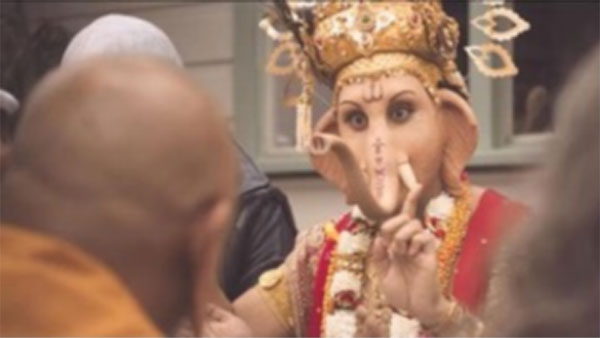
This is not just an Indian phenomenon but the culture police also exist in other countries. This is very familiar to the Ganesha ad that got shot down in Australia. Meat and Livestock Australia put our favourite Lord Ganesha in an ad which showed meat-eating.
This enraged the local Hindu groups who of course besides staging protests to Ad Standards, in Australia
The ad showed Lord Ganesha sitting and enjoying the meat with Jesus Christ, Moses, Aphrodite, lord Buddha, Zeus, Obi Wan Kenobi from Star Wars franchise along with Ron Hubbard, the founder of Scientology. Ad Standards Australia upheld the complaint from local Hindu organisations and the ad went off air.
The latest ad questioned by the Culture Police is Manyavar Mohey ad (Mohey is the brand for women) featuring Alia Bhatt which was received with mixed feelings. While the ad was trying to break away from the age-old practice associated with marriage, where the daughter like a commodity, ( kanyadaan), the ad proposed greater respect for women (kanyamaan ). Unfortunately, when celebrities like Kangana Ranaut join the culture police, the attack on ads become stronger. She is known to have said: “Don’t use religion to sell products.”
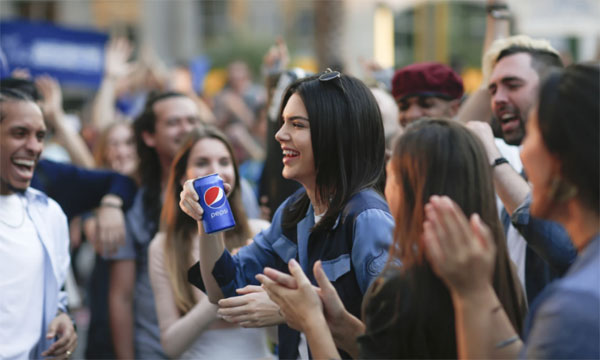
Again, not very different from the Pepsi ad which showed supermodel Kendall Jenner leading a Black Lives Matter movement with a fizzy can of Pepsi.
It provoked Martin Luther King’s daughter to make a blistering remark on Twitter, that read: “If only Daddy would have known about the power of #Pepsi.” Bernice King’s tweet was accompanied alongside a photo of her father being pushed back by police.
Another ad that was forced to bite the dust.
The Human Rights Police
Here the human rights police objected to the extreme conditions that Zomato delivery men are put through when they don’t even get a moment to themselves between orders. In the commercial, Hrithik Roshan goes in to get his mobile to get a selfie with the Zomato delivery man. But the delivery man is so busy that he forgoes the opportunity of a pic with Hrithik because he is getting late for his next order. Zomato was quick to appease the trollers with their tweet which read, “We have been listening intently to the chatter about gig workers and the problems associated with this part of the economy. We understand you expect more and better from us”.
Advertising uses Figures of Speech
A few advertising regulators coupled with public groups on social media who keep a watch, means that advertising will have to be more careful than before. Diversity and inclusion is no longer an option, it is an imperative. In 2021, it will need to become a habit for most advertisers.
For the last 100 years or so, advertising has used figures of speech to communicate. So parody (humour), hyperbole (exaggeration ) to make a point, and metaphor (where a word or phrase is applied to an object or action to which it is not literally applicable ) are some of the main figures of speech that advertising uses to make an impact. Advertising can continue to use them but now will have to keep away from sensitive subjects.
A long time ago, Jerry Della Femina said: “I honestly believe that advertising is the most fun you can have with your clothes on”.
I am not so sure it is any longer for more than one reason. The times they are a changing!
Prabhakar Mundkur is a former advertising agency captain and has spent over four decades in marketing services across geographies. He is a prolific writer and was a few years back rated as among the top voices by LinkedIn. Other than advertising and writing, Prabs, as he is known to friends, is a very active musician and a self-taught producer of music. In the pandemic, he has performed and produced nearly 50 songs, including one with the very accomplished Usha Uthup. Mundkur’s views here are personal.
Tanishq has launched a new campaign this Durga Pujo. conceptualised by Tanishq and Lowe Lintas, the Pujo campaign, ‘Utshob Amader, Shaaj’o Amader’, celebrates the spirit of Pujo and is an ode to all Bengali master karigors of Tanishq.
Speaking about the campaign, Ranjani Krishnaswamy, GM – Marketing, Tanishq, Titan Company Ltd, said: “Pujo is a festival that is as much about adorning the festivities as it is about adorning ourselves and our relationships. ‘Utshob Amader, Shaaj’o Amader’, celebrates relationships in an endearing and heartwarming manner in the midst of all the festivities. It showcases our new collection ‘Shaaj’, an exquisite artistry from our Karigors who truly are the pride of Tanishq. We hope our traditional Bengali designs in gold brought to life by our master Karigors, will adorn the Durgas of today and add a little more sparkle to your Pujo celebrations as we offer our prayers to Maa Durga together.”
Added Sagar Kapoor, Chief Creative Officer, Lowe Lintas: “In the year gone by and the unprecedented times we are living in, we see this as an opportunity to celebrate tradition and the bring alive the spirit of rejuvenation of the human spirit during the Pujo festival, one that transforms all of Bengal into an artists’ canvas. This Pujo, Tanishq celebrates all the creators who bring Pujo alive, with a collection of unparalleled beauty created by our Bengali karigors.”
Mia by Tanishq has launched a series of short films as part of its latest campaign, ‘#GiftSmartGiftMia’ for the IPL season, created by Famous Innovations.
Speaking about the campaign, Shyamala Ramanan, Business Head, Mia by Tanishq, said: “The Mia gifting campaign is an outcome of intense data analysis and social post listening. Jewellery is one of the most gifted categories and an in sighting exercise confirmed that men who believe their partners are modern, independent and expressive veer towards Mia by Tanishq as it is a choice that can never go wrong!”
Added Melvin Jacob, Executive Creative Director, Famous Innovations Bangalore: “IPL is when India’s huge viewership gets into celebration mode. We wanted to use this opportunity to capture fun millennial dating goof-ups and the gifting choices people make. The films pick on the thought that gifting isn’t about spending money, rather it’s about gifting smart and being tasteful. The spots are lighthearted, insightful and fun – and definitely a fresh take in the jewellery space.”
Tanishq has launched its latest digital film on Raksha Bandhan. The film is conceptualised by Tanishq and Webchutney.
Speaking about the campaign, Ranjani Krishnaswamy, GM – Marketing, Tanishq, Titan Company Ltd, said: “Raksha Bandhan has always been a beautiful occasion to celebrate diverse relationships, their special bonds and reinforce the promise of taking care of someone – and that needn’t be just a brother-sister equation. #SistersByChoice is our humble attempt to showcase and celebrate the unique tradition of Lumba Rakhi capturing a loving banter between a sister and her sister-in-law that spreads happiness and positivity. With our latest campaign, we hope to celebrate the underlying promise & emotion around Raksha Bandhan which is all about love and care.”
Added the Strategy X Creative duo from Dentsu Webchutney, Shambhavi Ramanathan and Binaifer Dulani: “Women uplifting women is the underlying theme of our times. We’re elated to add a new dimension to the Rakshabandhan conversation by shining the spotlight on progressive womanhood. We’ve challenged the baggage around the dynamic shared by sisters-in-law, and portrayed a newer and more nuanced narrative with #SistersByChoice.”
Digital Refresh Networks has bagged the digital mandate for some of the leading brands based in Bengaluru. Mia by Tanishq, Motherhood IVF and iKounsellor are accounts recently added to Digital Refresh Networks’ portfolio.
As a part of the mandate, the agency will be in charge of delivering SEO management, Content, Social Media and Performance Marketing for the brands. The role would be to enhance the brand awareness and eventually the brands overall growth and revenue.
Speaking on the win, Barin Mukherjee, Co-Founder, CEO, Digital Refresh Networks said: “We are overwhelmed with our recent victory and are proud to add multiple leading brands to our portfolio. With our expertise in the digital marketing domain, we aim to propose a holistic solution in order to elevate the reach and engagement of the brands. The agency does look forward to have a long-term collaboration with our existing accounts, acquire additional businesses and build Bangalore as one of the promising centres for DRN going forward”
Tanishq has launched its latest film to celebrate the commitment of the healthcare community, this National Doctor’s Day which falls on July 1. Written and conceptualised by Dentsu Webchutney, the film revolves around frontline doctors. Through Project Rahaat, Tanishq is providing medical equipment and infrastructure to help the healthcare workers fight the pandemic and has supported 13 hospitals across the country.
Speaking about the launch of the film, Ranjani Krishnaswamy, General Manager – Marketing, Tanishq at Titan Company Limited said: “Many of our consumers who come from the medical community have been bravely weathering the storm since last year, helping us feel safe one day at a time. While we wanted to honor their resilient and relentless spirit, we also wanted to pause and applaud the unconditional support offered by their families. It requires immense strength, courage, and selflessness to let your loved ones battle it out every single day for the greater well-being of others in need. This film is our humble salute to all such doctors and their inspiring families.”
Added Binaifer Dulani, Creative Director, Dentsu Webchutney: “The narrative spun around the medical community often refers to them as superheroes – but when we do that, we fail to acknowledge that they are also human. Through this pandemic they have constantly had to put us and our families ahead of their own, and that is an emotionally draining decision to make. This film tries to show a real relationship between a mother who is a doctor-frontliner and her daughter, and through it helps us all empathize with the medical community.”
Dentsu Webchutney has won the digital mandate for Tanishq. The agency aims to chart an aggressive creative growth strategy, which captures the timeless essence of Tanishq.
Said Shambhavi Ramanathan, Planning Director, Dentsu Webchutney: “We are thrilled to be associating with one of the finest brands in India – Tanishq. As champions of change, always testing waters and staying ahead of its time, we found a complete vision match as digital brand-building partners. It is a privilege to join forces to shape emerging culture and progressive womanhood.”
Added Binaifer Dulani, Creative Director, Dentsu Webchutney: “With a fierce, woman-strong team and some of the brightest young talent from the industry, we look forward to making jewellery a powerful form of self-expression through digital.”
Said Ranjani Krishnaswamy, General Manager-Marketing, Tanishq: “We’re absolutely thrilled to join forces with the young and dynamic team at Dentsu Webchutney to lead our digital mandate. Partnering with them sets us off on yet another exciting journey of meaningfully engaging with our consumers on digital. We’re sure that Dentsu Webchutney, with their nuanced understanding of the digital landscape, will fuel our vision to be the country’s most loved jewellery brand.”
The Bhima Jewelers ad. The Kalyan Jewelers ad starring Katrina Kaif and Amitabh Bachhan. The Myntra Anouk ad from 2015. Geeli Puchhi, from the Ajeeb Daastaans anthology released on Netflix.
What do these all have in common?
Other than the six-year-old Myntra ad, they all released last week and focus on inclusion and diversity as their central themes. Some sparked conversation and high appreciation, the Kalyan Jewelers ad, which touched upon inter-cultural marriage (though very lightly) focused more on the stars rather than the story was a lost opportunity. I wonder whether the inter-cultural theme was touched upon lightly to avoid a furor similar to the one caused by the withdrawn Tanishq ad
In the last few years, Inclusive Marketing has become quite common (and hallelujah for that). Unilever’s Dove really started the trend with the Real Beauty Ad campaign in 2004, but for long, Dove was the lone ranger with other major brands peddling narratives focused on the rich and beautiful. This despite the fact that their target audience was not always rich but aspiration rather than acceptance was the calling card. In the last few years, facilitated by the interwebs that the masses have gained exposure to, progressive ideas and conversations around inclusiveness have become mainstream. This has helped to both start and sustain many a cultural revolution while also becoming a part of many brand narratives.
Inclusive Marketing will continue to catch on as more people become conscious of their biases, and are willing to pay a premium to overcome past prejudices. Brands will play to the gallery, because it is good for business however, in the race for the revenue is where many narratives fumble.
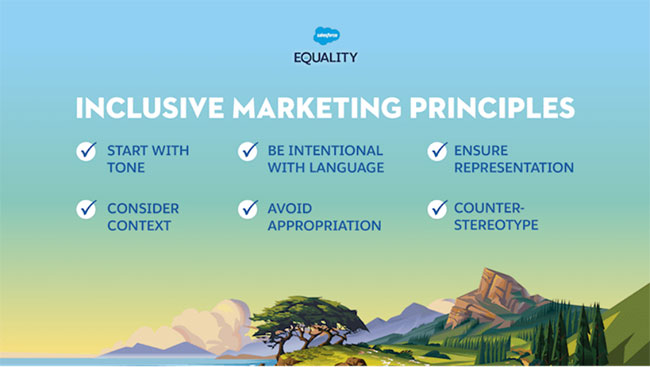
Inclusive marketing as defined by Salesforce is the creation of content that truly reflects the diverse communities that they serve. This means, they make a concerted effort in elevating diverse voices and role models, decreasing cultural bias, and leading positive social change through thoughtful and respectful content.
Their six principles of inclusiveness in communication cover the gamut of what inclusive marketing should cover
Inclusive marketing principles as defined by Salesforce
Start with Tone, & Be Intentional with Language
Both tone and language form a crucial part of inclusive communication. While language most brands are cognizant of ensuring that the tone is respectful is as important.
Avoid Appropriation
Many pieces of communication made on marginalised communities miss nuance as there is only so much that research can do. Hence, ensuring that the narrative is written or whetted by people from the community is key to an authentic narrative.
Ensure Representation
Marginalised communities anyways have limited opportunity; hence the cast should be as close ethnically to the character as possible. A good example from cinema is the stories told by Dalit film -aker Neeraj Ghaywan who made Masaan and recently the most acclaimed short of the Netflix anthology Ajeeb Daastaans, Geeli Puchhi. Being from the community, Ghaywan’s stories have authenticity about caste and privilege unlike other narratives, because he understands the depth of the issue.
Consider Context & Counter Stereotype
The truth is that brands are putting forward messages about inclusion and acceptance because the audience relates. Advertising has relied on clichés and stereotypes for far too long and evolving audiences are finally allowing brands to showcase storylines, which break the glass ceiling. Brands should embrace this and stop showing a fat woman as the sidekick friend or a male boss with women subordinates. This gem from Heineken, which truly speaks to not let perception drive functioning, elucidates this point well.
Inclusivity can help brands connect on a deeper, more meaningful level with their audiences — which can be a major asset to marketing campaigns.
In a country like India where the landscape, language culture changes every 100 kilometers, inclusivity and acceptance become all the more important because even the most privileged Indians feel marginalised in multiple ways – the colour of their skin, height, weight, hometown, knowledge of English and umpteen others.
I can’t tell you the joy I feel when I land up on a ecommerce website only to see models with real proportions (and I am not even plus-sized)
However, it is imperative that inclusive marketing is not used as a crutch to prop up marketing communication, because audiences are smart. As Salesforce’s principles entail being inclusive without being representative is commercial, and audiences see through the charade, which end up being counter-productive.
Beyond just a focus on bottom-line and hopes for virality, companies should ensure they are inclusive inside the company by applying these principles to HR and recruitment policies, and in their day to day functioning.
 Advertising like the other arts of cinema, music, is the perfect mirror of an emerging society. Often the arts can lead society, and at other times, it may just be a mirror of where society is today. It’s important for a brand to constantly search for cues from our daily living. So, a brand can often be a mirror of where we are but equally a brand may lead society into their own future.
 Never has marketing communication been under the scrutiny of so many, ever before in its history.
 Said Shambhavi Ramanathan, Planning Director, Dentsu Webchutney: “We are thrilled to be associating with one of the finest brands in India – Tanishq. As champions of change, always testing waters and staying ahead of its time, we found a complete vision match as digital brand-building partners. It is a privilege to join forces to shape emerging culture and progressive womanhood.”
 The Bhima Jewelers ad. The Kalyan Jewelers ad starring Katrina Kaif and Amitabh Bachhan. The Myntra Anouk ad from 2015. Geeli Puchhi, from the Ajeeb Daastaans anthology released on Netflix.