
Tag: Sundeep Nagpal

  • Comment: The Suspension of News Ratings


    By Sundeep Nagpal


    At the outset, let me state that this piece is not meant to comment on whether or not there have been any malpractices in the TRP measurement process. Nor is it designed to be an opinion on whether any channel is guilty of abetting such unscrupulous practices or not. It is not my role to comment on this aspect. That’s the job of the law-enforcers and the fact that there is an FIR on this, certainly suggests that there could be a serious problem. Most importantly, given that some skeletons may still tumble out of the cupboard, as we are seeing in the course of the daily investigations, it’s too early for anyone to pronounce judgment.


    So, what is this article about? It’s meant to lend a perspective on various aspects of the issue at hand. And it is being written purely on the basis of my experience as a media professional, who not only uses data to allocate brand advertising budgets to channels, but also as someone who has worshiped data, trained no less than a thousand individuals on its utilisation and strongly propagated its application in the decision making process, even to advertisers, for over three decades now.


    For a media professional, all it would take is a keen sense of observation and some common sense to read between the lines, to understand the reality.


    So, here are the aspects that are being addressed in this piece.


    Aspect No 1: The Suspension of News channel ratings, for upto 12 weeks, apparently for them to clean up the mess?


    Aspect No 2: Did someone say, that this a scam, and that too of the order of Rs. 30,000 crore… seriously?


    Let’s talk about the First Aspect:  The suspension of the News channel ratings, for upto 12 weeks, ostensibly to clean up the field issues in data collection.


    There could be three possible reasons for this:

    1. As claimed by a faction of news channels, there have been frequent and inexplicable fluctuations in the ratings of some news channels, and that ought to be examined and corrected, in case there are measurement flaws (In fact, in this context, readers would recall, that recently, the sudden growth in viewership of a wild card Hindi news channel, had become a big bone of contention, and this was vehemently debated by both sides, without any significant outcome. By now, perhaps the ratings have stabilised – as evident from the graphs). So, viewership fluctuations have been a way of life for media planners to contend with.

    2. Secondly, given the dust storm that has risen on news channels, another unstated consideration for this temporary suspension, could possibly be to let the dust settle on this matter, and until such time, to adopt some interim measure to avoid any further controversies, and mitigate the risk.

    3. This tussle between the state machinery on the one hand, versus the controversial network on the other, is only likely to bolster the network’s viewership, (yes, let’s not forget that the majority of viewers, regardless of how they’re inclined, just tend to get excited about such developments), and that may actually happen at the cost of some of the network’s competitors.


    So, one faction of news channels (called the NBA – which comprises mainly of the said network’s competitors), has been very vocal about supporting this move of temporary ratings suspension. Whereas the other faction, called the NBF – which comprises of he said network and several other regional networks, is dead against this temporary embargo. In fact, last Thursday, NBF released a statement to the effect that ratings agency, BARC has been unfair by singling out the news genre, for an overhaul, and that it was done without any consultation with its member channels and that other genres are equally fraught with anomalies, and hence are also in need of an overhaul, and therefore implying that all ratings should be re-examined, etc. etc. etc.


    So, the fact that BARC has suspended the news ratings, even temporarily, can actually be due to any one or more of the above reasons, but this embargo in itself, can be looked upon as an admission of a systemic problem.


    Now let’s talk about the Second Aspect: Rs 30,000 crore? Really?  Where did this number come from? Has any industry professional provided this figure or verified it? Can anyone substantiate and explain how it has been arrived at? Has BARC even hinted at such a large figure? Let’s understand, that Rs 30,000 crore is (probably less than the profit of Reliance Industries, but it is), still humongous, for anything to do with the advertising/ media business.


    So, again, where did this number come from? Or is it that, after the various ‘Bad Boy Billionaire’ scams, the yardstick for any issue to be labelled as a scam, has suddenly increased to a few thousand crores, by default? Just so that it is taken seriously !


    Hence the question here is not just as to what the general public is being told, but what lay persons end up believing !


    There can only be two reasons for such a headline – it’s either a desperate attempt to grab audience attention (sensationalise) or it reflects the ignorance of the claim maker, about the reality of the BARC system, or perhaps, both !


    As media/ marketing professionals, we must try to understand this: even if there is some malpractice about households (HHs) being paid to keep certain channels on, then how many such HH’s can make a significant difference to the viewership of the allegedly rogue channels? How much can some HHs in a single city, affect the national ratings of that channel? How much money would have to change hands to make a significant difference to the channel? And even if the viewership did rise, how much additional advertising could the channel in question attract, in return for this unscrupulous investment?


    Moreover, if the viewership number did not rise sufficiently enough, would that channel retain the loyalty of its existing advertisers? In other words, do advertisers select every channel only on the basis of viewership? Or do other intangible factors, like content synergy and audience profile also have an important role to play, in the decision making process?


    The answers to these questions are obvious.


    Incidentally, the number of channels that are included/ covered by the system, are in excess of 400.


    Also, the total amount of advertising revenue generated, annually, by all channels put together could be somewhere in the region of Rs 30,000 crore. (the exact number is not necessary here when we are only trying to understand the bigger picture)


    So, by logical extension, any such claim that alleges a scam of Rs 30,000 crores, must necessarily imply that all (approx.. 400+) channels, have been indulging in this fraudulent and illegal practice, of artificially boosting their viewership ratings, by paying some amount of money to sample households (HHs), right through the last 12 months !


    Now, for the mathematically inclined, here’s a small extension of this theory. Of the 44,000 sample HHs in the country, only about 2000 of them are in Mumbai. It’s impossible that all of these HHs could ever be paid off, in the above manner. So, as a ratio of the sample HHs all over the country, where viewership is being measured, to what extent can the viewership of these channels stand to gain, from this small allegedly rigged sample? In other words, how much can the TRP go up, even if the viewership in these few sample HH’s is artificially boosted?


    So, the claim that this is scam of the order of 30000 crores, seems preposterous, given that so far, just three channels have been alleged to have indulged in it.


    So, firstly the “scam”, if there is one, is probably not worthy of the magnitude of the hue-n-cry/ attention that it has generated so far. In my opinion, the newsworthiness of this entire ‘so-called scam’ (and I’m being objective, here), comes from other reasons, such as the controversial nature of the channel being implicated.


    Another reason for this, is that this is really not the first time ever that such a malpractice has come to light. There were at least two similar instances in the distant past, which were curtailed and rectified in a short time. And so, hopefully, so would this.


    Further, consider this. Do advertisers, media planners, marketing professionals rely only on TRP data for their decision-making? Don’t they understand the limitations of the data collection methodology? Surely there’s got to be some way in which their experience and first-hand feel/ non-data related expertise, come into play?


    It is also my humble opinion that any media analyst, worth his salt, understands when and where not to apply the data, in the decision-making process, and how to make the decision on other, less tangible/ non-tangible factors.


    It is my strong belief and contention that niche/ special interest channels, from genres such as English Entertainment/ English News/ Lifestyle/ Infotainment or even the Children’s channel genre, mostly do not attract advertising based on their viewership estimates. These channels are chosen by advertisers primarily based on their content and profile, which need not deploy the use of any data.


    This aspect can further reduce the intensity of the issue at hand, (for whatever has unfolded up to this point in time, unless more skeletons come out from the cupboard later).


    So, given the above two aspects – the question that arises is, why such a brouhaha over ratings? If there’s even a shadow of doubt on the field practices, then just correct those, why suspend the release of the ratings in the public domain, …. unless of course, there is enough evidence that the disease has reached pandemic levels.


    Ultimately, I believe, that no matter how superficial audiences may be, w.r.t their understanding of somewhat technical issues, they are not idiots. Their ability to connect the dots and come to their own conclusions, about the underlying causes of this issue, must not be undermined.


    Because, obviously, these developments are more than what meets the eye. It’s not just a question of news channel ratings, but it’s a no-holds barred business warfare between channels, and the Kurukshetra (battlefield) is not just the TV news arena, but in fact, a larger political arena as well.


    Some media professionals must believe that this entire TRP saga makes about as much difference to their jobs, as a drop of cyanide in the Atlantic (whereas it is being made out to disrupt marine ecology). All the same, true professionals (journalists or media planners), ought to be more concerned about how to retain and enhance the credibility of our own role / effort. But are we doing any better than the lay viewer ? We’re only being a little more than innocent bystanders, coz, we’re also basically just watching the drama unfold.


    Satyameva Jayate !


    Sundeep Nagpal is a veteran media profession and Director, Stratagem Media Pvt Ltd,  an independent media specialist firm, in the business for nearly three decades. His views here are personal

  • Mitron, the Nation wants to Know…


    Call it the News Channel Dangal or whatever, here’s an analysis by Stratagem Media on how the English news channels fared post-demonetisation and Arnab Goswami’s exit

    Background :

    The economic and political scenario in the country over the last two months has been fodder for the news business – mainly with the announcement and unfolding of the demonetization drama, followed by the demise of Tamil Nadu Chief Minister, J Jayalalithaa. But for all of us in the marketing and media fraternity, something equally dramatic happened about the same time.

    On November 2, the media fraternity witnessed a piece of truly “breaking news” –Arnab Goswami, the editor-in-chief and star NewsHour anchor of Times Now channel had resigned. Well of course, he was still on air, for the next few days, when on November 8, even as everyone was trying to predict the after-effect of his departure from the TV screen, the shock-n-awe of demonetisation happened.

    Speculation about Goswami’s departure from the TV screen, and his plan thereafter,has been rife, ever since.

    Objective of the study:

    At Stratagem Media Pvt. Ltd, we were equally eager to understand the effect of these developments on the viewership of news channels. Our friends (mitrons) and fellow professionals in the media and marketing fields (by and large, our ‘nation’), would be keen to understand

    – whether news viewership has risen post-demonetisation

    – whether there is a difference between the after-math of demonetization on English and Hindi news channels?

    – Or has Mr Goswami’s absence from the TV screen, had any effect on channel viewership and if so, how much?

    But we felt it would be prudent to resist the temptation of jumping to conclusions and not rush through the analysis. So, we waited for the scenario to stabilise, till viewership data for at least a few weeks had trickled in.



    Here’s a study of viewership,both pre- and post-demonetisation, which happened to also coincide with ArnabGoswami’s last week on the screen. Naturally, the questions that have been addressed are whether the viewership of English and Hindi News channels was affected in any way, post that week, and what was the effect on the viewership of specific channels.


    Methodology:

    A simple viewership comparison was undertaken for a period of 10 weeks i.e. five weeks pre- and five weeks post demonetisation/ Mr Goswami’s departure from the screen.

    This study was focused on the ‘9 pm to 11 pm’ time slot on the weekdays, (which historically contributes to a major proportion of viewership). This analysis was done for three relevant geographical units (the 1mn+ cities across the country, Mumbai+Delhiand Mumbai+Delhi+Bengaluru), as well as for a relevant and sufficiently wide target group comprising of Males,above the age of 22 years belonging to the top two segments of affluence (i.e.NCCS AB)Although not all of it is published here, the analysis was also undertaken simultaneously, but separately, for the entire genre of Hindi News channels and English News channels (including English business channels).

    Two viewership parameters were examined – gross impressions and relative channel share (for the English and Hindi channel genres).

    The source of all data was the BARC viewership ratings.

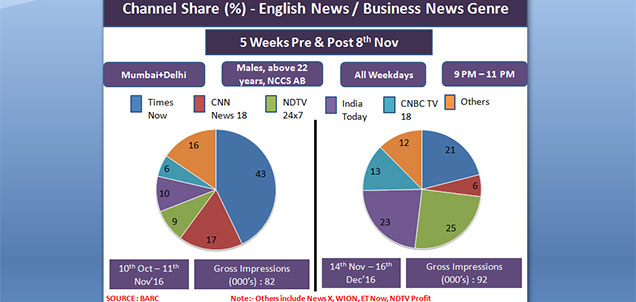
    Conclusions (English channels):- (Refer slides above)

    From the above analyses,in the five weeks post-demonetisation,it is evident that (within the specific TG of Men, above the age of 22, from the top 2 affluence classes – NCCS A&B), in the prime time slot of 9 pm to 11 pm,

    – The viewership of English News channels in all main cities in India, in fact declined by 1 %, in the 5 weeks post demonetization. But it increased by about 11 % to 12 % in the 2–3 main metros. In other words, as expected, the viewership pie of English news genre as a whole has only managed to increase in the main cities (Mumbai, Bengaluru, Delhi) where the English news channels get most of their eyeballs.

    – While Times Now continues to lead the pack in the English News genre, the decline in its viewership, ranged from – 29 % to  -45 % in these 3 market units. In fact, even CNN News18 declined by about 27 %, to 61 %,whereas the gain in viewership of other channels such as NDTV 24×7 and India Today TV, was considerable, ranging between 99 % to 230 % for either of them, over the same period. However these channels grew from a relatively much smaller base.

    – Consequently, in the main cities of the country as a unit, the decline in the relative share of viewership for Times Now was from 55 % to 40 %, whereas NDTV 24×7’s relative share grew from 8 % to 17 %, and India Today TV’s relative share grew from 12 % to 19 %.

    – The corresponding changes in viewership shares, in the main metros for these channels were even more pronounced, as evident from the graphs.

    – And yet, without doubt, Times Now still stands head-n-shoulders above the other English News channels.


    Conclusions (Hindi News channels)

    From the analyses, it was also evident that in the 5 weeks post demonetisation, (and within the specific TG of Men, above the age of 22, from the top 2 affluence classes – NCCS A&B), in the prime time slot of 9 pm to 11 pm

    – The viewership of Hindi News channels increased by as much as 29 % in the 1 mn + cities, with some channels registering gains of more than 50 %

     – In terms of relative channel shares, the biggest gainers were News18 India, Zee News and AajTak.

    So, on an apple-to-apple comparison, Hindi channels seem to have grown in the post-demonetisation phase, in the cities, whereas English channels have in fact, marginally declined. So, could this perhaps be a case of missed opportunity.

    This does however give rise to another pertinent question. What constitutes brand identity for a media house – be it a newspaper title, a TV channel, an FM station or a website? They say ‘Content is King’, but is it just content, or the values that the brand is perceived to stand for, or production quality, or just the sheer the persona of the anchors/ RJs.

    To validate some of the quantitative findings of this analysis, we asked senior media professionals about their individual opinions and experiences. This is what they had to say :

    Sandip Tarkas

    Sandeep Tarkas, CEO (Sports, Media & Special Projects), Future Group, states that “I think Arnab was the person I missed the most during the entire demonetisation debate. After initially watching a lot more of news for about a week, I have almost stopped watching news TV, and that’s where I missed Arnab. He would have brought the right issues to the fore even if one didn’t agree with his take on the issue”.


    Karthik Mani

    Kartik Mani, Founder, Chief Insurgent – Merry Men, says that although he has never been a fan of Arnab Goswami, but Arnab’s absence has made watching Times Now, a lot less compelling.


    Munnish Puri

    Munnish Puri, media expert & Founder, Indian Financial Advisors, has this to say:”Beyond doubt, Arnab and Times Now were a highly impactful combination. Viewers tuned-in to get real ‘inside information’ of the news that mattered. Even global audiences took a strong liking to Arnab. Looking at the recent viewership data, it is not surprising that the Times Now viewership has been impacted. The Newshour is certainly not as engaging without Arnab!’


    Bharat Kapadia

    Bharat Kapadia, veteran media expert, confesses that he gets put off when news channels become noise channels, and that leads to reduced exposure. But he adds that Arnab always had the last & loudest word which at times made it interesting. And that he has hardly watched Times Now after Arnab quit. Bharatbhai also adds that his time spent watching news channels post demonetisation had increased, but he was disappointed about the way the topic was covered by all channels in general. There was no depth in the content, just opinionated angles and gimmicky presentation. He feels that it is entirely possible for face value to outweigh brand value of a media house, just as it happens in the film industry.


    Sumit Roy

    For Sumit Roy, Founder Director Univbrands, Times Now was not the preferred channel. He sums it up by saying: “Times Now isn’t any better now, without Arnab. As a policy I switch channels when any Anchor speaks over the Panelist and cannot control panelists speaking over each other. Some other anchors seem to have gone that route as well.As a result my preferred news channels are India Today, NDTV and BBC World. In that order. I stay with whichever (of these) has the more interesting story at the time of watching.”


    Nevertheless, as evident from the above analyses, it’s not just content, or the values of a news channel, or production quality, that builds a TV brand. Viewership also seems to be obviously sensitive to changes in brand persona.All in all, with state elections around the corner, we can be sure that the News Channel ‘Dangal’ is far from over.


    Sundeep Nagpal

    This report has been conceived and produced by Stratagem Media Pvt Ltd., an independent media specialist company, headed by its Founder–Director, Sundeep Nagpal


  • 25 years of Stratagem


    By Anuka Roy


    The first thing that gets your attention about Stratagem Media is its logo. It is a chameleon. And if you are wondering the reason behind this, it’s simple. A chameleon does not change colour, it merely blends in with as per the need of the hour. So, the belief as mentioned in the company website is, “In fact to a chameleon, stratagem is inherent! Its adaptation of colours is its natural stratagem. Similarly, at Stratagem Media, we believe that we reflect the colours of our client and adapt to their ever-changing requirement from time to time.”


    Founded in mid-1991, by media services veteran Sundeep Nagpal, Stratagem operates in the fields of media buying, planning and consulting. Currently, the company is celebrating its silver jubilee year. On this occasion, we caught up with Nagpal to know more about his journey, the current trends in the industry and more.


    The beginning

    There is no answer to why I began. I was young and it was an impulsive decision to be on my own. I began by just actually offering whatever I thought I knew to anybody who I thought could use my services. So, I had been lucky that I had worked on some of the best brands in the country by that time. I decided to offer my services to media professionals, initially to those agencies that did not have in-house media planners. Thankfully, there were maybe half a dozen of them who said that we do not want somebody full-time and were looking for somebody part-time. That is exactly what I wanted, so I said I can give you part media planning service and I will operate out of my office but I will also come here and take briefs whenever it is required. There were three or four such agencies who tied up with me later in the sense that they became clients. And, that is how we started.


    Then and now – the difference in media planning

    Now, the service of media planning, first of all has not only become very large in scope because the media players have increased so much but also it is more easily available. There are individuals, agencies who have enough of expertise now. In those days, there were a very few of us and we were somehow a rare breed those days. Obviously, now, one has to think about how to stay afloat.


    There are many brands who now know what media is planning, they understand it, and they get some of the nuances, even the Indian entrepreneurs they know about it. Now, I do not have to explain to people what I do. Earlier, I had to explain to them in great detail that this is what I do but now I do not have to explain so much.


    Milestones

    Somewhere in the mid-90s, my company was asked to start a new kind of an initiative with seven medium-sized agencies, which was a media buying initiative on behalf of all those seven media agencies combined. That was a milestone because nobody had done it before, we did not know how to go about it and we went and did it. Whatever time it lasted, it did not last for more than two and a half years but whatever it was, it was perfectly natural. There was no worry about why it was not working. Everybody understood these were the pitfalls and therefore we may not be able to push it forward. But that was a fantastic time because for me it was a great moment as I had done this.


    In 25 years, there have three or four milestones. Again, somewhere in the mid-90s we started working for brands who not only wanted to use media planning but media companies such as newspaper groups and television channels wanted to understand how to increase their advertising revenues. So, we started consulting with them. We used the same knowledge and background to help them to earn more advertising revenue, again something nobody had done before. I was very happy that I am to do this and continue to do that even today.


    Then, the third milestone was in the late-90s where we stopped working with agencies because the entire industry changed because these agencies either they were absorbed by other larger agencies or they lost their main clients or for whatever reasons.  So, I reinvented the whole process and was working directly with brands, with advertisers. That was another milestone for us.


    We did a couple of other things which were very unique. One was, we worked with a large financial investment company on a three months project where they wanted to understand the strengths and weaknesses of a particular television network in the current competitive scenario. That was a humongous exercise which we never realised that we would be capable enough to do it but we did it.


    Now, of course, we are looking towards a few new things as well in the area of digital perhaps.


    The evolution of clients

    They have had to learn how to separate the wheat from the chaff- this is good and this is not and this is what is going to work for me. Earlier, they did not bother and left it for the agency to bother. Secondly, despite the fact that they have learned something, unfortunately or as a parallel the number of options has grown hugely. They are still grappling and they are still not consistent with what they want to try. See, as a final result of any particular communication exercise there could be many things that could have gone wrong. Very few people understand how to identify what has exactly gone wrong in the communication exercise which is an overall thing or let us say in the brand’s bottom line or top line. There could be 100 reasons but you should not give up what you have started on. Try it consistently, identify the problems and move on. Plug the loopholes, most people do not want to plug the loopholes. That is probably the wrong attitude.


    Surviving the obstacles

    Any business goes through ups and downs because of the market. Initially, like I said, I was quite content providing my services to the ad agencies but the mid-sized agencies I was working with were either absorbed by larger agencies or they lost their main clients, the big pitfall that happened for me was that I was not ready for it. I did not even expect it. And, it happened almost overnight. I was forced to stand up on my own again. So, that challenge happens anywhere. Now, for example, if I was to look for challenges, how do I keep pace with changes that are happening in the media sector and I do not want to call it just digital because within digital there are so many options. And, I do not want to necessarily say I am an expert in all of them. But I must know how to judge one from the other. Once I know that, I need to know how I execute it for a client. We have a very small set of clients and thankfully some of them are very happy with us in the sense that within the realm of whatever they require we have delivering well enough which is now nothing to feel very happy about but the next thing is how do I get some growth for them as well and for me as well.


    Looking forward

    The future is a mix of some trepidation in my mind along with some amount of excitement. There is excitement about doing something new but at the same time there is a concern that will I get it right.


  • Media captains mull future of biz


    By Anuka Roy


    Top leaders of the media and marketing services business in India addressed students at the annual Media Management Conclave of the Pune-based Symbiosis Institute of Media & Communication hed on Sunday (August 7). The broad theme of the Conclave was ‘Agency of the Future’, focusing on how media in India has evolved over the past years.


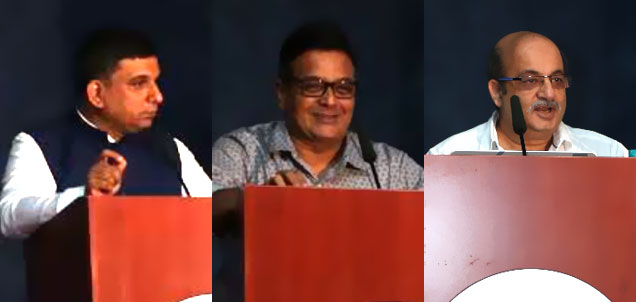
    The Conclave was part of the silver jubilee celebrations of the institute and was followed by a Media and Marketing Analytics Conclave held in the second part of the day. Kartik Sharma, Managing Director at Maxus; Suresh Balakrishna, CEO, Middle East and South Asia at Kinetic and Sundeep Nagpal, Founder Director at Stratagem Media Pvt Ltd were the speakers on Media Management.


    “The value of data will shape not only the future of organisations but countries and human kind as well,” stated Sharma in his keynote speech. His presentation focused and elaborated on the trends which can currently be seen in the country, especially with mobile phones, whose reach is higher than that of television. “We are becoming a visual world driven by mobiles,” he said. He spoke about advertising on television, which still gets huge investments from brands for their products. According to him, television is the most effective in generating not just sales but profits. The importance of content was highlighted by him through video examples. He said that sometimes knowingly and sometimes unknowingly, the consumer becomes the producer of the content it consumes. Moreover, he encouraged everyone to closely notice how technology would change the world.


    Next up, Suresh Balakrishna shared a fresh perspective on the concept of ‘Out of Home’ (OOH) consumption and its dynamics. In his opinion, OOH includes television, newspaper and the internet. He cited how 80% of mobile consumption is done outside of home. Besides this, he also stressed on how innovations in digital OOH would impact OOH marketing. He opined, “Anything is OOH, and we do all of it.” He stressed on the importance of digital displays and gave the example of ‘Cadbury Bubbly’- which successfully carried out digital displays in metro stations. In conclusion, he said that once the measurability issue is resolved, OOH will become larger.


    ‘How to make media work for brands? – Black Magic’ was the name of the presentation by Sundeep Nagpal. He added that the reason behind the same would be understood once the presentation was over. Through various video examples he stressed on the changing investment scenario of media businesses in the digital era. The videos were also used to show what should be and what should not be done by brands to promote their products through content integration and Advertiser-Funded Programmes (AFP). “Big data is considered to be the most important thing happening not just to communications but to businesses as well,” he said. He spoke about the concept of branding and big data analytics, where businesses actually track every movement of their consumers. Nagpal also stated briefly about micro targeting, for which he said Netflix is the best example to understand how it can be done and about augmented reality. Even though the advancement of technology was spoken about in detail at the conclave, he concluded by saying “Technology is not everything, simplicity matters.” And, what does Black Magic actually mean? Black- a clean slate for you to start anywhere in the ecosystem.


    The second half of the day was dedicated to Marketing and Media Analytics Conclave, where NiteenBhagwat, Executive Director and CEO at Asterii Analytics; SarangPanchal, CEO at MRSS India; Mubin Khan, Head of Products, Research and Analytics, Senior VP at BARC, India, shared their expertise on the subject.


    The Marketing and Media Analytics Conclave opened with NiteenBhagwat, who spoke about the basics of analytics and the prospects it holds. Speaking on why measurement is the core of analytics he opined, “We cannot manage what we cannot measure.” Further, he underlined the amplification of human behaviour by technology and social media, and interestingly pointed out how social media is driven by altruism, homophily, tribalism, narcissism and control.


    Sarang Panchal, who covered the concept of research in the media landscape, further explained about the trends in the market research industry and its future, which involved the growth of DIY research, popularisation of market research, online communities and predictive analysis.


    The last speaker of the event, Mubin Khan began his discussion by saying, “What BARC envisaged for the future is happening now.” He elaborated on how market research is no more as simple as it used to be and predicted that the future agencies will not just depend on analytics but on consumer insights as well.


    The Analytics Conclave concluded with the speakers in a panel discussion with SIMC Adjunct Professor and MxMIndia columnist Indrani Sen moderating the discussion. They shared their personal experiences in the industry to make the students understand what the companies require from them during recruitment.


    The correspondent was hosted by Symbiosis Institute of Media and Communication


  • Stratagem Media announces 2-day training for ad sales and media/mktng pros

    By A Correspondent


    Leading Mumbai-based media advisory Stratagem Media has announced a two-day open training programme for media practitioners as well as marketers and advertisers.


     

    The fifth in the series of intensive learning sessions under the Media Rhythm banner, under the Media Rhythm series. “I’ve always believed that the media business is a combination of both, knowledge and a skill,” said Sundeep Nagpal, founder-director of Stratagem while unveiling details of the sessions scheduled for November 28 and 29 in Mumbai.  “Once a year, we organise this programme where our endeavour is to contribute to the development of this knowledge and skill and bring participants up-to-date with the latest practices being adopted in the business, as much as make them a bit future-ready, if possible,” he said.


    We asked Mr Nagpal a few questions, and rather than let the finer details get lost in the paraphrasing, we present his responses as is:


    What will this year’s session offer:

    Sundeep Nagpal : Over the last five years, we have stayed relevant with the Media Rhythm series of programs. The topics have kept pace with the current needs of the industry.  So, this time we felt it would be relevant to combine the understanding of digital media with that of traditional media. I have observed that hitherto, these were quite compartmentalized. So, this program is titled – The Big Fat Media Wedding – Digital weds Traditional Media


    Firstly, more than 50 % of the program is devoted to Digital marketing – it breaks up into separate modules on Search, Social, Mobile and Display.


    Then there are separate modules on Media measurement, Creativity in Media and even one on ‘How to integrate multi-media for a given campaign’.


    Is a two-day programme sufficient for all the topics you have planned?

    SN: We have conceived this more like a workshop. And hence, it’s a two-day programme, so, I think, we will have the bandwidth to deep dive into the concepts, metrics and practices.  And given the variety of topics, we have chosen to have 4 specialist trainers for this programme.  Participants will get a chance to think and do. They will be put through a few exercises – on creativity and strategy development as well as some hands-on analytics.


    Who are the trainers?

    SN:  It would not be incorrect to say that all trainers are highly experienced specialists in different areas of the media business.


    Mr  R P Singh: who will handle the digital module, has been in the digital space for as long as it has existed in this country. He was with Group M and McCann (APAC for Commonwealth), and now is the CEO of a Delhi-based digital company called Sirez.


    Mr  Bharat Kapadia : is the man of ideas and has more than 35 years, mostly as a publisher, with 4 prestigious media houses in this country.


    Mr  Suresh Balakrishna: who has spent more than 28 years and has had considerable experience on both sides of the media business – planning/ buying as well as selling. And now heads BPN, part of IPG Mediabrands


    And myself:: For most of my professional career of 28 years,  I’ve inter-acted intensely, with media sellers and advertisers, and I feel there’s a lot of scope to bridge the gap.


    Ideally  who would you target/ like to see as participants?

    SN:  Well, as such anyone who has anything to do with the business of media or who is in the field of marketing  would stand to benefit from this program.  Also, I’d like to draw special attention to the scope that this programme offers to media planners and sellers of traditional media – I think this would be an ideal opportunity for them to understand how to apply and add the learnings of digital media and marketing in their job profiles.


    So, all in all, professionals from media agencies, marketing companies as well as media houses, would stand in good stead with this program.


    To register:

    http://www.marketingbelly.com/digitalmarketing/program/The-Big-Fat-Media-Wedding-%3A-Digital-weds-Traditional/events/sucess/2   


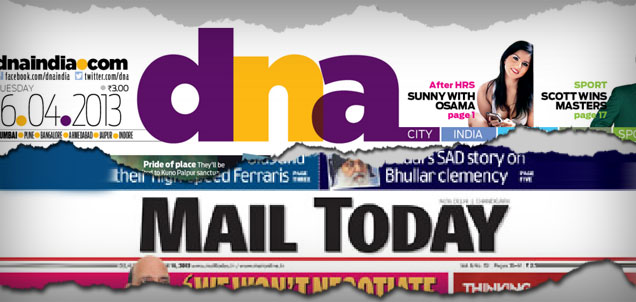
  • Is there room for DNA in Delhi and Mail Today in Mumbai?


    By Ananya Saha


    Mumbai-based DNA is reportedly galloping ahead towards the capital. Launched on July 30, 2005, in Mumbai, DNA (short for Daily News & Analysis) is an English broadsheet daily owned by Diligent Media Corporation, now an Essel Group company. With presence in Mumbai, Bangalore, Pune, Ahmedabad, Jaipur and Indore, the recently refreshed daily is scheduled to be in Delhi on May 13. While NCR is seen as a battleground for the English heavyweights Times of India and Hindustan Times, many English dailies do not boast of good readership numbers in this market. Does the Delhi market need yet another English daily?


    Sundeep Nagpal

    “I don’t think there is too much room for another English daily in Delhi, at least in terms of readership,” says Sundeep Nagpal, Founder-Director of Stratagem Media, an independent media agency. “The English daily readership as a category, went up by about 5% around the turn of the last decade, but it’s back to the level that it was at, in 2008. However, what seems to be happening in most major markets, is that they seem to be able to absorb additional circulation to some extent. So, basically this suggests fragmentation,” Mr Nagpal adds.


    Anwesh Bose, Senior Vice President- Media, DDB Mudra is of the view that DNA is launching Delhi more with an image perspective in mind than revenues, for now. “With the Delhi launch they would be able to call themselves a national daily, finally,” he said. DNA has plans to eventually be present in all the four metros, and then launch its financial daily too in these markets. The Ahmedabad, Jaipur and Indore editions are franchised to the Dainik Bhaskar group, formerly joint venture partner of Zee in Diligent Media.


    Anwesh Bose

    But to capture readers and advertisers in Delhi, DNA would have to be aggressive in its positioning, and promotions, and adopt a push and pull strategy. As Mr Nagpal viewed it, DNA will have to create a market of its own and that would mostly happen in terms of a share of time spent on reading, and not as much in terms of new readers. Meanwhile, DNA has firmed up its team in Delhi with senior journalist Saikat Datta being appointed as the Resident Editor.


    Mr Bose said, “DNA would have to step into Delhi with deep pockets as they need to sustain for a long period of time before they can see profitability. Their strategy ideally should be of first of all establishing themselves as a brand that stands for something.” The new daily, according to him would have to come up with interesting ways of increasing their circulation, since the old methods of free gifting on long-term subscription does not hold any value anymore.


    While DNA is planning to enter Delhi, the capital’s compact daily newspaper – Mail Today – is getting set for a Mumbai launch this year. Mumbai has seen a reasonable healthy growth of 40 percent in readership of English dailies over the last six years, whereas Delhi has been at about 18 percent only, vis-a-vis 2005, asserts Mr Nagpal.


    Having launched in Chandigarh recently, Mail Today will have to compete with Mid-Day and Mumbai Mirror in Mumbai.


    AS Raghunath

    AS Raghunath, a senior print media brand consultant based in the capital, is of the view that Mail Today will be able to carve the niche in Mumbai. He said, “The Chandigarh and Delhi editions of Mail Today usually have a front ad jacket. So they do have a permanent source of revenue. Content-wise, Mail Today is a mixed bag and carries an ‘exclusive’, usually every day, which no other daily has. Even Twitter and Facebook communities quote Mail Today. Also, given the fact that Mumbai is a multi-newspaper market with English, Hindi, Telugu, Tamil, Gujarati dailies and publications, I am sure Mail Today will be able to carve a niche for itself.” He further added that while size will not be a challenge for Mail Today, any daily going in Mumbai would probably not add numerically to the market.


    On Mail Today’s stint in Delhi, Mr Bose remarked, “Mail Today is by no measure a success in Delhi… although, they have tried their best. It is bought more on relationship with the India Today Group than because of its content differentiation.” Mr Nagpal concurs that for a large cross-section of advertisers, Mail Today did not offer a unique/significant enough benefit.


    According to Mr Nagpal, “Mumbai Mirror (MM) has been able to create a huge dent in the market”. “It has stalled other competitors right where they were in their tracks and even eaten away their share considerably over the last five years, so I think MM is quite a success. But that does not mean that every new tabloid will do as well” he added. Mr Bose, however, holds a different view. He said, “Even with the might of TOI behind it, Mumbai Mirror could not make a huge dent, therefore it will be an uphill task for Mail Today to achieve success.” Mr Nagpal is of the view that Mumbai ought to be an easier market for Mail Today, for a whole lot of other reasons such as being more cosmopolitan, more adaptable, etc.


    The advertisers, obviously, would watch with interest as to the direction in which each of these publications grow in the respective markets. “It is sure that a lot of advertisers would get free space or space at a very marginal cost to begin with as the publications would want the advertisers to sample their product as well as it becomes a talking point with other advertisers for the publication. Also, there would be a lot of freebies during the circulation drive, so the consumer is going to make merry,” opined Mr Bose.


    Success or not, only time will tell. But it is sure a sign of healthy growth for the print sector. As Mr Bose concluded, “Print has seen a growth in 2012, where it grew by 9 percent compared to 2011. This year print would gain more as a lot of TV-friendly categories have shown interest in print, primarily to drive sales in a period of slowdown.”


  • Newspaper degrowth: Reason to worry?

    By Ananya Saha


    Is the print market looking at bad times ahead? The recent IRS figures do compel one to think on those lines. Most of the print categories, including national and regional publications, have registered declining AIRs. Print Media witnessed a growth of 0.8 percent CAGR from 2012 Q2 to 2012 Q4. Though an increase, it is the least when compared to other media during the same period: TV (5.2%), Cable and Satellite (8.9%), Radio (1.9%), Cinema (11.6%), and Internet (24.2%). The 0.8 percent growth seems much less when literacy has increased at 3.7 percent CAGR during the said period.


    What the IRS says

    Jagran and Dainik Bhaskar, the top two Hindi dailies to lead in the Top 10 publications, have lost AIRs, going from 16.47 lakh in Q3 to 16.37 lakh in Q4 and 14.49 lakh in Q3 to 14.41 lakh in Q4 respectively. The only AIR gainers in the category are Dainik Bhaskar, Hindustan, Malayala Manorama and Rajasthan Patrika. Of the Top 10 Hindi Dailies, six show a decline in readership. The publications that saw a dip in AIRs include Dainik Jagran (1.04 lakh AIRs), Dainik Bhaskar (75,000 AIR), Amar Ujala (1.02 lakh AIR), Punjab Kesari 41,000 (AIR), Navbharat Times (6,000 AIR) and Nai Dunia (1.95 lakh AIR).


    TOP 10 PUBLICATIONS

    Publication Language Periodicity 2012 Q3 2012 Q4
    DainikJagran Hin D 16474 16370
    DainikBhaskar Hin D 14491 14416
    Hindustan Hin D 12242 12246
    MalayalaManorama Mal D 9752 9760
    Amar Ujala Hin D 8536 8434
    The Times Of India Eng D 7653 7615
    Daily Thanthi Tam D 7417 7334
    Lokmat Mar D 7409 7313
    Rajasthan Patrika Hin D 6818 6837
    Mathrubhumi Mal D 6415 6334


    The Times of India maintained leads the Top 10 English Dailies category but has registered negative growth and lost 38,000 AIRs: from 76.53 lakh in Q3 2012 to 76.15 lkah in Q4. On the second position, Hindustan Times has added 34,000 readers going from 37.86 lakh to 38.20 lakh readers. While the third daily in the category The Hindu has lost numbers, The Telegraph at fourth position has added AIRs. DNA, Mumbai Mirror and The Tribune have added AIRs while Deccan Chronicle, The Economic Times and The New Indian Express have seen a dip in readership.


    Top 10 English Dailies(AIR numbers; All figures in ‘000)

    Publication 2012 Q3 2012 Q4
    The Times Of India 7653 7615
    Hindustan Times 3786 3820
    The Hindu 2258 2164
    The Telegraph 1254 1265
    Deccan Chronicle 1051 1020
    DNA 962 972
    Mumbai Mirror 807 819
    The Economic Times 753 735
    The Tribune 653 671
    The New Indian Express 664 652


    Top 10 Language Dailies (AIR numbers; All figures in ‘000)

    Publication Language 2012 Q3 2012 Q4
    MalayalaManorama Mal 9752 9760
    Daily Thanthi Tam 7417 7334
    Lokmat Mar 7409 7313
    Mathrubhumi Mal 6415 6334
    Eenadu Tel 5957 5972
    Ananda Bazar Patrika Ben 5788 5750
    Sakshi Tel 5343 5379
    Gujarat Samachar Guj 5153 5114
    Dinakaran Tam 4912 4816
    Daily Sakal Mar 4403 4469


    The cause

    Sundeep Nagpal, Founder-Director of Stratagem Media, blames the decline on new media. Unsurprised by the degrowth he said, “Time has caught up with print media. Not-so-young people have been hooked onto tablets since nobody sees value in print media. I am not surprised by the figures.”


    A S Raghunath, senior print media brand consultant based in New Delhi NCR, disagreed and said, “The degrowth that one interprets on the basis of a quarter is not right. There is always a seasonality associated with print, and hence one should not look only at quarterly figures. There are seasons like monsoons or June-July when readership drops since people travel due to school holidays, or during exams etc.” According to him, due to new publications in a certain language, the universe of readers does migrate or changes. “According to the CAGR of one year, print has grown by one percent, and this is good news.” The worry should only be when the readers of a certain language decrease.


    English dailies have added 3.38 lakh readers in the last one year, and smaller dailies that have entered new regions have gained readers. In the past one year, the reigning leader The Times of India has lost readers while Hindustan Times has added readers. Hindi dailies have added 9.70 lakh readers in the last one year. Assamese, Oriya, Tamil, Telugu, Kannada dailies have added readers to its universe. However, Malayalam has lost the biggest chunk of 8.44 lakh readers in the last one year. The Bengali market, which saw the entry of TOI’s regional paper Ei Samay and ABP’s Ei Bela, has lost 5.16 lakh readers. “The reason could be the entry of new players or disenchantment with the existing dailies. Once the IRS figures of Ei Samay are out, only then would the reason be ascertained,” reasoned Mr Raghunath.


    One can say that new publications make the readers migrate from one product to another in a certain language universe but the losing readers is definitely a cause to worry. “For regional newspapers, the newer generation is not adapting to it. For them, news is not to be found in print or language paper. Obviously, there is a problem,” remarked Mr Nagpal.


    But Mr Raghunath is positive despite the figures. He maintained, “Major languages are doing well. For the languages that are losing readers, it is because the readers are migrating to newer platforms. News consumption, per se, has not gone down. News media cannot be threatened, individual platforms can be threatened.”


    Are the advertisers losing interest?

    The traditional media of print and TV has always managed to catch the fancy of an advertiser. While we are questioning the advertisers’ interest in internet and other new media, the loyalties to traditional media might also be undergoing a shift. Mr Nagpal reasoned, “Advertisers are also simultaneously moving to new medium since readers are moving. On the internet, ad dosage can be course-corrected according to usage. B2C believes in TV as a medium, so print loses out. Lots of categories are more internet-oriented. Hardly any e-commerce site has advertised in print.”


    Targeting a certain TG on the internet might obviously seem more cost-efficient and would also deliver ROI than advertising in print, which costs much more. Also, with the penetration of new devices such as phablets, tablets, smartphone, the lure of advertising in print media is shifting. What also needs to be considered is, that most of the news and in-depth news analysis (similar to as seen in print) available over internet, is English-based, and the universe of regional and Hindi news sites is still very small.


    Going forward

    Can print media revert to the days of glory? When magazines and newpapers did not fear the onslaught of online media? When digital was not a challenge? “Whatever print media could do to resurrect itself it has done. Anything more does not have cost benefit attached to it. The print has done lots of new things such as circulation schemes et al but it has not resulted in anything positive, given that revenues for newspapers are ad-driven. I cannot imagine change how and why it would change,” said Mr Nagpal.


    As Mr Raghunath sees it, the challenge for print is how to make news stand out for existing consumers and it is also a challenge for conventional journalists. While the signs do say that print media is facing tough times, the newer print publications are keeping the hope alive. Only if the degrowth story stops, will the picture be brighter.


  • Zee@20 | Sundeep Nagpal: What a score!!!

    Sundeep Nagpal

    By Sundeep Nagpal


    Those who are familiar with Abraham Lincoln’s famous speech that started with the words “Four score and seven years ago ….”  (which actually meant 87 years ago …), will recollect that the word ‘score’ refers to a period of 20 years (but of course, it’s seldom used in that context nowadays!)


    But the point here, is that Zee has scored! And how! It has been around for the last 20 years, in what has probably been the most eventful, dynamic, anarchic & explosive phase for the media industry in this country.


    Although Star TV, as it was known (not Star Plus, s’il vous plait!), was the first satellite TV network in India, it was certainly Zee that heralded the satellite revolution in India.


    Star TV’s only other claim to fame were the mother of Western soaps – ‘The Bold & The Beautiful’  and ‘Santa Barbara’.


    At that time, in the days when the best known channels were always ‘DD-some-number-or-the-other’, and when transponders were perceived to be some gadgets that aliens used for communication, most of us reacted quite surprisingly at an innocuous brand name as ZEE. And if I may say, even with a certain degree of scepticism with respect to a certain, Mr Subhash Chandra Goel – the man behind the idea of an Indian satellite channel. But it didn’t take long to recognize his vision and to realize that he already had a few firsts to his credit – Essel Packaging and Esselworld!


    But satellite television was to be a different ballgame. It even began with a tie-up with Star TV. Those were the earliest days of Stratagem Media. And I recollect developing a pitch for Subhashji, along with Ashok Kurien (the then chairman of Ambience Advertising, which handled the Esselworld account), to Star TV for this tie-up, which happened mainly for utilizing Star TV’s uplinking facilities in Hong Kong and perhaps for some content sharing as well (and which eventually fizzled out, a couple of years later).


    Stratagem Media continued to service Zee’s needs in those initial days, and I also recollect working on a handful of sponsorship proposals for P&G, etc, with the then chief of Zee – Digvijay Singh (Diggy). And coming to think of it, there were just a handful of them, and none other than the big boss had to be involved.


    I hardly need to elaborate on what followed. Tara became the new synonym for soaps in India and Navneet Nishan – the soap queen! Close-Up Antakshari became the best platform for relaunch of the brand in those days and TVS Sa Re Ga Ma, gave Bajaj a run for its money !


    And let’s not forget, advertisers and media planners went into a tizzy trying to match data with observation and other realities. Viewership measurement methodology, which used a diary (yes, a minuscule set respondents in some select cities supposedly recorded their daily viewing in a diary), in the 1990s, found its way out around the turn of the century, and made way for the electronic Peoplemeter system, because it was just not representative of the satellite channel scenario.


    Little wonder then, that Subhashji never really accepted TRP ratings as the yardstick of channel popularity, and I recollect that his comment about the futility of media planners pouring over reams of data, some years later, at an annual review of the Ad Club, in Mumbai.


    Without much doubt it can be said that Zee taught the lessons of TV content to the other players in the satellite TV business in India, not just by virtue of being the pioneer, but mostly by feeling the pulse of the viewer. So much so, that it took Star TV many years after Zee’s entry, to Indian-ize, and morph into Star Plus. In fact, prior to that, and thanks to the onslaught from Zee TV, even Doordarshan made two valiant attempts to resurrect themselves with two avatars of what was known as the ‘metro’ channel.


    And now, as we know it, the Zee bandwagon keeps rolling on, even in the face of stiff competition from at least three multinationals. So, cheers to Zee – keep scoring !!!


    Sundeep Nagpal is Founder-Director, Stratagem Media Pvt Ltd, a media agency founded in the early 1990s


  • By Invitation: Peter Mukerjea, Jaisurya Das, Sundeep Nagpal, Deepa Gahlot, Paritosh Joshi, Shailesh Kapoor & Sorbojeet Chatterjee

    Our galaxy of weekly and other regular columnists and contributors to write and/or reminisce:


    Peter Mukerjea: Where have the last 12 months gone?

    With MxM, I was happy that it was a real honest-to-God startup. The honesty with which I was approached was quite endearing but it is what I really liked and was moved by.

    http://www.mxmindia.com/?p=30684


    Jaisurya Das: Way to go…

    ‘Dear MxM’ – our little column has connected with students, professionals and media aspirants week after week.

    http://www.mxmindia.com/?p=30675


    Sundeep Nagpal: Striking that delicate balance

    The composure with which MxM has gone about its business in the last one year has only been a reminder that in the ultimate analysis, the aspect that matters most in any race is how it’s run!

    http://www.mxmindia.com/?p=30693


    Deepa Gahlot: Critiquing the critics

    Reviewing The Reviews gave me a chance to examine a cross-section of critical responses to a film and see if there was any consensus.

    http://www.mxmindia.com/?p=30672


    Paritosh Joshi: From the far side

    The start-up has revealed the opportunity that lay at the ‘x’ roads of ‘m’edia and ‘m’arketing. ‘Obvious’, did I hear someone say? Great ideas always are, in retrospect.

    http://www.mxmindia.com/?p=30677


    Shailesh Kapoor: An interesting, satisfying challenge

    There are many things to write about, but with most broadcasters as clients, one needs to strike a fine balance. With time, I may upset a few people. But stating facts the way they are should remain paramount.

    http://www.mxmindia.com/?p=30688


    Sorbojeet Chatterjee: Emerging super successful

    I sincerely hope this weekly quiz is doing its bit of spreading some useful media ‘gyaan’ (and increasing the page views of Google!).

    http://www.mxmindia.com/?p=30682


  • Sundeep Nagpal: Striking that delicate balance

    By Sundeep Nagpal


    As part of one’s job, one has had a few opportunities to interact with, as well as observe journalists, at their job – if only to understand how they manage their responsibility of informing and yet not commenting, of providing a foundation for reader opinion and yet not moulding it. Needless to say, this task of striking that delicate balance indeed requires a fine understanding of reader psychology as much as a recognition of one’s own boundaries.


    And I must say that over the last decade-and-a-half that one has known Pradyuman, I have come to believe that he is certainly part of that rare breed of journalists which is sensitive to this responsibility.


    Just before MxM launched a year ago, the road ahead must have seemed like a walk in the woods. But I guess there were at least a few others wanting to take that path, so it wasn’t long before the woods suddenly began resembling a race track.


    The composure with which MxM has gone about its business in the last one year has only been a reminder that in the ultimate analysis, the aspect that matters most in any race is how it’s run!

    But the composure with which MxM has gone about its business in the last one year has only been a reminder that in the ultimate analysis, the aspect that matters most in any race is how it’s run! In these days of multi-million dollar ‘mis’-appropriations, it’s easy to compromise and even go scot-free for those little ‘oversights’ in business. For news media, the pressure to compromise, exerted by those at the helm of the main source of business revenue (advertising), can be truly daunting. (Very recently, a journalist in this business narrated an incident about being threatened in her rookie days, with withdrawal of advertising ‘support’ by a senior ‘professional’ from a TV channel, for a story that she had done on that channel).


    Another noteworthy aspect of MxM’s business has been their ability to find that new angle for anything that unfolds in the media industry. And this is that makes for a compelling read.


    Lastly, based on first-hand recent experiences, I have to commend Pradyuman for his sense of fairness. He has been as forthcoming over business matters, as he has been forthright! And to my mind, that’s just another trait of a fast disappearing breed of real professionals.


    So, here’s wishing MxM the very best in the years to come.


    Sundeep Nagpal is Founder-Director, Stratagem Media. He is also Contributing Editor, MxMIndia.


  • End of Season 1 of Satyamev Jayate: The good, the bad and the ugly truths of life

    By Meghna Sharma


    In the past 13 weeks, one show has done what no other show has been able to in a long time – get people face-to-face with the ugly truths of our society. Aamir Khan’s television debut, Satyamev Jayate, was the most-talked about show even months before it was aired. It was touted to revolutionize the Sunday morning slot on the Indian television.


    From the very first episode till its last episode on July 29, the show was able to create a lot of buzz. People shared their views on the social ills the show highlighted on social networking sites. The news channels and newspapers carried expert views and opinions on the show. It didn’t back down from highlighting the fact that a country of one billion lives like ostriches when it comes to taking action against such evils.


    However, inspite of all the hue and cry, one question still remains on everyone’s mind: was it really effective?


    MxMIndia spoke to industry experts, journalists and even activists after the show was aired on May 6 and almost all of them gave it thumbs up. Now that the show has ended, we got in touch with the same people to know their opinions…


    TRP: the only yardstick?

    Chandradeep Mitra

    For any channel and show, the TRPs it gets are the yardstick at which its popularity is measured on. Star India’s Satyamev Jayate which premiered across nine channels – Star Plus, Star Pravah, DD National, ETV, Star Utsav, Vijay, Star Jalsha, Star World & Asianet – got a rating of an average 4 TVR for the CS4+ in the Hindi speaking markets and an average of 4.9 TVR for the All 4+, according to the TAM viewership data. But, as the weeks rolled on, the ratings dipped.


    Many, however, feel that such shows cannot be measured by TRPs as they are much bigger than that. “For a show like this, ratings alone cannot be the yardstick. One must not forget that the it was a non-entertainment show and was aired on Sunday mornings.  For a slot and content like that, the show did very good,” said Chandradeep Mitra, managing partner, Anvention.


    Anil Sathiraju

    He added: “We must look at the social impact it created and I’m sure it will remain in people’s memories for a long time. Apart from the buzz created on social networking sites and getting eyeballs, I’m sure now companies will also increase their CSR activities as it highlighted the work done by a few.”


    Similarly, Anil Sathiraju, Head – south, Mudra Max Media, too feels that content and impact are more important than the ratings: “What the show has done to the morning slot is evident enough, that it made people sit up and take notice. And I’m sure now most channels, including Star, will want to revive the slot and come up with shows which will not make the slot redundant.”


    Sundeep Nagpal

    The show wasn’t developed and promoted for TRPs, said Sundeep Nagpal, founder director, Stratagem Media. “It was applicable for the masses and not many shows of such genre have been created. Hence, it would be wrong to judge it on the ratings…it’s much more than that. It bought out the issues which are prevalent but under the surface. For example how many of us in Mumbai knew about Khap panchayats? The show is a turning point in the Indian television history.”


    The much-hyped show even went on to charge an exorbitant amount for the 10-second advertisement slot which was sold at thrice the usual rates. “For an advertiser, the show was the best medium to reach its audiences. For the first time, a show was created, which in turn created two new stakes – timeslot and a new category of a show. So, many didn’t hesitate in paying that extra for the quality they were getting in return,” explained Llyod Mathias, director GreenBean Ventures and former CMO of Tata Teleservices and Motorola.


    Aamir Khan vs Content

    Anita Nayyar

    According to the media planner, Anita Nayyar, who is moving back to her former agency Havas from Bennett, Coleman & Company (BCCL) by August, initially the show got the hype only because it was anchored by the actor and the fact that the concept of the show was well hidden. However, for a show like Satyamev Jayate, it’s the content which plays a bigger role.


    “Satyamev Jayate is a socially relevant show and in the beginning, I think, it did mobilize people. However, in between it lost its public appeal. And I’m not surprised as such shows only appeal to a certain section of the society. Hence, it wasn’t even able to garner the TRPs it deserved,” said Ms Nayyar.


    She explained that though the show was anchored by a popular actor like Aamir Khan there was a gap between enlightenment and mobilization. “The show was supposed to mobilize people, but it was only able to highlight the evils which we all know exist. Nonetheless, it was a good show.”


    Voicing the same opinion, Sarla Bijapurkar, sociologist, believes that if one has to score Aamir Khan vis-a-vis the content of the show, Aamir would win. “Public memory is very short and everything will be lost if there is no follow-up. For instance, take the episode where diktats of Khap panchayats were highlighted. Has anything changed? No, we still have such bodies making people’s lives miserable. Sometimes, when one hears or reads about such instances, it makes you wonder if we, as a society, take two steps backward for every one step taken forward.”


    “For me, the show will only mean something if it is able to do a follow-up on the issues highlighted. Also, instead of raising a new issue every time, I think, they should have focused on fewer and discussed about different dimensions related to a particular issue. Maybe, then it would have been able to brought about a change,” said Ms Bijapurkar.


    Waiting for a change…

    Ranjona Banerji

    However, there are many who think that the show was a success and was able to do more than just generate public interest and will eventually lead to some change as evolutions don’t happen overnight.


    Ranjona Banerji, a senior journalist and contributing editor, MxMIndia, feels that the show did justice to the concept though there were a few dodges like the show being too emotional, sometimes. The first two episodes – female foeticide and child sexual abuse – were able to create a lot of public interest. “Apart from these two episodes, the episodes which moved me were the ones on disability and senior citizens. The show did the work of a journalist and was even able to answer a few questions. Hopefully, they’ll tweak the show a little bit and come up with a second season – better and stronger.”


  • ‘If you’re not ready for digital, your company is’: Media Rhythm 4


    By A Correspondent


    Stratagem Media Pvt. Ltd, an independent media services company, held its fourth training program called ‘ReveNEW Concepts – The Media Rhythm series and Ideas’ on July 21 in Mumbai. The workshop saw participants from The Times of India, The Hindu, Malayala Manorama, Eenadu, Amar Ujala, MY FM and other media companies.


    Among the speakers were Mr Sundeep Nagpal, Founder Director at Stratagem Media Pvt. Ltd; Mr Suresh Balakrishna, CEO, Brand Programming Network; Mr Bharat Kapadia, Chairman, Whatuwant Solutions and Mr Madan Sanglikar, a digital media expert and CEO, AD2C.


    About bending backwards with ease:

    Mr Nagpal, the first speaker of the day, delved on ‘Bending back with ease’ wherein he asked the participants to first know what they are selling. He said that instead of selling many things at one time, there has to be some clarity and certainty of what is being sold and only then the expectations of the clients can be met. Mr Nagpal also spoke about the importance of reminding the consumers about the brand even after awareness is created: “A consumer needs to see the ad frequently. Time and again we have been able to convince clients that in a crowded market, playing one advertisement is not enough. Therefore a reminder is very important.”


    He also said that even though there is awareness, reminder and high impact, the brand may not sell as the problem could be because the competition is making more noise. “At times when everything is good, there is no recall because competition is making more noise. Response measurement is very tricky and must be done in a scientific way. Low response could be because of the lack of good features, price and distribution issues,” he said.


    Mr Nagpal also pointed out that it is very important to know the client’s business or product: “If you are managing client expectations, you must also know the client’s needs. When you do consultative selling, you can reduce the discount selling.”


    He also spoke about the two ways a brand can grow. First, get new consumers and second get the same old consumers to consume the brand more frequently. Some other ‘home truths’ Mr Nagpal shared were: remove discount, adopt differential and value based pricing.


    He said it is important to know the competition as is important to calculate, permute and innovate and that you can always refuse a business instead of selling lower than what you deserve.


    Customising media usage for brand communication:

    Mr Suresh Balakrishna kick-started his session by playing a one minute trailer of the film ‘Rocket Singh, Salesman of the Year’ as an example of how one should and can sell his brand to the consumer. He spoke about going beyond media objectives and looking at communication objectives, quickly pointing out that the media objective is only a channel; the client however wants a communication objective. “You need to create a connect between communication objective and media solution. It is important to understand the communication objective of the client, his needs and aspirations as well. You must, therefore, involve your clients and listen more to what your client wants.”


    Mr Balakrishan presented three case studies – Union Bank of India, Vodafone, and Cadbury Dairy Milk Shubh Arambh. He split the participants in different groups and asked them to do various exercises on the case studies presented. He gave the participants various challenges and asked them to come up with solutions to those challenges: how they would have connected with the consumers; how they would have amplified a particular campaign in the media or solved a certain problem in a different way.


    On Motivation and Innovision:

    Mr Bharat Kapadia spoke about the importance of motivation in an individual and the need for ‘innovision’- a combination of innovation and vision. “Everyone cannot have wrong card, what is important is how you play your cards. Unless ‘You’ believe that nothing is impossible, nobody will be able to help you out. Whenever you are given a tough task, don’t see it as impossible, but instead attempt it to raise the bar for yourself.”


    On the need for innovation, Mr Kapadia stated that even innovation needs to have a vision. He said that one needs to innovate, to not only stay ahead of the competition, but also to create a new experience or even to solve a problem which at first looked quite challenging.


    Mr Kapadia shared four crucial points for innovation: Uniqueness, Impact, Achieving the goal and Sustainability. He was quick to state that ideas and creations are nobody’s monopoly as each one is capable of generating ideas. Therefore, one needs to start thinking without any baggage.


    He also stressed that an idea needs nurturing, which could be achieved with the help of family, friends and colleagues. He asked the participants to mentor the ideas of their juniors, so that they would come up with better ideas. But he was also quick to stress that the real test lies in the execution of the idea. One must always think of the end objective of their idea, and the hurdles they might have to cross.


    Mr Kapadia also warned the participants about the dangers of an idea: “Be careful that your idea is not gimmicky and irrelevant, the idea must fit into the objective of the brand. A good idea becomes a great idea if it is implemented well.”


    He also told the participants not to be afraid of mistakes and failures, but to learn from them. Mr Kapadia shared his experience about how he managed to successfully execute the Bru Coffee aroma campaign on The Hindu and the challenges he have to overcome to execute the campaign successfully.


    Mr Kapadia also gave participants some practical or exercise work during his session. He asked them to come up with an innovation for any media vehicle for any brand, whether existing one or a fictitious one. He asked them to exploit the strength of that medium. The teams were split into five groups.


    While concluding his session, Mr Kapadia reiterated that an idea is no one’s monopoly. It must however be relevant, feasible and beneficial to the client. He concluded: “There is no dearth of money in the market because it is all about a good idea. If you come up with a good idea, then the client will also shell out the money required for that idea. A good idea can even bring new advertisers.”


    Teleporting to 2015:

    Mr Madan Sanglikar shared nine concepts on digital, emphasising the growth of digital and the implication of that growth to other medium and the brands. He spoke about the future of print, television, gaming, mobile, social media, e-commerce, data visualization and eco-system transition, pointing out the need to think digital, that innovations are also happening on digital, and the fact that digital media is the fastest growing medium in the country.


    He said that the growth of digital will see more advertising categories increasing their spends on digital. He also said that digital will reduce the urban- rural gap. On the future of print media: “Print will be the biggest beneficial from the digital growth among the media categories. Dailies and magazines will get a new lease of life and static and AV (Audio Visual) formats of content and ads will co-exist.”


    On the future of television, Mr Sanglikar said that television experience will get better, a lot of which will be gesture controlled. Online video format will merge with television; it will create an explosion of online and on-demand videos.


    Talking about the gaming market, he stated that it is expected to grow to Rs3,100 crore by 2015 and there is a shift of gaming from bedroom to living room, wherein it becomes a family entertainment medium.


    Mr Sanglikar gave the example of a bakery in London who used Twitter to attract customers to his bakery as an example of how social media can be used for enhancing the business. He said that very soon there will be no emails as corporate social network will see huge growth.


    On the e-commerce front, Mr Sanglikar stated: “E-commerce market is also growing tremendously. Online shopping is getting more interactive with more pay options available and newer shopping categories soon catching up.”


    Mr Sanglikar also explained the difference between paid media, owned media and earned media and how today we are witnessing owned media and earned media share growing. He concluded: “Digital is like another medium and not imbibing the medium will not work. If you are not thinking about digital, your companies are certainly thinking about it.”


    What the participants say:

    At the sidelines of Media Rhythm 4, MxMIndia spoke to some of the participants for their views on the daylong event. According to Mr Subin Thomas from MY FM: “It was very interesting and fun too. Mr Suresh Balakrishna’s session was especially very good. There has been lot of learning, especially about innovation and communication objective.


    Ms Zeenat from Eenadu said: “The workshop was definitely helpful for us as it helps us with new ideas. After being in the industry for a long time, you tend to get a rigid mindset but, when we attend such forums where so many different issues are discussed, it refreshes our thoughts and allows us to think differently. The session on digital will probably help us in our work in digital.”


    A Times of India participant said: “It was a good way of looking at certain things and even on media selling. All in all it was a good and interactive sessions. There have been some good learning and takeaways too. I would also be taking some of the takeaways from these sessions to my clients.”


    Mr Soham Khimani from Malayala Manorama said: “The sessions were really wonderful and the speakers too were good. There was lot of creativity in the session which is very important in media sales today.”