Tag: Subhash Chandra

  • Jaldi 5 with Ashok Kurien: Zee changed the Indian consumer forever!

    By Johnson Napier


    It was a dream that was waiting to become one big reality. When the rest of India was hooked on to the goings-on of the Gulf War in 1991 through relay from international news channels, a bunch of visionaries were contemplating launching a private channel that would do something similar in India. Thus was sown the seed of India’s first and private Hindi channel, Zee.


    Ashok Kurien, the man who ran Ambience Advertising which handled the ad business of Essel Group, recounts how a chance conversation took shape to create one of India’s earliest and most successful Hindi channels. Mr Kurien continues to be on the Board of Directors of Zee Entertainment.


    1. Do you recall how you reacted when Mr Subhash Chandra first came to you with the idea of launching Zee? From what we hear, it’s after your reassurance and active support that he got into it.)

    January 1991: Subhash, my client at Esselworld, and I were watching the Gulf War ‘Live’ on CNN. It was our early exposure to satellite TV in India.


    “Why can’t we do this here in India?” the conversation went.


    “What do you know about TV?” asked Subhash.


    “More than anyone else,” I replied, having spent many years on the ad agency side: Concepts and Pilot programmes, Sponsored programmes and FCT during the Doordarshan days…


    “Write me a business plan,” said Subhash.


    I did… and the rest is history.


    Of course, Subhash was way ahead of me, with advice and plans from some ex-Doordarshan people.


    The first 5 or 6 years, working hands-on to help Subhash build India’s first private TV station, was the most exciting chapter of my life.


    Zee changed the Indian entertainment scenario, and along with it changed the Indian consumer forever.


    2. Zee obviously had the advantage of being the first mover in the Hindi space, and later there were many others who entered the scene. What according to you is the reason Zee has been such a success story?

    Zee moved fast, was always the first, and stayed far ahead of everyone for over the first decade.


    Zee understood the emotions and tastes of the Indian consumer. It took a long time for the competition to figure it out… mainly by hiring Zee TV’s people.


    3. Other than being a director on the Board, are you active in advising the Zee management presently?

    No advice to Zee at all….. unless I am asked to.


    I have played a role in helping Dish TV grow to leadership over its first 3 or 4 years, and now helping to take the Zee group into new media with India.com.


    4. If there was one thing that Zee could have possibly have done differently in these 20 years, what would it be?

    Zee should have launched a Tamil/South channel 15 years ago. But it was my error of judgement and ill advice that prevented that. My one, big, unforgettable mistake!


    5. Zee, it’s said, mirrors Mr Subhash Chandra’s personality: dynamic, aggressive, a maverick, often restless, cost-conscious, risk-taker and a visionary. He’s been a friend for many years, would these descriptors be appropriate (for him and Zee). And how much would you attribute the success of Zee to Mr Chandra and in recent years, his family?

    Subhash’s personality is all this and more. He is fearless and will walk where angels fear to tread!


    But as a friend I have seen the warm, but very private, human side of him too. He has great inner strength, and this too is inbuilt in Zee’s DNA.


    Zee’s success was driven almost 100 percent by Subhash for many years, and only in the last decade or so did the professionals who joined Zee start contributing majorly.


    Punit has reinvented the ‘creative magic’ that Zee started with 20 years ago.


    But today, it’s certainly TEAM ZEE!!
     

  • Zee@20 | Rajdeep Sardesai: In 1992, no one believed a 24-hr channel was possible

    Rajdeep Sardesai

    By Rajdeep Sardesai


    I still remember the day in 1992 when I got a request to write about a private channel that was about to start and if I would be interested to meet the person behind the initiative. I was the city editor of the Mumbai edition of Times of India then. I went to the Worli office of Zee to meet Mr Subhash Chandra. During the course of the interview, he told me about Zee’s plans of launching 3-4 hours of entertainment programming, including films and serials, and then also told me about plans to make Zee a 24-hour channel.


    After that meeting, when I came back to office and told my colleagues about it, no one would believe that the 24-hour channel was possible. My editor allowed me to make it front-page news about Zee. In 1992, a 24-hour channel drew apprehensions of whether it would work or not work. To tell you the truth, even I was sceptical. Who would believe that in 1992, a channel that would be uplinked from Hong Kong and would show 24 hours of entertainment would work! It was the era of Doordarshan. Even Star had not made a mark then. Frankly, none of us had foreseen the future.


    But Zee has been ahead of the times in whatever they have done. In the media, they have successfully stayed ahead of the curve. And for this, the visionary Subhash Chandra deserves huge credit.


    Zee, as it stands today, has become synonymous with certain kind of strength. Even though I am not sure about their news since it is kind of patchy, they have shown enormous strength in entertainment. Their success lies and has root in the ability to foresee the future.


    I have another great memory of Subhash Chandra. We became good friends after the first article I wrote about Zee. We were members of the Bombay Gymkhana. And I have seen him many times sitting in a quiet corner of the club with his wife, and smoking a bidi. I am sure that even today he goes to the club, sits quietly, and smokes a bidi.


    Mr Chandra was never flamboyant or has courted publicity, even when he has reached this stature. Over the years, I have secretly admired the manner in which he has risen to this position.


    (As told to Ananya Saha)


  • Government mulls probe against TAM after complaints

    By A Correspondent


    The government is planning to launch a probe into the alleged fudging of television viewership data by TAM Media Research after several complaints from broadcasters.


    A top official in the Union information and broadcasting ministry, who did not want to be identified, said the government has received a lot of complaints about TAM in the past. “A lot of people have been raising concerns because of which we are looking at TAM very carefully. We will soon take some action,” he added.


    Broadcaster New Delhi Television Ltd (NDTV) sued The Nielsen Co, a global research and information firm, and Kantar Media Research, equal partners in

    TAM Media, for tampering with TV viewership data to favour broadcasters who allegedly bribed executives in their Indian JV.


    NDTV, which owns the news channels NDTV 24X7 and NDTV India, filed the suit in the New York State Supreme Court seeking damages of around $1.4 billion for negligence and fraud, and hundreds of millions more for interference and breach of fiduciary duty.


    Advertisers and media agencies in India depend on TAM data – the only available measurement for TV viewership – to negotiate ad rates. Any discrepancy in the data would have resulted in losses for several broadcasters, advertisers and ad agencies.


    News of NDTV’s lawsuit has created ripples in the media industry, with several broadcasting firms and advertising agencies saying this has only established what has been an “open secret” in the industry for a while, but this could be an opportunity to set things right.


    “I have always been saying that the TAM data is all wrong, fudged. And I have not changed my views on this,” said Subhash Chandra, chairman of Essel Group, which runs several TV channels under the Zee banner.


    “The allegations, which NDTV has made against TAM, are very serious in nature. It is a matter of concern for the broadcast industry. The industry in the past has raised issues like small sample size used by TAM. Even as a company, we have several times taken up issues with them.


    For example, we questioned them on this year’s IPL ratings. Given the large crowd in the stadiums we had imagined the ratings to be much more than what were released by TAM,” said Manjit Singh, CEO of MSM India, which runs the Sony and Max channels.


    Mr Singh added that MSM has taken up the issue with TAM. “They do come back with explanations but they may not always be satisfactory,” he said.


    In its 194-page lawsuit, NDTV claims that it had confronted Nielsen with evidence of data manipulation, including taped meetings with TAM India employees, which showed that they were willing to tamper data for bribes. Nielsen, according to NDTV, admitted in meetings and through emails that its data was being manipulated and that it was willing to address the issue by July 1, 2012.


    NDTV says that Nielsen continued to publish these ratings despite repeated demands to stop distribution of TAM TV ratings until the sample size was increased and a proper security mechanism was put in place.


    Another broadcaster told ET that it has taken up with TAM the issue of aberrations appearing in the time spent per viewer (TSV) numbers derived from TAM data several times.


    “We have raised concerns about skewed TSV patterns in select markets. It could be because of discrepancy at the ground level. But there has been no action from TAM,” a top executive at the broadcaster said.


    “We are totally disappointed at the lack of responsibility shown by TAM in dealing with this issue,” another broadcaster said, adding he has lodged a complaint with the I&B ministry about the fudged data.


    Most of the discrepancy is due to the small sample size, say experts and industry insiders. The current system is highly susceptible to manipulation. It is easy to manipulate the findings to distort the eventual numbers published by TAM, said one person.


    “I cannot say for sure if bribes are involved. But numbers are distorted without any logic and go unexplained. And it is easy to distort the numbers to favour someone,” he added.


    A media planner who did not wish to be identified said this is a chance to revive the Broadcast Audience Research Council (BARC) that was proposed by the Indian Broadcasting Foundation a few years ago. The government should also implement the Amit Mitra committee recommendations that talked about irregularities in the current measurement system.


    Source: The Economic Times

    Copyright © 2012, Bennett, Coleman & Co. Ltd. All Rights Reserved


  • Is the Bhaskar group exiting DNA?

    By A Correspondent


    Since the day Zee supremo Subhash Chandra took charge of operations at Diligent Media Corporation (DMC), the company that publishes newspaper Daily News and Analysis (DNA), rumours are rife that co-owners Dainik Bhaskar are exiting the JV. This happened two years ago, and nearly every week since then we hear stories about the Bhaskars selling their stake. There have been times when we’ve heard the same about Mr Chandra too, but if a report on the BusinessWorld website is to be believed, the Dainik Bhaskar Group (DB Corp) is in the process of exiting DMC.


    “Following the exit of the Bhaskar Group, Subhash Chandra and his associates will have 100 per cent ownership of Diligent Media. The road map for decoupling the English language media project, launched in June 2005 as a 50:50 JV, was confirmed by a senior D B Corp executive; but the promoters of the Bhaskar Group, the Aggarwal family, said the deal was “yet to be consummated”, the report adds.


    (Link: http://www.businessworld.in/businessworld/businessworld/content/Dainik-Bhaskar-Exiting-DNA.html)


    The Agarwals are known to be hands-on and aggressive newspaper owners. So while the official reason being given was that Mr Girish Agarwal needed to concentrate on the power projects, it was evident that interest had waned. A Bhaskar spokesperson said he was unaware of any such development.


  • Happy Birthday, Mr Subhash Chandra!


    By Punit Goenka


    Although I was too young in 1992 when Zee TV started, our family was confident of him achieving success in the media and entertainment space.


    * I have been fortunate to work with him. His perseverance, never-give-up attitude, and complete commitment to his work have helped him achieve the status that he has today. It was his visionary abilities that enabled him to foresee opportunities much before others and launch pioneering ventures like India’s first Hindi satellite channel – Zee TV, India’s first Hindi News Channel – Zee News, India’s first direct-to-home company – Dish TV and many more.


    * Zee, under his leadership, has always remained grounded through its journey spanning two decades. Our ability to implement cost-control initiatives has helped us overcome the economic slowdown and achieve further operational efficiencies, which is why Zee has been able to deliver a shareholder value CAGR of over 30 percent since inception. Apart from this, the connect with our viewers and ability to innovate and create successful indigenous home grown formats have helped us sustain our leadership.


    * He has done a lot for all of us. We want to consolidate on the strong foundation he has created for Zee. We are working towards making Zee Entertainment Enterprises Limited one of the leading Media and Entertainment Company from the emerging markets.


    * By becoming the first Indian to be conferred with the prestigious Emmy Directorate Award 2011 recently, he has done the entire Indian M&E Industry proud.


    * His vision when he started was to take entertainment to the home of every Indian. In fact he was able to envision and understand the value chain of the entire TV broadcast business from content creation to content delivery – right upto the last mile. Now he wants to take Indian entertainment to the global audiences.


    Punit Goenka is Managing Director and CEO, Zee Entertainment Enterprises Limited


    As told to Johnson Napier

  • Subhash Chandra gets Emmy Directorate Award

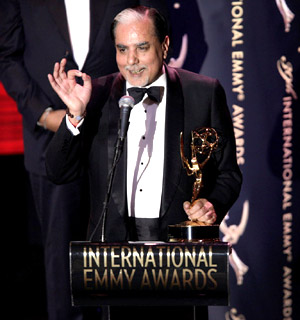
    Zee Group Chairman Subhash Chandra giving his acceptance speech at 39th International Emmy® Awards, held at the New York Hilton in New York City (CREDIT: Chip East / PSG)

    By A Correspondent


    Subhash Chandra, founder of Zee Group, has received the 2011 International Emmy Directorate Award. Mr Chandra made history by becoming the first ever Directorate Award recipient from India. The award was presented at the 39th International Emmy Awards, which took place on Monday, November 21 at the Hilton New York in New York City.


    “Subhash Chandra is a one of a kind visionary – a self-made entrepreneur who made his mark on the Indian television industry by launching the first privately-owned channel in India,” said Bruce Paisner, President & CEO of The International Academy of Television Arts & Sciences. “We happy to present him with our 2011 International Emmy Directorate Award as Zee Entertainment Enterprises prepares to celebrate its 20th anniversary, in 2012.”


    Remarked Mr Chandra, “India is the cynosure of the world today and it’s a great privilege to be the first Indian recipient of this award. It really means a lot to me, Zee Group and the Indian media and entertainment Industry.” He added, “While there have been many representations from India in the areas of technology and retail, this puts India’s media industry on the map and raises the profile of India with regards to its media and content.”


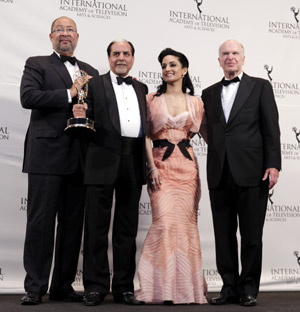
    Zee Group Chairman Subhash Chandra with Richard Parsons, Citigroup chairman and former chairman and CEO of Time Warner (far left), and Emmy Award-winning actress Archie Panjabi (The Good Wife), who both presented him with the 2011 International Emmy® Directorate Award, as well as Bruce Paisner, President & CEO of The International Academy of Television Arts & Sciences (far right) at the 39thInternational Emmy® Awards, held at the New York Hilton in New York City. Marks the first time in history that an Indian received this honor. (CREDIT: Allison Joyce / PSG)

    Richard Parsons, Citigroup chairman and former chairman and CEO of Time Warner, along with Emmy Award-winning actress Archie Panjabi (CBS Network’s critically acclaimed hit drama “The Good Wife”) presented the International Emmy Directorate Award to Mr Chandra during The International Emmy Awards Gala.


    The 39th International Emmy Awards were hosted by Jason Priestley, who was joined on stage by a cast of international celebrity presenters. Actor, director and producer, Mr Priestley was hosting for the second consecutive year. He was joined on stage by a starry cast of presenters including Brazilian actor Vladimir Brichta, Jeff Hephner (Starz’ Boss), Edward Herrmann (Gilmore Girls), Rick Hoffmann (USA Network’s Suits); John Larroquette, Danny Pino (NBC’s Law & Order: Special Victims Unit), Ally Sheedy, Blanca Soto (Univision’s Eva Luna and El Talismán), Jessica Szohr (Gossip Girl); Wendy Williams (host of syndicated talk show The Wendy Williams Show) and Goku and Luffy (characters from Toei Animation’s animated hit Dragon Ball Z and One Piece).


    The International Emmy Awards recognize excellence in television programming produced outside the United States. The awards gala is attended by 1,000 international entertainment decision-makers every year. For a list of nominees, visit http://iemmys.tv/news_item.aspx?id=136.

  • TV-wallahs eager for digital wave


    By Rishi Vora


    The television distribution scene in India has for many years seen the dominance of cable wallahs. Digitization only started in a big way when DTH players pumped in huge sums (there was no ordinance then) and succeeded in building a critical base of subscribers in the country. As a result cable operators were seen as laggards. Sample this: there are about 40-45 million DTH homes out of the total viewing population of more than 225 million households, so DTH has grown despite competition from cable and is likely to increase the subscriber base substantially with the recently passed ordinance by the government.


    As for the cable operators and MSOs, they are left with no option but to invest in infrastructure. Den Networks is investing Rs 1,000 crore and expects to get 2.5 million subscribers in the phase one. Hathway will invest Rs 500 crore and they are also bullish about increasing the subscriber base. Analysts feel that now is the perfect time for MSOs to increase their share in the business.


    So, while it seems all good for the industry, the fact is that digitization is something that was always talked about, and is now a work in progress as far as complete digitization is concerned. The government has, in a recent development, pushed the sunset day for four metros from March 2012 to June 2012. The date for cities with a population more than 1 million is March 31, 2013.


    For broadcasters, this is a big relief from the carriage fees, which in the past have resulted in loss of revenues. The four metros is a big market with 20 million households; and digital homes eating into cable and analogue… But, digitization, for broadcasters, also means that the consumer will now have a choice of what channel to pay and watch. That in experts’ minds is a challenge many broadcasters will have to face – to keep their viewers’ interest levels high and for the long run.


    Subhash Chandra, Chairman, Zee opines, “Digitization will only help the television industry further grow. The government’s decision on clearing the ordinance is a very positive move. It will give a boost to the cable and satellite industry and help create a more sustainable business model for the television industry.”


    On the growth of DTH players in the county, he said, “DTH is leading the adoption of digital technology. There are about 39 million gross DTH subscribers in the country. Now they have a great opportunity to consolidate their businesses.”


    However Dinyar Contractor, Editor-in-Chief of Satellite and Cable TV Magazine, has a contrary view to the whole scene. He feels that there is still some time for digitization to happen pan-India (2014) as the ordinance states. And that broadcaster are wary of going digital, or are wanting to delay the process of digitization of TV in India, as the profits are not much, plus there is the risk of losing eyeballs, as there will always be viewers who are not open to the idea of paying and viewing, as against the concept of free-to-air channels.


    Tarun Katial, CEO, Reliance Broadcast Network Limited, feels, “Digitization will bring-in fair reporting of subscriber base, which will lead to standard pricing and subsequently eradication of local monopoly. It will help companies increase subscription revenues and reduce down carriage fees for broadcasters in a phased manner.


    Ajay Chacko, President, A + E Networks | TV 18 JV, says that the move will bring in more accountability in the business. And apart from additional subscription revenues, he believes that digitization offers a whole new benchmark for broadcasters, and a platform which is more measurable than cable and analog.


    Neo Sports COO Prasana Krishnan welcomes the ordinance. “This is the much needed change in the industry. What it will do to the industry? I think it will revolutionize the broadcast landscape in India.”


    If the ordinance were not passed, Mr Katial is of the opinion that the current capacity constraints in analog cable would have stifled the growth of new channels and introduction of technologically advanced content. “The carriage costs paid by broadcasters which currently remain high in view of the limited bandwidth of analog cable would decrease post digitization. This would allow broadcasters to make higher investments in programming and marketing, thus improving the customer experience,” he explains.


    Another advantage the industry will see over the years in the fast adoption of HD television and 3D, which will open new revenue streams. As far as television distribution industry is concerned, the ordinance will lead to more transparency and greater accountability. It means opportunity for all stakeholders – broadcasters, distribution platforms including cable companies, MSOs and DTH.

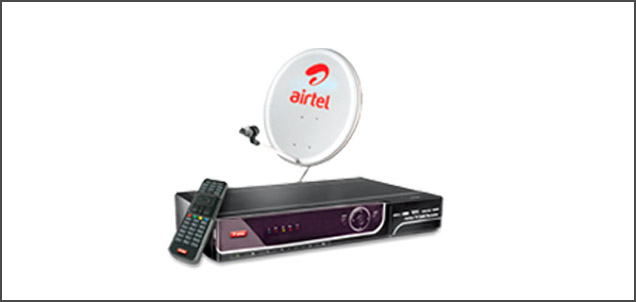
    Photograph: Airtel Digital TV HD Recorder from airtel.in