Dentsu Impact has won the creative duties for all brands from HT Media – including Hindustan Times, Hindustan (Hindi), Mint, Shine.com, HT Campus, Career Plus, Study Mate, English Mate and Bridge School of Management. With this move, Dentsu Impact becomes the prime strategic and communication partner for HT Media handling communication for all brands from the group, barring its radio brands Fever FM &Nasha FM, which are handled by Ogilvy & Mather.
The HT Group, which has so far worked with multiple agencies for different brands, initiated a process of consolidating all the brands with one single agency sometime in November 2016. Post an exhaustive pitch process, in which some of the country’s top agencies participated, HT finally decided to award the duties to Dentsu Impact.
Commenting on the association, RajanBhalla, Group Chief Marketing Officer, HT Media, said: “We wanted to move to a single partner for our diverse brand portfolio. Dentsu was already handling Hindustan, Mint and Shine.com and their team has done excellent work for the last few years, hence the decision to go with them.â€
Amit Wadhwa, President, Dentsu Impact, said, “This is a big win for us and an important one. When a group like Hindustan Times decides to award its entire portfolio of brands to one agency, it shows the level of trust as well as spirit of partnership from both ends. We are extremely excited and are rearing to create some interesting work.â€
Added Soumitra Karnik, National Creative Director, Dentsu Impact: “It’s a fabulous start to this year for us. Winning all the brands of HT group is something any creative agency would kill for. Along with this great news also comes great responsibility. We are quite committed to doing some great work on each brand.â€
Dentsu Creative Impact, the creative agency from Dentsu Aegis Network has made two major senior appointments in an attempt to further strengthen its creative product. The agency has roped in Anupama Ramaswamy and Akashneel Dasgupta as Executive Creative Directors. They will report to Soumitra Karnik, National Creative Director, Dentsu India Group.
Anupama Ramaswamy
Prior to joining Dentsu Creative Impact, Anupama Ramaswamy was Executive Creative Director at Cheil, Gurgaon and was in-charge of the Samsung Mobile account. In the recent years, Anupama has worked on the launch of the Galaxy J series, Note 4, Grand 2 and the extremely-popular “Fickle is Fun†campaign for Lavie Handbags.
Commenting on her new role, Anupama said, “I am very excited to join Dentsu Creative Impact. I have loved the vibe of the agency since the moment I walked in. Soumitra and Amit have been trying to get the best possible talent, and my mandate here is to have fun while building a vibrant and creative culture. This will involve less rhetoric and more hands-on hard work.”
She further adds, “While it is important to win metals, it is also critical for us to glamourize our day-to-day business as well. It can never be an ‘either/or’ situation. I would really like to see the more difficult every day work, which keeps the business ticking, to become more creative. Lastly, together we shall try and build a creative culture, which for me is the 3 P’s of advertising – People with a Positive Purpose. Once these three come together, we have a winner at hand.â€
Some of the agencies that Anupama has worked with include JWT, Lowe, Rediffusion, Havas and FCB. She has worked across a gamut of brands such as Nokia, Airtel, Woodland, Whirlpool, LG, Maruti, Lays and Boost. In her kitty are a number of  AdFest Golds, Spikes, Effies, New York Festival and a number of Abby’s. She was part of the One Show Jury in 2012 and is a regular face on the Goafest jury panel over the last few years.
Akashneel Dasgupta
Meanwhile, Akashneel Dasgupta’s last assignment was at ADK Fortune where he was heading the creative function. Akashneel started his career in advertising with strategic planning at Mudra. After spending a good 5 years in planning, he decided to venture into copywriting within the DDB Mudra group. In 2010, he joined Lowe Lintas as a creative director and then moved to ADK Fortune as vice-president and creative head in 2013. He has worked across categories such as automobiles (both two wheelers and four wheelers), FMCG, media, online travel, fashion, real estate, food and beverages, etc. Some of the brands that he has worked on are Maruti Suzuki, Paras Pharma (Moov, Itchguard, Dermicool, Krack, Livon, etc) Rasna, Johnson and Johnson, Yamaha, Honda, Emami, Woodland, Expedia, DLF and Wills Lifestyle amongst others.
Commenting on his new role, Akashneel said, “It’s an exciting time to join Dentsu Creative Impact where a young new team has taken shape and one cannot fail to notice the energy and enthusiasm. Also, it was a personal desire for some time to work with Soumitra and I am happy that an opportunity has presented itself. Hope you get to hear more from us, soon.”
Soumitra Karnik
Talking about the exciting new additions to the team, Soumitra Karnik, NCD, Dentsu Creative Impact said, “Great work happens when people commit to constantly raising the bar. We are young and tremendously hungry for qualitative growth. To satiate our appetite and to help us achieve our objective, people become easily our single most valuable asset and we cherry pick each one of them. Both Anupama and Akash are just the kind of people Dentsu Creative Impact needs to write its destiny. For me, they are our fantastic acquisitions.â€
India features as one of the countries with the highest rate of road accidents in the world. And Maruti Suzuki, being a leader in the Indian automotive industry, has, for long, been going that extra mile to spread road safety awareness and bring about change. As part of its efforts in the same direction, Maruti Suzuki has come out with its latest communication campaign on road safety – a series of 8 films that take on the challenge of positively impacting people’s attitude towards road safety.
The films are not so much about educating road users and creating road safety awareness amongst them, as they are about changing their attitude of apathy towards road safety. It is this apathy that Indian road users can sometimes have towards traffic rule violations, which has dire consequences for them and fellow road users. The campaign aims to stir their conscience and make them reflect on their apathy.
More than spreading awareness, Maruti Suzuki is hoping for an attitude change amongst road users, as an impact of the campaign. Road users are generally aware of rules in case of the most common traffic rule violations, such as not wearing seatbelt/helmet, not stopping before zebra crossings etc. What they lack is an attitude of concern towards the grave consequences that may arise owing to their violations. Hence, the intent is to create a conscience for road safety rules, which are otherwise most commonly neglected.
The films cover subjects which are integral to our everyday living – giving way to ambulances, saying no to drunk driving, always wearing a seatbelt, lane driving, avoiding phone calls while driving etc. The plot of each film lets you pause and ponder about your own behavior.  The campaign features 8 TVCs on road safety, conceptualised by Dentsu Creative Impact, Gurgaon, addressing the issues of non-adherence to the road safety rules and norms. The thought behind the communication is “If we know it’s wrong, why do we still do it?â€
Speaking on the films Vinay Pant, AVP, Marketing, Maruti Suzuki India Ltd., said “It’s a Hard-hitting campaign, rooted in on-road insights. Our desired impact would be that people are moved to think and reflect on their attitude. Intent is that every time people are breaking a traffic rule out of apathy, they should be reminded of these films, hopefully have a change of heart and start making the roads safer.â€
Mahesh Rajoria, AVP, Driving Training, Maruti Suzuki India Ltd., said “Being a leader in the Indian automotive industry, Maruti Suzuki, has always gone beyond providing people with mobility solutions. We always go an extra mile to ensure the well-being of our society. We believe that it is our responsibility to work towards making the Indian roads safer and our teams work tirelessly to spread awareness about safe driving and traffic regulations.† Amit Wadhwa, Branch Head & SVP, Dentsu Creative Impact, adds “Since the start, the intention was to look out for new and unconventional ways to communicate a simple message of road safety. With a strong insight, we feel we can reach out to those who may not always break the rules because they want to, but because they are so used to it by now that it has become a part of them. And our honest effort, is to at least make them think before they act.â€
Soumitra Karnik, NCD, Dentsu Creative Impact, said “We believe in developing strong campaigns using consumer insights as a base, so that the message reaches the right segment. With the core insight of ‘If we know it’s wrong, why do we still do it?’, the expectation is to touch base with each individual.â€
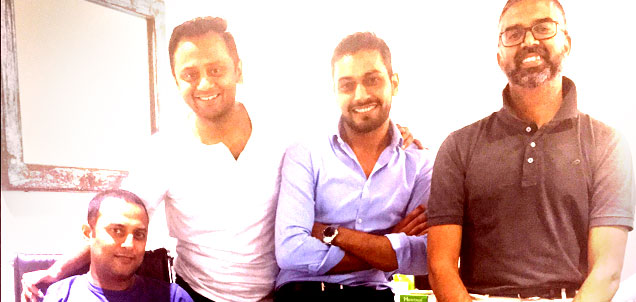
L to R: Soumitra Karnik, Kartikeya Srivastava, Amit Wadhwa and Narayan Devanathan
A few years back, not many would have known about Dentsu Creative Impact. But their debut at Goafest 2016 sure got everyone to sit up and take notice. A part of the Dentsu Aegis Network, they won 2 Gold, 3 Silver and 18 Bronze metals across seven categories, which included Radio, Print Craft, Print Single, Direct, Design, Ambient and OOH (Out Of Home advertising). Competing against seasoned industry names, the win did take everyone by surprise. Pradyuman Maheswari speaks to Narayan Devanathan, Group Executive and Strategy Officer, (erstwhile CEO, Dentsu Creative Impact); Amit Wadhwa, President, Dentsu Creative Impact; Kartikeya Srivastava, SVP & Head of Strategic Planning, Dentsu Creative Impact; and Soumitra Karnik, NCD, Dentsu India Group, the men instrumental in making this happen.
23 metals at Goafest, the # 4 creative agency… how it did happen, all of a sudden?
Soumitra Karnik (SK): I think it has been part of the plan. It is not something that has surprised us because we went about it very methodically. In the first few years, we had to stabilise the business side of Dentsu. And then very clearly we defined what the creative product will be eventually. So, even the hiring of the people that we have been doing for the past some time is in line with what we are seeing now.
You all have been around for a while, why did you enter Goafest now and not earlier?
SK: Team structure-wise we were not there very clearly. And when you say Dentsu has been around for a while, we count only the last four years. A lot of people from different agencies came together for a common cause.. There was no single vision or agenda. I think I give credit to Rohit (Ohri), he really brought the people together, from that point, we say, the birth of Dentsu 2.0 started, four years back.
What were the milestones achieved in this journey?
Amit Wadhwa (AW): If you cut to 2012, the basic objective was survival at that point of time.
That was when when Sandeep Goyal moved out?
2011 is when he moved out. Probably it was December, when we came together and obviously that was the year closing also. For all of us it was like, oh, is it a good thing that we have done?
All of you came together despite knowing the fact where Dentsu was….
AW: What we were trying to achieve was something that we could have created history or become history. But we finally did manage to create one. At that time it was a big challenge. Finally, the likeminded stuck together and we managed to pull it off. At that point of time, the basic objective was how do we grow and obviously our business and creative are linked together. The prime importance was we needed to be above floating line, we needed to manage the numbers nicely. We won a lot of businesses in 2012
Kartikeya Srivastava (KS): I was already there in Dentsu and you know everybody came together. To me, it has been a huge turnaround story. The three-four years saw the strengthening the fundamentals and foundation. Having lived in the early 2011 era, it was not even an advertising agency, to be very honest. The key really to our turnaround for me was the instilling of the right culture. It is an organic process and over the three years we have built a strong culture base.
What is the current staff-strength?
110 people at Dentsu Creative Impact (DCI) based out of Gurgaon.
What did you aspire to be eventually?
Narayan Devanathan (ND): Probably not size-wise but focus more on quality.
AW: In terms of numbers, I do not want to go by number of people. But we intend to grow 40% this year. So,we are not stopping on growth in the number front but what we are saying and seeing is that if we are doing well in the creative front, the other bit of growth will automatically come.
Santosh Padhi made a statement at Goafest that, ” Those guys are 2000 people, so many offices. We are 40 people and we got 40 metals and they have got 47″. So, how much does size matter?
SK: It does. I have been part of JWT for a very long time. It is a very strong network, it is a very well-oiled machinery, resources are available. The culture already exists for the past 100-odd years. So, the network support eventually, whether you call it financially or in terms of manpower, it does make a difference.
But in terms of, if metals are the indicators of how good you are, then Taproot has got 40…
All: That is fantastic.
SK: That is the point he was making. If these guys have 2000 people and if 1000 fire, it is still a substantial number.
ND: Eventually it boils down to the focus. Like Amit and Kartik said, last 3-4 years we were about stability. What we like to say is that, this is kind of bungee jumping. If the rope holds, thrill of a lifetime and if it doesn’t, hopefully you won’t feel the pain. But to add to Amit’s point is that, this is a ship that needs turning around and it won’t happen if people are standing on the shore and cheering. It is all hands on deck, power to everybody in the ship. That’s what is happening right now. This is the focus that we are driving towards to push stability. Creative excellence will take us further.
Where does DCI fit into the larger Dentsu portfolio?
ND: Each has an individual identity. Back in 2013, when Taproot became part of the group, we thought of it as a tugboat to pull the ship. But right now, this is more than a tugboat. Creative Impact on its own steam is going to take the Dentsu brand forward. Where we are now, there is enough steam on our own.
What were the surprises like? Was it a “God, these guys exist?”
KS: No, the surprise was that ” Oh god! We never knew these guys would exist”. The fact of the matter is that we were up against biggest agencies in the business. We could pull the rug out of a lot of people’s feet was happening, stood out for DCI.
AW: If you look at what we have been trying to do and what we have been trying to do and what we have done so far, we have managed to surprise. No one expected us to win. We managed to surprise them by winning 80% of the pitches in 2012 itself and managed to hold on to handle one brand of HT, now we handle 4 brands of HT, from 4 brands of Maruti Suzuki to 13 brands of it.
12. Where does DCI stand among other networks and why people should look at you’ll for their brandsand not the others?
ND:. There’s a reason behind it and the reason is that this is the difference in Creative Impact. It continues to be young and the average age is 28. It’s the young being fearless and thinking there’s nothing to lose. Bringing the A game whatever the consequence may be, not being afraid to do the unsafe.
There are agencies which are creatively run and some by suits. What about DCI?
SK: DCI runs creatively.. A simple reason is we all are creative. If one person comes into our thinking sessions, it could be a planning guy cracking an idea, could be an account management guy, it could be anyone. It is a free flowing session. What I say as a creative leader, when we started advertising, none of us said that we want to be an account management guy. We all said we want to be an advertising guy. So, all of us have to be ideas people. The thinking is creatively driven kind of a thing. Ultimately, we all drive towards creating a creative idea.
Is it really that everybody does everything?
AW: I’ll give you an example. We discussed this around 2013.. We had gone into a bit of rhythm, we had managed some numbers, we were stable and we said okay, next what? What should be our positives? What should be our playground? How should we be running the show? All of us are creatively linked. I keep pestering Soumitra with some idea or other, most of them he rejects. So does Kartik. We all have that creative streak. What we decided was that anyone and everyone who comes into the system needs to have that streak. SK: But you’re right that so far it has worked, going forward it might not. Nowadays, people are open. If I were reading the same article you’ll publish, I would be worried that here’s an agency where an account person is meeting the creative person. But it is not as bad as it sounds.
ND: I would be as cynical as you, if I read that. ‘Yaar ek aur agency aagayi, phir wohi baat bol raha hai’. But,two indications. Can’t name the client, as recently as last week, some grey hair and experienced heads were in the room defending this out-of-the-box idea that we had presented to the client. How much logic we put in front of the client , they weren’t buying it. The juniormost writer in the team stood up and said ‘ You know who are you trying to sell this to? You’re trying to sell this to me’. He made an amazing argument and didn’t hesitate to speak up. This is one indication. The other is a ghar wapsi movement. People have switched from our agencies to other agencies and it’s been less than 3 months they said ‘ ‘Acchi jagah nahi hai yeh. Can we come back?’. For us it is a testimony that we’re doing something right.
What is the path ahead?
AW: In terms of numbers we are very clear on how we want to go. But we are selective about what all we are going for. So,what is of prime importance is the set of brands that we have . Usually, what happens is that in the stretch of growing you go on pitching and you start neglecting the existing brands. It’s a conscious decision that we are going to make sure that we deliver on existing brands and obviously grow also. What will talk about us is the work we create.
SK: What could be flattering was that Aggie called up. He was in London that time. He has already set us the next year’s target. He said you guys should be the next Taproot. That’s a clear target, work wise and expectations also in the network,coming from the guy.
Awards are an indicator that you have arrived. How do you think you fare if you were to enter some of your work with Effies?
ND: Honestly, it’s a journey. Part of it is oriented internally to approach so that the data mindset is there. Fortunately or unfortunately, the Effies are the brand put together under case studies rather than work that has been envisioned and has been done. You have a data from an independent firm, that maps the results, which is always not the success seen on ground. Not all of our clients or us are oriented towards working like that.
KS: This is a start. I’ve always felt, professionally, that Effies are a great way to judge, to get recognition. The kind of work that we do today make us a good case.
How are you aligned towards 2017 where Dentsu wants to be the #2 agency network in the country?
SK: I don’t think specifically it would be awards and cut-throat competition and we’ll start doing work only for awards. Have we tasted blood? Yes. Does it add to the expectations of the network? Yes. So, I think we are completely aligned with the vision set in front of us both in terms of business and creative output.
ND: I would like to add what Amit was saying earlier about where next. And I’m coming at it from a not just Creative Impact point of view but specifically, I would like to make it about Creative Impact. One of the things we have going forward, biggest strength is that we are part of the Dentsu Aegis network and therefore the partners that we have within the group driving growth organically, through the networks internally, is the key KRA for all of us. But what Amit has done and this team has done is quietly without talking about it made it work already.
AW: And it’s important what Dentsu Aegis brings to the table, the scope of thinking has widened. We think of an idea and keep the rest for the client to execute. Now we know the intricacies of the other mediums, because we sit together, work together, interact a lot more and the idea is very closely guarded. What we have realised in the last few months is that clients are appreciating that a lot. And, the kind of output we’re getting is far far better. That’s another part of the change that is happening at DCI.
ND: We are lucky to have a creative leader like Soumitra who never starts a meeting by saying TVC banate hain. ‘ Kya idea kya nikalna hain first’ and then it will take form.
Name of the Campaign/Ad: Maruti Suzuki WagonR – Prank
The Brief: The WagonR is one of the most successful brands from the MSIL stable. Its features, functionality and design have always catered to the needs and tastes of its target group. With changing consumer preferences and growing competition, it becomes imperative that a seasoned brand like WagonR evolves so as to continue to meet consumer expectations. The new TVC must announce the launch of the new WagonR and communicate its features without it being a blind spot.
Research insights: After the huge success of the last campaign ‘Big like India, Smart like you’ which first saw the trio of Madhavan, Raghu and Rajiv of Roadies together in a novel format describing the car and its various features, the core idea of the new campaign picks up from there, talking about the new features of the smarter WagonR in an engaging format, once again using brand ambassador Madhavan and celebrities Raghu and Rajiv. This communication piece celebrates the feature-rich WagonR and its smart buyer.
The thought process behind the creative: The story revolves around two characters in clown masks who get into Madhavan’s car and tell him to drive them around while he’s held hostage at gunpoint. During the interaction, the features are revealed. However, Madhavan tricks them and drives away leaving them behind, proving his wit and smartness. In the end it is revealed that the clowns are no other but Raghu-Rajiv themselves who had set out to prank Madhavan but end up getting tricked by him.
Media vehicles chosen: TVC, Digital, Print, In-store.
Key issues kept in mind while executing the ad: Soumitra Karnik, NCD, Dentsu India, said, “The task was to announce the new changes in the widely sold WagonR and the challenge was how to make this announcement engaging. We decided to continue with the casting of the last commercial of Madhavan, Raghu and Rajiv as it was quite well received. This particular script was found to have all the elements of being an entertainer. A prank played by the twin brothers wearing clown masks who at the end get outsmarted by Madhavan, the car’s owner, who impresses them with all the new features in the car. One thinks of many different things but in the end you go with your gut with a script like this.”
What is the differentiating factor about the ad? The star power of Madhavan, along with Raghu and Rajiv in an engaging narrative with a prank, makes it easy to recall.
1. Name of the Campaign:Â Monster.com ‘Find Better’
2. Research insights:
Finding a better career/job is serious business, it’s no laughing matter. And yet, there is a danger of the brand and the business becoming too serious, too “manufacturer” oriented. According to a survey conducted by Monster India, 80 per cent of Indians believe that getting a new job is not just dependent on your capabilities and experience; ‘Luck’ plays an important role. 69 per cent people in India, believe that ‘Luck’ plays an important role in job search as well.
With social media and professional networking playing a pivotal role in all spheres of our lives, there has been a shift in the way both jobseekers and employers are consuming services. This new media opportunity led the path for Monster to innovate in the e-recruitment space. Monster is the worldwide leader in successfully connecting people to job opportunities. From the web to mobile to social, they help companies find people through their most advanced technology. The innovative products and services help connect jobseekers and employers better than anyone else across the world. Now is the right time to transient into the next level.
Monster India has introduced the new user interface. The company launched Monster College to facilitate campus hiring; Monster JobsActive, in partnership with DishTV, to help people with no internet access apply for jobs through Monster India. The company also launched The Monster Employment Index (MEI) which is a monthly gauge of online job posting activity in India based on a real-time review of tens of thousands of employer job opportunities culled from a large representative selection of career Web sites and online job listings
4. The thought process behind the creative:
Job-searching is subject to many vagaries – The pool of candidates in the fray, their relative ranking in the pool, having/not having any “contacts” in the field, the possible hiccups with the search and results of the job site, the timing of the opening, physical location of the opportunity, idiosyncrasies of the hiring manger, cultural fit, compensation criteria, not to mention an inevitable X factor.
That X factor? It’s a little something called luck. And inIndia, as in most parts of the world, luck plays a huge role in almost every sphere of our lives. Or at least, people like to believe that. From the use of innumerable lucky charms to invoking many symbols of auspiciousness from human and other-worldly sources (caution against signs of good-luck such as sneezing, breaking glass, walking under a ladder, having a black cat cross your path), luck is wooed relentlessly.
5. Media vehicles chosen: Owned, Paid, Earned
6. Key issues kept in mind while executing the ad:
The trick for a brand in this category is to find the right balance between creating clutter-breaking brand communications without dissing the serious nature of the task at hand.
7. Does the treatment do justice to the brief?
The TVC is about candidates who try to carry every possible symbol of luck with them to enhance their chances of getting a better job. The TVC exaggerates the acts of superstition in a humorous manner to show the extent that people go to, to get luck on their side. It then drives home the point that with Monster.com, you get luck on your side.
Striking a balance between levity and gravity, it is a culturally relevant interpretation of the “Find Better”. It leverages the core strengths of monsterindia.com and its presence on web, mobile as well as social , beyond just a superior search algorithm, and demonstrates powerfully each of monsters ‘features’, showcasing how you can get luck on your side and find better.
8. What according to you is the differentiating factor about the ad?
The highlight of the film is when the mother emerges from the bag in this show of one-upmanship. It’s most unexpected and at the same time humorous; you can almost hear a gasp followed by a chuckle from the viewer.
9. Market/client feedback:Â Not available yet
AdStrat, compiled by Shubhangi Mehta appears every Monday.
Continuing with the series of senior-level appointments, the Dentsu India Group on Tuesday announced the appointment of Soumitra Karnik as National Creative Director, Dentsu India Group.
Soumitra Karnik joins DentsuIndiaafter a stint at his his creative consultancy company, prior to that he was with JWT,Delhias an Executive Creative Director. In his over eleven years with JWT, Soumitra worked on brands like PepsiCo, Nestle, Hero Honda, Sony, GSK, Congress and Airtel.
Among the campaigns he is known for include ‘Youngistaan’ for Pepsi, ‘Aamsutra’ for Slice, ‘Yaari ki Gaadi’ for Hero Honda and ‘Dil jo chahe paas laaye’ for Airtel to name a few.
Welcoming Mr Karnik to Dentsu, Rohit Ohri, Executive Chairman, DentsuIndiasaid: “Soumitra is a truly gifted creative and great leader. He will partner the creative leaders at DentsuIndiaand me to take our creative product to the next level. Soumitra believes in integrated communication solutions and as a key member of theIndialeadership team, I see him helping us effectively deliver this core Dentsu belief to our clients.”
Speaking on his new role as National Creative Director, DentsuIndia, Soumitra Karnik said: “As far as my role is concerned, my first priority is to build a solid network of talented creative teams across Dentsu companies and to create a ‘boredom-less’ and fearless creative culture. I will also partner our clients in developing thought leadership and strategic superiority in their respective markets by the process of collaboration and co-creation.”
“We have pressed the ‘Refresh’ button at Dentsu and are pretty serious about being the very best, both for our clients as well as our own people. We want to be known as a place with a large heart where people with great minds work. And I can certainly promise a lot of action around us in the coming times,” he added.
Mr Karnik started his career in 1991 with a small-sized advertising agency called Pace. While working at Pace, Soumitra learnt everything from the printing process to delivering release orders for ad releases to various newspaper offices. Next, Mr Karnik joined Percept in 1993 as creative group head from where he moved to a boutique agency Rightangle in 1995. Over his rather eventful stints at Percept and Lowe (then known as Lintas), he has worked on accounts like Hero Honda, Nestle, Maruti Suzuki, The Oberoi Group, Joyco, Xerox and Wills Sport.
After a two-year stint at Rightangle, Soumitra joined Lintas in 1997 as associate creative director, and worked with the agency till 2000. Next, he moved to JWT as creative director, and was later promoted as executive creative director and vice-president.
Dentsu Inc,Tokyocommenced itsIndiaoperations in October 2003 in a joint venture with the Mogae Group. In 2011, the parent company acquired theIndiabusinesses and the new Dentsu India Group became a 100% subsidiary of Dentsu Inc,Tokyo. The new Dentsu India Group comprises three independent, full-service advertising agencies -Â Dentsu Communications, Dentsu Marcom and Dentsu Creative Impact, a media company, Dentsu Media and a digital company, Dentsu Digital.