Tag: Snapdeal

  • Does tweet spat herald consolidation?


    By Sagar Malviya


    Future Group CEO Kishore Biyani said the Twitter spat between India’s ecommerce poster boys Sachin Bansal and Kunal Bahl could indicate a consolidation wave triggered by Alibaba’s imminent entry into the space.


    Biyani, who runs the country’s largest brick-and-mortar retail company and is known to disparage ecommerce rivals, said social media had become the medium of engagement for many entrepreneurs. “Very often I see conversation as a precursor to hint something strategic or big. In this case, it could even be consolidation or something more,” he said.


    Flipkart’s Sachin Bansal vs Snapdeal CEO Kunal Bahl: Right guys stuck in a tough ecommerce battle


    By Biswarup Gooptu & Madhav Chanchani


    Three months into 2016 and the battle lines between India’s top two ecommerce companies are being drawn deeper. The exchange of barbs between Flipkart’s executive chairman Sachin Bansal and Snapdeal CEO Kunal Bahl on Twitter on Friday evening wasn’t merely a spillover of their rivalry but emblematic also of the significant pressure they are under with investors’ becoming tightfisted. It portends more ugly confrontations.


    “While in 2014 it looked like the game had consolidated between Flipkart and Amazon, the market suddenly opened with Snapdeal, Paytm and Shopclues jumping into the fray,” said Harminder Sahni, founder of retail consulting firm Wazir Advisors. “Now investors are evaluating (ecommerce firms) closely, so it becomes (important to establish) not only how good you are but also how bad the other players are.”


    This year is expected to be an inflection point for Flipkart and Snapdeal, which, along with Amazon, have dominated India’s $23-billion (Rs 1.5 lakh crore) market but are yet to show paths to profitability.


    Investors who have poured billions of dollars into Flipkart and Snapdeal are pressurising the firm’s managements to optimise their operations, curb discounts and focus on improving margins as they seek ways to sell their investments and maximise returns. Both Flipkart and Snapdeal are scouting for new investors to back them as they compete for top honours in India’s ecommerce industry while staving off the challenge from Amazon.


    Flipkart has been in the market awhile to raise $1.4 billion and, according to media reports, had approached Alibaba for funding, but investors have become fussy amid growing uncertainty.


    Snapdeal was able to raise $200 million in February in funding led by Ontario Teachers’ Pension Plan at a valuation of about $6.5 billion. A lot of that money, though, went to existing investors selling their shares in the company. “The pressure is too much,” said Sahni. “I don’t think we have seen this kind of a public spat between people from the industry in the modern times.”


    India’s ecommerce industry, though, is not in a position of uncertainty. In February, Morgan Stanley raised its forecast for the gross merchandise value of Indian online retailers to $119 billion by 2020 from its earlier estimate of $102 billion, indicating that more consumers are buying online.


    Source:The Economic Times

    Copyright © 2016, Bennett, Coleman & Co. Ltd. All Rights Reserved

    Licensed to republish

     

    While the Chinese ecommerce giant is a fringe player in its core business-to-business online trade in India, it has an indirect presence in the country’s ecommerce segment. It invested more than $500 million for a 40 per cent stake in One97 Communications, which runs Paytm, a wallet and ecommerce company, while Snapdeal raised $500 million from a clutch of investors including Alibaba last year.


    Alibaba said recently it will make a direct entry into India’s online space and is said to be looking at several options. One could be increasing its stake in Paytm and spinning off its marketplace into a separate venture.


    It has also been reported that it (Alibaba) was talking to the Tatas for a broader strategic alliance besides deepening its relationship with Snapdeal.


    The consolidation buzz in the ecommerce space has been strengthened by talks swirling around Flipkart. The Economic Times (ET) had reported on failed talks between the company and Amazon. Flipkart founders Sachin Bansal and Binny Bansal denied this.


    ET and a few other newspapers have also reported that Flipkart was in funding talks with Alibaba. The founders of Flipkart and Snapdeal had lashed out at each other on Twitter Friday night over Alibaba’s entry plans.


    Bansal, executive chairman of Flipkart, indirectly criticised the companies in which Alibaba has invested. “Alibaba deciding to start operations directly shows how badly their Indian investments have done so far,” he tweeted.


    Bahl responded with. “Didn’t Morgan Stanley just flush $5 billion worth market cap in Flipkart down the toilet. Focus on ur business not commentary :)”


    The reference was to a mutual fund managed by Morgan Stanley marking down the value of Flipkart’s shares by 27 per cent, signalling that global investors believe India’s largest Internet company may be overvalued. Flipkart had said in a press statement that it is valued at $15.2 billion. A 27 per cent drop would put this at $11 billion.


    In comparison, stocks of Biyani-owned entities — Future Retail, Future Consumer and Future Lifestyle Fashions — have gained 14-80 per cent on the BSE and have a combined market capitalisation of $1.5 billion. Biyani had accused online retailers of adopting predatory pricing two years ago. Earlier this month, he released a series of ads targeted at the three main online marketplaces — Flipkart, Amazon India and Snapdeal.


    Last month, investor Rakesh Jhunjhunwala said ecommerce companies were attracting too much investment without any meaningful retail disruption and was bearish on the business model. “I will consider buying Flipkart’s stake if it is valued at $100 million,” he had joked.


    The combined losses of the three leading online retailing platforms widened to Rs 5,052 crore in FY15 as they spent heavily on infrastructure and discounts to woo consumers.


    Source:The Economic Times

    Copyright © 2016, Bennett, Coleman & Co. Ltd. All Rights Reserved

    Licensed to republish

     

  • Flip the Cart, Snap the Deal and Amaz-Off. Future to tease ecom majors with ad offensive


    By Sagar Malviya & Pritha Mitra Dasgupta


    Future Group CEO Kishore Biyani, who’s never made a secret of his disdain for ecommerce rivals, plans to step up the offensive with a series of ads that use word play to target the three main marketplaces – Flip the Cart, Snap the Deal and Amaz-Off.


    This is probably the first time a brick-and-mortar retailer will engage in comparative advertising against online rivals, which have been grabbing share by discounting products.


    After nearly three years of deep discounting, most online sellers are now pulling back from this strategy in a desperate effort to shore up their finances, making them vulnerable on this front. Ecommerce discounts are now mostly limited to select brands such as online exclusives, old merchandise and own labels.


    The combined losses of the three leading online companies — Amazon, Flipkart and Snapdeal — ballooned to Rs 5,052 crore in FY15 from Rs 1,000 crore in the year before as they sought to build market share. At the same time, several brickand-mortar retailers clocked double-digit same-store sales growth last year, a reversal from the trend in 2014 when physical stores reported subdued demand as ecommerce players wooed away consumers.


    As part of the Future exercise, three newspaper jacket ads on Friday will direct shoppers to its Brand Factory discount outlet instead of hunting online for better prices in a manner reminiscent of the pot shots that Pepsi and Coca-Cola took against each other in the 1990s.


    The theme will be continued inside the stores, with staff and cashiers wearing T-shirts with messages such as ‘My deal got snapped’ and ‘My cart got flipped’. The 40 or so Brand Factory stores will also wear new facades and selfie zones with the same theme targeting Flipkart, Snapdeal and Amazon.


    “We just want to prove the point that both our merchandise assortment and pricing are better compared to online companies. We need to make consumers aware of this fact,” said Biyani, adding that Brand Factory’s gross merchandise value (GMV) in the year to March 2016 was Rs 3,500 crore. Future is India’s biggest listed retailer.


    “While we use sales numbers to talk about performance, we are bigger than Myntra or Flipkart in terms of GMV,” he said. As part of its Great Offline Denim Festival, Brand Factory will sell nearly a dozen brands such as Levi’s, Benetton, Lee, Wrangler and Pepe jeans at a 50% discount for three days.


    Future has fired ad shots at ecommerce before. For instance, “You can’t take the nation for granted even for a day,” was aimed at Flipkart’s Big Billion Day sale in 2014.


    Snapdeal has taken digs at Flipkart and Amazon with its campaign tag line: ‘You don’t need a billion offers to amaze you. You just need to snap the best ones’. It also had about 100 billboards in 20 cities emblazoned with the phrase ‘Achha kiya bata diya, #YahanSeKharido’ aimed at Flipkart, which was running the ‘Nahin khareeda? #AchhaKiya’ campaign last year.


    “The intent of a campaign is really crucial,” said McCann India CEO Prasoon Joshi. “Whether the campaign is offensive or not will depend on the intent of the brand. If the intent is shallow fun then it is different. But I personally believe that taking creative potshots at competition cannot be a long-term strategy.”


    Brick-and-mortar retailers are also investing in omni-channel strategies and experimenting with global models such as flash sales, such as by offering a single product for sale for a period of 24 to 36 hours. “We are planning flash sales where consumers can get discounts, coupons and offers on several brands by using an app but buying at physical stores for certain hours or days,” said Rajiv Prakash, cofounder of Shouut, which is in talks with Shoppers Stop, Oberoi Mall, Decathlon and DLF Promenade for deal-of-the-day sales.


    Source:The Economic Times

    Copyright © 2016, Bennett, Coleman & Co. Ltd. All Rights Reserved

    Licensed to republish
     

  • Gearing up for the Big Sales


    By Indulekha Aravind


    Manjunath V*, who juggles two jobs with college in Bengaluru, is one of Flipkart’s 16,000-strong delivery force, dropping off 70-80 packages a day. After his night shift with a courier firm ends at 3 am, he snatches a few hours of sleep before leaving for the ecommerce giant’s warehouse at 6.30 am. But, from this week, when the “Big Billion Days” sale kicks off, he says he will be reporting to work at 5 am and looking at an 11-hour shift so that he can complete that day’s sale season deliveries, likely to be 100 a day.


    “There’s no fixed time to when we finish — the sooner we complete the deliveries, the earlier we can leave.


    But we need to finish that day’s deliveries,” says the 19-year-old. Manjunath’s employer, Flipkart, is looking at shipping 1,03,000 packages daily during “Big Billion Days”, as opposed to 65,000 on other days, according to multiple operations executives with the firm. Its Gurgaon-headquartered rival, Snapdeal, saw sales grow 10 times during its preview Diwali sale held last Monday and is optimistic about similar numbers as the festival season picks up. Furniture marketplace Pepperfry is looking at sales doubling during these months while payment-solutions-firm-turned-marketplace Paytm is eyeing 3x growth. If these projections sound dazzling, it’s because the Diwali-Dassera season is traditionally the time when Indians have shopped the most online, and ecommerce companies expect 40% of annual sales to come from the months of October and November.


    And while deep discounts are still the way to the customer’s wallet for companies like Flipkart, Amazon and Snapdeal, ecommerce companies across sectors are also trying to leave nothing to chance while ensuring the customer gets what he ordered, on time.


    Gearing Up for Busier Days

    Though the sales only begin in mid-October, companies began supply-chain preparations as far back as May. In fact, Snapdeal says they begin gearing up for next year’s Diwali from the previous year. “Unlike Flipkart, we have a sale every week, which is a good stress test to gauge customer experience. We began getting ready for this Diwali as soon as the last festival season was over,” says Jayant Sood, chief customer experience officer at Snapdeal. The company, valued at $4.5 billion in its latest round of funding, saw a 15x surge in traffic last Diwali, according to Sood. Being a marketplace, it does not own inventory or a logistics team but, last Wednesday, Snapdeal announced a $20 million investment in third-party logistics player GoJavas, in which it holds a 40% stake. GoJavas, says Sood, now delivers in 350 cities. The fresh fund infusion in the logistics company is in addition to the $100 million Snapdeal has invested in the last six months to improve its logistics and supply chain.


    In Bengaluru, rival Flipkart has been streamlining its delivery process to meet the daily order avalanche during its biggest annual sale. With last year’s edition of its Big Billion Day coming in for a lot of flak from customers for price discrepancies, inadequate stock and server glitches, forcing the company’s founders Sachin and Binny Bansal to apologise to customers, the company has ramped up its back-end operations.


    Flipkart now has 16,000 delivery staff, has increased the number of fulfilment centres from 13 to 16 this year and has automated its warehouses, says Neeraj Aggarwal, senior director, delivery operations. According to another operations executive, who requested not to be named, half the members at each delivery hub have been trained to make 300 deliveries a day. “Earlier, staff would spend a lot of time settling the cash-on-delivery accounts. This year, we have installed cash deposit machines in cities where will see the heaviest sales so that they just need to deposit it in the machines,” he says. Handheld devices to scan items and segregating categories by the day are also expected to cut delay, he says.


    For Paytm, this will be the company’s first Diwali as a marketplace. The Alibaba-backed firm began talks with suppliers and logistics firms three months ago and has tied up with 30 courier partners. “We’ve ensured our third-party logistics partners have enough exclusive capacity and have shared our plans about expected sale volumes,” says Saurabh Vashishtha, vice-president, business, at the company’s headquarters in Noida. “We also have very strict service-level agreements whereby the logistics partners will incur losses if a package is not delivered on time. Also, the volume of business we give them would depend on the service,” he adds.


    Paytm has introduced a logistics cloud for local courier companies which are big in that particular region but not plugged into the ecommerce economy because they lack the technological capability. Similarly, the company is also creating a warehouse cloud to integrate warehouses run by third parties into its system, which would then be available to the smaller merchants selling on Paytm. “We negotiate with the warehouses so that the small players get a better rate,” says Vashishtha, who attributes the glitches that happened with most etailers last festive season to not anticipating the demand. At present, over 60,000 merchants sell on Paytm.


    Of Bulk Orders and Deliveries

    Delivery is particularly crucial for furniture sellers like Urban Ladder and Pepperfry, with staff usually having to assemble the items they deliver. Urban Ladder does not outsource any of its logistics and operates with a team of 850 delivery staff, predominantly in Bengaluru, Mumbai and Delhi. “We control the last mile, so we also take care of the training of all the delivery staff,” says Kaustabh Chakraborty, vice-president, operations. Though the company states that it will take 15 days to process an order, Diwali is the time when there are multiple requests to deliver much faster.


    “Each customer might also order 20-25 items for their homes, if it’s a “gruhapravesh” (housewarming) and there is huge pressure from the customer to deliver everything together,” says Govind Raj Kaushik, manager, operations, at the company’s warehouse in Bengaluru.


    Furniture marketplace Pepperfry has also moved to take complete ownership of its logistics chain. “This year, we stopped using third-party logistics providers. The entire distribution chain is now centrally controlled so the tradeoff that might have been there between our product and a rival’s will not be there this year,” says Ambareesh Murty, cofounder and chief executive of the company.


    Murty says Pepperfry, which ships 300,000 items a month, is looking at a 100% jump in the festival season, just as it did last year. “We deliver to 430 cities and will add another 200 in the next two months,” adds Murty. The company’s fleet of trucks and delivery personnel have seen a five-fold jump from the beginning of the year. It also has an app called Far Eye to track the deliveries in real time. “A delivery does not take more than half an hour. An alert is sent to the supervisor if it takes more time,” says Ashish Shah, Pepperfry’s chief operating officer.


    Feet On the Ground

    For hyperlocal grocery platform Grofers, the biggest challenge is ensuring there is adequate staff to deliver the 100% surge in orders it expects in electronics and gift items. The jump in demand is accompanied by higher attrition with delivery staff taking leave during the festival season, says cofounder Albinder Dhindsa.


    “We normally add around 10% staff month-on-month but we’ve ramped up our delivery capacity by 40% to 4,200 over the last two months anticipating the dip in attendance,” he says. “We also need to make sure we have a good relationship with the suppliers so that we are the preferred vendor.”


    Neeraj Jain, cofounder of electronics marketplace Zopper, is anticipating his first challenging Diwali because, till last year, the company was merely connecting buyers and sellers through calls, and not accepting orders. To help the smaller merchants on its platform deliver on time, Zopper will be underwriting part of the demand.


    “We have told them to scale up operations and will be paying them, even if there is not sufficient demand, provided their services are available exclusively to us. We’re also offering incentives if they perform well,” says Jain.


    One would expect higher pressure on delivery staff during the peak season, but many did not seem apprehensive. Ravish Kumar*, who picks up returned goods for Amazon in New Delhi and is on the payrolls of a third-party firm, says he will probably have to pick up 50 packages a day, instead of 40. “There was pressure when there were fewer centres but not anymore,” he says, though he adds wryly that the company does not give mithai dabbas for its delivery staff. Amazon also runs a programme whereby a delivery associate is given the opportunity to work as a process associate during the festival season, which could translate into a promotion. On average, in the bigger ecommerce companies, delivery staff are paid `12,000 a month. A customer associate with Vulcan, a logistics firm that works with Snapdeal, says the number of van deliveries might go up from 10-15 to 20 a day during Diwali and Dassera, with an additional `20 paid for each delivery after 20. In Mumbai, delivery agent Arjun Kumar is preparing to hit the jackpot during the festive season, when deliveries are likely to cross 100 a day from the usual 45-50, which would earn him incentives.


    “My take home could easily double in these three months,” says the 23-year-old. A section of delivery staff in Mumbai like Kumar had gone on strike earlier this year pressing for the fulfillment of some 21 demands that ranged from toilet facilities to incentives for additional deliveries and returns but unions affiliated to Flipkart, Snapdeal and Amazon and the like have adopted a more conciliatory position since. “Around 15 of these demands have been met,” says Sachin Gole, a leader of the MNS Kamgar Sena. It was the delivery staff affiliated to MNS, the Raj Thackeray-led political party, that had gone on strike in July. “These companies have promised to give delivery personnel incentives once the hectic sale season concludes,” adds Gole.


    But though personnel have been recruited, incentives promised and stress tests carried out, there is still one factor that could throw the best laid plans out of gear. “If it rains, it will spoil our delivery schedule,” admits the Flipkart operations executive quoted earlier.


    *Names have been changed on request (With inputs from Rahul Sachitanand)


    Source:The Economic Times

    Copyright © 2015, Bennett, Coleman & Co. Ltd. All Rights Reserved

    Licensed to republish


  • Ecommerce sector powering India’s SME growth, notes Snapdeal & KPMG study

    By A Correspondent


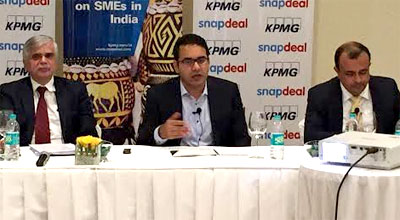
    Snapdeal released a first-of-its-kind study in partnership with KPMG titled ‘Impact of Ecommerce on SMEs in India’. The study examines the macro-impact of e-commerce sector on growth of SMEs in India and identifies remaining gaps in the eco system needed to be plugged to facilitate adoption of e-commerce by SMEs.

     

    The report compares the e-commerce led growth trajectory of SMEs in India vis-à-vis other emerging and developed economies. Additionally, it outlines different roles that various participants like the government, industry bodies and ecommerce companies themselves can play in making the SME ecosystem more robust.


    Speaking at the release of the report, Kunal Bahl, Co-founder and CEO, Snapdeal said, “At Snapdeal, we are working towards building the most impactful digital commerce ecosystem in the country and SMEs form the foundation of this ecosystem in many ways. With over 200,000 sellers operating on our platform, we felt the need to conduct a systematic unbiased study to identify opportunities and challenges to further accelerate the growth of the sector. We have taken a number of initiatives like seller training programs, seller financing program- Capital Assist and Snapdeal Seller Advisor Program, with an aim of creating life changing experiences for over one million sellers in the next three years. This study has given us deeper insights into what more we can do to enable small businesses become more successful online.”


    Richard Rekhy, CEO, KPMG India said, “The fast paced growth of the e-commerce industry in India represents an unprecedented opportunity for SMEs. We hope that the findings of this report will assist policymakers, industry bodies and e-commerce companies to strengthen the support ecosystem, which enables SMEs to ride the e-commerce growth wave successfully.”


    This report is the first in a series of initiatives that Snapdeal has undertaken for creating an ecosystem for MSMEs and leveraging ecommerce for their growth.


  • It’s Salman Khan again on ninth edition of Bigg Boss

    By A Correspondent


    India’s biggest reality show, , is getting set for its ninth edition. Set to premiere on on Colors on October 11, Bigg Boss Nau will see Salman Khan play host again. While the opening show will air at 9pm, the subsequent airings on weekdays (Monday through Friday) will be at 10.30pm and on weekends at 9pm.


     

    Even before the unveil of the show, the channel has roped in sponsors Snapdeal, OPPO Mobiles, Maruti Swift, Garnier Men Powerlight, CP Plus CCTV Cameras etc.


    Speaking about the show, Raj Nayak, CEO – COLORS, said, “The brand Bigg Boss today has transcended television screens and has become a phenomenon engaging kids and families to artists and musicians, sportstars, movie stars, fashion designers, social media mavens and even the nation drivers. This is the show where stars are made. With a volley of inimitable personalities even this year, Bigg Boss Nau is going to enhance family viewing with the promise of double entertainment. We once again welcome Snapdeal and OPPO on-board as sponsors for the second season in a row along with Maruti Swift. And of course, megastar Salman Khan who has become synonymous with Bigg Boss as the host for the sixth season.”


    I Srinivas Murthy, Senior Vice President Marketing Snapdeal, said, “Big Boss is only getting bigger and better with every season. We are very excited to partner with Big Boss Nau and look forward to great response from the viewers this season too.”


    Said Mike Wang, CEO, OPPO Mobiles India: “We are pleased to renew our association with the immensely popular show Bigg Boss this season.  There is no platform better that entertainment in India and we wish the show a huge success.”


    In his inimitable style, superstar Salman Khan who will host the show for the sixth time said, “This season with Double Trouble being the flavour, the contestants have no choice but to double up and face the trouble, or remain disconnected and invite trouble!”


    Revealing what Bigg Boss Nau contestants will be in for, Manisha Sharma, Programming Head – COLORS said, “The return of Bigg Boss each year marks the return of the ‘family viewing nights’ for the viewers. The addition of the show at 10.30 pm along with our other thriving prime time properties will only bolster the viewership further on Colors.”


  • Acche Din as ecom players expect $4bn sales this Puja/Dassera-Diwali-Xmas


    By Anjal Agarwal


    E-commerce firms are running their preparations for the coming festive season at full steam, expecting sales to the tune of Rs 25,600 crore ($4 billion). The festive months from October-December are expected to account for 40% of the $10-billion annual sales e-commerce firms are likely to record this year, according to management consulting firm Technopark Advisors. The industry had reported $7 billion sales in FY15, with 40% sales coming during the festive season, the firm’s senior vice-president Ankur Bisen said.


    Online marketplace Snapdeal, which saw a 15x increase in traffic last Diwali, is strengthening all aspects of business operations, including logistics, supply-chain, financial and technological support, Idi Srinivas Murthy, senior vicepresident, marketing, Snapdeal said. “We have launched faster last-mile delivery solutions and a refreshed user interface. We are also developing a host of solutions for our 1,50,000 sellers,” he added.


    Two major areas come into sharp focus as dozens of etailers jostle with each other for greater share of festive spends – delivery performance and customer satisfaction.


    Mumbai-based furniture and home products marketplace Pepperfry has increased merchant base, multiplied marketing outreach, and invested in doubling its logistics capabilities by expanding fulfilment centres, delivery and assembly capabilities as well as technology capabilities, according to chief marketing officer Kashyap Vadapalli. “Our sales were up 200% (last Diwali) as we took necessary steps both at the logistics and supply end,” he added.


    The coming festive months are crucial not just to the ecommerce industry, but also for companies providing logistics solutions. Logistics startup Delhivery is expecting a significant surge in volumes, similar to last year. “Delhivery is continuously investing in technology, infrastructure and automation to ensure such surges are managed well during the festive season,” said Mohit Tandon, co-founder, Delhivery. However, with rising demand, these companies are bound to face innumerable challenges.


    “Since the logistics partners are common to almost all players, fulfilling the demands over a given period of time becomes a concern,” said Praveen Sinha, managing director and founder of online fashion retailer Jabong. “It is not always easy due to the overwhelming response that we get during this time. It sometimes becomes challenging to have a constant stock of products,” he added.


    In the past one year mobile and internet penetration has increased further indicating that this year online purchasing will grow multi-fold compared to Diwali 2014, Kushal Nahata, CEO and cofounder of enterprise mobility platform FarEye said.


    Source:The Economic Times

    Copyright © 2015, Bennett, Coleman & Co. Ltd. All Rights Reserved

    Licensed to republish


  • Snapdeal acquires Letsgomo

    By A Correspondent


    In a move to further strengthen its leadership in the m-commerce domain, Snapdeal has announced that it has acquired Letsgomo Labs, a mobility solutions company.


    Letsgomo Labs provides end to end mobility solutions to businesses that are looking to harness the power of mobile. Founded by Manav Kamboj and Vikas Banga, the 76 member team with expertise across mobile technologies, design and strategy; consults businesses right from building mobile strategies to conceptualization of applications and mobile sites to implementation and hosting. The company also works with leading e-commerce companies to help them strengthen their mobile capabilities.


    With the acquisition, Letsgomo team, now a part of Snapdeal family will focus on further strengthening the organisation’s mobile technology capabilities. Mobile is one of the key growth drivers of e-commerce in the country and building a robust mobile commerce platform has been a key focus area for Snapdeal. With the acquisition of Freecharge in April 2015, Snapdeal has become the largest m-commerce company in the country. Already, 75 per cent of the orders on Snapdeal come via mobile based transactions. The recent acquisition of Martmobi – a mobile technology start up, was also a step towards further strengthening Snapdeal’s mobile platform.


    Rohit Bansal

    Speaking about this, Rohit Bansal, Co-Founder, Snapdeal said, “Mobile is one of our key focus areas and in a span of just 2 years, the medium has proved to be one of the biggest growth drivers for the company. Delivering a great user experience across varying data connections and numerous handsets being used in the country is the guiding principle for our mobile initiatives. Over 75% of our sales now come through mobile platforms and Letsgomo team becoming a part of our family will further propel our efforts in this direction.”


    Manav Kamboj, Co-Founder, Letsgomo said, “Snapdeal is focused on building strong mobile capabilities and we are truly excited to be a part of the Snapdeal family. We strongly believe that new age technology innovations will happen here. Mobile will continue to drive e-commerce in the country and how companies utilize this platform will be a key success determinant. We look forward to building world class mobile technology at Snapdeal and set new benchmarks for the industry in this space.”


  • Den Snapdeal TV-Shop launches its first marketing campaign

    By A Correspondent


    DEN Snapdeal TV-Shop, a 50:50 joint venture between Snapdeal, one of India’s largest e-commerce portals and DEN, India’s leading cable television distribution network announced the launch of its first ever marketing campaign titled ‘Kal Ki Wish Aaj Pao – Phone Uthao Khushiya Mangao’. The 360 degree campaign is targeted at television consumers with limited access to internet and non-internet savvy audience. These consumers most often miss out on great deals that brands offer across e-commerce portals. The marketing campaign is created by Adept Media and will start airing across channels in Punjab from May 19th2015.


    The marketing campaign targets Punjab, Karnataka, Maharashtra, Delhi, West Bengal & Gujarat and pushes its message through TV, Print, Outdoor, Radio & Social Media.


    Maneesh Goel, CEO, DEN Snapdeal TV-Shop says, “We’re all bargain hunters who have been taught to start saving up from a very young age. As kids, we were given pennies to be put in a piggy-bank or a gullak to save for the rainy days. With this simple and relatable plank, the integrated marketing campaign hopes to connect with our target audience in an entertaining and quirky way.”


    As human beings, our inherent nature is to save. The future is so important that ‘today’ gets lost in the plans we make for tomorrow. Gullak is symbolic of ‘postponing happiness’. Through this TVC, we try and replace the Gullak and shop for present to fulfill your aspirations. We are telling people to not postpone their happiness, but instead shop on DEN Snapdeal TV-Shop & get the product you desire today.


    Vandan Chopra, CEO Adept Media says, “We wanted to ensure that the idea was geography agnostic and did this medium justice. The central theme of our campaign came from the simple insight that no matter how much we crave happiness, we usually end up postponing it with the hope to find a better deal in the future. ‘Don’t postpone your happiness, buy now’ addresses the main challenge of building the urgency of sales conversion which is the basic premise of the offering.”


  • Mindshare on a roll, nets new biz of over Rs 700cr

    By A Correspondent


    You read about this in The Economic Times already, now read it here. Mindshare India has bagged accounts aggregating over Rs 700 crore in new business for the agency in the last four months. The new accounts include the digital mandate for Snapdeal, media mandate for PayU, Saavn, Practo, Housing.com, NewsHunt, Novi Digital Entertainment, TTK Skore to name a few.


    Speaking on the new account wins, Prasanth Kumar, CEO, Mindshare South Asia said in a statement, “We begin 2015 on a very promising note as Mindshare consolidates its leadership position in the market by adding several blue-chip clients especially in the ecommerce and digital industry. We are channelising our services and talent towards frameworks and tools that include adaptive and real- time marketing, giving our clients the edge in an ever evolving media market- The Loop at Mindshare is one such example. Mindshare also includes a full-service digital and social media agency to ensure seamless planning across all media for brand campaigns.” Mr Kumar took charge as CEO of Mindshare South Asia on March 1 from Ravi Rao who was designated Leader, South Asia.


  • Snapdeal appoints Idi Srinivas Murthy as Sr VP-Marketing

    By A Correspondent


    Snapdeal has announced that it has appointed Idi Srinivas Murthy as Senior Vice President – Marketing. Srinivas joins Snapdeal after a string of successes in Marketing at The Coca-Cola Company and GlaxoSmithKline.


    His last role was at GlaxoSmithKline (GSK), where as Regional Director, Marketing – Africa based out of Johannesburg, he spearheaded GSK’s portfolio expansion, innovation, and consumer and medical marketing across 44 countries. Srinivas’ work has also been widely recognized with multiple industry awards. In 2009, he featured in Brand Equity’s Indian Marketers League which covered the country’s brightest marketers. Prior to his appointment at Snapdeal, Srinivas has been a part of sales and marketing success stories of multinational brands like Coca-Cola and GSK.


    At The Coca-Cola Company, he worked across different roles in Marketing and Operations. There, in his last role as Marketing Director India + South West Asia BU, he was responsible for leading Sprite to the number one beverage brand in the country. Srinivas’s expertise lies in leading global initiatives, building iconic brands and executing strategies to tap into emerging market opportunities across countries.


    He is an electrical engineer from Vivekanand Engineering College, Mumbai and an MBA from Indian Institute of Management (IIM) –Calcutta.


    ‘We are very excited to have Srinivas join the Snapdeal family. He comes with rich experience in leadership roles across various markets and I am sure his vast knowledge will add tremendous value and further fuel the Snapdeal growth story”, said Kunal Bahl, co-Founder and CEO, Snapdeal.


  • Star CJ is now Shop CJ, to concentrate on TV-led sales

    By Dyanne Coelho


    Leading 24/7 home shopping channel Star CJ now has a new name. It dons a new logo and will be called Shop CJ Network Pvt. Ltd..The company, which started business in September 2009 with Star as a joint venture partner, has now allied with Providence Equity partners. According to Shop CJ Network CEO Kenny Shin, Star exited the alliance as it figured that home shopping was not a part of its core competency. “Star wished to focus on the entertainment and sports business, which is why they quit the alliance,” Shin said.


    At the launch of the new logo and identity of the network, Shop CJ also presented its new tagline – ‘Shop a new trend’ by which it wishes to cater to a wider spectrum of consumers.“Shop CJ is focused on trends to transform the Indian customer’s lifestyle. We are not focused on discounts and on catering to the customers pockets like our competitors Flipkart, Snapdeal and Amazon,” said Shop CJ Marketing head Donald Kwang. Kwang stressing that unlike some e-commerce destinations, Shop CJ’s major sales come from its television network. As much as 94 percent of CJ Shop’s sales are from TV, whereas a meagre 6 percent comes from the internet and mobile combined. “For the time being we would like to focus on our television consumers, as they contribute to the largest part of our revenue,” Kwang added.


    The rebranding of Shop CJ is to better align the company’s philosophy with its future strategy. Talking about future initiatives, Shop CJ CFO N. Ramakrishnan said, “We are looking to expand in the east and north-east through physical warehouses. We are also looking to enhance our warehouse management system in order to enhance logistics and boost back-end services.” In order to further their stance in the e-commerce market, the company is attempting to understand buying patterns of the Indian consumer. “Indian consumers have a much rationalizsd purchase behavior. If they don’t like a product, or if the quality of the product is not up to the mark, they will send it back. This is why we ensure a high standard of product quality testing,” said Shin.


    Other than India, parent CJ O Shopping operates home shopping networks in Korea, China, Japan, Thailand Turkey, Phillipines and Vietnam.


  • App publishers counter undercutting ad networks

    By Krithika Krishnamurthy


    Ad network Adatha was born four months ago when Venkatesh Rajendran, co-founder of online magazine publishing firm Magster, found discrepancies in the manner in which he was being paid for his services.


    Magster was advertising the mobile apps of Flipkart, Mobikwik and Snapdeal through various ad networks such as China-based Avazu, InMobi and SVG Media.


    For the same app, Rajendran said, he was getting different payments from different networks. Advertisers pay ad networks to display ads on relevant apps, mobile sites and websites. The websites like Magster get paid for the ads they showcase.


    “We got paid differently from different ad networks. Why were there variations for the same app?” he asked himself, he said. When he dug deeper, he said he found that despite having got impressions, the ad networks were undercutting him, by showing him the wrong metrics.


    In this case, Avazu was paying him a slightly higher amount for every ad installed, but it reduced the overall number of installs, he said. So, Rajendran said, the final payments would be much lesser at the end of the day. This prompted him to form an association of about 15 members called Indian Mobile App Publishers’ Network that aims to blacklist and showcase suspicious ad networks to publishers.


    CashOn, Pokkt and EarnTalk Time are some of the publishers that have come on board. Publishers claim Indian players like InMobi, SVGMedia and VServ are known to play by the rules, but those in China, especially YeahMobi and Avazu don’t necessarily do.


    Avazu refuted the claim while YeahMobi did not respond to requests for comment till late evening on Tuesday.


    “That’s not really true. We only cut publisher payments when we find fraudulent traffic or when publishers are not compliant with our advertisers’ policies and we always provide evidence on that, and provide all the guidelines within campaign descriptions of each advertiser campaign,” said Yi Shi, chief executive and founder of Avazu.


    Not just publishers, even advertisers claim they are getting the short end of the stick. Advertisers or brands pay for people who are viewing their ads; some pay for clicks while others pay for installing apps. But about 5-10% of it is generated by machines, according to online measurement firm comScore.


    AdCovenant, an ad agency, has come up with a solution that specifically aims to tackle the number of false clicks through rates with their solution. “We ensure 50% better return on investment as all of it is human impressions,” said Chetan Ahuja, spokesperson of Pune-based AdCovenant.


    Source:The Economic Times

    Copyright © 2015, Bennett, Coleman & Co. Ltd. All Rights Reserved

    Licensed to republish