Tag: Smriti Irani

  • Needed a new policy for broadcast sector: Madhavan meets PM Modi

    By Our Staff


    The Association of Indian Entertainment and News Channels, IBDF (Indian Broadcasting & Digital Foundation) President and Disney Star India Country Head, K Madhavan met Prime Minister Narendra Modi and brought to his notice crucial topics regarding the broadcasting sector in the country. He suggested the relevance of introducing a national policy on media and entertainment for the enhancement of broadcasting industry in the country. He pointed out that such a policy shall give better clarity to both media and governing bodies too.


    Notably, the PM has emphasised on the role played by Star Sports in upbringing Kabaddi as one of the much accepted sports in the country after cricket. They also discussed the possibilities of implementing similar ideas to enhance other sports too.


    It may be remembered that Minister Smriti Irani shot into fame after starring in a Star Plus ‘saas-bahu’ serial in the early0 to mid-2000s.


  • So much safer to discuss the beauty of Jaipur’s carpets…


    By Ranjona Banerji


    Ranjona BanerjiA naked film star, Ranveer Singh, took over the news cycle and the internet this past week.

    We have had news about how many famous Indian men have posed nude in the past. On the male physique and its beauty. On the carpet that Singh posed on. On Jaipur rugs themselves and what they are made of.

    All this provided a distraction from the wilful naked destruction of India’s environment and wildlife in some parts of India and the destruction of India’s infrastructure by the monsoon.

    In Uttarakhand and in Maharashtra, trees are being cut down. In variance with court rulings and common sense.

    The bigger noise has been on social media than on the internet itself. Women claim to have been manhandled and harassed by the police in Helang and in Dehradun in Uttarakhand, for trying to protect trees using Chipko movement tactics.

    I found one reference to Helang in an online search:

    https://www.newsclick.in/uttrakhand-helang-incident-snowballs-major-controversy

    And one reference to Dehradun’s Sahastradhara episode:

    https://timesofindia.indiatimes.com/city/dehradun/uttarakhand-sahastradhara-road-protesters-accuse-cops-of-harassment/articleshow/93016417.cms

    This is how news is suppressed. It is limited to local editions. And it is not picked up by other agencies and media outlets.

    And environmental news as we have discussed before gets maximum short shrift.

    The Aarey controversy has got more traction, because Mumbai is a big city and because of the change in policy after the Maharashtra government was brought down and a BJP-led Shiv Sena breakaway party took charge. The first act was to allow the destruction of forest in the Aarey area for a Metro car shed.

    https://www.hindustantimes.com/cities/others/as-aarey-demonstrations-spread-to-other-cities-campaigners-in-mumbai-receive-police-notices-101658689609221.html

    You tell me, how many prime-time TV screaming matches have you seen on ecological damage from the destruction of natural resources?

    Monsoon fury and damage got a little more space. A new expressway at Bundelkhand was inaugurated with great fanfare by the Prime Minister and the state’s Chief Minister. Thus, when you check the context and the allocation of responsibility, please admire how mild the media admonition is.

    Contrast this with the rage of the TV reporter directed at a postman who came to make a delivery at the building which starlet Rhea Chakraborty lived in.

    https://timesofindia.indiatimes.com/city/kanpur/part-of-new-bundelkhand-expressway-damaged-in-uttar-pradesh/articleshow/93042102.cms

    The criticism of this collapse, such as it is, comes from the Samajwadi Party. The explanation comes from some officials. No questions asked of the great claims made during the massive inauguration. Well, obviously!

    https://www.ndtv.com/india-news/days-after-inauguration-by-pm-parts-of-up-expressway-damaged-after-rain-3180695

    This story is just bumpf and some Twitter comments.

    Now let’s look at another kind of social destruction: false accusations of “love jihad” with apparent BJP connections.

    Not much some up on internet searches.

    There’s the Wire: https://thewire.in/communalism/uttar-pradesh-hired-love-jihad-rape-charge

    And there’s an older story from The Times of India:

    https://timesofindia.indiatimes.com/city/agra/two-men-hire-delhi-woman-to-frame-muslim-businessman-in-love-jihad-case-in-ups-kasganj/articleshow/93082531.cms

    How much screaming in the evening TV programmes, accusing the ruling party of, well, anything at all?

    Why nothing about the ongoing controversy about Union minister Smriti Irani and her daughter’s restaurant and bar?

    What’s the point? Most of the “news” is about Irani’s bravery, legal notices to Congress and so on. Very little about the actual problem. And even less about the daughter’s connection to this restaurant and bar in Goa.

    Welcome to the courage of the Indian media.

    Of course, there is a strong reason why we’re so lacking in courage.

    It is incidents like this:

    Freelance journalist Ravi Nair who writes about financial improprieties and dealings gets slapped with a criminal defamation suit for writing about the Adani Group.

    https://thewire.in/media/warrant-journalist-ravi-nair-defamation-adani-group

    So much safer to discuss the beauty of Jaipur’s carpets.


    Ranjona Banerji is a senior journalist and commentator. She writes on MxMIndia on Tuesdays and Fridays. Her views here are personal.

  • ASCI releases guidelines on gender stereotypes

    By Our Staff


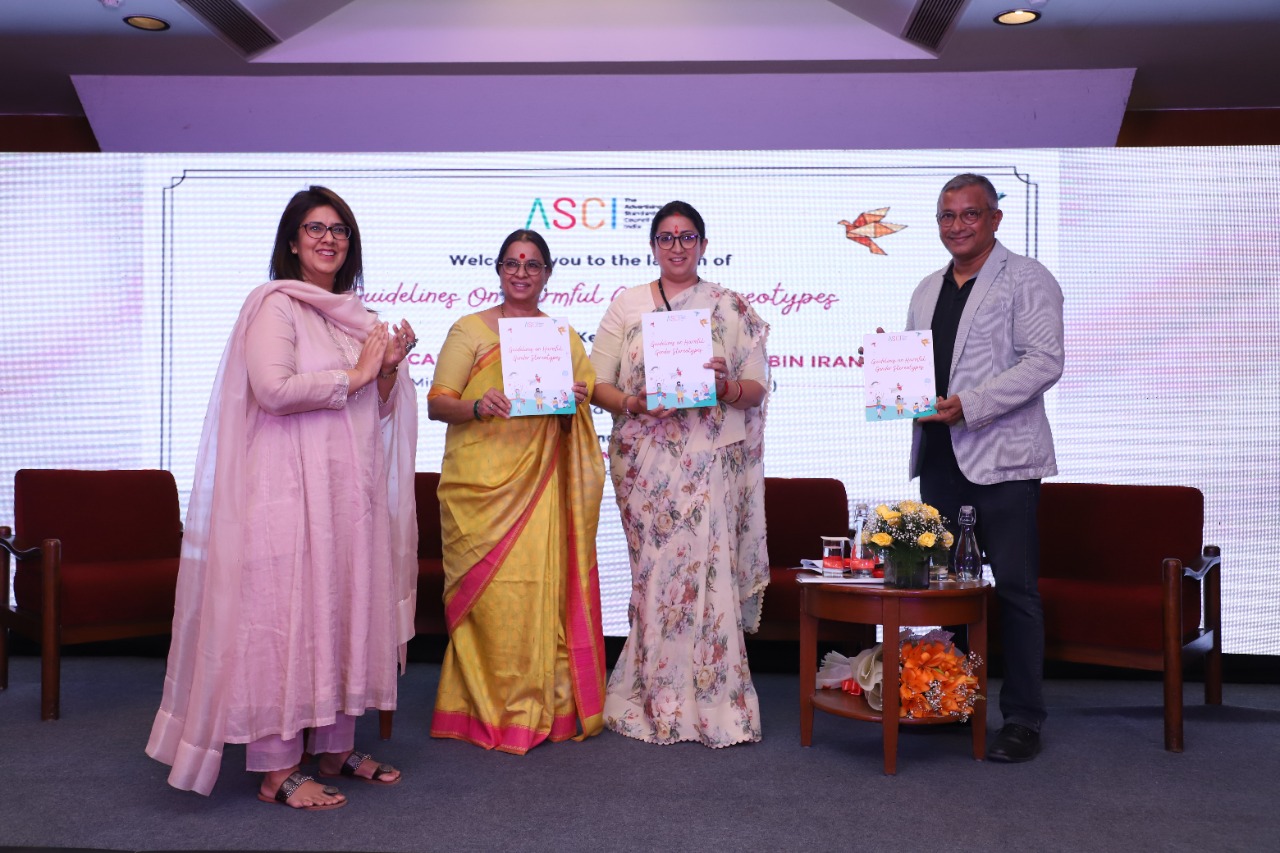
    The Advertising Standards Council of India (ASCI) has followed up the launch of its GenderNext report in October 2021, a study by ASCI and Futurebrands, with the release of guidelines that guard against harmful gender stereotypes. The guidelines were released at an event held in Delhi presided over by Union Minister for Women and Child Development Smriti Irani.


    While the guidelines focus on women, they also provide pointers for depiction of other genders.


    The guidelines, encourage advertisers and creators to deploy the SEA (Self-esteemed – Empowered – Allied) framework that guides stakeholders in imagining as well as evaluating portrayals of gender in their advertising by building empathy and aiding evaluation, as well as the 3S framework, which provides a checklist to guard against tropes and implicit stereotypes that creep into advertising.


    These frameworks can prove to be extremely useful for marketing and advertising professionals to improve their advertising ROIs.


    Speaking at the launch of the guidelines on harmful gender stereotypes, Irani said: “While there are women who are happy with the incremental change that has been made in the advertising industry, women of my generation are a bit more impatient. It is time not only for the men but also for the women in the advertising industry to step up. This is a very important move, and I believe that there is a long journey to be undertaken to turn the thinking but it’s required now. Work in this area must move with more and more speed and organisations like ASCI should lead this, the action beginning with its member base.”


    Added Subhash Kamath, Chairman, ASCI: “The new guidelines were created after extensive consultation with many partners- both from industry, as well as civil society organisations, including the Unstereotype Alliance and UNICEF. These guidelines are a big step forward in strengthening ASCI’s agenda to shape a more responsible and progressive narrative. We are grateful to the government and Shrimati Smriti Irani for supporting these guidelines, and to the many partners who have been with us on this journey.”


    ASCI’s Guidelines on Harmful Gender Stereotypes in advertising:

    Note:

    1. ASCI will consider an ad’s likely impact when taken as a whole and in context.

    2. ASCI will consider stereotypes from the perspective of the group of individuals being stereotyped.

    3. The use of humour or banter is not likely to overcome the underlying issue of such harmful stereotypes.

    4. The guidelines do not intend to prevent ads from featuring:

    5. glamorous, attractive, successful, aspirational or healthy people or lifestyles;

    6. one gender only, including in advertisements for products developed for and aimed at a particular gender;

    7. gender stereotypes as a means to challenge their harmful effects.


    Advertisements must not include gender stereotypes that are likely to cause harm or serious or widespread offence.

    1. While advertisements may feature people undertaking gender-stereotypical roles e.g., a woman cleaning the house or a man going to an office, or displaying gender-stereotypical characteristics, for e.g., a man being assertive or a woman being sensitive to others’ needs, they must not suggest that stereotypical roles or characteristics are:

    :: always uniquely associated with a particular gender;

    :: the only options available to a particular gender; or

    :: never carried out or displayed by another gender(s).

    1.1 Advertisements that are aimed at / depict children may target and feature a specific gender but should not convey that a particular children’s product, pursuit, behaviour, or activity, including choice of play or career, is inappropriate for one or another gender(s). For example, ads suggesting that a boy’s stereotypical personality should be “daring” or that a girl’s stereotypical personality should be “caring”, or someone chiding a boy playing with dolls or girls from jumping around because it is not the typical activity associated with the gender, are likely to be problematic.


    2. While advertisements may feature glamorous and attractive people, they must not suggest that an individual’s happiness or emotional wellbeing depends on conforming to these idealised gender-stereotypical body shapes or physical features.


    3. Advertisements should not mock people for not conforming to gender stereotypes, their sexual orientation or gender identity, including in a context that is intended to be humorous, hyperbolic or exaggerated. For example, an ad may not belittle a man for carrying out stereotypically female roles or tasks or make fun of a same-sex relationship.


    4. Advertisements should not reinforce unrealistic and undesirable gender ideals or expectations. For example, an advertisement must not depict a man with his feet up and family members creating a mess around a home, while a woman is solely responsible for cleaning up the mess, or a woman overly grateful for the man helping her in everyday chores. Similarly, a woman returning from work may not be shown as solely responsible for doing household duties while others around her are at leisure.


    5. An advertisement may not suggest that a person fails to achieve a task specifically because of their gender e.g., a man’s inability to change nappies; or a woman’s inability to park a car.  In categories that usually target a particular gender, care must be taken to not depict condescension towards any other gender or show them as incapable of understanding the product or unable to make decisions. This does not prevent the advertisement from showing these stereotypes as a means to challenge them.


    6. Where an advertisement features a person with a physique or physical characteristics that do not match an ideal stereotype associated with their gender, the advertisement should not imply that their physique or physical characteristics are a significant reason for them not being successful, for example in their romantic, social or professional lives. For example, an ad may not suggest that a man who is short, a woman who is dark, or any individual who is overweight has difficulty finding a job or a partner due to this aspect of their physique.


    7.. Advertisements should not indulge in the sexual objectification of characters of any gender or depict people in a sexualised and objectified way for the purposes of titillating viewers. This would include the use of language or visual treatments in contexts wholly irrelevant to the product.  For example, an online takeaway service featuring an image of a woman wearing lingerie lying back in a provocative pose behind various fast-food items would be considered problematic.  Even though the image may not be sexually explicit, by using a suggestive image of a woman that bears no relevance to the advertised product, the ad would be considered objectifying women by presenting them as sexual objects, and therefore is a gender stereotype that is likely to cause harm.


    8. No gender should be encouraged to exert domination or authority over the other(s) by means of overt or implied threats, actual force or through the use of demeaning language or tone. Advertisements cannot provoke or trivialise violence (physical or emotional), unlawful or anti-social behaviour based on gender. Additionally, advertisements should not encourage or normalise voyeurism, eve-teasing, stalking, emotional or physical harassment or any similar offences. This does not prevent the advertisement from showing these depictions as a means to challenge them.


  • Time to put rules to ensure that no one player dominates the industry: MIB Smriti Irani

    By A Correspondent


    Union Minister for Information & Broadcasting and Textiles Smriti Zubin Irani said that time has come to put laws, ethics and rules into place which will help in balancing the media industry so that one dominant player cannot rule the roost. Inaugurating the 15th Asia Media Summit (AMS) 2018 in New Delhi on Friday, she said that India will have around 969 million internet users by 2021 and Indian media industry looks upon the digital world not only as a challenge but also as an opportunity. How do we attract, retain and develop talent which frees good content from the trappings of revenue needs and brings about a balance in media institutions, the minister asked.


    The 15th Asia Media Summit is being hosted by the Ministry of Information and Broadcasting, Government of India, jointly with the Indian Institute of Mass Communication (IIMC), New Delhi and Broadcast Engineering Consultants India Limited (BECIL), from May 10 to 12, 2018 in New Delhi. The theme of this year’s Summit is ‘Telling Our Stories – Asia and More’, which would encourage regional and bilateral dialogue and cooperation to respond to challenges to the broadcasting sector in the region.


    Giving a perspective of the expanding Indian media industry, Irani said: “India is the fastest growing advertising market expected to touch 10.59 billion US Dollars by the end of 2018 and the mobile spend is estimated to grow to 1.55 billion US Dollars in the year 2018. We have a vibrant media industry which has a direct established impact of Rs 1.35 lakh crore and indirect and induced benefits of Rs 4.5 lakh crore, with close to 4 million people associated with it.”


    The minster expressed hope that the Asia Media Summit will throw up new ideas so that we can look at pathways to strengthen media institutions for a better mankind.


    Earlier, Vineet Jain, MD, Times of India group discussed regulatory reforms for a fair market place that benefits consumers. Talking about data protection, he said that data is being siphoned by global platforms today and we must proactively protect our national interest by ensuring that data stays within India and that it is protected.


    In his welcome address, Sitanshu Kar, DG, PIB talked of India’s strong traditions of storytelling in its 23 major languages and around 720 dialects. He said that due to emerging technologies, we are at the cusp of revolutionary shifts in the way we think and how we tell our stories.


    This is the first time that Asian Media Summit is being held in India.


  • M&E to cross Rs 2tn by 2020: FICCI-EY report


    By A Correspondent


    FICCI-Frames 2018 took off on Sunday evening with I&B Minister Smriti Irani as Chief Guest. As part of the inaugural session, the annual M&E industry report, this time presented by the team at Ernst & Young (EY). The venue this year is the Grand Hyatt in Santacruz East, away from the Renaissance at Powai where Frames has been happening for 16 of the 18 editions.


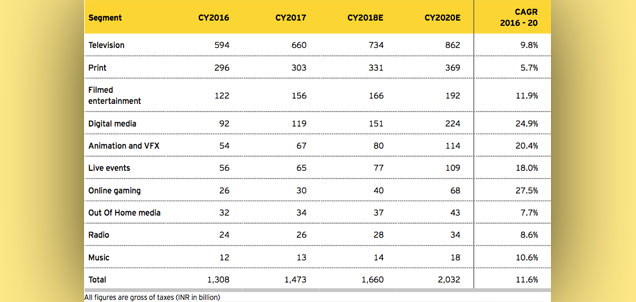
    Back to the report: the Indian Media and Entertainment (M&E) sector reached almost INR1.5 trillion (US$22.7 billion) in 2017, a growth of around 13% over 2016. With its current trajectory, it is expect to cross INR2 trillion (US$31 billion) by 2020, at a CAGR of 11.6%. The digital segment-led growth, demonstrating that advertising budgets are in line with the changing content consumption patterns The  FICC-EY report is appropriately titled ‘Re-imagining India’s M&E sector’ and captures key key insights from the Indian M&E sector.


    The M&E sector continues to grow at a rate faster than the GDP growth rate, reflecting the growing disposable income led by stable economic growth and changing demographics. The report states that subscription growth outpaced advertising growth in 2017 but advertising will continue to grow till 2020 led by digital advertising. The report estimates that approximately 1.5 million consumers in India today are digital only and would not normally use traditional media. It is expected that this customer base will to grow to ~4 million by 2020 generating significant digital subscription revenues of approximately 20 billion. Going forward, micropayments, enabled through the Unified Payment Interface (UPI) and Bharat Interface for Money (BHIM) platforms developed by the National Payments Corporation of India (NPCI) will further accelerate subscription revenues for entertainment content.


    Said Farokh Balsara, Partner and M&E Leader, EY India:  “Indian M&E sector reached INR1.5 trillion in 2017 led by digital. With digital subscribers expected to reach 20 million by 2020, has Indian M&E reached its digital tipping point? We now need to re-imagine the future of  Indian M&E sector.”


    Added Ashish Pherwani, Partner and M&E Advisor Leader, EY India: “Growth in 2017 was led by the digital, film & animation & VFX segments. We expect sectors like digital and gaming to grow between 2 to 3 times by 2020.”


    Key findings

    :: Television:
    The TV industry grew from INR594 billion to INR660 billion in 2017, a growth of 11.2% (9.8% net of taxes). Advertising grew to INR267 billion while distribution grew to INR393 billion. Advertising comprised 40% of revenues, while distribution was 60% of total revenues. At a broadcaster level, however, subscription revenues (including international subscription) made up approximately 28% of revenues.

    Key insights– While advertising is 41% of the total revenues today, the report expects it to grow to 43% by 2020. There are over 30% households in India which are yet to get television screens, but being at the bottom of the pyramid, these households will tend to move towards first towards free and sachet products.


    :: Print:
    Print accounted for the second largest share of the Indian M&E sector, growing at 3% to reach INR303 billion in 2017. Print media is estimated to grow at an overall CAGR of approximately 7% till 2020 with vernacular at 8%-9% and English slightly slower. This growth is expected despite the FDI limit remaining unchanged at 26% and therefore, restricting access to foreign print players and the imposition of GST at 5% on the advertising revenues of the print industry for the first time in history. While magazines contributed 4.3% to the total print segment, the segment was at largely status quo with not many significant new launches in 2017.

    Key insights– Today, 98% of readers read dailies and 20% read magazines. Reader base is 395 million, or 38% of the population. Readership has grown by 110 million over the last 3 years. Rural (52%) reader base is larger than urban (48%). 44% of children (aged 12 to 17 years) read a newspaper or magazine. Magazines have a higher readership in urban areas (57%) as compared to rural areas (43%).


    :: Films:
    The Indian film segment grew 27% in 2017 on the back of box office growth – both domestic and international – coupled with increased revenues from sale of satellite and digital rights. All sub-segments, with the exception of home video grew and the film segment reached INR156 billion in 2017.The Hindi films comprise the majority component of the Indian film segment. They contribute almost 40% of the net domestic box office (BO) collections annually, despite comprising only 17% of the films made. Films in 29 other Indian languages account for approximately 75% of the films released but they contribute approximately 50% to the annual domestic box office collections. Hollywood and international films comprise the balance. The top 50 films contributed approximately 97.75% of the total net box office collection. Box office collections of the top 50 films grew by 11.60% in 2017.

    Key Insights: Regional movies drove the growth in number of releases in 2017. Screen count increased from 9,481 in 2016 to 9,530 in 2017. Number of Hindi movies crossing the INR1 billion mark was highest in 2017 in the past 5 years. From 31 movies in 2016, Hindi dubbed movies increased more than 3 times to 96 in 2017.


    :: Digital media:

    Digital media has grown significantly over the past few years, and continues to lead the growth charts on advertising. Subscription revenues are emerging and are expected to make their presence felt by 2020. In 2017, digital media grew 29.4% (27.8% net of the impact of GST) on the back of a 28.8% growth in advertising and a 50% growth in subscription. Subscription, which was just 3.3% of total digital revenues in 2016, is expected to grow to 9% by 2020.

    Key insights: 250 million people viewed videos online in 2017 and expected to double to 500 million by 2020. Around 40% of total mobile traffic came from the consumption of video services in 2015. This figure is expected to touch 72% by 2020. 93% of time spent on digital videos is in Hindi and other regional languages. OTT subscription in India is expected to touch INR20 billion by 2020.

    M&A in M&E


    The Indian M&E sector witnessed a relatively new trend in deal activity with emerging segments such as gaming and digital gaining momentum, while the deal activity in the traditional media segments was slower. The slowdown can be partially attributed to challenges faced by the advertising segments of the industry due to demonetisation and GST. Overall, the number of transactions in the M&E sector decreased from 56 deals in 2016 to 40 deals in 2017. Further, the total deal value was also lower at US$1,261 million in 2017 compared to US$2,863 million in 2016.


    The entire report can be accessed at here


  • Barkha Dutt to host #WeTheWomen on Dec 9 & 10

    By A Correspondent


    Former NDTV editor and anchor Barkha Dutt will curate a festival titled ‘We The Women’ to be held in Mumbai on December 9 and 10. The festival is being presented by Facebook and UN Women and will be open to both women and men.


    Speakers include Union Ministers Smriti Irani and Harsimrat Badal, Cricket team captain Mithali Raj, Olympic medal winner Sakshi Malik, Corporate leader Roshni Nadar, Lawyer Pallavi Shroff, Hip-Hop sensation from Punjab Ginni Mahi, actor Twinkle Khanna (on a panel with ‘Padman” Arunachalam Muruganantham), Ankhi Das, Director of Public Policy at Facebook, Poonam Muttreja of the Population Foundation of India, Women soldiers of the Indian Army; a pace bowler from Kashmir, the women leading a private aerospace mission to the Moon and an 83 year-old sharpshooter called ‘Revolver Dadi’.Farhan Akhtar, Maati Baani and Ginni Mahi will perform at the festival.


  • Big Night for Marquee-ters!


    By A Correspondent


    There are awards and awards and awards in the marketing services and media domains, but none which are purely for marketing, as against advertising-led marketing. The Advertising Club (TAC) India hosted the inaugural edition of its “Marquee Awards” last Friday with Information & Broadcasting Minister Smriti Irani as Chief Guest. The awards saw brands being recognised for their excellence in marketing, building sustainable and pathbreaking brands.


    Hindustan Unilever won the Green Marketer Award, which honours brands that have been successful by keeping a close focus on environment sustainability. The Special Award for “Conquering an impregnable fortress” was won by beer brand Bira 91. Pro Kabaddi League was recognised as the brand that “Traversed unchartered waters” and Paytm was recognized for “Riding on an emerging wave”.  Honda Motorcycle & Scooter was awarded for “Breathing new life into a category”, Restaurant brad Indian Accent was recognised for “Creating a Global Impact” while Oppo was recognised for “Carving out a Niche” for themselves in a highly competitive category.


    Said the minister for the first time at an M&E event after assuming charge of I&B: “It fills me with a sense of deep gratitude and privilege that I stand here today as the Minister of the Information & Broadcasting. I am what I am today thanks to this industry,” adding: “The advertising industry inspires millions across this nation.  Having been a part of this journey, I have just one appeal this evening – while we sell dreams to the nation and world, there are many amongst us who wither away with the passage of time. All I implore today to the industry stalwarts is that we now, in a systemic fashion, build a platform that takes care of those who need help, specially from the creative faction of the industry, so that the world does not accuse us selling dreams but living a lie.”


    Speaking about the success of the Marquee Awards, Raj Nayak, President, The Advertising Club said: “Marquees 2017 has emerged as the gold standard in marketing awards. I thank the Honorable Minister for Textiles and Information & Broadcasting, Smt. Smriti Irani for gracing the maiden edition of Marquees 2017 as Chief Guest ad enhancing the prestige of the Marquees. I also thank the Jury Chair Sanjiv Mehta and the distinguished Jury for their indulgence and commitment in making the awards robust, transparent & credible.”


    Talking about the scale of Marquees 2017, Partho Dasgupta, CEO, BARC India who headed the Marquees organising committee said: “The debut edition of Marquees has set a new benchmark of excellence by recognising brands that have challenged the communication archetype in the industry, thus appealing to the evolved consumer of today. These awards through their differentiated scope, right from the jury panel to representation to categories has ensured that they are a marketer’s dream.”


    The Awards had News18 India as Presenting Sponsor and was powered by Colors and MTV and was partnered by print consortium One India. Said Avinash Kaul, Managing Director, A+E Networks | TV18 and President – Network18: “We take great pride in associating with the first edition of Marquees, and congratulate the winners. At News18 India we identify with the spirit of celebrating brands that drive positive change.”


    The awards are as below

    S. No

    Category

    Winner

    1

    Durables LG ELECTRONICS

    2

    Auto: 4 Wheelers MARUTI SUZUKI

    3

    Auto: 2 Wheelers Royal Enfield

    5

    Food WAI WAI NOODLES (CG GLOBAL)

    5

    Banking HDFC BANK

    6

    Personal Care LIFEBUOY (HINDUSTAN UNILEVER)

    7

    Insurance LIC

    8

    Telecom Services BHARTI AIRTEL

    9

    Home Care VIM (HINDUSTAN UNILEVER)

    10

    E-Commerce AMAZON INDIA

    11

    Beverages FROOTI (PARLE AGRO)

    12

    Telecom Handset XIAOMI SMARTPHONES
    Special Categories
         

    1

    Breathing new life into a category

    HONDA MOTORCYCLE & SCOOTER

    2

    Creating a global Impact INDIAN ACCENT

    3

    Green Marketer HINDUSTAN LEVER

    4

    Riding on an emerging wave PAYTM

    5

     Carving out a niche OPPO

    6

    Reimagining for the better GOOD EARTH

    7

    Traversing unchartered waters PRO KABADDI LEAGUE

    8

    Conquering an impregnable fortress BIRA 91


  • I&B Minister Smriti Irani to be Chief Guest at Marquees

    By A Correspondent


    The Advertising Club has announced that Textiles and Information & Broadcasting Minister Smriti Irani will be Chief Guest of Honour at the inaugural edition of Marquees 2017 to be held on Friday, August 11 in Mumbai.


    Judged by a panel of industry captains consisting of Jury Chair Sanjiv Mehta,CEO and Managing Director, Hindustan Unilever Limited and other jury members which included Harsh Goenka, Chairman – RPG Enterprises, Naveen Chopra – Ex-COO, Vodafone & Senior Advisor – TPG Capital, Ronnie Screwvala, Co-Founder – UpGrad, Dilip Cherian, Founding Partner – Perfect Relations, Agnello Dias, Chairman & Founder – Taproot India & CVL Srinivas, CEO South Asia – GroupM.


    This is possibly the first major advertising and media industry event that Irani will attend after she took charge of MIB recently.


  • Top 5 Voices Of Sanity in Political Debates


    By Shailesh Kapoor


    The General Elections are finally here. Even as the nation goes to polls, the quality of political debate has hit an all-time low. From Rahul Gandhi’s imbecile answers to vitriolic personal attacks by stray politicians (including one who said he will chop Narendra Modi to pieces) to using the Indian Army to polarise votes, I thought I had seen it all. And then yesterday, Mulayam Singh Yadav decided to make light of gangrape by calling it as a “mistake” young boys could make.


    Expecting a bit of courtesy, intelligence and maturity in political discourse is perhaps asking for too much. Even Narendra Modi’s language comes across as uncouth at times; language that’s certainly not befitting a potential Prime Minister. But if one’s benchmark is a Prime Minister who hardly communicated for 10 years, one should not be too demanding.


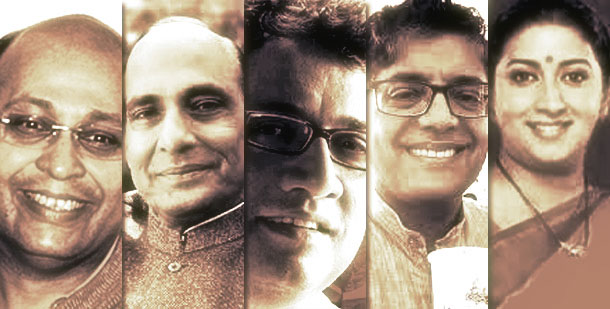
    In the midst of this class-less and even dangerous pitch, some politicians stand out as being the odd ones. Here’s my pick of five politicians who have brought some sanity to the degenerating political debate:


    5. Abhishek Manu Singhvi: It is difficult to pick a Congress talking head who makes sense these days, but Singhvi comes across as the most articulate and well-mannered of the lot. He is no political heavyweight himself, unlike some others on this list. But he communicates well, even in the midst of what are turning out to be by far the roughest elections for his party.


    4. Rajnath Singh: Even as Modi plays to the gallery via the lowbrow route, BJP chief Rajnath Singh has maintained dignity and composure throughout this campaign. He is evidently the back-end man here, keeping the pieces together, while leaving the talking to others. But when he speaks, he makes an impression alright, especially with his clarity of thought. Is there a chance he may be the compromise choice for the top position if NDA falls short by a small margin and other parties give support under the condition that Modi should not be the PM? Let’s wait for May 16.


    3. Derek O’Brien: The quizmaster turned Trinamool Congress leader has the unenviable task of defending the indefensible at times. His party chief Mamata Banerjee suffers from occasional bouts of the foot-in-mouth disease, but O’Brien is now well experienced in handling the mess. He has gift of the gab, and can even be cheekily entertaining at times. I have a feeling we will hear a lot more of him after May 16, as TMC may end up playing a crucial role at the Centre.


    2. Jay Panda: I find the BJD leader by far the most affable face in Indian politics today. He is always soft-spoken and dignified, and never short of deep knowledge and a clear view on the subject matter. Read his Wiki page to know what a model Member of Parliament could be!


    1. Smriti Irani: Throw the ‘actors can’t become serious politicians’ argument out of the window right away. Smriti Irani means business. Having struggled her way up the ranks in BJP, she has now got the exposure and the confidence that will catapult her in to top league soon. Irani is super entertaining too. Her sarcasm can be scathing at times, yet never unreasonably personal. In the true sense, she combines the qualities of a good politician and a good actor. Watch her recent Aap Ki Adalat episode with Rajat Sharma or her chat with Barkha Dutt earlier this week and you are sure to root for her. She is all set to stretch Rahul Gandhi in Amethi. More power to Smriti Irani and her commitment to a political career.