Tag: shruti pushkarna

  • Shruti Pushkarna: Accepting change in an ever-changing world

    By Shruti Pushkarna


    When I was studying journalism, we were made to read three to four newspapers everyday as part of acquiring editorial skills. As a young girl in my early twenties, I would go from one class to another, catching up on the printed word in between breaks. It was almost romantic, the idea of print that is. One aspired to have a ‘byline’ in the reputed dailies.


    But by the time I graduated, a lot had changed. The fascination with print was slowly replaced with 24×7 television news. Not that TV news didn’t exist earlier, but right at the time when I was applying for jobs, several new players entered the market.


    A large part of my initial career was spent in television newsrooms. And then some years later, another shift happened, with digital journalism as the latest entrant in news media.


    The reason I’m laying all this background is actually to highlight the most important thing that was occurring through these years. The values were changing. Values we attached to reporting, production, editing, scripting, everything rapidly transitioning given the advancing technology. Every medium had its pros and cons and content was being tailored to make the most of new platforms.


    Another notable thing happened. Amidst all this change, technology opened up the ‘elite journalism club’ to an average inquisitive mind. Barring the self-aggrandising old school journalist in me (who by the way scoffs at the new generation, like most old gens do), I find myself pleasantly surprised by the mechanisms and devices being used to put out newsworthy content for mass consumption.


    That is the power and nature of technology. It creates a level-playing field. The old versus new kind of debate takes place in every domain. When I transitioned from mainstream media to the development sector, my work in the domain of visual impairment brought many such examples to light.


    People working to rehabilitate persons with blindness are obsessed with the braille script. And that’s the common societal understanding as well. Anyone who is blind needs a braille script. Not true.


    Let me bust a few myths here.


    Every blind person does not know how to read and write using the braille script.


    There are people who acquire blindness at a later age and never get acquainted with braille.


    Braille embossing is time consuming and an expensive effort.


    Writing in braille takes much longer than keying the same content into a computer.


    Braille is useful to interact with fellow visually impaired people who can interpret it. In a mainstream classroom or a work scenario, it is limiting and distances blind people from their sighted counterparts.


    So what is this obsession with braille? It’s the same sense of denial that new technology cannot throw open newer options that may undercut the skills possessed by existing braille users.


    Visually impaired people can easily co-exist in an inclusive environment, given the vast variety of technological aids available today.


    Blind people can use screen reading software that reads out everything displayed on a computer screen or a mobile phone to interact with the device. They can type, browse, read, do almost everything with ease just like you and me.


    So in schools/ colleges, students with vision impairment can submit their assignments in a digital format (anyway most private schools are insistent on the use of technology these days). The government has laid down clear guidelines for reasonable accommodation in case a blind student wants to write exams using computers.


    This also opens up a whole new range of professions for persons with vision impairment. Let’s take the media industry for starters. Not long ago, I’d engaged with a graduate in mass communication from Bengaluru who was applying for a job in radio. There are journalists working in national media who happen to be visually impaired. Disability activists are efficiently using social media to advocate for their rights. Leaving out the very ‘visual’ jobs, many desk roles in the industry can be opened up to blind people simply by adopting technological solutions.


    Braille is ‘exclusive’ in the way it isolates visually impaired people to one medium of communication. Technology however is ‘inclusive’ as it makes the existing platforms of communication accessible to anyone with an impairment.


    It’s time to drop our fixation with a script that was invented in 1821, two centuries ago! No doubt it was a brilliant discovery to serve the needs of people back then, but let’s face it, equally exciting innovations are happening in this day and age. It’s time we embrace technology for its ability to enable access for all users irrespective of their limitations.


    Shruti Pushkarna is a former journalist (part of the founding team of MxMIndia) who has now moved full-time to the social sector. She heads operations of the New Delhi-based Score Foundation where she works as Director-Programmes & Communications. She writes for MxMIndia every other Thursday. Her views here are personal. She can be reached via Twitter at @shrutipushkarna


  • Shruti Pushkarna: Changing the Discourse on Disability

    By Shruti Pushkarna


    It’s 2020. As we cheer for new beginnings, it’s also time to reminisce on the years gone by.


    The last decade witnessed some significant changes in how we look at ‘disability’. When I was still in my twenties (now don’t try to guess my age!), there was hardly any mention of terms like ‘access’ or ‘inclusion’. In fact, the most commonly used term for disabled people was ‘handicapped’.


    Fortunately, we have seen a gradual shift come about in the past few years. Thanks to government campaigns and the latest Rights of Persons with Disabilities Act, newer terms have been added to the general media usage when it comes to disability-related issues.


    Of course awareness levels aren’t the same across media. I still see reports using the word ‘lame’, ‘retarded’, ‘dumb’ etc. That’s more of an oversight due to lack of awareness. It’s ignorance more than ill-intent.


    Clearly, there is a need to sensitise society, so it becomes more welcoming of persons with disabilities. Media can help transform how we perceive disabled people, not as outcastes but as equal citizens.


    Wheelchairs and ramps have been around for some time now and we’ve been exposed to seeing orthopaedically-challenged people in public spaces. But in the last five to six years, society has been introduced to the concept of ‘access’ for people with varied needs.


    Two flagship campaigns of the ruling government — ‘Digital India’ and ‘Accessible India’ — have triggered significant changes in the physical and the virtual space. Access to basic services like hailing a cab, booking movie tickets, catching a flight, making online payments, has become more of a reality compared to the distant dream it was.


    Once these businesses acknowledge their new clientele, they will need to make conscious efforts to cater to this target group. For instance, wheelchair-bound people and persons with vision impairment access movies. It could be in the cinema hall or on online platforms like Netflix, Hotstar, Amazon etc. Content developers and distributors need to recognise their specific needs and include them as part of their overall outreach plans.


    In my experience, changes in the physical environment happen only when attitudinal shifts have been brought about. Media has the power to change the discourse of this and the coming decades.


    Let’s admit it, people turned empathetic towards anyone suffering from autism after ‘My Name is Khan’ and ‘Barfi’. Dyslexia became acceptable after ‘Taare Zameen Par’. Back in the day, movies like ‘Koshish’ and ‘Sparsh’ also introduced people to the challenges of living life with hearing, speech and vision impairment. But the lack of social media in those days limited the impact of such cinema.


    We now have a powerful digital media which can sow the seeds of a new idea and create a tsunami of threads around it in the blink of an eye. End-result: people start talking of things they have otherwise not encountered. Once it reaches dinner-table conversations, objective achieved. So much needs to be done in terms of informing people, sharing data points, helping them form clear opinions, washing away archaic misconceptions. And who better to do this job than our media.


    Today, our society has reached a point where we are questioning almost everything. Our leadership, judiciary, journalism and democracy on a whole seem to be on a shaky ground. I see this as an opportunity to build something new.


    At a time when we are receding towards hatred and intolerance, I see an opportunity for the media to build on empathy for all Indians. The debate on equality has been initiated with the ongoing protests against the Citizenship Amendment Act. There is room for widening the scope of this discussion and integrating all those sections of people who haven’t so far been treated ‘equally’ or ‘fairly’.


    Let this decade denote a fight against all ‘discrimination’ and creation of a ‘New Empathetic India’.


    Shruti Pushkarna is a former journalist (part of the founding team of MxMIndia). who has now moved full-time to the social sector. She heads operations of the New Delhi-based Score Foundation where she works as Director-Programmes & Communications. She writes for MxMIndia every other Thursday. Her views here are personal. She can be reached via Twitter at @shrutipushkarna


  • Shruti Pushkarna: Are there hints of hypocrisy underneath the dissenting voices?

    Shruti PushkarnaBy Shruti Pushkarna


    Yesterday I had a unique experience. Almost 37 years old, I have grown up listening to stories of the India-Pakistan Partition from my paternal grandfather, stories of my maternal grandfather about protesting against the authorities to protect the rights of labourers, and more recently, stories from my father and aunt from their time in prison when they upped their voices against the Emergency imposed by the then Indian Prime Minister, Indira Gandhi.


    However graphic the pictures were in my head as these stories were narrated to me, but never had I experienced anything first-hand. Now before I build up your hopes as a reader for some thrilling piece here, I must confess I was not part of any action. I was just a first-hand witness. Not a listener, a spectator, watching the action live on the ground.


    The entire country is up in arms against the Citizen Amendment Act, recently cleared by the two houses of the Indian Parliament. Protests and slogan shouting everywhere. We have witnessed reports of services being disrupted, internet being withdrawn etc on several occasions from other parts of the country, but yesterday it was the capital of India. Parts of the Delhi city had internet, voice and SMS services withdrawn by network providers, on a directive issued by the government. This was a first for us. Access to media thwarted. How can the political capital of the country, the news hub of India, witness such a media blackout at the behest of politicians’ will? Are we assuming that if I’m unable to share my views using social media or develop an opinion based on others’ experiences being posted on media platforms, my voice can be drowned? We all assumed we were living in a fortress, untouched by common man’s woes. But yesterday these assumptions came crumbling down in the face of dissenting voices dissing the arrogant ruling class.


    When I left home yesterday morning, it was a regular working day for me. Taking a one-hour cab ride to my office in South Delhi, getting through meetings, meeting deadlines and so on. And then the news alerts started to pour in. One after the other. Roads blocked, police barricades, long winding traffic jams, metro stations being closed down, Section 144 imposed in pockets of Central Delhi. News bits went from bad to worse. I stepped out for a cup of coffee in my lunch break and saw CISF troops being rushed into the metro station nearby (same one I access to travel home daily). And it all came alive. Offices started to close down, parking lots started to clear up, people started to rush back homewards.


    As I took the Delhi metro back home (taking the roads was a bad option because of the violence on the streets), I looked around at my fellow commuters. Some were responding to phone calls from worried loved ones. Some were watching the news on their mobiles struggling with the sketchy mobile data. Some were watching right wing videos loudly on their phones, telling others around them that India is a Hindu sovereign. This last set of people actually broke out into shrieks of “Bharat Mata ki Jai” on the train. Some scared travellers looked away. Confused ones simple stared. A third category of people like me, not confused or scared, simple outraged, looked at them in disgust.


    A train journey is not the place to voice your opinion in an unruly manner. A train journey at that, where most stations were shut and people couldn’t wilfully deboard at their desired destinations. Also I doubt how much of the so-called ‘Bharatvarsha’ sentiment do these people embrace when it comes to other issues crippling the country.


    I for one work towards getting persons with disabilities an equal status as citizens of India. Will the same people stand by me, and fight for rights of this minority section tomorrow? I don’t think so.


    Will the same people offer food to the cook, driver or maid working tirelessly for their families? I don’t think so.


    When I go to a restaurant in Delhi, I see the same ‘protesting’ lot of people enjoying their dinner and drinks as their children’s nannies look from a distance. The nannies who are feeding their babies are not allowed on the same table, not offered the same food.


    I respect equality for everyone. I standby each religious group and their rights. But I also respect other vulnerable groups in their fight for rights. And I practise that respect in my day-to-day actions as much as I would do if I were at Jantar Mantar tomorrow.


    Let’s not be hypocrites ourselves when we accuse our leaders of the same. Would the same people hurl stones at the authorities if tomorrow a person with disability seeks equal employment or education rights? Will their children be told not to isolate disabled students in their classroom?


    If we talk of an equal India, then I must confess we are so far away from it. So who are we kidding.


    Shruti Pushkarna is a former journalist (part of the founding team of MxMIndia). who has now moved full-time to the social sector. She heads operations of New Delhi-based Score Foundation where she works as Director. Her views here are personal. She can be reached via Twitter at @shrutipushkarna


  • Disability: What Must Our Media Do


    By Shruti Pushkarna


    Shruti PushkarnaBefore I started writing this piece, I casually googled  ‘media and disability’. Interestingly, most results were pertaining to the role of the media, portrayal of disability, some academic papers on the subject and so on. Well, that’s typically what comes to mind when you throw these two words together at anyone.


    Having crossed over to the disability sector from journalism, I have witnessed several debates (both in official and informal settings) where disability experts, people with acquired disability, scholars and mediapersons battle with each other, presenting their views on the subject.


    Again, most debates are focused on ‘representation’. I find the premise of all such discussions fallacious. Our debates, writings, films, stories, all are from an ‘external’ standpoint. It’s always from ‘how I understand it’, or ‘how I perceive it’ or ‘what I have gathered from my research’. And that’s why any coverage or any engagement with disability in the media is at the surface level. Still.


    This is part of the reason why stories and accounts are either heroic or pitiful. What I see lacking is the ‘normalisation’ of the idea. We like to compartmentalise issues and people into boxes that are easier to handle. Look at them a certain way rather than making them a part of the overall landscape of things.


    In the process, someone else decides what is the issue, how does it impact a life and how it should be tackled. The understanding of it, once or twice removed.


    As a communications specialist, I recognise the influencing power of the media and the fraternity. Common notions of disability arise from our media exposure. The images and words that come to mind are ‘wheel chair’, ‘crippled’, ‘handicap’, ‘dependent’, ‘incapacitated’, ‘vegetable’ etc. Clearly, these are neither complete nor correct.


    Let’s try to break this down. ‘Disability’ is basically a condition that ‘limits’ a person. This condition could be mental or physical, it could be permanent or temporary. It could be a condition present from birth or acquired later in life. But it’s a ‘condition’. A person with disability is a person with certain limitations, but still a ‘person’. That’s what we often miss out on. We tend to focus on the disability so much that we seldom learn anything about the person. The person may be educated or a school dropout, interested in adventure sports or music, may be a foodie, or a movie buff.


    How often do you see a person with disability invited to a public forum to present views on anything other than disability issues? What about the regular issues that affect citizens of this country, like infrastructure, climate change, taxes, education, unemployment or inflation?  Do these not equally affect this section of society? Or are we assuming that disabled people don’t access any services, like you and I do.


    According to Census 2011, 2.2 per cent of India’s (then) 121 crore population is disabled. And these are government statistics, way less than the actual numbers. There is a legislation called the Rights of Persons with Disabilities Act (RPWD) 2016 that lists out 21 types of disabilities. The RPWD Act mandates equal access to all facilities and services to persons with disabilities. The Act is progressive in its view of shifting the focus from ‘reservations and entitlements’ to ‘empowerment and inclusion’.


    A policy can be enforced and implemented. But for it to become a ‘practice’, mindsets have to be altered. That’s what media can help with.


    Attitudes can often be more disabling rather than the actual barriers in access. I have worn spectacles since Class 2 or 3, I don’t even remember. My inability to see without glasses is also a ‘disability’. But spectacles can cover up for my impairment. Kids in my school use to single me out and poke fun at my thick glasses but with time, it changed. Slowly, with more people dependent on correctional lenses, it became ‘normal’ (it’s a full-blown market today!).


    It’s what we see and how much of it we see. If today in schools and workplaces, we start encountering persons with vision impairment, speech impairment, or any other disability, that will gradually become the new normal.


    Certain sectors like IT, hospitality and education have started employing persons with disabilities. Their limitations are easily addressed with small changes in the physical or digital environment. This has helped businesses understand the needs of the larger disabled population better. The media should also consider hiring them, so the ‘normalisation’ of disability can happen from within.


    This will change how people respond to ‘disability’. The element of shock or awe will slowly be replaced by a more pragmatic approach.


    Today, when I go to a movie theatre, I’m happy to see seats reserved for people in wheelchairs. But the access to the cinema still remains an issue. On several occasions, I have seen wheelchair-bound people being physically lifted by four staff members to get  them to a seat just so they can access mainstream entertainment.


    If it were easily ‘accessible’, more people in wheelchairs would be seen at the movies. Last year, I attended a special screening of the film ‘Sanju’ at PVR Cinemas in Delhi, for blind and visually impaired people. Wondering how blind people can see a movie? Well, they do. Often accompanied by sighted people who can help them follow the missing links in the absence of dialogues. Technology has reduced that dependence too. An app called XL Cinema, free to download on an Android phone, can enable a blind person to follow ‘audio description’ of the movie alongside the actual screening.


    There is the issue of access and then the issue of dignity. The industry needs to address both. And that will happen when we deal with them as ‘people’ and not as a mere ‘section with special needs’.


    According to Census 2011, there are around 104 million people aged 60 years or above. This group of people may also fall into the bracket of ‘people with special needs’. Similarly, with a sizeable percentage of disabilities caused by road accidents, India’s overall disabled population is constantly on the rise. We cannot ignore or outcast them.


    Often our imagination is curtailed because of their lack of participation in mainstream activities and spaces. Their absence leads to a confined view, further forcing them to live on the peripheries.


    This year, the theme of the International Day of Persons with Disabilities is to promote their participation in the development agenda. The UN-defined Agenda 2030 for Sustainable Development pledges on ‘leaving no one behind’. The media needs to look at ‘disability’ as a cross-cutting issue and promote inclusion in every sphere.


    Shruti Pushkarna is a former journalist (part of the founding team of MxMIndia). who has now moved full-time to the social sector. She heads operations of the New Delhi-based Score Foundation where she works as Director. Her views here are personal. She can be reached via Twitter at @shrutipushkarna


  • First Person Team accounts by: Alok Kapuria, Tuhina Anand, Vidya Heble, Johnson Napier, Shruti Pushkarna, Ananya Saha, Meghna Sharma, Akash Raha, Robin Thomas, Shubhangi Mehta, Insiyah Rangwala, Rafiq Barak & Kishor Kate

    While some of those who were part of our founding team have moved on, we value their contribution in helping MxMIndia attain the success that it has.  Presenting Team MxM accounts on ‘The Year That Was’:


    Alok Kapuria: A superb innings

    We have been able to achieve what we aspired to, and that is gaining editorial trust and respect from everyone from the industry. All one needs is clarity of thought. I feel proud to say that we at MxMIndia have managed to keep our environment clutter- and confusion-free.

    http://www.mxmindia.com/?p=30606


    Tuhina Anand: Giving something more… &more!

    MxMIndia has always been about pushing boundaries, it’s about giving an edge to our coverage, knowing that when people will read the same stories on different media the next day, they will realize that we have gone that extra mile to give our readers something more meaningful.

    http://www.mxmindia.com/?p=30623


    Vidya Heble: A year of living excitingly

    Getting the story, ensuring it is accurate, telling it well… we do it all in a sort of measured frenzy, and though we have moments when we think we’re going to fall short, it somehow all comes together

    http://www.mxmindia.com/?p=30624


    Johnson Napier: Daring to dream

    Though it has turned a year old now, MxMIndia’s story is one that could easily be referenced by aspirers or businessmen as a model to go by when launching a venture of a similar kind in future.

    http://www.mxmindia.com/?p=30609


    Shruti Pushkarna: A year of learning happily

    When I look back now, I can say I got a chance to do a lot of other stuff that I wouldn’t have done in my conventional role as a TV producer. But back then, the first time I was writing and reporting a story, the idea seemed ridiculous!

    http://www.mxmindia.com/?p=30627


    Ananya Saha: Short but sweet

    I have not been a part of this journey for long, but it looks promising. It has been a good month chasing crazy stories, always-tied-up in-meeting people, and just-do-or-die deadlines.

    http://www.mxmindia.com/?p=30607


    Meghna Sharma: Happy to be here

    We are small team; some work from home; but somehow, the office never feels empty. We discuss work, industry trends and ideas. And of course, have our share of fun too. Who doesn’t love a little office gossip?.

    http://www.mxmindia.com/?p=30625


    Akash Raha: Being different

    What makes me proud is when I see a media house reports fearlessly on issues. There are obvious disadvantages of doing that. Losing friends in the industry is one, and if I may, even losing an advertiser.

    http://www.mxmindia.com/?p=30690


    Robin Thomas: The journey has just begun

    Despite the tough competition in the market, brand MxM has already created positive vibes, not just among the media industry but also with advertisers and agencies.

    http://www.mxmindia.com/?p=30626


    Shubhangi Mehta: MxM’emoirs: An experimental voyage

    The admirable element of working with MxMIndia has been that whether one is a beginner looking to express one’s own voice or someone experienced looking for inspiration, there has been room for it all.

    http://www.mxmindia.com/?p=30628


    Insiyah Rangwala: Breaking through the comfort zone

    MxM for me personally has been a great experience. It has been a fantastic stepping stone in the media field, as well as just a great place to start one’s working life.

    http://www.mxmindia.com/?p=30608


    Rafiq Barak: Getting the picture

    Of all the tasks, the one that is the most challenging but also fruitful for me is preparing imagery for the Big Story.

    http://www.mxmindia.com/?p=30629


    Kishor Kate: High on feel-good factor

    One of the best things about working with MxMIndia is the fact that I am constantly learning new things, and the exposure it offers me to various multinational companies and big media houses, many that I have only heard about.

    http://www.mxmindia.com/?p=30610

  • Are we Duhs in Digital Media?


    By Tuhina Anand and Shruti Pushkarna


    India has once again drawn a blank in the Cyber Lions category at Cannes 2012. From the 27 entries from India in this category, none made it to the shortlist. Considering that digital is the talk at all industry forum and the future, or is it actually the present, of advertising, its dismal performance at Cannes makes one realize that India is still miles behind on this medium.


    Nagesh Alai

    Nagesh Alai, Executive Director – India Operations at DraftFCB Group, pointed out: “It is not surprising not seeing a shortlist in the Cyber Lions from our shores. Most in our industry continue to see and use Digital as a ‘medium of messaging’ instead of seeing and using Digital as a ‘medium to engage with and start a conversation about the brand’. It is a classic case of getting stuck in hoary mindsets of a 30-second TV commercial. The day our digital specialists get out of this mindset, I reckon one will see a sea change in the digital executions and becoming award worthy. I am sure we will see that happen in the not too distant a future.”


    Talking about the digital in India, Carlton D’Silva, Chief Creative Officer, Hungama Digital Services Pvt. Ltd, said: “As I have mentioned in the past, the standard of good digital work in India to compete at the Cannes can only be made possible if the playing fields are even.”


    He listed the factors that go against good digital creative work, which remain remains the same – the inability to acquire the requisite budget for a digital campaign, the lack of time and the lack of risk taking (both from the client as well as agency side) the digital medium is still used more for its effectiveness than creativity.


    A senior mobility and digital media executive with a leading media agency felt that India’s performance in Cannes Digital categories should at least have some positive side-effects. “Why this happened? If I have to sum up in short, it is because of lack of respect for the Digital medium, which comes from ignorance about the medium and its possibilities; lack of budgets, which comes from lack of respect for the medium; lack of creative talent, which stems from lack of budgets,” she added.


    The executive explained that there is a need for a reality check on how evolved the consumers, marketers and agencies are, as compared to Cannes shortlisted entries or winners. “Look at the short-listed entries for Cyber Lions, they come from countries which have more than 75% internet penetration, while we are celebrating our 10% mark. Of course, one can argue that the population of these countries is lesser than some of our states but one also needs to understand that their consumers are also much more evolved. Again, take a look at the Mobile Lions winners, what do you see? Smart phones and Tablets! In our country Voice is the most penetrated medium on Mobile and we have 21 million smartphones in a mobile subscriber base of 900 million plus. If rich media creatives are the tickets to Lions, I would rather design mobile campaigns that work in Indian eco-system and bring value to advertisers in terms of media effectiveness,” she said.


    Vikas Tandon

    Giving his take on India’s performance in this category, Vikas Tandon, Founder and Managing Director, Indigo Consulting said: “To start with, I think we should recognise that Cannes is as big as it gets, the competition is really tough with hundreds of entries from all over the world, so there is no shame in not winning. We must keep learning from the experiences and pegging away at it. Let’s not write off the Indian team because we lost one tournament. But, definitely it must serve as a reminder that we need to commit ourselves a lot more to Digital than we are now. Among Indian marketers, it is still not as important/critical a piece in the marketing game plan as it is in many other countries and hence, while it seems to get some attention, it just does not get the time or budgets. One of the most frustrating challenges that digital agency invariably have to encounter in India is lack of execution time. Once you have an idea/construct, and even detailing it takes time. Execution is, of course, equally critical for success, and the time constraints often do not allow an idea to reach its full potential.


    So one thing has clearly come out from this, is that for Indian marketers, digital is an after-thought and not still a critical medium.


    Naresh Gupta

    Naresh Gupta, Managing Partner, Bang in the Middle when asked on what ails Indian digital advertising said that he would rather look from the perspective of why the Indian digital advertising is not growing up. Giving his take, he pointed out four aspects: “The digital advertising in India is stuck in a time wrap. The traditional method of advertising is about creating awareness, to generate Interest that creates desires that leads to action. More often than not, digital campaigns are built around the same parameter. Digital behaviour is really about search and share, and that is a paradigm that marketers haven’t been able to factor in. This is part of the reason why campaigns neither aid search, nor motivate share.”


    Mr Gupta also mentioned that Digital engagement has been reduced to a Facebook page and a Twitter handle: “I am not saying they are not important, they are, but they are just the tools. For a lot of brands getting the followers or number of likes becomes the strategy. Now that’s not really smart. The brands have to have a strategy for social media.”


    His third points is that the TV-led thinking for brands where an idea is crafted for TV and then adapted to digital is actually the biggest problem. Consider this, all marketing theories were written before the advent of Internet. The need to position, the need to leverage a singular attribute and build on one are all fine with TV-centric thinking, but not so for ‘word of mouse’-centric thinking. The digital medium has its own dynamics and needs a different take. The strategic thinking that leads to ATL idea needs to be interpreted keeping digital dynamics in mind.


    And lastly: “Most importantly, the brand owners need to recognize the importance of digital and craft the entire strategy accordingly. The brand owners too fret to get their TV brief right, but rarely debate to get their digital idea right.”


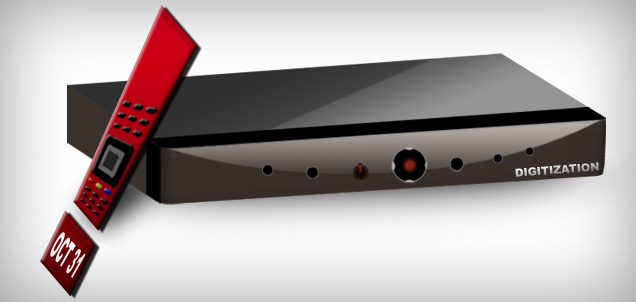
  • Can we achieve the October 31 deadline?


    By Shruti Pushkarna


    Under mounting pressure from various stakeholders, the government announced an extension of four months for the first phase of digitization of cable television. Digital Addressable System (DAS) will now be effective from November 1 in the four metros, Delhi, Chennai, Kolkata and Mumbai.


    A press release issued by the I&B Ministry read: “The Cable Television Networks (Regulation) Amendment Act, 2011 has made it mandatory for switchover of the existing analogue Cable TV networks to Digital Addressable System (DAS) by December 2014, in a phased manner. In respect of four metros of Delhi, Mumbai, Kolkata and Chennai, the digital switchover is mandated to be completed by 30th June 2012.”


    But towards the end in the press note, the ministry acknowledged that keeping ground realities in mind, the MIB is compelled to set a new deadline. The statement reads, “…keeping in view public interest and after intensive and extensive consultations, as well as written commitments from all the stakeholders, for fully implementing the regulations of TRAI, the Ministry of Information & Broadcasting has decided to modify the 30th June deadline for a complete switch over to 31st October 2012 for all four Metro Cities i.e Delhi, Mumbai, Chennai and Kolkata. All the TRAI regulations for DAS will come into effect from 1st November, 2012.”


    The extension was announced notwithstanding the pending matters before the Delhi and Bombay High Courts and the TDSAT. The Bombay High Court will hear the petition on June 21 and the Delhi High Court will hear the matter on June 25, which is also the date when TDSAT will hear a similar matter filed by LCOs and IndusInd Media & Communications Ltd.


    Soon after the announcement of the new sunset date, MxMIndia spoke to various stakeholders to get their reactions on the new timeline and to find out if October 31 is an achievable deadline. While some welcomed the government’s decision for postponement to November 1, others felt that the extension issued by the ministry is not enough for the humongous task at hand.


    MSOs welcome the govt’s decision, though some still unsure of achieving the deadline

    Ashok Mansukhani

    Ashok Mansukhani, Director, IndusInd Media & Communications Ltd said: “I think it’s a sensible development and it will help in smooth transition to digitization. The new date is completely achievable, it was fully discussed in the taskforce. I don’t know about Tamil Nadu since the government there is supposed to install the set top boxes but for the other three metros, certainly it will happen. It’s a welcome step and it was fully discussed in the taskforce and it’s a natural result of the taskforce deliberation.”


    JS Kohli, CEO, Digicable said: “We are happy with the postponement. Although it’s not a six month extension but yes we can deliver on the new date. We are satisfied with the extension.”


    JS Kohli

    Ravi Gupta, Independent MSO, Delhi said: “The new sunset date is good although it is two months less than what we were expecting. They should have given a six months extension, I still don’t think we can achieve the task by November 1. A lot of digital headends are under installation and integration is what takes time. I don’t think anyone from the ministry has done a detailed study of this process. No senior official from the ministry or from the TRAI has visited a digital headend. A minimum of six months extension should have come.”


    LCOs happy with the extension but feel four months not enough

    MR Srinivasan, General Secretary, Chennai Metro Cable TV Operators Association said: “It is good in a way because we are not yet ready because in Chennai only 2 lakh boxes are available. But now atleast we have some breathing time. Moreover, the government of Tamil Nadu is planning to start some MSO operation in Chennai, so it’s some relief and we have some time to plan ahead and be ready before the sunset date. Actually we expected an extension upto December but atleast we have got a slight relief, something is better than nothing.”


    Sanjay McGee, Local Cable Operator, East Delhi said: “Although it’s a good decision, in the last meeting between LCOs and I&B Ministry, Rajiv Takru agreed that four months extension was not enough. At first the ministry refused any extension, but when we urged on atleast three months extension, Rajiv Takru stated that if there has to be an extension then take atleast six months. But they have taken a middle path and decided on four months. They shouldn’t have announced the extension at this point, they should have waited till June 29. Now the consumer will not take the deadline seriously and the pace will slow down. If we keep working at the same pace as of today, then we might be able to achieve the new deadline.”


    Swapan Chowdhury, General Secretary, Cable & Broadband Operators’ Welfare Association, Kolkata said: “I am not satisfied because four months will not cover up the whole situation. Government might have given an extension but they have not considered any facts and figures. I say that because 70 per cent in Kolkata still don’t have set top boxes (STBs), so four months are not enough for deployment of such a huge number of STBs. It will not even happen on November 1. Maybe another 20 or 30 per cent seeding will be done up till the new date but what about the remaining numbers. In the June 8 meeting with the I&B Minister it was categorically mentioned that none of the government appointed nodal officers have checked the actual seeding position or the status of ordered material. Unless and until the government studies the ground situation deeply it will again fall back. The actual facts are different from what’s being presented on paper. They should have given an extension upto atleast Jan 1.”


    Broadcasters disappointed with the postponement, suggest on strict penalties for those who don’t adhere to the timelines

    Sunil Lulla

    Sunil Lulla, Managing Director & CEO, Times Television Network said: “It’s a complete disappointment. What is the guarantee that the new date will be held, when there is a date set by law, why should the date be changed? A lot of time, money and effort has gone by broadcasters in promoting and communicating the date and making sure consumers went along. The industry and the consumer suffers because there are some parts of the entire constituent which may not have adhered to these deadlines, may not have implemented the seeding of the boxes. This was announced on the net through a press release, the government hasn’t really notified us. I think it would have made sense for them to invite all stakeholders and agree on a new date if there was to be one and to a process by which these date wont slip.”


    Rahul Sood

    Rahul Sood, Head- Network Distribution & Affiliate Sales, NDTV said: “Basically LCOs were pushing for a Jan 1 timeline and broadcasters were saying that if you have to give an extension, it should be only for three months. So I guess they have taken a middle path by extending it upto October 31. The TRAI guidelines which came out on April 30 were such that within six months there has to be implementation of the same. I think that’s the loophole that MSOs and LCOs were quoting and asking for a minimum six months extension. So keeping all that in mind, I think ministry has taken this step. But if as an industry we have this discussion again on October 20, then it’s a real shame. There should be no excuses now, timelines have been extended, now there has to be a joint willingness to from all stakeholders to make sure this happens. While they have issued this date change, I think with that strict penalties and penalization code should be put in place as well for those who don’t adhere to the new timelines.”


    An independent commentator says new sunset date ill-conceived

    Dinyar Contractor

    Dinyar Contractor, Editor and Executive Publisher, Satellite and Cable TV Magazine said: “This is not going to work, this date is ill-conceived. There is no way that set top boxes can be procured and deployed in that timeframe even if the order is released today. As I’ve mentioned earlier, delivery time on set top boxes alone is around four months so this extension makes no sense except postponing one more extension. Any date prior to end of December is not realistic and is not going to resolve the problems or the issue, which is obtaining and deploying set top boxes. So I feel that the extension is inappropriate.”


  • Times Internet acquires stake in logistics co

    In a move towards enriching customer experience and delivering quality service, Times Internet has invested in New Delhi-based logistics company, Delhivery to step up its last mile delivery for Indiatimes Shopping. Speaking to MxMIndia’s Shruti Pushkarna, Mr Gautam Sinha, Director- Technology & e-Commerce, Times Internet Ltd said that this acquisition is done to boost the delivery capabilities of the e-commerce vertical. He said: “After pivoting from a marketplace to a retailer model, we had to strengthen our warehouse network and last mile delivery. Some e-commerce companies in India are doing this by launching their own courier network, but that requires time to scale, hence we have decided to take the acquisition route.” Currently Indiatimes Shopping has Fedex, Bluedart, ASL and Aramex as its logistics partners.


    Gautam Sinha joined the Times Group in 2007 as CTO, and is heading e-Commerce as well. He leads and drives the technology strategy, vision and execution for all the internet, mobile and telecommunication properties of the group. He has over 24 years of rich experience in technology innovation and execution, which includes a wealth of startup and industry expertise. Most recently, Mr Sinha was the COO/CTO of CashEdge Inc, where he worked since 2001 building and leading the company from startup to profitability.


    Mr Gautam Sinha spoke about the recent investment in Delhivery given the importance of logistics and the focus area for TIL’s e-commerce business.


    Can you throw some light on the strategic investment you are making in a logistics company?

    Logistics is the key to any e-commerce player and there are multiple approaches a business can take. One is to build your own logistics company. Another approach is to work with third party partners, which we have been doing so far, and have strategic tie ups with one or more such partners. The third case is what we have done. Understanding the importance of logistics, we invested in a company which can have very tightly coupled systems and processes with us to make it work as if it’s your own company in-house logistics. That’s the reason why we invested in Delhivery. And this is just first of the series of investments and we are actually looking at multiple such investments.


    Why this investment in logistics? Wouldn’t it better to outsource it?

    We continue to outsource, so even with the investment, we are still outsourcing. They will execute the orders as an independent company.


    How is Times Internet’s e-commerce doing?

    We are doing very well. The growth has been on target and as per plan. We expect to grow another 100 per cent this year in terms of business. And we will be a credible player in this space. We used to be in the marketplace model, and we are pivoted to the e-commerce model, where we own the entire experience, right from warehousing to last mile delivery is owned by Indiatimes Shopping. Previously, this part of the experience was owned by the suppliers, which were on our platform; now we do end to end experience management for every business that we do.


    There have been several e-commerce players that have come up in the last few years… especially in the lifestyle segment?

    Indiatimes is a horizontal player. Our primary focus, as of today, is in the electronics, mobiles, computers, cameras, movies, music, books and games. The other category we are interested in is gifts. Although it’s true that a lot of players have come up in the fashion category recently, we don’t see a lot of impact on the business because of fashion as an industry.


    Deals sites have been doing very well, as also classified sites like Olx, Quickr and so on?

    They will continue to do well because there are a lot of people who are in the market for second hand products because of the price advantage. So Olx is a good place for buying used products. But if you talk of deal sites, they are typically in the services space, and only recently, a lot of them have started using products in terms of deals. For example, Snapdeal and Mydala are using more products in the deals space, but primarily they have been in the services space like spas, restaurants and so on.


    Given the current environment, what are the steps you are taking to shore up revenues?

    I think the market is growing at 60 per cent atleast and certain players are growing at 100 per cent or more. And the growth of the market is because of a lot of people converting from offline to online, the growing penetration of internet and the improved ability to brand yourself and deliver quality services. The first two are functions of the market, so our focus is on getting the repeat customers, so that the lifetime value of a customer is realized with the platform. So using that, we expect to grow at 100 per cent this year as well.


    If you look at the revenue pie of TIL, how much of it is brought in by e-commerce?

    See I can’t share this information, but I can tell you that e-commerce as a business is a focus area for TIL. We have put increased focus on it and that’s the reason you’ll see investments made by TIL in e-commerce in other players which are contributory to the ecosystem in the way we play in. So for example, Flipkart went ahead and built their own logistics network, we chose to invest, Snapdeal doesn’t want to do either, they want to outsource. For us, outsourcing but having a strategic relation was the right way to move forward. And we want to do it with more and more such companies so we can strengthen the ecosystem in which we play.


  • Can JWT create digital Hungama with stake buy?


    MxMIndia spoke to a cross-section of media professionals to elicit their views on the JWT Singapore acquisition of a majority stake in Hungama Digital Services


    Hungama’s telecom business is intact


    By A Correspondent


    Make no mistake. Hungama hasn’t sold out. Of the 1000+ employees, only 120 will be off to the new company which will only be 51 percent owned by JWT Singapore. And the key telecom business is intact, as are various others.


    When on Wednesday, leading advertising agency JWT confirmed its acquisition of a majority stake in Hungama Digital Services, the digital and promotions marketing division of Hungama Digital Media Entertainment. The size of the deal is not known, though the digital services division is said to have aggregated a turnover of Rs50 crore last fiscal. WPP reportedly earns revenues of over Rs 2500 crore from India and Hungama earned around Rs 450 crore last fiscal.


    The new entity which will be called Hungama Digital Services Pvt. Ltd.will be a full-service digital agency specializing in digital marketing and social media solutions. As part of the acquisition, Hungama’s activations arm, Hungama Promo Marketing will become a part of Hungama Digital Services Pvt. Ltd. and provide an engagement platform linked to online and offline deliveries.


    However, it is not known who from the existing team at Hungama Digital Media would move to the jv. “We haven’t received the new org structure,” a Hungama spokesperson told MxMIndia.


    Said Neeraj Roy, MD and CEO, Hungama Digital Media Entertainment, “With JWT, we are now part of the largest advertising network in the world. Hungama Digital Services is the coming together of two exceptional teams in a globally relevant market.” “With this partnership with JWT we hope to offer integrated digital and experiential services to our clients and prepare brands to connect, interact and now transact with their customers.”


    Hungama Digital Services has been a dominant player in the digital space for 13 years and is spread across six cities in India. In fact the creative services devision is what Hungama started out with over a decade back. The 120-strong team will continue to drive the agency, including servicing old and new clients and offer creative and promo marketing services, viral marketing campaigns, social media marketing and mobile marketing, applications, managing websites and video services.


    For JWT, it’s a good acquisition, an insider told MxMIndia. Said Colvyn Harris, JWT India CEO: “Digital is our next new frontier.The idea of the partnership is to build a digital offering for our clients so we can live up to being a ‘single source’ partner across all their ‘marketing solutions’ needs. What will be most effective in the future is a new set of talented, digital high end specialists who will add new skills and capabilities to what JWT already offers to its clients. We want all our clients to be leaders in their respective categories.”


    “We have greatly expanded our digital capability across the region, and we are not standing still. JWT will continue to hire new digital experts and explore possible acquisitions across the region this year,” said Michael Maedel, President, JWT Asia Pacific.


    See earlier report: JWT acquires 51% stake in Hungama Digital

    Raghav Anand, Segment Leader-Digital, Ernst & Young (The observer and often advisor)

    Raghav Anand

    I think Digital is an extension that every creative arm should have, but the real efficiency comes from how well it is syndicated with the overall collusion. Most of the agencies which have bought digital companies have not been able to integrate them into the overall setup, and hence not been able to leverage the synergy. So, how well you integrate and leverage the synergies will really decide whether it’s a fantastic acquisition or not. Apart from that, the other important things is that companies like Hungama are not just agencies, they are more of digital workflow companies which do a lot more than advertising and creative. They integrate into mobile and few other things. So it’s important for an agency to fully leverage them.


    Arvind Sharma, Chairman of the Indian Subcontinent, Leo Burnett (He recently acquired Indigo, a digital agency)

    Arvind Sharma

    Setting up an outfit from scratch has its own merit as you don’t have to pay a hefty acquisition price. However, I think this is a chicken and egg situation as the challenge is that when starting from scratch, you lack the scale and expertise in the beginning which is a handicap when attracting talent or meeting the needs of a client. You get stuck in sub-optimal size and scale. Particularly in Digital, one needs technical expertise and should be armed with a suite of capabilities to meet the clients’ demand. Therefore, it makes sense to acquire an agency of 150-plus people who are specialists, especially in the digital category which is witnessing a lot of interest from clients too. It immediately gives you scale and expertise. Also today clients want gamut of services under digital. They are not looking for few pieces of digital work; hence having an in-house digital agency helps in delivering.


    Mahendra Swarup, Former CEO, Indiatimes, Chairman, Smile Interactive (He’s worked with Pepsico, Indiatimes, Smile Interactive whose Quasar was acquired by WPP, and is now a well-known VC)

    Mahendra Swarup

    I think Digital is not an easy space to get into for traditional agencies. And at this point of time, digital agencies’ valuations are pretty realistic, so it’s always good for the traditional agencies to take over an existing team which understands digital. Also, the digital space is going to start growing at a fast pace, although at this point of time, it has a very low share of the total spends. But it will probably end up growing almost by 75 to 80 per cent year on year. So, it’s a big growth area. Also, I think organic development of a digital agency within an existing traditional agency is just not possible, the existing teams will not understand this space at all. So it’s more an acquisition of knowledge and competence, rather than of revenues. It’s only a question how do they (traditional agencies) get into a space which they will then grow faster.


    Alok Kejriwal, CEO & Co-founder of Games2win (He’s a contemporary of Mr Neeraj Roy…)

    Alok Kejriwal

    Whatever be the nature of the investment, I think it is brilliant that Hungama Digital has managed to get a partner like JWT. It shows that people who have been around and helped build the digital landscape over the last 10-12 years have finally begun to see the fruit of their labour as it has been one long arduous battle. Neeraj Roy has fought many battles to get media owners and brand planners to get convinced about the digital platform for India.


    Creative people are not like cement bags where you can go to the market and buy them. They are like yogis in the mountains. So when you get hold of a yogi, you’d do anything to keep him. It’s not one size fits all. JWT has a large client portfolio while Hungama has the digital capability. There are some cutting-edge creative digital agencies in the world that are the ones trying to set shop inIndia. For them to buy it makes a lot of sense, but then there are existing creative agencies inIndiathen why buy an outside agency when they are cutting-edge themselves? If you look at Quasar, which is a WPP company, they too are doing a good job. So it varies according to the needs of the marketplace.


    Mahesh Murthy, Founder, Pinstorm (He embraced digital early and is known for his forthright views on everything!)

    Mahesh Murthy

    India is one geography in the world where MNC agencies are absent among the large digital agency houses. The basic reason is perhaps their unwillingness to give up on their bread-and-butter – that is media kickbacks and TV film production over-billing. Both of these tend to disappear when you move online and digital-first agencies like Pinstorm have built large practices by focusing more on new technologies and processes, having avoided the kickback-led business that still drives mainstream advertising. Given India’s importance on their global client rosters, the MNCs here have finally figured out that if they can’t build a digital business themselves, they’ll try to buy one. I personally don’t think these random purchases will make much of a difference.


    Vikas Tandon, Founder & Managing Director, Indigo Consulting (Indigo was acquired recently by Leo Burnett)

    Vikas Tandon

    It is no surprise at all. The pace of change in the world today is stupendous, and digital media is causing consumer behaviour to change very rapidly. There is no time to build the expertise from scratch, and scale is also critical to success. Another compelling reason is there is not enough digital talent out there – a lot of the experience and expertise resides in entrepreneurial outfits. Hence acquisitions make eminent sense.


    Karl Gomes, Co-founder – AgencyDigi (He co-started the agency after a great run as a digital CD)

    Karl Gomes

    When it comes to digital, any news is good news. In fact if you look around in the media marketplace, there have been similar news developments that have happened in the recent past. The focus for agencies should be about coming up with the right idea and focus on the consumers and brands. In today’s world you have to collaborate. My only worry with these acquisitions is I hope they don’t treat them as another division but they work together and in a synergistic fashion. They need to be sitting together on the table when a brief comes across to them rather than just approach it passively. So, an acquisition like this should be good for both the people buying them and for people selling them. We have been approached by agencies but we are completely funded by clients and their business. So we will continue to run independently.


    Compiled by Shruti Pushkarna, Johnson Napier and Tuhina Anand


  • TDSAT reprieve for broadcasters, stays TRAI’s ad duration rule

    By Shruti Pushkarna


    The Telecom Disputes Settlement and Appellate Tribunal (TDSAT) has stayed the Telecom Regulatory Authority of India’s (TRAI) notification to limit the duration of ads to 12 minutes per hour. The case will come up for hearing next on July 17.


    The TDSAT stay comes is a relief to broadcasters who slammed the TRAI’s move to limit the duration of ads on their networks. Uday Shankar, President of Indian Broadcasting Foundation (IBF) and CEO of Star India has confirmed the development to MxMIndia.


    In an earlier statement, Mr Shankar had said, “TRAI has no jurisdiction in the subject. Advertising is governed by the Cable and Satellite Act and the appropriate authority is with the ministry of information and broadcasting. The regulator is overstepping its brief.”


    Speaking to MxMIndia after the stay order by TDSAT, Mr Sunil Lulla, Vice-President, IBF and Managing Director & CEO of Times Television Network said, “Since the stay is only for a month, there’s another hearing coming up. It’s not appropriate for us to comment when it’s work in progress. As for our stand on the ad cap issued by TRAI, our stand is well known and it won’t change.” Mr Lulla, who is also on the Board of Directors of the News Broadcasters Association, had criticized the TRAI’s decision on limiting the duration of ads, in the past. He said, “This move is completely ridiculous. Self-regulation is the best regulation.”


    Broadcasters believe that low revenues from subscription leave them no option but to rely heavily on revenues from advertising. However, there is a large section of media professionals and consumer organizations which which believes that broadcasters have misused the leeway given to them so far, and the number of ads screened at peak hours mars the viewer experience.


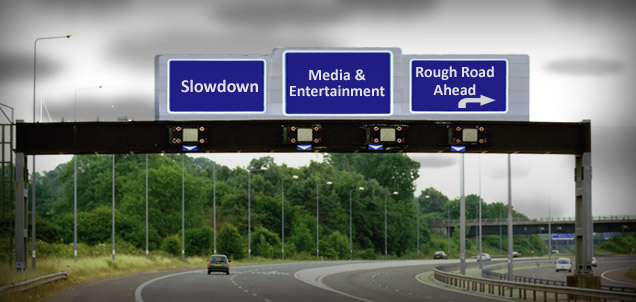
  • Rough roads ahead for M&E, but not everyone’s complaining


    By Johnson Napier with Tuhina Anand, Shruti Pushkarna, Meghna Sharma and Shubhangi Mehta


    Not many in the business arena would want to relive the harsh moments of 2008-09, which saw the economy at its most downward. While the phase did see a few corporate entities engage in a growth spree of daredevilry proportions, most brands were put to the ultimate test of surviving the slowdown odds or risk folding up business. The phase was, as most experts would agree, the toughest that had hit the Indian shores in a long time. And that there wouldn’t be anything harsher than that in a long time to come.


    But then that phase was a thing of the past and if one has to assess the current scenario, there is a sentiment of adversity that’s staging a strong comeback yet again. Given the spate of hurdles facing the economy like rising inflation, hike in petroleum prices, falling value of rupee and global uncertainty, the question doing the rounds is whether the current economic crisis is putting as much strain on the industry as it did in 2008-09? And, importantly, will the gloom see the growth numbers nosedive to lower levels than what was originally anticipated for 2012-13?


    To recap the growth numbers that was predicted for the media industry for 2012, Mindshare’s annual report – ‘This Year, Next Year: Indian Media Forecasts’ – had projected net revenue for 2012 at Rs37,397 crore, slated to grow at 12 per cent over 2011. This was somewhat close to the kind of growth that was witnessed in 2011, which stood at 12.8 per cent. But with the current crisis refusing to die down and with the sector already moving at a slow pace since January this year, the growth figures may see a marginal fall or remain stagnant.


    Sectoral evaluation

    Providing his outlook, Sujay Ghosh, Senior Vice President, DDBMudra South said that there is indeed a slowdown being felt across sectors. “There is a slowdown across several sectors like retail, apparel, real estate to name a few. As it happens with every slowdown, consumer spending gets concentrated on essentials and indulgences get affected. So, footfalls have shrunk and “like to like” buying has also come down. And with the petrol price hike, things will worsen further.”

     

    Divya Gupta

    Sharing a similar sentiment, Divya Gupta, CEO, Dentsu India said that there is a slowdown being witnessed in certain sectors, but then there are others that are doing business as usual.


    When analysed further across sectors, the buzzword that’s doing the rounds is “caution”. Expressing such a trend in the domain of television, Ravikumar Gilganchi, VP, Sales, Kasthuri TV shared that in the last two months there has been an increased demand from the advertisers on returns and they have become very rigid on spending: “The dip would be around 15-20 per cent. However, I would like to believe that this is a short-term scenario and by June things would bounce back to normal.” His reason being that since it’s just the start of the financial year many would still be getting their budgets approved and hence, June is when the action would begin.

     

    Sujay Ghosh

    He further shared: “For the first rung channels, there is not much choice for advertisers and they will go with whatever price is being quoted with not much negotiation as they would want that channel to be part of their media plan. They would start negotiating hard with second rung channels where there are many options available.”


    And it’s not just broadcasters who are feeling the heat. Production houses that play an integral part in the broadcast business too are seeing a rough patch. Hemal Thakkar, Director, Playtime Creations, whose show ‘Ruk Jana Nahi’ airs on Star Plus said, “This time economic slowdown has brought inflation with it which is the biggest cause of concern. This has led to a spike in manufacturing cost of product and budget limitation puts everyone in a spot. Interest costs too have shot up in last two years and so it triples the burden of execution in limited budget.”

     

    Hemal Thakkar

    But Rahul Kumar Tewary from Swastik Productions Pvt Ltd  whose show Navya airs on Star Plus thinks there is also an opportunity in all this: “The economic downturn has affected the industry as can be seen with the shutdown of channels like Imagine, but it hasn’t made any impact on the major players. The TV industry is on track for major growth as per the industry reports.” According to him, there are unlimited opportunities in the media space as it is a growing industry.


    Another sector that may see a saturated growth pattern is print, which is the second favourite with the brands after television. Alok Sanwal, Project Head & Editor, Inext, expressed concern as he said, “Largely, there is a note of caution for each one of us and this phenomenon is something that a lot of ad agencies had predicted from the beginning of the year for us. If we look at the larger advertising scenario, it was not good even last year. As of now things have been fine for most publications, including us. I feel each one of us have to be sceptical of how things would shape up in the second and third quarter of 2012-13.”

     

    Rahul Kumar

    As for the larger players, Sanwal feels that there is a word of caution there and the trend is utilitarian, by which he means, it is extremely sales driven: “So to that level, I think, it is a challenge for them. At the end, revenues may continue to grow but the larger challenge would be how to control expenses or optimise investments.”


    R Rajmohan, publisher, Open said: “What we are seeing now is worrisome but the print industry has been witnessing a slump from January this year onwards. The range varies across newspapers and magazines and in some cases it is much more than 20 per cent drop in revenues. The market sentiments have not been positive for a long time and this has led to people curtailing their ad spends on a large scale.” As for the brands, he feels they are playing the game of caution. “They will only spend where they see a genuine need. As for the genre, I feel the lifestyle magazines would continue to do well while the others may not do so well. But the scenario may change with the onset of the festival season. Till then it is wait and watch.”


    But there are those who believe that the scenario is not as bad for the sector and that it is on track for recording modest growth. Krishna Prasad, Editor, Outlook said: “I don’t know if the sentiment is as gloomy as it looks. If you look at the papers and magazines, there are so many sectors that are still promoting ads in them. The media, per se, has been witnessing tremendous action with so many new channels being launched and so many acquisitions and takeovers being the order of the day. So from a macro view, the economic gloom is not really taking a toll on our industry. But that does not mean all our problems are over, far from that. Oil prices are shooting through the roof, the value of rupee is falling further and all these factors will make our growth a challenge. We will have to see how things pan out in a couple of months from now.”


    He added: “Brands are being careful with their spends. Even big brands are treading cautiously and are not going overboard, unless required. We will have to wait and see what the forthcoming months will unfold for the print industry.”


    Agreeing with him, Mr Ghosh said that there are indeed pressures being felt by the clients as well: “There are client pressures in terms of numbers and therefore the client expects us to value add…in terms of strategic thinking on how to get more share of wallet. So our involvement with the client has gone up significantly. Similarly, the clients are concentrating on trying to get more out of their spends from everywhere.”


    He further stated: “I think the spends will remain constant or probably fall a little but nothing drastic will happen. Because the clients have been through it earlier and are experienced enough in not going overboard with expenses…especially with hiring, inventories and so on. So they won’t have to cut down much on marketing spends or any other spends for that matter.”


    Need for self-introspection

    KV Sridhar

    Always the one to be bridging the gap between the client and the consumer, the advertising agencies too are approaching the gloom with a note of caution. Providing his outlook, KV Sridhar, NCD, Leo Burnett, said: “If the industry is affected, the agency is affected and all this is caused by our internal issues more than the external issues. There are three pointers to this. First, advertisers do cost cutting and there are agencies available that are ready to work at lesser prices, this in turn affects the complete industry. Second, there are inefficient government policies, where the government is neither affected nor concerned about the sky-scraping inflation. And third, it’s the fact that we are all a part of a global family as an advertising fraternity. Keeping all this in mind we can still expect a double digit growth, the issue being that growth is also not enough for us, we are always aiming for more.”

     

    Agnello Dias

    Agnello Dias of Taproot India spoke on behalf of small and independent agencies when he said: “Ours is a small and independent agency, and hence personally, I do not think that agencies like us get affected by slowdown. It’s actually the bigger agencies having clients who play a part in the rise and fall of the economy of the country who get affected by the slowdown.”


    Representing the industry as president of AAAI and also the Executive Director – India Operations of Draftfcb Ulka Group, Nagesh Alai too feels that the current slowdown is affecting the advertising industry: “The advertising industry, to a considerable extent, is linked to the fortunes of the country’s economy/GDP. The recalibration of GDP growth to under 7 per cent, the high inflation, the high interest rates, falling FDI inflows and share portfolio pullouts, the plunging rupee, lowered credit rating, policy paralysis at the government et al have significantly heightened concerns in the business world and that is reflected in poor business confidence.” According to him, while a few sectors like FMCG seem a bit more confident, most other sectors are seeing a softening and are seeing revenue and profit pressures.


    Suggesting the possible solution that agencies could adapt, he said: “Overall, it’s going to be quite a challenging 2012. Most agencies will be affected and may have to relook at their numbers. Having said that, it is better to accept the situation as a business cycle and weather it with prudence and caution. It’s certainly not gloom and doom. My sense is that this time around, it is entirely up to us to rescue the situation and the sooner we do it, the better it will be for everybody. I only hope that the incumbent government gets out of paralysis and inaction and takes some positive steps in the interest of our economy and its people, if they are hoping to win at the 2014 general elections.”


    Though a relatively small domain, Out of Home too is seeing the effects of the slowdown. Sunder Hemrajani, MD, Times OOH highlighted the trend as he said: “After the last slowdown which happened in 2008-09, when the industry actually declined, subsequently the industry had two good years, 2010-11 and virtually 2011-12. The last year, 2011-12 started well for the industry, in the first half from April to September, the (Out of Home) industry saw good double digit growth rates. The slowdown started in November and carried on right upto March and April this year. So overall, you had a situation where the industry grew at about 8 per cent but first half was significantly better than the second half.”


    According to Mr Hemrajani, what has happened is the whole environment, and this is true not just of OOH but all media segments, has become very uncertain. “As a result of that uncertainty you find that people are holding on, clients are not making long term commitments. Earlier one used to get an annual deal or a six months deal, but now they have become three months and one month…so the level of commitment is becoming more short-term rather than long-term. Secondly, the pricing…it’s becoming difficult to increase prices and in some segments the prices have declined as well.”


    But the situation is not as bad for Rajan Mehta, Founder and CEO, LiveMedia. He said, “Contrary to the current economic situation, our business is growing quarter on quarter. Possibly because it’s new and hasn’t hit saturation as yet and also because it is very well targeted and hence cost effective. We are seeing that marketers for whom we were not a priority medium earlier are beginning to consider us as their media budgets have been reduced. They say ‘necessity is the mother of invention’ and therefore it is in these hard times that when advertisers are being challenged to get a bang for their buck that they are discovering and adopting mediums like LiveMedia.”


    Adding his thoughts, Haresh Nayak, MD, Posterscope Group India said, “From trade point of view we are seeing trends as close to 2008 and clearly non occupancy has gone up resulting in loss of business. This coinciding with monsoon which is supposed to be the lean period for OOH has brought down business and according to our estimates the non-occupancy has gone to 50 per cent. Though we implemented 18 campaigns last month, we are seeing a trend of quick availability and ease in implementing large campaigns due to slowdown.”


    With the rupee showing slow signs of recovery and with petroleum prices expected to be hiked further in the coming months, the M&E industry will have to look at alternative strategies to see itself emerge stronger from the economic broil. It may help that the mediums of digital, radio and so on are putting up a strong show, especially digital that is scheduled to grow in excess of 30 per cent. Radio, too, could make merry with the stage set for phase 3 rollout, providing them alternate streams for revenue generation. For now, players are opting to tread on the cautious route and one will have to wait a couple of quarters before the fate of the sector could be ascertained.


  • Apology + Rs 500cr: Is Indian Express right in sending Open a legal notice?


    By Pradyuman Maheshwari and Shruti Pushkarna


    Shekhar Gupta

    It was the most read story on MxMIndia yesterday. As the news of the legal notice served by a lawyer representing Indian Express, Shekhar Gupta and three others filtered in, there were heated discussions in newsrooms on whether the Express and its legal eagles were right in serving a legal notice to Vinod Mehta, Open and its senior staffers.


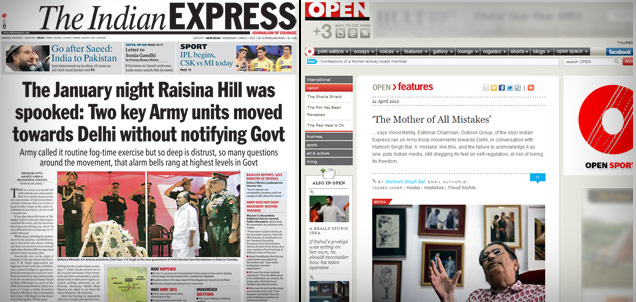
    First some background. On April 4, The Indian Express carried a story by editor-in-chief Shekhar Gupta with Ritu Sarin and Pranab Dhal Samanta on two key army units moving towards New Delhi without informing the government. Ajmer Singh contributed to the report.


    Vital Links
    The Indian Express report (April 4, epaper)
    The Open interview (April 21)
    The ‘notice’ (May 15, note: source unverified and unknown)

    There was outrage and denials issued by all and sundry in the government and armed forces. However, save the outbursts, it wasn’t proven that the Express story was incorrect.


    Meanwhile, ever since the report appeared, The Indian Express – while still respected as a no-nonsense, credible newspaper – was the butt of ridicule by commentators and on social networks. Those in print may have been a lot more gentle, but a few television discussions were indeed scathing.


    And then came this interview with Outlook’s editorial adviser (and former editor-in-chief) Vinod Mehta in newsmag Open on the issue. The headline of the interview said it all: The Mother of All Mistakes (issue dated April 21, 2012). In his inimitable style, Mr Mehta suggested that Mr Gupta was taken in by a story that was planted on the Express.


    While a magazine has a limited readership, since the article was freely available on the internet and it carried a very pointed allegation by one high profile editor on another, the interview viralled in the media fraternity a great deal.


    This legal notice by a lawyer representing The Indian Express and the four writers of the story – Shekhar Gupta, Ritu Sarin, Pranab Dhal Samanta and Ajmer Singh – came less than a month of the publication of the interview.


    One would’ve let the notice be, but its contents make for interesting reading. So while Mr Mehta may be suggesting in the interview (and he also said  amidst some cheer at the Press Club Bombay awards recently) that he quit the Independent owning moral responsibility of an incorrect story, the notice points out that in his memoirs (Lucknow Boy), he projects that he was compelled to do so. “Till now, I am unsure why I had to quit.”


    The notice asks for an apology and pulling the story off Open’s internet edition openthemagazine.com. At the time of filing this report, Open hasn’t done either and two senior staffers told MxMIndia that the magazine does not intend to do either.


    The notice also demands damages of Rs 100 crore each to the lawyer’s clients. That’s five of them – the Indian Express, Shekhar Gupta, Ritu Sarin, Pranab Dhal Samanta and Ajmer Singh. The Rs 500 crore damages have to be paid regardless of the apology.


    MxMIndia asked a few senior editors for their views on the issue. While many of them did not want to be drawn into the controversy, there were a few who told us that they didn’t know enough of the matter to be able to comment.


    Our questions were: Is the media too sensitive to criticism? Just as the Express, Shekhar Gupta & Co sent a legal notice to Open and Vinod Mehta, can governments, politicians, businesspersons and even film-makers who are critiqued by the media also send notices and ask for crores as damages?


    Here are reactions from four veteran commentators:

    Dileep Padgaonkar

    Dileep Padgaonkar, former editor-in-chief, The Times of India:

    Of course it is… the media is sensitive to criticism. The media thinks it is fit to criticise everyone but the minute everyone points a finger at the media, the media bristles. I think media should take criticism directed against it in its stride, this is part and parcel of democracy. And I don’t think one should be too prickly in these matters unless of course there is a clear case of personal attack, defamation… in that case legal course is available but otherwise one should ignore these things and go on.


    As it is, the censorship of cartoons was a dismal warning of the sensitivity of the political establishment. Now if media is going to go at another section of media, there is going to be a free-for-all and the big casualty out here would be good, decent, honest journalism.


    Sevanti Ninan

    Sevanti Ninan, editor, The Hoot, columnist and media-watcher:

    Criticism is not an accurate word for what Vinod Mehta called The Indian Express story. He essentially said it was a planted story and it was a huge mistake to carry it. Considering that the first byline on the story was that of the chief editor, that is quite statement to make. You are saying the chief editor and his colleague are susceptible to plants, thereby seriously questioning their credibility. So I guess the Express could hardly ignore it. IE did come in for a lot of criticism on the import of the story and the display given, including a critical editorial in the Hindu but nothing quite as damning as Mehta’s statements.


    This is the 3rd 100 crore notice involving the media over the past year, in any case. So it is becoming more common.


    Paranjoy Guha Thakurta

    Paranjoy Guha Thakurta, independent journalist and commentator:

    I think The Indian Express has over reacted. I think it’s gone a little over the top. They may disagree with what Vinod Mehta has said… my personal view is that it’s a point of view which obviously the Express doesn’t agree with but I don’t think that what Mr Mehta has said can be construed to be criminally defamatory. And the kind of damages sought are excessive. They are as excessive as the damages that Justice Sawant has sought from Times Now and what Times Now has sought from TheHoot. I mean these are ridiculous sums of money.


    I think we’ve become an extremely intolerant society. I think people talk about freedom of expression being a fundamental right but I don’t think people are really believing in Article 19(1)A of the Constitution of India. Like so many sections of Indian society, including our political leadership which is very upset about these political cartoons that have appeared in textbooks, I think even sections of the media are becoming extremely intolerant of criticism. If you are in a democracy, you have to give the right to everybody to disagree with you.


    Sucheta Dalal

    Sucheta Dalal, senior journalist and commentator, consulting editor, Moneylife:

    Well, not the media, but The Indian Express is too sensitive to critcism… It’s an interesting thing, it’s the first time it is happening and we should see where this goes, whether they follow through by actually filing a case. It’s the first time that somebody in the media is suing another person in the media, we need to look at how it goes… as I said everybody else is sensitive, everybody else does send defamation notices but I don’t know how many of those notices actually get converted into legal action. So we have to wait and watch.


    Otherwise the notice is also a way of making a point, it’s a way of putting pressure. It’s not just Vinod Mehta, if he looks at what was said about that story on the social media, then there are a lot more people that they would probably need to sue. So maybe he is making a case out of Vinod Mehta and Open magazine, we need to see whether they follow through. I would say that the test is not in the legal notice, the test is in seeing whether they are actually going to follow through, stand in court and argue it out.