Tag: Sanjeev Kotnala

  • Sanjeev Kotnala: INMA South Asia Conference: The House of Inertia

    By Sanjeev Kotnala


    The INMA South Asia Conference went through the rituals on November 12 and 13 with total dedication. It was a somewhat smaller gathering from the earlier editions. The networking break was redefining with 50 percent delegates either representing sponsors or The Times of India group. The opening address, macro-data session and panel discussions were monotonous set pieces with little variation. The expected hedging of opinions and futuristic statements were ruthlessly displayed. The lack of transparent nakedness and trust amongst industry stalwarts was as loud as a Salman Khan movie.


    The lack of second level of leadership was apparent. The same set of faces stared at you from the dais, making statements that have refused to move forward in time. This is not the way to address or seek new ideas.


    “Next year, we will celebrate the silver jubilee of the cover price discussion” was a relevant comment from a senior industryperson. This was immediately after CEO panel with the theme ‘Options to Grow Newspaper Revenues Beyond Advertising’ moderated by DD Purkayastha with Sanjay Gupta, Rajiv Verma, Pawan Agarwal and Rajiv C Lochan as speakers. With due respect, other than Lochan (possibly, because he is new in the game), all were diplomatic in their speaking if not thinking. Cover price, content justification, advertorial, news plants and events were briefly celebrated in discussions. Unfortunately, no one referred to low cover price as the strategic entry barrier, which it is. The internal mistrust among titles remained unaddressed.


    Rewind to 2011 or 2012, I may have got the year wrong but the panel was same with few changes. The cover price issue was raised then and Sanjay Gupta said: “If 7 people on this dias decide to change the cover price, it can happen tomoorow – but we will always be with a  shadow of doubt – debating who will be the first to blink.” And that is the ugly truth we don’t want to accept.


    For the umpteenth time, INMA CEO Earl Wilkinson tried to showcase an urgent need to evolve to Print+Digital, the new way of approaching content and the business. His presentation with a powerfully passionate delivery ‘A Window to the World: Media Worldwide And Its Relevance to South Asia’ seeemed a rehash of the same idea with newer support examples. He presented  relevant examples demonstrating the media companies adaptation/ exploitation/ defending/ amplifying the use of new realities of a multi-platform brand.


    However, if you looked at this year’s INMA South Asia Conference with an open mind strongly searching for positives, the picture could be different.


    One of the highlights was Santosh Desai’s presentation titled ‘Changing Consumer Behaviour: An Expert’s Opinion’. It brought alive the unspoken imperatives for the newspaper business, leaving the audience to complete the imperatives-cause-result loop in their mind. A nice move.


    The panel discussion ‘Search engine/aggregator: Friend or foe?’ led by a well-prepared Paritosh Joshi with strong speakers Ashwani Kumar, Punitha Arumguam and Anant Rangaswami was interesting. They spurred with thoughts with brutal honesty. Though it remained inconclusive, the content and digitisation aggregator roles were dissected for their impact across the business. Though one missed participation from a content businessperson from the Search Engine in the discussion.


    It pained to see a totally relevant subject ‘UnMetro your mind- Emerging India Opportunities in Markets Beyond the Metros’ plugged by Dainik Bhaskar with smart AV fizzling out in discussions. The context was aptly created by Kaacon Sethi in her inimitable style but could not sustain it in discussions with Lloyd Mathias and Sanjay Tripathy.  The whole spectrum of possibility remained in sepia tones.


    The editorial session ‘How is Newsmedia Driving Change?’ boomed with sharp observations and comments by Harivansh in the panel moderated by Nicholas Dawes. He did plug Prabhat Khabar but he was one of the best. The so-called Integrated Newsroom, a buzz of 2011, is yet to become a reality in this zone as we continue to grapple with changing realities. There was unanamity in the panel on need for social-level enagement with readers and the newspapers do need to involve themselves in ground-changing programmes.


    It was interesting to watch Dawes correctly deciphering comments by Harivansh (in Hindi) without much knowledge of the language. INMA could have got an immediate translation of done of his comments and projected on screen to help not only the moderator but also the delegates not conversant with Hindi.


    The HR session ‘Media Companies Need To Attract Robust Talent from Different Industries’ moderated by  Arunabh Das Sharma with Rekha Jacob Koshy, Vibha Paul Rishi and  Nina Chatrath had some good news: the employability for media employees with other industries exist. It however skirted the issue of internal training versus bringing in people from other industries in various and mostly senior positions. Trust me, this issue of enhancing the internal team potential is something the industry needs to address fast.


    As an afterthought, I wish INMA team could have whetted the presentations. Hate to see presenters skipping slides saying ‘As we do not have time I will skip’.  With due respect, I suspect they were ill-prepared. Either they were unaware of the time allotted or were serving a canned presentation.  A 60-minute slot extending to 90 minutes is as bsad as a panel opening for discussion with 15 minutes remaining!. Both happened at INMA. The radio Session on Day 2 would really be the top contendor for waste of time with ample pitching and plugging.


    One question that remains unanswered and is equally relevant to INMA and the delegates: If one had attended the 2011, 2012 or 2013 conference and missed the 2014 edition, would he or she miss out on anything substantially important? I don’t really have an answer.


    ……………………………

    Observations include sessions till Lunch on day II.

    ……………………………..

    Sanjeev Kotnala is Head Catalyst at INTRADIA and believes that the best way forward for an Organization is to enhance the potential of  internal teams instead of depending on external resources. He is a management consultant and  conducts specialised workshops in the area of  Liberating Ideas and Innovation.  To contact email netkot@yahoo.com or tweet at s_kotnala visit www.intradia.in  www.sanjeevkotnala.com


  • Sanjeev Kotnala: Newspapers: Wanted One Good Reason…

    By Sanjeev Kotnala


    Today, the 8th South Asia INMA Conference gets underway in Delhi. In this zone circulation and revenue in print continues to grow. But, the threat from  the global digital wave and mobile screens today is more real than ever before. No one is willing to bet on the Indian print industry’s readiness for the tipping point, that may not be  too far in future.


    INMA South Asia Conference opens to the theme; “Print: Transform Diversify Grow!”. The descriptor ‘How can the South Asia Newspaper industry grow grow grow in the current scenario? ‘ is hopefully more a statement of intent than of fear.


    For a reference check, let’s unwind to 2013. INMA forum resonated with  speakers propogating digital becoming a part of regular media plan. One can agrue that it’s not yet the situation, but it is tough to deny the way wind is blowing. One does not need data to support such statements. The  consumer experience and observation in metro is enough of an eye-opener. And honestly it would be surprising if more than 50 percent of the delegates would have read the newspaper today.


    Extrapolation of metro behaviour into Tier-II and Tier-III towns may not be statistically valid, but the new generation in markets after markets have adapted to Digital in more ways than one. We should be thankful that it is still centered around e-mail, Facebook, Whatsapp, e-retailing  and games, as digital fails to answer their hyperlocal needs. Digital after the tsumani of cheap smartphones is definitely more sexy, engrossing, involving and engaging than print.


    On the  other side, Indian publishers refuse to read the line.  Instead of fast adapting and experimentating with the ‘Print + Digital’ or  ‘New Print and/or New Digital’ format they been myopically resisting it. In India one is not worried about the newspaper format dying soon. It has its buisness viability and reader advertiser involvement is something that will be questionned at every stage.


    The changing environment is not really about ‘Digital Vs print’. It’s about service, need fit, utility and value add. The reader will continue to source and seek their newspaper, if there is something relevant in it readers that only newspapers can provide,  There is no direct and clear answer to it. Print anyway  has never been colloborative and we should not expect it to change. The biggies like The Times of India, Hindustan Times, Dainik Bhaskar, Dainik Jagran, Hindu, ABP, Amar Ujjala, Rajasthan Patrika will never come together to explore and lead such possibilities. If it’s not enough that they are as brotherly as Kauravas and Pandavas but there are enough Shakunis and Dristhrastras in this game.


    In INMA, you should be seeing the dominance of Sales, Marketing, Brand and  Circulation. Editorial as usual is expected to be sadly under represented*. Editorial is busy protecting its turf from demands and dictates of marketing  and management. That leaves very little time for rekindling enagagement and interest of readers. Very few resist the change, and very few lead the change.  Hyperlocalaisation is an old story.  Credibility as a rationale is dead. And there been nothing new in print space worth writing home. Success and future survival of titles is hinged to their content.  Edit (and industry) has failed the trust of readers in changing with the times (LOL). They have failed to create relevant content which could keep the romance on fire. In the new world, they have failed miserably in giving reader a reason to read. The world unfortunately is  changing. Now you do not hear ‘I can not live with out my newspaper’ but what echoes is nightmarish ‘Don’t know when I started not-missing my newspaper’.


    I want to share  an experiment conducted by a leading newspaper group. Readers form different zones were called to share their experience with senior management. What is imprinted in mind is the 15 minutes of spellbinding conversation with a  young reader from Indore.  He raised an issue which the industry better be focussing on. He said ‘The excitement which I used to feel when I picked up the newspaper is  dead, There is nothing you are adding to my lfe’. He was categorical and it jolted me when he said in his fearless voice  ‘You are doing no service to me, you are costing me time. Should I not be charging you for the obligation of reading , which keeps you in business’. He finished the evening with a question that did not get a answer ‘Give me a reason, one good reason to part with my 5-10 minutes of my daily time. Give me a sense of missing if I do not see you. Don’t be my Dadi (grandmother), keep the romance alive, Be my girlfriend’


    *Based on all earlier INMA  conferences.

    Sanjeev Kotnala is Head Catalyst at INTRADIA and believes that the best way forward for an Organization is to enhance the potential of  internal teams instead of depending on external resources. He is a management consultant and  conducts specialised workshops in the area of  Liberating Ideas and Innovation.  To contact e-mail netkot@yahoo.com or tweet at s_kotnala visit www.intradia.in  www.sanjeevkotnala.com. The views express here are his own.


  • Sanjeev Kotnala: Why Advertsiers Have Not Kissed the Digital Frog

    By Sanjeev Kotnala


    The call for advertisers to keep 20 percent investment in the digital medium is not new. And trust me they have the reason to do so. The world over, the Digital Religion is gathering pace. That leads us to question: Why is DIGITAL, the media child prodigy, not growing fast enough in India? It has the best growth-propelling advertiser-delight vitamins like low-cost, viral, clear measurability, likes, followers, awards, glamour and even a publicly positively inclined industry. Print and TV conspiracy theories fail when one sees them promoting them in industry forums. Will Digital in India remain the Crown Prince that was never crowned?


    Digital hasn’t had it so good in this nation. The current government swears by the social medium. The new smart generation is pushing for a digital shift. But the resistance comes from the powerful digital illiterates, the 40-plus sitting in the seat of decision-making. They hide behind the unfulfilled unmeasured tangible ROI and laugh loudly. There is no other media with a better measurement possible. So why is digital not growing?


    As a nation, we are sensitive and overtly caring for the minorities. Digital for long has been under focused care, with differentiated laws and uncontrolled supportive aggression coupled with intensified overtones to strength its productivity and understanding. Why have the results remained unchanged?


    Is digital a victim of over-expectation and unmeasured under-delivery. May be for the country’s media planners and advertisers….


    It is the least understood of mediums.


    As a community, we are way behind. We do not crib if the AC rakes for Mumbai local delivered more than a year back are yet to go for trial. We do not crib about the lack of infrastructure. 2014 Mumbai is ready for 2000… and we do not crib. So, dear digital, wait for your turn! What is this with issues of bandwidth, content, screens, cost of access, last mile connectivity etc!? Who asked you to land an A380 loaded with goody bags to land in an airport meant for Cessna aircrafts?!


    We are at our best when it comes to doing lip-service and a** licking. Too many day-time gurus who are digital students by night are chasing the market with Internet-based knowledge. The industry leaders and decision-makers openly confess their confusion and unwillingness to experiment with a dynamic technology. They fear the shifting goalpost and the quicksand of technology shift. Even the pseudo-practitioners acknowledge the tireless assault of tsunami of technology and innovation. They no longer are trying to keep pace with it. Instead of just talking, by now the digital Industry should have been creating converts with free education. Maybe there is something to learn from e-retailers. Digital is expecting an orgasmic euphoria without diligent foreplay!


    Reservation or minority quota is never an answer. Our country has seen it and yet we never learn. A call for quota in advertising spends is the most stupid call. The clients having burnt their fingers in befriending every new girl who walked in their pub are now far understandingly more serious. Anyone can call for explanations and it can ruin their reputation. Why place 20 percent in Digital, remains an unanswered question. Moreover, there cannot be a worse explanation than ‘Globally brand have shifted’. It does not work with us. See Print and TV. See Multinationals and the global strategy and approaches fail. We are smarter. We need ‘glocal’ approaches or we are willing to create new rules and learn from our own mistakes. Why be nasty to deny us this pleasure of learning?


    Seriously, there is something majorly wrong. Digital reminds me of often-repeated unsuccessful matrimonial ads in regional markets ‘Young, smart, fair, well-educated, very beautiful virgin girl’ and she is not finding a match. The reasons may not be what we all think. We do not wish to risk going to unchartered territories. We do not risk taking risks. ‘BE BAD’ we need to be encouraging the industry to be more provocative. In an era of enormous change, we need to remain focussed when getting distraced is so easy. New technology and constant upheaval. Are there to distract. Distraction is the enemy of great work. What’s really needed is to ‘Be Bad’ with Digital more often.


    Sorry, Ad Fest Pattaya, for picking up and using your thought ‘BE BAD’


    ………………………………

    Sanjeev Kotnala is Head Catalyst at INTRADIA (www.intradia.in). He believes, the best way forward for an organization is to enhance the potential of  internal teams instead of depending on external resources. He is a management consultant and  conducts  specialised workshops in the area of  Liberating Ideas and  Team bonding.  To contact email him at netkot@yahoo.com or tweet at s_kotnala


  • Sanjeev Kotnala: 163 Days to Goafest 2015. 12 Suggestions

    By Sanjeev Kotnala


    Why speak of Goafest 2015 so early? Most likely it will be held on April 9-10-11, 2015. The answer is simple. I Love Goafest. I have attended every edition and I will be there again. It is still THE INDIAN ADVERTISING & MARKETING FESTIVAL. It has the Abby, the most prestigious Indian awards in creative and media. It expanded to include Publishing & Broadcasting awards, which are yet to make an impact. Meanwhile we know Kyoorius has upped the benchmark.


    I also hate controversies linked with Goafest. Its brand equity has been taking a huge beating in the last few years. With this humble piece, I want to provoke the organising team to deliver a seamless smooth fest and set new benchmarks.


    Therefore, here are my suggestions:

    1. DEFINE THE ORGANISING BODY NOW

    Do not wait for Jan-Feb. 2015.


    2. LET MR SUNDAR SWAMY GUIDE AND ORCHESTRATE GOAFEST 2015.

    He did a phenomenal job in the short time available for Goafest 2014. Let him choose the team he wants and can depend on. As an experiment, let us keep fragile egos and side-nudges to minimum.


    3. DECLARE THE DATES.

    It not only helps planning but also helps in getting the right speakers. It will decrease dependence on supporting agencies and clients to prop up a few speakers and in process make the event more ‘Value for Money’ for the delegates. Let’s get whom we want and not whom we can!


    4. ENHANCE RELEVANCE TO AUDIENCE.

    Stop being futuristic zooming at 2020 and beyond. Leave that for boardrooms. It is irrelevant to most of the delegates who are young. Be realistic and zoom onto current imperatives for the industry. Stop being a Digital-plus event. In India, print, radio and TV are still a huge part of the ad investment.


    Get the right speakers. Reject recyclers. People who present two-year-old Cannes winners as insights or just do a brand sales pitch. The fest should ideally be delivering focused learnings, debate and healthy arguments.


    5. GET THE CLIENT SIDE INVOLVED.

    We cannot afford not to focus on it. It is critical for future and current success. There are no readymade solutions. I am hoping that the industry that claims to work wonders for brands based on consumer insights would not fail Goafest (the brand) in getting Clients (consumers) to its 2015 edition. Maybe like clients we could call for an idea pitch. In addition, there are brands to willingly sponsor such a contest.


    6. REVISIT THE AWARD PROCESS NOW.

    TASK #1. Get all who can constructively contribute to define the award and its process. Use crowdsourcing to publicly solicit suggestion and objections. After that, we should just roll with the new process and stop worrying about distractors.


    I support creating an unreleased/ not approved by client category. In addition, severely deal with scam in any category. Ban the individuals (client and agency) for a three-year period. Ban the brand/ organization for a year. Ban should be complete- they can no longer, be a delegate or a speaker.


    7. TAKE ACTION ON FEST SPOILERS.

    To participate or not is an internal decision and is respected. Positive criticism and suggestions are more than welcome. What is unacceptable is the publicly raising doubt on Goafest credibility. Bar the organizations engaging in such practices from being part of Jury panel or attending or speaking at the fest. Can we stop licking for the few that take the industry for granted. Do we have balls to take such a stance?


    8. HONOUR THE WINNERS PROPERLY.

    The blank plate on trophy is an insult to the winner. No name! No Category! The industry known for great execution skill failed on this front in Goafest 2014. Not again.


    Please do rationalize number of awards. Otherwise, dinner and late night parties become an event by ‘Mutual Admiration Society’. Everyone is a winner. It kills the excitement and pleasure of winning.


    Do not end up discriminating between award categories. Same treatment to metal winners is necessary. Unlike 2014, please do not call bronze winner of one category on stage and deny other bronze winners in some other category the pleasure to accept trophy on stage.


    9. GET SOME NON-MEDIA SPONSOR!

    This is a tough one and a tougher to manage. Media organizations have been sponsoring almost all industry events. Why are the advertisers and advertising agencies not sponsoring Goafest? Do we have a selling proposition?


    10. MAXIMIZE RETURNS FOR SPONSORS AND DELEGATES.

    The answer to above is here. Let delegates go back enlightened or with smile of having got something worth which is more than networking, backslapping, beer and raindance. Let the sponsor get more than mere logo presence and memento delivery. We have neglected this in past and are paying a price for it now.


    11. TAKE THE ‘TBL’ PAIN OUT.

    Internationally not done does not mean we should not do it. What about ‘travel inclusive’ or ‘Travel + stay inclusive’ tickets? Use the technology and firms specializing in it. What about an early morning flight to Goa and midnight return flights? Maybe lot many more will consider coming only for a day and the party that night.


    12. GET BACK TO OUTDOOR VENUE IF POSSIBLE.

    This is not the most important thing on agenda. Beach was fun and indoor does not have the same feel. Indoor is not really Goa. I understand the issues associated with outdoor but no harm in poking a bit more.


    Sanjeev Kotnala is Head Catalyst at INTRADIA and believes that the best way forward for an Organization is to enhance the potential of internal teams instead of depending on external resources. He is a management consultant and runs specialised workshops in the area of Liberating Ideas. To contact e-mail netkot@yahoo.com or tweet at s_kotnala


  • Sanjeev Kotnala: Blame it on the Publisher for decreasing Press Advertising

    By Sanjeev Kotnala


    The acid test of newspaper advertising is really Dhanteras, the festival where the one-has-to-buy mentality supersedes every economic parameter and pocket size. When retail, regional and corporate clients fight to fill up the prime sqcm in the leading newspapers. A period when the print salesperson feels a bit more wanted and in demand, a time when the newspaper used to be completely unreadable.


    This is not just another year. It is a special year.


    In this very first year of e-retailing crossfire, the newspapers along with retail have lost some shine.  The bottom of the pyramid has joined the top in e-buying the most socialistic democratic approach to buying. The RBI Governor is sounding positive and expecting things to be better.


    On the other side, in Metros and Tier-II towns, retailers are openly complaining of thinning traffic. Many brands are blaming e-retailers for selling at unheard prices and eroding their brand image. Malls are looking like deserted decade-old single screens. There is no festivity in the seller’s voice. The retailer in its attempt to remain in the system is trying to get hold of remaining money in so that he can pay financiers and lenders at the end of season. There are visible signs of future that are tough to negate. The future that is definitely not too distant.


    This Dhanteras, the mainline newspapers were of 32 to 56 pages, much lower than last year making them a bit manageable to hold. Surprisingly the advertisers, INS or the Ministry of Environment have never attempted to define the limit for maximum number of pages in a newspaper. Maybe this is also an area of self-regulation.


    It would be stupid to believe that additional pages are meant to balance the edit- ad ratio. The newspaper on such festival dates with uninspiring creative and traditionally-led media planning/ buying is not something a reader wants. It is maybe worth researching, if given a choice, would the reader not want to drop the newspaper on such days.


    ‘Multiple false front pages’ (ads) in newspaper is no longer an unheard phenomenon. Alarmingly, some of the well-known centers have gone without false front page! Time to introspect.


    In the titles that managed false front pages, brands have not advertised across editions. This clearly shows a positive shift towards buying of select editions. I am sure that media agencies have nothing to contribute in this change.


    Unexplained is the phenomenon of clients and agencies blindly buying into multiple front pages? There is a huge consumer apathy and immunity developed against such formats. They are worse than the inserts; at least inserts are picked up before being discarded.


    Inside the newspaper, you faced consecutive pages with little or no edit. Pages with multiple medium- and small-sized advertisements closely packed together. This is hardly conducive for easy reading or referring.


    The right hand ad placement continues. Result traditional wisdom blindly followed by clients and agencies and patronized by publications. Time to realize that the newspaper is neither held nor read like a magazine. What the clients should have been demanding is placement next to interesting content and news.


    Everything in newspaper advertising seems to defy logic. So, for the print to still hold its fort for a bit longer than predicted, few things must feature in its To-Do List.


    Instead of propagating digital, newspaper bodies like INMA, INS along with the MRUC, should have the courage to do primary free-to-circulate research. Identify individually the new best print practices for advertisers and publishers.  Rationalize the real impact of ad placement, multiple ad placement or multiplier effect with other medium.


    May be it’s time that full-page ads are banned and there is a diktat for a minimum 20% edit per page and 30% collectively. This is a must to increase print ROI and fight the growing reader apathy.


    Do a favour to advertisers and in turn to readers by pushing for solus 35*5 or 30*6 and charge special premium for surrounding it with interesting edit/ features/ news content. I am in no way suggesting paid news.


    Create an internal regulatory body that defines the advertisement-edit ratio, the maximum pages allowed for any publication and even not-more-than one false front page policy before a government regulatory body is created for just this purpose.  May be this will help revive interest in print more than pushing sales.


    I am sure that Print and TV will co-exist with Digital for a long time. But to co-exist happily, print must rejuvenate and recreate itself. May be time to realize ‘What got you here won’t take you there’

    NOTE: My reference material is yesterday’s e-papers of top titles. Times of India – Mumbai and Delhi, HT – Delhi and Mumbai, HH – Delhi- Ranchi and Patna, Dainik Bhaskar – Jaipur, Raipur, Bhopal, Chandigarh and  Ranchi, and Dainik Jagran – Lucknow, Kanpur and Patna. There are a few other  publications and their lead editions that have been considered. I must confess I have indulged in the back-of-envelope calculation and banked on an overall visual impression and my memories of the past years. I have stayed away from circulation revenue to compensate the ad revenue loss as that is another story and subject needing a second examination.


    Sanjeev Kotnala is Head Catalyst at INTRADIA and believes that the best way forward for an organization is to enhance internal teams potential. To contact e-mail netkot@yahoo.com or tweet at s_kotnala


  • Sanjeev Kotnala: Dear Election Commission: Who Is The Candidate From My Area

    By Sanjeev Kotnala


    I am told there is election today in Mumbai and Rest of Maharashtra. And I would not have believed that but for the inked fingers on my Facebook timelines and the flurry of full pages in newspapers over the last two days.


    I am from an old school of Election frenzy. Having helped Sharad Yadav collect funds when he first stood for election from Jabalpur. I hope country forgives me for that mistake in judgment. Have stayed as late as till 2 am to listen to Shri Atal Bihari Vajpayeejee. And have listened to local orchestra filling up for a late-latif VIP. The current socially hyperactive intrinsically digital generation is unfortunately missing the fun.


    Earlier there were massive clues for you to know elections were on. People would go door-to-door canvasing. Every corner would become a rally point with crowds contributing towards a hugely chaotic traffic. Loudspeakers, posters, pamphlets and full-page print ads would keep you company.


    Blame it on the Election Commission for taking out the juice from elections. Restricting a ridiculous low piggybank amount as the spending limit. Coming down heavy on Paid News. Local administration added time and decibel limits. No late loud broadcast of a local meeting. EC minutely scrutinises use of flowery language by candidates. Elections now are seriously no fun.


    There are no ads in newspapers and I don’t mean the full pages. Print under the disguise of responsible media still grudgingly covers elections. It’s more of an optimist attitude refusing the death of a cash cow. The socially responsible  (LOL) debates in news channels are a blindspot. They anyway shout in this manner throughout the year.


    But, some media are benefiting from the EC’s low spending limit and really addressing the vote bank. Radio is on an overdrive. Congress, BJP, Shiv Sena and other are busy finding their voice in multiple languages. Shiv Sena spots in English and BJP in Marathi can be heard. Organized outdoor is sporadic again crumbling under the expense limit. Social media has been sort of keeping low.


    But what do you do when you are not aware of the candidates in your zone. You do have 3-4 choices. NOTA: most likely you will not use this as a meek protest and just a statistical item on news coverage. You are unlikely to vote for a candidate you do not know. Not voting is not an option. How will the Selfie happen? May be you will vote for a party and not a candidate. And that would be the failure of the Indian democratic process.


    Blame it squarely on the Election Commission. By capping the expenditure at a ludicrously low amount, EC has in fact done disservice to the nation. Indian elections were meant to be democratically challenging. Parties and candidates should have collectively decided your vote. Social media-dominated General elections have shown how damaging party-led voting can be. As unknown and even ill-famous candidates have taken advantage of party tsunami.


    EC limit is like the INR 35 poverty line. Absurd. How can a new candidate (mostly independent) be expected to reach out to the masses about qualification, achievement and challenges or just Why should public elect them. In one stroke this has ensured death of individual candidates.


    Mayb e when our RIGHT TO INFORMATION is being denied by this act of EC, it is time for government-sponsored neutral election communication.  Let EC use any media or medium but communicate in the local language and English. Just tell the voters about the candidates, their picture, achievement, assets and criminal record etc. For candidates seeking re-election add usage of last funds. May it would somewhat negate EC fault that is leading the country dangerously towards a full-blown silent soft party led elections.


    And while we are at it, ensure elections are held on weekend or Wednesdays to bring down incidence of weekend clubbing for holidays. And introduce compulsory voting.  If you do not vote without a valid reason, you should be a fined an Election Tax. Your right to question government or seek government jobs stands withdrawn.


    Above is a full-blown orgasmic fantasy: till then let me go and vote for a party and shout loud on the Social Media. I am a socially responsible citizen!


  • Sanjeev Kotnala: Is Innovation in Print Dead?

    By Sanjeev Kotnala


    The passionate print guy in me waited through the Navratra for some surprise. I have not seen, heard or read about any Innovation in Print for sometime.


    Print has moved from Basic innovations: Size, Shape, Position, stapling, sticking and false cover etc., no longer innovations to Technology-based innovations: Gatefold, Double gat fold, Central gatefold, Outer fold, Inner fold, outer cut etc. soon these will lose the innovation tag. That leaves Exotic sensorial innovations: 3D, audio, smell, image treatments, Heat sensitive or soluble colour based etc. And this still is an unexploited territory.


    I know there is lot possible in print. In the Dainik Bhaskar Group I have been exposed to the spectrum of possibilities. I fear they will remain in files and not find a client sponsor to implement. This in my view will be most unfortunate.
    Today, more than ever before, print needs innovation to bring back some mystic and romance in the category. Lack of innovation during Navratra is not a good sign. I hope in the four days of Diwali we will see some print innovation.


    Some of the reasons cited for this are –

    1. Digital is the new attraction and focus with agencies and clients. Digital and TV create their own buzz. Print needs to shout.


    2. Print innovation is costly and geographically restricted. No one wants innovation beyond metros. And anyway there is no way to measure the change in impact from a simple ad to an innovation.


    3. Death of private equity where the cash cost of innovation was cushioned


    4. There is a lack of knowledge not only in client and agencies but also within the sales teams at publications of the possibilities that exist


    5. Print sales team are not aware of possibilities in other media (specially Digital) and hence can not think of ways to counter thrust


    6. Low return on time spent for media and creative teams. Print media is not given importance at client’s end. Print awards do not have the same oomph factor as TV and digital awards. And there is no print talent or talent wanting to work on print


    7. Across media the goalpost has been shifting but print seems to be tied to old school and is yet to grow out of Space Selling mold


    What the Print Industry Can Do? Sporadic individual efforts will not yield the result good enough to shift the inertia. It is time to invest or to sign the death warrant. The choice is open and clear.


    1. STOP SELLING SPACE AND INNOVATION. Print has failed to keep kept pace with the changing needs. Still selling space. They should have been investing in knowing the brand they service so as to provide right solutions. Not surprising that most newspaper sales teams do not see/know the ads released against the RO.


    2. STOP FOCUSING ON DIGITAL. Time to collectively find ways to sustain fast eroding Print equity. Stop industry forums to rehash the same futuristic discussions. Print + Digital is a model that will work best when Print retains its strength. Industry will do itself a favor by discussing ‘TODAY- NOW & HERE’ than talking of years down the road.


    3. CLIENT ENGAGEMENT. Maybe in INMA (November) discussion should centre on ideas and ways to create client engagement programme.


    4. SHOWCASE PRINT INNOVATION. What has INS done for the print industry in business domain? Nothing. The least it can do is create / maintain a print innovation reference site showcasing possibilities in print.

    Newspapers need to be open and frank in ideation. They are right now cocooned fearing someone else will ride on their ideas. Trust me, keeping the Innovation secret will never work. If not you, someone else will work with the client to do things you have been holding back.


    5. Subsidies innovation. It may sound horrendously non-business like but try it to bring excitement back.


    6. High incentive ‘Print Innovation Award’ created and promoted by INS. Make it really larger than life. So big that the creative and media teams find reason to resist digital pressure. There was an annual competition called THINK PRINT – publications need to rejuvenate that in somewhat contemporary way.


    7. CONNECT WITH CLIENTS. ASK FOR DIRECT BRIEFS. The trick lies in direct interaction with client’s marketing teams. Get the brief directly, interpret it and pitch with relevant and practical innovation. Media and creative agencies may not be your best friend in this battle. Remember you are not the preferred media or business partner. Also, don’t bank on your DTP operators for the creative. Invest in outside experts. Do whatever but DO NOT force fit a possible innovation or push just because that us what you have to sell.


    8. Focus on measurement matrix. If the need of the hour is to measure engagement and involvement, then MRUC must focus to find means to measure it, instead of concentrating measuring cross indices with TV and Digital in IRS. Publications must be vocal and fund / find matrices that can demonstrate / measure impact amplifier effect with innovation and even cross media communication


    9. Educate clients and agencies.

    Easy to say tough to do. I have seen Dainik Bhaskar push this agenda with limited success. Maybe at Industry level it may succeed. An event by INS or by the Top 5 groups that engages clients and agencies. Expose them to possibilities in print. If for gaining dedicated time you need to take members abroad, then just do it. Don’t wait.


    But if you believe that Innovations agenda is misplaced and nothing can enhance print excitement; just ignore what has been said above.


    Sanjeev Kotnala is Head Catalyst with P1P2Solutions. To connect mail at netkot@yahoo.com or tweet at S_Kotnala


  • This Dassera, Burn the Ravana Within


    KOTmartial/By Sanjeev Kotnala


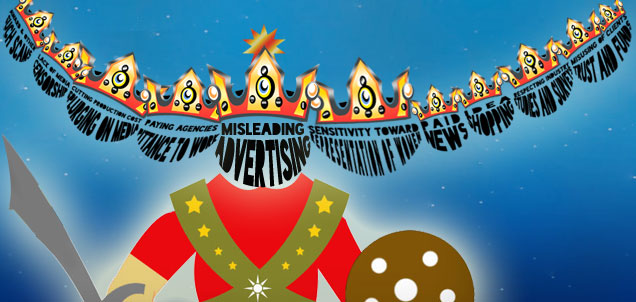
    On Friday,  we will celebrate Dassera, a festival of good prevailing over evil. This  day Rama killed Ravana, the demon with 10 heads, the most learned man of his time but a symbol of evil.


    Calling out the hidden professionals; the Rama within you to finish the new Ravana thriving in our industry. The power of trinity (Advertising, Marketing & Media) in consumer interface is amplified with rich insights, knowledge and deep consumer understanding. But, we the fallen ones, have been using it wrongly and have given birth to the new Ravana. This has been eroding the trust we enjoyed.


    This Dassera, let’s pledge to attempt decreasing Ravana’s influence if not finishing is not a possibility. Is that too much to ask?


    This is my List of 10 EVILs in MEDIA, COMMUNICATION & MARKETING


    1. MISLEADING ADVERTISING

    The biggest evil.  Guidelines have failed, may be we need legal and government intervention. Time that ASCI is reborn as ARAI (Advertising Regulatory Authority Of India).  Stop accepting briefs with unsupported claim.  Force the client to come clean on this subject. Stop misusing technology to create misleading communication. Just do not create ads that you don’t want your family to be influenced with.


    2. SENSITIVITY TOWARD REPRESENTATION OF WOMEN

    Women are more often than not props and item numbers. This is true for advertising in general. Respect women and take a stance against projecting them as a subject/ object of sexual desires and fantasies. Respect their privacy while reporting. Stop the cleavage and leg show. Stop using technology to enhance their sex appeal or creating unwarranted desires.


    3. PAID NEWS

    Media better watch, it has been violating the unwritten contract and exploiting the trust imposed by its audience. I am not against paid news. I am against hiding the fact that it is paid news.  Suggest come forward and acknowledge this good deal you been paddling with a industry defined clear loud format- maybe equal in weightage to the headline it carries!.


    4. IDEA SHOPPING

    Who is the culprit – one who calls for the pitch as a business role or the agencies standing in queue willing to sign on the dotted lines at a fee that is ridiculous? If agencies are willing to prostitute their assets (creative, strategic, consumer understanding and all of it) as an item number in the idea shopping carnival masquerading as pitches, why blame the client?!

    Okay, I understand you are weak and you can’t fight the system. But can you  start with asking for a decent pitch fee or at least make the client sign a strong contract that prevents it from exploiting innocently presented ideas?


    5. RESPECTING INDUSTRY STUDIES AND SURVEYS

    Raise your issues, scrutinizing the processes and ensure that the system is perfect, but do that before the results are out. The current scenario is hardly helping the industry. No measurement raises more doubts than solutions. Syndicated industry studies need to be better supported by stringent rules/ contracts that prevent participating media to complain about it. One of the biggest evil that it’s real tough to tame them.

    More so, all parties benefiting from the studies – media, advertisers and the agencies must share the cost of doing these studies. More paying stakeholders will strengthen the process commercially but also intellectually.


    6. MISUSING OF CLIENTS TRUST AND FUNDS

    The client imposes faith on the agencies to deliver the best results within the budget and other constraints. The agencies willingly do this at a fee that is illogical and which makes no business sense. But this does not give them reasons to create preferred media cartels, inefficient planning and execution, not passing the negotiated cost advantage to the client or overcharging on creative and media execution. Trust me, it is rampant within the industry and a media/ creative audit is a real good idea.


    7. PAYING AGENCIES PITTANCE TO WORK

    The current business model at agencies does not make it viable to hire the best of the talent forget retaining or nurturing them. Result:n clients deny themselves the best of inputs, strategy, execution and/or media intervention. Yet, they continue to have fantasies and hold unrealistic expectation.

    Time that clients really looked at their needs, demands and the fee they pay. Time to arrive at a win-win solution. This I know is true fantasy.


    8. CUTTING PRODUCTION COST SPLURGING ON MEDIA

    This is a process defect that has amplified with the separation of media and creative agencies along with the retainership fee model. This is something that defies logic. It is only forcing mediocrity.

    Follow the golden rule: ‘Better to have a good creative/solution/strategy with low media weights than a bad creative /solution/strategy with huge media support’


    9. LACK OF MEDIA CENSORSHIP

    Stop accepting and releasing ads that are misleading, promote regional and religious fervors, wrongly promotes superstition, violates rules and norms like Magical Remedy Act, Education and Fairness product guidelines or running ads banned by ASCI.

    Have I suddenly made few channels and newspaper commercially non-viable?


    10. AWARD AND OTHER SUCH SCAMS

    Someday someone like a Rama maybe in another era will have to fight the final battle on this front. Expecting this from industry is hoping for a miracle. But I believe miracles can be created. Blacklist individual professionals and the companies from future entries. Suggest get Cannes into loop on this front. And before that maybe come to an agreement nationally on entries and evaluation process for awards in India. What about a regulatory body to scrutinize and license any new or existing awards?


    May be time for ASCI to symbolically adopt Dassera,. May be on Friday, create your own Ravana of the industry. Just draw it and symbolically shared it to start with.


    It does not matter if you have a different list. Just  identify the evil in the industry and go for the kill.

    It is in the interest of the industry that each constituent across media, advertisers and agencies to focus on investing into training and enhancing capabilities of their teams. Do invest in teaching your teams to fish rather than serving them fish. In the long term it will create a distinct advantage for you. Trust building internal team for success and facilitating tapping their potential is the best thing you could do this year.


    Sanjeev Kotnala is Head catalyst with P1P2SOLUTIONS that believes in liberating ideas. Connect with him at netkot@yahoo.com or  send send him a tweet at @S_Kotnala


  • Sanjeev Kotnala: Learnings from Ma Durga

    By Sanjeev Kotnala


    It’s the first day of Navratri tomorrow. The start of 30 days of festivity till Deepawali.  As much as 35% of Indian advrtising spends are expected in this short period.  Keep your fingers crossed and pray to Ma Durga for a real media spends revival, more than just a feel-good factor.


    The 9 nights of Navratri is associated with a specific ‘roop’ (form) of Ma Durga with specific roles, story and significance. Om Ganeshai Namah. Jai Ma Durga. Here is first an overview and then learnings from the individual forms of the Goddess.


    Ma Durga’s vehicle is the Lion. It  represent three forces that one must poccess to get over ego. Power ,Will and Determination.  The Bow and Arrow represent the kinetic ad potential energy and by holding in one hand it shows her command. Just like one must command and use gut fee and research collectively. Thunderbolt which will break everything in assaut without getting affected. Hence we fueled with our firm convictions need to address challenges in life  without getting shaken in our confidence.  Lotus in hand is not fully bloomed showing contineous evolution as part of life. Mud, where it grows is the seat of lust and greed. If well controlled,they can be equally powerful weapons. Her sword and its shine shows the power of knowledge devoid of any doubt.


    Now the 9 forms of MA DURGA


    SHAILAPUTRI (Shila – mountain, Putri- Daughter) Parvati. She is a culmination of  powers of  the trinity Brahma, Vishnu and Shiva- who must work together for life to continue. So does the trinity of Client- Agency and Media.  Riding a bull is like riding opportunity and taming challenges. And the lotus, the flower of knowledge tells that it can be win-win solution.


    BHARMACHARINI signifies of practising austerity. Holding a rosary in her right hand and a water utensil in her left hand. Telling us that continued rejuvenation of  the right brand idea has the power of creating brand happiness a way to market moksha. Peace, grace and bliss are her fruit to devotees.


    CHANDRAGHANTA brings tranquility and prosperity in life. A halfmoon shaped like a bell on her forehead (and hence Chandra Ghanta) shows importance of time and ten hands, three eyes and weapons in her hand – shows the need to multitask. She is of golden complextion – representing the glow that you get on gaining success.


    KUSHMANDA ( Ku- small / little, Ushma- warmth anda- cosmeic egg) she created universe with her light in the dark void. She has eight hands and holds weapon. The  rightful implementation of strategies based in true consumer insights can enhance engagement and involvements to ensure brand shine in  the market.


    SKANDA MATA– Dev Kartikeya-  Dev Ganesha’s brother and the commander in chief of Army of Gods in the war against demons. She holds  Dev Kartikeya on her right upper hand and lotus in her right hand. The left upper  arm is in pose to grant boons and left lower arm also holds lotus. Protect the ideas as they have will grow in power by sharing and debating- the ways of feeding them with knowledge.


    KATYAYANI: Sage Kata’s son Katya observed  penance as he wished a daughter in the form of goddess. Mother Goddess granted his request and Katyayani was born to Kata as an avatar of Durga. So if you have passion and patience to devote all energies to achieve the goal- success will be yours. Single focussed approach delivers result.


    SHUBHAMKARI, one who does good. Dark-complexion, disheveled hair and a completely fearlessness posture. Her three eyes shine and she breaths fire riding a a donkey. The left eye signifies Desire, the right eye sun or Action and the central eye Knowledge. A action  collective fued by desire and knolwedge will only help you succeed. She grants boon and  assures protection, giving freedom from fear and troubles. She licked the blood of demon Rakta Beeja- never allowing a drop to reach earth- as every drop would have given birth to 1000 demons. Challenges and opportunity comes together. Life has two sides the light- knowledge and dark. Nature mother assures and take care but the same can become voilent creating havoc.


    MAHA GAURI: Intelligent, peaceful and calm. Unfailing and instantly fruitful. Devotion to her  purifies life of all sins past and present. In all aspects of life. Maha Gauri is intelligent, peaceful and calm. She grants boons and removes fear. She holds a trident and a rattle drum (Damaru). Trishul signifies Satwa (inactivity), Rajas (activity) and Tamas (non-activity) and the related miseries physical, mental and spiritual which must be taken are of before success and growth. Peacefully working and using intellegence to create  innovative solutions is bound to get results that will bring fame.


    SIDDHIDATRI with supernatural healing powers is always blissful and happy. She rides on the lion as her vehicle. She is collection of all divine powers. Every element is important. Every success is a collective output. You must source all your energies to succeed. Even Shiva got his Siddhis (powers) by worshiping her. By her blessings Shiva took the form of Ardhnarishvara:- half female and half male .  Polarity is a balance in itself. To be complete we must conquor and harness the complementing eneregies. Everything is important. Everything is part of a larger cosmic source. Supreme Being or Brahman is there in everyone. And like her multiple arms you must vbe vigilant to analyse and evalaute a challenge or an opportunity from every direction.


    Sanjeev Kotnala is Head Catalyst- P1P2SOLUTIONS. He can be reached at netkot@yahoo.com and via Twitter at @S_kotnala


    NEXT WEEK: the 10 RAVANAS of Advertising , Marketing and Media that we must kill this Dassera


  • BARC-ing up the right tree!


    MxMIndia columnists and industry experts Shailesh Kapoor and Sanjeev Kotnala were at the BARC roadshow in Mumbai on Thursday (*See Disclosure). Presenting their views


    BARC-ing up the right tree!


    By Shailesh Kapoor

    This week, BARC (Broadcast Audience Research Council) conducted roadshows across four cities, sharing important details of the new audience measurement system, to be implemented soon. While we did not get a specific date when the first ratings will be rolled out, there was a lot of new information shared in the roadshow, especially on the universe and the sample design.


    The details of what was shared should shortly be available in the media, including the BARC website. Hence, I can stay away from writing about them. It is suffice to say that there are sea changes, not incremental ones, over the current measurement system, not just in terms of the panel size and the market coverage (inclusion of rural being the mega addition), but in terms of the sheer approach to how the new system has being envisaged, both in terms of technology and data credibility.


    But what impressed me even more was the candor and warmth with which the roadshows were conducted. In the Mumbai roadshow that I attended, BARC CEO Partho Dasgupta and Technical Committee head Shashi Sinha made the main presentation. They were later joined by technical committee member Paritosh Joshi, and together, the three answer more than 20 questions from a packed audience.


    Throughout the presentation and the question-answer session, there was an air of approachability on display. Even for questions for which BARC did not want to share too much information, they could say so with reasons upfront, than give an uptight, no-comments type of response.


    Importantly, one could sense great chemistry between the team members. With constant pressure on timelines and an all-eyes-are-on-us awareness, one won’t blame if the BARC team were to be tense and on the knife’s edge. Instead, they were unbelievably relaxed (in a very good way, lest I should be misunderstood) and there was smart sprinkling of humor through the session too.


    Clearly, we are looking at a more inclusive audience measurement company; one that’s open to new ideas and suggestions, from all constituents of the industry. That has been one of the known problems with the incumbent, where the approach has been more on the lines of: This is what our product is, and you have little choice but to take it. I suspect, we are going to see a huge attitudinal shift in the year to come.


    No specific dates were committed, as I mentioned before. There has been some media talk about the delays. To me, this is largely a non-issue. The roadshow gave a clear sense of progress. If the first ratings don’t roll out in early 2015, they surely will by mid 2015. If we have stayed with the current system for more than 15 years, in various forms, we can surely wait a few more months, can’t we?


    Shailesh Kapoor, founder and CEO of media insights firm Ormax Media. He spent nine years in the television industry before turning entrepreneur. The views expressed here are his own. He can be reached at his Twitter handle @shaileshkapoor.


    Pregnant BARC. Delivery date unknown


    By Sanjeev Kotnala

    Yesterday, the weather in Mumbai was cloudy with some areas reporting scattered rains. Inside the Nehru auditorium BARC’s promising session remained uneventful. The mystery hardly got resolved. What one heard were futuristic promises. With the IRS episode fresh in mind and BARC many months away from data release, this status update seemed more aimed at leaving no square vacant for a later date checkmate.

    The update by the BARC team was like an election manifesto; full of good intent.  Hopefully technology will ensure smooth and quality execution. The BARC team wants to start basic reporting before tackling never ending value enhancement demands from industry.

    The presenters understandably  were unwilling to share much information. Most good question returned unanswered. Presenters cited BARC Board directive as something that held them back! No harm in being cautious  and not to over-promise and under-deliver.

    BARC is  definitely on the right track, promising what industry needs; a robust data with minimal error percentage.  That this is the need is no rocket science. But the most important question – when and how – remained unanswered.

    The team at BARC must be applauded getting the best technology for Indian situation. They are sensitive to the industry need and well aware of possible mal-practices. Their roadshow itself was inspiring confidence on BARC’s future delivery.

    A lot rides on the data BARC will project and its natural for anxiety to build up as a new technology (watermark) and new NCCS reference points will be used.  So here is the gist.

    BARC TV viewership draws on Watermark technology embedding  signals during transmission at the broadcaster end. This is picked by the recorder/ meter/ devise when people watch TV. The signal through integrated SIM card in the device sends back information to Data analytics team. This is cross-matched with the logs maintained at two centres (Mumbai-Bengaluru). Net data is projected basis 20,000 HH (expected to go up to 50,000 in 3 years). Reporting uses IRS, Census data references to finally report  TV Viewership on NCCS Grid, mainly in U and U+R basis.

    BARC data will be primed to report ‘What India is watching’ and will cover almost all states. Data devices placement reflect 153 MN TV sets geographical dispersion on state level. It will give report basis ‘telecast + 7day’ accounting for repeat / delayed viewing too. But rural standalone will not be reported.

    The BARC team seems to be moving with the demand imposed by current technology.  A lot of promises are being made: Robustness of reported data. Reduced margin of error. Holding back non-stabilized data. Adhering to government guidelines. Transparency and external audit. Reporting on multi screen basis. Attempt to map viewership on digital devices, TV Viewership on same day basis. 25% annual churn in panel. Internally and across business associates information shared on need-to-know basis. Strong filters to prevent infiltration. Etc. etc.

    The openness of the BARC team for suggestions sends out positive signals. Add to it BARC’s confidence in creating rules to prevent stakeholders disputing unfavorable results. Just a reminder on this one: the IRS had such conditions as part of their member agreement but we all know the situation. Surely only Time has the answer on this one.

    Meanwhile Industry waits for BARC to deliver the final bite.


    Sanjeev Kotnala is Head Catalyst at P1P2SOLUTIONS and can be reached at netkot@yahoo.com. The views expressed here are his own.


     * MxMIndia had partnered BARC to announce the roadshows


  • Sanjeev Kotnala: The ABC of the TOI-HT Battle

    By Sanjeev Kotnala


    I am enjoying the TOI-HT fight for Delhi-NCR supermacy. Are you?


    You may love TOI for the action and pity HT for pathetic explanation or be completely neutral with ‘I don’t care -WTF’ attitude. The lines are drawn depending on ‘who you hate’ and ‘who you love to hate’. Trust me, you will enjoy this, when you pick your side to fight for.


    For me this is not about TOI-HT or ABC-MRUC or IRS. It is about anomalies in syndicated third party studies and audits. The truth is that the industry would really want to trust these surveys and report but they can’t. Net-net, the industry suffers.


    On the other side, it is adrenaline-seeping excitement injected in the inert print planning environment. May be the print industry needs such episodes at regular intervals. Like Dainik Bhaskar-Rajasthan Patrika, Dainik Jagran-Dainik Bhaskar- Punjab Kesari, Hindu-TOI, Divya Bhaskar-Gujarat Samachar, Divya Marathi- Lokmat to name a few.


    It’s about the state of affairs, where just like the Oscar Pistorius case, the IRS is served a unanimous verdict for its process and data robustness validity.


    In such a situation , all you have is your point of view. Which is the root cause of what is currently happening.


    TOI is known and respected for its synchronised all guns blazing attack.  It’s no different this time (case facts at the end). TOI has taken a leaf out of a Standard Operating Procedure  at Dainik Bhaskar and adapted the famed process of ‘let stakeholders see reality at ground zero’. TOI was smarting under the tainted IRS 2013 and ABC took its pain to next level. Result: TOI launched  ‘THE TOI CHALLENGE’. Trust me this frontal confidence and trick always works in B2B scenario.


    You would have seen the simple but brutal video with a super- ‘For Internal discussion / usage only not to be forwarded to anyone else other than the intended recipient’ video ( 24280 views !). No one believes that super but it saves some skin.  http://www.youtube.com/watch?v=eMGC53YlDz0 .


    Look at it differently. ABC stipulates that while reporting combined circulation data the constituent’s title/ edition detail is a must. For TOI to be correct, at least one of them –  HT /ABC / MRUC must be wrong. In that case, some communication is definitely misleading. ABC and ASCI please step-in.


    Technically speaking, if you have to depend on only one parameter for print media planning, it should be Readership and not Circulation. Circulation is somewhat outdated, over-manipulated, completely misunderstood and under-leveraged. Irrespective of the newspaper title, the circulation-readership ratio would move in a narrow band for a given market–language combination. Market forces like  circulation will course-correct it in case of a deviant picture. Circulation can play the role of initial benchmarking for print planning.


    In an era of media fragmentation, readership  through content consistency and quality reporting defines Circulation and not the other way round. In long term, neither pushing copies to gain readers nor buying/ hoarding/ burning works.


    But then above is a picture of idealistic world. The current IRS and ABC along with publications like  TOI, HT, Dainik Bhaskar, Dainik Jagran, Lokmat tell me just one thing:  ‘Believe at your own risk’. I am still learning.


    So, something must change and it must happen at the root of the process. The ABC must treat titles as independent allowing no combo-reporting / listing / communicating. The IRS in addition to improving its processes/ systems/ data robustness/ industry involvement / cross check/ high data security must differentiate within groups and subgroups of title if ownership is differentiated or the media space is bought and sold separately.


    But there is no messiah in sight to attempt to redefine an idealistic research envirounment.  So until that time, take a side you’d like to back and enjoy the next round!


    THE TOI- HT FILE.

    The TOI-HT Battle File:
    FACT   :

    • ABC JD 2013 – DELHI NCR- HT 10.6 TOI 10.4 lakh copies

    TOI CLAIM / ANALYTICS/ INFERENCES


    • HT 2 Minute is on 12-pager (average) priced much lower than HT MAIN and inserted with HINDI HINDUSTAN Monday to Friday.
    • 26% of 10.4 lakh (2.75 lakh) copies of HT’s circulation refer to ‘HT-2 Minutes’
    • HT 2 MINUTE carries only 30% of HT MAIN ads.
    • Maybe the advertiser is unaware that the ad is not exposed to this 26% HT 2 MINUTE reader
    • Even if the ad is carried in HT2MINUTE, it reaches an  unplanned first preference Hindi readers
    • ABC JD 2013. TOI’s fully loaded edition (regular copies: Listed in ABC as ‘single’ / ‘combo’) is 38% ahead of HT

    TOI CHALLENGE :


    • Seeing is Beleiving. Come and see for yourself.  We outsell HT in every Sales Point/ Depots. with this new campaign.


    Sanjeev Kotnala is Head Catalyst at P1P2SOLUTIONS and can be reached at netkot@yahoo.com. The views expressed here are his own.


  • Sanjeev Kotnala: Tell A Story to Deliver The Brand Message Right

    By Sanjeev Kotnala


    India has three religions: Cricket, Cinema and Religion, not necessarily in that order. All of them are full of stories, characters and personalities. The viewers and followers (audience) fall in love with the story and the characters in them. Yet we have been more focused on the message than the story. Once we correct this anomaly, the brand message and brand cut-through will automatically happen in our communication.


    Look at Sholay, Kabhi Kabhie, Dabang and even Bheja Fry. Look at the last ball win and the tandav of an inning by Sehwag. Try understanding the matches you remember. Feel the engagement of blockbuster Mahabharata and the power of a dramatic message delivery in the Gita or the well-crafted real life characters in Ramayana. Look at your own first love and may be your last love. They are all characters brought alive with memories and impactful small stories (episodes). An integral part of our relationship with them and it logically should hold true for the ads we produce.


    The scenario is not so bad. Some brands do reflect a brilliant understanding of it. We smile with All Weather Voltas AC Murthy. We debate the Airtel; ‘Boss Can Cook’ and share a smile with Airtel ‘Soon to be Married’ TVC.


    Is there something special about them?


    And the answer is simple. They don’t overtly sell a brand proposition, message or benefit. It gets delivered silently and effectively. We don’t have to exert to relate to the situations. They bring smile to our face without intellectually challenging our thought process and social norms.


    They are a treat to watch. We savour the mood enhancement delivered by them and fall in love with the characters. We react violently if the future script fails our expectations. Remember the famous K serials and their art of reviving dead even after cementation.


    These story-centric TVCs give us a ringside view to the episode in the life of the character. Take the Murthy example. He is our next-door neighbour with a south Indian tone. He has been transferred many times over and every time his Voltas AC saves him from the weather and other elements including his father-in-law test. The stories are all about his experience and the advice is woven into it. He leaves the thought with us and waits for the BUY penny to drop. So much so, that few Non-Voltas AC owners can be expected to seek or recommend ‘Murthy wala’ or Voltas AC.


    We have been friends with Murthy for long. Slowly his wife and then his father-in-law made were introduced. We are slowly coming to know of this endearing family. Maybe later his sister-in-law, his mother-in-law, brother and sister will join. The south Indian pronunciation and slow dialogue delivery add trust to message delivery and comprehension in North India too. Hats off to the creative team, casting director, the scriptwriter and the client. There is a lot of juice still left in Murthy for creative to exploit. And on top of that Murthy and wife are a loving couple, who can lend themselves to newer roles.


    The simplest of the stories address the Smallest Consumer Unit (SCU) around which the life of the customer revolves. It is not an individual but a complex set of relationships defined as family. They are like the Kilo Bots. The individual mind, taste and experiences fighting, pleading, debating and trying to convince at the same time. Every SCU (family) member takes on roles as per the demand of the situation. They are the opinion-makers, influencers, customer, consumer, early/late adapters and the buzz creator. Our story and characters must be friends with them to go past their logical and emotional test.


    Life after all is a long story comprising many short episodes.


    Unfortunately, the creative process is usually trapped in discussion of under and over delivery of brand message(s), the pack shot, the flowing hair, the hold of soap, the revolving mobile and so on. It should give equal focus to the character, relationships, story and dialogues.


    Kurkurey, Maggi, ZooZoos and Jago Re do this brilliantly. Add the Airtel ‘couple ad’ to the list, where, we voyeuristically become part of their love talk. We smile when she with a perfect expression says ‘Hum Raat Bhar Baatey karengey’ or the doubt ‘Ha sahi kar rahey hai’ question at the nth hour. Such relationships are rich in language, cultural and even play with stereotypes allowing for a creative riot. Airtel brand has an opportunity to build on the story with episodic unveiling of their experiences. Show us the life progression as a story ( the soap of TVCs) while strongly delivering the desired message & experience. You tell the story right – to deliver the brand message right.


    Sanjeev Kotnala is Head Catalyst, P1P2Solutions. He can be reached at netkot@yahoo.com