Tag: Samyak Chakrabarty

  • Relative Values | More like friends: Sanjoy and Samyak Chakrabarty

    Every Thursday, MxM will take you beyond our regular news and look at the people in the business of media and marketing. So on the first Thursday of every month, we will have a section titled ‘RELATIVE VALUES’ featuring siblings, parents-children, cousins etc who may be working in the same or allied sectors of media, advertising and marketing.


    This Thursday, Sanjoy and Samyak Chakrabarty talk about life’s teachings. A child’s first and greatest teachers are none other than his/her parents. And since yesterday was Teachers’ Day, we spoke to a father-son duo to understand how one has been able to shape each others lives.


    By Meghna Sharma

     

    Samyak and Sanjoy Chakrabarty

    Zenith Optimedia’s managing partner Sanjoy Chakrabarty is a well-known name in the media fraternity and his son Samyak Chakrabarty made headlines when he became Chief Youth Marketer at DDB Mudra Max and Managing Director at Electronic Youth Media Group at the tender age of 18.


    Both belong to the media industry, though there is a difference between what they do, but when asked if his father influenced his choice about entering the same field, Samyak recalls, “I have learnt the ropes through my father and my first orientation into the media industry was through him since I would keenly follow the work he does and I even got a chance from a very young age to interact with his colleagues from whom I got to learn a lot as well. Also I got to learn that working in the media is more of a state of mind than just a mere mechanical profession.”


    Over the years, their relationship has matured and now they are more like friends. “We share a good healthy relationship wherein we are open to listening to each other’s point of views and thoughts. And whenever he seeks views on his new personal ventures, we do chat. Otherwise no work-related discussion,” says Sanjoy.


    However, Samyak does feel that it is his father’s goodwill in the industry which gave him a push initially. “It is only later that I started building my own contacts since I have always been taught that being self-sufficient is more sustainable and would help me command more respect.”


    So, what is one big lesson he has learnt from his father? “It has to be that I and my approach to what I do must evolve with time along with always having a strong value proposition to offer so that I am able to maintain demand for me/my product in the constantly changing market,” says Samyak proudly.


    And like any other father, Sanjoy too has big dreams for his son. “He has very strong leadership skills, is intelligent, a go-getter, and he has enterprise. He is going to be very successful very soon.”
     

  • Understanding young minds with ‘Generation Einstein’

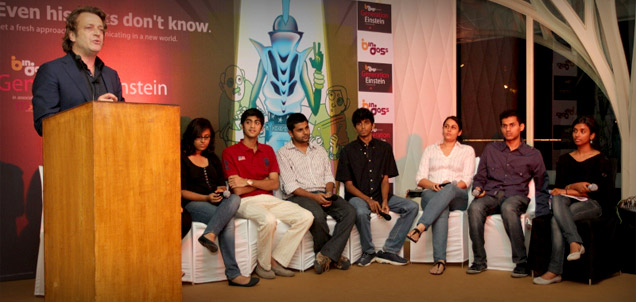
    Jeroen Boschma with young minds on the panel ahead of the release of ‘Generation Einstein’


    By A Correspondent


    It was youth power in all earnest as Bindass launched the India edition of ‘Generation Einstein’ on Monday evening at Mumbai’s tony Tote on the Turf. The book is co-authored by Bindass along with well-known international author and speaker Jeroen Boschma.


    The book describes the new generation, ‘Generation Einstein’ that was born during the last decade of the previous century. It also stresses upon the significance of the youth as an important part of the market and how fast the new generation understands the world better than anyone else. The book attempts to decode this generation and help marketers reach out to them.


    At the event, Mr Boschma spoke about how today’s generation is completely different from the previous generations. He was of the view that unlike the youth of previous generations which lived in a world of their own, the youth of this generation are very much in this world as they understand brands and marketers better: “Strong brands worldwide are brands that believe in what they do and youngsters who connect with these brands are madly in love with them.” (see interview: It’s not about co-creation, but increation: Boschma)


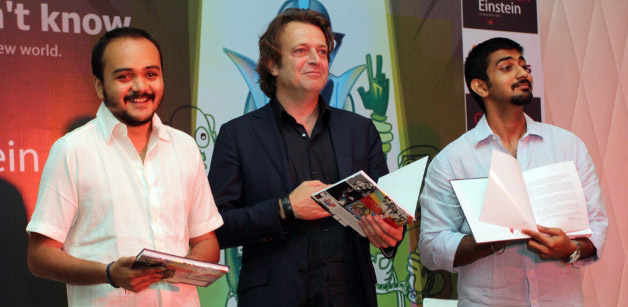
    Jeroen Boschma (centre) with Samyak Chakrabarty (to his right) and Arjun Paul Vednayagam


    The Indian edition of Generation Einstein is authored by Samyak Chakrabarty and Arjun Paul Vednayagam. “The aim of the book is to open the mind of brand managers, and to stop defining the youth, as it is not possible to define them. It is all about making interesting campaigns and allowing the youth to decide the fate of the brand,” said Mr Chakrabarty.


    The objective of the study conducted for the book is said to be about understanding the thought process of a young consumer, the factors that influence the youth to build their brand preferences, how they come to their final choice, and then using this knowledge to effectively engage the youth.


    “Every brand today has fanatic fans. Marketing is nothing like what it was before. If you want to communicate with this generation, forget what you have learnt. This generation understands that advertising is about lying. Generation Einstein says that the future of marketing is to find the purpose of their life and we need to find out how to be part of their life,” Mr Boschma added.


    In a panel discussion, moderated by Mr Boschma, the panellists, including college going teens, spoke about their favourite brands and the factors that influenced their buying decisions.


    Mudit Ganguli, a student from JaiHind College, Mumbai said that his favourite brand is Blackberry because it is cheap and convenient to use, it has versatile features, helps him get regular updates and allows him to communicate easily. Another reason why he preferred a Blackberry is because of good advertisement.


    Mohini Mukherjee, also a Jai Hind student said her favourite brand is ‘Bingo Chips’, primarily because of good advertisements, but also due to no celebrity involvement, funny advertisements, and good quantity of chips.


    Another student said that Twitter was her favourite brand because it helps her express her feelings, provides instant updates, and allows her to follow her favourite celebrities.


    One of the students talked about the reasons he trusted ‘Nike’ as a brand – good advertisements, the quality the brand offers, and the ‘Just do it attitude’ that it displays. He also spoke about how the brand is empowering the youth. He said that brands need to go back to delivering quality products and not try to create a product for everyone and eventually reaching no one.


    In conversation with MxMIndia, Samyak Chakrabarty spoke about his marketing plans for the India Edition of ‘Generation Einstein and his learnings from the study: “We would like to put this into the curriculum of mass media courses where the next generation marketers can learn about how to engage the youth. We plan to take Jeroen Boschma to colleges and deliver lectures and, of course, the book is available online for Rs200. The biggest learning we have had is that in order to understand and engage the youth, one has to keep his mind open and the fact that brands cannot define or assume or presume about the youth today.”


    The event was organized in association with MxMIndia.


    Photograph: Fotocorp

  • The Anchor: 5 Reasons why Brands get it wrong with the Youth

    By Samyak Chakrabarty


    1. Boxing youth into strict definitions

    In a country as diverse asIndia, one cannot define our youth or predict consumption behaviour by merely categorizing them under conventional economic segmentation or geographies. Our youth is continuously evolving, especially those born after 1988 are still caught in a transitional phase from and into very different eras. It can never be obvious what a SEC A+ 20 year old male inNew Delhiwill purchase just by looking at the size of his wallet or the kind of college he studies in !


    2. Youth don’t wake up thinking about brands

    Just because your brand ambassador maybe Ranbir Kapoor or your communication is ‘cool’ (I hate it when brand managers say this!), one can’t take it for granted that youngsters will always have your brand on their top of mind or will purchase your product. Today, we are more conscious and calculative about what we consume, hence substance is equally as important as packaging. Second, to build loyalty with this generation, the brand has to be equally loyal to them!


    3. Digital is the holy grail

    There was a time when brand managers would pull out their hair trying to figure how to engage youth sustainably. Soon enough,Silicon Valleyanswered their prayers and there landed from ‘the cloud’ Facebook, Twitter and YouTube. But unfortunately, brands take it for granted that just because they are on social media or rather have a million likes/views, theirs is a ‘cool youth brand’. This is not true, these days we ‘view’, ‘like’ or ‘tweet’ about anything and everything that comes into our online space – it has become a function of habit. These numbers cannot be used to measure brand engagement/conversions in pure statistical terms. Just because your brand is now digital, it is not young.


    4. Trying to measure word of mouth

    Indiais perhaps the only country in the world where brand managers ask for a ‘measurement matrix’ for world of mouth campaigns conducted in colleges. I guess they like to show off to their bosses how much they know and meticulous they are. How can one ever measure, record or contain conversations that happen offline? And just because therefore there is no direct ‘ROI’, youth brands in India refuse to run simple WOM campaigns, even though in fact, if rightly administered and structured, the investment can be more profitable then all digital spends put together since most purchases/brand decisions happen through peer references that take place in conversations over chai in the canteen or a beer in the pub – NOT on Facebook.


    5. Today’s Youth is an alien species

    To my final point, brands look at ‘youth’ as a totally alien species, which they are trying to figure and due to that very attitude, all the numbers, insights and ideas start not making sense. I, myself, have written above that those born after 1988 are indeed a totally different than their predecessors but that doesn’t mean that we overcomplicate and give too much importance to the way they think, eat, drink and surf! I guess the simplest thing to do is work on an intelligent, creative and smart campaign without reading too much into youth behaviour because reality is that one will never ever be able to understand how these mindsets function since there is no one point where this transition will end.


    Samyak Chakrabarty is Chief Youth Marketer, DDB Mudra Max