Tag: Samyak Chakrabarty

  • Samyak Chakrabarty makes it to Forbes Asia’s Top 30 Under 30

    By A Correspondent


    Samyak Chakrabarty

    The Social Street’s Samyak Chakrabarty has made it to the list of Forbes Asia ‘Top 30-under-30’, which was announced few days ago. Samyak Chakrabarty- Managing Partner, The Social Street is the only Indian from the advertising and marketing industry.


    Pratap Bose

    Commenting on this achievement, Pratap Bose, Chairman The Social Street says, “I am very thrilled by the news that my colleague Samyak has been featured in the Forbes 30 under 30 list! Samyak is a thinker, a go getter and is a rare breed; on a mission to innovate and create a difference in the society. I am indeed very proud of him. Here’s to many more accolades awaiting this young achiever!”


    Samyak Chakrabarty, Managing Partner, The Social Street had this to say, “It’s thrilling to be part of a list which recognizes disruptions and ideas of the future. For me this is just the beginning of a long journey.”


    Forbes Asia announced it’s inaugural Asia Top 30 Under 30 list that identifies the region’s future leaders across Business, Media, Finance, Social Impact & Entrepreneurship. The Asian list is a continuation of the global expansion of the Forbes 30 Under 30 franchise. It’s a franchise that has had amazing alumni such as Palmer Luckey from Occulus, Evan Spiegel and Bobby Murphy from Snapchat, LeBron James and Star Wars’s John Boyega to name just a few.


    Samyak founded India’s first Youth Marketing and research firm at the age of 18, which was recently acquired by the DDB Mudra Group. He is now at the helm of The Social Street, a new age communications company which develops technology driven solutions for brands to engage with India’s diverse & complex population set. He is currently also developing a research model to understand youth mindsets more effectively and has published 2 books in this domain.


  • Samyak Chakrabarty quits DDB Mudra, to start social enterprise. May join Pratap Bose

    By A Correspondent


    Samyak Chakrabarty

    Joining in the flurry of activity at DDB Mudra is Chief Youth Marketer Samyak Chakrabarty who is also reported to have quit the network  along with his team.


    He has been working with DDB Mudra since 2011 when the agency decided to partner and eventually acquired his start-up Electronic Youth Media, billed as India’s first youth marketing & communications agency.


    So what’s next for Samyak: Setting up Social Quotient, a social cause marketing and communications enterprise. Social Quotient has signed a jv with Cineyug to Launch “SamajScope” which will create online content/ conversations for brands around social causes – another first in the industry.


    In addition, he is also looking at taking the youth marketing concept to the next level with former DDB Mudra COO Pratap Bose.


    The recipient of the Young Emvie of the Year 2014 by the Advertising Club, he has figured in Impact magazine’s ‘Top 30 under 30’ list for two years in a row. He has bagged awards for the Tata Nano Student Brand Manger Programme and was associated with Operation Black Dot which enabled 40,000 students to vote for 2014 general elections. He produced the DDB Mudra Group Youth Report and built an “offline social network” of insight seekers and conversations seeders in campuses for clients spreading across 6 metros


  • Maxus wins big at Emvies 2014


    By A Correspondent


    In September 2013, when it was announced that Ajit Varghese was promoted to an Asia-Pacific role at Maxus, we asked him whether there was any unfinished item on the agenda. Knowing how fiercely competitive he is, although always gracious in praise for his competitors, we were digging for an answer he gave us. “May be winning at Emvies is an unfinished agenda,” he said with a smile.


    Maxus, given Mr Varghese’s spirited leadership over the years and with Kartik Sharma at the helm ever since he moved to Singapore, has ensured the Maxus flag flies high.


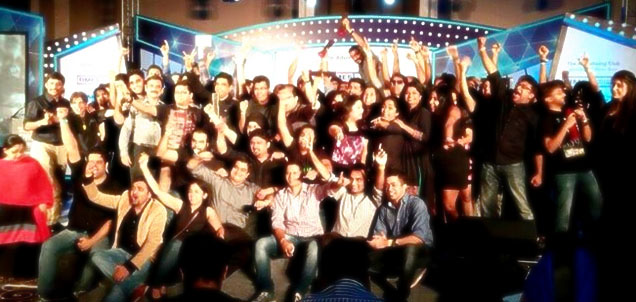
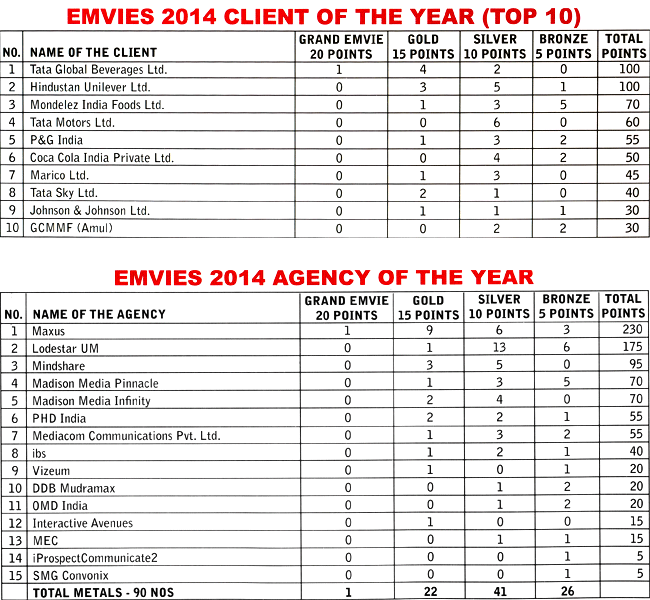
    At the 14th edition of the Emvies on Wednesday night, soon after an all-new logo of the Advertising Club was unveiled by recently re-elected President, Pratap Bose, Maxus was the clear winner. Ahead of runner-up by a good 55 points.


    But the icing on the cake was that not only was Maxus the Best Media Agency of the Year, it also won the Grand Emvie along with client Tata Global Beverages for the Power of 49 campaign. In fact Tata Global Beverages shared the Best Media Client of the Year with Hindustan Unilever for its seven big wins for the Power of 49!


    “We have accomplished a lot over the last seven years,”  Mr Varghese told MxMIndia. Unable to attend the ceremony as he was in Shanghai, the Maxus South Asia Managing Director said: “Emvies was a summit that was left unconquered. Although we came close and gave a tough fight but you know there is less room for No 2 and No 3 in life. We wanted our clients to feel the No 1 status of their work getting showcased as “the best”.


    And what’s his sentiment now that the Summit is scaled? “What a feeling to get it all! Agency of the Year, Client of the Year and the Grand Emvies!!!  I truly believe that today every Maxusite who is and has been part of this journey feels he or she is a winner! That’s makes us proud. Cheers to Kartik and team to continue the Maxus Creativity, Passion and Entrepreneurial spirit. A new journey has begun with a bang!”


    Among other notables, Samyak Chakrabarty of DDB Mudramax bagged the Gold in Young Emvie of the Year with the Silvers shared by Alka Bhavnani of Mindshare and Vikesh Jain of Maxus.


    As for the rest of the story, the tables below tell it all.


    Photograph: Facebook post by Gaurav Hirey, GroupM Chief Talent Officer South Asia

  • DDB MudraMax’s OBD attracts 40,000 first time youth voters

    By a correspondent


    Since taking flight about six months ago, Operation Black Dot, an initiative by DDB MudraMax and Thincquisitive Foundation to help make voting easy, engaging and fun for the urban youth, has managed to successfully bring about a shift in the way youth looked at voting. By breaking down politics and making it more engaging and inclusive, the OBD team has effectively registered 40,000 first time youth voters to exercise their fundamental right.


    The aim was to present conventional political discourse in a format which interests below 25 age group as well as explain important political events/facts. At one level the team worked in 60 campuses across the city, helping students make their voter IDs by use of cutting edge technology to quicken the process and at another also conducting such engagements to generate awareness leading up to the 2014 General Elections.


    Pratap Bose

    Pratap Bose, COO, DDB Mudra Group, “The whole concept of “voting” has always been looked as an activity that is to be addressed and taken upon by the older generation. While it is the youth of our country who are going to play a significant role in building the Indian economy and tend to the future of our nation. It was hence important for us to not only change the face of voting, to make it appealing to the youth, but also provide guidance, help them understand the nature of politics and also reiterate the fact that they can make a difference.”


    Samyak Chakrabarty

    Samyak Chakrabarty, Founder of Operation Black Dot & Chief Youth Marketer, DDB Mudra Group said, “Operation Black Dot has been able to successfully convey that political discourse does not always have to be conventional and can be disseminated in a format which appeals to the younger generation. From putting Member of Parliaments on a bean bag at youth hangouts to catchy videos on complex parliamentary affairs, we are making an attempt to bridge the gap between policy makers and young citizens. Going forward, our intent is to continue this movement and find more innovative methods to keep young India engaged with political affairs.”


  • Young Track by Samyak Chakrabarty: 4 key differences between youth in Europe and India

    By Samyak Chakrabarty


    Throughout my travels to Europe, I have been trying to decipher the fundamental differences between urban youth there and in India. Just last evening at a bar in Helsinki in Finland, I bumpedinto an ethnographic researcher from whom I derived certain insights on the formation of Europe’s ‘Modern Social Fabric’ that reaffirmed my observation that in almost every way, the two human sets are totally different species unlike compared to say a North America or the Far East. This has more to do with history than geography. In fact, I am exploring making this a chapter in my next book: ‘Species 1988’.


    1. Relationships: A lot of my young friends in countries like Germany, Sweden, Austria and France often mock me when I talk about commitment, persevearance and loyalty when it comes to relationships (with partners, friends, colleagues and family). At first I thought, these are just a bunch of brash playboys – but a more indepth reasoning reveals that while they too hate frivolity at one level, practicality takes the front seat. They prefer to remain at the convergence of holding on and letting go – hence making it easier and quicker to decide. The average divorce rate in Finland is 50%! Young India on the other hand gives more importance to emotions, memories and wants to try preserve which is of course great but often becomes a bad practice when dealing with relations that are at its expiry date.


    2. Ambition: Indian youth by far surpasses all benchmarks of ambition levels! We always seem to want more and more out of life. Whereas, the average youngster in Europe prefers to lead a less riskier life by following the routine of struggling through college, finding a good (and in today’s times – sustainable) job and shoveling snow out of the driveway! Of course they too have exceptions of some very successful achievers, but then outliers are born everywhere… Just a few months ago, I was at this session on the ‘Indian Jugaad’ for Scandinavian media entrepreneurs and it amazed them on how we had more stories about growth than survival (for every day, common people !). But another truth is that while in our learning system, it is ingrained right from the beginning about the merits of being first (by any means) – for them, it is mainly about substance. Most youngsters these days in Europe are choosing their line of work based on passion and interest rather than on what is the quickest option to make the million.


    3. Adaptibility: The Europeans seem to be more resistant to change and prefer to conform to habit. Experimentation is not their favourite hobby. Interestingly, I first noticed this from their beer drinking habits – it has been the same brand since their first time. The bartender always hates it when I take five minutes to ponder over which brew to sample next… he tells me: “You should know what you want, like everybody else does”. A more serious dig into this reveals that the same conformity is applied in their very way of life – working hours, scheduling, outlook towards work, building new relationships, adhering to rules etc. Whereas we Indians are always on the look out for new experiences, love to challenge norms and are open to anything that is new.


    4. Spending: But obviously, the Europeans are more conservative with their cash outflow and one would think recession is the reason. However, this is untrue. Unlike the Americans for example, people from this land have always valued their wealth. When I say conservative - I do not imply in any way that they spend any less, rather they do so more wisely. They think through every major expense (even the ‘rich guys’) and will always ensure there is ample saving. In my opinion, modern young indians are somewhere in between the American impulse and the European caution  if one were to average the spending habits of urban 18 to 24-year-olds.


  • Young Track by Samyak Chakrabarty | Causes that Young India is fighting for

    What’s a 23-year-old writing a column on a site where the average age of columnists is… ? Ok, ok, we won’t reveal that number, but like it or not the youth constitute a majority of India’s population. Since the last few years, young Samyak Chakrabarty has been in and around media events and offices with his vision of how the youth can be targeted.


    In this period, he has organized a few conferences, participated in several of them in India and abroad, and works as Chief Youth Marketer with the DDB Mudra group. He’s organized a TedX youth conference in Mumbai, was invited to meet Hillary Clinton when she visited India and has co-authored a book ‘Generation Einstein 3.0 – India version’.


    Samyak’s column appears on Wednesdays and as the title suggests, it tracks the young – specifically keeping in mind the advertising, media and marketing fraternity – Ed


    Today’s urban youngsters are very socially conscious and aware. They do not want to live under the fear of natural disasters or any form of threat to their existence and ambition. Hence we see a large number of participants in protests, Facebook activism etc. Here are four causes that metro youth are most concerned about and taking the initiative to address:


    Freedom to enjoy: One won’t see many organizations taking this one up (as yet!), but as our system and its agents (police, municipal corporation, political parties) get more primitive in behaviour, a mass urban youth uprising won’t be far away. Things like arresting people for Facebook posts or using archaic laws to raid bars anger the new generation equally, as much as those below. Parallel to other advancements in the world, the definition of ‘a good life’ has evolved for those born post-1988, and these kids will do anything to ensure they have it!


    Education: Initatives like Akanksha, Raindancer (part of the Swades Foundation) and Teach for India demonstrate how young people’s energy and skills can be utilized for providing education to the underprivileged. Students from ‘good schools and colleges’ have begun to realize that one of the key solutions to resolving a number of India’s problem is to ensure that people from all sections of society must receive basic learning and training. Hence one will observe a number of youngsters even informally teaching kids of their home staff or those in the neighbourhood.


    Environment: Compared to a Japan or USA, India has been well shielded from major natural disasters. Through new media and easily available knowledge resources, youngsters in India are well aware of the consequences of not conserving nature. Therefore one will see a number of students starting projects like Batti Bandh, Indian Youth Climate network, etc, to create awareness and make a concerted effort to protect our environment.


    Corruption: I was not surprised to see Anna’s Lokpal movement attracting so many youngsters, including many from relatively affluent backgrounds. It begins when a kid with deeper pockets and/or powerful connections takes away the precious seat during admissions from a more deserving candidate … and makes your rage stronger when greedy enablers (of what work you need done – government offices, recruitment, hospitals etc) haunt you at every step. Youngsters find it necessary to take stringent action about this cause – in fact, when it comes to everyday life, more than anything!


  • Young Track by Samyak Chakrabarty | What youth think of Samsung vs Apple

    What’s a 23-year-old writing a column on a site where the average age of columnists is… ? Ok, ok, we won’t reveal that number, but like it or not the youth constitute a majority of India’s population. Since the last few years, young Samyak Chakrabarty has been in and around media events and offices with his vision of how the youth can be targeted.


    In this period, he has organized a few conferences, participated in several of them in India and abroad, and works as Chief Youth Marketer with the DDB Mudra group. He’s organized a TedX youth conference in Mumbai, was invited to meet Hillary Clinton when she visited India and has co-authored a book ‘Generation Einstein 3.0 – India version’.


    Samyak’s column appears on Wednesdays and as the title suggests, it tracks the young – specifically keeping in mind the advertising, media and marketing fraternity – Ed


    Why Samsung can never enjoy the same aspirational value as Apple amongst Young Indians

    Post the courtroom battle, we conducted a brand tracker to ascertain what young india thinks about the two mobile giants and has any of the legal proceedings affected their opinions. The result was clear – Apple not only maintained its high aspirational value, it crushed ‘ image to a level where many students were even ashamed to bring out their Galaxy smartphones out of their pockets for a long while. Those who could afford it, even discarded them. We looked at what Apple does so right, that it is (not only in India) the most highly regarded youth brand.


    1. Innovation: They always ensure there is enough fodder amongst techies and enthusiasts to talk about ensuring that the word of mouth is sustained. Secondly, as a technology brand they have kept up their promise of delivering to customers newer products at regular intervals. But then so does Samsung, but the difference is – at Apple it is not about ‘new’, its more about being ‘ahead of time’ – something every consumer wants to be!


    2. Design and packaging: Suave and simple is the new flashy. From looks to functionality to packaging, they have ensured that the word ‘sleek’ is heard everywhere. The problem with Samsung is that even though loaded with equal amount of features, if not more, it has not been able to create the aura around its products as Apple.


    3. Pricing: Everybody knows that an Apple does not come cheap, hence if you have one, you have arrived in life. In this case, the higher tag is working to its advantage even for volume sales. Youngsters in colleges are known to save up and cut down on other expenses just to have that device even though going by the SEC they belong to, it would be unaffordable. The likes of Samsung and Micromaxes are perceived as a poor man’s smartphone and more crudely (after the battle) – a copycat brand!


    4. Steve Jobs: Believe it or not, many youngsters aspire to posses an Apple product because of their sheer respect for this genius. He is the best brand ambassador they could ever have and it continues to be so even after his death. Samsung unfortunately has no story behind its creation, hence the legacy factor is missing.


    My reading from this is that today’s young indian consumer is all about the 360-degree. It does not matter if one factor alone is perfect – everything has to be so! Apple has sustained its brand promise and the proof of loyalty is that even through various criticisms related to the product, its perception equity has never been affected. Samsung may end up being the choice of actual purchase due to economic reasons, but Apple will always be a dream possession.


  • The Anchor & Young Track by Samyak Chakrabarty: 5 brands that appeal most to urban youngsters

    What’s a 23-year-old writing a column on a site where the average age of columnists is… ? Ok, ok, we won’t reveal that number, but like it or not the youth constitute a majority of India’s population. Since the last few years, young Samyak Chakrabarty has been in and around media events and offices with his vision of how the youth can be targeted.


    In this period, he has organized a few conferences, participated in several of them in India and abroad, and works as Chief Youth Marketer with the DDB Mudra group. He’s organized a TedX youth conference in Mumbai, was invited to meet Hillary Clinton when she visited India and has co-authored a book ‘Generation Einstein 3.0 – India version’.


    Samyak’s column appears on Wednesdays and as the title suggests, it tracks the young – specifically keeping in mind the advertising, media and marketing fraternity – Ed


    My team and I recently conducted a brand tracker to check as to which brands enjoy maximum top-of-mind recall these days. This of course has nothing to do with actual purchase decisions due to other factors such as price, availability etc. This survey is themed on the effectiveness of campaigns, presence at which touch points, core message and the overall aura. (This is not in any numerical order.)


    Airtel


    Specific campaign: Har Ek Friend Zaroori Hota Hai


    Why it worked:


    1. Use of normal everyday students (as models) in all the visuals made it more relatable as well as appealing.


    2. The sound track was easy to understand, fun to repeat.


    3. It conveyed that as a brand, Airtel understands what the average youngsters needs from a mobile provider and will strive to deliver it.


    Redbull


    Specific Campaign: College sampling (continuous)


    Why it worked:  1. Use of good looking promoters and well designed creative collaterals.


    2. Presence outside colleges at strategic times such as after exams, during college events or late evenings when students are tired and about to leave.


    3. The TG gets to experience the product right where they are without having to go anywhere.


    Bindass


    Specific campaign: Be Restless – Do More


    Why it worked:


    1. Shows like Emotional Atyachaar and Super Dude and their promotional activations keep the TG engaged – everybody watches it even if it is to make fun of it.


    2. Their association with marquee music festivals like NH7 or David Guetta give an impression that the brand is an enabler of all cool things youngsters like.


    3. The very tag line captures what youngsters are all about today and hence develops an easy appeal.


    Pepsi


    Specific campaign: Change the Game


    Why it worked:


    1. Football is slowly becoming a ‘cool’ sport to be associated with and hence the brand becoming an early adopter earned them a lot of brownie points especially when it been forever known to be only associated with cricket.


    2. Like it or not, Ranbir Kapoor does have a considerable influence on guys as well as girls when it comes to brand endorsements.


    3. Perfect timing in sync with the football cup which was being sponsored by coke. Yet – pepsi enjoyed more association to that sport amongst average youngsters (who may not be football fans but still think of it to be cool).


    Anna Hazare (Shocked to see this name come up myself – but proves to be an interesting case study on Youth Marketing)


    Specific Campaign: Anti Corruption Movement


    Why it worked:


    1. Anna is no longer one person, it personifies a mass demand for transparency and good governance. Youngsters no longer want to live in a world of economic uncertainty and populist democracy – hence this movement gave voice to what they wanted.


    2. Inclusion of youngsters in the strategy and implementation of the entire movement. In marketing terms, youth became custodians of “brand anna”.


    3. Effective and optimum use of social media. Rather than encouraging Facebook activism alone, they use the network as a mere tool to excite and ignite.


     

  • Young Track by Samyak Chakrabarty | Mindset shifts impact youth behaviour

    What’s a 23-year-old writing a column on a site where the average age of columnists is… ? Ok, ok, we won’t reveal that number, but like it or not the youth constitute a majority of India’s population. Since the last few years, young Samyak Chakrabarty has been in and around media events and offices with his vision of how the youth can be targeted.


    In this period, he has organized a few conferences, participated in several of them in India and abroad, and works as Chief Youth Marketer with the DDB Mudra group. He’s organized a TedX youth conference in Mumbai, was invited to meet Hillary Clinton when she visited India and has co-authored a book ‘Generation Einstein 3.0 – India version’.


    Samyak’s column appears on Wednesdays and as the title suggests, it tracks the young – specifically keeping in mind the advertising, media and marketing fraternity – Ed


    I have been noticing a slow but sustained transformation in the way youngsters are looking at life, career, decision-making etc. There is a huge difference in the perspective between those born before and after 1990. I am highlighting some interesting examples of mindset shifts which have been shaping youth behaviour since 2011.


    1 Entrepreneurship: The thirst for quick success and an unconventional lifestyle has encouraged college students to explore the possibilities of starting something of their own immediately after passing out. Around 67 percent of students from urban campuses want to be entrepreneurial while setting out on their career paths rather than lead a typical 9-to-5 life.


    Insight

    “We’ve seen our parents slog day and night to profit for another company in return for a meagre salary. I think if we put the same effort into building something of our own, it would reap more gains!” – Tahir Shaikh, 21, Mumbai


    2 Ethical Citizenship: With an increase in natural calamities and fears of climate disasters, young people have been seen to work diligently towards conserving natural resources while also protecting civic amenities. The ‘brash’ and ‘carefree’ youth species will soon be extinct.


    Insight

    “We don’t want our work to end anytime soon. There is so much to see, lots to achieve and experience. This creates the need for us to conserve whatever is left and oppose any lobby which is working against the interests of our society.” – Sneha Kapoor, 17, New Delhi


    3 Offline Networking: Students have begun to realize the importance of being physically connected to their peers rather than using the web as a medium alone since it lacks that personal touch. This feeling has created a rise in social events, gatherings, visit to hang outs. Social networks will soon just become a medium for dissemination rather than a meeting place for this segment.


    Insight

    “There was a time when we looked forward to meeting up with friends but now Facebook has transformed our relationships in a manner where have begun to take it for granted that post 9pm everyone will be online anyway so there’s no point in initiating a ‘meet up’. But then slowly we’ve started to miss the ‘real’ conversations.” – Arun Kuwalekar, 27, Pune


    4 Individuality: 8/10 students from campuses want to build their own independent image and make purchases based on their own individual judgement rather than follow trendsetters. Each wants to have his/her own unique style and be known by the choices they make. So this could mean the end of using ‘herd mentality’ as a basis for formulating a brand’s communication strategy.


    Insight

    “I want to build my real self and make that as my identity rather than camouflaging myself into becoming someone else just to be in the crowd. This reflects in my clothes, habits and way of life in general” – Tanya Singh, 23, Chandigarh


    5 Rebirth of Indian Values: 6/10 students from urban campuses have slowly started discovering the immense wealth of knowledge/experience which our culture has to provide and have began to rely on it more than ever before. A significant streak of patriotism and secularism is also evident because of this mindset shirt. What will be interesting to see is how they imbibe lessons from the past and embed them into their way of life and decision making.


    Insight

    “After seeing a lot of our seniors go on to the wrong path because of peer pressure. I think a lot of us want to lead more secure and stable lives.” – Sanskriti Chatterjee, 18, Kolkata


    The most interesting one to watch out for is in fact the last one. While there is so much of westernization on the one hand, youngsters are also wanting to do things “the Indian way” which could potentially affect a number of purchase decisions and factors that influence consumer behaviour.


  • Young Track by Samyak Chakrabarty | 5 key things to consider when marketing to youth

    Samyak Chakrabarty

    What’s a 23-year-old writing a column on a site where the average age of columnists is… ? Ok, ok, we won’t reveal that number, but like it or not the youth constitute a majority of India’s population. Since the last few years, young Samyak Chakrabarty has been in and around media events and offices with his vision of how the youth can be targeted.


    In this period, he has organized a few conferences, participated in several of them in India and abroad, and works as Chief Youth Marketer with the DDB Mudra group. He’s organized a TedX youth conference in Mumbai, was invited to meet Hillary Clinton when she visited India and has co-authored a book ‘Generation Einstein 3.0 – India version’.


    Samyak’s column will appear on Wednesdays and as the title suggests, it will track the young – specifically keeping in mind the advertising, media and marketing fraternity – Ed


    This week, I would like to share five learnings I’ve had in my time so far as a youth marketer. While these are not scientifically proven facts, they are derived from my numerous interactions with college students at a very candid level (not survey sheets!).


    1 Youngsters don’t wake up thinking about brands:

    Large consumer brands often take it for granted that students already know about them and enjoy an automatic recall within that community. Often such arrogance is seen in the campaigns they conduct. But the truth is, brands are the least on the priority of the college-going crowd who have many more crucial things to worry about. The solution is not to therefore surround them with your brand and its aura at all touch-points all the time. In my opinion it would be prudent to ensure that the communication’s core message is so evocative and compelling that they are bound to not only remember it, but generate WOM even after the campaign expires.


    2 Youth is not a singular set:

    It is not sufficient to just aim at ‘targeting youth’ (this statement always irritates me in meetings!). Do bear in mind that youth behaviour is not uniform and hence a brand’s first goal should be to identify the ‘sub-set’ within the 15-35 age group which you want to target. As the next steps one has to develop a critical understanding of how those kind of youngsters think, breathe, talk, buy and dream. Often brands commit hara-kiri by assuming that being ‘cool’, ‘colourful’ and ‘celebrity-endorsed’ will appeal to all kinds of youngsters. It all depends on the product, price, persona and utility value.


    3 Product first, then packaging:

    Those born after 1990 have become more critical and conscious about what they buy. Therefore, the key factor which influences purchase is the product and not the brand’s communication. Hence, it is important that the brand manager as well as the product team work in sync and no silos to ensure that the two parallel functions deliver what each other promise to the young consumer, who will not think twice about shifting loyalty should he/she feel cheated. A classic example could be of a telecom brand – many students that I work with often complain that they are happy to move away from their existing provider just purely based on service issues, even though it means a more expensive plan or a less cool brand.


    4 Price does not always hit the G-Spot:

    One would often assume that for pocket money-dependent students, price would always work as a primary factor in deciding what to buy (applies for FMCG, Mobile Service Providers, daily utility gadgets and hangout places). In fact even I assumed so – but if one closely studies students from a metro city, price sometimes actually becomes a discouraging factor to buy if the aura around the product is more about its cheap price than about the qualities / aspiration value. I have noticed that many a time they tend to save up just to buy something more expensive because it is assumed to be better (nothing to do with reality!).


    5 The way your brand manager thinks, makes a huge difference:

    Often I see that some of the greatest brands often go through a period of disappointing communication only because their newly appointed manager (who may be extremely qualified and experienced) does not share the same thought process as the values embedded in the brand. This is more of a human resource function, but an extremely critical one – it amazes me how quickly a guy working for a sanitary pad brand can start to think for a cola! Many may hate me for saying this, but I believe that youth marketing too is not a uniform skill – one has to specialize and remain in that category to be able to successfully steer the brand in the right direction.


    Lastly, I think one should also start looking at adolescents today to be able to plan in advance as to how when they transform into young adults – your brand can already enjoy an automatic connect. In many ways, we have already lost those born after 1990 since preferences for essential products are already formed at a very young age.


  • Young Track by Samyak Chakrabarty | Why SEC data doesn’t reflect youth behaviour effectively

    Samyak Chakrabarty

    What’s a 23-year-old writing a column on a site where the average age of columnists is… ? Ok, ok, we won’t reveal that number, but like it or not the youth constitute a majority of India’s population. Since the last few years, young Samyak Chakrabarty has been in and around media events and offices with his vision of how the youth can be targeted.


    In this period, he has organized a few conferences, participated in several of them in India and abroad, and works as Chief Youth Marketer with the DDB Mudra group. He’s organized a TedX youth conference in Mumbai, was invited to meet Hillary Clinton when she visited India and has co-authored a book ‘Generation Einstein 3.0 – India version’.


    Samyak’s column will appear on Wednesdays and as the title suggests, it will track the young – specifically keeping in mind the advertising, media and marketing fraternity. The column started last week, and we are happy to present the second in the series  – Ed


    Very recently I read the latest India SEC report which really made me think: does any of this make sense when I look at youth consumption and purchase behaviour? After critically observing patterns of youngsters from varied backgrounds, I realized that at many points the standard classifications fail to justify much of the spending in this age group (16 to 28, urban, male and female) since the larger money outflow is coming from the most unexpected lot. Thinking aloud, here are three reasons why I think so:


    1. Parents’ income does not always necessarily trickle to the kids

    I compared the lifestyle and backgrounds of two 17-year-old males studying in the same college in South Mumbai. Paras’s father, a wealthy businessman had an annual income of Rs 75 lakh and lived in a plush apartment on Marine Drive. Whereas Amit lived in Bandra and his father earned about Rs 18 lakh a year working as a senior accountant in an MNC. Obviously, it would seem that Paras would fall under SEC A+ and Amit in SEC B. But, when I compared both their possessions (gadgets, variety of clothes and smartphone apps) and expenditures (nightclubs, restaurants and outings with the GF) – Amit’s life seemed more interesting since he had the latest iPhone, went to the best of bars and all that. Paras on the other hand only got a pocket allowance of Rs 1000 a week and travelled by local trains all that time, even though he had two luxury sedans in the garage. Typically, brands would target him vs Amit since Paras’s background made him a potential spender on premium products. The truth is otherwise, only because Amit’s dad wanted to give his son all that he could never have in his youth as compared to Paras’ dad who wanted his son to get everything the hard way. This is an everyday occurrence in many homes, but realities like these which don’t reflect in algorithms and statistical formulae can prove some very expensive brand targeting decisions wrong.


    2. Income levels fluctuate until 24

    A number of college students, in metro towns especially, are doing a number of entrepreneurial activities as one-offs (such as events, paid blogging, part-time internships etc) which for a certain period of time give them access to a lot of money. So let’s assume, in the summer break some students occupy themselves with a lucrative activity. During that period, the profit could enable them to buy pretty much any gadget, meal, excursion or extravagance that the twins in Antilla could (apart from the private jets and Maybachs ofcourse). But then due to zero knowledge about the virtues of saving up at this age, the money is over as quick as it came and there is no scope for continuing their buying spree. Hence marketing to this set could prove to be a loss-making investment. Through this example, which of course is not an everyday one, I am trying to indicate that the personal income of college students is never sustainable, hence a lot of their buying decisions are more on impulse than well thought out.


    3. Even with a lower income of first jobbers, there is more willingness to spend

    Blame the credit card for this, but many first jobbers tend to spend more than what they actually earn. This is very often seen when it comes to call centre employees or in our own advertising industry, where based on income levels the ability to buy certain products seems bleak but they always end up having it all – like a car, smartphone, Europe trips to name a few. Hence in such a case, brands while marketing should analyze their potential client base at the convergence of mindset and the income level to be able to (as much as possible) accurately identify them.


    In my opinion, the most practical method would be to classify youngsters based on “Mindsets” rather than SEC alone, since that way one could get more of an insight into factors which will trigger purchase and a better understanding of the type/brand of products they would be most likely to buy. It is also important to consider that the time difference between wanting something and acquiring it has reduced drastically for the enterprising young born post-1990, and this has nothing to do with present income since they find many innovative ways of working smart to make that quick buck.


  • Young Track | New column on youth marketing by Samyak Chakrabarty

    What’s a 23-year-old writing a column on a site where the average age of columnists is… ? Ok, ok, we won’t reveal that number, but like it or not the youth constitute a majority of India’s population. Since the last few years, young Samyak Chakrabarty has been in and around media events and offices with his vision of how the youth can be targeted.


    In this period, he has organized a few conferences, participated in several of them in India and abroad, and works as Chief Youth Marketer with the DDB Mudra group. He’s organized a TedX youth conference in Mumbai, was invited to meet Hillary Clinton when she visited India and has co-authored a book ‘Generation Einstein 3.0 – India version’.


    Samyak’s column will appear every Wednesday and as the title suggests, it will track the young – specifically keeping in mind the advertising, media and marketing fraternity – Ed


    Measuring ROI: When it comes to spending on Marketing to Youth

    I am 23, not (academically) qualified to tell Mr Brand Manager of a 100 crore+ FMCG on how to sell his product to youngsters, but yet I decide to take the Dutch shot of courage and enter the room. Someone once told me, “As a youth engagement consultant in a country like India, you have 2 choices -“either tell your prospective client how cool his/her brand is and give some worldly gyaan with complicated numericals on how I can come on board to make it cooler OR stick to what my stand is on his brand is even if its at the risk of hurting his/her ego (which, I’ve come to realize is more of a suicidal thing to do then even going wrong in the deliverables) and loosing the business”.


    So at this meeting, I am faced with the question that I am asked at every other meeting, party or conference – “Youth is on our agenda now, now tell me how can i increase the number of likes on our Facebook page from this TG”. At best the variation is “I think youth is the future of our brand, can we sponsor some college festivals (sic: and tell youngsters that we exist for them?)”.


    Youngsters in India who are born post 1990 are at the cusp of the transformation in the way we communicate, consume, dream, think and live. Obviously, modern external influences such as social networking, information overload, evolved societal expectations and most importantly a plethora of choices in everything does play a critical role how they make their decision. However I am a believer of the theory which says that “the modern consumer is just perceived to be so, in reality – at a store, he behaves exactly as his forefathers did”. Yes it is true that they think faster, spend more and want more all the time – but that does not change the very DNA of how a consumer behaves whether young or old.


    One cannot rely on statistics alone to ascertain which way the wind will blow (predicting youth trends), it requires the brand custodian to also be instinctive, passionate and most importantly have an open mind. As prominent inhabitants of modern society, youngsters (irrespective of SEC) are more whimsical and their preferences change constantly until they touch the age of 27 since they are more exploratory / risk taking then the previous generation.


    Young Track Files #1: Redbull
     

    An example of a brand which is rich in social currency amongst Indian college students


    There has always been little or no TV advertisement of this brand and nor is there a film star endorsing it. However it always enjoys top-of-mind recall among students. The red bull vans and hot ladies stationed outside colleges giving out free samples especially after exams, college festivals and sporting events has been their only sustained marketing expense which in my opinion is giving them 100 percent ROI. They hit the G-Spot by doing this since it conveyed that the brand thinks about their TG and is present where they need it. So therefore next time during a match, hardcore party or after an intensive exam – youngsters will always desire that cold can of crispy Red Bull. Furthermore, the company has ensured that their consumer does not have to walk many meters to get hold of one when he needs it - the distribution team has ensured presence of the product at all possible touch points. Their association with Formula One has also won them many brownie points in India as well.


    You may find a slight contradiction in what I am saying now and what I’ve written above – my point is that as consumers, youngsters are almost the same as their forefathers but as people they are very different (than the previous generation) and it is this very ‘split personality’ which creates a confusion in thinking what will really influence youngsters. Before you disagree – let me guess what you are thinking “This is BS, my son is more aware of brands then I ever was and has more gadgets then I ever did”… right? Now, think again -“Is it only because your son (as a consumer) is more evolved then you or is it because the choices/influencing factors now are greater in number than in your time?” J . I hope this proves my point to an extent.


    This brings me back to talking about the holy grail, how does one then measure ROI on investments made towards marketing to youth? Truth is, numerically the method is the same as what works when you compute numbers of what is spent on the other age groups. But then there is another parallel matrix which one must also consider i.e “Social Currency”.


    As the custodian of a youth brand, being a Millionaire with this form of earning is key in not only sustaining but growing your connect with youngsters. I would base the valuation of your brand’s social currency wealth on these five things ie conversations, perception, feedback,(active) social media influence (such that it is engaging not just by number of likes / posts alone) and how inclusive is your TG in shaping your product as well as marketing strategy. I hope you noticed that this has nothing to do with how cool, colourful, cute your brand is or which film star is your brand ambassador – these are just peripheral things that may or may not be needed.