Tag: Reliance

  • Reliance Retail to turn hypermarkets into wholesale stores, to court kirana shops

    By Rasul Bailay


    Mukesh Ambani’s Reliance Retail is converting some of its big hypermarkets into wholesale cash-and-carry stores, in an apparent sign of modern retail’s inability to effectively take on neighbourhood stores in India.


    The Reliance Mart hypermarket in Bhopal’s Aashima Mall is currently under renovation and getting refitted to be reopened in February in a new avatar, as a cash-and-carry store.


    This 44,000-sq-ft hypermarket is among Reliance’s big-box stores, including one in Ludhiana and another in Aurangabad, that are being converted into cash-and-carry formats.


    The company has realised that in some locations, low-frills wholesale stores have better prospects of making money sooner than consumer-centric hypermarkets, which have wide margins but also are more expensive to operate, two people with knowledge of the development said on condition of anonymity


    So, in order to convert the adversaries – the mom-and-pop stores in this case – into allies, Reliance is adopting a simple strategy: It is courting them.


    In the cash-and-carry format, companies sell to bulk buyers, such as neighbourhood or kirana stores, who are their members. Reliance is setting up its wholesale stores in places where the concentration of kiranas is high as it is easier to make them customers than competing with them. The business also offers huge potential.


    Industry experts estimate cash and carry in India to become a $22-billion (about Rs 1.4-lakh crore) annual opportunity by 2017, and the market leader in the segment is expected to corner $4 billion to $5 billion of this. The main rival for modern cash-andcarry stores in India is “wholesale retailers” – thousands of small retailers crowded into large markets, such as the Sadar Bazar in Delhi.


    “Reliance Retail continues to evaluate its offerings and realign them in specific locations in order to establish sustainable relevance of the business with the consumer ecosystem,” a Reliance Retail spokesman said in an e-mailed reply to queries on the company’s plans on its cashand-carry business. In the traditional retail segment, the going hasn’t been smooth for organised players.


    Over the past five years, Reliance Retail, Aditya Birla Retail, Spencer’s Retail and others shuttered hundreds of smaller convenience stores to focus on expanding big boxes as the smaller stores faced direct competition from kirana stores.


    But hypermarkets, generally spread over 40,000 sqft to 60,000 sqft, come with their own set of challenges, such as high cost structure associated with a large number of staff, look and feel of the store as well as logistical cost that ultimately eat into overall profitability On the other hand, cash-and-carry business generates much higher volumes – as customers buy in bulk, albeit at low margins – with smaller operational cost. Cash-and-carry stores can be low-frills in terms of look and feel and ambience, and they save on logistical costs as companies and distributors would supply merchandizes directly to these stores.


    Generally, Reliance Markets, as Reliance’s wholesale stores are called, allows only bulk buyers through memberships.


    But the store at Bhopal’s Aashima Mall is also likely to sell to consumers apart from traditional kirana stores even after it is turned into a Reliance Market, according to Ashish Jain, marketing manager of the company that owns and runs the mall. “Since it is in a mall with a heavy consumer footfall, it will also cater to consumers,” he said.


    Reliance, in fact, is undertaking an aggressive plan to expand its cashand-carry chain. It entered this business with a store in Ahmedabad in 2011 and the pilot was tested for the next one-and-a-half years before opening another one in Bangalore. In the past nine months, however, Reliance has opened about a dozen cashand-carry stores. Plans are also afoot to make an upcoming store at Mohali in Punjab, which was originally planned to be a Reliance Mart, into a wholesale store as well, one of the persons cited earlier said. In comparison, Germany-based Metro AG, a pure cash-and-carry player that has so far opened 17 stores in India since its entry into the country a decade ago.


    An industry analyst said converting a hypermarket into the cash-and-carry format may not work in some cases. Hypermarkets and cash-and-carry stores are two entirely different formats with different demands and economies, Amitabh Mall, partner at Boston Consulting Group, said.


    “Converting any hypermarkets into cash-and-carry has to negate the disadvantages of lower margin at the cash-and-carry with the high rentals (of the existing hypermarkets),” Mr Mall said. “That is the equation someone needs to solve. It could work in some cases and may not in others. So it’s a mixed answer.”
    One of the anonymous persons cited above said Reliance has plans to convert many more hypermarkets into cash-and-carry in the coming months. However, Reliance denied this and said the conversion is limited and selective.


    Further, as a conscious approach, locations and stores are identified as opportunities for the entire retail business and the precise format or offering is finalised after due consideration of the consumer demography,” the company spokesman said.


    Source:The Economic Times

    Copyright © 2013, Bennett, Coleman & Co. Ltd. All Rights Reserved

    Licensed to republish



  • MEC India expands media agency mandate within Reliance ADAG

    By A Correspondent


    Leading media agency MEC India has announced expansion of its media mandate within Reliance Group.


    The agency has bagged the mandate for Reliance Capital (including Reliance General Insurance, Reliance Life Insurance, Reliance Mutual Fund and Reliance Commercial Finance), Reliance Infrastructure, Reliance Power and Reliance Energy.


    MEC India has already been managing the media mandate for Reliance Communications, Reliance Net Connect & Reliance Digital TV and is now enthusiastic about managing the media agency responsibility for more group companies.


    On this development, T. Gangadhar, Managing Director, MEC India said “The team at MEC India is eagerly looking forward to provide excellence in crafting and executing customized integrated solutions across its suite of services. MEC India has shared a long standing relationship with various companies in the Reliance Group and our objective will be to provide superior assistance with media, analytics, content, activation and digital media services, as we have been doing with the award winning RCOM mandate in the past.”


  • Reliance Games expands to Japan, Korea

    By A Correspondent


    Reliance Big Entertainment Pvt. Ltd, part of the ADAG Reliance group, has announced that Reliance Games, its international mobile gaming business, in a bid to expand its global presence has made a strategic entry into the key gaming destinations in the world – Japan and Korea. The company has announced the acquisition of a mobile game development and publishing company in Japan and a mobile game development studio in Korea, thereby augmenting its footprint in the global mobile gaming industry.


    The recent ingress of Reliance Games into Japan and Korea will play a pivotal role in the company’s international roadmap. The Japanese and Korean business set-ups give Reliance Games direct access to the two largest mobile gaming markets known to the world. The company aims to adopt a two pronged approach for the new set-ups; while the Japanese and Korean facilities will develop IPs targeted to local consumers, they will in future also be responsible for R&D of multi-player mobile games for the western markets.


    Manish Agarwal

    Commenting on the milestone, Manish Agarwal, CEO, Reliance Entertainment Digital said,   “Reliance Games, after the success of Real Steel & F1 2011 mobile games globally, has embarked on a journey of expanding its business beyond North America markets. With this acquisition in Japan & Korea Reliance Games has made inroads into the world’s largest mobile gaming markets and looks forward to tap the 5.5 Bln USD & 1.3 Bln USD mobile gaming markets of Japan & Korea respectively. Investment in the development studio at Busan, Korea and in the distribution team at Tokyo, Japan will enable us to develop games for local markets instead of trying to force fit western games in these markets. I have full confidence on teams at Korea and Japan to establish Reliance Games as a very innovative and successful gaming brand.”


    Eric Marlow, Vice President of Global Studios, Reliance Games said, “The Company’s expansion into the Japanese and Korean markets is significant and strategic. We see now a clear path that allows us product and development capacity in both countries. We are extremely excited by the new capabilities added to our team and we think our customers will enjoy the games we are preparing for them.”


    The company has brought on board Hwa Seok Choi in the role of Chief Revenue Officer for Reliance Games Japan. Commenting on his new role, he said, “It is a great opportunity to be a part of Reliance Games’ global expansion strategy. I am looking forward to the successful games that we will bring to the mobile gaming markets in times to come.”


    On partnering with the Reliance Group, Hojin Song, CEO of Bluesom Inc. said, “It’s a pleasure to partner Reliance Games in its phase of expanding global presence. I am certain that together we will be able to effectively cater to the mobile gaming markets globally.”


  • Abdul Khan returns to Reliance Industries

    By Ananya Saha


    Abdul Khan

    After spending seven years at Tata Teleservices, Abdul Khan is heading back to Reliance Industries. His first stint with Reliance began in the year 2000, where he was responsible for launching the mobile services.


    He served as Senior Vice President and National Head of Business Marketing of Tata Teleservices Ltd. He joined the company in January 2009 as Head of GSM marketing and Advisor to Managing Director at Tata Teleservices (Maharashtra) Ltd (TTML).


    Mr Khan told MxM India, “Telecom is a dynamic industry, where everything you create can be replicated in 24 hours. There was a great amount of learning in this sector, which has helped me.”  However, he said that he will not be taking care of marketing and branding in his new profile.


    Mr Khan called his stint at Tata Teleservices enormously fulfilling. He was responsible for “launching various products during turbulent times including Walky, Docomo, Photon.”


    A graduate of IIT (Kharagpur) and IIM (Ahmedabad), Mr Khan has close to three decades of experience in brand marketing and advertising. He has also worked with RK Swamy BBDO, Mudra Communications, Asian Paints, and across various product markets.


  • Ranjona Banerji: Getting a bum deal from Yahoo India

    Ranjona Banerji

    By Ranjona Banerji


    Last month, I dumped my Reliance internet connection (dip in connectivity and more importantly, rude service) and opted for Tata Photon. But my grouse is not with either of them. It is with Yahoo India. The Tata Photon opens with a Yahoo India page (I can’t shut it down too quickly because then Mozilla Firefox won’t reload and I can’t go back to Google Chrome because it slows down my machine and particularly did not like this website… so who said the internet was all plain sailing!).


    The page is dominated by Bollywood nonsense (celebrities who married young, star break ups that hurt us more than it hurt them) and then a sprinkling of political news in the next segment and only cricket news in the next.


    I am now inured to the stranglehold which Bollywood has on our lives. But I still question a news source which can look no further than the lowest common denominator. I also don’t quite know if the average internet user in India wants only Bollywood and cricket and nothing else. Has Tata Photon done any such research about its average user?


    Out of curiosity and since the damn page was open, on Tuesday evening I ventured further into the Yahoo India page and decided to see how it treated other news. In the sports category, there were only cricket, tennis and football, in that order. I went to tennis since that’s my area of interest. There was a story about Maria Sharapova, nothing at all about Rafael Nadal and Novak Djokovic’s French Open battle and Nadal’s historic seventh French Open title.


    Instead I see a story about how reality TV star, Kim Kardashian, “flashed her bums” during some family tennis match. I went no further into the story, credited to ANI, but it is wrong on so many levels. For one, the English. It is not “flashed her bums”. Bums when it applies to the buttocks is a singular entity, like bottom. Unless Kardashian has cultivated a collection of homeless drunks which she brought along to a family tennis match.


    But more than the grammar, it is the intent which is offensive. I understand that sex is a human impulse which beats all others (well…). But why should this daft little story find itself in a sports section of a well-known website? Is there any connection with tennis at all? If I wanted to fulfil my baser instincts on the internet there are enough explicit sites for my guilty pleasures. Yahoo India is not the preferred choice for anyone, unless that it is intention? The Yahoo.com website has an excellent, up to the minute and comprehensive sports section. Is Yahoo India so far away from there?


  • Why media purists needn’t worry about Kumar Mangalam Birla’s 27.5 % in Living Media

    By Pradyuman Maheshwari


    On April 10, the TV Today network clarified to the Bombay Stock Exchange on rumours that the Aditya Birla group was acquiring a stake in the India Today group. The clarification said the Company (TV Today) was not aware of any such transaction and was not in a position to confirm the contents of the media reports.


    A little over a month later, the same organization sent the BSE a copy of the press release stating that 27.5 per cent of Living Media India, better known as the India Today group, was sold to the Aditya Birla group.


    A senior member of the AV Birla group told this correspondent that the investment was made by chairman Kumar Mangalam Birla on a personal level and not by any of the group companies.  After the customary approvals in a few months, we would get to know the real numbers. Late on Friday, Ashish Bagga, recently appointed CEO of the entire group (including TV Today), informed staff of the development by way of an email.


    The question which everyone wants to know is the price that Mr Birla paid for the 27.5%. There have been various figures floating around… that the money paid is in the region of Rs 350-500 crore. In the communique issued, Mr Birla is quoted saying: “The media sector is a sunrise sector from an investment point of view. I believe that Living Media India offers one of the best opportunities for growth and value creation.”


    Also read:

    AV Birla group buys 27.5% in India Today group


    Birla may use personal money for buy, Mail Today may now launch editions in Mumbai, other metros


    Loss of plurality is worrying: Paranjoy Guha Thakurta

    And here’s what Aroon Purie, chairman of the India Today group said: “I am delighted to partner with the Aditya Birla group to aggressively address the current and future potential of the Indian media business which is at a tipping point. The Aditya Birla group with its strong leadership global footprint, diversified business interests and its shared values of integrity, commitment and social responsibility make it a perfect fit with the India Today group.”


    So where’s the money going to be used? For one, it would mean expanding its current businesses. Specifically, Mail Today to move to markets like Mumbai and other cities and for TV Today to get into the regional space, and possibly a business channel. With a question mark on overall growth of newsmagazines, Living Media needs to invest its resources on segments with a growth potential.


    It has already done so by investing in smaller, niche magazines which have a smaller print run and attract fair amount of advertising as also bringing in international content.


    The TV Today network has also been in pressure in recent months with competition gaining ground. The radio station -Oye 104.8 – also needs to grow on the ratings roster.


    And what does it mean for the industry? Although a 27.5% equity will give Mr Kumar Mangalam Birla a toehold in media, it’s not significant enough for him to wrest editorial control. However, while there is fear of how big business money may impact the media, the fact is that it is already doing so. Even today, there exist managements and editors which buckle under pressure from large advertisers and influential individuals. There are enough stories of vested interests at play in Indian journalism, and for the media as a whole, the infusion of money from big business houses and foreign players could possibly ensure better salaries and hence lesser corruption. Standards of journalism are bound to improve.


    Also, it’s not that business empires haven’t been in the media already. The KK Birla group runs Hindustan Times, the Tatas would own the Indian title of Reader’s Digest until it sold to Living Media and there are other smaller players too who are known to back media players. Zee TV’s Subhash Chandra has a successful enterprise running under the Essel brand and even The Times of India group’s Jains have had long-standing interests in other fields.


    Since the media needs to increase scale, it needs the money for expansion. A route followed by some groups like Dainik Jagran, Dainik Bhaskar and Deccan Chronicle has been to go public. Still others – like Network 18 and Television 18 – have been public and also secured investment. Last year, the Abhey Oswal group bought 14.17% in NDTV.


    The Reliance Anil Ambani group has significant presence in the media with radio and television. It has also acquired a majority stake in business channel Bloomberg UTV. Just yesterday (Sunday, May 22), one saw a programme airing consumer complaints with a subscribers’s peeve against Reliance Communications. So it’s not that Bloomberg UTV blanks out all criticism of Reliance ADAG activities.


    According to me, more than the possibility of business empires exerting pressure after investing in the media, the worry is when the situation reaches oligopolistic proportions. This has in fact been seen with media groups having a stake in allied business like radio, television and events.


    Buzz me if you have a story to tell. Confidentiality assured. There are various ways you can reach me:

    pradyumanm[at]mxmindia.com, BBM 23050B5D, Gtalk pradyumanm@gmail.com, Twitter @pmahesh and of course the mobile: 98338 76278.


    Disclaimer: Although he is CEO and Editor-in-Chief of this site, Pradyuman Maheshwari’s views in Mediaah! are not necessarily those of the rest of the team and MxMIndia.com.


  • Day 1 @ the Dome: ‘Innovation is the magic of Ideas’


    By A Correspondent


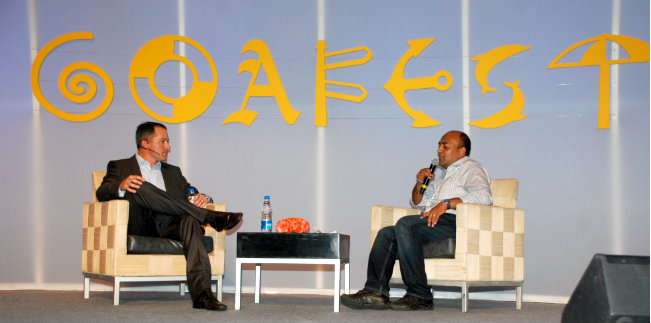
    Goafest 2012 kicked off with the lighting of the lamp by the industry dignitaries, Mr Arvind Sharma, Chairman Goafest 2012; Mr Nagesh Alai, President, AAAI; Mr Shashi Sinha and Mr Ambi Parmeswaran, ED and CEO, Mumbai Draftfcb Ulka Advertising. Mr Sharma said that he was thrilled as Goafest 2012 over 3,000 participants, including representatives from Sri Lanka and Bangladesh.


    Mr Parmeswaran said that he was ecstatic about the event this year as there was a restructuring of knowledge sessions. Mr Sinha observed that with more metals and more categories at the awards than last year, more participants, representatives from foreign countries, exciting prices for the audience, Goafest 2012 is aiming to give participants an experience with qualitative improvement every year. And unlike previous years, presentations by speakers were followed by the Q&A sessions moderated by industry veterans.


    The first session, ‘Magical Ideas Come when You Harness the Power of Many People’, commenced with a flash mob from YouTube, taking everyone by surprise and perhaps sending a message that it was one way of using consumers to building your brand.


    Mr Lucas Watson, Global Vice President, YouTube spoke about how passionate consumers can help one build brands and how online videos can help even startups spread awareness and the reach needed in a very cost effective and efficient way. “Just get started online, you don’t have to be a big brand, all you have to do is gain trust among your consumers and you will be surprised how passionate people are to participate in the brands they love. The magic of YouTube is available for all to see, as it allows everyone to participate and that too in a cost efficient manner.”


    The first session was moderated by Mr N Rajaram of Airtel. When asked about the scope of co-existence between television and online videos, Mr Watson said: “Like many industries, we too are going through a transformation. There are brands which are afraid to disrupt their current mode of functioning and there are brands who want to try new and better ways of reaching out to their consumers. So I believe there will be some co-existence, nevertheless there will be winners and losers as well.”


    Gerson da Cunha, stage and film actor, social worker and author dedicated Ad Katha, a book that tracks the history of Indian advertising to the late Bal Mundkur, founder of Ulka. Mr da Cunha gave the audience a glimpse of the Indian advertising right since it started through the present day advertising. He also pointed out that advertising bloomed in India from print media and that in 1991 it even opened doors to the global economy.


    Mr Jonathan Mildenhall, Vice President, Global Advertising Strategy and Content Excellence, Coca-Cola spoke on the use of creativity and content and how Coca-Cola moved from creative excellence to content excellence. He also explained that there is a need to encourage consumers to express their stories and how a brand must move to dynamic storytelling. “A brands story must show that it’s committed to make world a better place. There is a need to converse and not just listen to our consumers but to create inspiration and provocation.”


    In the session moderated by Sanjay Behl, CEO, Reliance Digital, when asked about a marketer’s role in the future and the consequences of negative conversation on a brand, Mr Mildenhall said: “Brands have to be a lot more transparent, if you inspire good conversation, it manages itself and I believe good eventually wins over evil. Brands, therefore, need to rethink the creative story they are telling their consumers. A 30 second media spot is valuable and it should be a gateway for brands to reach higher grounds.”


    Mr Tim Love, CEO, APIMA and Vice Chairman, Omnicom Group spoke about ‘The Magic of Ideas- Our Language Impediment’. He was of the view that innovation is the magic of ideas and that language is a technology. Mr Love also pointed out that as internet penetrates further in India, language communication will be going to new heights.


    The session (all of them held at what’s called the ‘Dome’) on Language Impediment was moderated by Kainaz Guzdar of P&G. When asked for his suggestions on how marketers and advertisers can come up with great ideas on language impediments, Mr Love said that they will have to be more cognizant in language and respect the sensitivity of various people. He also said that ideas are best when communication is from one individual to another.


    Mr Charles Wright, MD of Wolff Olins shared his insights about how consultancies are equally important to creating and building brands. He spoke about how by combining rigour with magic, one can solve complex business problems and how a Wolff Olins experience of branding may be completely different from an advertising agency’s experience despite working on the same product or brand. “In order to build brands that succeed, it is important that one understands what is important to the customers. We are all living in a world of perception but branding is all about changing the way people behave, and simply making promises is not important but, delivering on those promises is far more important.” He added: “Design, as a language, can help change people from hating a particular brand to making them like the brand and then probably even love that brand.”

    Click here to view all Goafest 2012 stories


  • Border War Face Off gets one million downloads on Nokia

    By A Correspondent


    Border War Face-off, an arcade game made on patriotic lines by Jump Games (a part of Reliance Entertainment Digital and a leading developer and distributor of mobile games) was released in October 2011 across all leading operators like Vodafone, Docomo, Reliance, Idea, and others.


    The game is to save Mother India from enemies’ invasion by playing a courageous soldier defending our borders from an enemy invasion. This game is Jump’s own IP and is extremely popular among the youth gamers. The figures have been good from the very beginning but in mid-February Jump decided to ad wrap this game and put it up on Nokia OVS stores and by mid-March the game had over one million downloads.


    Since then Jump’s social website pages have been flooded with user requests to add innovations to the game. After the over whelming success of Border War Face Off and persistent user request Jump has now come up with the sequel called Border War-LOC.


    Border War Line of Control is the modern day rendition of an arcade classic. The gamer, as an Indian soldier, will have to protect the Indian borders with a new age weapon, Super Cannon.


    The various features of the game are:

    • A classic arcade game with very vivid and crystal clear graphics
    • A huge diversity in the type of enemies
    • Easy to use controls


    Speaking about this particular launch of the game, Chaitanya Prabhu, Business Head India, Jump Games said: “The game ideation started around august last year. We wanted to create games which are suitable for Indian audience and tap the Indian mentality, sensitivity and lifestyle. The game Border war, as the name suggests is based on patriotic lines with some great visual graphics. Jump has always believed in the motto of Think Global – Play Local. Now seeing the over whelming response of Border War -Face Off we have made a sequel to the same called Border War -LOC. It has a very engaging game play and we are expecting a similar or better response for the same.”


    The game, priced at Rs 50, will be available on all leading operators like Vodafone, BSNL, Idea, Docomo.


    Jump Games is a leading International developer and publisher of mobile games, apps and content. It is an integral part of Reliance Entertainment (Digital Business). Jump’s foray and expertise lies into the media and entertainment space.


    Jump’s experience and expertise in creating innovative and cutting-edge gaming content reflects in its client roster, which sports some of the best brands from across the world – Codemasters, GLU, Playboy Hands On / Connect 2 Media, Honest Entertainment (Fido Dido), Coca-Cola, Cartoon Network, and Konami to name a few.


    The company develops content across leading wireless platforms and its catalogue includes leading titles like Ben 10: Battle of the Omnitrix, Bloons, Putt-Putt Golf 3D, ICC World Cup, Ashes Cricket.


    Distributed across the US, Europe, South Africa, Australia, the Middle East, and Asia, Jump’s content can be accessed through 80 leading networks across 40 countries as well as global AppStores.

  • Retailers Mahindra group, Godrej Interio, Reliance Retail hire specialists to up sales

    By Writankar Mukherjee


    Whenever Mahindra Group decides to set up a new store for its speciality mother and child retail venture Mom & Me, it first looks out for ‘super moms and dads’ . These are experienced parents or grandparents who have the experience of raising a child and can offer customers, especially first-time parents, advice on choosing the right product and its usage.


    At last count, the Mahindras had appointed more than 60 super moms and dads across India, at a much higher salary than what its customer care executives earn. In the process, it is reaping huge business benefits. The conversion at the Mom & Me stores is more than 50 per cent, double the industry average.

    Conversion rate is the measure of the number of people who visit a shop making a purchase – a key indicator of a store’s success.


    “The last-mile service helps in increasing conversions, especially in tough times like this,” said Saloni Nangia, president of management consultancy Technopak Advisors. “The consumer experience also improves, and it builds a long lasting connect with them. In fact, such specialised talent will guide buyers to meet their specific requirements so that they are satisfied,” she added.


    In an emerging trend in the country’s Rs 20,000-crore organised retail sector, retailers are increasingly hiring specialists who can influence shoppers, provide personalised shopping advice and thereby increase conversion. As a result, shop floor jobs, earlier reserved for plus-two and general stream graduates, are now seeing a growing influx of specialized graduates or domain experts.


    Retailers see such specialised shop floor employees as critical to success in the current economic scenario, when consumer sentiments are down. Key retail categories like apparel, furniture and electronics are seeing far less trading, prompting retailers to spice up demand backed up by heavy discounts and promotions.


    Several studies have said consumer sentiments have been down for the past two to three quarters due to rising interest cost and inflation, though it improved in the urban markets from mid-January.


    Diamond jewellery chain, Orra, has started appointing designers at the shop floor to help customers in their purchase decision. The company has also started an extensive training programme for such designers on the various types of jewellery, gold and other precious stones.


    The company has hired one designer for each of its 33 stores. “The conversion rate has jumped by 10 per cent. We are now planning to increase the number of such specialised designers in the shop floor,” said CEO Vijay Jain. A 10per cent jump in conversion is no mean number, considering the per sq ft revenue in jewellery retailing is one of the highest in retail, as much as Rs20,000 per sq ft per month.


    Godrej Group’s furniture retailing arm, Godrej Interio has started training its existing shop floor employees on interior design and is also hiring specialised interior designers for its premium venture, U and Us, where consumers can design their own furniture.


    Hiring such specialists and training them is aimed at helping the sales force evolve as consultants, said COO Anil Mathur. Reliance Brands, a wholly-owned subsidiary of Mukesh Ambani’s Reliance Retail , which runs a chain of 55 premium stores for global brands like Diesel, Timberland, Ermenegildo Zegna, Paul & Shark and Steve Madden, has been hiring talent from fashion institutes to run the stores.


    This year, Reliance Brands hired 32 people from National Institute of Fashion Technology and three to four designers from London College of Fashion. The company refers to its store employees as ‘sales consultants’. Reliance Brands pays at least three times more salary to such employees compared with those in its other lifestyle formats. “We need such specialised talent, since a person buying a jeans for Rs15,000 at Diesel would require specialised knowledge on the product, design and far more engagement with the brand. Similarly, the average selling price at Paul & Shark is Rs24,000 and that at Ermenegildo Zegna is Rs 54,000. Selling such high-value products requires specialised skills,” said Reliance Brands president and CEO Darshan Mehta.


    The specialised hiring strategy also works for the employees as a second career opportunity. Mahindra Retail’s supermom and superdad concept, for instance , helps professionals coming from a break or as a post-retirement job opportunity . The super moms and dads have no sales targets either. The customer connect adds to the store’s sales; some of them end up dealing with sales worth as much as Rs 70,000, said Mahindra Retail CEO K Venkataraman.


    Architect Anjali Kar (name changed on request), joined Future Group’s furniture and home decor retail venture, Home Town in Kolkata, to gain experience in sales. “The selling experience and directly dealing with clients is a plus in career growth, more so if someone were to start up their own firm,” said Ms Kar.

    ‘Supermom’ Preeti Jhingran (46), joined Mahindra’s Mom & Me store in Bangalore after a stint with Genpact. She says the unique nature of the job impressed her. “I play the role of a mother to would-be parents,” she said. “In cities like Bangalore, where most young couples have nuclear families, all they need is some trustworthy advice which we provide by meeting their needs at the store,” she added.


    Similarly, pharma industry veteran Ganapathy Sankarnarayan (69), joined Mom & Me as a superdad, post-retirement . A soon-to-become grandfather with his children settled abroad, Sankarnarayan says he has already enjoyed being a grandfather at the store.


    Several new parents even leave their children with him while completing their shopping in the store. Retailers have started drawing career progression plans for specialised professionals . “The best way to dirty your hands in retail is on the shop floor. Such professionals can then move up the ladder,” said Mr Mehta. All in all, it’s a win-win for both.


    Source:The Economic Times
    Copyright © 2012, Bennett, Coleman & Co. Ltd. All Rights Reserved
  • BIG CBS goes balle-balle with Spark Punjabi

    By A Correspondent


    The BIG CBS, a Reliance Broadcast Network and CBS Studios International complement JV, on Tuesday announced the launch of its fourth channel, Spark Punjabi, marking its foray in regional television.


    The BIG CBS has already launched three channels – BIG CBS Prime, BIG CBS Love and BIG CBS Spark. The JV is the number one English entertainment network in the country.


    Spark Punjabi, a category creator, is positioned as the first international Punjabi channel. It will be launched on January 14. Targeting the 15+ audience, the channel will feature the best of CBS content, dubbed in Punjabi, giving local audiences immediate access to world class entertainment.


    The channel will be available across Punjab, Haryana,Chandigarhand Himachal Pradesh (PHCHP) region. The channel will be distributed on digital and analog platforms, with an extensive reach of over 6mn+ C&S households in the region.


    Spark Punjabi will air the latest seasons of international shows such as jerry Springer, Hawaii Five-O,America’s Next Top Model, Masked Warriors – an international wrestling format, amongst others, dubbed in Punjabi. The channel will also feature a judicious mix of Punjabi music, international dubbed movies and local programming in Punjabi.


    The PHCHP is one of the richest regions and boasts of a strong base of affluent consumers. With 78 per cent TV penetration and 88 per cent C&S penetration, coupled with limited local language entertainment options, the market offers a good business opportunity. The Rs1,200 crore advertising pie also creates an exciting opportunity for this platform.


    With Reliance Broadcast Network Ltd’s (RBNL) existing leading radio brand 92.7 BIG FM, reaching 22 cities in the region and its OOH arm, BIG Street’s 3000+ ambient media options across the markets, Spark Punjabi will offer marketers an integrated media opportunity like none other in the region.


    The channel will be supported by an integrated marketing plan leveraging multi-media. Added to this will be the media muscle of the entire Reliance Group.


    Tarun Katial, CEO, Reliance Broadcast Network Ltd. said: “India’s booming regional television industry with limited regional entertainment options is an opportunity that we are leveraging. With our robust radio network in place, Spark Punjabi will allow a more integrated offering to marketers, while presenting audiences with the best television entertainment.”


    Armando Nuñez, President, CBS Studios International said: “The move into the regional market perfectly complements our existing bouquet of channels in India, utilizing existing programming resources customized to the Punjabi market and backed by Reliance’s great media assets in the region.”


  • Recent deals point to consolidation in media, say experts

    By Ravi Teja Sharma & Meenakshi Verma Ambwani


    Purveyors of news are rarely objects of news themselves, but India’s splintered media landscape has made news in the past two weeks. A flurry of deals or talk of more similar transactions have stirred up the sector in recent days, putting the spotlight on the possible motivations and some crystal ball gazing on what lies ahead.


    Last week saw a little-known chemical and fertiliser company Oswal Green Tech buying a 14.17per cent shareholding in New Delhi Television (NDTV) through two block stock market deals. Media reports said Mukesh Ambani-controlled Reliance was looking at buying into Network18, which runs CNBC India. Before him, younger brother Anil’s firm Reliance Capital increased its shareholding in UTV News, which runs Bloomberg TV, by buying out UTV founder Ronnie Screwvala’s 66 per cent stake.


    Industry executives and experts believe the consolidation trend will pick up momentum in 2012, separating the men from the boys in this highly splintered sector that is being increasingly hobbled by cost pressures and revenue challenges in a slowing economy.


    With more than 700 television channels in India and only few making money, experts believe consolidation in the industry is inevitable.


    “Consolidation has to happen. It is required,” said Mr Haresh Chawla, who recently announced his resignation as group chief executive officer of Network18 and Viacom18 after leading the company for more than a decade.


    One major problem for the industry is that it has been too dependent on advertising revenues, while subscription revenues have been elusive.


    Analysts say some signs of consolidation are already visible, as media companies cobble together bouquets of channels.


    “It is already starting to happen and going forward, media companies will look at building a portfolio of broadcast assets across genres, geographies and languages to create a national setup,” said Mr Jehil Thakkar, head of the media and entertainment practice at KPMG.


    The move towards regional channels, spread across geographies and genres, is triggered by the high growth in advertising revenues in the segment. Growth in advertising revenues in big cities has been around 12-13 per cent even in good times because of an inventory overhang, while regional advertising has been growing at more than 20 per cent for the last few years, say analysts.


    Analysts say this could explain why Network18 may be looking at Eenadu TV. “Network18 does not have any regional channels in its portfolio. This move will give them an entry into the fast growing regional market,” said one analyst. Buying Eenadu TV could give Network18 a bouquet of 11 regional channels.


    What may also be attracting new investors such as the Ambanis and foreign media companies such as Walt Disney is the promise of higher revenues and growth as the full benefits of digitalization kicks in. Collateral benefits of media ownership include access to content sources to power non-media business and potentially even some influence.


    In the case of Reliance Industries, which is setting up a national 4G broadband service, ownership of a media company will give it an edge over competition, with access to exclusive content from a bouquet of channels as well as web properties.


    The Cable Television Network (Regulation) Amendment Act, enacted two weeks ago, could help subscriptions finally become a good source of revenues for media companies, reducing their dependence on advertising. Today, a viewer pays as little as 50 paise to watch an hour of TV. Even this revenue does not reach the channels completely because of under-reporting by local cable operators.


    “This (the digitalisation law) will be a game-changer for the television business if well executed,” said Mr Sunil Lulla, managing director and chief executive officer of Times Television Network, which runs Times Now, ET Now and Movies Now channels.


    Meanwhile, some deals have already happened in the non-news segment, in anticipation of large changes in the sector. In July this year, Walt Disney Co said it is buying out rest of the 49.56 per cent stake in UTV Software Communications that it does not own from public shareholders and other promoters of the company for Rs 2,000 crore.


    “There is clearly a need for sellers to look at strategic investors. For the buyers, in the long term there is value in Indian media,” said Mr Nikhil Vora, managing director and head of research at IDFC Securities.


    India’s entertainment and media industry is estimated to grow at a compounded annual rate of 13 per cent to Rs 1,19,890 crore in 2015 from Rs 64,600 crore in 2010, PwC’s India Entertainment and Media Outlook for 2011 revealed earlier this year.


    The sector’s woes, notably because of high costs and low subscription revenues, coupled with the general weakness in the markets have cast a dark shadow over media stocks. The market value of NDTV stood at Rs 171 crore on December 21, 2011, the day Oswal Green Tech, formerly Oswal Chemicals & Fertiliser, acquired its stake for around Rs 24 crore.


    The company was worth Rs 215.66 crore on January 3, 2012, Rs 552.5 crore at the beginning of 2011 and Rs 3,300 crore at its peak in January 2008. Network18’s market value has dropped from Rs 1,540.7 crore on January 1, 2011, to Rs 535 crore as on January 3, 2012, while that of TV18 has dropped from Rs 2,122.4 crore to Rs 1,220.13 crore in the same period.


    The sector trades at price earnings multiple of 18.3 compared with nearly 19 for the telecom sector or 21.43 for the technology sector.


    While digitalisation will help increase subscription revenues and remove capacity constraints, it will also aid the process of consolidation in the sector by forcing smaller regional channels into the embrace of larger, pan-India players. Smaller regional channels are enjoying better advertising growth today, but after digitalisation they could face problems in getting themselves well placed in the line up of channels and may feel the need to be aligned with larger players either by selling out or through a distribution deal.


    “Larger players with a bouquet of channels will have more bargaining power with cable operators. Smaller channels will find it difficult to get into prime tiers,” said Mr Chawla.


    With valuations low, experts feel now may be the time for consolidation. “The overall multiples for media companies have been low for a while. This is a good time to buy. Broadcasting does present a good opportunity,” said Mr Thakkar.


    Source: The Economic Times

    Copyright © 2012, Bennett, Coleman & Co. Ltd. All Rights Reserved

  • Done deal? Mukesh Ambani to enable Raghav Bahl to pick up ETV. RIL likely to invest Rs 1.5k cr for 30% & 4G rights

    By R Sriram


    Reliance Industries is embarking on a major diversification into the media and entertainment sector with the Mukesh Ambani firm agreeing to fund a transaction that will result in a sizeable stake for itself in a company controlling two of the industry’s largest businesses, the Network18 Group and the Eenadu Group of channels run by the Hyderabad-based Ramoji Rao.


    People close to the transaction, which has a number of stages, told ET that an RIL subsidiary will help the promoter group of Network18 fund the rights issues of its two listed entities, Network18 Media and Investments, which runs the portal moneycontrol.com, and TV18 Broadcast Ltd, which operates a number of business and general news channels, notably CNBC TV18 and CNN-IBN.


    ET was not able to independently verify the amount to be invested by RIL, but people with direct knowledge of the transaction estimated it to be more than Rs 1,500 crore. The money from RIL will help Mr Raghav Bahl, the promoter of the TV18 Group, subscribe to the rights issues of both the listed companies, Network18 and TV18. The full amount expected to be raised through the rights issues is estimated at over Rs 3,500 crore.


    The boards of TV18 Broadcast and Network18 Media will meet on Tuesday to discuss plans for a rights issue. Mr Raghav Bahl did not respond to an email questionnaire; a Reliance group spokesperson also remained silent, while Mr B Sai Kumar, the CEO of Network18, declined comment.


    Times NOW and ET NOW, owned by Bennett, Coleman & Co. Ltd, the publisher of The Economic Times, compete with some of the television channels owned by Mr Bahl. The strategic investment by RIL will be used by the Network18 Group to retire debt and eventually buy out RIL’s stake in Eenadu, the pan-India vernacular language channels owned by Mr Ramoji Rao.


    RIL sources said they had invested Rs 2,600 crore in the Eenadu Group through a subsidiary giving it ownership of all businesses apart from its Telugu channel, in which it owns 49 per cent. The transaction, once complete, will result in RIL recovering most of its investments in Eenadu. Messages and an email sent after business hours to the office of Mr CH Kiron, the managing director of Ushodaya Enterprises, the holding company of the Eenadu Group, did not elicit any response.


    By its own admission before the Andhra Pradesh High Court, Reliance Industries has said it has invested Rs 2,600 crore in entities of Mr Nimesh Kampani-led JM Financial Group, which in turn had invested in Ushodaya Enterprises. The AP High Court is hearing a petition alleging the investment was a payoff to Mr N Chandrababu Naidu, the former chief minister of Andhra Pradesh, an allegation RIL has denied in its affidavit. RIL’s deal with Mr Bahl, likely to be announced on Tuesday, is expected to create a powerful national news and entertainment company spanning several regional languages as well as English and Hindi.


    RIL to get Exclusive Rights to Content


    RIL, people close to the transaction said, is expected to hold an economic interest equivalent to a 30 per cent stake in the promoter group of companies, with the original promoter Mr Bahl owning 51 per cent and all voting rights.


    Further, RIL will have exclusive rights to content from 30 channels and web properties of the two media houses, which will lend a competitive edge to its broadband services to be rolled out later this year.


    RIL is laying the groundwork for national 4G broadband services expected to be launched sometime this year. Content for broadband services is generally outsourced, but RIL will have an advantage over others with this transaction which will give its subscribers a wide variety of channels ranging from general entertainment to news and movies.


    Earlier on Monday, Mr Sai Kumar, in a letter to all employees of TV18, hinted at a solution to the group’s debt problems. “Let me also take this opportunity to tell you that we are very close to addressing our debt levels and related issues which have been reported by various media in the last few weeks. We will learn the details from Raghav pretty soon,” said Mr Sai Kumar, who took over as CEO after the sudden resignation recently of long-time CEO Mr Haresh Chawla.


    The money is likely to be invested directly in companies controlled by Mr Raghav Bahl, such as RB Holding Pvt Ltd and RB Investments Pvt Ltd. These companies own 30.34 per cent stake in Network18 Media while Mr Bahl holds 9.03 per cent in his name. Network18, in turn, is the main shareholder in TV18 Broadcast with a 49.98 per cent stake. The two companies have suffered heavily in the downturn triggered by the financial crisis of 2008-09. While revenue growth has been strong, profits have plummeted and borrowings have soared.


    At the end of March 2011, Network18 had debt of Rs 1,777.89 crore. Its profit for that year fell 87.27 per cent. TV18’s debt stood at Rs 550.54 crore while profit fell 17.40 per cent. The markets have punished the two companies. Network18′ s market cap is down 171.57 per cent since January 5, 2009 while TV18’s has fallen 560.23 per cent in the same period. Mr Bahl’s companies also have a distribution joint venture with the Chennai-based Sun Group, called Sun18. It is not known if Sun’s channels, among the strongest in the south, are a part of this arrangement. American giant Viacom too has a joint venture with Mr Bahl for producing movies.


    Source:The Economic Times

    Copyright © 2012, Bennett, Coleman & Co. Ltd. All Rights Reserved